Politic?

This is a blog dedicated to a personal interpretation of political news of the day. I attempt to be as knowledgeable as possible before commenting and committing my thoughts to a day's communication.

Saturday, September 19, 2020

Rwanda's Canadian Connection : Arrest of Paul Rusesabagina

"Trudeau's very close to the guy. He's been cozying up to [Rwandan President Paul] Kagame for a while. They are friends."
"The weight of Canada on the international scene, really, it's not much, but Trudeau could at least speak up. I think it's important to try to maintain some normal legal world order and not allow international abductions like this."
"Without that [the intervention of the Office of the High Commissioner for Human Rights in Geneva, spurred by an appeal of an intermediate country like Canada], his chances [Paul Rusesabagina] of a fair trial are nil."
Philippe Larochelle, human rights lawyer, Montreal
Paul Rusesabagina. President Bush, 2005. LAWRENCE JACKSON/AP/SIPA
"So there's a slew of charges, but most significant is the Rwandan government's assertion that he is trying to topple President Kagame. And in general, any opposition to President Kagame has almost been like a death sentence for most politicians or opposition candidates. Many of them have ended up dead, in prison, sometimes beheaded."
"Mr. Rusesabagina is not the first opposition activist to Kagame to be arrested and brought to trial in Rwanda. You had Victoire Ingabire in 2010. And even before her trial began, the local press smeared her for all sorts of misogynistic accusations. She was described as an enemy of the state, much as Mr. Rusesabagina is facing now."
"The fact that Mr. Rusesabagina is an ethnic Hutu means that he's very likely politically popular in Rwanda. The fact that he saved many Tutsi lives during the genocide means that he is also favored by many Tutsis. And the fact that he has international support as the heroic figure in the movie "Hotel Rwanda" means that he is a credible threat to Mr. Kagame. And so that's partly why Mr. Kagame sees it as so important to arrest him and to eliminate - to neutralize the political threat."
Journalist Anjan Sundaram
Paul Rusesabagina, portrayed as a hero in a Hollywood film about Rwanda’s 1994 genocide, is paraded in front of the media in handcuffs at the Rwanda Investigation Bureau in the capital Kigali © Clement Uwiringiyimana/Reuters

A Hutu -- at a time when the Hutu-led government in Rwanda planned a mass atrocity under the very noses of the United Nations peacekeeping mission, calling upon the Hutu population to wreak bloodshed upon Rwanda's Tutsis -- Paul Rusesabagina has been credited with saving a thousand Tutsis from genocidal extermination, shielding them and giving them haven in his Hotel des Millies Collines in Kigali. And nor was he the only Hutu who attempted to save their Tutsi neighbours, while the bulk of the Hutsi population engaged in mass butchery. In the event, those Hutus who exposed themselves also became victims of the mass murder spree.
 
The 2004 Hollywood film Hotel Rwanda celebrated Mr. Rusesabagina's inspired humanity in April 1994 when in a frenzy of demented brutality 800,000 people lost their lives. He has citizenship status in Belgium and is also a legal resident of the United States, while becoming an influential figure in the Mouvement Rwandais pour le Changement Democratique, an opposition coalition operating for the most part in exile. The National Liberation Front, one of the constituents of the coalition has involved itself and its members in armed violence that often impacts on Rwandan civilians. But this is not the kind of action supported by Mr. Rusesabagina. 

The dictatorship government of Paul Kagame is only too happy to portray this bothersome opposition figure who has great popularity both among the Hutu and the Tutsi population in Rwanda, as a violent terrorist. And since the government controls all the news sources, their versions of events is all that the reading public is exposed to. No effort was made by the government authorities to use legal means to persuade Mr. Rusesabagina to return to Rwanda in the face of charges levelled against him. He had flown from Chicago to Dubai at the end of August, with an early September return ticket.
 
Refugees who fled the ethnic bloodbath in neighboring Rwanda carry water containers back to their huts at the Benaco refugee camp in Tanzania, near the border with Rwanda on May 17, 1994. With a population surpassing 300,000, aid agencies are having difficulty feeding, treating and sheltering them. Karsten Thielker, AP
 
His return was planned for the U.S., not Rwanda, but mere hours after landing in Dubai he was in the hands of Rwandan agents, flying to Kigali aboard a Bombardier Challenger jet, two hours after  he had made contact with his family to assure them that he had arrived in Dubai. Paul Kagame rules with an iron hand and has done so for the past two decades manipulating election results, taking care to imprison any candidates with the misbegoten idea of opposing him in presidential elections. Dissidents are routinely kidnapped and assassinated, as are opposition leaders.

Yet, known as the liberator of Rwanda, the man who put a stop to the genocide, the former Ugandan army officer whose Patriotic Front took over the country, has a friendship with Canada's Liberal-progressive prime minister. Justin Trudeau is steeped in the green movement and Paul Kagame speaks with conviction about climate change, is a proponent of international trade and calls himself a 'feminist', all issues that Prime Minister Trudeau is deeply invested in. Theirs is a mutual friendship based on presumably shared commitments. And Mr. Trudeau's seeming infatuation with dictators.

In 2010 the feminist president of Rwanda charged a female candidate running against him for president with trumped up terrorism offences, had her barred from running for public office and she was sentenced eventually to a 15-year jail term. After eight years in a prison cell, Victoire Ingabire was finally released and of course Kagame won that year's election with 93 percent of the vote. Another female candidate, Diane Rwigara during the 2017 presidential election was arrested on charges of terrorism, incitement to insurrection, forgery and tax evasion, along with her mother and a number of family members.

Quite obviously, announcing oneself as a candidate opposing the current president's ongoing dedication to serving Rwandans in perpetuity, is a foolhardy decision with a guaranteed outcome. But such is some hardy souls' dedication to the concept of justice and democracy that they nonetheless aspire to attain both for a country they love. Prime Minister Trudeau welcomed his Rwandan counterpart to Canada, thanking him for "a very good discussion on fighting plastic pollution and a variety of issues affecting our two countries", at the very time that Ms.Rwigara was in prison, her family's business sold to profit the government.

Rusesabagina, Hotel Rwanda actor Don Cheadle. Michael Kappeler/DDP/AFP/Getty Images
But Paul Kagame won 99 percent of the vote when he was once again re-elected to the presidency in 2017. "Canada congratulates Paul Kagame on his inauguration today as President of Rwanda", Canada's High Commission in Kigali stated. During that same visit to Canada, General James Kabarebe was hosted by Canada's Defence Minister Harjit Sajjan. A UN Security Council investigation identified General Kabarebe as the leader of a Zairean terrorist group held responsible for mass atrocities, mass rapes and "systematic, methodical and premeditated" attacks on Hutu refugees in the jungles of the Democratic Republic of Congo where they had fled when the savage Rwandan massacre of Tutsis ended.
 

Labels: , , , ,

Tuesday, July 02, 2019

Eluding Rwandan Justice

"Mr. Teganya was convicted and sentenced for the most serious form of immigration fraud: lying about his status as a war criminal to win asylum in the United States,"
"Based on the evidence admitted at trial, the defendant committed horrendous crimes during the Rwandan genocide and then sought to deceive U.S. immigration authorities about his past."
"Especially in the context of genocide, American asylum laws exist to protect the persecuted – not the persecutors."
United States Attorney Andrew E. Lelling

"The defendant committed unimaginable acts of violence and brutality."
"Today’s sentencing clearly demonstrates that this nation will never be a safe haven for human rights violators and war criminals."
"Homeland Security Investigations will continue to work closely with our federal and international partners to relentlessly pursue such criminals and protect our nation’s legal immigration systems."
Special Agent in Charge Peter C. Fitzhugh, Homeland Security Investigations, Boston

"Do I sentence him as a liar or do I sentence him as a murderer, or a rapist, or genocide participant?"
Judge F Dennis Saylor IV
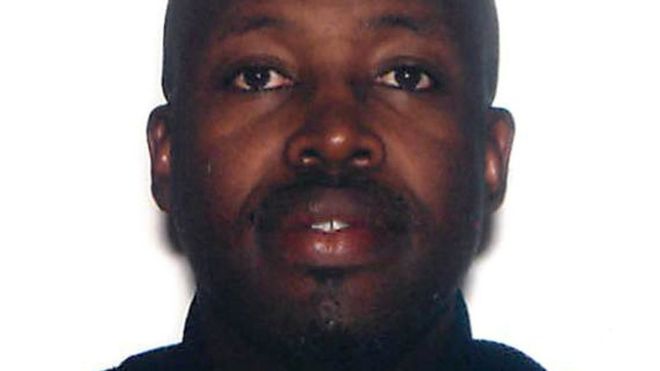
Jean Leonard Teganya is seen in this undated photo provided by the US Attorney's Office for the District of Massachusetts.
Prosecutors in Jean Leonard Teganya's case said they would have sought a life term if sentencing had been for murder and rape   Reuters
A United Nations peacekeeping mission in Rwanda headed by Canadian General Romeo Dallaire whose inadequate and ill-equipped peacekeeping troops were unable to respond when mass violence broke out in the country teetering on civil conflict in 1994, leading to massive violent brutality later identified as a genocide when the governing Hutu population was incited to turn on their neighbours, destroying the lives of an estimated 800,000 ethnic Tutsis and moderate Hutus, horrified the world with the speed in which the carnage took place and the helplessness of the peacekeepers to restrain the bloodshed.

That same year a now-48-year-old Jean Leonard Tegana left Rwanda, travelling through Congo, Kenya and India, arriving eventually in 1999 to Canada where he settled in Quebec. He applied for asylum in Canada in 2011. An investigation into his background informed authorities that this was a man who had in fact, participated in atrocities against Rwandan Tutsis, and his asylum request was refused. He appealed the decision and years of litigation followed, despite which his removal from Canada was ultimately upheld.

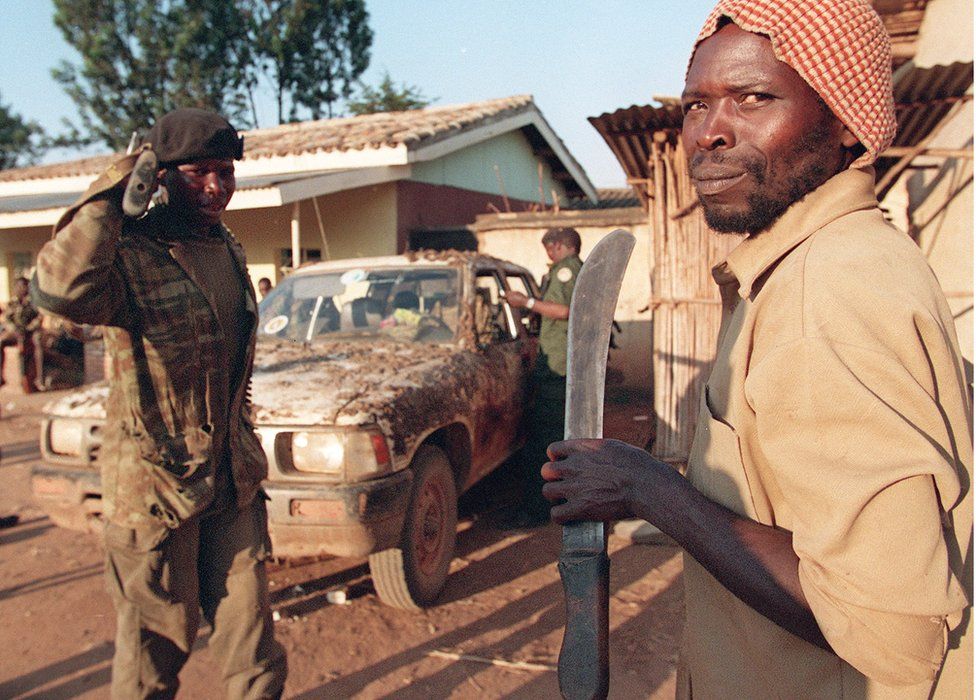
Hutu militiamen in 1994
Neighbours killed neighbours and some husbands even killed their Tutsi wives, saying they would be killed if they refused. AFP

He had been a medical student at a hospital in Rwanda when the massacre broke out in the southern city of Butare. Previous to which he had been active in the political party that was involved in the perpetration of the genocide, a party that his father was involved with and who himself was known to have committed dreadful crimes during the violence. As for Jean Leonard Tegana, he was helpful to the Hutu marauders going through the hospital corridors, identifying for them which patients were Tutsi.
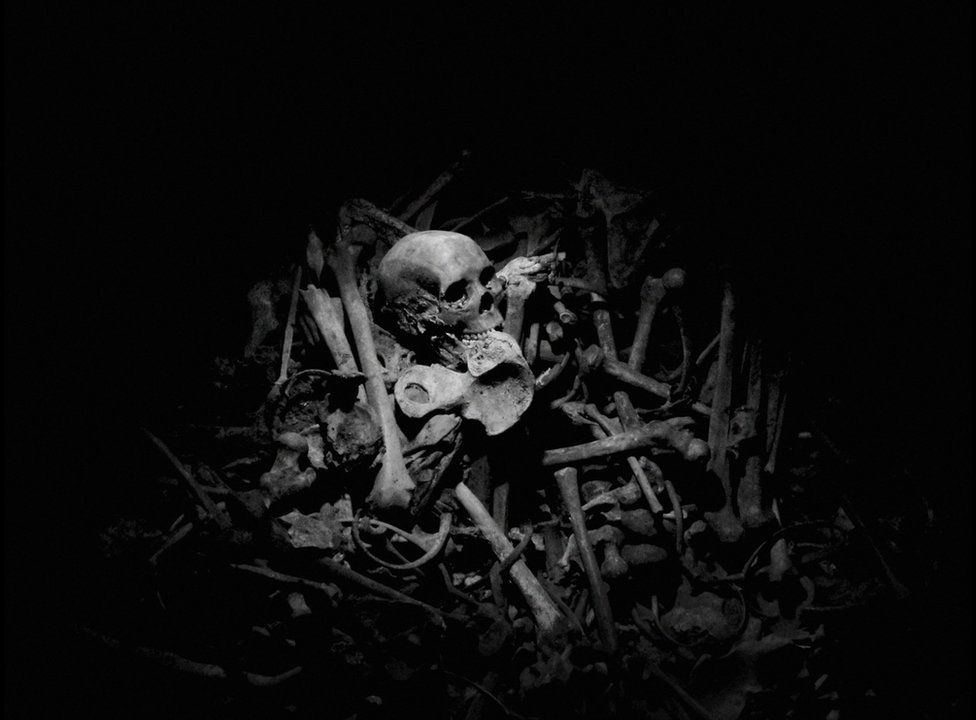
A genocide memorial in Murambi, Rwanda, seen in 2006.
Alex Majoli / Magnum Photos

During the ensuing mass murder, witnesses place him with the Hutu soldiers who went on their killing spree. Mr. Tegana was identified as a participant in the murder of seven Tutsi victims, as well as in five rapes. He denied any such involvement. Insisting that he was being confused with his father's actions, not his own. He stated that if returned to Rwanda he would be in danger of his life, detained without charge. On his final deportation order, he went underground, leading to a Canada-wide arrest warrant being issued.

In 2014, he was spotted by a resident in Maine in the town of Houlton, illegally crossing the border from Richmond Corner, New Brunswick. Consequently, U.S. Customs and Border Control officers moved in to arrest him. In both Canada and the United States, he sought to conceal his past involvement in the Rwandan genocide. He hoped to gain asylum in the United States, having been refused in Canada, but his past just kept catching up with him.

Federal prosecutors in Boston felt that if he could be sentenced for murder and rape, a life sentence would be applicable. But since these were crimes not committed in the United States, U.S. District Judge F. Dennis Saylor while considering the genocide "horrifying", felt unable to press those charges, and instead focused on immigration fraud. "The punishment should fit the offence", he stated, and handed down an eight-year prison sentence.

He will appeal through his lawyers who claim their client fled Rwanda because as a Hutu following the genocide anyone of his ethnic origin could be implicated. It is unlikely that any follow-up appeal would meet with success. Once his sentence has been completed in the United States, he will be returned to his country of origin, and there it is likely that the consequences of his crimes during the genocide will be revisited.
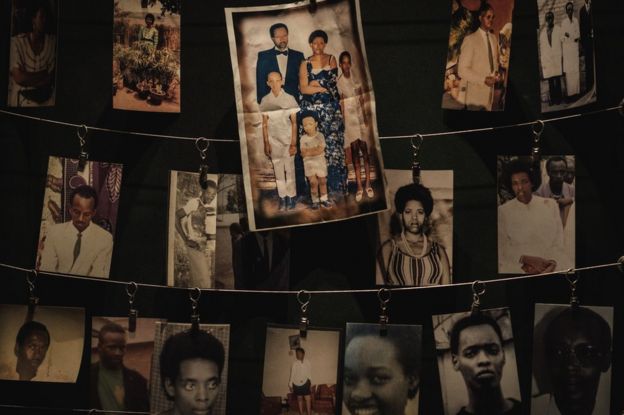
Photographs of victims in the Kigali genocide memorial
Image copyright AFP
Image caption About 800,000 people were killed in the 1994 genocide


Labels: , , , , ,

Saturday, January 23, 2016

Hush, Hush, Rwanda

"Very quickly my students began to tell me that they weren't free. They wanted to be free. They asked me how."
"Kigali is clean, Kigali is quiet. There are hotels, nice hotels, fancy hotels. And I think this is many people's experience of the place."
"The quiet in the country is not because the country is calm and harmonious, but because people aren't speaking, because dissent has been crushed."
"I wasn't aware of the full impact of the destruction of a free press, of a silent media, until I saw things like that, when people were doing themselves harm on government orders because they knew it was futile to speak up. Who were they going to speak up to? There was no one to talk to."
"I think so many people are oblivious to the role of a free press and to how their lives are shaped by the access to information and the freedom with which information circulates in places like Canada and America."
"I want to ask, are we willing to give up free speech or trade away free speech for a certain quantity of economic growth, for money? Because that's what we're doing in places like Rwanda. We're supporting a government and we're saying, for Rwandans this is an acceptable trade-off."
Anjan Sundarani, author, Bad News: Last Journalists in a Dictatorship
Author Anjan Sundaram found the experience of trying to report the news in Rwanda "chilling."
Author Anjan Sundaram found the experience of trying to report the news in Rwanda "chilling" -- Freddy Bikumbi / Random House 

India-born Mr. Sundarani, a Yale graduate raised in Dubai, took a teaching job in Kigali in 2009. He felt he could manage the job in the capital of Rwanda, and it could fund his writing of his first book, Stringer: A Reporter's Journey in the Congo. Rwanda had been the scene of a spectacular failure in United Nations peacekeeping, when the ruling Hutus were stirred to murderous frenzy by their leaders and embarked on a wholesale killing spree of the ethnic Tutsis in 1994.


Photographs of some of the 800,000 victims of the 1994 genocide. The 20th anniversary of the massacres was marked in 2014. (Reuters/Noor Khamis)

It is now a Tutsi government that holds the power in Rwanda, and reconciliation between the two large ethnic groups is the order of the day, as far as can be determined from the propaganda that issues from government sources, augmented by the country's news media. Rwanda's President Paul Kagame was the victorious commander of the Rwandan Patriotic Front for most of the Civil War which ended in the slaughter of an estimated 800,000 Tutsis and moderate Hutus.

He and his government present to the international community the facade of a nation in harmony with its parts. A free democracy, whereas the truth appears more elusive; the government rules with the authority of tyranny and fear. More than typical of most African countries. The Hutu militias who were banished from Rwanda crossed borders into neighbouring countries where they pursued their ongoing killing sprees targeting minority Tutsi populations there and unsettling countries like the DRC.

But in Rwanda, while the pretense of government protection and civility creates the impression that the country has completely recovered from its tribal and ethnic violence, encouraging international aid and investment, the truth is it is a dictatorship which challenges the agenda of foreign investigation by imprisonment on the basis of charges of "threatening state security". Mr. Sundaram was intimidated, observed and identified as a subversive because he realized that what he saw and experienced ran counter to the official account.

Attempting to report the reality of occurrences, he ran up against roadblocks of government silence that events had actually occurred. The official line was that of national unity and progress and nothing would dissuade it from that path. While attempting to teach journalism he learned through his students how they were beaten and imprisoned for their temerity in reporting on subjects known to be taboo. One of his best students was threatened and fled into exile.

Rwanda celebrates itself as a country that succeeded in moving beyond 1994's ethnic slaughter. Foreign investment helped it to prosper. Newspapers, radio stations, opposition politicians and businessmen portrayed a normal country. His students guiding him, however, Mr. Sundaram discovered what had not been obvious. "We the poor, we are like the insects, scared of the lights. We hide from the government, which wants to see us all the time", one student confided to him.

Eventually all his students melted away, lost to threats, to harassment, to beatings and arrests for the crime of threatening state security. Some went into exile, but not before publicly condemning the government, and being forced to flee. One person that Mr. Sundaram had recruited for his journalism program was murdered. The population had become compliant, through fear and frustration; there were no avenues of dissent or criticism left open to them.

In his book there is a description of a village he had visited. Where people lived literally out in the open, under trees with the most fundamental of shelters, their farm animals alongside them. They had been informed by local authorities that the traditional thatched-roof huts they were living in were backward, and Rwanda had become a progressive, forward-looking country. Not knowing how to respond, the villagers destroyed their homes.

Reporters Without Borders Press Freedom Index lists the worst offenders of press freedom under attack: Somalia, Iran, Sudan, Vietnam, China, Syria, Turkmenistan, North Korea, and Eritrea. Russia, of course, and Turkey are in that illustrious company as well. Rwanda ranked 161st out of the total number of 180 last year, just as it had the year before.

Labels: , , , ,

Friday, May 22, 2015

Gatestone Institute


  • The first priority of most Western governments today seems to sign a deal with Iran's Supreme Leader, Ali Khamenei, who openly calls for Israel's and America's destruction.
  • The next priority of many European governments, and apparently the Pope, is to entrust a state to the Palestinian Authority and Hamas, a movement that does not hide its genocidal intentions.
  • Unless the Obama Administration and Congress stop Iran, we are about to witness the world's next genocide, committed by Iran. By teeing up Iran's nuclear capability and triggering a Middle East nuclear arms race, the U.S. and the negotiators of the P5+1 are creating conditions that can only lead to a disastrous war with catastrophic results.
On April 28, ceremonies were held to commemorate the seventieth anniversary of the liberation of the Dachau concentration camp. It might seem not a major event, as Dachau was not an extermination camp. Auschwitz-Birkenau, the main Nazi killing center, had fallen three months earlier. The absolute horror of Nazi crimes was fully known. The end of World War II was near: ten days later, on May 8, 1945, the surrender of Germany was signed.
Dachau nevertheless has a special meaning: it was the first camp. After its doors opened in 1933, it became the model for all Nazi concentration camps.[1]

More than 30,000 Jewish men were sent to concentration camps shortly after Kristallnacht -- a wave of violent anti-Jewish demonstrations throughout Germany and Austria on the night of November 9-10, 1938. At the instigation of the Nazi party, Jewish businesses, synagogues and homes were attacked and burned, nearly a hundred Jews were murdered and thousands injured, and tens of thousands of Jews were arrested and sent to concentration camps.

The rest of the world could still have saved Jews and stopped the destruction machine. But the world did nothing. Hitler knew -- as Iran knows now -- that the world would do nothing.
Six weeks earlier, on September 30, the Munich Agreement had been signed. Britain's Prime Minister, Neville Chamberlain, had presented the agreement as "Peace for our time" -- in exchange for allowing Germany to help itself to the German-speaking part of Czechoslovakia, later known as Sudetenland. Chamberlain and France's Prime Minister, Édouard Daladier, had accepted Hitler's conditions without even mentioning the fate of the Jews.

Six months earlier, in July 1938, during the Evian Conference, no country had agreed to take in Jewish refugees.[2]

There were few consequences for Germany. Nothing had changed.

In May 1940, Auschwitz opened.

On January 20, 1942, the Wannsee Conference was held, during which high-ranking German officials coordinated what they called, "The Final Solution to the Jewish Question."[3] Auschwitz became an extermination camp a few days later.

The plight of European Jews, and the crimes at Auschwitz and other extermination camps, came as no surprise. Witold's Report, written by Captain Witold Pilecki, a secret agent of the Polish resistance, who entered and escaped from Auschwitz, had been forwarded to the British.[4] The report detailed the "selection process," the three crematoria that could burn 8,000 people a day, and the so-called "medical experiments." The British questioned the report's reliability. [5]

The recognition and commemoration of the Holocaust began in Israel several years after 1945.[6] For decades, however, the rest of the world remained silent.

Political considerations prevailed over ethical considerations. Emphasizing the responsibility of Germany would have implied that many more Germans than those tried at Nuremberg would have had to be tried. Several Western political leaders could have been considered accomplices. It was only when almost all the perpetrators and survivors were dead that the time of remembrance came. But were any lessons learned?

The crime of the Holocaust was the only attempt at the total extermination of a people by industrial means, and it was committed on a continent considered the "cradle of Western civilization."

The other horrific acts of extermination that took place during the twentieth century were treated as of little importance -- and still are.

The crimes of Communism -- including the Communist killing fields of Cambodia that took place during in the late 1970s -- were also immense. They were committed on five continents and lasted several decades. Communism killed about a hundred million people.[7] Although the crimes of Communism are public information, the world is still mostly silent. Again, political considerations prevailed over ethical consideration. The Black Book of Communism was published in 1999. The issue was then dropped. It is likely that there will never be a Day of Remembrance for the Victims of Communism.

Another genocide took place in Rwanda, in 1994: 70% of the Tutsis living there were killed. One of the most horrifying aspects of the Rwandan genocide was that international forces, sent by the UN, stood by and remained passive. France launched a military operation to evacuate French and Belgian citizens, but refused to evacuate any Tutsis. Hundreds of people were massacred a few feet away from the French forces. Once again, political considerations prevailed over ethical considerations. The responsibilities of the international forces and the responsibilities of France have been internationally ignored.[8] An International Criminal Tribunal for Rwanda was established; it will end its work soon. Only Rwandans were incriminated. Hardly anyone in the rest of the world remembers the Rwandan genocide.

A genocide also took place in the Ottoman Empire at the time of its collapse, during World War I, a quarter century before the Holocaust. Beginning in 1915, between 800,000 and 1.5 million Armenians were slaughtered by soldiers of the Ottoman army.[9] Turkey has never recognized the massacre as a genocide.[10] The world was, again, largely indifferent to the fate of the Armenians. Hitler seized on this indifference to say that if the world condoned what happened to the Armenians, it would condone what would happen to the Jews. He was proven right. Again, political considerations prevailed over ethical considerations. As Turkey was an ally of the West against the Soviet Union, any decision likely to annoy or offend the Turkish government was set aside. Since the collapse of the Soviet empire, however, Turkey has lost some of its geopolitical importance, but it contributes to new genocide-like massacres. In recent months, tens of thousands of Christians and Yazidis have been savagely murdered in Syria and Iraq by the Islamic State -- which could not exist without the support of Turkey. Much of the oil sold by the Islamic State, and its needed military supplies, pass through Turkey. The silence of the West continues. No doubt. Political considerations are at work.

Seventy years after the fall of Dachau and Auschwitz, Israeli Jews, Christians and Arabs are threatened with a second Holocaust by people who deny the existence of the first Holocaust: Iran's leadership. The West, apparently willing to vote Iran nuclear breakout capability, pays no attention and acts as if Iran's continual threats had no meaning.

The first priority of most Western governments today seems to sign a deal with Iran's Supreme Leader, Ali Hosseini Khamenei, who openly calls for Israel's and America's destruction.

Iran's Supreme Leader, Ayatollah Khamenei (center), is shown meeting in May 2014 with Iran's military chief of staff and the commanders of the Islamic Revolutionary Guards Corps. (Image source: IRNA)

The next priority of many European governments is to entrust a state to the Palestinian Authority and Hamas, a movement that does not hide its genocidal intentions. Political considerations are at work, full time and at open throttle.

Since the Armenian genocide, one hundred years have passed, marked by mass killings, massacres, and genocides. These culminated in the Holocaust, but did not end with it. The Communist killing fields of Cambodia took place during the 1970s. The Rwandan Genocide of the Tutsis was perpetrated just twenty-one years ago.

The twentieth century was appropriately described by historian Robert Conquest as a "ravaged century."[11]

It is urgent that that ethical -- not political or monetary -- considerations receive priority. If not, this will be the second "ravaged century."


[1] The Dachau Concentration Camp, 1933 to 1945: Text and Photo Documents from the Exhibition, with CD. Dachau: Comité International De Dachau, 2005.
[2] William R. Perl, The Holocaust Conspiracy: An International Policy of Genocide, Shapolsky Publishers, Inc, 1989.
[3] Mark Roseman, The Villa, The Lake, The Meeting: Wannsee and the Final Solution, Allen Lane, 2002.
[4] Witold Pilecki, The Auschwitz Volunteer: Beyond Bravery, Aquila Polonica, 2012.
[5] There were three other reports about the conditions in Auschwitz as well: The "Polish Major's Report" by Jerzy Tabeau; the "Vrba-Wetzler Report" by Rudolf Vrba and Alfred Wetzler in April, 1944, and a short report by Arnst Rosin and Czelaw Mordowicz, who escaped from Auschwitz in May, 1944.
[6] Yom HaShoah ("Day of the Holocaust") became an annual memorial in Israel in 1953. The Days of Remembrance of the Victims of the Holocaust were held in the US for the first time in 1979, twenty-six years after 1945. The French government acknowledged France's responsibility in the deportation of Jews in 1995. A Day of Remembrance of the Victims of National Socialism was established in Germany in 1996. Holocaust Memorial Day was established in the UK in 2001.
[7] Stephane Courtois, Nicolas Werth, Jean-Louis Panné, Andrzej Paczkowski, Karel Bartosek, Jean-Lous Margolin, The Black Book of Communism, Harvard University Press, 1999.
[8] Gerard Prunier, The Rwanda Crisis, Fountain Publishers Limited, 1999; Romeo Dallaire, Shake Hands with the Devil: The Failure of Humanity in Rwanda, Arrow, 2004
[9] James Nazer, The first genocide of the 20th century: the story of the Armenian massacres in text and pictures, T&T Publishing inc., 1968.
[10] Fatma Müge Göçek, Denial of Violence: Ottoman Past, Turkish Present, and Collective Violence Against the Armenians, Oxford University Press, 2014.
[11] Robert Conquest, Reflections on a Ravaged Century, W. W. Norton & Company, 1999.

Labels: , , , , , , , ,

Monday, April 21, 2014

Reconciling Exclusion

"There is a huge hope and belief that schools contribute to peace, but in Rwanda, there are ways in which they contribute to underlying conflict."
"It's a really dangerous and negative direction to be excluding the views, the losses, the mourning of a really important and majority segment of the population."
"Hutu who feel excluded find it hard to relate to and to embrace the suffering of Tutsi Rwandans and that's really problematic for peace building."
Elisabeth King, author of From Classrooms to Conflict in Rwanda

In this photo taken Monday, March 24, 2014, Rwandan students standing next to a mural talk amongst themselves after finishing an examination and waiting to eat lunch at the Agahozo-Shalom Youth Village near Rwamagana, in Rwanda. Most of the kids in a school set amid the lush green, rolling hills of eastern Rwanda don't identify themselves as Hutu or Tutsi. That's a positive sign for Rwanda, which is now observing the 20th anniversary of its genocide (The school is the brainchild of New Yorker Anne Heyman who decided to open a school on the model used in Israel for orphans of the Holocaust. With help from the American Jewish Joint Distribution Committee and corporate donor Liquidnet Holdings, she purchased land in 2006 to build a school and dorm-like homes. The school's annual budget is $2 million a year, or about $4,500 per child. An oasis of calm in a sea of distrust.
 
In the aftermath of the Rwandan genocide little was left of the country's 1,836 schools to enable them to be functionally useful. Many of the sites had been scenes of bloody massacres. Looters trashed the Ministry of Education, broke windows, doors and furniture. But that was nothing whatever, compared to the fact that over a million children had been left orphans after the blood-letting was done with, and the country had a good, hard look at itself.

In the twenty years since the genocide that shocked the world out of its complacent trust that United Nations peacekeeping forces were capable of keeping tribal hatred from demolishing a nation, over $1-billion has been invested through foreign aid into the country's education system, according to the UN's Educational, Scientific & Cultural Organization. Rwanda today can boast it enjoys the highest primary school enrolment in Africa.

But just as the politics that saw the dominant, majority Hutu conspire against the once-dominant, minority Tutsi population of the country resulted in one hundred days of atrocities leaving an estimated 800,000 people, mostly Tutsi, but Hutu as well dead, the education system of the country in this new era of peace and reconciliation looks as though it is inspiring ethnic tensions all over again. And where there is tension, resentment and mistrust there will be hatred and the potential for violence.

The teaching of contemporary history is itself at the root of the problem, since it is canted, biased toward the "official" version as per the present government's view of the genocide. That official version places emphasis on the fact that most of the victims were Tutsis, which is undeniably true, but the while diminishing the fact of tens of thousands of Hutu deaths during the terror, it overlooks their anguish and the terror they too were confronted with.

If it is estimated that at least a half-million Tutsis were slaughtered by the hordes of rabidly hateful Hutu extremists, it is glossing over the fact that moderate Hutus who wanted nothing to do with the hate and slaughter campaign themselves became victims because of their unwillingness to embark on a killing spree of their neighbours.

After 1994 groups associated with the Tutsi ruling party set upon thousands of Hutu refugees had had attempted to remove themselves from harm's way by seeking shelter in countries bordering Rwanda, killing them by the thousands. This too is part of the history of Rwanda's dreadful dissolution into barbarism, but it is never mentioned in the history curriculum. Pointedly iterating and reiterating the role of the Hutu as genocide perpetrators while true, picks at the nation's scab so it can never heal.

And the impression left is that all Hutu are genocidaires by their very nature. While historians from outside the country hold the impression that most people who took part in the killing spree did so from fear and confusion, according to Timothy Longman, director of the African Studies Centre at Boston University. It is unlawful to discuss ethnicity in public, yet the new generation knows instinctively who is Hutu and who is Tutsi.

"They are being told that Hutu and Tutsi no longer exist, but people feel that identity is still important and power depends on it", said Ms. King who teaches at the Trudeau Centre for Peace Conflict & Justice at University of Toronto. Teachers may not speak frankly about the genocide; some have been arrested by government authorities for speaking of the killings in a manner that differs from the official line.

"It's impossible to promote reconciliation if people can't talk about their experiences", said Mr. Longman.

"And, for a lot of people, their experience is that of having suffered human rights abuses at the hands of the current government. Because that is off the table, there's no way that schools can actually promote real reconciliation", he further explained. Ethnic discrimination in access to schools and the history curriculum, points out a 2011UNESCO report, was partially responsible in laying the groundwork for the 1994 genocide.

The Rwandan education minister stresses the need for sensitivity in addressing the needs of all groups. "Peace education" and annual genocide commemoration activities are presented at every school in the hopes of promoting unity and reconciliation. "The genocide was committed by Rwandans against other Rwandans. It is a very sensitive subject. We are approaching it with caution", said Vincent Viruta, the education minister.

In the meantime, about 40% of the population is under the age of 15, and almost every child attends primary school while secondary school admission is merit-based now where once it was linked to ethnic quotas. From 3,000 in 1995, university enrolment has risen to over 80,000 at the present time. Even yet, however, poor, mostly Hutu youth are not in school, and struggle to exist.

"If you're teaching people a distorted history and one that serves the political interests of the regime, it lays the groundwork for politicizing the population", warned Mr. Longman.

Labels: , , , , ,

Saturday, March 29, 2014

The Aftermath of Horrific Realities

"You cannot measure the consequences of war and conflict by counting the number killed. You have to count the survivors and what happened to them."
"The health outcomes aren't good."
Duncan Pederson, World Health Organization Collaborating Centre for Research and Training in Mental Health, Montreal

"We're not just starting to see PTSD, we are in the thick of it. It's an extremely big problem and we're not keeping up with the suffering."
"Will we come out of it quickly. I don't think anyone knows, but we need to work or study or do something that allows us to think of something other than death."
Naasso Munyandamutsa, Rwandan psychiatrist

"The whole thing is just so pervasive, you probably need 10,000 counsellors to even begin to make a difference. For most of us in other countries, the problem is anxiety, and this is ten times deeper than that. It's a huge challenge."
Delanyo Dovlo, World Health Organization Rwandan representative
Young people gather in Amahoro Stadium in Kigali for the 18th commemoration of Rwanda’s genocide, in 2012. Photo by Sue Montgomery/The Gazette

Young people gather in Amahoro Stadium in Kigali for the 18th commemoration of Rwanda’s genocide, in 2012. Photo by Sue Montgomery/The Gazette

The question is: How do vulnerable young children survive the horror of witnessing atrocities so brutal that their minds would be forever in a state of confused derangement over the loss of parents, siblings, extended family, leaving them as children to cope on their own and attempt to surmount that horror? Over a quarter of the Rwandan population now suffer post-traumatic stress disorder.

Each of the country's 43 district hospitals sees between 15 and 25 patients a day for psychiatric problems. Its first addiction facility, recently opened, treats 300 to 400 people a month, from age 16 and up. There are six psychiatrists serving 11.4 million Rwandans. A UNICEF national trauma survey that took place a year after the genocide took place warned of problems to come.

Of the estimated 99.9 percent of Rwandan children who witnessed violence during the genocide, 79.6 percent had at least one death in their family; 69.5 percent witnessed someone being killed or injured, and 31.4 percent witnessed rape of sexual assault. Those children in the UNICEF study are now young adults, and the trauma of their experiences has left them still struggling to understand what they experienced.
In 1994, at the Munigi refugee camp near Goma, a Rwandan child cries at his dying mother's side. Associated Press file photo
 
On April 7, Rwanda mourns the 20th anniversary of the genocide that befell it. And every April 7 there is a national recognition of the genocide, with a national week of mourning. The very churches and schools where hundreds of thousands of desperate Tutsis sought refuge, but found death instead, stand as memorials, testament, if any were required, of their torment. An estimated 300 people butchered each hour of one hundred days of slaughter.

Those young adults still struggling to understand what their young eyes were assaulted by in one hundred days of butchery where neighbours, former friends and even relatives by marriage viciously used machetes, nail-studded clubs and spears engaged on mass slaughter. Their minds cannot help but wander helplessly in the direction of the same question repeated without answer; what would make Hutus turn on that segment of the citizenry known as Tutsis?

This is an entirely different country now than it was twenty years ago. It present as clean, safe, and swiftly developing to embrace and meet all of the advanced indices the United Nations' eight Millennium Development Goals by next year. The very picture of success in living standards for Africa, achieving a list of targets agreed to by all countries in 2000; inclusive of pledges of poverty reduction and universal primary education provision by 2015.

And while the country becomes an information-technology hub, installing over 1,600 kilometres of fibre-optic cables and a 4G network covering 95 percent of the country, many among its population are barely managing to function. An estimated 600,000 people who lost both parents and have little to no access to psychological support, plagued by stress, epilepsy, unable to sleep, resorting to alcohol and drugs for relief.

Jonathan Nettal, a psychotherapist working for a Canadian NGO called Hopethiopia/Rwanda, counsels 19- to 23-year-olds how to help one another, even while traumatized. A native of Montreal whose grandparents are Holocaust survivors, Mr. Nettal teaches small groups of ten to 15 people coping skills. "So you have more calm, people are more supportive, more socially connected, and that's a huge resource in terms of post-traumatic resilience."

Think about it: how do you cope as a teen when you've just been informed you were conceived through mass rape. That venomous, self-destructive mind-flood of shame, confusion and anger must be confronted and dealt with. Mental illness in Rwanda is a dire issue, where thousands of "genocidaires" (perpetrators) live among their victims.
Egidie walks arm in arm with her son, Bertrand, who was born after Egidie was raped several times by many men during Rwanda’s 1994 genocide. Through counselling, they have learned to accept the horrific past and love each other. (Neither wanted their last names published) Photo by Sue Montgomery/The Gazette

Egidie walks arm in arm with her son, Bertrand, who was born after Egidie was raped several times by many men during Rwanda’s 1994 genocide. Through counselling, they have learned to accept the horrific past and love each other. (Neither wanted their last names published) Photo by Sue Montgomery/The Gazette


Labels: , , , ,

() Follow @rheytah Tweet