Politic?

This is a blog dedicated to a personal interpretation of political news of the day. I attempt to be as knowledgeable as possible before commenting and committing my thoughts to a day's communication.

Wednesday, December 29, 2021

Vladimir Putin Redeeming the Glory of the USSR

"Memorial is a special organization with its own ideology. We combine what's called relevant human rights activities with historical studies and comprehending the historical path of Russia in the 20th century."
"It seems that such a union does not please someone in the Russian leadership."
Oleg Orlov, Memorial board member

"The decision ...confirmed that the history of political terror ... does not remain an academic theme for Russia of interest for just specialists but an acute problem for modern Russia."
"Our country needs an honest and scrupulous reflection on its Soviet past."
"Memorial is the need for Russia's citizens to know the truth. Nobody will succeed in 'liquidating' this need."
Memorial statement
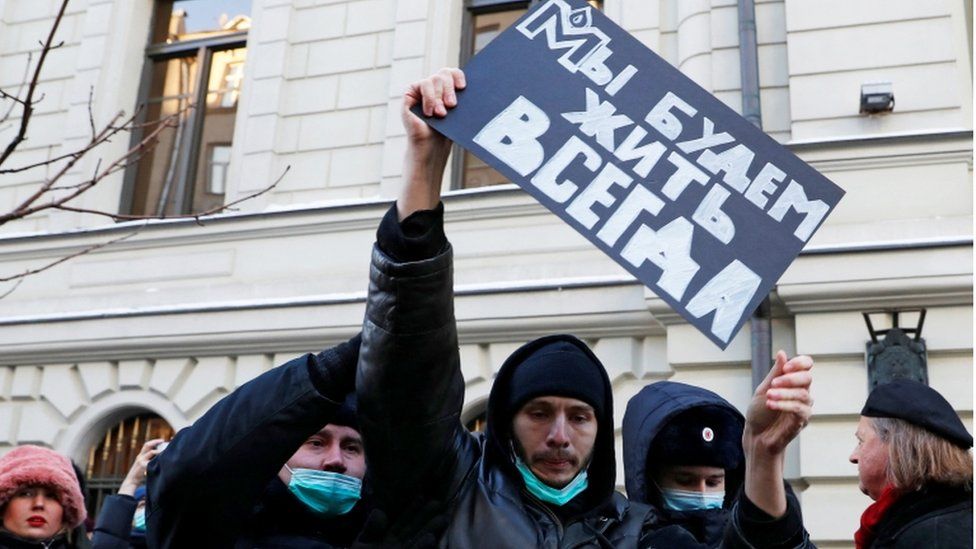
Police officers restrain a supporter of the human rights group International Memorial outside a court building during a hearing of the Russian Supreme Court to consider the closure of International Memorial in Moscow, Russia December 28, 2021. The placard reads: "We will live forever"
Supporters hold placards saying "we will live forever" with Memorial's flame symbol above the Russian word "we"    Reuters
 
The Supreme Court of Russia has found the country's most seasoned human rights group, Memorial International, to have offended the country's dignity and pride in its past. The group has been ordered to disband. Critics within Russia of the Kremlin, of its policies, of its crackdown on dissenting voices, and above all, of its president-for-life, disturb the peace and serenity that Moscow enjoys in the capable hands of its new czar who aspires to return Russia to its former glory days.

The order for Memorial International to cease and desist, to fold up and be no more, more or less caps a few successful years of silencing and setting aside critics of the regime. As explained by Moscow, it owes the nation protection from those involved in extremism, who plan to do harm and destabilize Russia, with the considerable encouragement, incitement to violence, and funding from abroad. Clearly, foreign agencies are at the heart of nefarious plots to unseat the government and the Kremlin will not stand for it.

Memorial's mission is to document and to remind the nation of what Josef Stalin wrought in his "Great Terror", when those inconvenient to and critical of his brutal regime were sacrificed to the altar of Communism. The mass killings of intellectuals, Bolshevik officials, political officials, members of the military, writers, ethnic minorities, scientists, writers, foreigners and peasant land-owners. Along with any other groups Stalin conceived of as saboteurs. 
 
The number of dead during the great purge has been variously estimated to be between three-quarters of a million, to two million people, while political prisoners numbered around a million, sent to the Gulags, as Stalin's reign consolidated its position by eliminating challengers and suspected challengers. Since Vladimir Putin ascended to power and changed the constitution to allow him to reign in perpetuity, he has imprisoned critics, assassinated others, a silencing mechanism hugely relied upon for its finality, however clumsily undertaken.
 
He has banned political groups critical of his administration, and imprisoned their leaders on implausible charges. He has taken to emulating Stalin's purges to silence his critics. And he seems determined to restore the reputation of the USSR as a force for good, both for Russia and for its satellite states. Memorial was established during the period of 'glasnost' introduced to Russia by then-president Mikhail Gorbachev, determined to modernize Russia and move it away from a closed state. 

Addressing the court, a state prosecutor stated that Memorial had promoted a 'false image' of the USSR as 'a terrorist state', besmirching its proud memory during the Second World War. "Someone" was paying Memorial for such treachery, he averred. Subsequently, Memorial was found to have broken a controversial law on foreign agents by repeatedly failing to use a disclaimer in its materials and its website relating to receiving foreign funds.

This, despite that Memorial is quite openly frank that it receives funding from abroad, where its website lists funding from Poland, Germany, Canada and the Czech Republic. The U.S. ambassador to Russia, John Sullivan, spoke of the court order as "a blatant and tragic attempt to suppress freedom of expression and erase history". Memorial had been co-established by nuclear physicist and Nobel laureate Andrei Sakharov.

It had recently challenged the repression of critics, publishing lists of people it considers to be political prisoners. In 2015, Russian authorities had placed Memorial on an official list of "foreign agents", burdening it with restrictions on its activities. The Memorial Human Rights Centre and Memorial International were accused of violating the foreign agent law.

Memorial International, according to prosecutors, breached regulations through failing to mark all its publications, including posts on social media with the distinguishing label. They also accused the group of condoning terrorism and extremism. According to President Putin, Memorial had defended organizations that Russia labels extremist and terrorist; its list of victims of Soviet-era repression included Nazi collaborators.

Labels: , , , ,

Wednesday, July 04, 2018

Perspective: Terrorist Cult or Freedom Fighters?


"Members and supporters of the MKO terrorist group hold a rally on first of July each year in Paris."
"Harper attended this year's event alongside his former minister of foreign affairs, John Baird."
"'Thank you for your long battle for a free and democratic Iran', Harper told a crowd at the Free Iran rally in Paris in a defiant support of the MKO terrorist group."
"#Canada should seriously investigate the scope and nature of @stephenharper [Canada's 22nd Prime Minister Stephen Harper] and @Baird's [Former Canadian Foreign Minister John Baird] relationship with the #MEK [MKO] cult during their tenure as Prime and Foreign ministers', Reza Nasri, a prominent law expert from Geneva's Graduate Institute of International and Development Studies tweeted recently."
Islamic Republic News Agency
So that is the take from the official news agency of the Islamic Republic of Iran over the presence of former Prime Minister Stephen Harper at the annual National Council of Resistance of Iran group. The group had, in fact, invited an entire smorgasbord of well-known and -connected international public figures to attend and to speak at this publicized event. The group, whose founding came out of the Mojahedin--Khalq (MEK), dedicated to the overthrow of the Iranian Republic, has more than its share of critics damning it as a terrorist group.

Based in Paris, the MEK's reputation is frequently assailed; though devoted to overthrowing the current Iranian regime, even among some Iranian dissidents abroad it is considered extremist and controversial, with claims of a cult of leadership along with a questionable history of violence. Mr. Harper's appearance at the event became  hugely unpopular among many critics of the MEK, along with some expatriate Iranians living in Canada such as Samira Mohyeddin known as a critic of the regime who called the MEK a "well-documented terrorist cult who have committed many crimes against humanity".

In fact, the MEK was on a terrorist watch list in the U.S. and Canada and elsewhere, but has long since been removed. Farzan Sabet, an Iranian policy expert with the Center for International Security and Cooperation at Stanford University claimed that Mr. Harper's presence at the conference "speaks to the sophistication of MEK political operations, and naivete or venality of Western politicians who chose to attend." Harsh condemnation by no uncertain means. And reflective of the usual polarized opinions strongly held by opposing parties in the Middle East.

When Stephen Harper was Prime Minister of Canada, Iranian interference in Canada with its propaganda and its efforts to control its expatriate population for propaganda and infiltration purposes -- along with its well-known record of supporting terrorism and the lesser-known fact that Iranian-produced school curricula was found in Shiite madrasas and parochial schools operating in Canada, redolent of hate-mongering -- persuaded his administration to cut diplomatic ties with the country. In so doing, he closed the Canadian embassy in Tehran and shuttered the Iranian embassy in Ottawa in a distinct persona-non-grata rebuke.

For years, Canada's UN ambassador led a well supported move to single out Iran at the United Nations on an annual basis as a human rights abuser, stemming from the murder in Evan prison of Canadian-Iranian photographer Zahra Kazemi. Under Prime Minister Harper, the government of Canada held close ties with the State of Israel. Coincidentally the MEK has ties with Israeli intelligence. The State of Israel is in the direct cross-hairs of the Iranian Republic's goal of destruction, often enough publicly stated, even within the United Nations.

It seems passing strange that among many international guests at the MEK conference there were two notable personages, one of whom was the former director of the FBI, Luise Freeh who held his position with honours for an eight-year period before stepping down. Another was the former French Foreign Minister, Bernard Kurchner, who also happens to have been a co-founder of Medecines sans Frontieres. How likely is it that two men of their calibre would support a terrorist group? They were there to support a group dedicated to dismantling a terrorist theocracy.

Proud to stand up for freedom and democracy for the people of Iran. While the Iranian regime poses a threat to us all, the most oppressed are its own citizens. Freedom, dignity and self determination are universal values.

"The Free Iran event was attended by thousands of Iranian dissidents, from all political backgrounds from around the world."
"Mr. Harper has not, and will not, endorse specific political movements or candidates."
Anna Tomala, spokesperson, Harper & Associates
Although at its founding in the 1960s,the People's Mujahedeen of Iran (MEK) helped to overthrow Shah Palevi's unpopular regime, and was involved with the typical Middle East assassinations and violence, it has long since renounced violence. Its headquarters stationed in Iraq on the border with Iran at the time of the U.S.-led invasion of Iraq in 2003 led to its being forcibly disarmed which initiated its transformation, prompting Canada and the U.S. to remove MEK from their roster of terrorist groups.

When Mr. Harper addressed the gathering of thousands, comprised hugely of expatriate Iranian supporters, he took pains to denounce the Republic's repressive regime, speaking of his own actions as prime minister of Canada including having listed Iran as a state sponsor of terrorism and his move to sever diplomatic relations with the government. "We closed the Canadian embassy in Iran and told the mullahs to get out of Canada!"

John Bolton, current American national security adviser was present at the Free Iran rally, as was Rudolph Guiliani, former New York City mayor at the time of the 9/11 terrorist attacks.

Labels: , , , , , , ,

Sunday, November 27, 2016

His Way, All The Way, Full Speed Ahead

"The European Parliament ... strongly condemns the disproportionate repressive measures taken in Turkey since the failed military coup attempt in July."
Non-binding motion сalling on the European Commission and national governments to institute the largely symbolic freeze in negotiations with Ankara.
© Murad Sezer / Reuters

"The government and parliament can extend the length of state of emergency. What's it to you? Does the European Parliament rule this country or the government [of Turkey]? Know your limits! Those days are over."
"Saying ‘don't fight terrorism’ to a country who fights against terror every day is to tell them to put up the shutters."
"Are you [European Parliament] inviting terrorist groups? [Turkey will continue to] go on its way no matter what they say."
Turkish President Recep Tayyip Erdogan
Turkish President Tayyip Erdogan. © Murad Sezer


Turkish President Recep Tayyip Erdogan feels that he should be imperviously protected from criticism emanating from within his own nation. To that end he has launched a series of lawsuits against anyone who dares defame him or question his authority. And since the independent press in a democratic society is given to questioning the legality or the justice in certain processes undertaken by governments, those enquiries are viewed by Mr. Erdogan as "terrorist" activities, which require that the government crack react forcefully.

Any hints of support for Kurdish nationalist aspirations is tantamount to treason. If news stories forget to state the number of people killed in the attempted coup of last summer, this represents proof of sympathies toward terrorism. According to Erol Onderoglu as the Turkish representative with Reporters Without Borders, 150 news outlets have been closed down while government-loyal business people have been urged to take possession of the remaining news outlets. Turkey has succeeded in out-distancing China's repression of journalists and the news media.

"What's left, they are all basically Pravda", Gulsin Harman, a former journalist for one independent now in government hands, observed glumly. While a senior official with the government stated that jailed journalists were in prison for criminal and terrorist offenses, certainly not for their unfortunate journalism.  Erdogan took on emergency powers in the wake of the failed military coup purportedly carried out by supporters of Turkish Muslim cleric in exile Fethullah Gulen.

Other "terrorists" abound in Turkey. There is, for example, the Kurdish movement restive to persuade anyone who will turn a sympathetic ear to their just wish to be finally accorded the national homeland their heritage status in the geography demands -- their actions and their perceived alliance with the PKK, designates them a terrorist group of the first order, seen to be a threat to Turkey that must be countered by arrests and whatever other means suggest themselves.

Oh, yes, and then there's the Gulenist movement which Turkey accuses of having masterminded and carried out the attempted military coup which loyal Turks helped the government to successfully defend itself against. They too, needless to say, are terrorists, which explains why tens of thousands of civil servants, police, lawyers, judges, teachers and other riff-raff within Turkish society have been arrested as enemies of the state.

The insufferably interfering European Union protests that Turkey's over-reaction to these events disqualifies it from membership in the EU.

The summary and absurdly justified arrests of Kurdish members of Parliament, the military bombardment of Kurdish enclaves and villages in the south-eastern Kurdish-majority areas of Turkey
all represent glaringly obvious instances of violent repression from a government that insists it is justified in whatever action it takes to counter the "terrorism" it faces from within and without. 
Turkey has historically repeatedly faced criticism from the EU for its record on human rights, democracy and freedom of the press. No less so today.

President Erdogan's declaration that he is seriously considering the reinstatement of capital punishment to deal with terrorist traitors who he charges took part in the coup has also alarmed EU lawmakers. Entirely justifying Mr. Erdogan's not-so-veiled threats that he is also considering releasing himself and his government from the year-old agreement with the EU to hold back the tide of Syrian refugees from once again overwhelming Europe by dangerously crossing the Mediterranean in flimsy boats to invade Greece in their passage through Europe.

Refugees wait for the arrival of officals at Nizip refugee camp near Gaziantep © Umit Bektas

This is Erdogan's Trump card. Perhaps the EU should consult with the president-elect of the United States, a man they have learned to love to hold in deep abhorrence and who they might feel has much in common with Erdogan, and who may yet surprise them when it turns out they are wrong. The simple fact being that it takes a very special mindset to reflect Erdogan's grandiose vision of himself as the caliph the Muslim world has long been yearning for. Mr. Trump has a personal aversion to that kind of aspiration, even though it mirrors what he has himself orchestrated elsewhere.

Labels: , , , , ,

Saturday, January 23, 2016

Hush, Hush, Rwanda

"Very quickly my students began to tell me that they weren't free. They wanted to be free. They asked me how."
"Kigali is clean, Kigali is quiet. There are hotels, nice hotels, fancy hotels. And I think this is many people's experience of the place."
"The quiet in the country is not because the country is calm and harmonious, but because people aren't speaking, because dissent has been crushed."
"I wasn't aware of the full impact of the destruction of a free press, of a silent media, until I saw things like that, when people were doing themselves harm on government orders because they knew it was futile to speak up. Who were they going to speak up to? There was no one to talk to."
"I think so many people are oblivious to the role of a free press and to how their lives are shaped by the access to information and the freedom with which information circulates in places like Canada and America."
"I want to ask, are we willing to give up free speech or trade away free speech for a certain quantity of economic growth, for money? Because that's what we're doing in places like Rwanda. We're supporting a government and we're saying, for Rwandans this is an acceptable trade-off."
Anjan Sundarani, author, Bad News: Last Journalists in a Dictatorship
Author Anjan Sundaram found the experience of trying to report the news in Rwanda "chilling."
Author Anjan Sundaram found the experience of trying to report the news in Rwanda "chilling" -- Freddy Bikumbi / Random House 

India-born Mr. Sundarani, a Yale graduate raised in Dubai, took a teaching job in Kigali in 2009. He felt he could manage the job in the capital of Rwanda, and it could fund his writing of his first book, Stringer: A Reporter's Journey in the Congo. Rwanda had been the scene of a spectacular failure in United Nations peacekeeping, when the ruling Hutus were stirred to murderous frenzy by their leaders and embarked on a wholesale killing spree of the ethnic Tutsis in 1994.


Photographs of some of the 800,000 victims of the 1994 genocide. The 20th anniversary of the massacres was marked in 2014. (Reuters/Noor Khamis)

It is now a Tutsi government that holds the power in Rwanda, and reconciliation between the two large ethnic groups is the order of the day, as far as can be determined from the propaganda that issues from government sources, augmented by the country's news media. Rwanda's President Paul Kagame was the victorious commander of the Rwandan Patriotic Front for most of the Civil War which ended in the slaughter of an estimated 800,000 Tutsis and moderate Hutus.

He and his government present to the international community the facade of a nation in harmony with its parts. A free democracy, whereas the truth appears more elusive; the government rules with the authority of tyranny and fear. More than typical of most African countries. The Hutu militias who were banished from Rwanda crossed borders into neighbouring countries where they pursued their ongoing killing sprees targeting minority Tutsi populations there and unsettling countries like the DRC.

But in Rwanda, while the pretense of government protection and civility creates the impression that the country has completely recovered from its tribal and ethnic violence, encouraging international aid and investment, the truth is it is a dictatorship which challenges the agenda of foreign investigation by imprisonment on the basis of charges of "threatening state security". Mr. Sundaram was intimidated, observed and identified as a subversive because he realized that what he saw and experienced ran counter to the official account.

Attempting to report the reality of occurrences, he ran up against roadblocks of government silence that events had actually occurred. The official line was that of national unity and progress and nothing would dissuade it from that path. While attempting to teach journalism he learned through his students how they were beaten and imprisoned for their temerity in reporting on subjects known to be taboo. One of his best students was threatened and fled into exile.

Rwanda celebrates itself as a country that succeeded in moving beyond 1994's ethnic slaughter. Foreign investment helped it to prosper. Newspapers, radio stations, opposition politicians and businessmen portrayed a normal country. His students guiding him, however, Mr. Sundaram discovered what had not been obvious. "We the poor, we are like the insects, scared of the lights. We hide from the government, which wants to see us all the time", one student confided to him.

Eventually all his students melted away, lost to threats, to harassment, to beatings and arrests for the crime of threatening state security. Some went into exile, but not before publicly condemning the government, and being forced to flee. One person that Mr. Sundaram had recruited for his journalism program was murdered. The population had become compliant, through fear and frustration; there were no avenues of dissent or criticism left open to them.

In his book there is a description of a village he had visited. Where people lived literally out in the open, under trees with the most fundamental of shelters, their farm animals alongside them. They had been informed by local authorities that the traditional thatched-roof huts they were living in were backward, and Rwanda had become a progressive, forward-looking country. Not knowing how to respond, the villagers destroyed their homes.

Reporters Without Borders Press Freedom Index lists the worst offenders of press freedom under attack: Somalia, Iran, Sudan, Vietnam, China, Syria, Turkmenistan, North Korea, and Eritrea. Russia, of course, and Turkey are in that illustrious company as well. Rwanda ranked 161st out of the total number of 180 last year, just as it had the year before.

Labels: , , , ,

Saturday, November 01, 2014

Gatestone Institute


In Egypt, a young Coptic Christian man, accused of blaspheming Islam for simply "liking" an Arabic-language Facebook page, was sentenced to six years in prison.
One of the intruders in Uganda was shouting, "Today we shall kill you [for converting to Christianity] -- you... are not respecting our prophet's religion." He then heard his 12-year-old-girl's cries as the Muslim intruders were strangling her. Then they seized him.
Muslims in Germany were granted their own section of the cemetery. Now these same Islamic communities are demanding that, during Islamic funerals, Christian symbols and crosses in the cemetery be removed or covered up.
During the Islamic State's June invasion and consolidation of Mosul, Iraq -- where Christians have been present since the first century -- countless atrocities against them were committed. Accordingly, the region is now reportedly empty of Christian presence.

The Islamic State, among other acts, reinstituted the collection of jizya, the "tribute" conquered Christians (and Jews) were historically required to pay in order not to be killed in accordance with the Koran (9:29).

In one instance, three Islamic State members burst into the home of a Christian family, demanding the jizya-money. When the father of the house pleaded that he did not have the money, the intruders raped his wife and daughter in front of him. The man was reportedly so traumatized that he committed suicide. Four other Christian women were killed for not wearing the Islamic veil.

Soon after taking over Mosul, the Islamic State also announced that it would destroy all Christian places of worship. Several churches were burned, including the Armenian church near the Al Salam hospital, and the Church of the Holy Spirit, after first being looted and desecrated. A large statue of the Virgin Mary disappeared.

Among the many Christians missing are two nuns from the Daughters of Mary Order, who managed an orphanage for girls in Mosul. It is believed they have been kidnapped.

Sister Utoor Joseph (left) and Sister Miskintah, are nuns who disappeared on June 28 in Mosul, Iraq, and are believed to have been kidnapped by Islamists.

The rest of June's roundup of Muslim persecution of Christians around the world includes (but is not limited to) the following accounts, listed by theme and country alphabetical order, not necessarily according to severity.

Church Attacks and Slaughters
Indonesia: Another Catholic community was attacked in the world's largest Muslim-population country. The Parish of the Sacred Heart in Pugeran, in the South of Yogyakarta, was targeted by three different groups of unknown assailants riding motorcycles during the first morning Mass. The incident coincided with the start of Ramadan, Islam's holy month, which often sees a rise in hostility for religious minorities. The attackers, who were dressed in black and covered their faces with masks, broke through the parish gates while shouting, "Allah is Greater!," Islam's historic war-cry. They attacked some Christian objects and posters placed there by members of the local Catholic community. Weeks earlier, on May 30, "Islamic extremists attacked a group of Catholics gathered in prayer, beating up the community leader; a week later, Pastor Niko, leader of the Protestant Christian community, was targeted by extremists 'accused' of having set up an 'illegal' house of prayer without permission," according to Asia News. It continued, "Indonesia is the most populous Muslim nation in the world. Increasingly however, it has become the scene of attacks or episodes of intolerance against minorities, whether they are Christians, Ahmadi Muslims or belong to other faiths."

Kenya: Approximately 50 militants from Somalia's Islamic Al Shabaab ("the youth") network attacked two hotels, a police station and other buildings in Mpeketoni, a predominantly Christian town on Kenya's coast, during the night of Sunday June 15. They chanted "Allahu Akbar!" ("Allah is Greater!") and killed whoever could not recite verses from the Koran. The militants reportedly also went door-to-door asking residents their religion and killing them if they said, "Christian." More than 57 people were killed, including six children of church pastors.

Nigeria: Suspected Boko Haram jihadis killed nine Christians during a June 1 Sunday church service, hours before bombing a Christian area in neighboring Adamawa state. The blast resulted in nearly 50 deaths. In addition, at least 10 gunmen attacked the Church of the Brethren in Nigeria during worship in Attagara village. The jihadis killed nine Christian members who were volunteering as security for the rest of the congregation during service. Another Christian church in Central State Plateau was set ablaze by armed men who also killed at least eight Christian worshippers. According to the Italian news agency, AGI, "The police made their statement, saying that for now they have not assigned the blame for the action, even though the MO and the aims of the attack lead to presuming it was the work by the Boko Haram Islamic Fundamentalists, who have killed thousands of people since 2009." Speaking about the June 1 church attack, one area Christian leader said that the attackers were a small part of 200 assailants who have invaded Attagara and other predominantly Christian villages around Gwoza the past two weeks, destroying homes and churches: "Our church in Attagara was attacked also on Sunday," said Dr. Rebecca Dali. "There have been 24-hour-a-day attacks on Christian communities of Attagara, Hawul, and Gwoshe around the Gwoza mountains…. The Boko Haram Islamists have destroyed 36 churches in Gwoza area, including that of Attagara attacked on Sunday. We now have only two churches that have not been affected."

Sudan: Authorities in North Khartoum demolished another church building, that of the Sudanese Church of Christ. Bulldozers came and demolished the church just one day after authorities gave verbal notice of the decision during the congregation's Sunday worship service the previous day. Congregation members stood by watching their church razed to the ground. About 70 security personnel armed with guns and tear gas stood by, threatening anyone who dared to interfere or protest. "They wanted to beat us or throw tear gas on us," said one congregation member. Authorities gave no clear reason why the church, which has stood since 1983 and which has all the legal paperwork, was being destroyed. According to Rev. Kwa Shamal, the church's pastor who questioned the commissioner, "They did not want us to ask many questions on why they were demolishing our church." Because the government refuses to grant the church any compensation, "We will have to pray in a makeshift tent next Sunday" along the road, said the pastor.

Attacks on Christian Freedom: Apostasy and Blasphemy
Afghanistan: The New York Times told the story of "Josef," a Muslim convert to Christianity who is on the run from Afghani family members trying to slay him. The apostate from Islam lives in a 10-by-10 dilapidated room, his few worldly possessions a tattered Bible and wooden cross with the Sermon on the Mount written on it: "Josef's brother-in-law Ibrahim arrived in Kabul recently, leaving behind his family and business in Pakistan, to hunt down the apostate and kill him. When reached by telephone, Ibrahim, who uses only one name, offered a reporter for The New York Times $20,000 to tell him where Josef was hiding. 'If I find him, once we are done with him, I will kill his son as well, because his son is a bastard,' Ibrahim said, referring to Josef's 3-year-old child. 'He is not from a Muslim father.'" Earlier, when Ibrahim first discovered Josef's conversion to Christianity, he and his family attacked the convert, tied his hands and feet and were going to slaughter him until the father intervened, calling for time to investigate matters. Josef used the time to escape. Having had a long spiritual journey and closely studying all religions, the Christian convert said, "Even if I get killed, I won't convert back."

Egypt: Islamic vindictiveness against Coptic Christians accused of "blasphemy" and "apostasy" was in the air all throughout the month of June in President Sisi's not so "new" Egypt. First, Kerolos Shouky Attallah, a young Coptic Christian man accused of blaspheming Islam for simply "liking" an Arabic-language Facebook page administered by an anonymous group of Christian converts, was sentenced to six years in prison. According to Attallah's attorney, the Copt did not make any comments on the site, share any of the postings or upload anything to it, and removed his name from the page once he realized that it might offend Muslims. In the hours preceding the sentencing, a rioting mob burned down several Christian-owned shops in the area near Luxor. Safwat Samaan, Chairman of Nation Without Borders, a human rights and development group headquartered in Luxor, said, "The sentence today was a shock not just to Kerolos but to everyone who uses Facebook in Egypt. Any person who uses Facebook in Egypt and presses 'Like' on any page … can be put into prison for six years."

Also, An Egyptian appeals court upheld a blasphemy conviction against Dimyana Abdel-Nour, a Coptic Christian teacher, and sentenced her to six months. The ruling overturned an earlier sentencing, which only imposed a fine. The appellate court in Luxor stated that the elementary school teacher had insulted Islam in front of her pupils. Last year, three 10-year-old Muslim children complained to their parents that the Coptic teacher showed disgust for Islam when discussing it in class.

Bishoy Armia Boulous—more notoriously known as Mohammed Hegazy, the first Egyptian ever to try legally to change his religious identity from Muslim to Christian on his official ID—was sentenced to five years in prison. (Years earlier, when he first tried to change his ID, he was also imprisoned and tortured.) The judge cited "disturbing the peace by broadcasting false information" as the reason for sentencing the apostate, who in the weeks before, was documenting political unrest in Egypt brought on by innumerable Muslim extremist attacks on Christians. The exact section of the nation's criminal code that Boulous allegedly violated was not released. According to Boulous's lawyer, the real reason he was charged and sentenced is because he abandoned Islam and became a Christian: "The officer who arrested him, when he found that he hadn't committed a crime, made up things to keep him in prison so he could be sentenced," said the lawyer.

Uganda: After Muslim family members tried, but failed, to poison a relative who converted to Christianity, he was attacked again by Muslims who killed his young daughter. On June 16, four men forced their way into the home of Hassan Muwanguzi—a former sheikh who converted to Christianity in 2003. One of the intruders was shouting, "Today we shall kill you—you have been a trouble-maker and are not respecting our prophet's religion." Thinking they would not hurt Grace Baruka, his daughter, he fled into a room, but then heard the 12-year-old girl's cries as the Muslim intruders were strangling her. When he came out of the room they seized him: "They hit me with a blunt object, and I fell down. I just woke up and saw neighbors surrounding me while wailing, saying that my daughter is in critical condition." Neighbors took Grace to a clinic but she was declared dead upon arrival.

Muwanguzi has suffered greatly for embracing Christianity: first he lost his wife and job as a schoolteacher after his conversion; then an aunt tried to poison him by putting insecticide in his tea; and now his 12-year-old daughter has been killed. Lamented the former Muslim, in tears, to Morning Star News: "I am regretting why I survived the poisoning. God could have allowed me to die. My daughter has died, and I am now mourning for her death as well [as] have pain all over my body."

Dhimmitude
Lebanon: The Abra Municipality, a predominantly Christian suburb in the coastal city of Sidon, released a memo urging all citizens—the majority of whom are Christian—to respect observant Muslims during Ramadan and abstain from eating in public. In his memo, Mayor Walid Nicolas al-Mchantaf stressed the importance of showing consideration during the holy month and refraining from dining at restaurants and cafes during the fasting period, which begins at sunrise and ends at sunset. A large Muslim community exists in the town and has been in the spotlight since last year's violent clashes between Islamic gunmen and the Lebanese Army.

Germany: Muslims were granted their own section at the cemetery in the Hessian town of Seligenstadt. And they have been allowed to conduct Islamic ceremonies, in which the corpse is wrapped in cloths and buried facing Mecca. Now these same Islamic communities, including Ahmadiyyas, are demanding that Christian symbols and crosses in the cemetery be removed or covered up during Islamic funerals.

United Kingdom: The National Health Services suspended a Christian health worker on full pay for nine months for praying with a Muslim colleague. Victoria Wasteney, a senior occupational therapist, was also accused of "bullying" the colleague after giving her a book about a Muslim woman who converts to Christianity. According to Wasteney, her relationship with the Muslim woman was friendly; the Muslim female often came to her for support; the Christian health worker did not think that she was behaving coercively or disrespectfully. Andrea Williams, the chief executive of the Christian Legal Centre, said the case demonstrated that "the NHS is increasingly dominated by a suffocating liberal agenda that chooses to bend over backwards to accommodate certain beliefs but punishes the Christian."

About this Series
While not all, or even most, Muslims are involved, persecution of Christians is expanding. "Muslim Persecution of Christians" was developed to collate some—by no means all—of the instances of persecution that surface each month.
It documents what the mainstream media often fails to report.
It posits that such persecution is not random but systematic, and takes place in all languages ethnicities and locations.
Raymond Ibrahim is author of Crucified Again: Exposing Islam's New War in Christians (published by Regnery in cooperation with Gatestone Institute, April 2013).

Labels: , , , , , , ,

() Follow @rheytah Tweet