Politic?

This is a blog dedicated to a personal interpretation of political news of the day. I attempt to be as knowledgeable as possible before commenting and committing my thoughts to a day's communication.

Monday, January 26, 2026

"He Overcame Trauma By Becoming a Witness"

EW_award
Elie Wiesel:  Israel advocate 1928 – 2016
"I wanted my language to be a monument to my people -- especially those who died."
"I wrote it [And the World Remained Silent ... Night] -- for the other survivors, who found it difficult to speak and I wanted to tell them, Really ... you must speak."
"I have tried to fight those who would forget."
"Because if we forget, we are guilty, we are accomplices."
"We must always take sides Neutrality helps the oppressed, never the victim." 
Elie Wiesel, Holocaust Survivor 
 
"My father clearly articulated that the antisemite will always hate, even if they mask that hate as anti-Zionism -- as though it were something separable from antisemitism."
"Our object as Jews is to keep embracing our Jewish faith and heritage and our connection to our over seven million Jewish brothers and sisters in Israel."
Elisha Wiesel, businessman, activist, philanthropist
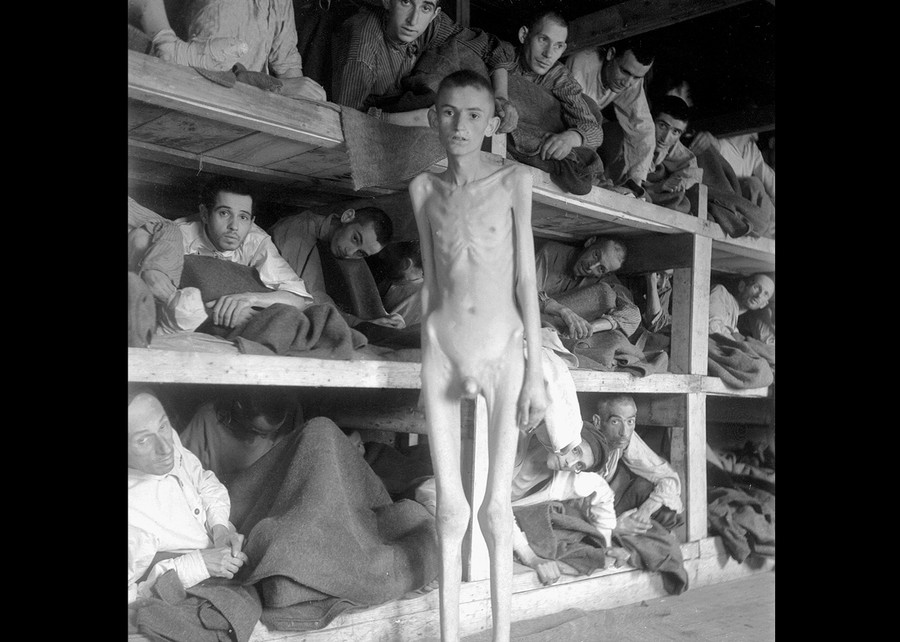
Jewish survivors in Buchenwald concentration camp, after the liberation of the camp in 1945  AFP/Getty 
 
Holocaust Remembrance Day is held each year on January 27. This year, Elie Wiesel: Soul on Fire, premieres at the Montreal Holocaust Museum. Elisha Wiesel, 53, will speak of his father and his mission to ensure the world 'never forgets'. Elisha Wiesel is chair of the board of the Elie Wiesel Foundation for Humanity. Along with his mother, Marion Wiesel, a Holocaust survivor, the Foundation was launched after the death in 2016 of father-and-husband, to continue the work Elie Wiesel dedicated his life to.
 
Directed and written by Oren Rudavsky the 90-minute film addresses the personal story and legacy of a man known as one of the world's most respected Holocaust survivors, known as well as a prolific author, humanitarian, passionate educator and Nobel Peace Prize laureate.
 
Eliezer Wiesel was a boy of 15 when he was deported from Sighet, Romania with his parents and three sisters in May of 1944 to Auschwitz-Birkenau where his mother and younger sister Tzipora were killed on their arrival at the death-and slave labour camp. Elie and his father were selected to go to the slave labour component of the notorious death camp. 
 
By early 1945, as Germany was losing the war and emptying the camps by forcing starving, skeletal inmates on death marches, Elie and his father were sent on a march to the Buchenwald concentration camp where his father later died. In April of that year the camp was liberated by American soldiers. The Jewish orphans in the camp, Elie among them, were transported to France, where his sister Hilda recognized him in a French newspaper photograph.
 
The siblings reunited, along with their sister Beatrice who moved eventually to Montreal. Working as a journalist in France, Wiesel studied at the Sorbonne. "He overcame trauma by becoming a witness", noted a family friend. His memoir of a young boy's reaction to Auschwitz, originally published in Yiddish in 1945 was a 846-page recollection of pain, loss and suffering. Abridged and translated to French, it was published as La Nuit in 1958, and in 1960 as Night, in English.    
 
Night sold over six million copies in 30 languages, and he went on to write many more books. Moving to New York in 1956, Wiesel became a writer, teacher and academic, teaching at City College of New York, then at Boston University in 1976, as Andrew W. Mellon Professor in the Humanities. "Your suffering is not what defines you, but it can inform you. It shapes you and then it is your job to make it the best tool you can", a former student added of her own mental journey under his tutelage.
 
https://canadatalksisraelpalestine.ca/wp-content/uploads/2016/07/wiesel-nobel.jpg?w=300

Having suffered the most inhumane circumstances and losses in his young life, Elie Wiesel matured a determined human rights upholder, refusing to stand silent in the face of immoral human rights abuses, speaking up and bringing attention to some of the modern world's most shameful human rights atrocities. His trauma led him to undertake action of moral outrage against wrongs committed against the vulnerable. Human rights violations that took place in Rwanda, Cambodia, the Sudan and the former Yugoslavia engaged his moral outrage and his propensity to speak loudly, publicly, determined to move others to do the same.  
"[My father] never failed to stand up for Israel, asserting that only Israelis can best decide how to reach their goals of living in peace and security in an extremely hostile neighbourhood."
"And lastly, he insisted that we never relinquish our desire to have a positive impact on the world as a whole."
"He strongly resisted isolationism as a principle."
Elisha Wiesel  
https://static-cdn.toi-media.com/blogs/uploads/2024/10/WhatsApp-Image-2024-10-02-at-02.30.03_e531e148-e1727825564747.jpg 

Labels: , , , , , ,

Wednesday, July 02, 2025

A Sacred Trust > Righteous Among The Nations

"The inactions of our country [Canada] underscore the empathy and humanity of our grandparents, who could also have done nothing." 
"A supposed civilized country could ignore the suffering around it, but Moeke and Opa could not."
"It was dangerous. It was an act of heroism that until now, was unrecognized."
"What did they have to lose? I would say everything."
Elizabeth Quinlan, granddaughter of Eimericus and Anna Maria Thijssen 
 
"I think they [her deceased parents] would be terribly surprised."
"I think it would be almost unthinkable for them because they didn't see themselves as heroic."
"They did the right thing at the right time. Doing the right and honourable thing doesn't need recognition, they would say."
Jantina Veldboom Devries, daughter of Hendrik and Frederika Veldboom 
 
"Were they heroes? They would laugh They were farmers. Parents. Neighbours who kept chickens and worried about harvest."
"Were they saints? They would object. They made mistakes. They felt fear. They were gloriously, beautifully human."
"We call them what they were: Righteous. Not perfect. Not fearless. Not superhuman."
"Simply people who saw clearly when the world went blind." 
Idit Shamir, Israeli Consul-General, Toronto 
https://thecjn.ca/wp-content/uploads/2025/06/Elizabeth-Idit-Jantina-e1751310958649-1536x1123.jpg
Elizabeth Quinlan, granddaughter of Eimericus and Anna Maria Tijssen; Idit Shamir, consul general of Israel in Toronto and Western Canada; Jantina Veldboom Devries, daughter of Hendrik and Frederika Veldboom, at a presentation at the Israeli Consulate in Toronto, June 26, 2025. Photo by Ron Csillag
 
Hiding Jews -- coming to the rescue of Jews who were hunted down in Nazi-occupied Europe to save them from annihilation at a time when Nazi Germany launched its Final Solution during World War II -- was a criminal offence, one which offenders could be guaranteed to pay the swift punishment for with their lives. Yet there were some people, although aware of the consequences should they be caught, their life-saving mission revealed to authorities, went on to do what their conscience demanded of them regardless.
 
They and their courage and determination have been noted and honoured at Israel's Yad Vashem Holocaust museum and memorial. They were, dead or living, inducted into the humanity-elite gathering called Righteous Among the Nations. 51 countries produced 28,486 individuals so recognized for their courage as non-Jews risking their lives to rescue Jews during the  unthinkable era of the Holocaust. They did so, while all around them others professed not to notice that Jews were being arrested, incarcerated in death camps, and systematically murdered.
 
Two recent Posthumous inductees represented by two Dutch families were honoured during a ceremony in Toronto. The four members of the two families had moved from the Netherlands to Canada shortly after the war. Their children and grandchildren, gathered from across Ontario, Edmonton, Texas and the Cayman Islands were joined by Ontario members of Provincial Parliament, and the occasion was marked by "certificates of honour" and medals inscribed with the Talmudic blessing of "Whosoever saves a single life, saves an entire universe". 
 
https://smartcdn.gprod.postmedia.digital/nationalpost/wp-content/uploads/2025/06/Hendrik-and-Frederika-Veldboom.jpg?quality=90&strip=all&w=564&h=423&type=webp&sig=Hg-hzzj8GJlz6VyHF3eK1A
Hendrik and Frederika Veldboom, who hid a Jewish couple in their rural farmhouse near the border with Germany and rescued their newborn son during the Holocaust. Photo by Handout
 
Food scarcity of the time, occupation and the reality that neighbours might notice something unusual and report them to the authorities risking shipment to a concentration camp or being shot then and there, did not stop Eimericus and Anna Maria Thijssen, parents of seven children of their own. from welcoming a two-and-a-half year-old Jewish girl, Elia (Annie) Muller, brought to them by the Dutch underground. The child soon called them Opa (Grandpa) and Moeke (Grandma). With them, the child was kept safe from 1943 to six months following Holland's liberation in 1945, when she was reunited with her parents. 
 
Now 84 years of age, that young Jewish girl, living in Holland, spoke via video hookup to dredge her still fresh memories of a large family, playing with other children "and being naughty"; no need to fear anything. Now an artist, Elia Muller's work focused on themes of memory and resistance -- "a tribute to the people who saved me". 
 
In 1950 the Thijssens emigrated to Canada, settling with four of their children in Ontario to work on a farm. They moved eventually to Strathroy where Eimericus became a local golf course groundskeeper and his wife Anna Maria worked at a canning factory. Their granddaughter Elizabeth Quinlan, a retired judge from Barrie, noted during the ceremony Canada's miserable record of avoidance in admitting Jewish refuges during the era of the Second World War, lowest among western countries. 
 
Newly married Hendrik and Federika Veldboom were members of the Dutch underground. Their rural farmhouse was turned into a hiding place for Jews and for young Dutch men averting forced labour. Lena Kropveld and her husband Yitzchak Jedwab, a cantor, were among the Jews harboured by the Veldboom family. Secretly married in 1942, they spent months in a hidden space behind a wardrobe. 
 
Lena gave birth to a baby boy, and Hendrik Veldboom placed him in a cardboard box, bicycled at night to place the baby on the leader of the  underground resistance's doorstep. The newborn, registered as abandoned, was taken in by the underground leader's family to live among their own eight children for the duration of the war years. Eventually the child was reunited with his parents, following liberation. Following the end of the war, the Veldbooms came to Canada in 1952, settling in Brockville, Ontario as farmers.  
 
https://pbs.twimg.com/media/Guaqe6EXoAAqVrC?format=jpg&name=small
The Righteous Among the Nations Award honours those who, in selfless acts of bravery and courage, risked their own lives to save the lives of Jews during the Holocaust.
 

Labels: , , , ,

Saturday, March 29, 2025

A Meeting of Like Minds

"I heard the surname, and I was like, 'Is this my family'?"
"I was shocked, and I was ashamed. Who wants to have a man like that as your grandfather? It was just tragic."
"[After reading the book [Commandant of Auschwitz], I felt so indebted by what my grandfather had done, I had this desire to do something."
"It's a meticulous record. He caused so much pain. It just broke my heart."
"People need to understand how inhumane, how horrible, how cold-hearted this was."
"The truth is painful, but silence is more dangerous." 
"What we're trying to do is move Holocaust remembrance from the head to the heart."
Kai Hoss, grandson of Rudolf Hoss, commandant of Auschwitz
https://www.washingtonpost.com/wp-apps/imrs.php?src=https://arc-anglerfish-washpost-prod-washpost.s3.amazonaws.com/public/ZHWJDC45DZBNJBRRNR2UFKFJK4.png&w=916
Rudolf Höss with his wife and children in an undated photo. (Courtesy of Kai Höss)

"I realize how important it was for my grandparents to share not only the story, but also why it's important."
"[My grandfather used to tell me:] The Holocaust was the worst in people. But it was also the best in people."
"We need to be not only educating people but galvanizing them through these lessons. That's how we  honour the victims and the survivors; that's how we keep them alive."
Mike Igel, grandson of three Holocaust survivors
Mike Igel, interim chief executive officer and board chair emeritus of the Florida Holocaust Museum spoke of plans to meet with Rudolf Hoss's grandson: "He and I are running in the same lane. We're using these lessons and experiences as the fuel to combat antisemitism -- the very thing that led to all of this." Mr. Igel's family was on the receiving end of Mr. Hoss's family's involvement in murdering Europe's Jews.
 
"We are still combating on a daily basis", said 44-year-old Mike Igel whose father's parents were able to survive the Holocaust when non-Jewish Polish farmers, Michel and Katarzyna Gerula, hid four Igel family members, along with three members of another family, in their barn. The Gerulas had three young children of their own at the time. 

Eventually betrayed by a neighbour, the two Gerulas were executed by the Nazis when they were taken into custody, tortured for weeks, all the while refusing to reveal where the Jews under their care were hiding. They are recognized as "Righteous Among the Nation", at Yad Vashem, where their courage and memory is kept alive.
 
As for Kai Hoss, he is a non-denominational pastor in Stuttgart, Germany where he leads services for local English speakers and American service members stationed in the vicinity. He tells his story of stumbling upon the name of his grandfather in his history book when he was in fifth grade. His mother confirmed to him when he was 16 that the infamous Rudolf Hoss who was responsible for the operations in Auschwitz was his grandfather.
 
https://www.washingtonpost.com/wp-apps/imrs.php?src=https://arc-anglerfish-washpost-prod-washpost.s3.amazonaws.com/public/6ZW7F4GRPZAHHMCV545DICRODI.png&w=916
Kai Höss with his wife, Rahma, and their four children. (Courtesy of Kai Höss)
 
Decades on, he began to deliberately meet with Jews to speak of his family history. "It became clearer and clearer who they are and what my grandfather had done. I had several wonderful experiences where I met these people, and they're very gracious. There is a spirit of forgiveness and kindness", he said. He began speaking against antisemitism at schools, synagogues, churches and other venues.
 
More recently a meeting has been planned between himself and the grandson of Holocaust survivors, Mike Igel; a planned conversation relating to their family and historical legacies linked to their shared advocacy. The meeting, the Florida Holocaust Museum which described the talk as exploring "history's impact and the power of our choices" where they will speak together at Eckerd College, St. Petersburg, Florida.
 
According to the Anti-Defamation League, a sharp rise has been reported in antisemitic incidents since the October 7, 2023 Hamas attack on Israel, responsible for the ongoing war in Gaza to this date. An over 200 percent increase soared in antisemitic incidents in the United States the first year following October 7. A global survey by the ADL found that close to half of all people worldwide have antisemitic beliefs. 

https://www.washingtonpost.com/wp-apps/imrs.php?src=https://arc-anglerfish-washpost-prod-washpost.s3.amazonaws.com/public/4VSJ2LVOSJENHP3O2HIEVCIRYE.jpg&w=916
Mike Igel at the Florida Holocaust Museum in front of a railroad boxcar — the same type used by Nazis to transport Jews to death camps. (The Florida Holocaust Museum)


Labels: , , ,

Sunday, January 26, 2025

The Cynical Hypocrisy of the International Community

"Relatively many people survived, which for example barely happened in sites which didn't have such a forced labour component."
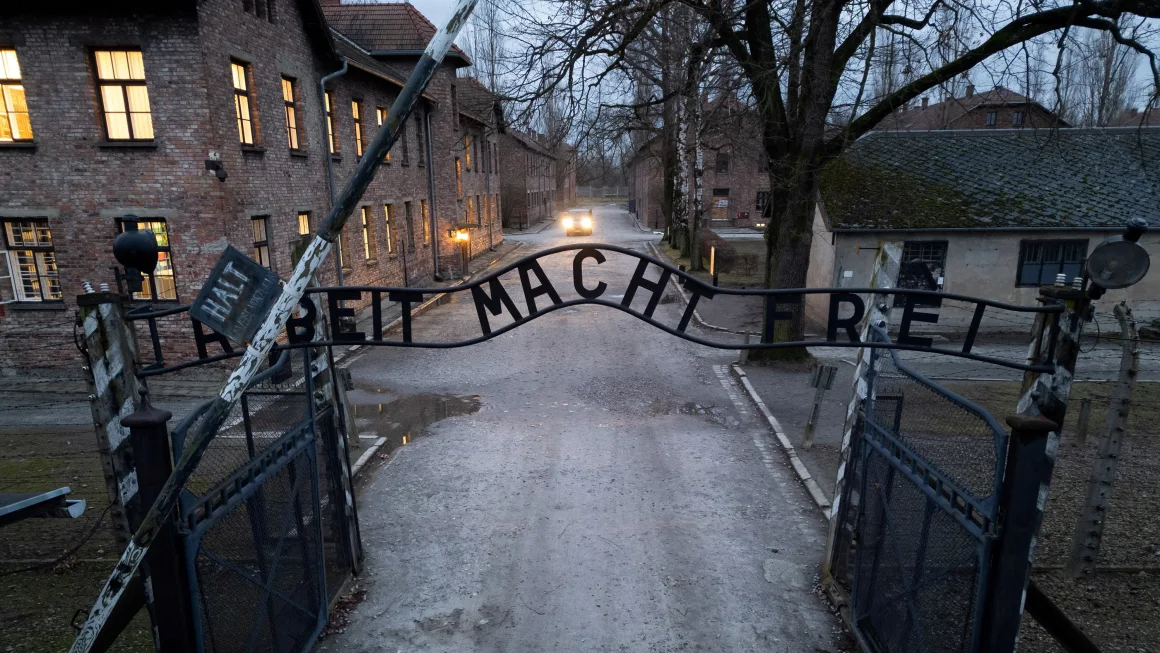
"[As testimony to the past purpose of Auschwitz, maintaining the death camp as a memorial site has its value]: You have the gate [Arbeit Macht Frei], you have the wagon [transport]. You have the incredibly long railway platform which leads to the former crematoria and gas chambers."
Thomas Van de Putte, scholar specializing in Holocaust memory, King's College London

"I saw thousands of tortured people whom the Red Army had saved -- people so thin that they swayed like branches in the wind, people whose ages one could not possibly guess."
Boris Polevoy, Pravda correspondent, eyewitness to Soviet liberation of Auschwitz Jan.27, 1945

"This is the anniversary of liberation. We remember the victims, but we also celebrate freedom."
"It is hard to imagine the presence of Russia, which clearly does not understand the value of freedom."
Auschwitz Museum director Piotr Cywinski
https://media.cnn.com/api/v1/images/stellar/prod/2025-01-23t125508z-33514047-rc2v6cacymkf-rtrmadp-3-holocaust-memorial-auschwitz-survivors.JPG?c=16x9&q=h_653,w_1160,c_fill/f_webp
 
The world is set to mark the 80th anniversary of the most dreadful mass atrocity that a country at war designed in an orgy of hatred against an ethnic population drawn from the countries of Europe whose citizenry included millions of diaspora Jews forced in antiquity from their ancestral homeland for exile abroad by a Roman occupation of the holy land that implacably put down an insurrection of Judean origin in a paroxysm of violence that millennia later was replicated with more modern and equally savage technological means of broader dimensions.

It is highly doubtful that Romans of the period felt it incumbent upon themselves to harvest the hair, skeletal remains, attire, gold dental fillings, marriage rings, to enrich themselves and produce stuffing for pillows, the production of soap from the remains of their victims as Nazi Germany felt disposed to do. The slaughter of children, women and men of all ages may be a casualty of war anywhere at any time when civilian populations bear the brunt of conflict that uproots and victimizes them in loss of home, necessities of life and life itself, but Nazi Germany brought its obsession with the extermination of Jews to a fine art.
https://cdn.theatlantic.com/thumbor/xF31tXC8yTwKZU6Gc2RuReeZB8U=/1200x1607/media/img/photo/2011/10/world-war-ii-the-holocaust/w02_05043944/original.jpg
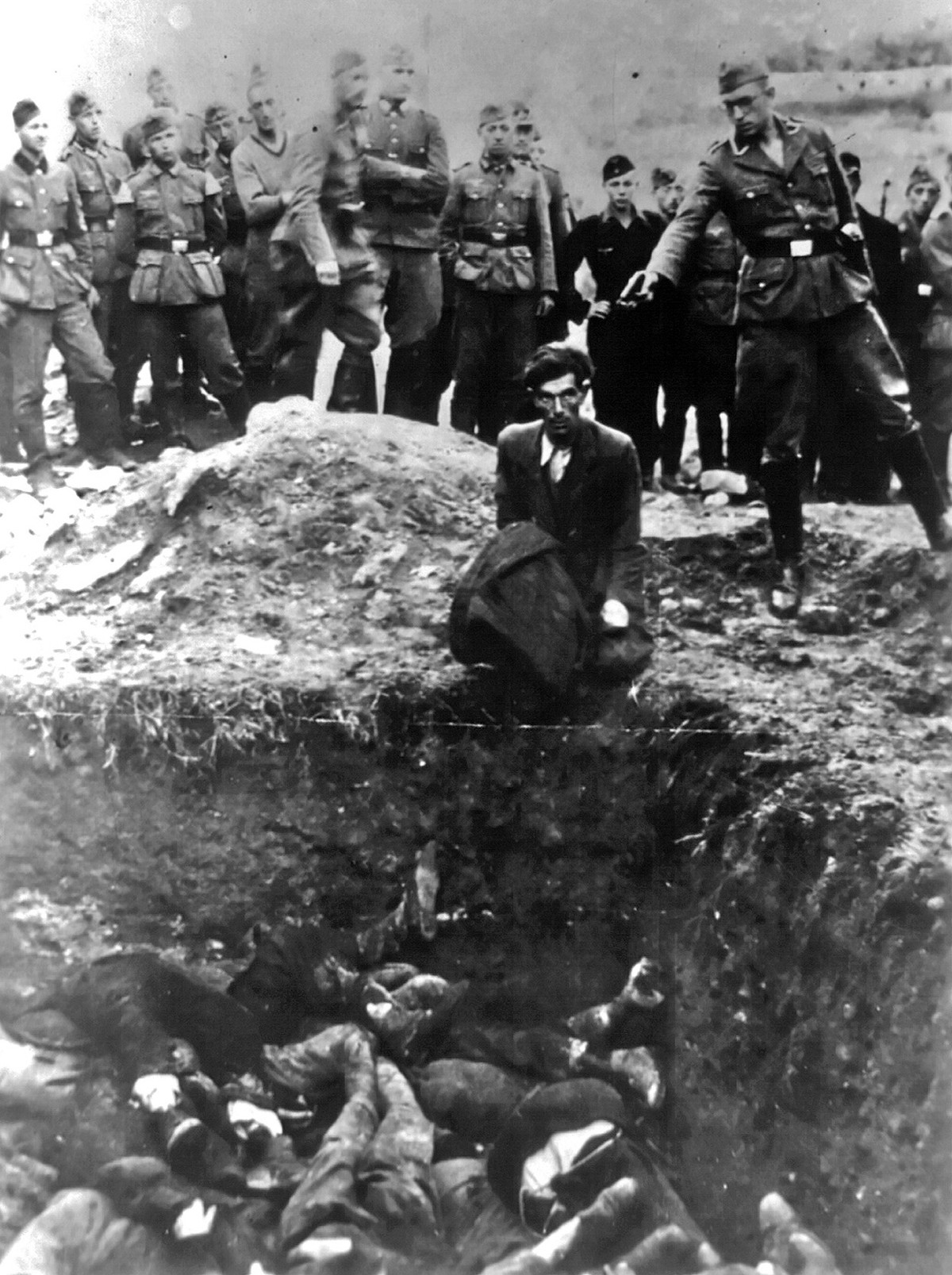
This photo provided by Paris' Holocaust Memorial shows a German soldier shooting a Ukrainian Jew during a mass execution in Vinnytsia, Ukraine, sometime between 1941 and 1943. This image is titled "The last Jew in Vinnitsa", the text that was written on the back of the photograph, which was found in a photo album belonging to a German soldier
 
It took an orgy of mass dementia to organize round-ups, persuade populations that a nest of vipers lived amongst them that German authorities prepared to save them from, infesting those non-Jewish citizens with a suspicion and loathing of Jews they had lived among for centuries to convince them that the goal of extermination would make for a more refined, pure society once the presence of Jews was eliminated. People adapted nicely and deliberately turned their faces away from the putrid agonies of exclusion and humiliation their fellow Jewish citizens suffered, glad when they suddenly vanished into slave labour camps since out of sight, out of mind was a great relief,

Now, generations after the Holocaust for most people inhabiting our familiar world the memory of mass annihilation is beyond faint and growing fainter. Just as the thousands of Jews who managed miraculously to survive have grown old and are growing older, their witness status soon to fade itself, in and out of history. To be sure, others besides Jews died; political prisoners, Poles, Roma, Sinti, Soviet prisoners of war, homosexuals, but it was Europe's Jews that comprised the target focus.
 
This year, on the 80th anniversary memorializing the Holocaust, an estimated 50 survivors are expected to be present, and they will speak to the world once again of their loss, their ordeal, their endurance, their unforgettable memories. Two-thirds of the Jews of Europe perished in that orgy of hate and demonic destruction of human life. They were murdered in the death camps established all over Europe, places like Treblinka, Majdanek, Stutthof, Auschwitz, Buchenwald, Dachau, Mauthausen and Bergen-Belsen among a plethora of others. 

There were survivors at Auschwitz for the simple reason that though it was a death camp it also was a labour camp. Where those who survived the journey to Auschwitz in crowded train transports were separated on arrival into groups deemed sufficiently healthy to work, the others directed to groups who would enter the 'shower rooms' where they were gassed to death with Zyklon B, their remnants cremated in giant furnaces, their ashes belched out of massive chimneys to nurture the surrounding soil.

Presidents, royalty, ambassadors, politicians, rabbis and priests will be among those in attendance to memorialize the fixation of a nation and a continent on the destruction of a tiny ethnic/cultural/religious group that had lived among them for  generations, enriching those countries with their presence as artists, scientists, teachers, factory workers, lawyers, doctors, justices, soldiers, entertainment figures, industrialists, bankers and journalists, bakers and cobblers.
 
https://ichef.bbci.co.uk/news/480/cpsprodpb/ca12/live/96f3a860-db1d-11ef-a37f-eba91255dc3d.jpg.webp
The royalty, presidents, ambassadors, politicians and priests of the time who failed to exert their moral outrage over the persecution, then the demonization, then the isolation, then the ghettoization, then the imprisonment and finally the murder of six million Jews were in a very real sense complicit with the perpetrators of the vast act of genocide. Their present day counterparts are in a very real sense not much different than those during the Holocaust who couldn't be moved to make an effort at prevention and deterrence.

The rising tide of antisemitism which bears such an uncanny resemblance to that of the 1930s and 1940s and the growing calls of accusations against a tiny Jewish state established in its ancestral geography to restore pride in Judaic heritage but above all to give strength to the cry of "Never Again!" by its pledge to protect and guide Jews into the future is once again under existential threat. Collegial nations of the West, supporters of the Jewish state, have managed to remain on the sidelines once again, leaving Israel and Jews to their own defense.

https://ichef.bbci.co.uk/news/1024/cpsprodpb/b671/live/549e7b30-dbe9-11ef-99c3-d14ec5dc850f.jpg.webp
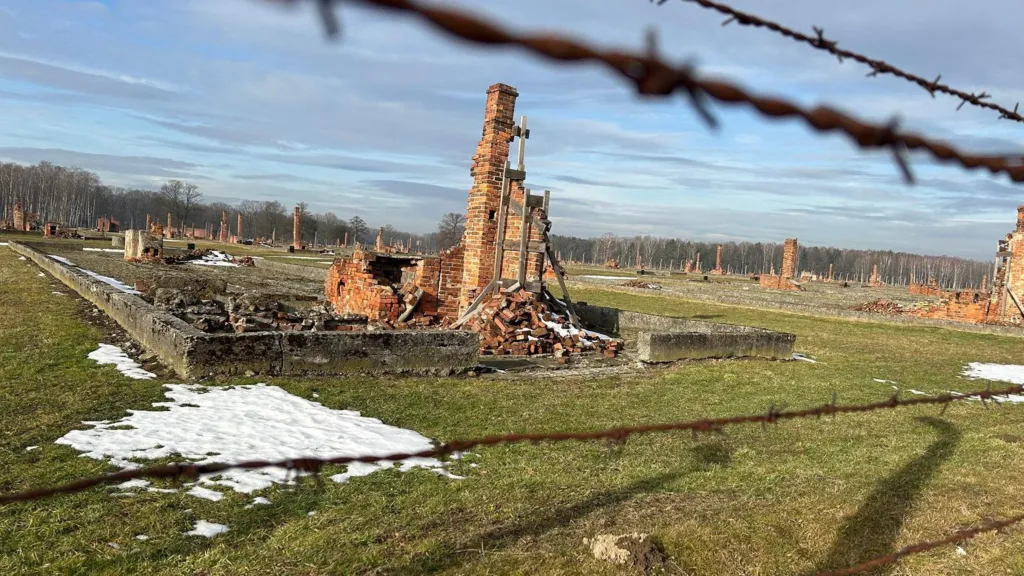
The ruins of the sprawling Birkenau site stretch far into the distance

Labels: , , ,

Friday, January 10, 2025

"Auschwitz. Not long ago. Not far away"

"I had no idea where we were. It was unreal and beyond my imagination."
"After being tattooed [133628] and inducted as a prisoner and losing my identity, I thought this was hell on Earth, from which I had little or no hope of getting out. I was in total despair."
"Only my father's presence gave me some hope."
Nate Leipciger, 96, from Sosnowiec, Poland
 
"[The artifacts, augmented by survivors' recorded testimonies], are the traces of genocide, the remnants of a murdered people, and the material evidence of crimes against humanity."
"They are what remain despite the perpetrators' attempts to conceal their crimes."
Paul Salmon, curator, exhibit catalogue, "Auschwitz. Not long ago. Not far away" 
 
"It's not easy to go to a museum to learn about the particular story of Auschwitz, but sometimes the things that are more difficult are the ones that are more necessary."
"We knocked on many doors. I never got no for an answer."
 Luis Ferreiro, director, Musealia, Spain
 
"[The Royal Ontario Museum's mission is] to help people understand the past, make sense of the present, and come together to shape a shared future."
"[With the Auschwitz exhibit], we could not imagine an exhibition that more materially fulfilled our mission."
"[There is a deliberate attempt to avoid] gratuitous depictions of violence." 
Josh Basseches, museum director and CEO, ROM
Auschwitz
Jews from Lubny, Ukraine, shortly before their murder by an Einsatzgruppe, 1941. This photo is one of the items in the exhibit Auschwitz: Not long ago. Not far away. Photo by Musealia

In 2008, Luis Ferreiro, director of his family's Spanish company Musealia, in mourning after the death of his 26-year-old bother, read psychotherapist and philosopher Viktor Frankl's book, Man's Search for Meaning. It gave him comfort. Viktor Frankl was a survivor of Auschwitz. It was there that his pregnant wife, parents and his brother perished in Nazi Germany's campaign to extinguish all Jewish life in Europe. The book's story of survival and finding purpose in life despite the worst possible circumstances, resonated with Mr. Ferreiro.

Although not a Jew, he took inspiration from the writer's message and decided to pursue "a moral necessity to do something. It was always about Auschwitz for me". He collaborated with the Auschwitz Museum and spent time tracking down other potential involvement in a long but rewarding process to showcase human survival in the most obscene, inhumane period of modern human history. His decision to dedicate himself to this project gave purpose to his own life, through his grief.
 
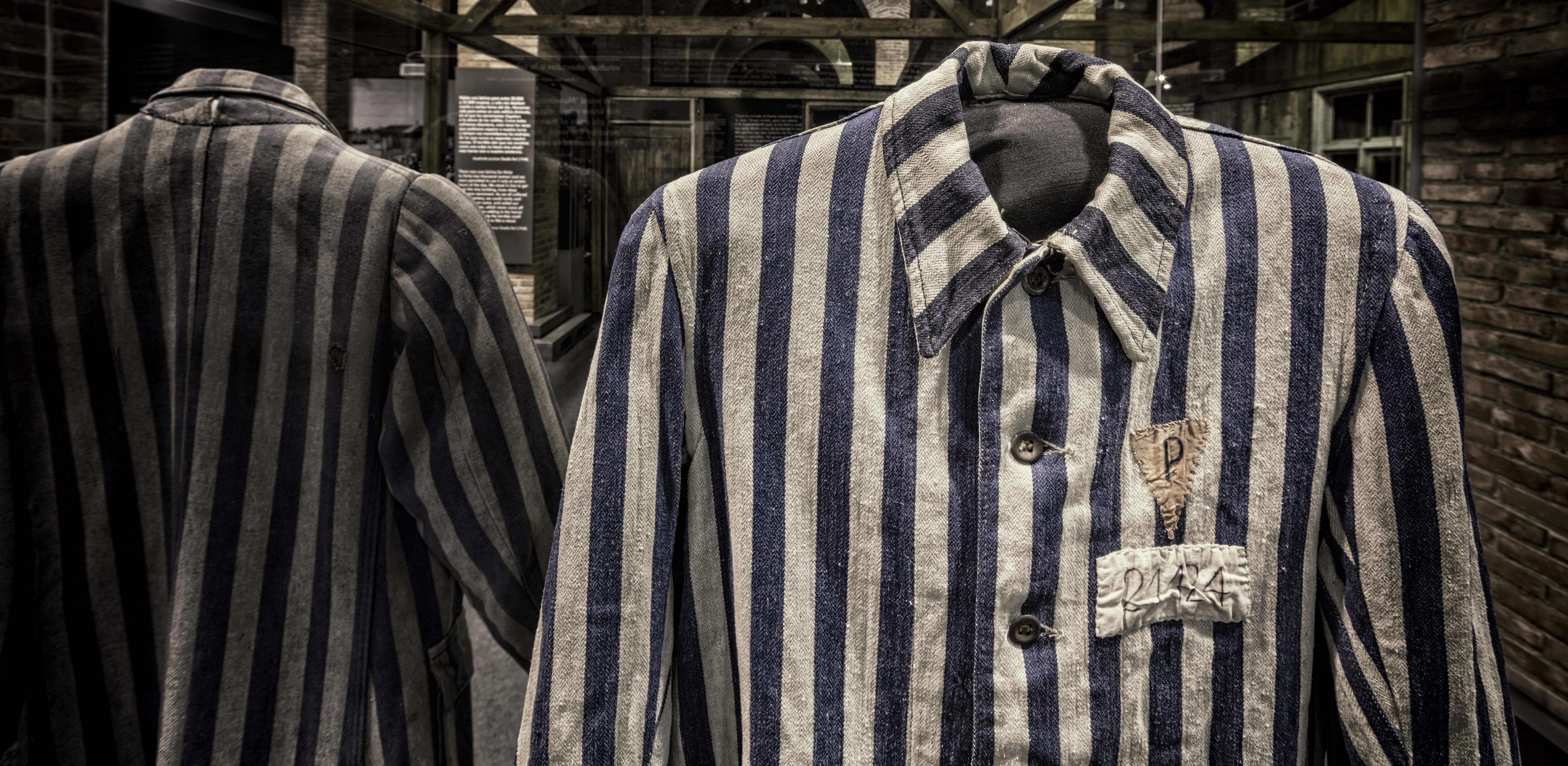
A blue and white striped uniform jacket. There is an upside-down triangle with the letter P on it stitched onto the left breast.

The end product of his research and organizing of an exhibit to feature the Auschwitz death camp during the years of the Holocaust, in the Second World War, opened in 2017 in Madrid. Since then the exhibit has toured in New York, Kansas City the Ronald Reagan Library in Simi Valley, Malmo, Sweden, and Boston. Between 1.4 and 2 million people have viewed the exhibit, according to Mr. Ferreiro's estimation. During his search for collaborators for his project, Mr. Ferreiro discovered Robert Jan van Pelt, professor at the University of Waterloo, among the world's leading experts on Auschwitz, who became the exhibit's chief curator.

At Birkenau, the largest of the nearly fifty sub-camps collectively known as Auschwitz, 96-year-old Toronto resident, Nate Leipciger, Holocaust survivor, who has over the years dedicated himself to educating the public about the Holocaust, had lost his mother and sister, murdered along with eight other members of his extended family. Their lives were taken in the gas chambers of Birkenau.

Of the Nazi death camps scattered throughout Europe, Auschwitz was the largest, most notorious and deadliest. At liberation, photographs of skeletal inmates in striped uniforms and dazed eyes, many too weak to rise from their serried bunks, were  seen worldwide as examples of the Nazi atrocities perpetrated against Europe's Jews in the slaughter of six million of Europe's Jewish communities. 

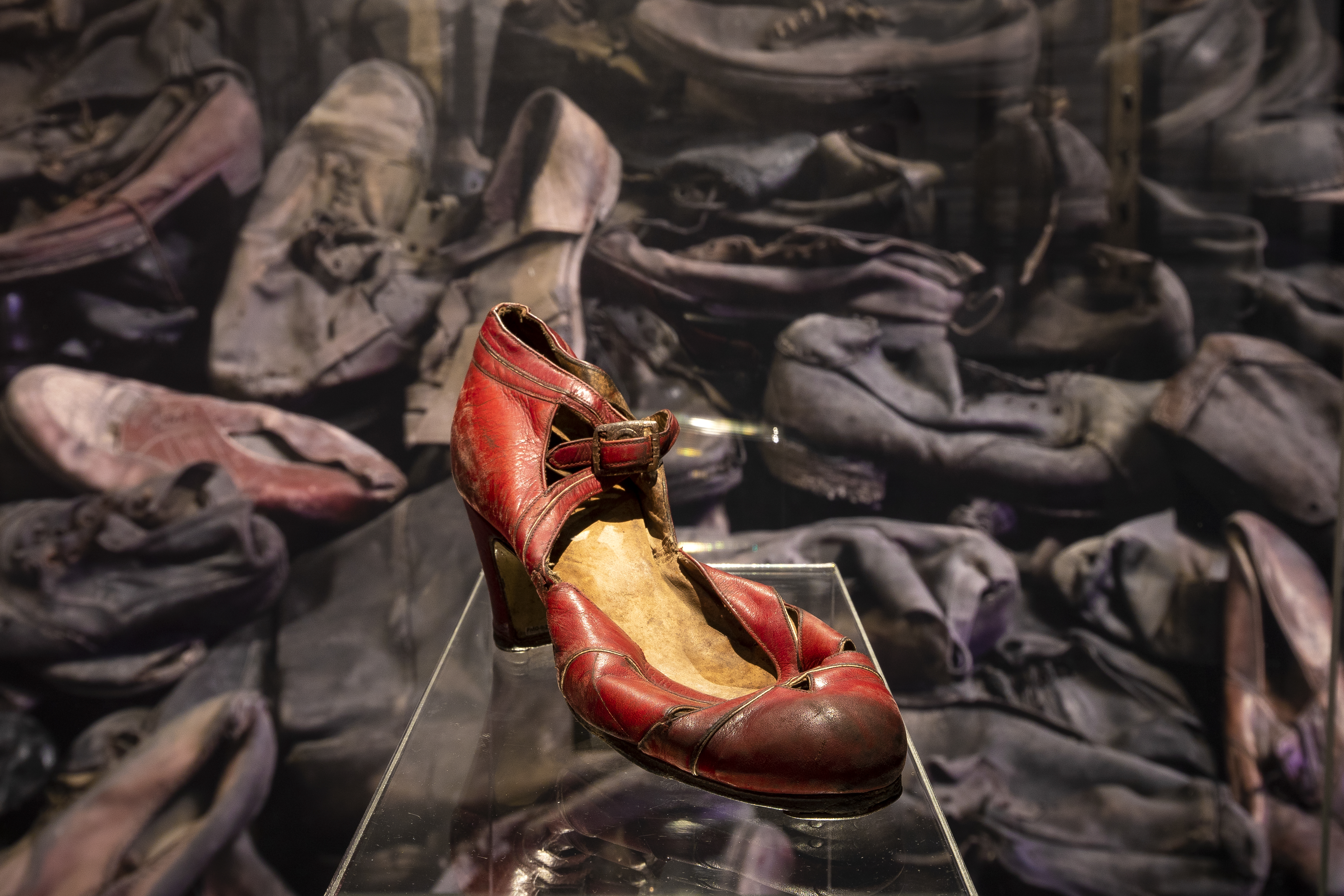
A battered and worn red high-heel shoe, shown in front of a pile of hundreds or other shoes.

Details like crammed boxcars, crematoria, belching chimneys of human ash, barbed wire enclosures, a gate whose legend read "Arbeit Macht Frei" have become symbolic of the Holocaust. 1.3 million people were deported to Auschwitz in the four years of 1940 to 1944; 1.1 million were Jews. 900,000 were gassed soon after their arrival in packed rail boxcars. Others were used for slave labour until they died of exhaustion and malnutrition. Some 75,000 non-Jewish Poles, 21,000 Roma, 14,000 Soviet prisoners of war and up to 15,000 of other categories including criminals, homosexuals, Jehovah's Witnesses and "undesirables", were also murdered there.

On January 10, preceding the 80th anniversary of the camp's liberation on January 27 (annual International Holocaust Remembrance Day), the exhibit will open at the Royal Ontario Museum in Toronto. Over 500 original artifacts, along with hundreds of photographs, charts, drawings, correspondence and diagrams will be shown at the exhibit, most of them on loan from the Auschwitz-Birkenau Memorial and Museum, and from over 20 other institutions.

Among many other items are receptacles that once contained Zyklon B pellets. Belongings of newly-arrived prisoners of the time, are heaped within a large glass case, comprised of everyday common personal items such as shaving material, perfume bottles, eyeglasses, hair brushes, bowls and buttons. Personal property items of the victims were in such abundance they were stored within 30 barracks, referred to as "Kanada", a country imagined to be brimful of wealth.
 
During the Holocaust an estimated 1.5 million Jewish children were murdered or died of deprivation. At a time of steeply rising antisemitism all over the world, a time when knowledge of the Holocaust is fading, the exhibit strives to reawaken a disinterested world's memory and conscience. The exhibit will be on display until September 1. The ROM is its only Canadian destination. The museum has suspended an admission charge for Grades 6 - 12 students in organized school visits.
 
 https://www.rom.on.ca/sites/default/files/styles/hero_image_xl_x2_2812x1580/public/2024-08/AUSCHWITZ_CARTEL_FLAT_CMYK_AF_Web.png?h=1c57675e&itok=_fF7L0mE


Labels: , , , , , , ,

Saturday, November 16, 2024

The Arab/Muslim/Palestinian Lobby in Canada

"While we stand firmly behind protections against discrimination for al communities, including Palestinians, [anti-Palestinian racism] crosses a line by targeting expressions of Jewish identity linked to Israel."
"Holding differing opinions is not a breach of human rights."
Richard Marceau, vice-president, external affairs, Centre for Israel and Jewish Affairs

"[A meeting with the prime minister took place to] highlight how Islamophobia, and its intersections with anti-Palestinian and anti-Arab racism, continues to harm our social fabric, undermines pluralism and poses a direct threat to our democracy."
Amira Elghawaby, anti-Islamophobia representative

"Racism is an appropriate construct for describing the experiences of Palestinians."
"Israel's treatment of Palestinians is ... at its essence[,] predicated on the superiority and dominance of one group of people over another."
"A form of anti-Arab racism that silences, excludes, erases, stereotypes, defames or dehumanizes Palestinians or their narratives."
Arab Canadian Lawyers Association 2022 report
https://smartcdn.gprod.postmedia.digital/nationalpost/wp-content/uploads/2024/11/CP165770132.jpg?quality=90&strip=all&w=1128&h=846&type=webp&sig=H5z23xx6W8XhGNtdKksYuw
Amira Elghawaby, Canada's special representative on combating Islamophobia. Photo by Jacques Boissinot/The Canadian Press
 
The very height of unredeemable hypocrisy expressed by the Arab Lawyers slandering Israel's treatment of Palestinians, typical and predictable of Muslim interpretation of justice, when it is Palestinian violence meted out in constant death threats and active attempts and successes in random attacks killing Jews within Israel that is the real issue in the ongoing standoff between Israel and the Palestinians. Surpassed in inhumane savagery by the Palestinian terrorist attack led by Hamas on October 7 2023, when  thousands breached the border fence in southern Israel to slaughter 1,200 Jews and rape innumerable Israeli girls and women, mutilating many in sheer sadistic inhumanity.

Added to the fact that Arab, Muslim and Palestinian 'public relation' campaigns endlessly stereotype, defame and dehumanize Jews and the State of Israel, entirely reversing reality in pursuit of demonizing the Jewish State and Jews worldwide as oppressors of Palestinian victims of Jewish cruelty. Now, those who have celebrated the October 7, 2023 massacre of innocent Israeli civilians and who portray those rapes and murders as just desserts in punishment for those who victimize Palestinians -- which is to say a state that defends its citizens from mass psychopathy -- are lobbying Canada's government to make it a crime to slander Palestinians.

Irony upon irony; the very people who expend endless time and energy on slandering Jews insist the world is obliged to protect them from opinions garnered from their violent performance in mass murder, along with their anti-social machinations in never-ending loud and sometimes-violent, always-threatening marches and demonstrations calling for the destruction of the Jewish State and the ouster of Jews from Canada; to 'send them back to Europe' -- ostensibly to the Holocaust ovens of annihilation -- continue to portray themselves as victims, not the victimizers that they are.

The concern within the Jewish community is that accepting the thrust of the argument that Muslims deserve a law that would outlaw criticism of Palestinians and by extension Muslims who have, in the past year, broken myriad Canadian laws with impunity, it would become a criminal offence for Jews to criticize the mobs who threaten them on the streets, in their communities and their businesses. The issue of conflating pro-Israel declarations with racism, in the process insulating Palestinian interpretations of history and present performances from criticism is beyond incomprehensible to a logical, neutral mind.
 
https://i.cbc.ca/1.7022457.1699469086!/fileImage/httpImage/image.jpg_gen/derivatives/16x9_780/adil-charkaoui.jpg
Adil Charkaoui, speaking Arabic, denounced "Zionist aggressors" and called on Allah to "kill the enemies of the people of Gaza and to spare none of them."Adil Charkaoui's speech has drawn broad condemnation from politicians like Premier François Legault and groups like the Centre for Israel and Jewish Affairs. (Adil Charkaoui/X)
 
At the very time that Canada's civil compact of community equality and plural social mores of acceptance and civil tolerance of others are being turned into a psycho-social morass of harassment, threats and unsubstantiated claims of Jewish supremacy plotting the genocide of Palestinians, the Palestinians, their defenders and allies are accusing Canadian Jews of plotting against them and turning society into a critical mass of Palestinian denigration. The classic of victimizer cloaking itself as victim.

"Denying the Nakba" will become grounds of prosecution should the Arab Canadian Lawyers group's definition of 'racism' against Palestinians -- a group that can hardly be claimed to be a race to begin with -- be agreed to by the Liberal government. The 'Nakba' is a term used to describe the displacement of Palestinians in the 1948 Arab-Israeli war when the nascent Jewish State declared itself and combined Arab armies marched on Israel to destroy it, and 750,000 Arabs calling themselves Palestinians fled, to become refugees while believing Israel would fall, and they could immediately return to claim the land their very own.

Balance that against the estimated 800,000 Arab Jews who were expelled, their properties taken, by the Arab countries where they had lived for centuries in the diaspora forced upon indigenous Jews by the Roman Empire in the 2nd century BC, dispersing Judeans from their ancestral lands. Jewish organizations are concerned that equating the Holocaust with the Palestinian 'Nakba' "risks opening the door to Holocaust minimization".
"These comparisons are problematic because they equate the Holocaust -- a systematic industrial-scale genocide in which six million Jews were targeted and exterminated solely for their identity -- with the displacement of approximately750,000 Palestinians during the 1948 Arab-Israeli War."
"This framing not only undermines the historical uniqueness and gravity of the Holocaust but also fosters perceptions that Jews are committing atrocities similar to those they endured."
"By blurring these distinctions, anti-Palestinian racism diminishes the specific trauma of the Holocaust and undermines the educational impact of Holocaust memory."
Richard Marceau, Centre for Israel and Jewish Affairs
Canada had accepted the International Holocaust Remembrance Alliance definition of antisemitism for the purpose of combating forms of anti-Zionism; a distinct form of antisemitism. The IHRA definition was added to Canada's anti-racism strategy in 2019. It states "manifestations [of antisemitism] might include the targeting of the state of Israel conceived as a Jewish collectivity". As an example, "denying the Jewish people their right to self-determination e.g., by claiming that the existence of a State of Israel is a racist endeavour"; as well, "drawing comparisons of contemporary Israeli policy to that of the Nazis".

All of which, manifestly, the pro-Palestinian, anti-Israel lobby in Canada has engaged in, fulsomely, loudly and in public demonstrations of noxious and society-disturbing magnitude. Justin Trudeau was the recipient of criticism for failing to mention anti-Palestinian racism in a strategy update of Canada's anti-racism to guide the federal anti-racism program. Liberal MP Salma Zahid faulted the Prime Minister for failing to mention anti-Palestinian racism in a strategy update this year. Now she purrs on the strength of the meeting held by Amira Elghawaby with Justin Trudeau.

https://smartcdn.gprod.postmedia.digital/nationalpost/wp-content/uploads/2024/11/0127-ts-salma-zahid.jpg?quality=90&strip=all&w=1128&h=846&type=webp&sig=e2RzczUaJITSgGeZImI4dw
Liberal member of Parliament Salma Zahid talks to reporters as she arrives to a caucus meeting in Ottawa on Wednesday, Nov. 8, 2023. Photo by Sean Kilpatrick /The Canadian Press
"I welcome the prime minister's commitment to recognizing and adopting a definition of anti-Palestinian racism."
"In Canada in recent months, we have seen increasing levels of Islamophobia, anti-Palestinian racism and antisemitism."
"Before we can fight against such hatred, we need to be able to recognize what it is and what it looks like."
"I look forward to working with the government to move this forward."
Liberal MP Salma Zahid

Labels: , , , , , ,

Thursday, October 31, 2024

Adampol Slave Labour/Death Camp, Poland

"We never had the opportunity to lay a flower for any of our beloved ones who died here. But we will mourn them today. Their souls in heaven will always be with us."
"He [his father Jack Pomeranc] had tremendous anxiety and regrets and fear. [He was] crying and apologizing to his family that he wished he [had] saved them, and he could have but he didn't and should have."
"And at that time, I understood very well that this was something I needed to put closure to for him, since he was traumatized all his life from it."
Today we bring closure to this chapter in our lives."
Michael Pomeranc, son of Holocaust survivor
https://zapomniane.org/wp-content/uploads/2020/10/ADAMPOL-1024x683.jpg
 
After many long years of planning, Michael Pomeranc and his close relatives fulfilled a personal mission when they took part in a ceremony to unveil memorials to murdered Jews during the Second World War. The venue was a forest in Poland. And the memorial was to honour the Jews murdered by German forces. Dozens of Michael Pomeranc's relatives among them, at a little-known German labour camp named Adampol.

During the dedication ceremony, Pomeranc spoke of his childhood in the United States. Where there were no cemeteries that held the remains of his family members, no graves to visit that held the remains of his predecessors in his family tree. Jews were forced to work as slave labourers in fields nearby the Nazi labour camp. Once their usefulness was over, when they became too weak, too ill to continue labouring, they were murdered, in 1943.

Poland, under Nazi German occupation, was the site of many such labour and death camps where Jews had value as slave labourers and when they could no longer perform the labours assigned to them they were scheduled for mass extermination in the death camps. Auschwitz is the most well-known of all such death camps, but it was only one of many, although it was responsible for the extermination of over a million Jews of all ages.
 
https://assets.editorial.aetnd.com/uploads/2020/01/auschwitz-gettyimages-89237122.jpg?width=2048&height=1332&crop=2048%3A1332%2Csmart&quality=75&auto=webp
Women in the barracks at Auschwitz, Poland, January 1945. Photo taken by a Russian photographer shortly after the liberation of the camp.
 
The event was attended by local schoolchildren in the presence of descendants of Holocaust survivors who witnessed it far from Poland, via livestream. Two living survivors of Adampol are left to contemplate their living hell during that time. Too old and frail to make the trip to Poland. New York city hotelier Pomeranc visited the site 25 years earlier with his father Jack Pomeranc. His father had been imprisoned there but was able to escape, to join Jewish partisans and took part in blowing up Nazi-occupied buildings and train tracks in efforts at war sabotage.

Jack, whose Yiddish name back then was Jankiel, along with a brother and two sisters managed to survive, but his parents and two little sisters, age 3 and 4, along with aunts,  uncles and cousins were all murdered. At the commemoration a memorial with the names of 73 of over 600 victims were included; the only identification so far of those who perished. The organizers' goal is the restoration of identities of as many victims as possible to preserve their memories.

The event is part of a more expansive effort by the Polish Jewish community to commemorate sites of mass murder of Jews during the Holocaust, neglected and unmarked a lifetime after the Second World War. Of the 3.3 million Jews who lived in Poland before the 1939 German invasion, most wee murdered. Polish Chief Rabbi Michael Schudrich along with a group named Zapomniane (Forgotten) aided by non-invasive technologies have succeeded in systematically locating sites of mass burials to mark them for posterity.

So far, witness testimony of local people and technology have aided researchers in identifying over 20 possible mass grave sites in Adampol, verified by a forensic archaeologist who has carried out years of research at the site.

https://static.timesofisrael.com/www/uploads/2024/01/AFP__19990719__SAPA990719760540__v1__HighRes__PolandAuschwitzFenceBarracks-e1706225808675-640x400.jpg
Illustrative photo of electric fences with concrete posts and insulators surrounding the barracks where deportees where held at the Auschwitz concentration and death camp established by the Nazis. (Jack Guez/AFP)


Labels: , , , , ,

Saturday, September 07, 2024

Canada a Haven for War Criminals

"A few stakeholders were concerned that the release of the report would result in new legal action [criminal prosecution, citizen revocation, or otherwise] being brought against the individuals named in the report." 
Library and Archives Canada (LAC) report summary

"[Library and Archives Canada had received three requests under the Access to Information law for the Deschenes document and as a result] undertook targeted consultations with external stakeholders."
"As of today LAC is still refining and concluding its analysis to respond to the Access to Information requests received."
LAC spokesperson Richard Provencher

"We know many survivors that feel very strongly about this issue and would have wanted the opportunity to speak."
"Why were they not included? Do they not have a right to be heard on questions related to the investigations against Canadians who may have been involved in committing acts of genocide against their families?"
"The idea that Canadians should be worried about the embarrassment or privacy of war criminals is obscene. We know that individuals involved in implementing the genocide of six million Jews during the Holocaust have been living peacefully in Canada for decades and it is well past time that all the facts come to light."
Jaime Kirzner-Roberts, Friends of Simon Wiesenthal Center for Holocaust Studies, Toronto
https://thecjn.ca/wp-content/uploads/2024/02/Screenshot-2024-02-02-at-4.42.03%E2%80%AFPM-e1706910204638-1920x969.png
Screenshot from a 1987 news report by CTV News—based on the information that was public at the time.
 
"In view of the large numbers of people involved in the perpetration of war crimes who merged with the DP [post-war 'displaced persons'] and general immigration stream; in view of the inadequacy of the screening performed by international agencies and Canadian officials during the postwar years; and in view of the Canadian government’s policy of ethnic immigration and of concentration… on weeding out Communists, it would be rash to assume that significant numbers of war criminals and Nazi collaborators did not enter Canada."
Historian Alti Rodal
https://smartcdn.gprod.postmedia.digital/ottawacitizen/wp-content/uploads/2024/09/himmler-ss-galicia-1.jpg?quality=90&strip=all&w=1128&h=846&type=webp&sig=tGanxAF97ggb8560KEcxVQ
The 1986 war crimes commission headed by Justice Jules Deschenes was tasked to look into the issue of the presence of Nazi war criminals living in Canada. People who fought with and acted for the Fascist Nazi Third Reich. Canada, of course, has rules and regulations on admitting foreigners into Canada as immigrants or refugees; they are inadmissible if they have a criminal record, and particularly a link of any kind with a national military involved in war crimes. 
 
Despite which it has been known since the end of World War II that many war criminals entered Canada and lived there freely. There were 900 names on a list of war criminals living in Canada, compiled for inclusion with the Deschenes Report.

The report, named the Commission of Inquiry on War Criminals in Canada, commissioned by the government of Brian Mulroney long after the conclusion of the war -- the only prime minister who could be persuaded to look into the issue -- clarified the issue, yet its contents were never revealed, and it was shelved for decades. Alternately called the Deschenes report, it compiled a list of 900 names of war criminals living in Canada. 
 
Finally the government of the day released a 618-page report in February written by historian Alti Rodal which investigated how Nazi war criminals entered Canada after the Second World War.
 
Now, it seems that in June and July, Library and Archives Canada undertook consultations with "discrete groups of individuals or organizations" on whether the list of names should be made public. Members of Canada's Ukrainian community were among those consulted, and it was from among members of the Ukrainian community that Nazi collaborators during the war years found their way to Canada, entering with no trouble at all. 
 
Notably, those most affected by the Nazi years in power, victims of the Holocaust and Jewish-Canadian groups were not made aware of the consultations, not invited to participate; their vested-by experience interest completely ignored.

Those who were consulted expressed grave reservations over the prospect of the information contained being made public knowledge; arguing against releasing any of the information. Warning that to do so would be embarrassing in its revelations, or might lead to prosecutions of those alleged to have been war criminals. In other words, naming those who are considered to have been war criminals could unobligingly lead to their past catching up to the present with consequent criminal charges. Not to be conceived....

Prior to the consultations, Library and Archives Canada had thought to release information to the public at some time between September 16 and September 20. Unknown is the number of names that might be released to the public. LAC withheld to the present specific details on the individuals involved and organizations that had been consulted on the issue. As to why Holocaust survivors were excluded from the discussions remained unanswered. Friends of the Simon Wiesenthal Center for Holocaust Studies had not been advised nor invited to the advisory meeting.

In February 2023, B'nai Brith advocacy group pointed out to a House of Commons committee on Access to Information that the Canadian government's attitude toward Nazi collaborators had been marked with the "intentional harbouring of known Nazi war criminals", along with "deliberate inaction". That was the year that an invitation went out to a Ukrainian veteran, Yaroslav Hunka, to appear in the House of Commons during a visit by Ukrainian President Volodymyr Zelenskyy. Hunka, 98, a former member of the Waffen SS was given a standing ovation by parliamentarians.
 
https://www.wsws.org/asset/c60ea00b-a339-455e-b8af-1bebf0392f0b?rendition=image1280
Canada’s parliament applauds Yaroslav Hunka, a former member of the Waffen-SS. Canada’s Chief of Defence Staff General Wayne Eyre is on the far left.
 
None thought for a moment that they were applauding a Nazi collaborator, but they were, and they did. From parliamentarians to Canadian military members, all lauded a Nazi collaborator, not instinctively realizing that anyone who fought against the Soviets for Germany after 1941 was part of the Axis, their units like Hunka's division, the 14th SS Galicians, had sworn allegiance to Germany and Hitler, and taken part in the extermination of Jews and Poles. And Canadians responded writing angry notes to the government, to the prime minister pointing out the gross stupidity of hailing Hunka as a war hero.

https://www.wsws.org/asset/a46b66e5-7c4d-4dfd-8de4-1000042a7355?rendition=image1280
Yaroslav Hunka (front center) among Nazi Waffen-SS Galicia Division troops. [Photo: Ivan Katchanovski/Twitter or X]

"Canada has a really dark history with Nazis in Canada."
"There was a point in our history where it was easier to get in as a Nazi than it was as a Jewish person."
"I think that's a history we have to reconcile."
"Those who suffered under Nazi Germany and their descendants want transparency when it comes to this shameful chapter in our history. This is what led to the creation of the Deschênes Commission almost 40 years ago, and why we took this step to make the vast majority of the Rodal Report publicly available. More can and should be done to provide transparency."
Canadian Immigration, Refugees and Citizenship Minister Marc Miller


Labels: , , , ,

Monday, October 02, 2023

Righteous Among The Nations

"Why did Jozef and Wiktoria Ulma become martyrs for solidarity with the Jews? After their deaths, the Ulma family's Bible was discovered. The Good Samaritan passage was underlined in red ink. Jesus told that parable in response to the question: 'Who is my neighbour?' That question was put in response to Jesus teaching that the two great commandments were love of God and love of neighbour." 
"Jozef and Wiktoria Ulma applied that lesson in the most harrowing and heroic circumstances. They taught their children that their Catholic faith demanded their resistance, and invited them to sacrificial solidarity."
"That lesson was soon learned beyond their family home. Their story was known, preserved and treasured by their fellow villagers."
"In 1994, Yad Vashem, Israel's Holocaust remembrance centre, declared Jozef and Wiktoria Ulma to be 'righteous among the nations', the recognition granted to those who saved Jews during the Shoah."
"Since 2018, the anniversary of the murder of the Ulma and Goldman families has been declared in Poland as a 'National Day of Remembrance of Poles Who Saved Jews under German Occupation'."
Father Raymond J. de Souza, Academic, Priest, Journalist
This undated photo shows Polish farmer Jozef Ulma with his wife Wiktoria. The Ulmas were killed with their seven children by the Nazis in 1944 for having sheltered Jews during World War II. (Mateusz Szpytma, Deputy head of Poland's IPN history institute via AP)
 
A lifetime ago, almost 80 years past, on a farm in southeast Poland in a matter of stark, horrendous minutes pf savagery, 17 people were murdered in Nazi-occupied Markowa, Poland. All these years later, the Polish family central to the story of honouring and caring for others at risk of death, a ceremony took place of deep emotional and historical significance with the beatification of an entire family, signifying the penultimate step prior to canonization in the Catholic Church.

The war began in 1939 and by 1942 the Nazi regime prepared its Final Solution to the 'Jewish problem', the plan to organize the systemic murder of Jews in Europe, enlisting the aid of other ethnic groups that were occupied by Nazi forces, to volunteer for positions with SS divisions tasked to obliterate Jewish lives. There was no shortage of volunteers eager to join the killing battalions, but at the same time there were those among whom Jews had lived for countless generations who felt empathy for their neighbours.
This undated photo shows Polish farmer Jozef Ulma with his pregnant wife Wiktoria and their six children. (Mateusz Szpytma, Deputy head of Poland’s IPN history institute via AP)
 
The Ulma family was among the latter group, who strove to help their Jewish neighbours escape the fate in store for those for whom a genocide had been planned, even at risk of losing their own lives. To give any kind of assistance to Jews was to risk immediate death, well known in the greater population, but set aside as inconsequential by Jozef and Wiktoria Ulma, a farm family by no means well off, but prepared to absorb into their humble farmhouse eight Jews from two families, to give them shelter.

The Jewish neighbours of the Ulma family were accustomed to their children being playmates. Like any other rural community, neighbours knew one another. And Jozef and Witkoria also knew that Jews in their village were being rounded up and taken away. They decided to act, and in December of 1942 they took into their household an extended Jewish family. Saul Goldman and his four adult sons, Baruch, Mechel, Joachim and Moses, became a temporary part of the Ulma household.

But it didn't end there, the Ulmas soon welcomed two sisters, Golda Gruenfell and Lea Didnet, daughters of a relative of Saul Goldman's, along with Lea Didner's daughter, Reszia. The little household became crowded indeed. And the Ulma family with their own six children accepted that they would endure living in such crowded conditions in a house with two bedrooms and an attic. They viewed it as their neighbourly responsibility to house and feed not only their own family but eight others.

To complicate matters, Wiktoria was pregnant with her seventh child. They lived together, miraculously, for a year. Until the presence of Jews living in a Polish home was revealed to police by someone who felt it their duty to be an informer, knowing what the outcome would be. On March 24, 1944, the Nazis arrived to the humble farmhouse, lining up the Goldmans and the Ulmas. First the eight Jews were shot and killed in the presence of the Ulmas.
 
Soldiers stand guard at the flower-covered grave of the Ulma family, a couple with six small children, who were killed by the Germans in 1944 for sheltering eight Jews, who were also killed with the family, during remembrance ceremonies at the cemetery in Markowa, Poland, March 17, 2016. (AP Photo/Czarek Sokolowski)
 
The soldiers then turned to Jozef and Wiktoria Ulma, shooting and killing them in front of their screaming, horrified children. The children were soon silenced as Stanislawa, eight,  Barbara, seven, Wladyslaw, six, Franciszek, four, Antoni, three, and Maria, two followed their parents into death's dominion. And there was a seventh child -- for in the trauma that resulted before their deaths, Wiktoria had gone into labour.

Her seventh child was a little boy, discovered dead alongside his parents and six siblings. When all had been murdered, the Nazis set the house on fire, and celebrated a job well done. Later, on their departure, the neighbouring villagers arrived to exhume the bodies and bury them. 

At the beatification ceremony, the program included the chief rabbi of Poland, Michael Schudrich, attending in honour of the "Good Samaritans of Markowa". Prayers were to be offered at the cemetery where the Goldman family is buried.

Clergy at the beatification ceremony of the Ulma family
Clergy at the beatification ceremony of the Ulma family, who were murdered by Nazis for sheltering Jews in Markowa in south-eastern Poland.   Reuters

Labels: , , , ,

() Follow @rheytah Tweet