Politic?

This is a blog dedicated to a personal interpretation of political news of the day. I attempt to be as knowledgeable as possible before commenting and committing my thoughts to a day's communication.

Sunday, April 23, 2017

The Turkish Armenian Genocide

"Until recently, the smoking gun was missing. This is the smoking gun; an earthquake in our field [historical genocide. The discovery of which should remove] the last brick in the denialist wall."
"My firm belief as a Turk is that democracy and human rights in Turkey can only be established by facing history and acknowledging historic wrong-doings."
"The past is not the past in the Middle East. This is the biggest obstacle to peace and stability in the Middle East."
Taner Akcam, Turkish historian, Clark University, Worcester, Massachusetts
Picture of the crumbling Surp (Saint) Garabed Church in Çüngüş, eastern Turkey
The archways of the crumbling Surp (Saint) Garabed Church in Çüngüş, eastern Turkey, hint at the former heights of Armenian culture here. Many old churches have fallen to ruins or been converted into mosques in the former Armenian heartland. But grassroots attempts at reconciliation, often led by Turkey’s minority Kurds, have also helped rebuild one of the largest Armenian churches in the Middle East, in the city of Diyarbakır.

As a prelude to the Armenian genocide, hundreds of thousands of Armenian men, women and children were murdered between the two years of 1893 to 1896 by the military of the Ottoman Empire tasked by their leaders to rid the world of Armenians who would not accept Turkish demands that they must integrate themselves completely into all aspects of Turkish life and identity, surrendering their entire heritage; geography, language, religion, social customs and aspirations for an independent Armenia.

There is a startling resemblance between the Turkish-Armenian polarization of over a century earlier to that which now faces Kurds living in Turkey whom the government of Turkey has for generations insisted they surrender their identity, culture, heritage, geography, language to that of Turkey. The current Islamist government of Turkey following in the tradition of an earlier era arrests, charges and imprisons political Kurds as enemies of Turkey, while attacking and killing militant Kurds who return deadly fire. And in the tradition of the Ottoman war on civilian Armenians, the Turkish military targets civilian Kurds.

When Turkey committed in the First World War alongside Germany it was with a declaration that they were engaged in jihad against the infidel and mass arrests of the Armenian intelligentsia and professionals took place with many being hanged. Systematic death marches were carried out killing Armenian men, woman and children, marched into the Syrian desert to die of exhaustion and starvation and disease. An estimated one and a half million Armenians died during these death marches or were executed en route.

Turkish historian Taner Akcam published The Young Turks' Crime Against Humanity: The Armenian Genocide and Ethnic Cleansing in the Ottoman Empire, in 2012. Accessing Turkish archives he was able to prove the deliberate, planned, coordinated genocide of the Armenian people for which the government and military of Turkey were responsible. Over the decades since, Turkey has always denied anything remotely resembling a deliberate genocide took place, insisting that during the war years, unfortunate deaths on a wide scale, simply occurred.

Turkey may have joined Germany in its conflict against Allied nations, but Turkey's exploit in slaughtering a million and a half of Europe's Armenians, killing children, raping women, executing their men, and generally leading them toward certain, excruciating death by whatever means were possible, most certainly must have impressed Adolf Hitler who had his own extermination plans for the near future in the elimination of European Jewry. Building on Turkey's exploit, Germany ambidextrously waged a massive war effort and launched an equally massive genocide.
Armenian orphans evacuating from Turkey, 1922
A group of Armenian orphans evacuating from Turkey, 1922 - See more at: http://www.genocide-museum.am/eng/online_exhibition_18.php#sthash.LMWEOylL.dpuf

Historian Akcam has studied the Armenian genocide for decades, patiently putting together a damning jigsaw of documents sourced from around the world to prove state complicity in the killings. An original telegram that came out of an archive held by the Armenian Patriarchate of Jerusalem from the post WWI trials came into his possession recently. Which elaborated on a Ottoman Empire official in the Turkish city of Erzurum sending a telegram in secret code to a colleague.

Details were asked relating to the deportation and slaughter of Armenians in eastern Anatolia. Eventually a copy of the telegram, deciphered, helped in the conviction of the official, Behaeddin Shakir, who was involved in planning what historians have acknowledged and Turkey continues to deny, as the well organized extermination of up to 1.5 million Armenians by Ottoman Empire leaders, representing the first 20th Century genocide.

Mr. Akcam, diligent scholar and historian that he is, argues that attribution for a great deal of the chaotic misery roiling the Middle East of today resulted from distrust between the various communities relating to historical wrongs no one is interested in admitting to, much less to confront, discuss and understand. Which is certainly a refreshing change from the usual claims made by self-interested Middle East entities who trot out continually the accusation that the existence of Israel is to blame for all that goes awry in the Middle East.

"He has piled clue upon clue upon clue", stated Eric D. Weitz, history professor at City College of New York. Naming Mr. Akcam as "the Sherlock Holmes of Armenian Genocide". Turkey will never, certainly never under the leadership of Recep Tayyip Erdogan, accede to an admission of responsibility. Genocide is not a word nor a concept that Turkey is prepared to admit to; for as they insist, the chaos of a world war produced the Armenian deaths, and the Turks suffered difficulties, as well.
Near East Relief Society Armenian Orphans
Children taken in by Near East Relief
Collection of Near East Relief Society
Maria Jacobsen, DIARY 1907-1919, KHARPUT, TURKEY
Tessa Hofmann & Gerayer Koutcharian
Armenian Review, Spring/Summer, 1992, Vol. 45, No. 1-2/177-178, p. 119, Fig. 56
- See more at: http://www.genocide-museum.am/eng/online_exhibition_3.php#sthash.aYj0TVVa.dpuf

The Armenians were traitors, as Turkey would have it, planning to fight Turkey in concert with Russia. This is a version that Turkish culture values, long a standard explanation published in Turkish school curricula, supported by a vast majority of the Turkish population. "My approach is that as much proof as you put in front of denialists, denialists will remain denialists", stated historian Bedross Der Matossian, at the University of Nebraska, author of Shattered Dreams of Revolution: From Liberty to Violence in the Late Ottoman Empire.

Picture of villagers picnicking at the border town of Bagaran, Armenia
Picnicking at night beneath apricot trees—and a giant cross shining defiantly into Turkey—villagers in the border town of Bagaran, Armenia, belt out songs of memory, cultural endurance, and survival. The bitter dispute between Armenia and Turkey dating back four generations has paralyzed economic, diplomatic, and political progress in the region. The ancient crossroads between Turkey’s eastern highlands and the Caucasus remains in the thrall of ghosts.

Labels: , , ,

Wednesday, January 18, 2017


Turkey, Then and Now

"In the mass burning of Armenian orphans, plain sadistic fiendishness was mostly at work. After eliminating the rest of the Armenian population, these remnants had become a nuisance to the perpetrators. In several regards it was deemed most economical to end their misery by torching them en masse. In four provinces, Diyarbakir, Harput, Bitlis, and Aleppo, this method was applied with special ferocity."
"That which took place around beautiful Lake Goeljuk in the summer of 1915 is almost inconceivable. Thousands and thousands of Armenians, mostly innocent and helpless women and children, were butchered on its shores and barbarously mutilated."
"An Armenian boy, adopted by a Turkish family in Mezre, Harput province, related a graphic description of rapes committed regularly by a Turkish man with the full knowledge of his wife in that household. The other modality involves rape before murder. In Ankara province, near the village of Bash Ayash, two rapist-killers — a brigand, Deli Hasan, and a gendarme, Ibrahim — raped twelve boys, aged 12-14, and subsequently killed them. Those who did not die instantly were tortured to death while crying 'Mummy, Mummy'.
"A female survivor from Giresun relates how in Agn (Egin), Harput province, some 500 Armenian orphans collected from all parts of that province were poisoned through the arrangement of the local pharmacist and physician."
"I do not believe that there has ever been a massacre in the history of the world so general and thorough as that which is now being perpetrated in this region, or that a more fiendish, diabolical scheme has ever been conceived in the mind of man."
U.S. Consul Leslie A Davis, Harput, Turkey, 1915 
http://www.turkishnews.com/en/content/wp-content/uploads/2010/03/image007.jpg


Historical documentation that validates the occurrence of the Armenian genocide at the orders of the-then Ottoman Turkish government. No Turkish government since that era has ever admitted that what occurred was a deliberate, institutionalized program of genocidal intention. Denial of the deliberate nature of the crime, and the numbers affected has always represented the official Turkish line of defence.

It was wartime, and the Turkish administration of the Ottoman Empire viewed the Armenians as representing a traitorous element within Turkish society. The hundreds of thousands of Armenians who were deprived of their homes and prodded forward on forced marches were simply casualties of the era, a time marked by the chaos of wartime conditions when civilians everywhere became collateral victims, unavoidable in the fog of war, goes the Turkish explanation.


Any country that sympathized with the horror that struck Armenian Turks and recognizes the event as the first genocidal event of the emerging 20th Century has infuriated Turkey which rained down on them the verbal blows of enmity and spite. Those nations that intended to remain in Turkey's favour, even though they knew the truth of the situation, simply empathized with the Armenians, but failed to commit to censuring Turkey for its obvious lack of ownership of the barbaric event.

Turkey's apologists and philosophical allies are wasting no time in making an effort to influence the incoming Republican President, to maintain the fiction that the Armenian genocide simply never took place. The fear by Turkey and its supporters is that the new administration of Donald Trump would be led by Turkey's 'enemies' to have the U.S. Congress declare its censure of Turkey for its lack of remorse over the Armenian genocide.

A set of proposals has been presented to the incoming administration, with the title of "U.S. Policy on Turkey". Turkey is, after all, a member of NATO, despite that its President, Recep Tayyip Erdogan has taken to accusing the United States of perfidy in refusing to turn over self-exiled Turkish cleric Methullah Gulen, a rival of Erdogan's who accuses him of being behind the July 2015 attempted military coup to unseat the Justice and Development Party and President Erdogan.

That Turkey is a member of NATO, a collective Western defence establishment that President-Elect Trump characterizes as a body that has outlived its purpose, may signal that a President Trump would have little sympathy in the kind of diplomacy of 'see-no-evil, hear-no-evil, speak-no-evil' of a co-member of NATO, and feel compelled to shrug off the overture to "guarantee" that the U.S. Congress would not acknowledge the Armenian genocide.


"The United States can quietly guarantee Turkey that the Armenian Genocide resolution in Congress will not pass. This has always been critical in the relationship, and most Turks care deeply about the issue", is the wording in part of the paper presented by The Washington Institute for Near East Policy (WINEP), and authored by former U.S. ambassador to Ankara James F. Jeffrey and Turkish scholar Dr. Soner Cagaptay.

The Turkey that castigates the United States as being responsible for all the intractable problems Turkey now faces with Syria, with the Islamic State, with Turkish and Syrian Kurds, may not strike a note of sympathy in this administration, and why should it? Turkey's military has been attacking its own Kurdish civilian population, it has targeted Syrian Kurds opposed to Syria's Bashar al-Assad who has slaughtered a half-million Syrian Sunnis.

And the threats posed by Erdogan toward Europe, destabilizing it further with the prospect of releasing additional Syrian refugees in Turkish refugee camps, to once again inundate Europe unless Turkey's demands of blackmail funding, visa-free access and EU membership come its way, is all unlikely to endear and obligate the new administration to this bullying, dysfunctional government of Turkey's.

History haunts Turkey, deservedly: 
"In the provinces of Sivas, Harput, Trabzon, Erzurum, Diyarbekir, as well as the independent sanjaks of Urfa and Maras the genocide was earned out in part through deportations and in part through massacres... In all of these operations children were part of the general population targeted for wholesale destruction. In many instances they were also subjected to separate and differential forms of mass murder."
Professor Vahakn Dadrian, expert on the Armenian Genocide, "Children as Victims of Genocide: The Armenian Case"

The Armenian Genocide   Why Wont American Presidents Mention
1915 Aghet : The Armenian Genocide
 

Labels: , , , ,

Saturday, September 17, 2016

Turkey, a Blight Among Nations

"When the Turkish authorities gave the orders for these deportations, they were merely giving the death warrant to a whole race."
"In their conversations with me, they made no particular attempt to conceal the fact."
"[Theirs is a deliberate] campaign of race extermination."
Henry Morgenthau, American ambassador, Ottoman Empire, 1915
A picture released by the Armenian Genocide Museum-Institute dated 1915 purportedly shows soldiers standing over skulls of victims from the Armenian village of Sheyxalan in the Mush valley, on the Caucasus front during the First World War. Armenians say up to 1.5 million of their forebears were killed in a 1915-16 genocide by Turkey's former Ottoman Empire. Turkey says 500,000 died and ascribes the toll to fighting and starvation during World War I.
A picture released by the Armenian Genocide Museum-Institute dated 1915 shows soldiers standing over skulls of victims from the Armenian village of Sheyxalan in the Mush valley, on the Caucasus front during the First World War. Photo: STR/AFP/Getty Images
"The brutal treatment of the deportees, most of whom were made to walk to their destinations, made it apparent that the deportations were mainly intended as death marches. Moreover, the policy of deportation surgically removed the Armenians from the rest of society and disposed of great masses of people with little or no destruction of property."
Armenian National Institute, Washington, D.C.

Armenian genocide is 'fact of history and nothing to do with election' Armenia says up to 1.5 million of its people were killed during World War I by forces belonging to Turkey's former Ottoman Empire
"I decided to present his data [papers of Talaat Pasha, one of the Young Turks in charge of the Ottoman Empire, published by a Turkish journalist in 2011], as the official view of the Armenian Genocide according to Ottoman records... It has a column showing the Armenian population of different provinces in 1914 according to official Ottoman statistics, and it has a column that has been generated from the returns to the 1917 survey. Most of these missing Armenians were probably killed."

Raffi Sarkissian, co-chairman, Armenian Genocide Centenary Commemoration Committee. 
In April of 1914 the-then government of Turkey suspicious of Armenian allegiance, arrested two hundred Armenian community leaders in Istanbul. Their arrest went on to imprisonment but not for a very prolonged stay; they were mostly put out of commission when they were executed as traitors to Turkey. Echoes of that event can be seen in the mass arrests that have taken place in Turkey of those considered by Turkish authorities to be loyal to Methullah Gulen whom President Recep Tayyip Erdogan views as a threat to his Islamist rule of the country.

In this modern era, a month ago a failed attempt at a coup instigated the ruthless crackdown on the followers of Gulen who was once a supporter of Erdogan until he became disenchanted with the virulent Islamist tack he was leading the country into. Mr. Gulen's disavowal of Erdogan's politics enraged the president of Turkey who views the self-exile as plotting against him, convincing himself that tens of thousands of civil servants of all stripes including police, military, justices, journalists are all attempting to undermine his authority.
Recep Tayyip Erdogan is planning to make Arabic-alphabet Ottoman language compulsory in high schoolsRecep Tayyip Erdogan  Photo: AFP

When the world's attention was diverted from an obscure corner of the world by the horrifying events of the First World War, Turkey felt free to dispose of its Armenian citizens by force-marching hundreds of thousands of men, women and children of all ages out of the country's borders, disowning them, leaving them to die of privation, illness and starvation in the process, and killing those who did not; an estimated total of one and a half million Armenians losing their lives. Turkey insists nothing of the kind occurred.

Turkey's leaders have a propensity to reach extremes in their denials; to even make mention of the genocide is forbidden by law. Those Armenians whose lives were forfeit were merely deportees. That they left Turkey by foot, with no provisions and no mechanical aids to their progress led them to they fall victim to unfortunate circumstances, and these were complex events that led to their unfortunate mass death, having nothing whatever to do with a Turkish plan for extermination.

That the Turks are Muslim and Armenians Christians is one of the complex circumstances of two ethnic groups living together under Ottoman rule. The Armenians have much in common with Jews; tending to be better educated and more financially well off than their Muslim counterparts. They also found much in common with Russia and at the time of the First World War, Turkey aligned itself with Germany. Turkey saw its Armenian population as a "wartime measure of military security" seeking a solution.

That solution was a forced death march through deportation. Massacres took place on the way with countless Armenians unable to defend themselves, simply shot while others became a helpless mass of famished humanity. And so, Armenians who for three millennia inhabited the highlands of their heritage lands, were forced to find a new home for those who survived. A small enclave was formed, Russian Armenia, by those who managed to evade the deportation proceedings. Late in 1920 the region was recognized under the Soviets as the Armenian Soviet Socialist Republic.

With the collapse of the USSR, the Armenian enclave was renamed to the Republic of Armenia. Armenian activists have long been involved in insisting that governments give recognition to their plight, acknowledging that they had experienced genocide before Nazi Germany undertook the systematic obliteration of European Jewry, Hitler reasoning that no one remembered or cared about the Armenian genocide, leaving him free to achieve his goal of freeing Europe from any Jewish presence.

Turkey's skill and determination in denying equality and the division of Turkey's geography to non-Turks is legendary. Its incessant quarrels with Greece over Cypress more than adequately describing Turkey's scorn for its neighbours. Recep Tayyip Erdogan's renewal of Turkey's blisteringly violent war with Kurds, the world's largest ethnic group whom European colonialist politics cheated of their own homeland, speaks volumes of Turkey's incapacity as a Muslim quasi-democracy bordering Europe to ever become a stalwart of human rights.

© Ruptly
© Ruptly
Turkish authorities accuse Kurdish militants of detonating a car bomb in the city of Van in the southeast of Turkey. 48 people injured, no fatalities confirmed.The blast took place around 200 meters from the city’s provisional governor’s office. No group has claimed responsibility for the assault.

Up to the present, 28 nations have chosen to recognize the Armenian genocide, sending Turkey into vicious spasms of rage. Those nations who have the courage to recognize the reality of history and Turkey's place in it have been threatened and slandered by Turkey. That Pope Francis has also chosen to speak of the Armenian suffering as a genocide simply confirms for Islamist Erdogan that the Christian and non-Islamic world is an enemy of both Islam and Turkey.

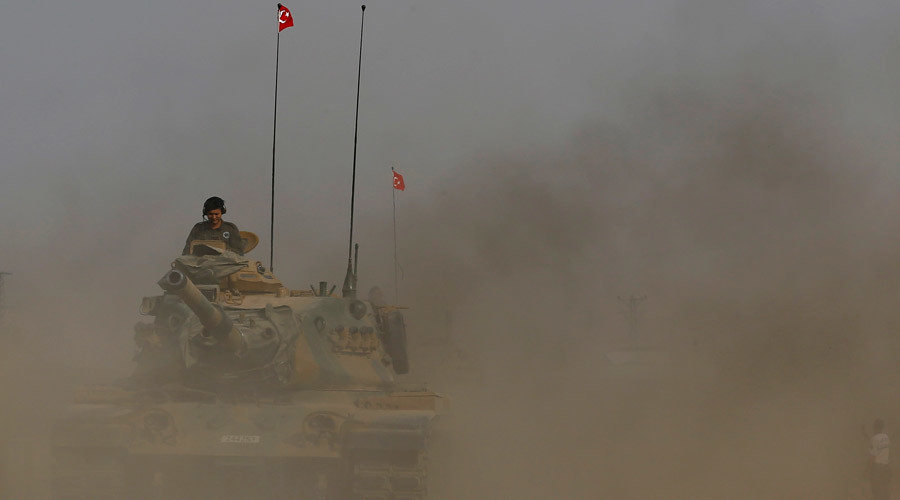
A Turkish army tank drives towards to the border in Karkamis on the Turkish-Syrian border in the southeastern Gaziantep province, Turkey, August 25, 2016. © Umit Bektas

Labels: , , , , ,

Monday, May 30, 2016

Talking The Talk in Turkey

"These descriptions are very ugly, it is offensive and an insult to our religion. There is no moderate or immoderate Islam. Islam is Islam and that’s it."
"It should be known that adopting a malicious and offending approach toward the sensitive issues of  [the] Islamic world by hiding behind some democratic freedoms like freedom of speech and right of free publication is unacceptable." 
Turkish President Recep Tayyip Erdogan 
Turkey's Prime Minister Recep Tayyip Erdogan addresses lawmakers at the parliament in Ankara, Turkey, in June (photo credit: AP)
Turkey's Prime Minister Recep Tayyip Erdogan addresses lawmakers in parliament, Ankara, Turkey (photo credit: AP)

"If the faith of all religious groups in this country is guaranteed in the constitution, and the state’s equal distance to all religious groups is a foundation, why do you need to emphasize Islam? If I can live my faith as a Muslim the way I want to, the issue is over. If a Christian can live his/her Christianity, if a Jew can live his/her Jewishness or an atheist can live his/her atheism, the issue is also over for them."
Prime Minister Ahmet Davutoglu 
 
"Erdogan is turning Turkey into a powder keg in an attempt to shore up his own political base. He is intentionally activating the longstanding fault lines separating religious and secular Turks — and most dangerously the divide between the country’s Sunni majority and its Alevi [Kurdish] minority. If he continues to do so, Turkish democracy itself could become a casualty of his confrontational policies."
Turkish researcher Halil M. Karaveli
Well, no big surprise, Mr. Karaveli's prediction is now recognized as reality, and Ahmet Davutoglu is no longer Turkey's prime minister. Effectively, it could be said, Recep Tayyip Erdogan, who began as prime minister then transitioned to president to remain in power in a masterful subterfuge emulating Russian President Vladimir Putin (disproving the adage that imitation is the sincerest form of flattery), has now altered the constitution to his liking and has become the government incarnate.
 
The West was all agog over the "Turkish model", not so long ago. When Erdogan's Justice and Development Party was elected to government in 2002, surely alarm bells rang in the ears of most Turks who valued the separation of church and state in their country's tradition? But then Mr. Erdogan headed the country during a time of economic growth and prosperity, and he tamped down fears of fundamentalism, in a clever bid to present as dedicated to democracy.
 
How else be accepted into the European Union, as the country lodged between East and West, moderate and secular? It was only its human rights record, fairly abysmal in its treatment of Turkish Kurds and just incidentally a free press, and its failure to acknowledge the genocidal treatment of Armenians that had the EU keep Turkey at arms-length. Not NATO, though, accepting Turkey with one of its membership's largest standing armies.
 
He garnered high praise as a reformer and basked in the admiration that came his way, presiding over a wealthier, more peaceful country on the verge of cleaning up its human rights record and soon to be invited into the EU. And then, everything began to fall apart. Cordial relations with the Syrian regime became impossible with an Alawite Bashar al Assad attacking his rebellious Sunni majority. And soon enough anger with Moscow's decision to enter Syria provoked the irascible Erdogan.
 
Who had already demonstrated how volatile he could be when his own citizens protested at Gezi Park and he set the military police on them. His subdued authoritarian penchant was divulged. And when corruption that was taking place with impunity in a party that publicly prided itself on its anti-corruption stance was made public by revelations implicating Erdogan's son and his cronies he struck hard and fast; the police, the judiciary, the journalists, the population found themselves purged.
 
The military had already faced his righteous wrath when he had senior members imprisoned, charged with plots to unseat him. He was transforming Turkey back into a vestige of its Ottoman Empire glory and he would become its timeless leader. Turkey's reputation in the West  has since also undergone a transformation, its brash negotiating blackmail with the EU to stem the tide of Syrian refugees, and Erdogan's pathological hounding of his critics betrayed his aspirations as a modern-day caliph.
 
One beset and embattled by Western cabals plotting against him, enlisting "agents" of nefarious intent in Turkey in their campaign to tarnish the great man ensconced in his sumptuous palace befitting the stature of a caliph. When the Turkish generals, determined to preserve Turkey's secular-type society and governance attempted to keep the A.K.P. from power they paid the price once it attained power. But in the process the A.K.P. presented itself as democracy-bound.
 
They were intent on acquiring EU status for Turkey by moving it unerringly in the direction of liberal democracy. And so liberal reforms were enacted and above all the liberal rhetoric that was so beloved of the West. No longer would the state not recognize citizens' rights. A new perspective on Kurdish nationalism was to be viewed as authoritarian-resistance. Given greater rights and freedoms the Kurds would surrender their aspirations toward autonomy and an eventual state of their own.
 
All so very persuasive. Once the electoral victories were achieved, alongside a subdued military there was a gradual relaxation of liberal rhetoric to be replaced by social conservatism of the type that marks the existence of Islamist rule. When popular dissent challenged the A.K.P. in 2013 it responded by a more authoritarian stance by Mr. Erdogan. And the A.K.P. revealed itself to be the aspiring Islamist tyranny that it had kept under wraps.
 
Those who support Mr. Erdogan have been amply rewarded with wealth and recognition, and they have no intention of seeing it all fade away, so they are loyal not to the vision of a faded Turkish democracy, but to its replacement, a reflection of the glory of the Ottoman Republic. Welcome to the future. This is the Turkey we all know and deplore, the Turkey of Armenian vengeance, of Kurdish conflict, of a Cyprus challenge of Greek possession.

Labels: , , , , ,

Friday, May 22, 2015

Gatestone Institute


  • The first priority of most Western governments today seems to sign a deal with Iran's Supreme Leader, Ali Khamenei, who openly calls for Israel's and America's destruction.
  • The next priority of many European governments, and apparently the Pope, is to entrust a state to the Palestinian Authority and Hamas, a movement that does not hide its genocidal intentions.
  • Unless the Obama Administration and Congress stop Iran, we are about to witness the world's next genocide, committed by Iran. By teeing up Iran's nuclear capability and triggering a Middle East nuclear arms race, the U.S. and the negotiators of the P5+1 are creating conditions that can only lead to a disastrous war with catastrophic results.
On April 28, ceremonies were held to commemorate the seventieth anniversary of the liberation of the Dachau concentration camp. It might seem not a major event, as Dachau was not an extermination camp. Auschwitz-Birkenau, the main Nazi killing center, had fallen three months earlier. The absolute horror of Nazi crimes was fully known. The end of World War II was near: ten days later, on May 8, 1945, the surrender of Germany was signed.
Dachau nevertheless has a special meaning: it was the first camp. After its doors opened in 1933, it became the model for all Nazi concentration camps.[1]

More than 30,000 Jewish men were sent to concentration camps shortly after Kristallnacht -- a wave of violent anti-Jewish demonstrations throughout Germany and Austria on the night of November 9-10, 1938. At the instigation of the Nazi party, Jewish businesses, synagogues and homes were attacked and burned, nearly a hundred Jews were murdered and thousands injured, and tens of thousands of Jews were arrested and sent to concentration camps.

The rest of the world could still have saved Jews and stopped the destruction machine. But the world did nothing. Hitler knew -- as Iran knows now -- that the world would do nothing.
Six weeks earlier, on September 30, the Munich Agreement had been signed. Britain's Prime Minister, Neville Chamberlain, had presented the agreement as "Peace for our time" -- in exchange for allowing Germany to help itself to the German-speaking part of Czechoslovakia, later known as Sudetenland. Chamberlain and France's Prime Minister, Édouard Daladier, had accepted Hitler's conditions without even mentioning the fate of the Jews.

Six months earlier, in July 1938, during the Evian Conference, no country had agreed to take in Jewish refugees.[2]

There were few consequences for Germany. Nothing had changed.

In May 1940, Auschwitz opened.

On January 20, 1942, the Wannsee Conference was held, during which high-ranking German officials coordinated what they called, "The Final Solution to the Jewish Question."[3] Auschwitz became an extermination camp a few days later.

The plight of European Jews, and the crimes at Auschwitz and other extermination camps, came as no surprise. Witold's Report, written by Captain Witold Pilecki, a secret agent of the Polish resistance, who entered and escaped from Auschwitz, had been forwarded to the British.[4] The report detailed the "selection process," the three crematoria that could burn 8,000 people a day, and the so-called "medical experiments." The British questioned the report's reliability. [5]

The recognition and commemoration of the Holocaust began in Israel several years after 1945.[6] For decades, however, the rest of the world remained silent.

Political considerations prevailed over ethical considerations. Emphasizing the responsibility of Germany would have implied that many more Germans than those tried at Nuremberg would have had to be tried. Several Western political leaders could have been considered accomplices. It was only when almost all the perpetrators and survivors were dead that the time of remembrance came. But were any lessons learned?

The crime of the Holocaust was the only attempt at the total extermination of a people by industrial means, and it was committed on a continent considered the "cradle of Western civilization."

The other horrific acts of extermination that took place during the twentieth century were treated as of little importance -- and still are.

The crimes of Communism -- including the Communist killing fields of Cambodia that took place during in the late 1970s -- were also immense. They were committed on five continents and lasted several decades. Communism killed about a hundred million people.[7] Although the crimes of Communism are public information, the world is still mostly silent. Again, political considerations prevailed over ethical consideration. The Black Book of Communism was published in 1999. The issue was then dropped. It is likely that there will never be a Day of Remembrance for the Victims of Communism.

Another genocide took place in Rwanda, in 1994: 70% of the Tutsis living there were killed. One of the most horrifying aspects of the Rwandan genocide was that international forces, sent by the UN, stood by and remained passive. France launched a military operation to evacuate French and Belgian citizens, but refused to evacuate any Tutsis. Hundreds of people were massacred a few feet away from the French forces. Once again, political considerations prevailed over ethical considerations. The responsibilities of the international forces and the responsibilities of France have been internationally ignored.[8] An International Criminal Tribunal for Rwanda was established; it will end its work soon. Only Rwandans were incriminated. Hardly anyone in the rest of the world remembers the Rwandan genocide.

A genocide also took place in the Ottoman Empire at the time of its collapse, during World War I, a quarter century before the Holocaust. Beginning in 1915, between 800,000 and 1.5 million Armenians were slaughtered by soldiers of the Ottoman army.[9] Turkey has never recognized the massacre as a genocide.[10] The world was, again, largely indifferent to the fate of the Armenians. Hitler seized on this indifference to say that if the world condoned what happened to the Armenians, it would condone what would happen to the Jews. He was proven right. Again, political considerations prevailed over ethical considerations. As Turkey was an ally of the West against the Soviet Union, any decision likely to annoy or offend the Turkish government was set aside. Since the collapse of the Soviet empire, however, Turkey has lost some of its geopolitical importance, but it contributes to new genocide-like massacres. In recent months, tens of thousands of Christians and Yazidis have been savagely murdered in Syria and Iraq by the Islamic State -- which could not exist without the support of Turkey. Much of the oil sold by the Islamic State, and its needed military supplies, pass through Turkey. The silence of the West continues. No doubt. Political considerations are at work.

Seventy years after the fall of Dachau and Auschwitz, Israeli Jews, Christians and Arabs are threatened with a second Holocaust by people who deny the existence of the first Holocaust: Iran's leadership. The West, apparently willing to vote Iran nuclear breakout capability, pays no attention and acts as if Iran's continual threats had no meaning.

The first priority of most Western governments today seems to sign a deal with Iran's Supreme Leader, Ali Hosseini Khamenei, who openly calls for Israel's and America's destruction.

Iran's Supreme Leader, Ayatollah Khamenei (center), is shown meeting in May 2014 with Iran's military chief of staff and the commanders of the Islamic Revolutionary Guards Corps. (Image source: IRNA)

The next priority of many European governments is to entrust a state to the Palestinian Authority and Hamas, a movement that does not hide its genocidal intentions. Political considerations are at work, full time and at open throttle.

Since the Armenian genocide, one hundred years have passed, marked by mass killings, massacres, and genocides. These culminated in the Holocaust, but did not end with it. The Communist killing fields of Cambodia took place during the 1970s. The Rwandan Genocide of the Tutsis was perpetrated just twenty-one years ago.

The twentieth century was appropriately described by historian Robert Conquest as a "ravaged century."[11]

It is urgent that that ethical -- not political or monetary -- considerations receive priority. If not, this will be the second "ravaged century."


[1] The Dachau Concentration Camp, 1933 to 1945: Text and Photo Documents from the Exhibition, with CD. Dachau: Comité International De Dachau, 2005.
[2] William R. Perl, The Holocaust Conspiracy: An International Policy of Genocide, Shapolsky Publishers, Inc, 1989.
[3] Mark Roseman, The Villa, The Lake, The Meeting: Wannsee and the Final Solution, Allen Lane, 2002.
[4] Witold Pilecki, The Auschwitz Volunteer: Beyond Bravery, Aquila Polonica, 2012.
[5] There were three other reports about the conditions in Auschwitz as well: The "Polish Major's Report" by Jerzy Tabeau; the "Vrba-Wetzler Report" by Rudolf Vrba and Alfred Wetzler in April, 1944, and a short report by Arnst Rosin and Czelaw Mordowicz, who escaped from Auschwitz in May, 1944.
[6] Yom HaShoah ("Day of the Holocaust") became an annual memorial in Israel in 1953. The Days of Remembrance of the Victims of the Holocaust were held in the US for the first time in 1979, twenty-six years after 1945. The French government acknowledged France's responsibility in the deportation of Jews in 1995. A Day of Remembrance of the Victims of National Socialism was established in Germany in 1996. Holocaust Memorial Day was established in the UK in 2001.
[7] Stephane Courtois, Nicolas Werth, Jean-Louis Panné, Andrzej Paczkowski, Karel Bartosek, Jean-Lous Margolin, The Black Book of Communism, Harvard University Press, 1999.
[8] Gerard Prunier, The Rwanda Crisis, Fountain Publishers Limited, 1999; Romeo Dallaire, Shake Hands with the Devil: The Failure of Humanity in Rwanda, Arrow, 2004
[9] James Nazer, The first genocide of the 20th century: the story of the Armenian massacres in text and pictures, T&T Publishing inc., 1968.
[10] Fatma Müge Göçek, Denial of Violence: Ottoman Past, Turkish Present, and Collective Violence Against the Armenians, Oxford University Press, 2014.
[11] Robert Conquest, Reflections on a Ravaged Century, W. W. Norton & Company, 1999.

Labels: , , , , , , , ,

Friday, April 24, 2015

The Histrionics of Repudiation

“I saw Talaat, the man who was responsible for the deaths of my parents, my brothers, and my sisters.” Tehlirian grabbed the loaded pistol he kept with his underclothes in a trunk, ran after Talaat, and fatally shot him. At the sound of gunfire, a crowd descended upon Tehlirian, beating him and holding him down. Witnesses reported that Tehlirian tried to break free, declaring, “I am an Armenian. He is a Turk. It is no loss to Germany.” 
Ali Salih was the assumed name of Talaat Pasha, the former interior minister and last grand vizier of the Ottoman Empire. One hundred years ago today, on April 24, 1915, Talaat oversaw the arrest of hundreds of leading Armenian community members, a step generally regarded as the first salvo in the Ottoman campaign to deport Armenians from the Anatolian Peninsula, thus beginning the Armenian genocide.
Jeffrey Veidlinger, Tablet Magazine

"Let's remember that the Germans were wartime allies of the Turks. Let's remember that the Germans had consular heads in each of the major Turkish centres who were reporting back to their Reichskanzler with reports that were properly horrified by what was taking place."
"We now understand that many of these German officers who observed the Genocide were later key members of the monstrous team that aided in the design of Hitler's Final Solution. "
"As Armenians we are often quick to point out that the Genocide was committed by the Ottoman Turks. A century after this virulent denial, why are we so careful about this nomenclature? I believe that we have been careful not to mention Turkey because we want the current state to have a way out. To say that the decision to eliminate our ancestors was confined to this moment of history."
"Today, 100 years after the horrible events of April 24, 1915, let us no longer obfuscate. When the invitation comes from the Turkish Prime Minister, as it did earlier this year, to "contribute to a new beginning and to believe that Turkey shares the suffering of Armenians", let us be clear."
"Turkey cannot share the suffering of Armenians -- nothing it has experienced can compare to this catastrophic loss. It can try to understand it. It can feel sorry about it. It can apologize for it. But that nagging little word -- 'IT' -- is precisely what Turkey has refused to acknowledge."
Atom Egoyan, Toronto filmmaker
The Armenian Genocide   Why Wont American Presidents Mention
Crucified Armenian women in the area of the Der-es-Zor.

The Council of Turkish Canadians has published a half-page advertisement reading "Reconciliation -- Not Hatred; Fairness -- Not Insult". And with that neat set of slogans sets about explaining why it is that the Ottoman Turks did not actually slaughter one and a half million Armenians; it was the Armenians who had committed an act of high treason, and they were being 'relocated' as a military measure, and that forced march, unfortunately, was the death of one and a half million souls.

Not the fault of the Turks, for as the advertisement states: This tragedy cannot be characterized as a one-sided genocide. 

Right in line with the Government of Turkey whose Islamist President knows what constitutes genocide, and it was certainly not genocide when the Ottoman Turks punished the Armenians; the deaths during relocation, as the advertisement from the Council of Turkish Canadians states; resulted from famine, disease spread, bandit attacks, poor war conditions where Armenians and non-Armenians suffered equally in a tragic war. End of story as they have it.

For Turkey's Erdogan, genocide is an accusation he has hurled at Israel. For committing crimes against humanity in Gaza. His virulent anti-Semitism recognizes genocide in his very own terms. And what the Armenians suffered they alone were responsible for; a pity, a tragedy to be sure, but not of Turkey's making. There is a certain unspeakable degree of arrogance in refusing to commit to the recognition of responsibility; that of a predecessor government.

The forced 'relocation'

Turkey has had ample experience in targeted ethnic killing. Armenian genocide was one. Its relations with the Kurds reflect its position on human rights. And because the world 'forgot' eventually, and laid the matter to rest, Adolf Hitler did precisely what Pope Francis warned would happen again; when the world fails to take firm note and allows such a wholesale atrocity  a free pass into history it gives inspiration to those who would repeat such events. Memories are too short; declarations of 'never again', are heartfelt but fleeting.

Germany's horror inflicted on the Jews during the Holocaust has been acknowledged by Germany, owned by Germany, deplored by Germany, suffered by Germany and sits heavily on its shoulders, bowed to the reality of having committed an organized, well-oiled and hugely successful genocide. It was the successor to the brutally gruesome slaughter of a million and a half Armenians. Jews and Armenians have much in common, and a shared history of mass slaughter is only one.

The Armenian Genocide   Why Wont American Presidents Mention
Like the Nazis, many Armenians were also transported via rail. And, also like the Nazis, the Turks forced their victims to purchase tickets for the ride to their own extermination.

"Writing in the racialized language of the time, U.S. Ambassador to the Ottoman Empire Henry Morgenthau, who was also a prominent Jewish activist, noted of the Armenians: “There has been considerable intermarrying with Jews and that by this time there is a decided strain of Jewish blood in them. I asked about this because they all look like Jews and have the same characteristics, the same stubborn adherence to their past and religion and a strong race pride.” Morgenthau was the first major international figure to alert the world to the Armenian genocide. In 1919 he would also head a commission to Poland to investigate the pogroms against Jews."
Jeffrey Veidlinger, Tablet Magazine 

Labels: , , , , ,

Thursday, April 23, 2015

Visitors lay flowers at the Tsitsernakaberd Armenian Genocide Memorial in Yerevan, Armenia on April 21,2015. (AFP)
A hundred years ago this week, as British and French troops were bogged down facing Germany on the western front of World War I, the Kaiser's ally in the east, the Turkish Ottoman Caliphate, was preparing for a new kind of war.
A war of extermination.

The target of the Turks was their large Armenian Christian population living within the Caliphate, whom the Turks feared was loyal to Russia.
On April 19, 1915, Cevdet Bey, the Turkish governor of the city of Van, (today on Turkey's eastern border with Armenia) ordered the city's residents to furnish him with 4,000 soldiers under the pretext of conscription.

The Armenians, fearing for their lives, refused.
Bey accused the Armenians of "rebellion", and laid siege to the city, asserting his determination to "crush" it at any cost. "If the rebels fire a single shot", he declared, "I shall kill every Christian man, woman, and (pointing to his knee) every child, up to here."

The next day, April 20, the siege of Van began until a Russian military force intervened and rescued the Armenians.

The Russian intervention in Van provided the Turks with the pretext to label the minority Armenians as traitors.

On April 24, the Turkish government rounded up and imprisoned an estimated 250 Armenian intellectuals and community leaders in Istanbul, sending them to holding centers near Ankara, where they were shot in cold blood. By the time 1915 came to an end, nearly 1.5 million Armenians were dead.

Many historians and scholars, as well as the governments of many countries, including Canada, have labeled the ethnic cleansing by Turks as the Armenian Genocide, commemorated annually on April 24.

Some Islamic groups in the United States have come together to echo Turkish denialism.
Turkey, however is adamant. It refuses to acknowledge the crimes committed by the Ottoman Caliphate against its Christian Armenian citizens. In fact, when Pope Francis earlier this month referred to the Armenian Genocide as one of the "three massive and unprecedented tragedies" of the last century, Turkey's president, Recep Tayyip Erdogan, rebuked the Pontiff, warning him not to "repeat this mistake."

Turkey is not alone. Some Islamic groups in the United States have come together to echo the Turkish line, claiming the Armenian Genocide was just one event in "the painful history of over 30 nations fighting for over four years and the loss of over 37 million lives in World War I, including those of the Armenians."

The U.S. Council of Muslim Organizations (USCMO) said in a press release they "share the pain suffered by Armenians during this period" but oppose referring to it as genocide. Another reason USCMO gave for opposing the United States acknowledging the Armenian Genocide, was that Turkey was "the only Muslim-majority member of NATO."

In Toronto, where thousands of people gathered at Queen's Park on Sunday to commemorate the Armenian Genocide, a small group of Islamist men and women held a counter protest promoting the Turkish position.

Keyvan Soltany, a Kurdish Canadian from Iran who attended the commemoration told me, "I was disgusted to see Islamist women in burkas and hijab trying to insult the memories of the Armenians who the Turks killed."

Time and again, too many Islamic leaders have demonstrated that they represent the interests of global Islamism in the United States and Canada, not the values of universal human rights, individual liberty and freedom that make us who we are.

On the issue of the Armenian Genocide, too many Muslim leaders have failed their community, again.
Tarek Fatah is a founder of the Muslim Canadian Congress, a columnist at the Toronto Sun, and a Robert J. and Abby B. Levine Fellow at the Middle East Forum. He is the author of two award-winning books: Chasing a Mirage: The Tragic Illusion of an Islamic State and The Jew is Not My Enemy: Unveiling the Myths that Fuel Muslim Anti-Semitism.

Labels: , ,

Tuesday, April 21, 2015

Jews and the Armenian Genocide

The 100th anniversary is the time for Israel to rethink the moral concession it has made by abetting Turkish denial

Armenian woman in national costume; Artvin. Photograph taken between 1905 and 1915 by Sergeĭ Mikhaĭlovich Prokudin-Gorskiĭ. This photo was part of a series in which Prokudin-Gorskii, on the eve of both the first World War and the Russian Revolution, travelled the Russian Empire to photograph the diverse populations living throughout. Included in the collection are rare chromagraphic portraits of Armenian people in national and religious costume, shortly before the Ottoman government’s systematic extermination of Armenians who were living in present-day Turkey. The number of Armenians killed is estimated to be between 1 and 1.5 million. (Sergei Mikhailovich Prokudin-Gorskii Collection at the Library of Congress)
 
The role of the Righteous is a vitally affirmative part in any history of mass-violence. In the Holocaust the place of the Righteous is well documented at the Yad Vashem memorial in Jerusalem where the Avenue of the Righteous Among the Nations was inaugurated in 1962. A memorial of trees with plaques honors non-Jews who risked their lives to save Jews during the Holocaust.

While rescue is one of the noblest acts of courage in histories of genocide, other kinds of righteous action in the aftermath of genocide can also be of vital importance. In the case of the Armenian genocide this has had a distinctive meaning because the aftermath of the extermination of the Armenians has been marked by an aggressive state-sponsored assault by the Turkish government on the historical truth of the Armenian genocide. Scholars, writers, filmmakers, editors, curators, journalists, and others who have engaged with the history of Ottoman Turkish government’s extermination of the Armenians in 1915 have played a particularly important role in redressing Turkey’s denial.

So continuous is Turkey’s pressure on institutions outside of its own country to suppress the Armenian genocide that in 2008 Turkish diasporic organizations mounted a campaign to stop the Toronto school board from including the Armenian genocide in a human rights curriculum. In 2007, Turkey demanded that the Rwandan government scrap a presentation on the Armenian genocide at a panel on genocide at the United Nations. In 2010, the Turkish government was successful in demanding that the British government order the Tate Gallery to remove the word genocide from the wall text of the exhibit of the work of Armenian genocide survivor Arshile Gorky.

In confronting Turkey’s refusal to accept the history of the Ottoman government’s eradication of the Armenians and their 2,500-year-old culture, many Jewish voices have been eloquent and pointed. The distinguished Holocaust scholar Deborah Lipstadt’s statement reminds us what a morally important issue denialism is for both Jews and Armenians: “Denial of genocide whether that of the Turks against the Armenians, or the Nazis against the Jews is not an act of historical reinterpretation … but an insidious form of intellectual and moral degradation.”

Henry Morgenthau returning on leave to New York on Feb. 22, 1916, and being greeted by philanthropist Cleveland Hoadley Dodge and educator Samuel Train Dutton. The men were all members of the New York Committee for Armenian and Syrian Relief. (Library of Congress)
Jewish witness to the Armenian genocide goes back to Henry Morgenthau, Sr., the U.S. ambassador to Turkey (1913-16) who had the courage to confront the Turkish leaders about the massacres of the Armenians and implore the U.S. government to intercede and stop what he called “a campaign of race extermination in progress.” After he lost his job because of his outspokenness, he wrote an acclaimed memoir, Ambassador Morgenthau’s Story, which contained the first full narrative about the Armenian genocide in English.

In 1934, Franz Werfel, the Austrian Jewish novelist who escaped Hitler’s death list by a hair, wrote the first major novel about the Armenian genocide, The Forty Days of Musa Dagh, which depicted Armenian resistance to the massacre in a small mountain village, and in the narrative he also embedded warnings to the Jews of Europe about what could happen to them soon. The Nazis banned and burned the book in 1934.

Raphael Lemkin, the Polish Jewish legal scholar who coined the word genocide, also noted in his autobiography Totally Unofficial that the destruction of the Armenians during WWI was instrumental in his developing the concept of genocide as a crime in international law. It was Lemkin who first used the term Armenian genocide in the 1940s. As he put it on CBS TV in 1949: “I became interested in genocide because it happened so many times. It happened to the Armenians. And after, the Armenians got a very rough deal at the Versailles Conference, because the criminals, who were found guilty, were not punished.”

The Israeli government has not been able to pass an Armenian genocide resolution, which is to say, to make an official gesture of redress to Turkish denial.
In recent decades, the contributions to the understanding of the Armenian genocide made by Jewish scholars both in Israel and worldwide have been extraordinary. The list is long and includes Elie Wiesel, Deborah Lipstadt, Robert Jay Lifton, Robert Melson, Irvin Staub, Jay Winter, Yehuda Bauer, Israel Charny, Donna-Lee Frieze, Colin Tatz, Yair Auron, documentary filmmaker Andrew Goldberg, and many others. In the United States, the Center For Jewish History, the Museum of Jewish Heritage, U.S. Holocaust Memorial and Museum, the Houston Holocaust Museum, the Illinois Holocaust Museum, and the Museum of Tolerance have all made a difference in giving space to program Armenian genocide events over the past two decades.

Notwithstanding the deep involvement and commitment of Jewish intellectuals to the Armenian plight and discourse, the Israeli government has not been able to pass an Armenian genocide resolution, which is to say, to make an official gesture of redress to Turkish denial. In recent years, the Israeli government has reiterated at times some of the Turkish government’s propaganda. For example, several years ago Foreign Minister Simon Peres stated, “We reject attempts to create a similarity between the Holocaust and the Armenian allegations. What the Armenians went through is a tragedy, but not genocide.” Until recently Turkey has been a friendly Muslim ally in a hostile region. In their trade relationship Turkey is a key supplier of water to Israel, and Israel supplies Turkey with high-powered weapons, and the lucrative military manufacturing deals are important to Israel’s economy. But in recent years the alliance between Turkey and Israel has eroded. The Turkish flotilla incident of 2010—when Turkey sought to bring relief to Palestinians in Gaza and were met with gunfire by Israeli forces that killed several Turks—created a significant rupture. And a new wave of anti-Semitism has erupted in Turkey, and now Hamas has its headquarters in Istanbul. Recently, President Tayyip Erdogan accused Israel of surpassing Hitler’s “barbarism” for its military actions in Gaza.

At the 100th anniversary of the Armenian genocide might this be a time—when the ironies of history have surfaced, especially in the wake of the collapse of Israeli-Turkish relations—for Israel to rethink the moral concession it has made in this ethical arena? Not as revenge against Turkey, but as thoughtful reflection on painful truths.

Given Turkey’s relentless campaign to deny the Armenian genocide and insinuate its own extreme national narrative into democratic societies around the world, Israel’s call for the genocide’s proper and long-overdue recognition would have important ethical meaning. It would, among other things, be a redress to genocide denial in general. As scholars have noted, denial is the final stage of genocide. Deborah Lipstadt has written that “denial of genocide, whether that of the Turks against the Armenians or the Nazis against the Jews …  strives to reshape history in order to demonize the victims and rehabilitate the perpetrators.” And, as Pope Francis made clear in his recent address about the Armenian genocide, “Concealing or denying evil is like allowing a wound to keep bleeding without bandaging it!”

In officially recognizing the Armenian genocide Israel would embrace the deeply rooted relationship between Jews and Armenians in the modern age. When Hitler exhorted his military advisers eight days before invading Poland in 1939: “Who today, after all, speaks of the annihilation of the Armenians?” he made it clear that he was both inspired by what the Young Turk government had done to the Armenians in 1915 and also noted that because the memory of what had been the most well-reported human rights catastrophe of the first quarter of the 20th century had been washed away, it was easier to commit genocide again.

Hitler learned a good deal from the genocide of the Armenians because Germany was Turkey’s wartime ally, and there was a great deal of documentation from German foreign officers and other German personnel in Turkey at the time. There are, of course,  parallels—in bureaucratic organization, killing squad implementation, race ideology and more—between the two events. Yet what ties Jews to Armenians even more deeply is the powerful role Jews have played in bearing witness to and later defining Turkey’s genocide.

Given this long-standing record of Jewish engagement and intellectual achievement concerning the Armenian genocide and the deep ties between the two cultures—it would seem an organic thing for Israel to finally say: The game is over. The truth of history, the meaning of genocide, the importance of ethical memory is a defining part of Jewish intellectual tradition and identity. And, in the Armenian case, the two genocidal histories commingle in deep and historical ways. As for fear of Turkey? The other 22 countries (including Argentina, France, Italy, Sweden, Poland, Greece, Canada) that have passed Armenian genocide resolutions have witnessed Turkey’s initial diplomatic anger, an ambassador recalled for a short time, etc., and then it’s been back to business  as usual—proving that the hysteria passes and life goes on.

The Israeli government could recognize the Armenian genocide by honoring the words of the great founding genocide scholar Lemkin—a Holocaust survivor who lost 49 members of his own family to the Nazis. In August 1950 Lemkin wrote to a colleague: “Let us not forget that the heat of this month is less unbearable to us than the heat of the ovens of Auschwitz and Dachau and more lenient than the murderous heat in the desert of Aleppo which burned to death the bodies of hundreds of thousands of Christian Armenian victims of genocide in 1915.”

The depth of Jewish engagement with the Armenian past in all forms and genres and especially in the face of Turkish efforts to pressure Jewish museums when they program Armenian genocide events recalls the importance of the Jewish values of tzedakah and tikkun olam. Tzedakah is the Hebrew word that signifies righteousness, justice, and fairness; and tikkun olam embodies the notion of repairing or healing the world. In the Jewish response to the injustice of the Armenian genocide of 1915 and the continual wound of Turkish state denialism for the past 100 years, these humane values have been wedded to intellectual and ethical work of an uncommon kind by Jewish voices worldwide and remind us how much scholarly and cultural work can also make an ethical difference.

Amos Elon, writing in Haaretz about the “hypocrisy, opportunism, and moral trepidation” of Israeli collusion with Turkey, put it well when he asked: “But where is the boundary between the natural chauvinism of exploitation and the cheap opportunism of hypocrisy? What happens when the survivors of one Holocaust make political deals over the bitter memory of the survivors of another Holocaust?” For Israel, colluding with a denialism is too ironic, and it is a fitting moment for the Israeli state to follow the lead of Jewish intellectual and cultural leaders.

Labels: , , , , ,

() Follow @rheytah Tweet