Politic?

This is a blog dedicated to a personal interpretation of political news of the day. I attempt to be as knowledgeable as possible before commenting and committing my thoughts to a day's communication.

Monday, August 07, 2017

Enlightened or Merely Hopeful?

"American security is undermined by frail and failing nations where hope is nonexistent, and where conditions foster radicalism, produce refugees, spark insurgency, and provide safe havens for terrorists, criminal gangs, and human traffickers."
"[Strategic development assistance] is not charity -- it is an essential, modern tool of U.S. national security."
Assertion message of 15 retired U.S. admirals and generals 
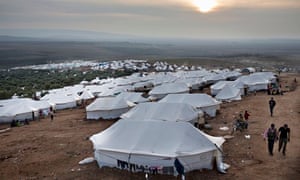
Displaced Syrian Refugees Escape Conflict At Camp In Atmeh
Syrian refugees encamped at the Turkish border. Many of the world's refugees are not in tents but squatting in urban areas. Photograph: Paris Match/Getty

This was, in essence, the message delivered by top military personnel, now retired, to the U.S. Senate Armed Services Committee this past June, taking stock of the current administration's loss of interest in following through on traditional American views dating from the end of World War Two that economic development assistance helps to prevent conflict in disadvantaged nations. Which led to a program of economic incentives and practical assistance by the U.S. to developing countries as a matter of internal policy reflecting on American national security.
"The factors that explain which countries have been at risk for civil war are not their ethnic or religious characteristics but rather the conditions that favour insurgency."
"These include poverty -- which marks financially and bureaucratically weak states and also favours rebel recruitment -- political instability, rough terrain, and large populations."
Professors David D. Laitin and James D. Fearon, political scientists, Stanford University
These two expert academics in political science reached the conclusion through an analysis of global conflict that less than $1,000 in per capita income links with 41 percent greater odds that within any given year civil war will break out. Irrespective, they feel of political failures following popular uprisings in Egypt, Libya and Syria resulting from the Arab Spring fever that surged through these populations, the violence that followed might have been minimized if people had been aided in their ability to cope with rising food prices.

And it is true that protests were partially spurred in Egypt by the rising unaffordability of cooking and heating oils and basic foods, but in all three of those Arab nations cited, the rise of fundamentalist Islam had already long since begun, and the region's usual dysfunction arising from tribal, clan and sectarian antipathy, alongside tyrannies and dictatorships would guarantee that public restlessness and challenges to the current political order would ensue.

It has long been a truism that poverty breeds violence, and that people who have been disenfranchised, the voiceless, the vulnerable, the politically bullied and challenged are those who create the movements that lead to violence countering that which they are treated to. Yet facts and reality appear to prove otherwise; it is the well-educated and those from upper-class, economically stable backgrounds who form the base of the violent antagonists.

Creating a docile public by exporting humanitarian funds and charitable aid of all kinds simply removes the onus of responsibility from the tyrants who make the lives of their subjects miserable; transferring aid funding to those governments ensures that the funding is spent on their military and on lining the pockets of the elite. There is a middle way of convincing those nations receiving American largess that it will be halted until and unless a considerable amount of it trickles down to where it is needed.

There are some continents and regions of the world where, as in Africa and the Middle East, endless streams of funding finds its way from the international community to those it deems whose interests they must support, if only to ensure that sharing wealth will not only help to enhance the lives of those who struggle to survive beyond mere existence, but that it will keep them there. The current situations unfolding in the Middle East and Africa prove otherwise.

Europe has been invaded as a result of innumerable refugees fleeing carnage imposed on them by a vengeful, murdering dictator whose response to a protest from a large segment of his sectarian population for equality rights, has been to destroy not only their will to protest, but their homes and their lives. The implosion of Iraq and Syria has been along sectarian lines. The growth of terrorist militias has morphed from the stimulation of the Muslim Brotherhood established 80 years earlier, by Saudi Arabia, by Iran.

Those who consider themselves 'progressive' liberals in their politics see sacrifice on their part as a requirement to aid those living in dire conditions of impoverishment and brutality, and they rise in indignation against a new administration that has decided to increase the budget of its military by cutting billions from the diplomatic and foreign aid budget to pay for that increase. And non-state charities feed on that guilt, prodding those who support their humanitarian business model to lobby government on their behalf.

Labels: , , , ,

Thursday, July 21, 2016

"No To The Coup"

Turkish President Recep Tayyip Erdogan's hatred of the Internet is legendary. Like all tyrants, even those as benevolent as he believes himself, as a 'respecter of democracy' to be, he is convinced it is the work of the devil, meant to undercut his authority by giving Turks an avenue to express themselves, in ways contrary to how he feels he should be regarded. Moreover the tools of the devil, like Facebook and Twitter permitted Turks to communicate instantly with one another, to devise conspiracies and to plot insurrection.
Turkey's President Recep Tayyip Erdogan
Burham Ozbilici, AP

The protests that took place at Gezi Park in Istanbul three years ago resulted from Erdogan's plans to transform the public and much-used green space so beloved of area Turks into a business and investment opportunity, to change the green atmosphere of nature's design, to the green transference of money through building on that natural site -- depriving people of a social gathering place -- a high-end shopping complex attractive to foreign investment.

Demonstrators heading for Taksim Square. Masks and swim goggles help protect...
AFP   Demonstrators heading for Taksim Square. Masks and swim goggles help protect them from tear gas.

Prime Minister at the time, Erdogan sent out the security police and the troops who used water cannons and tear gas to disperse the crowds in a show of violent disgust at the untrustworthy population unable to recognize economic advancement in favour of quality of life. And he waxed enraged over the protests that refused to dissipate, as people continued to protest even while facing the reality of exposing themselves to physical harm. Erdogan called the protests an attempted coup.

Photo Gallery: United against Erdogan
The protests in Turkey keep flaring up, in the street and on the Web. Police arrested activists because they had allegedly sent 'libelous' tweets. It's a sign of the government's contradictory approach to the Internet, which it purports to embrace. Spiegelonline

Since then, Erdogan has arrested journalists, shut down news sites, mounted thousands of lawsuits against those he feels insufficiently respectful of his august person. Press and Internet freedoms have been tightened. Journalists in their hundreds forced out of work. Cases against thousands of people have been opened by state prosecutors charging them with insulting the president online.

AN58901871Staff members and.jpg
Staff members and supporters of the Zaman newspaper editor-in-chief Ekrem Dumanli shout slogans as he is arrested by plain clothes police and led towards a car.  AP

During the Gezi Park protests, Erdogan characterized Twitter as "the worst menace to society", used by protesters to organize demonstrations against censorship, police brutality and the authoritarianism of their-then Prime Minister, now President-in-perpetuity. Erdogan's reaction to the protests was to become ever more dedicated to democracy by attempting to entirely shut down his critics, going so far as to reach beyond Turkey's borders into Germany to complain about insults to his majesty.

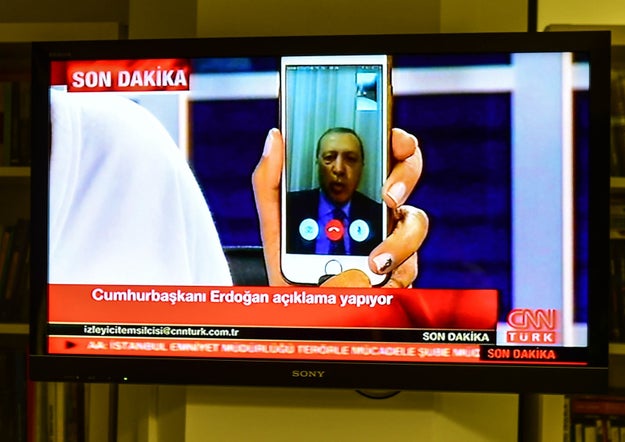
But when a real putsch raised its ugly head, Erdogan suddenly became enamoured of the Internet and what instant outreach to plugged-in Turks could create; a loyalty-based population who could be urged to march right out of their homes into the public squares to confront the putschists. And they did just that. In response to Erdogan's having called a television station through FaceTime's video chat app and urging the population to react to save Turkey and just incidentally Erdogan as well.

Calling on his loyal subjects to flood onto the streets and bridges and squares to guard the airports and to place themselves in direct confrontation with the members of the police and military who were intent on overturning the Justice and Development Party rule, to return secularism long protected by the Turkish military, back to governance. In the process lives were lost, but the people were triumphant. And now they're back at square one, saddled with a president planning to change the constitution to crown himself President with fully executive powers, ad infinitum.

Turkish President Recep Tayyip Erdoğan speaks on CNNTurk via Facetime. Burak Kara / Getty Images

Throngs of Turks responded, contacting friends and relatives as they reached their destinations, to persuade them to come out to join them. Using WhatsApp, Twitter and associated communication tools on social networking they mobilized in their numbers, waving Turkish flags, daring the coup soldiers to thwart their intention to protect their government. No more coups in Turkey, autocratic dominance or not.

The overwhelmed coup plotters and the soldiers were no match for the unifying message that Turks have no more patience for coups, despite that many in opposition decry the direction Erdogan has taken Turkey in, isolated from its neighbours and traditional allies, attacked by the terrorist groups it had initially supported, and back at war with the Kurds because Erdogan decided the peace agreement with the PKK had gone on too long.

Labels: , , ,

Saturday, January 23, 2016

Hush, Hush, Rwanda

"Very quickly my students began to tell me that they weren't free. They wanted to be free. They asked me how."
"Kigali is clean, Kigali is quiet. There are hotels, nice hotels, fancy hotels. And I think this is many people's experience of the place."
"The quiet in the country is not because the country is calm and harmonious, but because people aren't speaking, because dissent has been crushed."
"I wasn't aware of the full impact of the destruction of a free press, of a silent media, until I saw things like that, when people were doing themselves harm on government orders because they knew it was futile to speak up. Who were they going to speak up to? There was no one to talk to."
"I think so many people are oblivious to the role of a free press and to how their lives are shaped by the access to information and the freedom with which information circulates in places like Canada and America."
"I want to ask, are we willing to give up free speech or trade away free speech for a certain quantity of economic growth, for money? Because that's what we're doing in places like Rwanda. We're supporting a government and we're saying, for Rwandans this is an acceptable trade-off."
Anjan Sundarani, author, Bad News: Last Journalists in a Dictatorship
Author Anjan Sundaram found the experience of trying to report the news in Rwanda "chilling."
Author Anjan Sundaram found the experience of trying to report the news in Rwanda "chilling" -- Freddy Bikumbi / Random House 

India-born Mr. Sundarani, a Yale graduate raised in Dubai, took a teaching job in Kigali in 2009. He felt he could manage the job in the capital of Rwanda, and it could fund his writing of his first book, Stringer: A Reporter's Journey in the Congo. Rwanda had been the scene of a spectacular failure in United Nations peacekeeping, when the ruling Hutus were stirred to murderous frenzy by their leaders and embarked on a wholesale killing spree of the ethnic Tutsis in 1994.


Photographs of some of the 800,000 victims of the 1994 genocide. The 20th anniversary of the massacres was marked in 2014. (Reuters/Noor Khamis)

It is now a Tutsi government that holds the power in Rwanda, and reconciliation between the two large ethnic groups is the order of the day, as far as can be determined from the propaganda that issues from government sources, augmented by the country's news media. Rwanda's President Paul Kagame was the victorious commander of the Rwandan Patriotic Front for most of the Civil War which ended in the slaughter of an estimated 800,000 Tutsis and moderate Hutus.

He and his government present to the international community the facade of a nation in harmony with its parts. A free democracy, whereas the truth appears more elusive; the government rules with the authority of tyranny and fear. More than typical of most African countries. The Hutu militias who were banished from Rwanda crossed borders into neighbouring countries where they pursued their ongoing killing sprees targeting minority Tutsi populations there and unsettling countries like the DRC.

But in Rwanda, while the pretense of government protection and civility creates the impression that the country has completely recovered from its tribal and ethnic violence, encouraging international aid and investment, the truth is it is a dictatorship which challenges the agenda of foreign investigation by imprisonment on the basis of charges of "threatening state security". Mr. Sundaram was intimidated, observed and identified as a subversive because he realized that what he saw and experienced ran counter to the official account.

Attempting to report the reality of occurrences, he ran up against roadblocks of government silence that events had actually occurred. The official line was that of national unity and progress and nothing would dissuade it from that path. While attempting to teach journalism he learned through his students how they were beaten and imprisoned for their temerity in reporting on subjects known to be taboo. One of his best students was threatened and fled into exile.

Rwanda celebrates itself as a country that succeeded in moving beyond 1994's ethnic slaughter. Foreign investment helped it to prosper. Newspapers, radio stations, opposition politicians and businessmen portrayed a normal country. His students guiding him, however, Mr. Sundaram discovered what had not been obvious. "We the poor, we are like the insects, scared of the lights. We hide from the government, which wants to see us all the time", one student confided to him.

Eventually all his students melted away, lost to threats, to harassment, to beatings and arrests for the crime of threatening state security. Some went into exile, but not before publicly condemning the government, and being forced to flee. One person that Mr. Sundaram had recruited for his journalism program was murdered. The population had become compliant, through fear and frustration; there were no avenues of dissent or criticism left open to them.

In his book there is a description of a village he had visited. Where people lived literally out in the open, under trees with the most fundamental of shelters, their farm animals alongside them. They had been informed by local authorities that the traditional thatched-roof huts they were living in were backward, and Rwanda had become a progressive, forward-looking country. Not knowing how to respond, the villagers destroyed their homes.

Reporters Without Borders Press Freedom Index lists the worst offenders of press freedom under attack: Somalia, Iran, Sudan, Vietnam, China, Syria, Turkmenistan, North Korea, and Eritrea. Russia, of course, and Turkey are in that illustrious company as well. Rwanda ranked 161st out of the total number of 180 last year, just as it had the year before.

Labels: , , , ,

() Follow @rheytah Tweet