Politic?

This is a blog dedicated to a personal interpretation of political news of the day. I attempt to be as knowledgeable as possible before commenting and committing my thoughts to a day's communication.

Wednesday, March 20, 2019

Land Reform in South Africa : Proceed With Caution

We are making history and celebrating the return of your land today. We are righting the historic injustice and returning the land to its rightful owners; [the country’s constitution will be changed to explicitly allow for the expropriation of land without compensation for return of around 4,500 hectares, the first of a number of land claims] that we aim to unlock over the next few months."

"Any failure on our part to reverse the injustices of our past... will result in social instability and economic decline in our country. This we cannot afford."
"As the government, we concede that much more could have been done since 1994 to accelerate land reform. This government is resolute in our commitment to returning the land in an orderly and lawful manner. We shall not allow illegal land occupations."
"The intention of the proposed amendment is to promote redress, advance economic development, increase agricultural production and food security."
South African President Cyril Ramaphosa

 
"We are currently in a consultation process where South Africans are participating in a process of review — we have actually taken the time to participate in this process — and this announcement by the governing party serves only to undermine the process under way."
 "SA needs more black farmers and black farms. Constitutional amendments — and even worst-case expropriation without compensation — may make for good electioneering but it doesn’t make more black farmers."
"[President Ramaphosa’s announcement was] irresponsible electioneering and the leaders of our country should be more vigilant and responsible when it comes to the future of the economy and job creation for all South Africans … We are a full and active participant in the upcoming ANC jobs summit — this position will not encourage us to invest in the sector to create more jobs."
AgriSA president Dan Kriek
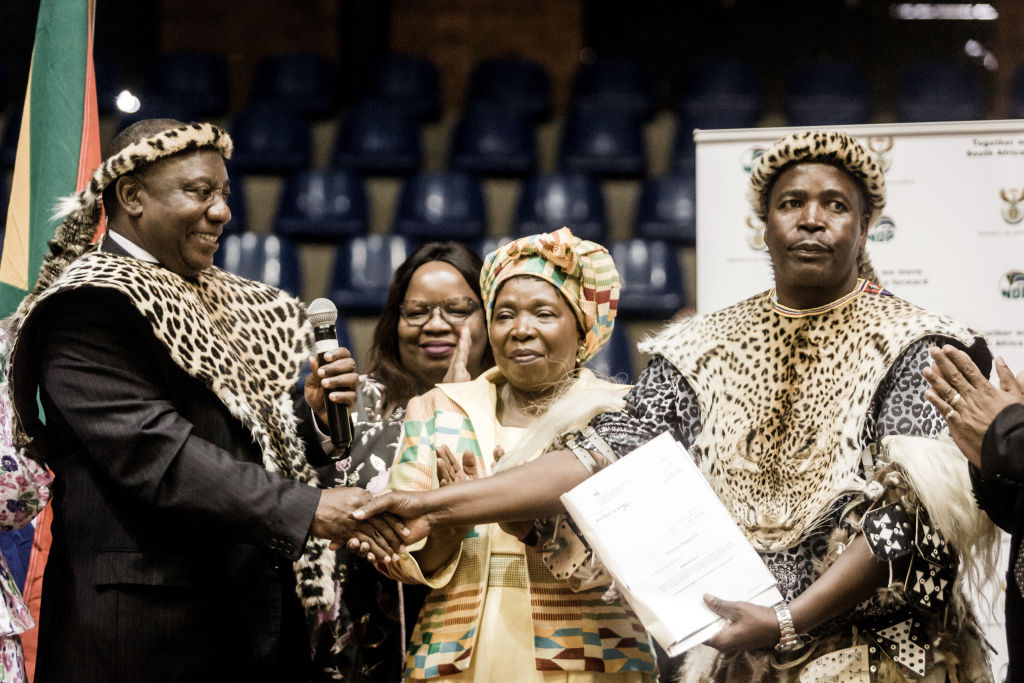
South African President Cyril Ramaphosa (L) hands over the title land deeds to Inkosi (Chief ) Mandla Mkwanazi of the KwaMkwanazi community/ Getty Image
South African President Cyril Ramaphosa (L) hands over the title land deeds to Inkosi (Chief ) Mand

"[Expropriation without compensation and economic growth] are diametrically contrasted — and nowhere in the world has this worked in any shape or form. Agrarian reform can only happen successfully working hand-in-hand, in partnership, with the private sector."
"We have seen this movie play out all over world — Venezuela, Russia — the promise for emerging farmers of tools, fertiliser, seeds and extension services are superficial; many have promised this as election ploys — and yet the outcome is always catastrophic for agriculture and food security."
Omri van Zyl, executive director, AgriSA.

"[Ramaphosa’s announcement shows that the ANC has been] forced to listen to ordinary South Africans across the country who have attended public hearings and who have said: 'We want land and we feel the government has not listened to us'."
"People have blamed the Constitution for the government’s inaction over the land issue. I think we are going to head into a new phase now where government is going to be forced to take the land issue much more seriously."
Professor Ruth Hall, Institute for Poverty, Land and Agrarian Studies, University of the Western Cape
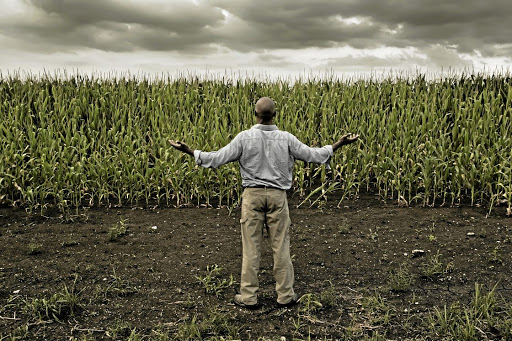
Picture: JOHN FEDELE

The situation is never as simple as taking the straight-cut initiative without considering ramifications that will ensue as a result of hasty action irrespective of consequences. Who should own the land in any country but its original inhabitants? In South Africa as in other once-colonized African countries up to 70% of the geography is held by whites in a black nation. Colonization has never quite departed the scene; as civilized societies a declaration of independence and self-rule did not include nationalization of properties confiscated by blacks for white ownership.

But there is yet another truth, that as stewards of the land that white colonialists wrested by force of occupation from the indigenous population, the land has been put to good use. When Zimbabwe's Robert Mugabe turned his country around from white ownership of the majority of agrarian land, authorizing Zimbabweans who had fought alongside him in its war of independence from white Europeans who named it Rhodesia, violent occupations took place and people were killed. But the upshot of forcibly removing generations of white farmers from their productive farms that fell into the hands of blacks who had no knowledge of farming, no interest in growing crops was disastrous.

The once-thriving economy of an African agricultural-producing giant able to export what its internal use found excessive to their needs resulted, under occupation, in arable fields lying fallow, leading to the need to import food, and inflation soared, the economy sank, unemployment exploded and its currency became worthless. A more recent example of social engineering carried out by ignoramuses is Venezuela where neglect of its infrastructure and celebration of a socialist 'Bolivarian revolution' led to the collapse of the economy, malnutrition, food and medical shortages, massive unemployment and millions migrating out of the country.

South Africans stand now prepared to continue the burial of apartheid by reclaiming South Africa for its indigenous black population. Since the end of apartheid and the departure of Nelson Mandela from its leadership, his successors have, one after the other, mismanaged the economy, failed to support the needs of the greater population living in poverty and neglect, failed to build housing, to increase opportunities for greater economic equality and employment and now faces the demand of its population to reclaim its geographical heritage.

Homeless squatters are now being organized by groups opposing the ANC and its failures, to enter restricted areas owned by white farmers, to put up huts and claim their right to live there, infuriating the farmers and raising the spectre of violent encounters. Where white farmers don't own the land their farms sit on outright, they rent on public land, locked into 50-year leases signed for white farmers by local authorities in the early 1990s at the tail end of apartheid. "We see that land, we must take that land", said activist Zola Ndlasi, 44, leader of a takeover.

The failure of the African National Congress to provide access to black South Africans to land for the black majority has left a taste of betrayal. An ANC program to buy out land from willing white farmers saw politicians ending up with more land than was required by those citizens who were meant to benefit from the exchange. The Economic Freedom Fighters, a spinoff of the ANC, tapped into this frustration to call on black South Africans to proceed with taking land themselves rather than wait for the government to act.

ANC leader Cyril Ramaphosa, mindful of voting trends, plans to alter the Constitution for expropriation of land without compensation to proceed. Yet commented in January: "We are not going to allow land grabs in South Africa", with an eye to avoiding international condemnation. A judge ordered squatters on one wine-producing vineyard to vacate the farm, despite which the shacks remain and the decision is under appeal with the municipality negotiating with the farmer to buy the plot on which the shacks sit.

In Stellenbosch, the wine region of South Africa, a black township called Kayamandi is bursting with a swiftly accumulating population abutting several wineries. New residents arrive daily from impoverished Eastern Cape Province, a steady migration of desperation that has made black South Africans the largest racial group in Stellenbosch, outnumbering whites and mixed race groups. Their dire need for housing in this crowded corner of South Africa has led them to face off with white farmers by erecting huts on farm property.

According to a local law, squatters cannot be evicted without a court order once they have lived in those shacks for two days or longer. "If I build a house, then I will leave this for my children", said 20-year-old Lubabalo Mpiliso as his shack was being ripped apart and he resisted, unwilling to return to the two-bedroom government house he had shared with ten relatives. The arrival of black newcomers to Kayamandi who may not vote for the incumbents at City Hall has local politicians loathe to support them, pointing out the squatters are leaping ahead of people waiting for housing.

In one plot on one farm close to a thousand shacks were spread out, leading the municipality to install two water taps. An earlier such occupation in a steep valley established in 2005, has become a dangerously overcrowded shantytown with few toilets and no electrical connections nearby. "We need land, we took land" reads signage some of the protesters carry. The landowner began receiving messages: "They said they'll burn me alive", he said.

Catching attention: Protesters who oppose farm murders march to the US and Australian embassies in Pretoria on October 29. Picture: REUTERS

Labels: , , , ,

Friday, October 19, 2018

Violence Committed Against Aboriginal Women : Whose Violence? The Solution to End it Lies Within

"When we're hunting moose, we're also looking for human remains because there are so many missing and murdered women along that highway. A lot of those logging roads we go down are exactly the same kinds of places where those women's remains are found."
"We got a moose that morning [In 2001]. We had been talking about the Highway of Tears [Highway 16, northern British Columbia] and Raven said, 'You know Dad, I wish there was a way that we could wipe away some of those tears'."
"Like a lot of guys in this country, I grew up in the home of a violent, alcoholic father. That's the story of so many guys who are in jail or who are struggling. When they were little, their dad would drink and beat them up."
"It's almost as simple as it gets for some of the domestic violence cycles in Canada."
Paul Lacerte, Yinka Dene, Carrier First Nation, northern British Columbia

"It's a reality for a young Indigenous woman like me that life is not as safe. I've heard the stories of murdered and missing Indigenous women all my life."
"Our family is close and connected. I knew that we could get together and make something happen and make a difference."
Raven Lacerte, northern British Columbia


Raven had been out moose-hunting with her father Paul when she was 16, seven years ago. They had been talking about the dread menace hanging over aboriginal girls and women of violence and violence that at times becomes lethal. The pair travelled along the infamous 'Highway of Tears', Highway 16, where the reality is that up to thirty Indigenous women are known to have disappeared, never seen again alive. And this tragic reality was in teenage Raven's mind while she was cleaning the moose they had bagged.

The thought occurred to her while cleaning the moose hide that it could be made into a symbol of a new awareness campaign they would launch. They called their campaign the Moose Hide Campaign and it couldn't have been more grass rooted in origin than in the mind of a 16-year-old haunted by the thought of psychopathic violence that harms, injures and kills women like herself. Raven and her three sisters cut the hide into small squares and set to work producing 25,000 cards they hand-lettered, explaining the significance of the hide squares.

Their campaign has swept into the consciousness of Indigenous people with its initiative to persuade boys and men, Indigenous and non-Native to commit themselves to taking a personal position to prevent violence against women. The Lacerte family recently brought awareness of their campaign to Parliament Hill in Ottawa, a yearly ritual. In the space of seven years they had managed to proliferate over 1.2 million of the moose hide patches distributed in over 350 communities.

They engaged with local Ottawa and area high school and post-secondary students, who set out to pledge themselves to upholding a day-long fast in a demonstration of their own commitment to see an end to violence committed against women. Their campaign led politicians, as they are wont to do, in supporting obvious public-good campaigns to show their 'progressive' bona fides, to come out in support of this initiative of awareness, education and commitment.
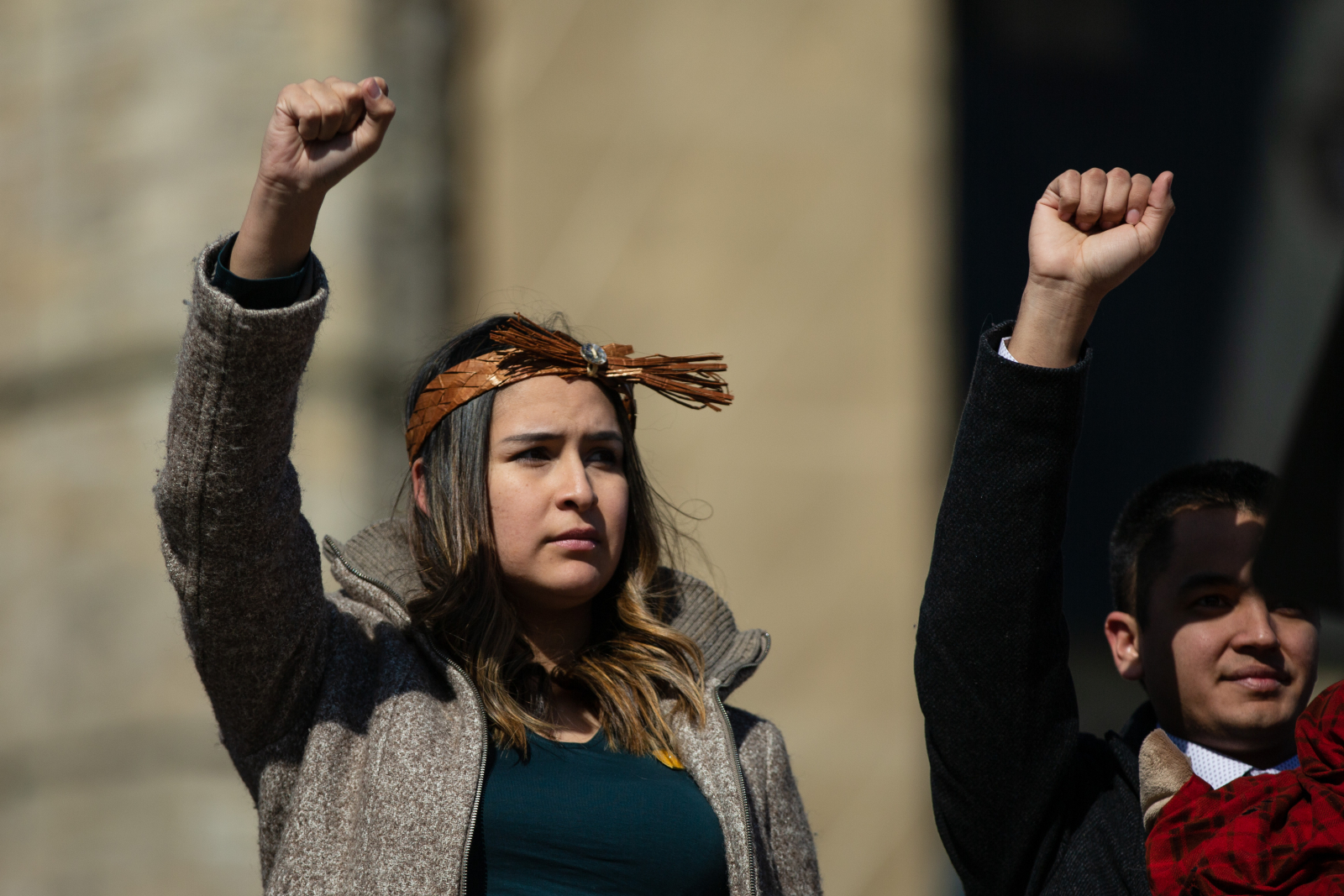
Raven Lacerte, co-founder of the Moose Hide Campaign, raises her fist on Parliament Hill in Ottawa on Oct. 18, 2018. Photo by Alex Tétreault

And so, Minister of Crown-Indigenous Affairs Carolyn Bennett, addressed a crowd of several hundred on Parliament Hill, speaking of the inter-generational phenomenon of violence against women, and inevitably linking it to the legacy of the residential school system now a topic of incendiary condemnation against the-then colonialist 19th century government that had initiated a project to remove aboriginal children from their families and educate them in the ways of the white folk at custodial schools. Much like, in fact, the upper-crust British 'public' school system.

Absolutely everything recognized as First Nations troubles, from addiction to child neglect, criminal activity to an inherited welfare syndrome, all the malfunctions and dysfunctions of a people seemingly incapable of adjusting to ordinary life in a democratic system, to be responsible for their own well-being, to respect the law, to engage in generalized social life, to be gainfully employed, to be responsible for raising healthy, educated children -- is now attributed to the 'trauma' imposed by the residential schools system.
Sage Lacerte, national youth ambassador for the Moose Hide Campaign, on Parliament Hill on Oct. 18, 2018. Photo by Alex Tétreault

A trauma that has lingered and festered generation after generation, explaining why it is that more First Nations children are removed from the bosoms of their incapacitated family to be given shelter and presumably opportunities by public welfare agencies, and that aboriginals are over-represented in Canadian prisons in comparison to their numbers in the general population, and that alcohol and drug addictions consume too many First Nations lives, all attributable by default to their grandparents having been placed in residential schools.

The violence committed against Indigenous women is commonplace and horrendous. And although there is the prevalence of hostility and discrimination from wider society against First Nations people, a human rights crime in and of itself, much of the contempt in which they are held would without a doubt dissipate were they viewed as willing and able to integrate into general society. First Nations people have a proud past and they should regard that with pride and dignity. There is a way to fight bigotry and seek the justice owing them through their own efforts.

But as long as their communities, with the support of a sympathetic broader public continue to deny that most of the violence committed against girls and women come from within their own communities, not those outside them, and insist on attributing that violence to the lingering after-effects of the residential school systems and the degrading loss of self-esteem, nothing will be accomplished. They have indeed suffered viral discrimination. But they have also spurned opportunities to shed the past and embrace a presence as unhyphenated Canadians.

The transition from a dependent people insisting they represent an entirely different set of "nations" within the greater nation of Canada which does them no favours, is past due. Victimhood and resentment cannot forever mark their destiny, but it will unless they take the mature steps required to shed the dependency of federal handouts to finally assume their rightful place in the Canada that has prospered by absorbing people whose goal is simply to be Canadian and in the process take advantage of all opportunities that status offers them.
Our Goal is to end violence towards women and children. To help achieve this, the Moose Hide Campaign will distribute 10 Million Moose Hide squares across Canada.
  • We will stand up with women and children and we will speak out against violence towards them.
  • We will support each other as men and we will hold each other accountable.
  • We will teach our young boys about the true meaning of love and respect, and we will be healthy role models for them.
  • We will heal ourselves as men and we will support our brothers on their healing journey.
  • We encourage you to Take Action, Make the pledge, and Stand up to end violence towards women and children.

Labels: , , , , , , ,

Tuesday, November 14, 2017

Fascism Lives! 

"[The annual Polish Independence Day march this year represents] a dangerous march of extreme and racist elements."
"We hope that Polish authorities will act against the organizers. History teaches us that expressions of racist hate must be dealt with swiftly and decisively."
"[The march disproved] anyone who thinks that hatred of Muslims protects the Jews."
Israeli Foreign Ministry spokesman Emmanuel Nahshon

"[Polish government authority strongly condemns racist, anti-Semitic and xenophobic ideas, but the  march represented an expression of patriotic values]."
"[The rally was misunderstood, it was] a great celebration of Poles, differing in their views, but united around the common values of freedom and loyalty to an independent homeland."
Poland’s Foreign Ministry 

"It's clear that these types of marginal voices are caught and send abroad by the Polish press, and this is an image problem."
"Poland is an oasis of security, peace and tolerance."
Deputy Prime Minister Mariusz Morawiecki

"[Poles must take the initiative to lead] sick Europe [to the path of] health, to fundamental values, to true freedom and to the strengthening of our civilization based on Christianity."
Law & Justice party leader, Jaroslaw Kaczynski
Demonstrators burn flares and wave Polish flags during the annual march to commemorate Poland’s National Independence Day in Warsaw on November 11, 2017. (AFP PHOTO / JANEK SKARZYNSKI)

Protesters carrying poster pictures of Roman Dmowski, a leading Polish nationalist of the 1920s and 19302, a virulent anti-Semite, played homage to his vision of a Jew-free Poland, reprising his vision  to the present, where fewer than 10,000 Jews are left in Poland, after 90 percent of the three million Jews in pre-war Poland were exterminated during the Holocaust years.

Small assemblies of counter-protesters were kept separate from the main March, by police. But groups of women carrying signs saying "stop Fascism", were still kicked and pushed around by nationalists. Masked protesters shouted racist slogans, their banners reading Pure Blood, Europe will be white or uninhabited. Other expressions of pure unadulterated good will and Polish pride in patriotism read variously:
  • Pure Poland, Jew-free Poland
  • Jews out of Poland
  • Refugees get out
  • Clean Blood
  • Pray for an Islamic Holocaust
Flags of Falanga, a historical nationalist group that advocated "Catholic totalitarianism" and removing civil rights from Jews were also in evidence. But the government was firm, accusing Polish media of fomenting problems for the country through its focus on "fringe incidents" and "provocateurs" among those in the 60,000-strong march whom one organizer described as 70% patriots, and 30% right-wing supremacists. Adding that it was the voice of the 70% that mattered; every country had its disgruntled 30%.

The ruling Law & Justice party has rallied Poles to the embrace of their national heritage. With that rallying came a vow that the country's traditional conservative Catholic roots were destined to be returned to their place of honour, and Poland was embarking on a path of "pride, independence and strength". Eastern Europe altogether has rejected diluting its culture and heritage by the acceptance, as the EU demands, of millions of Muslim refugees.

Life has been made dangerously intolerable for Jews in Belgium, France, Germany, Sweden and Britain by the introduction of millions of Muslim immigrants, refugees and migrants bringing their special brand of Islamist anti-Semitism with them. The irony is that in Eastern Europe which has rejected the EU call for all member-states to acquiesce to the demands of acceptance of the Muslim refugees and migrants, right-wing nationalists have taken to openly decrying the presence of Jews who have traditionally lived there.

POLANDINDEPENDENCEDEMO
Demonstrators burn flares and wave Polish flags in Warsaw on November 11, 2017.
JANEK SKARZYNSKI/AFP/Getty Images


Labels: , , , ,

Sunday, October 29, 2017

The Best-Laid Plans Going Awry

"The Iraqi theatre of operations is dynamic and requires deliberate, responsible reflection. As is the case for any Canadian Armed Forces operation, our contributions are constantly under assessment in order to ensure all appropriate strategic and tactical steps are taken."
"The program to provide equipment and small arms [to the Kurdish Peshmerga] is no different."
"[Canada] has a responsibility to ensure any such aid is provided under the right conditions. We will continue to monitor the situation on the ground and exercise strategic prudence."
Dan Le Bouthillier, Department of National Defence spokesman

"Given the fluidity of the current situation, Canada's Special Operations Task Force has temporarily suspended the provision of assistance to various elements of Iraqi security Forces."
"Once more clarity exists regarding the interrelationships of Iraqi security forces, and the key priorities and tasks going forward, the Task Force will resume activities."
"In the interim, they will continue to monitor the situation and plan for the next potential phases of operational activity."
"Only the provision of assistance to various elements of Iraqi security forces has been temporarily suspended."
Col. Jay Janzen, Canadian Forces spokesman
Iraq
An Iraqi soldier removes a Kurdish flag from Altun Kupri on the outskirts of Irbil, Iraq, on Oct. 20. Iraqi federal and Kurdish forces have exchanged fire over the past two weeks, following the disputed vote for an independent Kurdistan. (Emad Matti/Associated Press)

With those announcements Canada has chosen to suspend assistance its special forces provided to Iraqi security forces in the face of Iraqi and Kurdish forces at battle with one another. Canadian assistance was geared toward aiding both Iraqi military and the Kurdish Peshmerga fight the Islamic State of Iraq and the Levant terrorist group, to recapture territory they had assumed for their Islamist 'caliphate', and to oust the terrorist jihadist group from the country.

The Canadian commandos dispatched to work with the Kurds, along with assistance given to the Iraqis is now in suspension. Awaiting 'clarification', in the wake of the Iraqi government ordering its military alongside Shiite militias with links to Iran, to assume national control of Kirkuk and the Kirkuk oil fields, as well as a military base that had been occupied by the Peshmerga with the intention of including Kirkuk and the oil fields in a newly independent Kurdistan. It was the Kurds who had, after all, wrested the valuable territory from ISIL.

The same Kurds who had made no secret of their intention, once ISIL was defeated, to declare independence, to finally establish Kurdistan as a sovereign state no longer dependent on the whims and control of a government whose predecessors had persecuted the large Kurdish population in the country's north, bringing death and destruction, gassing villagers, destroying farms and towns courtesy of Saddam Hussein.

The Kurdish leaders held a referendum that their supporters asked be held off, with then-President Barzani announcing his intention to hold talks with Iraqi government officials to come to an agreement with respect to Kurdish independence. An issue that Iraqi Prime Minister Haider al-Abadi spurned, deploying his military in combat with the Peshmerga, and with superior forces and arms negotiated by Iran, forced the Kurds to withdraw from defence of Kirkuk once their ammunition gave out.

With the Iraqi military's offensive against Kurdish fighters at the border with Turkey and Syria underway the intention to close off the Kurdistan vital trading route was clear enough; with the border crossing falling into Iraq's control U.S.-led coalition forces would also be affected, losing access to allies in Syria engaged in battling ISIL.

As for the weapons that Canada meant to supply to Kurdish troops, that plan has always been dependent on the central government, for Iraq's willingness to transfer the weapons to the Peshmerga. In recognizing the government of Iraq's national position, all such weapons were to be delivered to the government on the agreement they would be transferred to the Kurds. Under current conditions that plan has fallen through with the Iraqi government certain to withhold approval.

"There is no easy path out of this mess", remarked defence analyst Martin Shadwick, recognizing the bind Canada is caught in, promising the Kurds weapons, yet since Kurdistan remains part of Iraq, it would be internationally illegal to move forward to provide arms without the approval of Baghdad. Kurdish leaders openly stated their intention to create an independent state, that the arms they received were to be used in the fight against ISIL, but also eventually, to defend their independent state.

The provision of .50-calibre sniper rifles with silencers, 60mm mortars, anti-tank Carl Gustav systems, grenade launchers, pistols, carbines, thermal binoculars, cameras, scopes and medical supplies are now held in abeyance. With the Department of National Defence in Ottawa confirming the arms shipments must remain under review.

BELGIUM KURDISH PROTEST
Kurdish protesters hold banners during a demonstration against the violence by Iraqi, Iranian, and Shia militias on Kurdistan, in Brussels on Oct. 25. (Stephanie Lecocq/EPA-EFE)

Labels: , , , , ,

Tuesday, October 10, 2017

Threatening Kurdistan

"The threats don't work against Kurds, and it's much better to engage in dialogue with us now."
"Baghdad and Erbil still need to cooperate against ISIS and the humanitarian crisis in Iraq."
"All we've done is hold a referendum. We have not unilaterally declared independence."
Bayan Sami Abdul Rahman, Washington representative, Kurdistan Regional Government
NYT
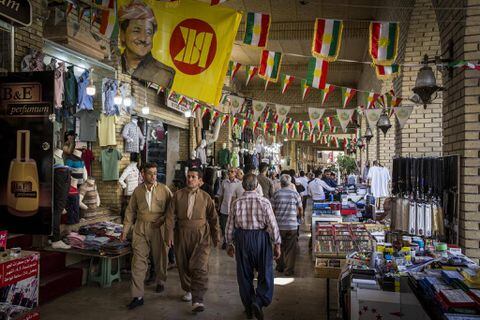
Patrons peruse the grand bazaar the Kurdistan region’s Irbil on Sept. 30. Kurds voted for independence weeks ago, but some elements have impeded the area’s quest for autonomy.
IVOR PRICKETT/NYT

Kurdish leaders in the Kurdistan Regional Government had good enough reason to believe that Washington -- despite its ongoing warning to President Masoud Barzani that the time is not right, that Kurdistan would do better to await another opportunity once the current prevailing atmosphere of conflict and uncertainty is past, to engage in their movement toward sovereignty, abandoning the autonomy that Iraq agreed upon, post-Saddam Hussein's reign of terror, once it carried out its plebiscite and the voters gave ample proof of the people's will -- would support it.

When would an appropriate time to declare Kurdistan's intention to finally become fully independent as a functioning state? Simply by continuing to pursue the status quo, surrendering its full sovereignty to Baghdad and the whims of whoever was placed in the top echelons of executive government would merely prolong the dissatisfaction of millions of people whose ethnic roots long predated those of the Arab tribes ensconced on heritage geography of the Kurds. Without doubt President Barzani might have felt he must lead his people to strike while their iron was still hot.

Waiting until such time as the Islamic State of Iraq and the Levant was fully routed, their caliphate geography a phantom of failure, would simply go on to 'normalize' Kurdistan as an ongoing autonomous region subservient to an Arab political culture that had historically persecuted the Kurds. That four countries claimed land traditional and by heritage the Kurds' throughout history vastly contributes to the emphatic rage of denial by Turkey, Iran, Iraq and Syria.

While Syria's President Bashar al-Assad mounts his ongoing campaign against his majority Sunni citizens by slaughtering hundreds of thousands of civil dissidents he terms 'terrorists', he has the eager assistance of Iran, Lebanon (through the Iranian militia proxy Hezbollah), Turkey and Russia whose interests in a deep-sea port and land base in Syria leads it to airborne military support of the regime enabling Assad to continue his atrocities against his own citizens.

But the overtures to Iraq's parliamentarians by Kurdistan's government to come together at a negotiating table in a civilized manner to discuss the means by which each would be satisfied by an amicable (albeit unwillingly grudging Iraq) to accept Kurdistan's sovereignty is considered beyond the pale, an assault and horrible affront against Arab dominance in the region. Iran has closed the land border with the Iraqi Kurdish region while threatening flights and accusing President Barzani of links to the Israeli Mossad.

Turkey is threatening to close off the Kirkuk oil spigot delivery system despite Russia's massive investment in Kurdistan's oil and gas output and despite Russian President Vladimir Putin's overtures toward reasonableness. Equable reasonableness is the furthest civil attribute that Recep Tayyip Erdogan could conceivably muster on any occasion for any reason that he feels threatens his own Caliphate. The malice that he evinces toward Kurds, not only those within Turkey, but in Syria and Iraq is incalculable.

It is time for the United States administration to recognize its indebtedness to an ally, the only one it could depend upon to rally to the enormous task of challenging and ousting the Islamic State from Iraq. It has been the Kurdish Peshmerga who have performed this task, not the Iraqi military whose courage has been demonstrated to be wanting; they had the U.S.-supplied weapons and rolling stock to effect a winning conflict with ISIL, and melted away in confused panic, leaving the weaponry to benefit Islamic State.

Peshmerga forces led the battles against ISIL with antiquated, inadequate weapons, awaiting the transfer of U.S.- and other NATO-allied nations providing war machinery and updated weapons to the Peshmerga through the government of Iraq; somehow those weapons failed to filter through to the only forces that required their immediate delivery. So, why should the Kurds continue to place any trust in Iraq, a nation whose leaders are more comfortable penalizing the Kurds for not being Arabs than cooperating with them?

It is past time for the Trump administration to threaten to cut off military and economic aid to Iraq and Turkey for their reactions to Kurdish aspirations. The Kurds have been loyal and trustworthy allies to the American war against Islamic State. By taking drastic steps to cut off international access and constrict the economy of the Kurdish region, Iran, Iraq and Turkey are busy with their intention of starving Kurdistan of its due in financial health in line with their plan to punish it for dreaming of nationhood.

If they see fit to threaten war against Kurdistan, the United States has the moral obligation to quietly, diplomatically, inform the threateners that they too will come under threat.
Iraq Vice President Ayad Allawi says there could be a "violent conflict" over the Kurdish-administered city of Kirkuk if talks over Kurdish independence are left unresolved.
Iraq Vice President Ayad Allawi says there could be a "violent conflict" over the Kurdish-administered city of Kirkuk if talks over Kurdish independence are left unresolved.  The National


Labels: , , , , , , ,

Monday, October 02, 2017

Kurdistan's Independence

"The West should support the mandate the Kurdish people are bestowing upon their leaders: to guide the peaceful emergence of a confident Kurdistan, rather than the reinforcement of a bad marriage destined to fail. The cause of Kurdish freedom is right and just, and it is overdue that the West should say so."
Shuvaloy Majumdar, Munk Senior Fellow, Macdonald Laurier Institute, Ottawa, Canada
Syrian Kurds wave the Kurdish flag in support of the independence referendum. Northeastern Syrian city of Qamishli, September 26, 2017
Syrian Kurds wave the Kurdish flag in support of the independence referendum. Northeastern Syrian city of Qamishli, September 26, 2017 DELIL SOULEIMAN/AFP

"Ankara coordinated its military response with that Iraq and Iran. Turkish armed forces mobilized on the border and rehearsed military action. Turkey’s President Recep Tayyip Erdogan threatened to close the Turkish-KRI border and cripple the flow of Kurdish gas to international markets. As a sign of things to come, on the day of the referendum, the KRI-Turkish border ground to a virtual standstill."
"The Kurdish march to independence from Iraq is irresistible. By Turkey firmly voicing its opposition Ankara has forgone an opportunity to lead on the world stage. Had Turkey expressed support it could have swayed the U.S., European countries and perhaps even Russia to do the same. Instead Turkey fell back to a position which fails to see the long-term benefits of Kurdish independence, and instead finds itself in the center of yet another regional crisis."                             Dr. Simon A. Waldman, Mercator-IPC fellow, Istanbul Policy Center, visiting research fellow, King's College London
When Iraq literally fell apart after the U.S.-led 'Coalition of the Willing' invasion meant to remove Iraqi dictator Saddam Hussein from his seat of power, where his Sunni minority Baathist Party ruled the majority Shiite country he led, it was only Iraqi Kurds in their semi-autonomous area of Iraq that were capable of mustering the strength of collective character and appreciation of democratic process to build and reinforce the infrastructure of a decent, humane society.

Elsewhere than Kurdistan in Iraq, the vanquished Sunni Baathists whose control of the Iraqi military and government had been disrupted and dismantled, and the majority Shiites who had chafed under Sunni brutality saw the opportunity to unleash their deadly sectarian hatred against one another, embarking on a protracted orgy of mass killing, even under the noses of the occupying U.S.-led forces whose partial purpose was to maintain order and security.

While violent death stalked both the Shiite and the Sunni communities in revenge attacks, the Kurdish territory remained a bastion of peace and security. The Kurds gave shelter to fleeing Iraqi Christians and other minorities targeted by the terrorist Islamist jihadis like al-Qaeda who entered the country through Syria to begin their own onslaughts to achieve status and prosecute jihad. As these venomous groups gained some measure of control, the dismissed Sunni military elite saw the opportunity to join them and eventually a schism between factions allied with al-Qaeda led to the rise of Islamic State of Iraq and the Levant.

The only fighting force that proved itself capable of challenging the deadly presence of these terror groups and providing haven to their hapless ethnic and religious minority victims were the Peshmerga, fighting back to retain their own territory, while the Iraqi military fled in panic as ISIL marched on Mosul and Kirkuk. The Kurds, whom Saddam Hussein had attacked with poison gas had always suffered dire persecution as a (significant) minority, and they always aspired to sovereignty, not merely autonomy.

On September 25, their long-awaited referendum took place, seeing over 90 percent of those voting giving their confidence to Iraqi Kurdistan Region President Massoud Barzani, to guide them through to independence which in reality would simply result in an ancient people formally reclaiming their heritage geography. The new federal democracy that is now Iraq's is not an equal one for all its citizens; now the majority Shiites are in control in a reversal of Saddam's Sunni control, while the Sunni Iraqis feel themselves disadvantaged.

The Kurdistan Region's authorities plan to negotiate separation with Iraq's Prime Minister Haider al Abadi; their intention never was to unilaterally, even on the basis of their people's almost-unanimous call for sovereignty, declare independence. Understandably, the government of Iraq balks at losing a portion of their geography (they had lost far more than that to ISIL's caliphate which, thanks primarily to the Kurdish Peshmerga and NATO-member assistance has been mostly restored), along with the oil revenues represented by Kirkuk's petroleum reserves.

But this is land that was unconscionably allotted by colonialist Britain to Iraq though it was promised to the Kurds for a recognized homeland of their own. The Kurds have no interest whatever in continuing as a satellite however autonomous, of Iraq and little wonder that, given their past in Iraq. That Iran, Syria and Turkey are all now anticipating that their own Kurdish populations will most certainly see Iraqi Kurds' initiative as one heralding their own eventually, rings alarm from them and from the West, foreseeing civil conflict spreading.

Even now, while the Kurds proved themselves as the only reliable fighting force against the vicious malevolence of ISIL, prevailing where the Iraqi forces could not, Baghdad chose to hold back needed arms from the Peshmerga which Western allies ferried through the Iraqi government as it demanded, with the expectation that it would send them on to the Peshmerga, which it failed to do. Trust and interdependence is not there on an equal basis. There is no true basis for a compromise for the status quo to be continued.

The differences between Iraq and Kurdistan are enormous; one fractious, the other fraternal and pluralistic. Kurdistan's social and physical infrastructure is modern and forward-looking, a model for all of the countries of the Middle East, but one they are loathe to emulate since it would require a recognition of human rights and equality. Kurdistan deserves recognition for its legitimacy to enable it to exercise economic, diplomatic, cultural and military independence. It has earned that right.

Turkey's belligerent response is predictable, but still wrong: Turkish and Iraqi soldiers conduct joint exercises on Turkey's border with Iraq's semi-autonomous Kurdish region the day after the Kurdish referendum. Silopi, Turkey, Sept. 26, 2017
Turkey's belligerent response is predictable, but still wrong: Turkish and Iraqi joint exercises near the Iraqi Kurdish region's borders the day after the referendum. Silopi, Turkey, Sept. 26, 2017    ILYAS AKENGIN/AFP

Labels: , , , , ,

Friday, September 29, 2017

Independence and Ultimatums

"The government of Canada is taking all reasonable steps to ensure that the Government of Iraq and the Kurdish Regional Government of Iraq provide the requisite commitments that any equipment provided from the Government of Canada will be used in an appropriate manner."
"Canada will ensure that end-user agreements are fully approved and in place before any equipment is delivered."
Capt. Patricia Brunelle, Canadian Forces spokeswoman

"It is bad enough that Canada and other members of the anti-ISIL coalition have failed to develop any meaningful strategy for heading off this entirely foreseeable crisis."
"It is worse still for Canada to bury its head in the sand and continue supplying weapons to the Kurdish Peshmerga. How is such action possibly consistent with support for a unified Iraq?"
(former) Canadian diplomat Peggy Mason, president, Rideau Institute

"The United States does not recognize the . . . unilateral referendum."
"The vote and the results lack legitimacy, and we continue to support a united, federal, democratic and prosperous Iraq."
U.S. Secretary of State Rex Tillerson, Washington

Iraqi Kurdish leader Masoud Barzani, center, arrives to vote in the independence referendum at a polling station near Irbil, capital of the semiautonomous Kurdish region, on Monday. (Ahmed Deeb/AFP/Getty Images)
"I called his excellency Prime Minster Abadi on this specific issue and I explained to him that this referendum is a normal, legal right of our people, and that afterwards we want negotiate the results of the referendum in a peaceful way through dialogue. He had an understanding of that. We told him that we want to solve this issue with Baghdad through peace and not through violence. He was receptive and understanding. He was positive."
"The referendum issue is about the destiny of a whole people. That’s why this issue is bigger than any other political framework, or any political parties, or any political problems within the party system. I’m sure that the majority of the people in Kurdistan are with the referendum. The supporters of the political parties, the majority of them are also pro-referendum. We had a very positive meeting with all the political parties, and they were all supporting it."
"When we have a referendum, it is to have that mandate from the people, to show to the domestic and to the external players what the Kurdish people want. Once the people decide and vote, then as I said, the first place we are going to start serious, peaceful negotiations and dialogue with is with Baghdad, to achieve and fulfill the wishes of the people."
"The referendum is for independence, and I want the others to understand this: Once we do the referendum and start dialogue, it doesn’t mean that we give up on the wishes of the people. So the referendum is for independence and its result must be implemented."
Leader of Iraqi Kurdistan, President Masoud Barzani

irbil-airport.jpg
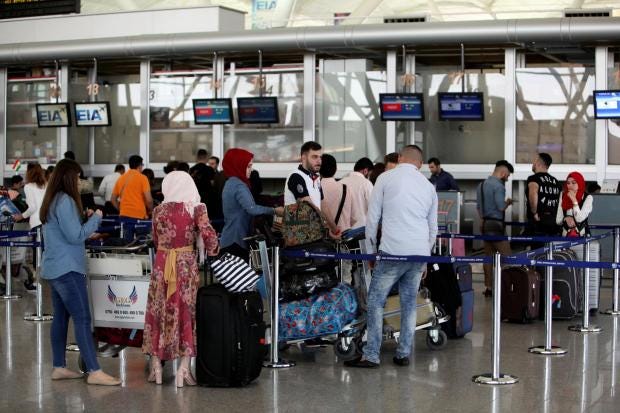
Passengers queue at the check-in counters at Irbil International Airport in Iraq on 27 September 2017 Reuters
There it is, the polarized opinion out of Western nations; on the one hand sympathizing with the need of this immense, 30-million strong ethnic group that has been persistently persecuted living within the borders of Arab (and Persian Iran) states refusing to entertain the very idea that in all justice if they feel it is fair that they enjoy a state of their own, why not the group that has called the geography encompassed by their borders their millennia-old heritage?

The occupying colonialist powers who promised the Kurds a hundred years ago that when new borders were struck for Turkey, Syria, Iran and Iraq, a portion of each would be set aside for a Kurdish homeland, betrayed the Kurds. Ever since, the Kurdish ethnic minorities in those countries have been discriminated against, and their lives made utterly miserable when in fact they weren't being subject to violence. They persevered and they proved themselves capable of self-governance.

Canada's ambivalence in stepping in after the tribal and sectarian implosion of Iraq, to instruct its military to help train and supply the Kurdish Peshmerga which proved itself the only reliable fighting force in the Middle East capable of challenging the murderous Islamic State of Iraq and the Levant group comes up hard against the government's diplomatic stance in echoing the opinion of its NATO allies by insisting on Iraqi insolubility.

Condemning, in other words, the Kurds who continue to aspire toward national independence, to remain subservient to what to them is a foreign government, one which in the past has denied their most basic human rights. In so doing, choosing to sit on the fence, despite continuing to arm Kurdish forces after the referendum for independence. A referendum whose purpose is to persuade the government in Baghdad to sit and discuss a situation that requires an inevitable conclusion.

Instead, Baghdad has slammed the door of negotiations shut in Kurdish President Massoud Barzani's face. Iraqi Prime Minister Haider al-Abadi has committed to measures to ensure that Kurdistan remains within the orbit of Iraq. Ordering the Kurdish region to submit control of its airports to Iraqi federal authorities, otherwise a total flight ban would be instituted with Iraq's Transport Ministry ordering international airlines to no longer service Irbil, the Kurdish capital.

Turkey has followed suit, as has Egypt, Iran, Syria and Saudi Arabia, with Turkey threatening trade sanctions and not ruling out military action. The sneering reference by Turkey to the sole ally backing Kurdish aspirations being Israel, emphasizes Kurdish isolation in a hostile-to-independence region, where Arab (and Persian) states lock forces, setting aside their own intractable and often violent differences to stand in unity against sovereign Kurdistan.

Iraq's Shiite dominated parliament has called upon al-Abadi for troops to be deployed to the disputed Kurdish-majority areas, including the city of Kirkuk, representing one-third of the oil riches of Iraq and which Kurdistan claims as its own. It won't take long to see what results from this regional animosity toward Kurdistan independence. Al-Abadi has all the support he would like to "enforce the rule of the federal authority in the Kurdish region with the power of the constitution."

Labels: , , , ,

Monday, September 18, 2017

Long Live Kurdistan

"How much progress have we really made if Iraq is so riven by internal divisions that new civil wars erupt -- between Sunni and Shia, between the Kurds and the central government, with ISIL, or its successors taking advantage of the various schisms and weakness of Baghdad at every turn?"
Peggy Mason, former disarmament ambassador, Canada; president, Rideau Institute, Ottawa

"I don't think they're [government of Iraq] going to say, 'Sure, take the oilfields and Kirkuk and go your way."
"It's not going to go peacefully."
General Raymond Thomas, head, US. Special Forces Command 
Marches in support of the vote took place in Irbil, 13 September 2017
Marches in support of the vote took place in Irbil last week   EPA

Kurdistan, the semi-autonomous and historical region where Kurds in their tens of millions have always lived had been bypassed by colonialist powers in apportioning territorial limits and borders to satisfy the demands of Arab Muslims, the majority population in the Middle East. The result has been that in Iran, Iraq, Syria and Turkey, the Kurds have been denied statehood, denied recognition of their heritage indigenous status, denied equality and been subject to gross instances of human rights infringements by the majority ethnic groups among whom they live.

In the modern era where Arab states with their defined borders erratically declared official by foreign interlopers whose 19th Century imperialist arrogance saw fit to install, prejudice and discrimination against minorities of ethnic, tribal, and religious groupings have run rife. Kurds, on the other hand, appeared to have few problems accepting others as equals deserving of equal treatment and security. More latterly they have proven themselves on the battlefield when their militias were the only groups capable of confronting the atrocity-laden excesses of Muslim Arab jihadists.

In the regional and international interests of combating the most recent of Islamofascist ideological campaigns for conquest and the installation of a caliphate, the Arab militaries of Iraq and Syria have failed spectacularly to defend their own territories, allowing them to fall to the Islamic State predators. Without the intervention of the West and later Russia, despite support from a hegemony-consolidation-seeking Iran and its proxy militia Hezbollah, it has only been the Kurdish peshmerga that could be relied upon to beat back the incursion of the Islamic State.

NATO-member countries have dispatched their military trainers to give support and training to Iraqi and Kurdish militias. Canada has spent its years of training with the Kurdish fighters. The Kurds have fought courageously for their homeland, their territory, the geographic area that they claim as their own and for which their aspirations to achieve statehood have been focused on. A referendum is on the near horizon where Kurds will vote formally in a democratic initiative for a declaration of independence.

This initiative has alarmed NATO-member Turkey which has fought an 'insurgency' launched by Kurds living in Turkey in their ancestral lands which Turkey continues to claim as its own. Neither Syria, nor Iraq is complacent about the potential for signing over part of their territory to its rightful owners, much less Iran. When Iraq had fallen apart after the removal of Saddam Hussein and the U.S.-led coalition was attempting to guide the country into an equal coalition of Sunni, Shia and Kurd in governing the country, it too failed.

The Kurdish region was the only part of Iraq that was capable of functioning with any degree of progress and normalcy, offering security to its people, and giving shelter to minority groups at deadly risk during the conflicts that erupted between Islamist terrorists, Shiite militias and Sunni minorities, and the threats to Christians and Yazidis and other minority groups were answered by Kurdish shelter, the assurances that living among the Kurds they would be safe.

In the years of turmoil brought on by the rise of ISIL, the Kurds managed to claim areas of Iraq that have been historically theirs through thousands of years of habitation before national borders were drawn. They have also claimed 40 percent of the geography's oil resources, along with Kirkuk; they are, after all, the majority population in those areas. Canada has been providing military training and equipment to Kurdish troops in northern Iraq for the past three years pursuing the common goal of ousting ISIL.

Now Canada sees itself in a quandary; not a new one, since the prospect of an independent Kurdistan was always recognized as a future problem. But the Canadian commandos who proudly wore Kurdish flags on their uniforms have been instructed to remove them, after the U.S. issued its decree to its troops that American special forces remove their Kurdish insignia from U.S. military uniforms, bowing to Turkey's complaints of the closeness to Kurds whom Recep Tayyip Erdogan considers "terrorists".

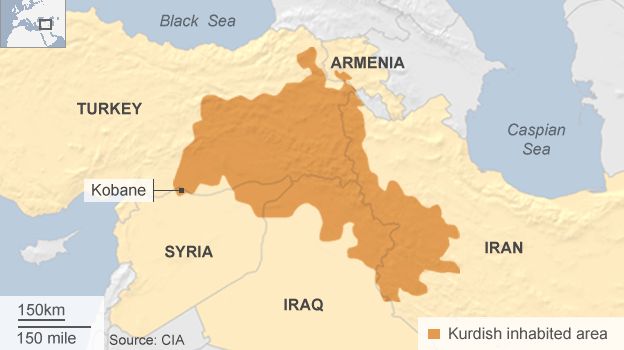
Middle East map showing Kurdish areas

What the U.S. and Canadian governments see in the near future is a crisis unfolding, with Kurdish patience at an end and their determination to finally rule their own roost paramount for their future, resulting in the potential for civil war after the September 25 referendum results. The U.S. has denied support to the Kurds at this critical time in the evolution of their declaration of independent sovereignty, and Canada appears on the cusp of responding in the very same way; separating themselves from the very group they have most relied on to complete their mission of destroying the power of Islamic State.

Insisting at this point, when Islamic State has been virtually vanquished as far as its territorial ambition is concerned, that unity is required to ensure that the fight succeeds, no longer seems quite valid. Kurdish independence is answering the question that Kurds are asking themselves: "If not now, when?", for 'when' is always far off on the horizon, and Kurds have finally decided to draw it in.

Ironically, it is Israel and Israel alone, at this juncture that is finally giving moral support and recognition of timeliness to Kurdish independence. One semi-outcast struggling for survival supporting another. The enemies of Israel -- Iran, Syria and Turkey -- are all now left with the concern that their turn too will soon arrive when they will be forced to surrender Kurdish ancestral land to the people who claim it as their own.

Their denials reflect the very same rejection that Israel has always faced; a people returning to its roots.

Labels: , , , , , , ,

Sunday, August 07, 2016

Self Respect in Accepting Personal Responsibility

"Nationally, aboriginal persons represent about two percent of Canada's population, but they represent 10.6 percent of persons in prison [1996]. Obviously, there's a problem here."
"We put the emphasis on restorative justice. We said when you have aboriginal offenders, please take into account any alternatives [to prison] that might be available."
"[Changing the sentencing provisions was] one part of the solution, but providing the alternatives to the court is the other, and I think we haven't done as good a job on that as we might have."
"The high rate of aboriginal incarceration is a symptom of a societal issue that we haven't confronted, which is the exclusion in large part of aboriginal people from access to education, access to the middle class, access to opportunities in the economy. As long as that goes on, you're going to find aboriginal offenders over-represented in the prisons."
"Putting a few words in that subsection of the Criminal Code ain't gonna be enough. You have to tackle the underlying issues."
Allan Rock, former Minister of Justice

"[This does not amount to ] a race-based discount on sentencing. The provision does not ask courts to remedy the over-representation of aboriginal people in prisons by artificially reducing incarceration rates. Rather, sentencing judges are required to pay particular attention to the circumstances of aboriginal offenders in order to endeavour to achieve a truly fit and proper sentence in any particular case."
Justice Louis LeBel, Supreme Court of Canada

"When you have a lessened sentence, it really does feel like a slap in the face. It really does feel like a re-victimization for the victim."
"I have seen how devastating it is for the victim [even leading to suicide]. The victims deserve to have someone advocating for them in court just as much as the perpetrator."
Dawn Lavell-Harvard, president, Native Women's Association of Canada

"Should there be some benefit given to an aboriginal man for attacking his aboriginal wife and killing her?
"She is no less deserving of consideration than he is; indeed, the contrary."
Justice John Rooke, Nunavut Court of Justice
The aboriginal community within Canada is indeed over-represented in the prison system. That is because, simply, more crimes are committed from within and in that community than from other Canadians and their communities. The death rate of young aboriginal men is high due to suicide, and it is higher yet as a result of rampant violence within the aboriginal community. Crimes against aboriginal women within the community are also high, but it is both genders who are vulnerable to community violence.

As are children. The dysfunction level of parental supervision of young aboriginal children is also high, with alcohol and drug addiction root causes, and patterning children to follow their parents' and communities' examples. Generally speaking, educational opportunities are not given the high value they should be regarded with, in the general aboriginal population. Aboriginals are swift to excuse themselves for these traditional cultural and social shortcomings by placing blame on the non-aboriginal community.

Discrimination certainly does exist, but latter day bigotry would certainly be reduced to fewer and further between if aboriginals themselves gave less fuel to the fire of discrimination. Turning toward rejection of the vices that destroy their lives and adopting the virtues that would enhance them. If not for themselves, then for the coming generation. Pride in heritage could be bolstered immeasurably by accepting responsibility for themselves, by rejecting the misogyny and violence that ruins lives.

Citing past injustices like colonialism and racism and the residential school program that took native children from their homes in an effort to wean them from aboriginal tradition is cited as a misguided and harmful practise that traumatized an entire population. Reality is never that cut-and-dry; in many instances those in the residential school programs learned to be industrious and capable people; they hadn't suffered the misery and violence that others have claimed.

Upper-class British (and Canadian) students have traditionally been wrenched from their families to be sent to residential preparatory schools and some lived through miserable experiences, yet by and large they prospered and survived the misery to become the best-educated and reliable scholars, educators, scientists, military personnel, lawyers and doctors in the elite-echelon of British society.

When in 1996 the-then government brought in a Criminal Code change to empower judges to consider 'the enduring impact of colonialism, displacement, residential schools in determining appropriate sentences in the carriage of justice for aboriginal offenders, including issues of extreme violence' the "Gladue" report instructed judges how they might proceed to administer the new law.

It has resulted in repeat offenders, and those who commit violent crimes, often not realizing the full extent of society's justice for such offenders. But even while the adjusted Criminal Code law was recognized and often utilized, the reality is that sentencing reform has done nothing to reduce the number of aboriginal Canadians behind bars. As four percent of the Canadian population they remain 24 percent of federal inmates; higher even for women with 36 percent aboriginal.

The government and Canadians at large generally feel responsible for the plight of native Canadians, accepting the past ills they suffered as having been reason for their high rate of crime and dysfunction. Continuing that sentiment may make the general population feel good about their high mindedness in willingly taking responsibility for the plight of the aboriginal society, but it really does no good for the native population themselves to rest comfortably in the soothing excuse that others are responsible, not themselves.

Substance abuse and mental health treatment programs could be increased, to offer both inmates and those in the general community more support, but in the final analysis it will have to be up to the aboriginal populations themselves to register their pride in who and what they are by redefining themselves as responsible for themselves. The high degree of dependency on government is no credit to an independent people who claim for themselves the status of a "nation", insisting on "nation-to-nation" respectful exchanges.

If they cannot respect themselves through full independence and mature responsibility, how can they find respect in the wider community, other than as vulnerable and hapless people needing constant direction and compassionate support without themselves exerting the effort to find their own direction with that support, as responsible citizens, proud of an independence they have not yet discovered.

Labels: , , , , ,

() Follow @rheytah Tweet