Politic?

This is a blog dedicated to a personal interpretation of political news of the day. I attempt to be as knowledgeable as possible before commenting and committing my thoughts to a day's communication.

Friday, May 22, 2020

Power Play

"You will be the first Indigenous Nation in Canada to have recognition of your Aboriginal title over your territory by agreement."
British Columbia Wet'suwet'en Hereditary Chiefs
Wet'suwet'en hereditary chiefs from left, Rob Alfred, John Ridsdale and Antoinette Austin, who oppose the Coastal GasLink pipeline, take part in a rally in Smithers, B.C., on Jan. 10. (Jason Franson/The Canadian Press)
"Canada and B.C. recognize the Wet'suwet'en rights and title are held by the Wet'suwet'en houses under their system of government."
"Areas of jurisdiction that will need to be addressed include ... child and family wellness; water; Wet'swet'en national reunification strategy; wildlife; fish; land use planning; lands and resources; revenue sharing, fair and just compensation, economic component of Aboriginal title; informed decision-making; and such other areas as the Wet'swet'en propose."
"In some cases the jurisdiction that is transferred ... will be exclusive, and in some cases it will be shared with Canada or B.C."
"[None of the jurisdiction will be transferred until] specifics on how Aboriginal and Crown titles interface have been addressed [or until] clarity [is achieved on the] Wet'sewet'en governance structures, systems, and laws."
Memorandum of Understanding

"If [the  negotiation] goes ahead you'll see more separation within the nation and they're [the group of six hereditary chiefs claiming to speak for the Wet'sewet'en nation, although opposed by the greater majority of Wet'sewet'en Aboriginals in B.C.] already separating clans and clan members and houses."
"We're not understanding what is the rush here. We sat here for 30 years already, waiting and talking about it."
"We can wait another year or two. It's not going to hurt anything."
Gary Naziel, hereditary Wet'suwet'en subchief

"I don't see why the government gave them this, because this has got nothing to do with what the protests across Canada started from."
"Those issues are not resolved. They can set up roadblocks again and do it again, and that's what I'm worried about."
Chief Dan George, Ts'il Kaz Koh First Nation
Protesters gather at the rail blockade on the 11th day of demonstrations on Sunday, near Belleville, Ont. (Lars Hagberg/Canadian Press)
Coastal GasLink pipeline project was poised to proceed with the building of a 416-mile-long pipeline that would deliver natural gas across northern British Columbia to a facility where LNG Canada would convert the gas to a liquified state (LNG) and transport it for export globally. The line was approved after years of consulting with Aboriginal groups, of undertaking environmental studies, and with the approval of those Indigenouss groups signing on to share in employment and gasline profits with band councils.

Wet'sewet'en elected chiefs were satisfied on behalf of the nations and clans and houses they represented that the project was environmentally sustainable, respected their heritage lands, their culture and their need for inclusion on their heritage lands, and signed their approval of the project. What happened next surprised many, when a group of men claiming to be 'heritage' chiefs, non-elected but culturally important, removed heritage chief status from others and in a group of six presented as a unified group of dissenters speaking on behalf of the Wet'sewet'en.

A court injunction was obtained to stop the group from protesting at the work site. And it was ignored by the heritage chiefs. The Wet'sewet'en themselves who had approved the project were furious. But the heritage chiefs attracted the sympathy and support of many non-Indigenous groups across Canada, along with that of the influential Ontario Mohawk community whose 'warriors' set up roadblocks and blocked railways, essentially bringing traffic and portage to a halt. The chiefs demanded to speak to the heads of government, and an 'agreement' was negotiated.

The heritage chiefs had succeeded in temporarily halting pipeline construction, in placing a lock on the economy however temporarily, and in being recognized by government as qualified to speak on behalf of the Wet'sewet'en over the legitimacy of the elected chiefs. They did this because the Ontario Provincial Police hesitated initially until matters became dangerously out-of-hand, to step in to enforce court orders that the protest blockages and camps be cleared away. And because the Liberal government of Justin Trudeau usually folds to Aboriginal demands.
Police officers make an arrest during a raid on a Tyendinaga Mohawk Territory camp next to a railway crossing in Tyendinaga, Ont., on Feb. 24, (Chris Helgren/Reuters)

When the hereditary chiefs came away with the draft of the memoradum of undrstanding which it was understood they would share with the Wet'sewet'en and hold discussions that everyone would be involved in, their promise to respect that detail was given short shrift; the memorandum kept to themselves as they undemocratically made all the decisions, and claimed to have won a great distinction for the Wet'sewet'en nation. At last the memorandum was finalized and released.

As for the Coastal GasLink pipeline project, despite the controversy manipulated by the hereditary chiefs in claiming that the project ignored Aboriginal heritage rights, irrespective of the Wet'sewet'en through their elected chiefs having happily agreed to sign the necessary contracts for it to proceed, it did just that. The project is well underway. The governments of B.C. and Canada knelt to the empty demands of the hereditary chiefs who had succeeded in producing an even wider schism between tribes and clans than already existed, and the elected band councils and their supporters have been left steaming.
 
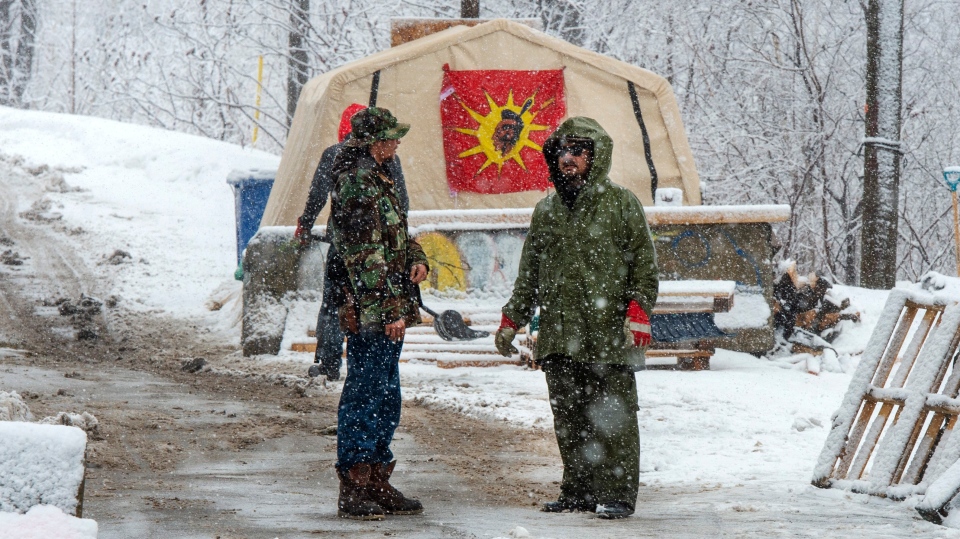
A Mohawk demonstrator gazes up at a Mohawk flag affixed to a railroad crossing arm. ALEX FILIPE jpg, BI

Labels: , , , ,

Saturday, February 29, 2020

Canada in Danger of Dissolving?

"This is one of the few polls that I just looked at -- and I've been doing this for 30 years, so I did polling around the Oka Crisis -- I was astonished when I saw some of these numbers, but I'm not surprised."
"People are truly frustrated with the inability of their leadership to come together and recognize that human beings are being affected by their decisions and that they're not simply voters."
John Wright, pollster, DART

"A lot of the blame has been centred on the prime minister and the Liberal government."
"There was some form of void. The government left the impression -- at least many people came to the conclusion -- that there was no one really in charge of the situation [of rail blockades]."
Daniel Beland, director, McGill Institute for the Study of Canada

"Canada is not broken. Canada's institutions are broken."
"In 1867 [year of Confederation], the concern was to protect Canada against democracy, not to protect regional interests."
"Until we have an institution that can speak on behalf of the regions, we are going to have a problem."
Donald Savoie, Canada Research Chair, Public Administration and Governance, University of Moncton

A nation united? Appears not; more accurately, a nation acutely polarized. The West -- blessed by natural resources which resulted in wealth, has enabled, through tax transfers via the federal government to dole out 'equalization' payments to the 'have-not' provinces to ensure that all Canadians regardless of where they live are equally endowed in social services -- has been left by the central government in Ottawa to flounder. Its resource sector, the source of much of Canada's wealth, has been hit by the Liberal government's commitment to its environmentalist backers.

Demonstrators in London blocked several intersections as they made their way toward RCMP offices on Dufferin Avenue. (Sofia Rodriguez)

A government which has done all it possibly can to place roadblocks in the way of investment and development of petroleum resources, causing tens of thousands of job losses, and the firesale of Canadian energy at steeply reduced rates exported abroad, for lack of pipeline delivery stymied time and again through legislation and the courts doing the bidding of the Liberal government of Justin Trudeau. A prime minister whose agenda is reconciliation with Canada's First Nations and meeting environmentalists' demands of shutting down the conventional fossil fuel energy sector.

Both coming together in a sudden and stunning shutdown of Canada's national rail system, both freight and passenger, through sometimes violent, and always illegal blockades launched by five Wet'suwet'en ancestral chiefs, defying the agreement of 20 Wet'suwet'en elected chiefs and the majority of the Wet'suwet'en who signed an agreement of cooperation meant to result in employment and profit through the operation of the northern B.C. Coastal GasLink project.

The transport of critical perishables, production parts, chemicals and heating products across Canada has been halted. This, at a time when Canada is preparing for a possible epidemic of COVID-19, the novel coronavirus that has devastated China, and has emerged as an epidemic in South Korea, Japan, Iran and Italy, and now infects people in over 50 countries globally, and growing. The poll results indicating that a majority of Canadians now feel strongly that the country is not being governed well, is indisputable.

While the country's prime minister was jetting abroad in Africa to drum up support for his legacy project of having Canada elected to a two-year stint on the United Nations Security Council, Aboriginal and environmentalists' protests have virtually shut down cross-country transit. Shipped goods have been piling up on docks awaiting transfer to rail for distribution throughout the country. For two weeks and counting the government urged patience and failed to see that the law went into action to shut down the illegal and dangerous blockades of rail across the nation.

Hundreds of Londoners joined an Indigenous-led demonstration in solidarity with opponents to a pipeline in Wet'suwet'en territory in northern B.C. The demonstrators marched toward RCMP offices in downtown London to show their opposition to the arrests of protesters. (Sofia Rodriguez/CBC)

Now that Justin Trudeau has finally declared that Canada has waited long enough for protest leaders to agree to discussing the issues with government leaders, giving clearance to federal, provincial and municipal police to act, and a few of the blockades have been shut down, others spring up in their place, with 'activists' lighting tires on fire on rail tracks, and setting up blockades that engines narrowly miss hitting. Some activists have taken to standing on tracks, moving out of the way at the last moment.

A full 62 percent of those polled feel Justin Trudeau's promise to Canada's Indigenous people has failed on delivery. Two-thirds of respondents are not averse to supporting one-time payments to Indigenous Canadians for immediate acquisition of "food, clean water and housing" for the "necessities of life", which in actual fact, does go out regularly to Indian reserves throughout the country for those very purposes, and more.

What the agreement that the Wet'suwet'en elected chiefs signed with the Coastal GasLink project would have done was provide dignity through employment, and independence through the share of gasline profits. The current situation has led to another project, in Alberta, for a giant mine investment by Teck Resources, a Canadian firm prepared to invest $20 billion and having reached similar sharing agreement with Aboriginals, being cancelled in view of the ongoing roadblocks, including a decision whether to approve the project expected in days from the Trudeau government.

Over 80 percent of Canadians believe politicians have a greater care for their partisan interests than to do the work they were elected for on behalf of all Canadians. This feeling is supported at 90 percent in Alberta. The federal government under Justin Trudeau and his Liberals has alienated Canada's Western provinces, leaving the country worryingly polarized and increasingly leaderless, while a small minority of Canadian 'activists' and unwanted visitors from the U.S. work to shut Canada down.

Wet'suwet'en protests
Protesters in support of the Wet'suwet'en hereditary chiefs stand near the entrance to the blockade of the commuter rail line in Kahnawake Mohawk Territory, near Montreal, Thursday, Feb. 27, 2020. THE CANADIAN PRESS/Ryan Remiorz


Labels: , , , , , ,

Tuesday, April 09, 2019

Murder ... Is Murder   Justice ... Is Justice

"There is no right to a jury roll of a particular composition, nor to one that proportionately represents all the diverse groups in Canadian society. Courts have consistently rejected the idea that an accused is entitled to a particular number of individuals of his or her race [on a jury or in a jury pool]."
"[If the state] deliberately excludes a particular subset of the population [then rights are violated]."
Justice Michael Moldaver, Supreme Court, Kokopenace decision

"These exclusions [for jury selection: criminal convicted, sitting federal, provincial and municipal politicians, current and former judges and lawyers, medical examiners, police officers all excluded] are acceptable because, in the legislature's reasonable view, there is a substantial possibility that persons in those categories would not be impartial as between an accused person and the Crown."
"The disproportionate effect of the impugned exclusion in the case of Indigenous Canadians points to a shameful feature of modern Canadian society, but it does not cause a jury selected through the application of that exclusion to be unrepresentative; rather, it serves to promote the impartiality of such a jury."
Judge Brian Burrows, Alberta Court of Appeal
Inset: victim of deadly beating, John Hollar on Edmonton LRT, 2012
When an Indigenous man from the Grassy Narrows reserve in Ontario was convicted in 2008 of manslaughter, there were no Aboriginals on the jury, leading the Ontario Court of Appeal to order a new trial. The Supreme Court of Canada overturned the appeal, and reinstated Clifford Kokopenace's manslaughter conviction. This week the Court of Appeal of Alberta referred to that decision when it turned down the appeal of an Indigenous man's murder conviction that he had been denied a fair trial by a representative jury of his peers.

Jeremy Newborn, who mercilessly beat a fellow passenger on the Edmonton LRT in 2012, leading to victim John Hollar's death two days later, appealed his conviction, his lawyer, Simon Renouf, claiming that Mr. Newborn's constitutional rights had been abridged. That being so because anyone with a criminal record is prohibited from sitting on a jury. And that being the case, Aboriginals are disproportionately excluded owing to the simple enough fact that they are disproportionately represented in Canadian prisons.

Aboriginals, making up 3.8 percent of the Canadian population, represent 23.2 percent of the federal inmate population. The jury composition system, insisted lawyer Renouf, is unfair to Aboriginals at trial for criminal offences since the disproportionate number of Indigenous Canadians have criminal records. Back in 2012, 29-year-old John Hollar was a passenger on a transit bus in Edmonton. He was suddenly attacked by Jeremy Newborn, then 32. The attack was viciously unrelenting and led to Mr. Hollar's death.
Jeremy Newborn File

And while Jeremy Newborn pleaded guilty to manslaughter, he pleaded not guilty to second-degree murder, which the Crown refused to accept, and proceeded with criminal charges to trial. Newborn was born with fetal alcohol syndrome resulting in an intellectual disability and he had drug and alcohol addictions, a band member of the Alexander First Nation. His case went to trial in 2014; the jury pool consisted of about 180 people. None among them was Aboriginal.

Newborn's lawyer, Mr. Renouf, objected to the jury makeup, calling a statistician as an expert witness in 2015 following an adjournment permitted to appeal the disparity in the makeup of the jury. Given the population of the city of Edmonton and its Indigenous component, it would be expected that of a group of 178 randomly selected people, approximately nine would be Indigenous, according to the statistician. The trial was re-scheduled as soon as Justice Burrows denied the motion for objection.

The trial proceeded and Newborn was convicted in 2017, given a life sentence without possibility of parole for 15 years. An appeal to the Court of Appeal of Alberta followed, argued on two grounds, one of which focused again on the jury exclusion. The provincial appeal court depended on the Kokopenace decision to reach their own, with the three-judge panel deeming it "an unfortunate consequence" referring to the exclusion of convicted Aboriginals sitting on a jury.

"Even if there is such an indirect effect (on Indigenous people), there is no basis to say it is deliberate", the decision rationalized in its judgment.
A screen shot from an Edmonton Transit System video that was played for the jury at the second-degree murder trial of Jeremy Newborn, 32, and showed the accused repeatedly punching victim John Hollar, 29, as shocked passengers looked on and moved away. Supplied


Labels: , , , ,

Friday, October 19, 2018

Violence Committed Against Aboriginal Women : Whose Violence? The Solution to End it Lies Within

"When we're hunting moose, we're also looking for human remains because there are so many missing and murdered women along that highway. A lot of those logging roads we go down are exactly the same kinds of places where those women's remains are found."
"We got a moose that morning [In 2001]. We had been talking about the Highway of Tears [Highway 16, northern British Columbia] and Raven said, 'You know Dad, I wish there was a way that we could wipe away some of those tears'."
"Like a lot of guys in this country, I grew up in the home of a violent, alcoholic father. That's the story of so many guys who are in jail or who are struggling. When they were little, their dad would drink and beat them up."
"It's almost as simple as it gets for some of the domestic violence cycles in Canada."
Paul Lacerte, Yinka Dene, Carrier First Nation, northern British Columbia

"It's a reality for a young Indigenous woman like me that life is not as safe. I've heard the stories of murdered and missing Indigenous women all my life."
"Our family is close and connected. I knew that we could get together and make something happen and make a difference."
Raven Lacerte, northern British Columbia


Raven had been out moose-hunting with her father Paul when she was 16, seven years ago. They had been talking about the dread menace hanging over aboriginal girls and women of violence and violence that at times becomes lethal. The pair travelled along the infamous 'Highway of Tears', Highway 16, where the reality is that up to thirty Indigenous women are known to have disappeared, never seen again alive. And this tragic reality was in teenage Raven's mind while she was cleaning the moose they had bagged.

The thought occurred to her while cleaning the moose hide that it could be made into a symbol of a new awareness campaign they would launch. They called their campaign the Moose Hide Campaign and it couldn't have been more grass rooted in origin than in the mind of a 16-year-old haunted by the thought of psychopathic violence that harms, injures and kills women like herself. Raven and her three sisters cut the hide into small squares and set to work producing 25,000 cards they hand-lettered, explaining the significance of the hide squares.

Their campaign has swept into the consciousness of Indigenous people with its initiative to persuade boys and men, Indigenous and non-Native to commit themselves to taking a personal position to prevent violence against women. The Lacerte family recently brought awareness of their campaign to Parliament Hill in Ottawa, a yearly ritual. In the space of seven years they had managed to proliferate over 1.2 million of the moose hide patches distributed in over 350 communities.

They engaged with local Ottawa and area high school and post-secondary students, who set out to pledge themselves to upholding a day-long fast in a demonstration of their own commitment to see an end to violence committed against women. Their campaign led politicians, as they are wont to do, in supporting obvious public-good campaigns to show their 'progressive' bona fides, to come out in support of this initiative of awareness, education and commitment.
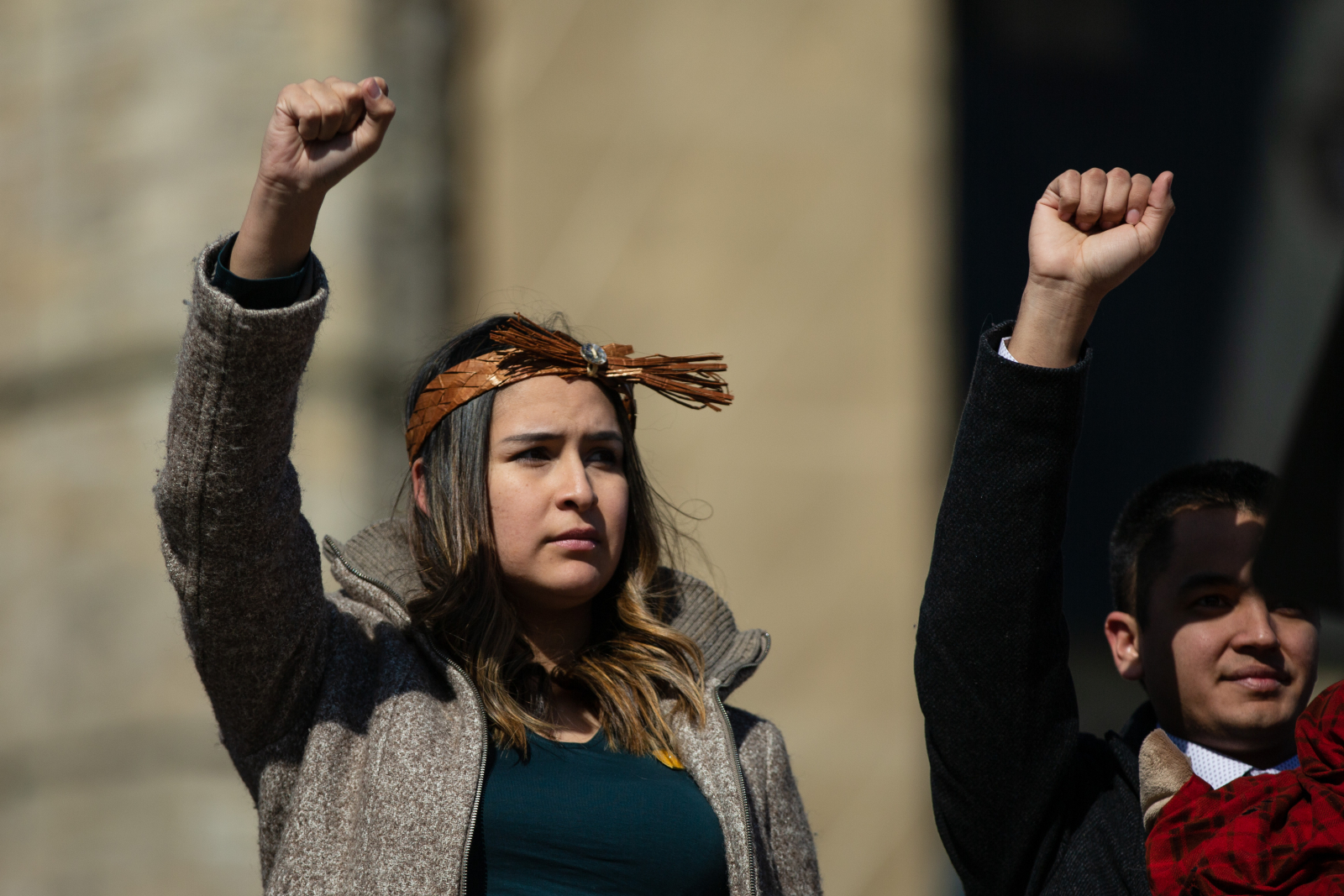
Raven Lacerte, co-founder of the Moose Hide Campaign, raises her fist on Parliament Hill in Ottawa on Oct. 18, 2018. Photo by Alex Tétreault

And so, Minister of Crown-Indigenous Affairs Carolyn Bennett, addressed a crowd of several hundred on Parliament Hill, speaking of the inter-generational phenomenon of violence against women, and inevitably linking it to the legacy of the residential school system now a topic of incendiary condemnation against the-then colonialist 19th century government that had initiated a project to remove aboriginal children from their families and educate them in the ways of the white folk at custodial schools. Much like, in fact, the upper-crust British 'public' school system.

Absolutely everything recognized as First Nations troubles, from addiction to child neglect, criminal activity to an inherited welfare syndrome, all the malfunctions and dysfunctions of a people seemingly incapable of adjusting to ordinary life in a democratic system, to be responsible for their own well-being, to respect the law, to engage in generalized social life, to be gainfully employed, to be responsible for raising healthy, educated children -- is now attributed to the 'trauma' imposed by the residential schools system.
Sage Lacerte, national youth ambassador for the Moose Hide Campaign, on Parliament Hill on Oct. 18, 2018. Photo by Alex Tétreault

A trauma that has lingered and festered generation after generation, explaining why it is that more First Nations children are removed from the bosoms of their incapacitated family to be given shelter and presumably opportunities by public welfare agencies, and that aboriginals are over-represented in Canadian prisons in comparison to their numbers in the general population, and that alcohol and drug addictions consume too many First Nations lives, all attributable by default to their grandparents having been placed in residential schools.

The violence committed against Indigenous women is commonplace and horrendous. And although there is the prevalence of hostility and discrimination from wider society against First Nations people, a human rights crime in and of itself, much of the contempt in which they are held would without a doubt dissipate were they viewed as willing and able to integrate into general society. First Nations people have a proud past and they should regard that with pride and dignity. There is a way to fight bigotry and seek the justice owing them through their own efforts.

But as long as their communities, with the support of a sympathetic broader public continue to deny that most of the violence committed against girls and women come from within their own communities, not those outside them, and insist on attributing that violence to the lingering after-effects of the residential school systems and the degrading loss of self-esteem, nothing will be accomplished. They have indeed suffered viral discrimination. But they have also spurned opportunities to shed the past and embrace a presence as unhyphenated Canadians.

The transition from a dependent people insisting they represent an entirely different set of "nations" within the greater nation of Canada which does them no favours, is past due. Victimhood and resentment cannot forever mark their destiny, but it will unless they take the mature steps required to shed the dependency of federal handouts to finally assume their rightful place in the Canada that has prospered by absorbing people whose goal is simply to be Canadian and in the process take advantage of all opportunities that status offers them.
Our Goal is to end violence towards women and children. To help achieve this, the Moose Hide Campaign will distribute 10 Million Moose Hide squares across Canada.
  • We will stand up with women and children and we will speak out against violence towards them.
  • We will support each other as men and we will hold each other accountable.
  • We will teach our young boys about the true meaning of love and respect, and we will be healthy role models for them.
  • We will heal ourselves as men and we will support our brothers on their healing journey.
  • We encourage you to Take Action, Make the pledge, and Stand up to end violence towards women and children.

Labels: , , , , , , ,

Thursday, February 01, 2018

Justice Will Prevail, Satisfying No One

"He turned and looked at me like he was going to be sick. He said, 'I don't know what happened ... It just went off ... I just wanted to scare them. It just went off'."
"Once I saw the collision, I took off running for the house."
"As they pulled him out that's when I saw what looked to be the barrel of a gun with no stock come out with the driver. It was laying between his legs and, as they pulled him, it came out with him."
Sheldon Stanley, son of second-degree murder suspect Gerald Stanley, Battleford, Saskatchewan
boushie_trial

The trial of 56-year-old Saskatchewan farmer Gerald Stanley is underway in Battleford, Saskatchewan. Mr. Stanley has pleaded not guilty to second-degree murder although it was his discharging of a gun that seems to have been responsible for the death on August 9, 2016, of Colten Boushie, 22, a Cree man from the Red Pheasant First Nation.Mr. Boushie had driven, with four friends, on to the rural property of Mr. Stanley. Mr. Stanley's 28-year-old son was the first to testify for the defence.

Fatally shot in the back of the head after a brief altercation on the Stanley farm in the Rural Municipality of Glenside, Mr. Boushie's family and friends and supporters are understandably upset at the fact that there were no Indigenous jury members accepted for this trial though plenty were available; scrutiny released them from jury duty. The jury is comprised solely of whites, and the grieving family and community suspect the fairness of the justice to be meted out in this most unfortunate of cases leading to the death of a young man.

Area members of the farming community are in support of Mr. Stanley, claiming that it is their right to protect life and property from those seeking to criminally access property not their own. The Aboriginal community insist that the death of the young man will lead to a miscarriage of justice because initially the investigating RCMP spoke of a possible criminal intent of robbery led the five young aboriginals onto private property.

One of the five friends in the vehicle that day, Eric Meechance, testified of their plans to go drinking and swimming at a nearby waterhole for the day. They first drove to the home of Boushie's grandmother and there they drank Crown Royal and shot at targets in the backyard, using a .22-calibre long-barrel rifle that had accompanied them in the SUV owned by one of the five, Kiora Wuttunee. The company was completed with two young women, girlfriends of Boushie and of another young man in the group.

From the grandmother's property they drove to a nearby river where they swam for an hour, then left in the grey SUV, sustaining a flat tire on the way. Meechance testified their having driven onto a property pulling up alongside a truck. The SUV driver, Cassidy Cross, asked for someone to give  him something he could hit the truck windshield with, and he was handed that same rifle and the stock smashed the window. Then they drove off the farm, the SUV's muffler trailing, the flat tire driven on its rim.

From there Cross drove the SUV onto the Stanley property, where Cross exited the SUV and jumped onto a quad (all-terrain vehicle) which he was unable to get moving. That's when they heard someone shouting, leading Cross to leap back into the SUV. Then something cracked the SUV's windshield. They hit a parked SUV backing up at which point Meechance and Cross began running off, then heard two gunshots. What Mr. Stanley's son Sheldon described fairly well meshed with that account.

Sheldon Stanley testified he had been busy helping his father build a gate for a fence. His mother was mowing the lawn. Both men heard a loud vehicle drive into the yard as the grey SUV pulled up beside a gold truck. They watched as someone jumped out of the SUV, got into the gold truck and rummaged through it. The SUV then moved toward the shed and he heard one of his father's quads being started. When the person on the quad saw the younger Stanley running toward them he leaped back into the vehicle to drive off.

Sheldon then smashed the front windshield of the SUV with a hammer, and Cross began backing it away, as the Stanleys watched it "take a hard 45-degree turn" into Lisa Stanley's parked SUV. The younger Stanley had dashed into the farmhouse for keys to the vehicle, planning to follow the grey SUV to apprehend them. As he ran out of the house and into the yard he heard shots. His mother shouted at him to call 911.

At that point the two young women exited the back seat of the SUV and one opened the driver's door, pulling the driver, Colten Boushie, then dead, out of the driver's seat. The women then turned and attacked Sheldon's mother, pulling her to the ground, repeatedly striking her. Then they simply walked away, walked away and out of the farm property. Sheldon was asked by the Crown prosecutor if he had noticed a weapon in the vehicle before Boushie was shot, and he responded he had not.

He was asked by Crown prosecutor Bill Burge if anyone in the SUV had spoken to Sheldon or his father and again he responded, no. An RCMP constable informed the court of a police report responding to calls of a trespass on a nearby farm, the Fouhy farm. Constable Andrew Park recounted that a broken barrel of what is believed to be the same rifle was discovered on the Fouhy farm. The vandalism there was comprised of a broken truck windshield, the suspicious vehicle described as a grey SUV with a flat tire and dragging muffler.

All of which comprised fairly damning evidence of five young people, likely in various stages of inebriation (Meechance had said they had fallen asleep in the moving SUV just before it arrived at the Stanley farm), routinely it seemed looking out to indulge in some mischief on private property, explaining in large part area farmers' contentions that they were entitled to protect their property from vandals.

That they were in a state, however mild of alcohol intoxication, had with them a rifle, were seen destroying property and seeming to engage in efforts at appropriation of property, points to a series of misadventurous and malicious sociopathy leading to an accidental death.

Petty crime is no excuse for an over-reaction induced by an atmosphere of earned mistrust, but it does go a long way to explaining why the two solitudes, the Indigenous community where the unemployed and sociopathic young grate on the nerves of the white farming community who believe their hard work in enabling them to acquire property should be respected become targets of illicit activities.

Such a dreadful outcome as the death of a young man in a disharmonious environment such as that described was perhaps inevitable; farmers carrying shotguns for 'protection' from thieves in their trucks and tractors;  young people carrying rifles for target practise in their vehicles.

Labels: , , , ,

Monday, January 29, 2018

Two Canadian Solitudes

"If you're a First Nations person, you live, you breathe this [racism]. As a First Nations mom, I live in fear. I would love for you to walk with me. I'd take a week off from work and I'd go incognito, maybe with a ponytail where nobody knows that I'm the chief."
"We'd walk around and go different places and you'd see clearly the fear -- not only physical but professional -- knowing that my [children]  are going to be viewed as less than ... as not worthy as their friends who are not First Nations."
Kim Jonathan, first vice-chief, Federation of Sovereign Indigenous Nations (FSIN)
Colten Boushie, 22, died on Aug. 9, 2016, after a shooting on a farmyard in the RM of Glenside.
Colten Boushie, 22, died on Aug. 9, 2016, after a shooting on a farmyard in the RM of Glenside. Facebook

"I see many posts from Aboriginals to fill the courtroom to show support for [Colten] Boushie. However, I haven't seen one request from local farmers, neighbours or family to show support for Mr. Stanley."
"As a farmer's wife, I believe what Gerald Stanley did was to protect his family, however, I think the courts will be pressured by Aboriginal presence to make an example of him. I think it should be posted somewhere, anywhere, that farmers support Gerald Stanley and the ability to defend our property from armed, drunk and violent trespassers, regardless of race."
Facebook member of Farmers with Firearms
Gerald Stanley Liam Richards / Saskatoon StarPhoenix
"Here's a situation where you've got some folks that are different from each other; there's a lot of unknown between each other and a lot of mistrust going both ways."
"It's a hot-point button that could drive more of a wedge between our communities."
"But if there's a not guilty [verdict], I'm scared how bad it could get."
John Lagimodiere, editor, publisher, Eagle Feather News
"This must stop."
"These comments are not only unacceptable, intolerant and a betrayal of the very values of and character of Saskatchewan, they're dangerous."
Saskatchewan Premier Brad Wall

"This case should make all Canadians feel uncomfortable. It should knock them out of their comfort zone."
"The night Colten died, the RCMP searched his mother's trailer while at the same time telling her that her son had been killed."
"I'm white. There is a zero-percent chance that, had I been shot, the police would have searched my parents' house while notifying them I was dead."
Chris Murphy, Boushie family lawyer
The initial RCMP press release intimated that robbery might have been involved when on August 9, 2016, a resident of the Red Pheasant First Nations, 22-year-old Colten Boushie, out for a day of swimming and drinking, with four friends, drove onto the property of farmer Gerald Stanley close to the town of Biggar. The farmer and the group of friends in the vehicle faced off confrontationally and while the others fled at the sight of the farmer's rifle, Boushie, still sitting in the vehicle, was fatally shot.

Ultimately, charges of theft were never laid against Boushie's friends who escaped injury. And why the friends made their way to the private property of the farmer, and the confrontation ensued remains uncertain, though it was suggested they had a flat tire and were looking for help. Which is passing strange in that most men know how to change tires, a common enough though nuisance occurrence on the highway. Mr. Stanley exited his farmhouse, rifle in hand, to confront what was purportedly a vehicle full of inebriated young men.

Farmers in the area, supporting Mr. Stanley's reaction claim that it is every farm owner's right to protect property from trespassers. If people are merely trespassing, it's odd that farm owners feel entitled to confront them, lethal weapon in hand, however. Many of those farmers, eager to make a point, posted photographs of the cabs of their trucks and tractors, rifles installed where they could be readily accessed. No racism was involved here, they claim, but rather a reaction to a crime problem.

"I think that Canadians should be thinking about how is it that Canada is at this place right now in terms of race relations. Where does it come from? How did it manifest to be like this? And how do we move forward", provocatively wrote Robert Innes, an Indigenous studies professor at the University of Saskatchewan. All worthwhile reminders that both 'sides' in this conflicting situation have much to consider, and much to lose. Those 'sides' are wider than Saskatchewan only; the personal search of conscience and introspective search for answers must be undertaken nation-wide. On both sides.

According to the RCMP the complaints filed by the Boushie family against the federal police force are without substance; that they had been treated with respect, rather than as the family claimed, made to feel like criminals. The officers involved were cleared of wrongdoing by an internal investigation into the situation. But as a sociology professor at the University of Saskatchewan pointed out, whatever motivated the shooting, there is a wider discussion relating to the kind of racism foisted on Indigenous people.

The controversy following Mr. Boushie's death, stated Julie Kaye, "reflected so many people's lived experiences", citing proven allegations that police on occasion engage in "starlight tours", where Aboriginal people found intoxicated on the streets are often driven to remote, isolated locations and simply dropped off, to somehow make their way back to town, in sometimes inclement weather conditions. "It's the work right now of the country to take these instances and really understand the broader context", Professor Kaye stated.
Alvin Baptiste stands by the grave of his nephew, Colten Boushie.
Alvin Baptiste stands by the grave of his nephew, Colten Boushie. (Richard Agecoutay)

Jury selection for the trial of Gerald Stanley in the death of Colten Boushie has been taking place this week in Battleford, Saskatchewan. Pitting the Aboriginal community against the white, rural farming community. The trial of the fatal shooting of an unarmed young Indigenous man where his shooter is charged with second-degree murder has divided the community anew. Eagle Father News suggested its readers guess the potential trial outcome.

Thirty-one percent felt that the farmer would be found guilty of a lesser charge Another 26 percent felt he would be found not guilty of any charges. The hope among those who prefer to avoid any further, future confrontations capable of provoking violence, is that leaders of both communities would find a way to improve relations. Should Mr. Stanley be released of responsibility for the death of young Mr. Boushie, however, all bets are off.

That jury selection resulted in not one Indigenous person out of the available hundreds of potential jurors being chosen, leaving the jury comprised of only non-Aboriginal white people, This turn of events  hasn't given the Indigenous community comfort in the sense that justice will be done, even if the trial itself will answer enough questions to ensure that justice has been done, if there is no conviction.

Boushie family lawyer Chris Murphy, left, and Jade Tootoosis, Boushie's cousin
Jade Tootoosis, the cousin of Colten Boushie, says she was disappointed to see Gerald Stanley's defence attorney challenge "every single visible Indigenous" person as a candidate for the jury in Stanley's trial. (Guy Quenneville/CBC)

Labels: , , , , ,

Friday, July 07, 2017

Pardon My Loyalty

"I told the young people they had crossed a line where their personal beliefs, their personal ideology -- which they are allowed to have -- got into the public domain."
"Their personal beliefs, whether religious, political or white supremacy, whatever the Proud Boys represent, it's not a shared value of the Canadian Armed Forces."
"I apologize for the actions of my young sailors, and ... I hope that those young people will find a moment to make their own apologies in due course."
"We  have such a very open and inclusive message. It helps to stabilize conflict around the world. Those values are very much at stake in an incident like this."
Rear Admiral John Newton, Halifax, Nova Scotia
Chief Grizzly Mamma
Chief Grizzly Mamma shaved her head  in Halifax at the Statue of Edward Cornwallis, former Nova Scotia governor, as a symbol of mourning. (Anjuli Patil/CBC)

"The actions of a few do not reflect the Royal Canadian Navy and Canadian Army commitment to being inclusive and diverse organizations."
"[The chain of command] takes action [when a member's conduct betrays the military code]."
Vice-Admiral Ron Lloyd/Lt.-General Paul Wynnyk

"What happened was deplorable. [The offending men were removed from training and duties as the military police conduct their investigation]."
"Their future [the offending five young men representing their personal pride as Canadians while members of the Canadian navy and army]in the military is certainly in doubt."
Chief of the Defence Staff, John Vance

"This kind of behaviour is not tolerated in the Canadian Armed Forces."
"There will be consequences for CAF [Canadian Armed Forces] members who express intolerance while in -- or out -- of uniform."
Minister of National Defence, Harjit Sajjan
Richard Blackwolf, far left, says the Canadian Armed Forces members who confronted Indigenous activists were 'silly' to have gotten involved in a standoff, but should not be forced out of the military.
Richard Blackwolf, far left, says the Canadian Armed Forces members who confronted Indigenous activists were 'silly' to have gotten involved in a standoff, but should not be forced out of the military. (Michael Fazio/CBC)

Oh dear. Pride in one's country may no longer be expressed, particularly on that most prideful of all days in the calendar year, Canada Day, July 1. And if an extra measure of pride and loyalty on Canada's 150th 'birthday' seemed appropriate to most Canadians who looked forward to appearing at significant Canadian commemoration spots throughout the country in all of its cities, inviting all of its citizens to enjoy themselves in a grand celebration, when would it be appropriate?

Oops, lest we forget. It was definitely not appropriate for Canada's aboriginal peoples. They put on particular and special shows of aggrieved defiance, from setting up protests on Parliament Hill to appearing throughout the country where tributes in statuary sit to founders of the nation, to express their fury at a celebration that they insist came at a dreadful cost to Canada's native peoples. Who had indeed experienced the misfortune of foreigners flooding a land they considered their own, with all the indignities, hardships and miseries that accompanied that history.

Canada's aboriginal communities insist that they are a nation within a nation. And contrite Canadians, asking forgiveness for the colonialist past where their ancestors deprived the original dwellers of the land of their status and their homeland, will never, ever be able to satisfy the aggrieved demands and the poisoned darts of blame that aim ceaselessly for a target mostly acquiescing in that blame and shame. Which accounts in large part for prodigious efforts to attempt to appease the claims.

But the fact of the matter is, victimhood is so tightly embraced that solutions elude. Any ventures undertaken are struck down with contempt. And contempt is precisely what Canada's sesquicentennial was treated to in the face of aboriginal claims of "a fu---ng genocide". So when the five young men in this controversy heard of a different kind of ceremony set to take place around the statue of the former governor of Nova Scotia and the founder of Halifax, they decided to have a look, carrying the old Red Ensign with them.

There they found a Canadian flag scribbled with "decolonize" on it, being carried upside-down, the intention to represent atrocities committed against Canada's Indigenous people. The young men explained when their appearance was  questioned that they were simply curious. Someone informed them "This is Mi'kmaq territory". One of the young men responded with his own statement: "This is Canada". At no time was there disrespect evinced, no loud voices, no accusations -- not from the five young men.

The acrimonious insults erupted from the First Nations people conducting their sacred ceremony which included disrespecting the national flag of Canada. Though they hadn't been in uniform, social media revealed them to have been members of the Canadian Forces; four sailors, one with the army. Now, their innocent encounter with bitterly aversive Aboriginals relishing their victimhood and whipping themselves into a frenzy of ferocious hatred on Canada Day has resulted in their abandonment.

The craven, politically-correct authorities in the Canadian Armed Forces, not to mention the Minister of National Defence illustrates just how morbidly absurd the situation is. The crude animosity of First Nations peoples unless they are kow-towed to constantly is suffered with good grace and patience. They can accuse and cast aspersions as unfairly and as frequently as they have a mind to, and that is often and venomously, but no criticism, however gentle, may come their way.

What a sad and sorry spectacle. The Minister of National Defence, sternly admonishing all and sundry that such untoward behaviour as that exhibited by the unfortunate five is not to be accepted. While he, on the other hand, in an exercise of prideful self-aggrandizement can tell whoppers to impress a foreign audience, in the process insulting the very Armed Forces he represents, and aside from public embarrassment there is little penance to pay.
"The whole military has become politicized, we're living in a politically correct era and they [the CAF members] should have realized that this thing would be a media event."
"But, hopefully, it won't affect their overall careers. I mean they just showed up there with a flag. They didn't beat up on anybody, it's not like that."
Richard Blackwolf, national president, Canadian Aboriginal Veterans and Serving Members Association (CAV)

Labels: , , , ,

() Follow @rheytah Tweet