This is a blog dedicated to a personal interpretation of political news of the day. I attempt to be as knowledgeable as possible before commenting and committing my thoughts to a day's communication.
"Experience shows that Iran's enemies, after failing to create a split
in the nation's united ranks, take revenge through violence and terror. "
"This crime will definitely not go unanswered, and the security and law
enforcement forces will teach a lesson to those who designed and carried
out the attack."
Iranian President Ebrahim Raisi
Photo: Associated Press
At a time when the Islamic Republic of Iran is undergoing ongoing paroxysms of inflamed protests throughout the country with woman gathering in huge numbers to emphatically give evidence of their unwillingness to continue to obey a restricted lifestyle to satisfy the misogynistic Islamist demands of the Iranian clergy, Islam demonstrates yet again the deep and violent antipathies within its major sects. Where loathing between Sunni and Shia factions are infamously demonstrated in attacks taking place in the sacred precincts of Mosques where blood is freely shed as a testament to the gentle faith of the religion of peace.
There is a seasonal regularity to attacks by Sunnis that the Iranian regime correctly identifies as terrorists attacking a terrorist state. They deserve one another. The regime that terrifies its own population, coercing and exploiting them to involuntarily accept the theocracy's edicts in strict adherence to Sharia law as it is interpreted by Iranian Ayatollas. The country whose penchant is to organize disaffected Shiite populations in other countries to become death-cult threats against majority Sunni Arab states and the Jewish state of Israel, sees its evil coming home to roost.
For people of faith who dedicate every aspect of their lives to worship of Allah honouring the Prophet Mohammad and in the process organize themselves to express the values purloined from a greater, earlier religion of ancient origins, Muslims seem to be infinitely more aggressive with a penchant for carrying deadly arms and using them than most inhabitants of other countries not located in the Middle East. With the additional penchant of preying on one another, in the process slaughtering other Muslims whose values deviate from their own.
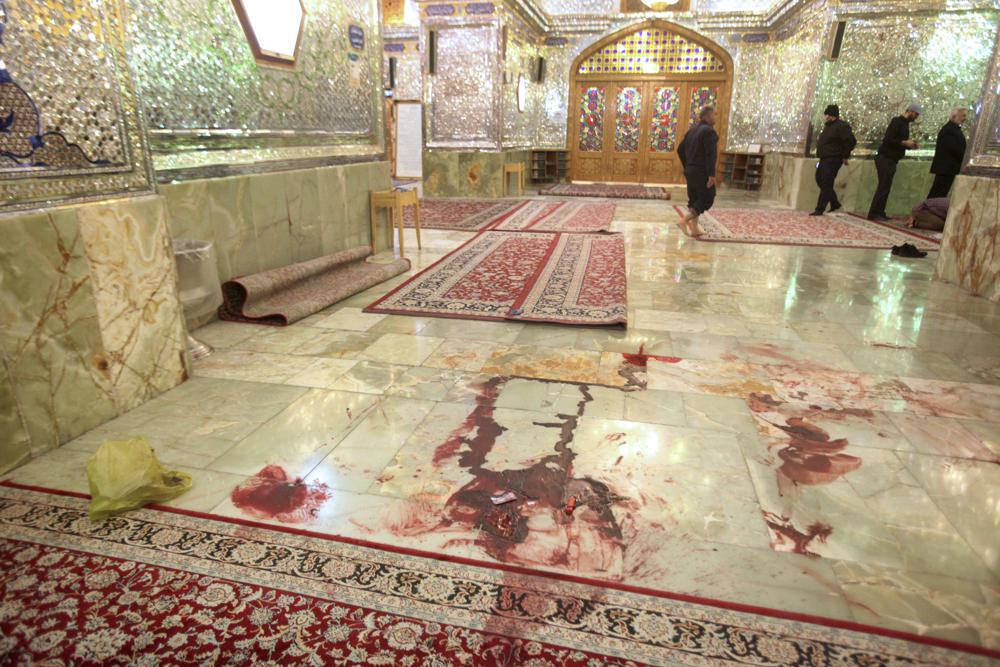
Two gunmen opened fire on Wednesday at a major Shiite holy site in Shiraz, Iran. Fifteen worshippers were murdered and an estimated 40 people in attendance at the Shah Cheragh mosque were wounded. Extremists targeting an extremist state. The worshippers guilty of nothing but honouring their faith and tradition. The gunmen are under arrest, and the authorities promise a retaliatory bloodbath. One they will not hesitate to deliver.
Their taste for blood has been whetted of late by the massive protests that have resulted from the murder in custody of a young Kurdish woman whose crime was to offend the morality police by wearing her headscrf too loosely. Mahsa Amini's death has been avenged by her fellow Kurds whose uprising has inspired Iranians all over the country, sick to death of being ruled by mullahs whose fundamentalism is an insult to human nature.
Protesters chant at a vigil for Mahsa Amini, a woman who died in police
custody last month, at the entrance hall of the Khajeh Nasir Toosi
University of Technology in Tehran, Iran, in this screengrab from social
media video released Wednesday. (Reuters)
"Death to the dictator!" has latterly replaced the chant of "Death to America" and "Death to Israel". The 40-day anniversary of Mahsa Amini's murder called for a traditional ceremony and one was planned in her hometown of Saqez, where huge crowds assembled to the local cemetery where she is buried. Her parents were informed that they were expected by the regime to cancel the ceremony; not to do so would place Mahsa Amini's brother's life in peril, they were informed.
The ceremony proceeded as planned. Women at the Aichi Cemetery ripped their hijabs off, waving them in the air. Ten thousand protesters were reported to be part of a massive procession to her grave. Schools and universities in the northwestern region were closed in solidarity with the protest. The Kurdistan governor spoke of the situation being "completely stable".
In Tehran, the downtown saw major sections of the immense grand bazaar closed, a symbolic gesture of support for the protests. Crowds clapped, shouting, "Freedom! Freedom! Freedom!" in the huge marketplace. "This year is a year of blood!" they chanted. "(Supreme Leader Ayatollah Ali Khamenei) will be toppled!"
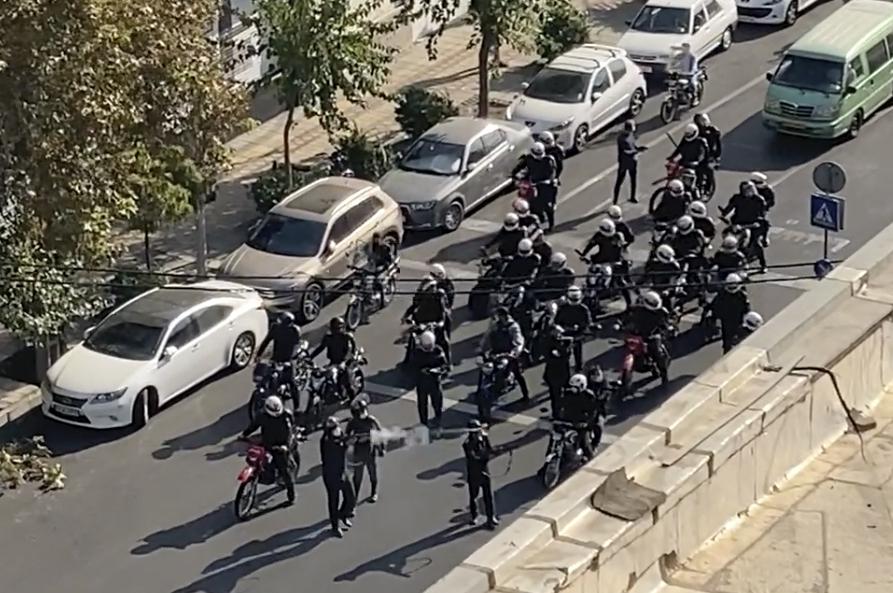
Iranian police arrive to disperse a protest in Tehran marking 40 days since the death of 22-year-old Mahsa Amini, whose arrest and death in custody sparked anti-government demonstrations and posed the biggest challenge to the Islamic Republic in over a decade. Photo: Associated Press
"I stopped eating almost a week ago. My body just can’t take this
anymore…this place guarantees you lost your sanity, your dignity, your
humanity one way or another…It’s exhausting trying to protect myself all
day, all night. I can’t do it anymore."
Kimberly Polman, 49, Canadian Camp Al Hol internee, Syria
"She was hoping she could go home, she was given reason to believe that
that might be the case from someone high up in the camp, especially
because of the snap election."
"She’s really
devastated [that she can’t come home], she’s been sick for a while, she
has broken teeth, she has kidney infections…she’s distraught and says
she doesn’t want to live anymore….it’s the last thing she has control
over."
"I am all for justice, and the choice she made has consequences beyond
anything that she could have ever imagined. But we don’t
have our Canadian citizenship on merit…even the most hardened criminals
and murderers are granted the rights of a Canadian citizen….they are
still human beings, they are still Canadians."
"I hate ISIS and everything that did, they stole my sister. But I believe that everybody can be redeemed if you give
them a chance, and that they should face justice when they get back…but
that doesn’t mean that they should be left to die out there."
Polman's sister, name withheld
"For over two years, dozens of Canadian ISIS suspects and their family
members have been unlawfully detained in locked desert camps and prisons
in northeast Syria."
"Most are young children who never chose to live
under ISIS. It’s deeply troubling that these
detainees and their families in Canada would have to resort to taking
their government to court to end this paralysis…"
"Prime Minister Trudeau
has the power to bring these Canadians home. He just needs to find the
moral courage to do so."
Farida Deif, Canada Director, Human Rights Watch
Women and children related to fighters of the Islamic State group wait
to board buses and trucks, leaving the overcrowded a an overcrowded
al-Hol camp to return to their homes on June 3, 2019, in Hasakeh
province, Syria. THE CANADIAN PRESS/AP, Baderkhan Ahmad
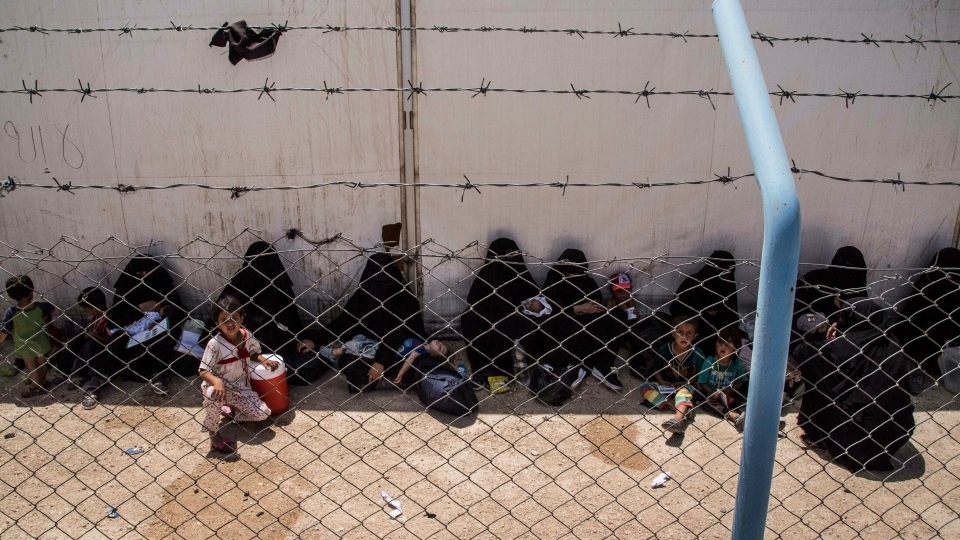
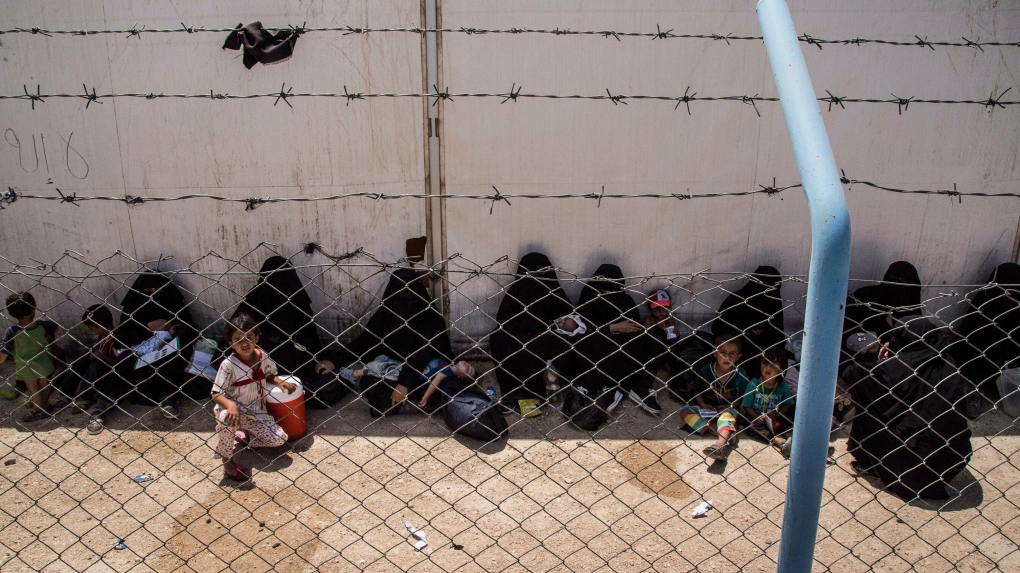
Eleven families with Canadian citizenship who have relatives being held at the Al Hol camp for relatives of members of the Islamic State of Iraq and the Levant have appealed to the Supreme Court of Canada to order the Canadian government to retrieve their relatives from the squalid camp housing women and children in a repatriation move setting aside their involvement with the Islamist terrorist fundamentalists whose litany of vicious deadly atrocities shocked the world, but evidently not the women who travelled from Canada to Syria to join ISIS and become 'brides' of ISIS.
The families, in the interests of maintaining anonymity, will not have their names and identities published. Using a covering name of "Bring Our Loved Ones Home", they are pursuing a law suit against Canada's government for refusing to act on their appeal. Either to repatriate the Syrian-Canadian men who travelled to Syria for the express purpose of joining ISIS and are incarcerated in the Al Roj prison maintained by the Syrian Democratic Forces, a Kurdish fighting group that would prefer to have the fighters and the women detainees taken off their hands altogether.
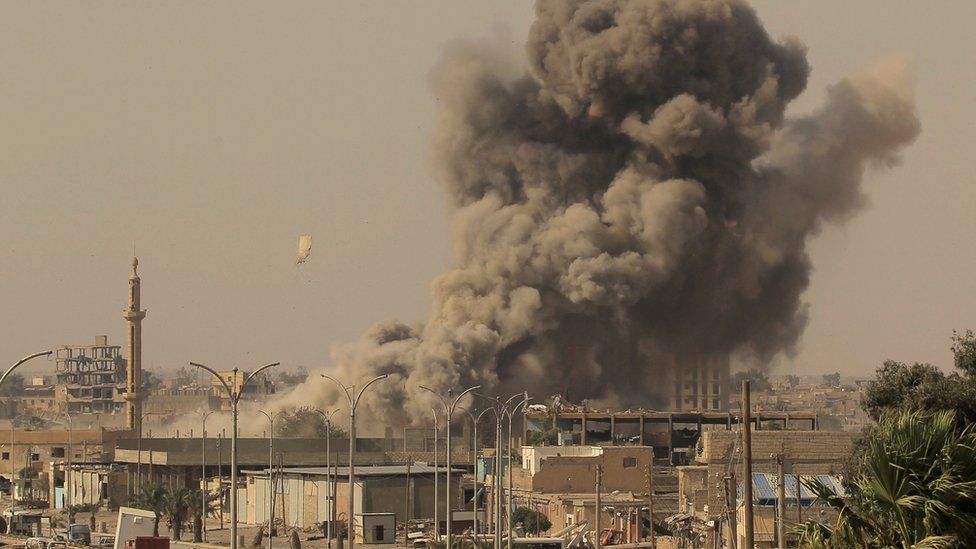
The Kurdish fighting groups were the only effective offensive against the Islamic State terrorists. They offered protection to Shiite Muslims whom the Sunni ISIS threatened, to the Christian and Yazidi minorities whom they killed and enslaved, giving them haven in Kurdistan while simultaneously battling the encroaching ISIS 'caliphate'. When their collaboration with U.S. forces eventually led to the overthrow of the ISIS stronghold in Raqqa the Syrian Democratic Forces ended up rounding up and incarcerating ISIS fighters and their wives and children, holding them in separate camps.
US-led air strikes helped Kurdish and Arab fighters capture the IS stronghold of Raqqa Reuters
The group's application describes camp conditions as "horrific", with "a lack of clean water malnutrition, non-existent hygiene measures, an acute shortage of medical care and facilities, violence and abuse". The detainees, they point out, have never been charged with any offences, and no trial dates have been noted. The government of Syria had repatriated their own citizens from the camps and trials are ongoing, the fate of the fighters who had captured a third of Syria for their caliphate will no doubt suffer a fate similar to that they imposed on those they took prisoner and committed atrocities upon from beheading to crucifixion and other imaginative methods of death-dealing.
The Canadian families, most of whom arrived in Canada as refugees escaping persecution in their Muslim home countries, state in their filing: "The Canadian government has the ability to bring the unlawful
detention to the end and secure the release of the detained Canadians". Characterizing the incarceration of Islamic State avowed Islamists as 'unlawful' is a bit of a puzzler to begin with. Universality of solutions to rogue mass slaughterers is generally to sequester them to ensure the safety of others rather than permitting them to remain at large to continue their violent depredations.
It's also a little difficult to evoke compassion for the plight of such human rights abusers whose actions shocked the world when propaganda videos were released of ISIS members exulting in the beheading of helpless prisoners whose crimes were that they were not fundamentalist Islamist butchers, but vulnerable outsiders for whom ISIS crimes represented an assault on civilized universal mores of human behaviour. That they now suffer the indignities of mass incarceration under less than hygienic conditions is sad, but no tragedy.
The tragedy is that of the children in the camp. Theirs was a tragedy when they were born to ISIS parents to begin with, and later to be raised and taught the values of fundamentalist Islamist principles of conquest and jihad. They were born abroad, not in Canada. The older children up to age 14 who were taken by their parents to Syria to be part of the brave new world of the Islamist caliphate were raised in the miasmic atmosphere of a brutalized social order, many of them exposed to and urged to take part in atrocities.
Islamic State adherents don't flinch at human butchery. They caused innumerable deaths, focusing on minority groups within their widening grasp as their geographic holdings increased and they created a mass of desperate refugees, anxious to escape death. Their victims include men, women and children. Just as the detainees by the Syrian Democratic Forces represent men, women and children -- who preyed on other human beings. These are people who share a deviant and fundamental lack of social conscience.
Calling now upon the conscience of decent people to come to their rescue.
Children hold water containers in al-Hol camp, Syria, on January 8, 2020. (Goran Tomasevic/Reuters)
"We really don’t know what happened. Anything is possible, the militants
might have panicked and shot the hostages dead, or they might have died
during the aerial bombings." "But the main point is not
who killed them but rather why the Turkish military carried out this
operation to bring the hostages back alive in a manner that led to their
deaths."
Human Rights Association’s president, Ozturk Turkdogan
"If we are together with you [the United States] in NATO,
if we are to continue our unity, then you will act sincerely toward us.
Then, you will stand with us, not with the terrorists."
"The US statement on the PKK’s execution of Turkish citizens in
northern Iraq is ridiculous. They claim they do not support the PKK, but
they certainly do."
If you want to continue our
alliance globally and within NATO, then you must stop siding with
terrorists."
"We kept trying to figure out how we can rescue our brothers from the
hands of the terrorists. We tried very hard, but we failed."
Turkish President Recep Tayyip Erdogan
"If the reports of the death of Turkish civilians at the hands of the
PKK, a designated terrorist organization, are confirmed, we condemn this
action in the strongest possible terms."
"The secretary expressed condolences for the deaths and affirmed our view that PKK terrorists bear responsibility."
United States State Department
The funeral of three Turkish military personnel killed in action at the
Ahmet Hamdi Akseki Mosque in Ankara on 12 February 2021 (AFP)
The
Kurdistan Workers' Party (PKK) is a guerrilla militia which established
itself in the 1980s to represent the heritage rights of the tens of
millions of Kurds, the world's largest minority ethnic group without an
established homeland of their own. Their native territory was divided
between Iraq, Iran, Syria and Turkey when two world powers, Britain and
France, occupied that vast area during World War I after the dissolution
of Ottoman Turkey the deposed hegemonic power.
Although Kurds were
promised in the boundaries of the Middle East territories their claim
would be honoured, it was not.
Ever
since, ethnic Kurds have dreamed bitterly of the betrayal and have
agitated for their own recognized sovereign homeland reflecting their
historical presence in the geography. Any attempt made to achieve
sovereignty earned them physical violence to tamp down their enthusiasm
for leaving their state of enforced occupation under which their
'separatist' notions were regarded as criminal, leaving them to live as a
people under merciless disciplinary duress.
Iraqi Kurds fear Turkey's drones in PKK mtn.war
A state of being that brings to mind China's crushing of Tibet and
Xinjiang and its aspirations toward absorbing Taiwan and shutting down
democracy in Hong Kong. Recep Tayyip Erdogan rails against the very
concept of a Kurdish nation desirous of and deserving of recognition of
their authenticity as the original territorial indigenous peoples. He sneers at the very concept of Jews returning to their ancestral
geography from a forced historical diaspora, championing Arab migrants
who began to populate Jewish Palestine in search of economic and settler
opportunities. The Turks themselves were migrants into the Mesopotamian
plain and the mountainous regions beyond, the historical Kurdish
homeland.
Kurds living in south-eastern Turkey have had their villages bombed on
the pretense that they harbour members of the PKK. The PKK expanded
their presence into Iraq as an operational base, with the Turkish
military following them, accusing another Iraqi Kurdish group, the YPG
of being their allies. Among the various Kurdish groups there are
manifestly different attitudes toward occupation with some choosing
diplomacy others violence to achieve eventual aims of freedom from
persecution and occupation.
The hunted PKK have taken Turkish members of the military captive from
time to time to use as leverage in prisoner exchanges. A group of such
Turkish hostages were being kept in Kurdistan, a mountainous area of
northern Iraq bordering Turkey, in a cave in the Gara region. There, the
Kurdistan YPG the Syrian Kurdish People's Protection Units, are accused
by Erdogan of aiding and abetting the PKK, calling them both terrorist
groups. The Turkish military under Defense Minister Hulusi Akar, despite
knowing that Turkish hostages were being held there, bombed the area
repeatedly in a four-day operation.
And after heavily bombing the Gara area for days, the Turkish forces
entered the cave complex on day four to discover, they claim, the
corpses of thirteen Turks, most members of the Turkish military, several
Turkish diplomats and three of them civilians. The PKK had made a
public statement on February 11 that Turkish war planes were hitting the
camp directly where the hostages were being held. It was this known fact that the U.S. State Department referred to when
they originally voiced skepticism over Turkey's claim the PKK had shot
the hostages dead.
The large number of Kurds in Turkey have elected their own to
parliament, the largest Kurdish-sympathizing parliamentary group called
the HDP had called upon Ankara to negotiate with the PKK for release of
the hostages. They had themselves in the past acted in that same role to
negotiate for the release of prisoners. President Erdogan spits rage at
the very thought of negotiating with "terrorists" though it had
bargained with the Islamic State for release of 49 hostages when the
Turkish Consulate had been overrun. Turkey freed a number of IS
prisoners in exchange for Turkish hostages.
This time Turkey chose to arrest hundreds of people it has identified
as linked to the PKK, a revenge move against the killing of the 13
hostages, ostensibly. Likelier, the Turkish military bombing of the area
around the cave complex led to the deaths of the hostages, which Turkey
pretends to hold the PKK responsible for; the event giving Erdogan the
opportunity to arrest and imprison those he considers his enemies. Among
them hundreds of members of the HDP. Fully 718 people were detained in
40 cities across Turkey, accused of links to the PKK.
One HDP
member of Parliament stated that roughly 150 members of his party were
detained overnight. City and district heads belonging to the pro-Kurdish
Peoples' Democratic Party (HDP) (Democratic Party of the People}
supporting Turkey's minorities were also arrested. President Erdogan
uses arrest and incarceration as a control mechanism of those Turks who
oppose his Islamist agenda and his oppressive authority. Any he believes
support the Gulenist movement after an aborted coup in 2016 languish in
prison.
These included high-ranking members of the military,
journalists, teachers, lawyers in their thousands as well as police and
members of the judiciary. Erdogan had a bitter dispute with the United
States when he insisted that Fethullah Gulen -- a popular and respected
imam, once an ally, more latterly a political adversary with a huge
following in Turkey, living in self-exile in the United States but
remaining hugely influential in Turkey and whom Erdogan blames for the
attempted coup -- be extradited to Turkey to stand trial on charges of
treason, a 'terrorist' meriting the death penalty.
Ibrahim Kalin
@ikalin1
PKK executes 13 civilian captives in a cave in #Gara, Iraq. It attacks Turkish & Iraqi security forces & civilians. It continues its terrorist attacks in northern Syria.
The world is silent. This silence is a shameful act of complicity.
But we will not remain silent.
Must a Child Live With the Choices Its Parents Make?
"He has done everything humanly possible to try and repatriate his niece, including going to the region earlier this year. He was told basically, face to face, all that needs to happen is the Canadian government has to make an official request and then provide a representative or delegate and they would be more than happy to send Amira on her way home, here to Canada."
"Amira is now five years old. She suffers from asthma. Any type of COVID outbreak in the Al-Hawl camp, which houses between 60,000 and 70,000 people, would be risking her life."
"For some reason, the Syrian government has asked, has looked into trying to identify her and locate her. We don't want to think about the consequences of what might happen if the Syrian government went after Amira and tried to take custody of her."
"This is very much a case that is being advanced on Amira's behalf, but depending on the results of it, for sure I would imagine there would be other applicants if we are successful."
"It is hard to try and understand the thinking. I don't know why they wouldn't want to repatriate a five-year-old orphaned Canadian girl to come live with her only surviving family."
Lawrence Greenspon, lawyer for Syrian-Canadian family
"This is an extremely complex situation and we recognize how difficult it is for this child and her family in Canada."
"Consular officials are actively engaged with Syrian Kurdish authorities and the international non-governmental organization providing care to her. Canada does not have a diplomatic presence in Syria and, in light of the security situation, it is extremely difficult to provide consular services anywhere in Syria. This is exacerbated by the COVID-19 pandemic."
John Babcock, spokesman, Global Affairs Canada
Women and children related to fighters of the Islamic State group wait
to board buses and trucks, leaving the overcrowded
al-Hol camp to return to their homes on June 3, 2019, in Hasakeh
province, Syria. THE CANADIAN PRESS/AP, Baderkhan Ahmad
Not all that long ago, when the Islamic State of Iraq and Syria had possession of great swaths of both Iraq and Syria, with plans to expand their 'caliphate' to execute the promise of Islamist conquest not only of majority Muslim countries in the Middle East, but far beyond, their clarion call to believers to join them resonated with Muslims throughout Europe, the Middle East, Africa, Oceania and North America, and an in-gathering of Muslims from all points of the geographic compass began.
Canada supplied ISIS with some of their jihadist warriors, aspiring to rise to the exalted levels of international terrorism that ISIS's exploits so exemplified. Regular updates in the form of news releases, videos and slick online 'magazines' horrified the world being exposed to the butchery and imaginative atrocities that the Islamic State scoured the annals of Medieval history to replicate. The numbers of terrorism volunteers basking in the glory of jihad re-awakened, soared.
News stories outlined the process of mosques being infiltrated by ISIS recruiters finding a ready and excited hearing among young Muslim men and women. Among those recruiters were Islamic clerics, people with influence in their communities who plotted with willing recruits to enable them to leave the country, destination Turkey where enablers were prepared to transit them into Syria to be incorporated into the caliphate and the ranks of ISIS terrorists. Among them were entire families.
Women and children walk inside the Kurdish-run al-Hol camp in
northeastern Syria on Jan. 14, where families of Islamic State foreign
fighters are held. DELIL SOULEIMAN/AFP via Getty Images
Young children were introduced in Raqqa to indoctrinating processes to bring them spiritually and culturally into the ISIS sphere, teaching them at an early age to handle weapons, not to flinch but to rejoice at taking lives and inducting them into the process of killing. Among other Canadians were the unidentified parents of a little girl now languishing in the notoriously violent camp holding ISIL prisoners and their families. The little girl was born in Syria. And her parents and her three siblings were killed in an airstrike during anti-ISIL operations in 2019.
When she was four, the little girl was found wandering about on her own in northeastern Syria and taken into protective custody, placed in the camp as an ISIL survivor. The only real resistance to the murderous ISIL onslaughts in Syria were the Kurdish fighters. Kurdistan also provided protection for minority groups including Christians who were targeted by ISIS; terrorized and murdered. The little girl, Amira, was located by her Canadian uncle, who envisioned rescuing her, bringing her to Canada, and raising her.
Syrian Democratic Forces (SDF) security launched a campaign to identify
and register foreign women accused of Islamic State ties at the Al Hol
camp in northern Syria, June 10, 2020. (Photo: Hawar News Agency)
Kurdish authorities would be only too pleased to have one less person to have under their guardianship. They have, in fact, been appealing for years to the global community that provided ISIS with some of their recruits and who have since shuddered at the prospect of repatriating them, though some have, to a degree. Canada has not been among them. Some Canadian Muslims who joined ISIS did return to Canada, and are purportedly under surveillance by Canadian intelligence agencies. Prosecuting them for war crimes under Canadian justice is problematical due to the lack of evidence of substance.
In Canadian public opinion to even think of bringing such brutal monsters back to Canada as a government move is hugely unpopular, and government has its ear to the mind of the public where outrage would be expressed with no uncertainty at their retrieval and at the ballot box. Bringing a child into Canada, orphaned by her parents' willingness to expose their children to the inhumanity of a religion's disregard for the sanctity of life of those not willing to surrender to Islam is another story altogether.
Amira's uncle contacted humanitarian organizations to locate her. She also has grandparents living in Toronto. What their politics happen to be, combined with their religion is unknown; what is known is that some parents were helpless to influence their offspring not to become part of the curse on humanity that ISIS represented. As a last-chance hope, the uncle appealed to the Federal Court of Canada to have the government of Canada commit to bringing the child to Canada to be raised by her remaining family.
Claims that Syria's government is interested in the little girl, are, on the face of the situation, absurd; a too-obvious bid to raise concern. No need to raise further concern over the welfare of a young child in the presence of the virulently hateful women controlling the camp who continue to support the agenda of ISIS as faithful jihadists. Amira is Canadian by virtue of her parents having Canadian citizenship. The family in Canada cannot be identified for privacy purposes.
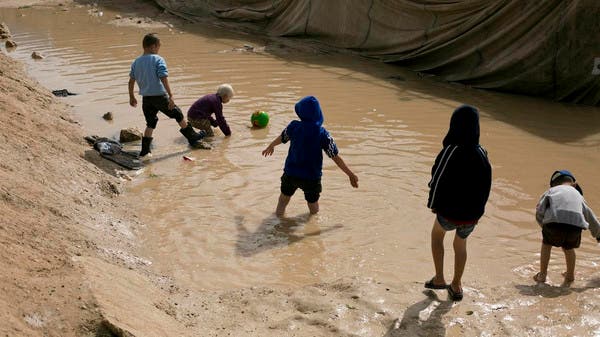
In this March 31, 2019, photo, children play in a mud puddle in the
section for foreign families at Al-Hol camp in Hassakeh province, Syria.
(AP)
On the other hand, should the uncle's appeal to permit the child to return to Canada in their care succeed, a flood of similar requests for return could ensue, involving unsavoury, criminally-involved Muslim Canadians being held in the camp. In the camp, another 26 Canadian children languish, however. The situation is a real puzzler; on the one hand as Canadian citizens, these retrograde humans are the responsibility of the government of Canada, on the other hand, with an ongoing lack of response from Canada, the Kurdish government in Syria is left with a problem not of its own making.
By continuing to do nothing, while declaring concern over a child's welfare, it is clear the government hopes the problem will simply disappear. The uncle, Ibrahim, had recently travelled to northeastern Syria and encountered no difficulties, meeting with the little girl and with Kurdish authorities who assured him of their willingness to discharge the child to Canadian care. Issuing the documents required, enabling the child to travel to Canada to be cared for by her family is simply the right thing to do.
Children at the Kurdish-run Al Hol detention camp in northern Syria last year. Credit...Ivor Prickett for The New York Times
"It is understandable that many Canadians would prefer to see these persons [Islamists with Canadian citizenship supporting ISIS overseas now held in custody] not be returned to Canada and instead remain locked up abroad." "Unfortunately, that instinctive reaction shifts the burden of dealing with these thugs and ideologues, and their children, to a country that was victimized by them and may not have the resources or stability to do what is needed." Scott Newark, former government security adviser, Toronto, Ottawa
"Given the security situation on the ground, the government of Canada's ability to provide consular assistance in any part of Syria is extremely limited." Spokesperson Department of Global Affairs, Ottawa
Men suspected of being ISIS fighters
wait to be searched by members of the Kurdish-led Syrian Democratic
Forces in Syria's northern Deir Ezzor province on Feb. 22, 2019. (Bulent
Kilic/AFP/Getty Images)
The 'security situation on the ground' is no longer the danger it once was. Certainly not in Kurdistan where members of the Islamic State of Iraq and the Levant and their families are being held, guarded by Kurdish fighters, held in Kurdish prisons. You might say in trust that foreign Islamist fighters who left the countries of their citizenship will soon be taken off the hands of courageous Kurdish militias whose exploits on the battlefield largely resulted in the defeat of ISIL.
They have no wish to hold these failed human beings as their responsibility. They vanquished the global threat which admittedly still festers and will continue to -- albeit underground until another opportunity arises where its leaders will once more infest the world with their violent threats, inflicting atrocities on the innocent -- and now they await the eventuality of these human discards being taken off their hands.
Europe doesn't want them, North America is loathe to have them return nor is Oceania anxious to reclaim their presence. An official Canadian presence in Syria is understandably difficult for political reasons, to be sure. But not impossible in semi-autonomous Kurdistan for the singular purpose of arranging that Canadian jihadis be returned to Canada for this is a Canadian responsibility as long as the government insists on not revoking citizenship from these bestial ideologues.
What is perhaps more to the point as far as uneasy Canadians are concerned, is that many of these Canadian-citizen jihadis returned from abroad of their own volition once Islamic State's 'caliphate' disintegrated, scurrying like rats from a sinking ship, to infest Canada with their ongoing presence. These are Islamists who committed themselves to a violent, disgusting ideology that embraced a very public and bestial form of violence against its 'enemies'.
Those currently in detention in Syria include a Canadian who used social media to encourage terrorist attacks in Canada, and another who is believed to have helped produce ISIS execution videos.
As such they themselves were either involved in mass murder, torture, persecution of minorities, rape, training of recruits and collaboration in communication and propagandizing threats, and with their allegiance and their militant skills now walk about unhindered on the streets of Canadian towns and cities, perhaps under RCMP and CSIS scrutiny, perhaps not. Government appears to be uncertain of its responsibility to hold these people accountable for the crimes they were involved in.
Lack of ability to gather 'proof' and 'evidence' of involvement in mass executions, rape, torture and general violence is cited lamely by the federal government as tying its hands under Canada's judicial system in holding them to account. That they are free and unhindered speaks to a lack of responsibility on government's part in not acting decisively, both to exact justice on behalf of those wronged by ISIS, and in protecting the Canadian public from the malign presence of those whose commitment to terrorism threatens Canadian public safety.
"Asked recently why these Canadians remain overseas without charge, the prime minister
deflected the question by pointing to RCMP independence. But it is the
attorney general who must approve the laying of terrorism charges and
offences under the War Crimes and Crimes Against Humanity Act (the
few that criminalize conduct by Canadians overseas). We also know that
the decision to repatriate Canadians is not the RCMP’s. That would fall
to the minister of foreign affairs, likely in consultation with the
ministers of Public Safety and National Defence if the Canadian Forces
were to be involved in their return." "The Kurds are shouldering the burden of detaining, feeding and clothing
these former ISIS members, and have repeatedly said that they do not
want this responsibility. As a non-state actor, they lack the authority
to hold trials and incarcerate them long-term. The Kurds are also facing
their own issues, notably ongoing threats from Turkey to “root out”
Kurdish terrorists, and a Syrian government that could seek to reassert
control over their territory. In either case, these conflicts could
seriously test the Kurds’ capacity to maintain control over the
detention centres. Putting a plan in place now, however unpalatable
politically, will avoid having to address this issue in an even more
insecure environment should a crisis develop on the ground."Leah West,
Amarnath Amarasingam,
Jessica Davis, June 17, 2019, Policy Options
Rewarding Loyalty : Canada and Iraq's Peshmerga Stalwarts
"The CAF [Canadian Armed Forces] delivery and distribution of equipment on the ground would ensure increased accountability and control while allowing for better synchronization of intended training efforts with equipment delivery and issue." Briefing document, July 2016
"The list of equipment comprised of small arms, ammunition and optical sights that has been acquired was originally intended to equip a force of between five to six hundred Kurdish security force soldiers." Dan Le Bouthillier, spokesman, Department of National Defence, 2018
A Peshmerga soldier returns fire as his
convoy drives through an area exposed to a sniper on November 8, 2016 in
the town of Bashiqa, during street battles against ISIL.ODD ANDERSEN/AFP/Getty Images
Prime Minister Justin Trudeau stated in February of 2016 that Canada was prepared to, and would provide weapons to the Kurdish fighting forces representing the sole regional, reliable and credible fighting force diminishing the advance of the Islamic State of Iraq and the Levant in Iraq. The then-government of Iraq made it known that it opposed providing weapons to the Kurds, despite their front-and-centre combat viability against ISIL.
Arrangements were made to filter the equipment and weapons through the government of Iraq which would then provide them for use of the Kurds. However, it was an open secret that the Kurds intended at some future date to secede from Iraq. Kurdish leaders themselves openly admitted that the equipment awaiting receipt from Canada had a double purpose; fighting ISIL, and eventually defending an independent Kurdish state at some time in the near future.
The issue is fairly straightforward. Turkey, Iran, Iraq and Syria became beneficiaries under French and British colonial rule of historically heritage land that was Kurdish and which was, in fact, promised by the colonial powers would be returned to them. However, that's not how reality played out; Turkey, Iran, Iraq and Syria were awarded the land promised to the Kurds, a large ethnic group comprised of approximately six million people.
Ever since, the Kurds have bemoaned the loss of their ancestral land, and hoped that by some miracle it would be restored to them. After the U.S.-led invasion of Iraq to remove Saddam Hussein, the only stable, forward-looking and responsible part of Iraq was in fact Kurdistan, which had suffered horribly under Saddam, where villages were razed, people were gassed, and a general upheaval took place of countless homeless and countless more slaughtered.
With the Kurdish Peshmerga dominating the offensive against Islamic State it was only reasonable that hope would be rekindled and they would be enabled to declare themselves independent, ensconced on their native homeland. But because of politics and the sensitivity of NATO countries to the wishes of the three Arab and one Aryan country squatting on Kurdish land, the promised equipment was never delivered.
C6 general purpose machine guns and C8 carbines, used by the Canadian Forces are among the military equipment being withheld from the Kurds, promises be damned. The Canadian military planned to use the Canadian Commercial Corporation to buy equipment which the Canadian Forces would be the "exporter of record" for. Non-lethal equipment was provided to the Kurds, such as helmets, clothing, bulletproof vests and bomb-hunting robots. A Kurdish Peshmerga fighter runs to take position as the Iraqi Kurdish
forces pushed deeper into the town of Bashiqa during street battles
against ISIL on November 8, 2016.ODD ANDERSEN/AFP/Getty ImagesIraqi authorities seized an aircraft bearing weapons for Canadian special forces on a training mission with the Kurds, in Kurdistan. That was the result of anti-western conspiracy theorists commanding Iraqi politics. The arms sit now in a military warehouse in Montreal, no plans underway to distribute the equipment either to Canadian forces or the Kurdish militias.
Canadian special forces were to have distributed the weapons to Kurdish soldiers whom they were dispatched to train in the active conflict against ISIL. A military aircraft was to have transported the weapons to Kurdistan for that purpose. The arms, estimated to be worth around ten million, got as far as the Canadian Forces Supply Depot in Montreal, and there they still are.
The .50 calibre sniper rifles equipped with silencers, 60 mm mortars, Carl Gustaf anti-tank systems, grenade launchers, pistols, carbines, thermal binoculars, cameras, scopes and medical supplies. No plans, according to an official with the Department of National Defence exists at present to distribute the weapons in Iraq for the federal government has not yet determined what to do with it all, and it doesn't seem that they will decide, any time soon.
Two years ago Kurdistan held a referendum for independence which was overwhelmingly passed despite some concerns of a backlash. The backlash brought those sovereign aspirations to a shuddering halt. And the plans of a future independent Kurdistan have been once again put on hold. With the hope that eventually justice will prevail.
Kurdish
leader Masoud Barzani’s decision to hold an independence referendum has
triggered a humiliating reversal of fortunes for Iraq’s Kurds. (SAFIN
HAMED/AFP/Getty Images)
"The Iraqi theatre of operations is dynamic and requires deliberate, responsible reflection. As is the case for any Canadian Armed Forces operation, our contributions are constantly under assessment in order to ensure all appropriate strategic and tactical steps are taken." "The program to provide equipment and small arms [to the Kurdish Peshmerga] is no different." "[Canada] has a responsibility to ensure any such aid is provided under the right conditions. We will continue to monitor the situation on the ground and exercise strategic prudence." Dan Le Bouthillier, Department of National Defence spokesman
"Given the fluidity of the current situation, Canada's Special Operations Task Force has temporarily suspended the provision of assistance to various elements of Iraqi security Forces." "Once more clarity exists regarding the interrelationships of Iraqi security forces, and the key priorities and tasks going forward, the Task Force will resume activities." "In the interim, they will continue to monitor the situation and plan for the next potential phases of operational activity." "Only the provision of assistance to various elements of Iraqi security forces has been temporarily suspended." Col. Jay Janzen, Canadian Forces spokesman
An Iraqi soldier removes a Kurdish flag from Altun Kupri on the
outskirts of Irbil, Iraq, on Oct. 20. Iraqi federal and Kurdish forces
have exchanged fire over the past two weeks, following the disputed vote
for an independent Kurdistan. (Emad Matti/Associated Press)
With those announcements Canada has chosen to suspend assistance its special forces provided to Iraqi security forces in the face of Iraqi and Kurdish forces at battle with one another. Canadian assistance was geared toward aiding both Iraqi military and the Kurdish Peshmerga fight the Islamic State of Iraq and the Levant terrorist group, to recapture territory they had assumed for their Islamist 'caliphate', and to oust the terrorist jihadist group from the country.
The Canadian commandos dispatched to work with the Kurds, along with assistance given to the Iraqis is now in suspension. Awaiting 'clarification', in the wake of the Iraqi government ordering its military alongside Shiite militias with links to Iran, to assume national control of Kirkuk and the Kirkuk oil fields, as well as a military base that had been occupied by the Peshmerga with the intention of including Kirkuk and the oil fields in a newly independent Kurdistan. It was the Kurds who had, after all, wrested the valuable territory from ISIL.
The same Kurds who had made no secret of their intention, once ISIL was defeated, to declare independence, to finally establish Kurdistan as a sovereign state no longer dependent on the whims and control of a government whose predecessors had persecuted the large Kurdish population in the country's north, bringing death and destruction, gassing villagers, destroying farms and towns courtesy of Saddam Hussein.
The Kurdish leaders held a referendum that their supporters asked be held off, with then-President Barzani announcing his intention to hold talks with Iraqi government officials to come to an agreement with respect to Kurdish independence. An issue that Iraqi Prime Minister Haider al-Abadi spurned, deploying his military in combat with the Peshmerga, and with superior forces and arms negotiated by Iran, forced the Kurds to withdraw from defence of Kirkuk once their ammunition gave out.
With the Iraqi military's offensive against Kurdish fighters at the border with Turkey and Syria underway the intention to close off the Kurdistan vital trading route was clear enough; with the border crossing falling into Iraq's control U.S.-led coalition forces would also be affected, losing access to allies in Syria engaged in battling ISIL.
As for the weapons that Canada meant to supply to Kurdish troops, that plan has always been dependent on the central government, for Iraq's willingness to transfer the weapons to the Peshmerga. In recognizing the government of Iraq's national position, all such weapons were to be delivered to the government on the agreement they would be transferred to the Kurds. Under current conditions that plan has fallen through with the Iraqi government certain to withhold approval. "There is no easy path out of this mess", remarked defence analyst Martin Shadwick, recognizing the bind Canada is caught in, promising the Kurds weapons, yet since Kurdistan remains part of Iraq, it would be internationally illegal to move forward to provide arms without the approval of Baghdad. Kurdish leaders openly stated their intention to create an independent state, that the arms they received were to be used in the fight against ISIL, but also eventually, to defend their independent state.
The provision of .50-calibre sniper rifles with silencers, 60mm mortars, anti-tank Carl Gustav systems, grenade launchers, pistols, carbines, thermal binoculars, cameras, scopes and medical supplies are now held in abeyance. With the Department of National Defence in Ottawa confirming the arms shipments must remain under review.
Kurdish protesters hold banners during a demonstration against the
violence by Iraqi, Iranian, and Shia militias on Kurdistan, in Brussels
on Oct. 25. (Stephanie Lecocq/EPA-EFE)
"The threats don't work against Kurds, and it's much better to engage in dialogue with us now." "Baghdad and Erbil still need to cooperate against ISIS and the humanitarian crisis in Iraq." "All we've done is hold a referendum. We have not unilaterally declared independence." Bayan Sami Abdul Rahman, Washington representative, Kurdistan Regional Government
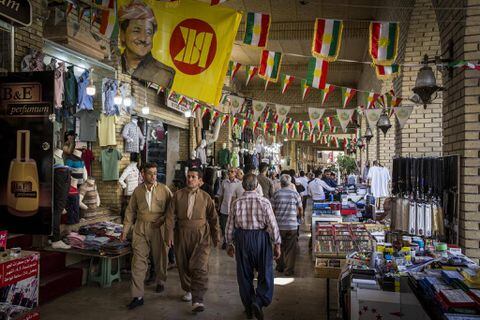
Patrons
peruse the grand bazaar the Kurdistan region’s Irbil on Sept. 30. Kurds
voted for independence weeks ago, but some elements have impeded the
area’s quest for autonomy.
IVOR PRICKETT/NYT
Kurdish leaders in the Kurdistan Regional Government had good enough reason to believe that Washington -- despite its ongoing warning to President Masoud Barzani that the time is not right, that Kurdistan would do better to await another opportunity once the current prevailing atmosphere of conflict and uncertainty is past, to engage in their movement toward sovereignty, abandoning the autonomy that Iraq agreed upon, post-Saddam Hussein's reign of terror, once it carried out its plebiscite and the voters gave ample proof of the people's will -- would support it.
When would an appropriate time to declare Kurdistan's intention to finally become fully independent as a functioning state? Simply by continuing to pursue the status quo, surrendering its full sovereignty to Baghdad and the whims of whoever was placed in the top echelons of executive government would merely prolong the dissatisfaction of millions of people whose ethnic roots long predated those of the Arab tribes ensconced on heritage geography of the Kurds. Without doubt President Barzani might have felt he must lead his people to strike while their iron was still hot.
Waiting until such time as the Islamic State of Iraq and the Levant was fully routed, their caliphate geography a phantom of failure, would simply go on to 'normalize' Kurdistan as an ongoing autonomous region subservient to an Arab political culture that had historically persecuted the Kurds. That four countries claimed land traditional and by heritage the Kurds' throughout history vastly contributes to the emphatic rage of denial by Turkey, Iran, Iraq and Syria.
While Syria's President Bashar al-Assad mounts his ongoing campaign against his majority Sunni citizens by slaughtering hundreds of thousands of civil dissidents he terms 'terrorists', he has the eager assistance of Iran, Lebanon (through the Iranian militia proxy Hezbollah), Turkey and Russia whose interests in a deep-sea port and land base in Syria leads it to airborne military support of the regime enabling Assad to continue his atrocities against his own citizens.
But the overtures to Iraq's parliamentarians by Kurdistan's government to come together at a negotiating table in a civilized manner to discuss the means by which each would be satisfied by an amicable (albeit unwillingly grudging Iraq) to accept Kurdistan's sovereignty is considered beyond the pale, an assault and horrible affront against Arab dominance in the region. Iran has closed the land border with the Iraqi Kurdish region while threatening flights and accusing President Barzani of links to the Israeli Mossad.
Turkey is threatening to close off the Kirkuk oil spigot delivery system despite Russia's massive investment in Kurdistan's oil and gas output and despite Russian President Vladimir Putin's overtures toward reasonableness. Equable reasonableness is the furthest civil attribute that Recep Tayyip Erdogan could conceivably muster on any occasion for any reason that he feels threatens his own Caliphate. The malice that he evinces toward Kurds, not only those within Turkey, but in Syria and Iraq is incalculable.
It is time for the United States administration to recognize its indebtedness to an ally, the only one it could depend upon to rally to the enormous task of challenging and ousting the Islamic State from Iraq. It has been the Kurdish Peshmerga who have performed this task, not the Iraqi military whose courage has been demonstrated to be wanting; they had the U.S.-supplied weapons and rolling stock to effect a winning conflict with ISIL, and melted away in confused panic, leaving the weaponry to benefit Islamic State.
Peshmerga forces led the battles against ISIL with antiquated, inadequate weapons, awaiting the transfer of U.S.- and other NATO-allied nations providing war machinery and updated weapons to the Peshmerga through the government of Iraq; somehow those weapons failed to filter through to the only forces that required their immediate delivery. So, why should the Kurds continue to place any trust in Iraq, a nation whose leaders are more comfortable penalizing the Kurds for not being Arabs than cooperating with them?
It is past time for the Trump administration to threaten to cut off military and economic aid to Iraq and Turkey for their reactions to Kurdish aspirations. The Kurds have been loyal and trustworthy allies to the American war against Islamic State. By taking drastic steps to cut off international access and constrict the economy of the Kurdish region, Iran, Iraq and Turkey are busy with their intention of starving Kurdistan of its due in financial health in line with their plan to punish it for dreaming of nationhood.
If they see fit to threaten war against Kurdistan, the United States has the moral obligation to quietly, diplomatically, inform the threateners that they too will come under threat.
Iraq Vice President Ayad Allawi says there could be a "violent conflict"
over the Kurdish-administered city of Kirkuk if talks over Kurdish
independence are left unresolved. The National
"The West should support the mandate the Kurdish people are bestowing upon their leaders: to guide the peaceful emergence of a confident Kurdistan, rather than the reinforcement of a bad marriage destined to fail. The cause of Kurdish freedom is right and just, and it is overdue that the West should say so." Shuvaloy Majumdar, Munk Senior Fellow, Macdonald Laurier Institute, Ottawa, Canada
Syrian Kurds wave the Kurdish flag in support of the independence referendum. Northeastern Syrian city of Qamishli, September 26, 2017 DELIL SOULEIMAN/AFP
"Ankara coordinated its military response with that Iraq and Iran. Turkish armed forces mobilized on the border and rehearsed military action. Turkey’s President Recep Tayyip Erdogan threatened to close the Turkish-KRI border and cripple the flow of Kurdish gas to international markets. As a sign of things to come, on the day of the referendum, the KRI-Turkish border ground to a virtual standstill." "The Kurdish march to independence from Iraq is irresistible. By Turkey firmly voicing its opposition Ankara has forgone an opportunity to lead on the world stage. Had Turkey expressed support it could have swayed the U.S., European countries and perhaps even Russia to do the same. Instead Turkey fell back to a position which fails to see the long-term benefits of Kurdish independence, and instead finds itself in the center of yet another regional crisis."Dr. Simon A. Waldman, Mercator-IPC fellow, Istanbul Policy Center, visiting research fellow, King's College London
When Iraq literally fell apart after the U.S.-led 'Coalition of the Willing' invasion meant to remove Iraqi dictator Saddam Hussein from his seat of power, where his Sunni minority Baathist Party ruled the majority Shiite country he led, it was only Iraqi Kurds in their semi-autonomous area of Iraq that were capable of mustering the strength of collective character and appreciation of democratic process to build and reinforce the infrastructure of a decent, humane society.
Elsewhere than Kurdistan in Iraq, the vanquished Sunni Baathists whose control of the Iraqi military and government had been disrupted and dismantled, and the majority Shiites who had chafed under Sunni brutality saw the opportunity to unleash their deadly sectarian hatred against one another, embarking on a protracted orgy of mass killing, even under the noses of the occupying U.S.-led forces whose partial purpose was to maintain order and security.
While violent death stalked both the Shiite and the Sunni communities in revenge attacks, the Kurdish territory remained a bastion of peace and security. The Kurds gave shelter to fleeing Iraqi Christians and other minorities targeted by the terrorist Islamist jihadis like al-Qaeda who entered the country through Syria to begin their own onslaughts to achieve status and prosecute jihad. As these venomous groups gained some measure of control, the dismissed Sunni military elite saw the opportunity to join them and eventually a schism between factions allied with al-Qaeda led to the rise of Islamic State of Iraq and the Levant.
The only fighting force that proved itself capable of challenging the deadly presence of these terror groups and providing haven to their hapless ethnic and religious minority victims were the Peshmerga, fighting back to retain their own territory, while the Iraqi military fled in panic as ISIL marched on Mosul and Kirkuk. The Kurds, whom Saddam Hussein had attacked with poison gas had always suffered dire persecution as a (significant) minority, and they always aspired to sovereignty, not merely autonomy.
On September 25, their long-awaited referendum took place, seeing over 90 percent of those voting giving their confidence to Iraqi Kurdistan Region President Massoud Barzani, to guide them through to independence which in reality would simply result in an ancient people formally reclaiming their heritage geography. The new federal democracy that is now Iraq's is not an equal one for all its citizens; now the majority Shiites are in control in a reversal of Saddam's Sunni control, while the Sunni Iraqis feel themselves disadvantaged.
The Kurdistan Region's authorities plan to negotiate separation with Iraq's Prime Minister Haider al Abadi; their intention never was to unilaterally, even on the basis of their people's almost-unanimous call for sovereignty, declare independence. Understandably, the government of Iraq balks at losing a portion of their geography (they had lost far more than that to ISIL's caliphate which, thanks primarily to the Kurdish Peshmerga and NATO-member assistance has been mostly restored), along with the oil revenues represented by Kirkuk's petroleum reserves.
But this is land that was unconscionably allotted by colonialist Britain to Iraq though it was promised to the Kurds for a recognized homeland of their own. The Kurds have no interest whatever in continuing as a satellite however autonomous, of Iraq and little wonder that, given their past in Iraq. That Iran, Syria and Turkey are all now anticipating that their own Kurdish populations will most certainly see Iraqi Kurds' initiative as one heralding their own eventually, rings alarm from them and from the West, foreseeing civil conflict spreading.
Even now, while the Kurds proved themselves as the only reliable fighting force against the vicious malevolence of ISIL, prevailing where the Iraqi forces could not, Baghdad chose to hold back needed arms from the Peshmerga which Western allies ferried through the Iraqi government as it demanded, with the expectation that it would send them on to the Peshmerga, which it failed to do. Trust and interdependence is not there on an equal basis. There is no true basis for a compromise for the status quo to be continued.
The differences between Iraq and Kurdistan are enormous; one fractious, the other fraternal and pluralistic. Kurdistan's social and physical infrastructure is modern and forward-looking, a model for all of the countries of the Middle East, but one they are loathe to emulate since it would require a recognition of human rights and equality. Kurdistan deserves recognition for its legitimacy to enable it to exercise economic, diplomatic, cultural and military independence. It has earned that right.
Turkey's belligerent response is predictable, but still wrong: Turkish and Iraqi joint exercises near the Iraqi Kurdish region's borders the day after the referendum. Silopi, Turkey, Sept. 26, 2017 ILYAS AKENGIN/AFP
"The government of Canada is taking all reasonable steps to ensure that the Government of Iraq and the Kurdish Regional Government of Iraq provide the requisite commitments that any equipment provided from the Government of Canada will be used in an appropriate manner." "Canada will ensure that end-user agreements are fully approved and in place before any equipment is delivered." Capt. Patricia Brunelle, Canadian Forces spokeswoman
"It is bad enough that Canada and other members of the anti-ISIL coalition have failed to develop any meaningful strategy for heading off this entirely foreseeable crisis." "It is worse still for Canada to bury its head in the sand and continue supplying weapons to the Kurdish Peshmerga. How is such action possibly consistent with support for a unified Iraq?" (former) Canadian diplomat Peggy Mason, president, Rideau Institute
"The United States does not recognize the . . . unilateral
referendum." "The vote and the results lack legitimacy, and we continue to support a united, federal,
democratic and prosperous Iraq." U.S. Secretary of State Rex Tillerson, Washington
Iraqi Kurdish leader Masoud Barzani, center,
arrives to vote in the independence referendum at a polling station near
Irbil, capital of the semiautonomous Kurdish region, on Monday. (Ahmed
Deeb/AFP/Getty Images)
"I called his excellency Prime Minster Abadi on this specific issue and I
explained to him that this referendum is a normal, legal right of our
people, and that afterwards we want negotiate the results of the
referendum in a peaceful way through dialogue. He had an understanding
of that. We told him that we want to solve this issue with Baghdad
through peace and not through violence. He was receptive and
understanding. He was positive." "The referendum issue is about the destiny of a whole people. That’s why
this issue is bigger than any other political framework, or any
political parties, or any political problems within the party system.
I’m sure that the majority of the people in Kurdistan are with the
referendum. The supporters of the political parties, the majority of
them are also pro-referendum. We had a very positive meeting with all
the political parties, and they were all supporting it." "When we have a referendum, it is to have that mandate from the
people, to show to the domestic and to the external players what the
Kurdish people want. Once the people decide and vote, then as I said,
the first place we are going to start serious, peaceful negotiations and
dialogue with is with Baghdad, to achieve and fulfill the wishes of the
people." "The referendum is for independence, and I want the others to
understand this: Once we do the referendum and start dialogue, it
doesn’t mean that we give up on the wishes of the people. So the
referendum is for independence and its result must be implemented." Leader of Iraqi Kurdistan, President Masoud Barzani
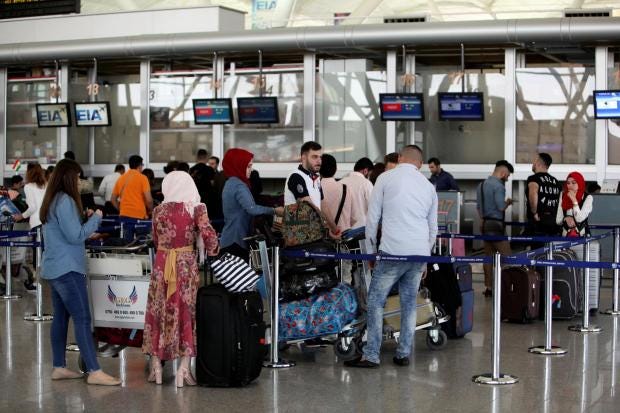
Passengers queue at the check-in counters at Irbil International Airport in Iraq on 27 September 2017 Reuters
There it is, the polarized opinion out of Western nations; on the one hand sympathizing with the need of this immense, 30-million strong ethnic group that has been persistently persecuted living within the borders of Arab (and Persian Iran) states refusing to entertain the very idea that in all justice if they feel it is fair that they enjoy a state of their own, why not the group that has called the geography encompassed by their borders their millennia-old heritage?
The occupying colonialist powers who promised the Kurds a hundred years ago that when new borders were struck for Turkey, Syria, Iran and Iraq, a portion of each would be set aside for a Kurdish homeland, betrayed the Kurds. Ever since, the Kurdish ethnic minorities in those countries have been discriminated against, and their lives made utterly miserable when in fact they weren't being subject to violence. They persevered and they proved themselves capable of self-governance.
Canada's ambivalence in stepping in after the tribal and sectarian implosion of Iraq, to instruct its military to help train and supply the Kurdish Peshmerga which proved itself the only reliable fighting force in the Middle East capable of challenging the murderous Islamic State of Iraq and the Levant group comes up hard against the government's diplomatic stance in echoing the opinion of its NATO allies by insisting on Iraqi insolubility.
Condemning, in other words, the Kurds who continue to aspire toward national independence, to remain subservient to what to them is a foreign government, one which in the past has denied their most basic human rights. In so doing, choosing to sit on the fence, despite continuing to arm Kurdish forces after the referendum for independence. A referendum whose purpose is to persuade the government in Baghdad to sit and discuss a situation that requires an inevitable conclusion.
Instead, Baghdad has slammed the door of negotiations shut in Kurdish President Massoud Barzani's face. Iraqi Prime Minister Haider al-Abadi has committed to measures to ensure that Kurdistan remains within the orbit of Iraq. Ordering the Kurdish region to submit control of its airports to Iraqi federal authorities, otherwise a total flight ban would be instituted with Iraq's Transport Ministry ordering international airlines to no longer service Irbil, the Kurdish capital.
Turkey has followed suit, as has Egypt, Iran, Syria and Saudi Arabia, with Turkey threatening trade sanctions and not ruling out military action. The sneering reference by Turkey to the sole ally backing Kurdish aspirations being Israel, emphasizes Kurdish isolation in a hostile-to-independence region, where Arab (and Persian) states lock forces, setting aside their own intractable and often violent differences to stand in unity against sovereign Kurdistan.
Iraq's Shiite dominated parliament has called upon al-Abadi for troops to be deployed to the disputed Kurdish-majority areas, including the city of Kirkuk, representing one-third of the oil riches of Iraq and which Kurdistan claims as its own. It won't take long to see what results from this regional animosity toward Kurdistan independence. Al-Abadi has all the support he would like to "enforce the rule of the federal authority in the Kurdish region with the power of the constitution."