Politic?

This is a blog dedicated to a personal interpretation of political news of the day. I attempt to be as knowledgeable as possible before commenting and committing my thoughts to a day's communication.

Saturday, January 18, 2020

UN Committees Hot on the Heels of Human Rights Abusers

"[The committee failed to study First Nations views toward the project; I] did not know [that most First Nations committees supported the Coastal GasLink natural gas pipeline]."
"I did not know that most First Nations agree on that. This is something new that comes to my understanding."
Noureddine Amir, Chair, United Nations Committee on the Elimination of Racial Discrimination (CERD)

"I frankly find it condescending to the work the 20 nations have done in the past six or seven years to get the project to where it is today."
"I think it speaks volumes in terms of the sensationalism [around] a topic that is getting so much attention."
"There are sides to the story that are not being reflected and frankly there are not many voices in the media in support of the project [to bring natural gas via a pipeline to an export facility along the West coast of British Columbia]."
"They [TC Energy based in Calgary] offer the solution to social issues that no other entity, no other political body, no other government has been able to do for our people."
Naisla Nation Chief Crystal Smith

"[CERD was] disturbed by the forced removal, disproportionate use of force, harassment and intimidation by law enforcement officials against Indigenous peoples who peacefully oppose large-scale development projects on their traditional territories."
CERD directive

"Of all people, someone in his position, you would think the very first thing he would do is at least to gather information on both sides of the story. It's unfortunate he never did his homework."
"He could have looked it up online and found out in seconds."
"I nearly spat out my coffee [reading the CERD directive]."
Chris Sankey, former elected band councillor, Lax Kw'alaams First Nation, Prince Rupert, B.C.
Wet'suwet'en Hereditary chiefs after issuing their eviction notice to the Coastal GasLink Pipeline. - Facebook

According to Haisla Chief Smith, the agreement in question that her community signed with TC Energy to build the pipeline in question represents their best opportunity to attain autonomy and to become financially independent. Proceeds that accrue to the First Nation, as it will to others signing the agreement, are set to be used in broad poverty-reduction programs along with associated social tools leading to efforts to "revitalize" the local culture.

A directive had been issued in December by the UN Committee on the Elimination of Racial Discrimination that called for three large-scale natural-resource projects in British Columbia to "immediately" be shut down. Those projects include the Coastal GasLink natural gas pipeline projected to feed into a massive export facility along the West coast, a project with signed benefit agreements linking 20 Indigenous communities along the 670 kilometre route cutting across their territory.

Ellis Ross
Chief Ellis Ross: “the UN has no frickin’ business talking about what’s happening here.”

Mr. Noureddine, chief of CERD had no real idea of what his committee based its conclusions on other than that they were defending the rights of Indigenous communities. No information had been sought to explain the issues involved because investigative work is not included in the committee's mandate. Which seems rather typical of any United Nations arm mandated to express opinion on issues based on surface circumstances when without a full understanding of issues and history they should neither condone nor condemn.

Major resource projects in Canada evolving around extraction, refining and use and shipping of fossil fuels have engendered great discussions and protests from environmental groups determined to halt any possible progression in the industry to the point where Canada, with its vast proven resources is unable to proceed with extraction, with pipelines sending product to other parts of Canada, instead shipping oil the vast distance from the Gulf States to North America. With the focus on the issue comes the erroneous impression that all First Nations are opposed to the industry.

The CERD directive called as well for an immediate stop to the Trans Mountain pipeline construction and the Site C dam in British Columbia. When Mr. Noureddine made it clear he had made no effort to investigate before condemning, First Nations representatives for whom the pipeline construction represents an opportunity to prosper from their territorial geology, responded with disbelief and anger. The Pacific North West LNG project since scrapped was a matter of negotiations for the Lax Kw'alaama First Nation as well.

"It is unbelievable that a  United Nations Committee who [s8c] attempted to single out Canada didn't even realize that many major Canadian projects have earned First Nations and community support", Sonya Savage, Alberta Energy Minister expressed in disgust, in a written statement. "With all the injustice in the world, it’s beyond rich that the unelected, unaccountable United Nations would seemingly single out Canada — one of the greatest champions of human rights, democracy and the rule of law. Canada’s duly elected representatives — not unaccountable international committees — are responsible for governing decisions in this country."

Part of the broader $40 billion LNG Canada project under construction near Kitimat, British Columbia, the Coastal pipeline will eventually ship supercooled gas to Asian markets, the first major LNG project at the construction phase after years of regulatory delays and political disputes delaying such large-scale developments in Canada. And while there are some First Nations bands that protest the pipeline construction, there are others who fully support development.
Pipeline
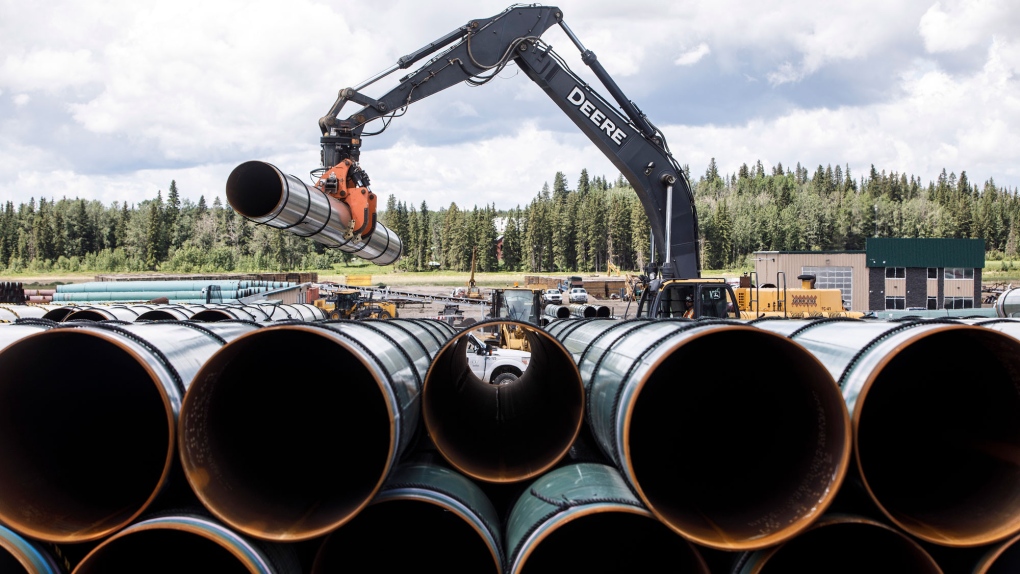
Pipe for the Trans Mountain pipeline is unloaded in Edson, Alta. on June 18, 2019. (THE CANADIAN PRESS/Jason Franson)

Labels: , , , , , ,

Thursday, June 13, 2019

Viva 'Progressive' Canada!

"The federal government must recognize the exclusive role provinces and territories have over the management of our non-renewable natural resource development or risk creating a Constitutional crisis."
"[Bill C-48 in particular] will have detrimental effects on national unity."
"Bill C-69, as originally drafted, would make it virtually impossible to develop critical infrastructure, depriving Canada of much-needed investment."
"Our [provincial] governments are deeply concerned with the federal government’s disregard, so far, of the concerns raised by our provinces related to these bills. As it stands, the federal government appears indifferent to the economic hardships faced by provinces."
"Immediate action to refine or eliminate these bills is needed to avoid further alienating provinces and their citizens and focus on uniting the country in support of Canada’s economic prosperity."

"Our five provinces and territory stand united and strongly urge the government to accept Bill C-69 as amended by the Senate, in order to minimize the damage to the Canadian economy."
"We would encourage the government of Canada and all members of the House of Commons to accept the full slate of amendments to the bill."

Premiers Doug Ford (Ontario), Blaine Higgs (New Brunswick), Brian Pallister (Manitoba), Scott Moe (Saskatchewan), Jason Kenney (Alberta), Robert McLeod (Northwest Territories)


"I think it's absolutely irresponsible for conservative premiers to be threatening our national unity if they don't get their way." 
"The fundamental job of any Canadian prime minister is to hold this country together."
"Anyone who wants to be prime minister, like Andrew Scheer [leader of the Conservative official opposition], needs to condemn those attacks on national unity."
Prime Minister Justin Trudeau

"Prime Minister Justin Trudeau has no one to blame but himself for the current strains on national unity."
"He has claimed the fundamental responsibility of any Prime Minister is to bring the country together yet his actions point to the contrary."
"He’s pushing legislation widely criticized by most provinces, industry groups, prospective investors in Canada and Indigenous leaders as clear violation of provincial jurisdiction and a profound threat to [the] future of natural resource development, economic growth and prosperity in our country."
"His government’s legislative actions have caused more division in Canada than we have seen for years, and today’s comments only further inflame those tensions."
Jason Kenny, Premier, Alberta 
The Hibernia platform in Newfoundland's offshore is one of the province's offshore facilities. (HMDC)

Well, actually, it's not just Conservative premiers -- who represent over fifty percent of all Canadians -- and whose provinces' natural resources have buoyed the Canadian economy since Confederation that have run afoul of the federal Liberal government's action plan on the environment clashing head on with resource development, since signatories to a previous letter sent to Trudeau were former Liberal premier Rachel Notley, and leader of the Alberta Liberals, David Khan. Furthermore, an Angus Reid poll found 50 percent of Albertans are so enraged over the federal government's stance on resource development in the oilfields they would support secession.

In Saskatchewan, over half the population would consider secession, according to an Environics poll, reflecting the evisceration of both provinces' plans for petroleum resource development that have gone awry as international investment has dried up in response to the federal government's slow and steady withdrawal from support of the oil industry, not to mention its deep-sixing of critical oil pipelines to deepwater ports for export abroad, preferentially leaving Canada's huge oil deposits untouched, a gift to strident environmentalists who prefer it that way.

A sign is located near a Trident Exploration natural gas well near the community of Didsbury, Alta. Trident blamed low commodity prices and a lack of export pipeline capacity, among other reasons, for shutting down this week. (Kyle Bakx/CBC)

The wealth generated to date by the oil and gas industries in Canadian provinces, including Newfoundland and Labrador, and particularly Alberta for many decades in tax transfers to the federal government paid the lion's share of 'equalization payments' to Canada's so-called 'have-not' provinces to ensure that all provinces in Canada would be able to offer equal services to all Canadians no matter where they live. With the Liberal government's steady encroachment on the Alberta government's responsibility for its natural resources, and its continual imposition of new environmental bills effectively halting extraction and pipeline activities, employment has plummeted and revenues along with it.

Lacking efficient export capabilities leaving Alberta to the use of trains to transport fuel to market rather than pipeline transfer, has made the province vulnerable to accepting pricing well below market value, a huge loss both for the province and for federal coffers for a government which has been profligate in other measures of spending for social welfare programs. Much like Quebec which has ever since equalization payments have been handed out, receiving the largest percentage of transfer payments to any province, enabling it to provide social programs far in excess of its own prosperity level.

Little wonder the petroleum product provinces are up in arms over the injustices they are now undergoing at the hands of the federal government. Justin Trudeau's agenda has been underhandedly undertaken, and it has impoverished the provinces that have been the engines of economic growth for the nation. He has alienated western populations by ignoring the needs of their provincial governments and putting huge numbers of people employed in the petroleum industry out of work. He is single-handedly managing to reverse the prosperity that Canada's potential promises.

And he has the unmitigated gall to charge those provinces' leaders with harming Canada's interests, with injuring national unity. We have this Liberal government to thank for social-improvement projects so dear to 'progressives' where euthanasia is now legal in Canada, as is the gateway drug to harder drug consumption at a time when the country is reeling under the ubiquity of overdose deaths, and where divisions have taken place in society over the narcissistic 'feminist' imperatives of Justin Trudeau.

A government which hands out millions in tax dollars to Islamist jihadis, and grants citizenship to convicted terrorists, while refusing summer employment funding to any organizations failing to unreservedly support abortion with no restrictions, and penalizing those in academia who refuse to use gender-neutral language in reference to LGBTQ2 demands. More, much more, all of it headache-inducing and heart-breaking for a unified Canada.

Labels: , , , , , ,

Friday, February 01, 2019

How're We Doing! Canada?

"Annual mean precipitation has increased, on average, in Canada, with a large percent increase in northern Canada. For Canada as a whole, observational evidence of changes in extreme precipitation is lacking. However, in the future, extreme precipitation is projected to increase in a warmer climate."
"For Canada as a whole, observational evidence of changes in extreme precipitation is lacking."
Xuebin Zhang, senior research scientist, Environment Canada

"The elephant in the room, from a climate-change perspective, is ... too much water in the wrong places."
"Flooding is the number one [insurance] cost in Canada ... due to climate change. The magnitude of the storms is increasing."
"The frequency, duration, the intensity of storms is much greater today than it was in the past."
Blair Feltmate,  Head, Intact Centre on Climate Adaptation, school of environment, enterprise and development, University of Waterloo

"The ombudsman [Guy Gendron, CBC/Radio Canada International ombudsman] has ruled in favour of the complainant [Robert Muir, Ontario municipal engineer, member of the Ontario Society of Professional Engineers]."
"Certain statements relating to rainfall amounts and the so-called 100-year events deemed to be inaccurate or irrelevant to the story have been removed and/or replaced."
"Information from Environment Canada has been added to indicate their statistics show no increase in rainfall or extreme rain events beyond 'normal' variations... These changes to the original story have been made on January 29, 2019 to comply with the ombudsman's decision."
Canadian Broadcasting Corporation correction 
CBC’s ombudsman issued a report saying flood claims by Blair Feltmate led the news network to publish stories last fall that contained “inaccurate and irrelevant” information.   Laura Pedersen/National Post files

The Insurance Bureau of Canada has been pushing provincial governments in an alert responding to flood claims, to fund green infrastructure in planning to mitigate flood damage. The Bureau plumps for 'green infrastructure' such as "natural" flood-control schemes defined including "natural heritage features" such as "street trees, urban forests,natural channels, permeable surfaces and green roots", bypassing hard infrastructure like waterways, improved sewer diversion and better urban water0management facilities.

Their version of improved green infrastructure as being more cost-effective and natural is disputed by the Ontario Society of Professional Engineers. In support of the Insurance Bureau, the Canadian broadcaster  decided to broadcast statements by the Bureau's frequent climate-change witness with claims that climate change has been responsible for triggering a surge in flood events in recent years. That resulted in a complaint to the CBC Ombudsman by an Ontario municipal engineer, Robert Muir, with the result, a CBC correction.

The thing of it is, despite Environment Canada's statement by its senior research scientist refuting those claims, there are other supporters of the climate change theory of lifetime-changing weather events, namely the Liberal government of Canada. Justin Trudeau is on record as claiming that a long-range plan to wean Canadians off current energy sources will bring Canada in line with other advanced nations pledging to curtail greenhouse gas emissions with the eventual use of alternate, 'green' energy sources.

That commitment to reducing Canada's use of conventional energy sources hasn't played out too well of late. This government has tinkered with rules and regulations on energy extraction and fine points in environmental consultation to the point where no urgently required pipelines moving oil and gas across the country, much less to shipping points benefiting Canada's exportation of both has left the country reeling with once-wealthy Alberta, the source of much of Canada's energy resources along with Saskatchewan and Newfoundland, unable to exploit those resources.

The absurdity of Canada importing Saudi oil while leaving Canadian oil underground has us burning fuel extracted elsewhere, costing Canada dearly to import that oil and much more in its incapacity to move the oil that is being extracted at a fair market value price to its major importer, the United States. Jobs in the energy field have dried up, investors have moved elsewhere, revenue is down, unemployment rising along with western resentment toward central and eastern Canada.

"The next election is going to be a referendum on Justin Trudeau ... and whether or not people think he has performed", stated Darrell Bricker hard on the heels of the latest Ipsos Public Affairs poll, referencing the government's stark failure in the energy field, and its comatose attitude toward illegal migrants flooding into Canada, swamping Canadian Immigration's ability to scrutinize and process refugee claims, leaving a situation of years of backlog, impacting on the process for legitimate claimants.

Now the Parliamentary Budget Officer has released a valuation in detail of the Trans Mountain pipeline the Trudeau government bought from Kinder Morgan last year for $4.4-billion, vastly overpaying for a worn-out investment caught in the clutches of the government's own web of increasingly fraught conditions to proceed with building the pipeline and bringing it to operation. the PBO vetted construction costs and risks of delay in construction, leaving the impression that with delays and rising construction costs that pipeline just may not be built.
Pipes are seen at the Kinder Morgan Trans Mountain facility in Edmonton on April 6, 2017. Jonathan Hayward / The Canadian Press

And given the constrictions imposed by this government on any kind of energy extraction and movement, investment from abroad by energy giants looking for new projects to fund, and observing the contretemps for the past few years of immovable projects designed to fail, are intent on maintaining a safe distance. All of which adds up to punishing costs to Canadian taxpayers on the hook for a pipeline which may never be completed, and the continued need to import oil in a country that has some of the largest reserves on the planet.
"If it was a car, we would say they paid sticker price, they didn't negotiate very much, they didn't get that many deals or manufacturers rebates — quite the opposite."
"It's a very risky project to have bought something that nobody else in the private sector wanted to acquire. There are lots of retirement or pension plans that like to buy infrastructure of that nature that generate streams of revenues."
Parliamentary Budget Officer Yves Giroux
Steel pipe to be used in the oil pipeline construction of the Trans Mountain Expansion Project sits on rail cars at a stockpile site in Kamloops, B.C. A PBO report released Thursday says Ottawa may have overpaid for the project by more than $1 billion, but its value for oil producers, and in turn government coffers, is considerable. (Dennis Owen/Reuters)

Labels: , , , ,

Friday, November 23, 2018

Bringing Alberta Oil To Market....

"When you have a price differential that's up around $42, $50 even, that's a massive challenge to local industry, to the livelihood of a lot of Albertans. I hear that very, very clearly."
"There is no question that folks in Alberta, folks here in Calgary, are living through extremely difficult times. This is very much a crisis."
"You think there's a super-simple easy answer and there's not. There's a multi-faceted complex issue and as much as there is a tendency out there in the world to give really simple answers to really complex questions, unfortunately the world doesn't work like that."
"We need to make sure that we're moving forward in the right way and that is where actually listening to the experts is sort of the best way to make policy."
Prime Minister Justin Trudeau

"The crisis happening in this province affects the whole country but they [the federal government] are speaking a different language."
"We must get our product to tidewater and nothing today addresses that [urgency]."
Alberta Finance Minister Joe Ceci

"We need more [rail] cars. We need to order more locomotives in order to get more cars onto rail. That's the bottom line."
"In the meantime however, we need to take a close look at the tools available to us to close the differential where it's feasible."
Rachel Notley, Alberta Premier

"My sense is that we will be able to do that [get projects built, such as the Trans Mountain pipeline which the federal government used $4.5-billion in tax funding to purchase the project from Kinder Morgan Canada Limited whose shareholders were fed up with all the obstacles put in the way of completing the pipeline by the very Liberal government which swears it intends to see that Alberta oil gets transported in a timely efficient manner so that it will no longer be sold at discounted rates] in a way that will provide confidence to the sector."
"I don't accept the argument that this government has not been very, very focused on how we can deal with the challenge of getting our resources to international markets."
"We're the government that substituted action for words."
Bill Morneau, federal Finance Minister


Before he was elected in 2015 by a Canadian public that failed to appreciate the guardianship of the Canadian economy and international relations that had Canada in a healthy fiscal and global position led by Conservative Prime Minister Stephen Harper, Justin Trudeau made no secret of his long-term goal to leave Canadian petroleum products underground. First, he meant to gradually wean Canadians off their dependency on oil with alternate sourcing of energy, and then he would shutter the oil industry leaving Alberta (Saskatchewan and Newfoundland) to find other sources of income) while delivering an ostensible environmental plus under his watch.

In the struggle to build pipelines, he compromised by promising the Trans Mountain pipeline would be built, but the Northern Gateway pipeline would be abandoned, at a time when Canada desperately needs to move its petroleum extraction industry forward both for domestic and trade purposes, rather than rely on oil sourced from Saudi Arabia. The Liberal government has focused on its pet project of empowering women, LGBTQ-2, Aboriginals in every sphere of public life, while ignoring the realities of the country's finances teetering vulnerably with a deficit far higher than anticipated and a growing debt, costly to the country's future.

Ontario along with Alberta were considered the nation's two power-house economies that kept the country strumming along, providing billions in equalization payments to the other provinces to ensure that social programs throughout the country were equally distributed. Ontario lost manufacturing jobs to cheap-labour countries and its wheels of commerce and production groaned to a downward spiral, while Alberta has had to struggle with opposition from the very provinces that benefit from its financial support, while they pursue an environmental agenda hostile to the very source of its wealth.

The Canadian Association of Petroleum Producers estimates the price discount ("differential") that affects heavy oil and has spread to light oil is costing Canada dearly. The impact for the first ten months of this year was a loss of $13-billion in revenue. In October the difference between what U.S. crude sold for a barrel and Alberta crude was a whopping $50-million daily. "The differential has blown out to such an extreme level for two reasons, the lack of access to markets and the fact we really have only one customer (The United States)", explained Tim McMillan, CEO of the Canadian Association of Petroleum Producers.


"If Northern Gateway had come on as planned, we wouldn't be in this situation", he said. "If this keeps up and we start to see either a lack of growth or more shutting in some of this production ... you're losing jobs and even personal income tax as well", noted Kent Fellows, research associate at the School of Public Policy, University of Calgary, who estimated the differential would translate into a $13-billion economic loss if it persisted for a year; $7.2 billion for the Alberta government, $5.3 billion to industry and $800 million to the federal government.


Labels: , , , , , ,

Tuesday, October 16, 2018

Discounted Canadian Crude -- Boosting China's Welfare

"The policy of boosting infrastructure investment has been bullish for bitumen."
"The supply of the Merey grade has been disrupted since May, pushing refiners to look elsewhere. As late-September and October is traditionally the peak season for construction projects in China, demand will be further supported."
Li Haining, analyist, industry consultant SC199, Shandong province, China

"On the demand side, there are expectations for bitumen growth in China due to a boost in infrastructure spending."
"With traditional heavy oil shipments shrinking globally, trade flows are being reshaped and alternative heavy oil supplies from countries such as Canada are becoming sought after."
Sophie Shi, analyst, industry consultant IHS Markit, Beijing, China

"The gap between Canadian and U.S. oil is nudging US$50 a barrel, while West Texas Intermediate is in the neighbourhood of US$72. The discount is so juicy that China has started switching away from Venezuela toward Bargain-basement Canada."
"That tells you something -- even claptrap, broken-down, corruption-riddled Venezuela can't undersell Canada's sadsack inability to peddle its oil."
Kelly McParland, National Post

"...Large emitters such as China, the United States, the European Union, India, Russia and Japan [collectively accounting for approximately 2/3s of total global emissions] matter the most."
"...The United Nations has sounded the alarm, releasing a report in early October suggesting a carbon tax of up to US$5,500 per ton [$7,183Cdn] may be necessary to limit temperature increases to 1.5 degrees."
"The UN report suggests that a global emissions reduction of 45 percent by 2030 is needed, amounting to approximately 24 billion tons. Canada's share would represent around 200 million tons -- or just 0.8 percent of world emissions."
"This is the argument Canadian carbon taxers are making; that securing 0.8 percent of global reductions is worth punishing millions of Canadians and destroying Canada's economic competitiveness. They are asking Canadians to make massive, tangible sacrifices in their everyday lives...meaningless in the highly probable event that most other countries don't also follow."
Aaron Wudrick, federal director, Canadian Taxpayers Federation
Steam rises from the Syncrude Canada Ltd. upgrader plant in the Athabasca oilsands near Fort McMurray, Alta., Mon. Sept. 10, 2018. Canadian oil is selling at the largest discount to global oil prices ever.
There it is, the politics in this country leaning every-which-way to broadcast we're so open for business that we labour to extract heavy oil at great cost and effort and it can be had for wholesale prices which may or may not cover the cost of extraction. Alberta's oilsands extraction attracted huge interest from giant international oil developers but this government gets stomach pains imagining the potential of fouling the atmosphere, the ground, the oceans in achieving pipeline construction, so looks the other way when industry makes do instead with tanker trains moving it overland to port.

The U.S. administration of Barak Obama, Justin Trudeau's inspiration in environmental protection, nixed the Keystone XL line, even while the U.S. was polluting the environment extracting and burning immense volumes of dirty coal because energy is energy and the U.S. needs and uses plenty of it. Somehow, fracking is A-OK despite that it may cause surface quakes and no one knows exactly the long term effect of forcing chemicals and water below bedrock for extraction that may affect deep-seated aquifers.

British Columbia is on its environmental high horse, rejecting Alberta oil pipelines but enthusing that a $40-billion liquefied natural gas plant is slated for Kitimat which had refused to allow the Kinder Morgan oil pipeline to pollute the town with its presence. The B.C. government moans that a pipeline through B.C. is environmentally offensive, that it won't stand for the potential of leaks yet it's fine with hosting the largest coal export terminal in North America.
Heavy haulers are seen at the Suncor Energy Inc. Fort Hills mine in this aerial photograph taken above the Athabasca oil sands near Fort McMurray, Alberta.   Ben Nelms/Bloomberg

Oil shipped by rail has gone from 30,000 barrels a day to 200,000 barrels daily from 2012 onward to the present. The chances of spills in rail transport are so much greater and present far more serious consequences than spills from pipelines, but never fear, an environment virtuous commitment by the Trudeau government to imposing a carbon tax will serve to stifle fears of ignoring the threat of climate change, even if the U.S. is responsible for 15 percent of global emissions and China with its 25 percent emissions globally, fail to hold up their substantial end of the international strategy.

And don't forget how important it is to Justin Trudeau to see Canada in the news, particularly highlighting his progressive policies. He likes being admired and having Canada considered a well-run and prosperous, fully-employed nation, generous to its struggling peer-nations, steadily growing the national deficit in the process, but not yet prepared to commit definitively to steaming ahead in supporting multiple pipelines to tidewater to enable Alberta oil to ship at full price, prepared to forfeit the crown of most-disinterested-in-filthy-profit purveyors of energy.

Meanwhile, Canada's cut-rate crude is making China happy, and whether that will help lead to a seat on the UN Security Council is yet to be seen in the future. China's spending on infrastructure in the last half of 2018 is accelerating five times the first half of the year with expectations that bitumen demand will only increase and refiners producing residue from cheap Canadian oil may consequently look forward to heftier profit margins. China profits from Canada's sacrifice, losing billions in the transaction of discounted Canadian crude.

China has alternative producers like Brazil since heavy crude is high in demand among the independent refiners in China, known as teapots. Facing competition from mega refineries these China teapots, small independents, process heavy crude as residential fuel oil. The demand for bitumen and cheaper Canadian oil aids them in capitalizing on demand. So there we are, Canada doing good things for the Chinese oil processing industry, allowing them to approach better profit margins.

Not only a source of fuel, however, Alberta crude is as well as 60 percent cheaper than West Texas Intermediate, but is also rich in bitumen, the black residue used in the building of roads, runways and roofs. As Venezuela's Merey oil varieties shrinks, Canada's crude looks ever more appealing to China's refiners, responding to their nation's building boom. Who needs free trade with China when Canada can give oil virtually free to that huge Asian nation?


Labels: , , , , , ,

() Follow @rheytah Tweet