Politic?

This is a blog dedicated to a personal interpretation of political news of the day. I attempt to be as knowledgeable as possible before commenting and committing my thoughts to a day's communication.

Monday, July 04, 2022

The War On Drugs in the Philippines

"We have bones that could speak."
"In Tagalog, we call it bones of truth because the bones cannot lie."
Reverend Flaviano Villaneuva, Catholic priest
 
"This looks like an entry [bullet hole in skull during forensic examination]. So an apparent gunshot wound to the head for this one." 
"That's how you get away with murder. And here I am in my ivory tower, saying]; no though, you're wrong. You've missed this, you've missed that [in police investigating their own]. How do you think they feel about me? They [police authorities] hate me."
"Am I at risk? Should I consider moving elsewhere? There's a certain effect on your psyche. You're not safe. Knowing that in the Philippines, assassins can simply come near you, start shooting and get away with it."
"When I'm there in the room [her office at the University of Philippines College of Medicine] with all of these skeletons, I feel that I'm giving them what was denied to them before."
"They were not given a proper investigation, no proper examination."
"What happens to the unnamed, unclaimed bodies? Where are they?"
Dr. Raquel Fortun, forensic pathologist, chair, pathology department, University of Philippines College of Medicine
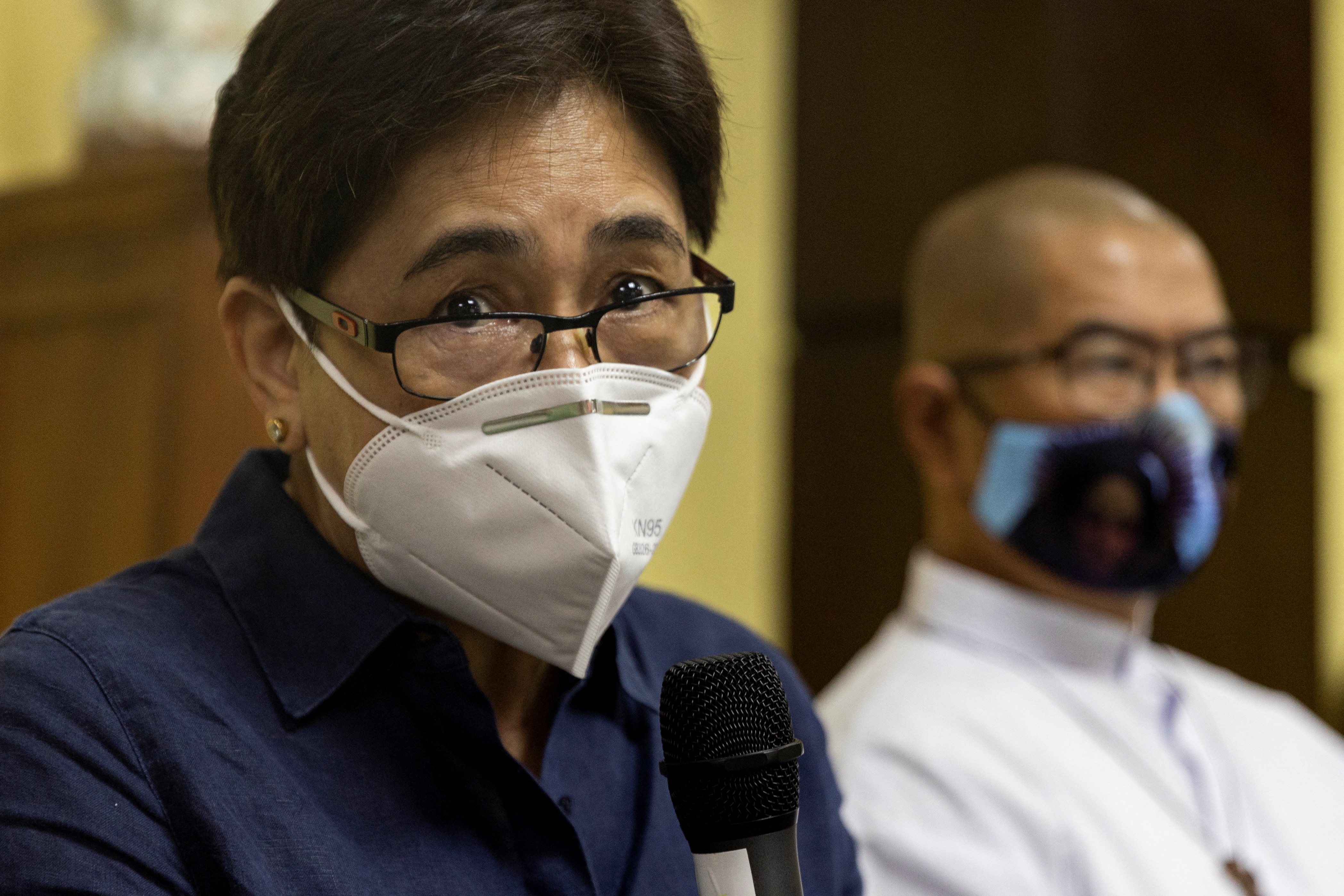
Philippine forensic pathologist discusses findings on drug war deaths in Manila
Forensic pathologist Raquel Fortun discusses findings on drug war deaths beside Catholic priest Flavie Villanueva, who counsels drug war victims, during a news conference in Manila, Philippines, April 12, 2022. REUTERS/Eloisa Lopez
 
When Philippine president, Rodrigo Duterte ran for election in 2016, one of the promises he made was a commitment to clean up drugs in the Philippines. This made the former mayor of a troubled Davao city which voters viewed as a testing ground of the candidate's ability to clean up corruption, rampant crime and the overwhelming availability of drugs creating a society of drug addicts vote with great enthusiasm for the man. And even though he gave police a clear mandate to clean up the drug trade urging them to use all means possible, his popularity did not wane.

News stories circulating in the country and abroad about the brutality of police tactics and the extrajudicial killings that took place targeting young men in poor neighbourhoods with claims that they were drug dealers were refuted by their grieving families who insisted they were victims of the drug trade, and not among those who led the drug trade making money out of the destitute for whom poverty was a fact of life and who sought comfort in drugs.

There were public executions the police defended with claims that the victims were resisting arrest or threatening police and their subsequent deaths resulted from their own ill-doing. With a new administrative government in a return of an earlier president whose dynastic family tradition of governing the island and who had proved incapable of doing so wisely and well and whose reputation for corruption led to the election of Duterte as a feasible alternative, it's anyone's guess whether things can improve.

Dr. Fortun, 62, is dedicated to her job, as one of few forensic pathologists in the country. She accuses the police and medical authorities of covering up state-sanctioned murder that took place under the Duterte government. She works alone, piecing together evidence of murder relating to the former government's drug war. For the past year she has been examining bones, working for the Reverend Flaviano Villanueva, linked to the families of the victims.

Of the 46 skeletal remains she has examined to date , seven cases were revealed where the death certificates indicated the cause of death to be of natural origins, while her investigation demonstrated clearly that these were in fact homicides. Disclosed at a news conference in April, the findings pointed a finger of suspicion at medical authorities who appeared to be complicit in a cover-up of official criminal malfeasance. As well, the full extent of the drug war was revealed to potentially be many times greater than what has been disclosed by the government.

The estimated number of people killed, considered since 2015 to be 30,000 is higher by far than the official figure. According to the Philippine National Police that number is just over 6,200. The murders and casualties of the drug war had seen no independent inquiry. Since Dr. Fortun's revelations, the International Criminal Court announced its intention to open an investigation. The Duterte administration responded by warning of its intention to block investigators from entering the Philippines.
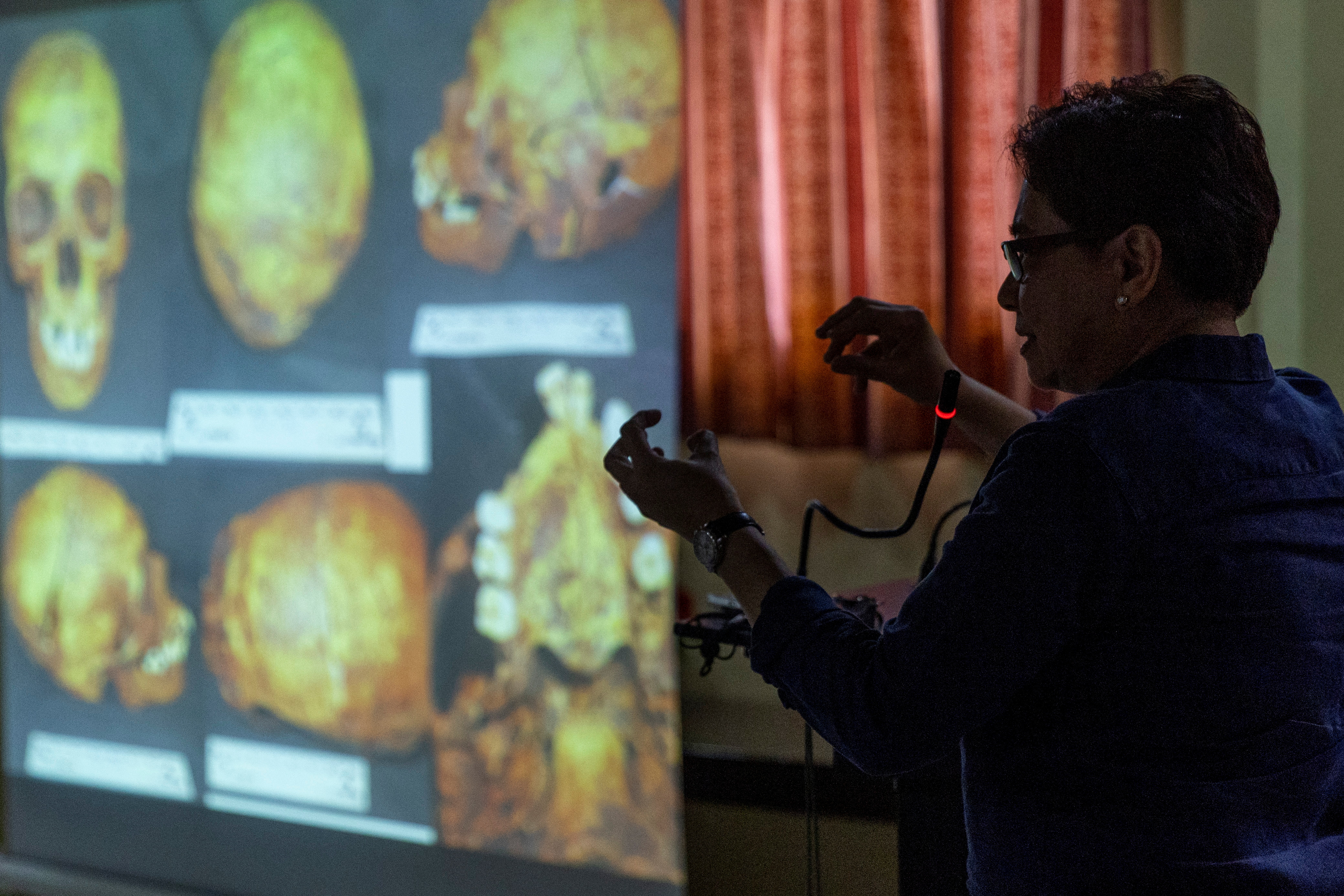
Philippine forensic pathologist discusses findings on drug war deaths
Forensic pathologist Raquel Fortun discusses findings on drug war deaths during a news conference in Manila, Philippines, April 12, 2022. REUTERS/Eloisa Lopez


Labels: , , , ,

Saturday, August 15, 2020

Death By Islamist Ideology

"What can I say? We wee all sad. But we didn't have time to mourn him, because we were so busy surviving ... We were told right away, 'You're next!'."               "They had guards watching us all the time, keeping us awake on purpose, just to break us down physically and mentally."                                                              "The weaker we become, the more they laugh. They think it's funny like hell."  "John [Ridsdel] and me ... we became like soulmates. We were thinking about -- planning is not the right word -- maybe dreaming, what we were going to do when we got out of there."                                                                                            Kjartan Sekkingstad, Norwegian, permanent resident of Canada

"His [Abu Sayyaf terror suspect Anduljihad Susukan] giving himself up to Mr. Misuari [Muslim rebel leader Nur Misuari] is not the surrender contemplated under the law and does not make him immune from arrest."                                    Maj.Gen.Edgard Arevalo Philippine military commander

Abduljihad Susukan, linked to the beheadings of hostages including two Canadians in the Philippines, surrendered on Friday, officials say. (Davos City Police)

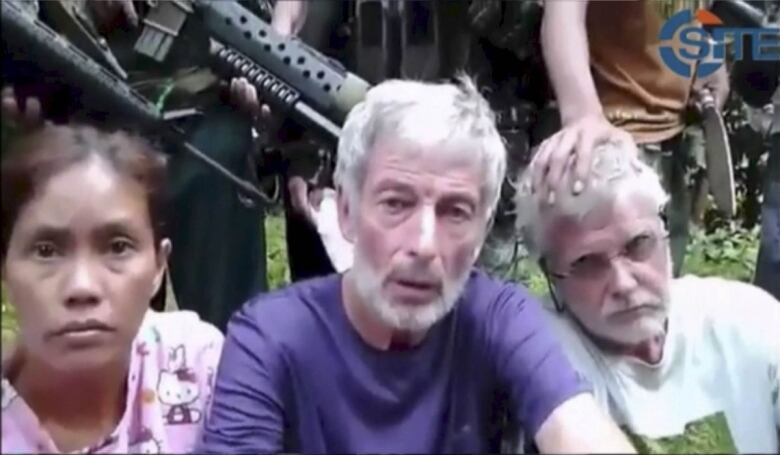
Like the Islamic State's propensity to publicize the atrocities they committed on their victims by video taping sophisticated theatricals of horror leading up to the beheading of the 'infidels' they captured, the Abu Sayyaf terrorist group, aligned with ISIL in the Philippines took the same apparent pleasure in terrorizing, tormenting and ultimately beheading those they took prisoner for ransom. In September of 2015, two Canadians along with a Norwegian with Canadian connections and a Filipino woman were abducted from a marina operated by the Norwegian in Davao.

Canadians Robert Hall, centre, and John Ridsdel, right, were taken hostage by Filipino militants in 2015. (Site Intelligence)

The terror group demanded a hefty ransom for the lives of John Ridsdel of Calgary along with fellow Canadian Robert Hall. It wasn't the first time Canadians were captured as they went about their business. There was a precedent to the Philippines' event, when Robert Fowler, a Canadian diplomat on assignment with the United Nations and his colleague Louis Guay were captured by al Qaeda in the Islamic Maghreb (AQIM) in 2008, held hostage in the Sahara Desert for 130 days. On their release, facilitated by the Conservative government of Prime Minister Stephen Harper, Mr. Fowler stated: "I owe a debt to Mr. Harper ..."

He also made a statement regarding the Liberal Party of Canada in March of 2010: "I believe the Liberal party has, to a significant extent, lost its way, at least in policy terms, and of course I mean, in particular, my area of foreign policy terms, and is in danger of losing its soul...To this observer, it seems that Liberals today don't stand for much in the way of principles...I have the impression that they will endorse anything and everything which might return them to power and nothing which won't, whatever the merits of either. It's all about getting to power, and it shows...I believe Liberals seem prepared to embrace an infinite array of special interests in order to shill for votes rather than forging a broad-based principled alliance founded in deep Liberal traditions, one with a distinct social contract and an independent  Canadian character, which would protect, project and defend core Liberal values at home and abroad..."

This was before the Liberals were returned to power in 2015, but it was a statement recognizing the Liberal hunger for power, determined to reassert their entitled place in Canada as the perpetual governing party. Robert Hall, 66 and John Ridsdel, 68, were out of luck when Prime Minister Justin Trudeau took Stephen Harper's place. For he announced that Canada would not sully itself by negotiating with terrorists, paying ransom to release two Canadians. That 2010 statement was prescient; five years later, the government of Canada stood firm on 'principles' and left two Canadians to die horribly.

In 2020 there is another episode with another two Canadians, this time abducted by the Chinese Communist Party, charged with a nebulous, evidence-lacking crime of 'espionage' against China: one, business man, Michael Spavor, the other a diplomat-on-leave, Michael Kovrig, both left to fend for themselves, trapped by circumstances whereby the CFO of Chinese technology giant Huawei being held in British Columbia on an extradition warrant issued by the United States has made them vulnerable to Chinese-style prisoner-chess. And there they languish, imprisoned, since December 2018, awaiting rescue from their nightmare, while the Liberal government continues to play footsie with Beijing.

The three men, Ridsdel, Hall and Sekkingstad, along with Hall's companion Marites Flor were abducted in Septmeber 2014 from the Davao Holiday Oceanview Marina on Samal Island. Ridsdell was executed in April, and Robert Hall was beheaded in June, but before that happened the terrorists teased him, telling him he was heading back to Canada. Then they placed handcuffs on him, allowed him to hug Flor, and led him to the place where the decapitation took place.

Susukan had been involved in a conflict with another Islamist group where he sustained a wound, losing an arm. He surrendered to the rebel leader Nur Misuari of the Moro National Liberation Front which signed a tentative peace agreement with the government back in the mid-1990s. Misuari then flew to Davao with Susukan where he was handed over to the government of President Rodrigo Duterte to face justice for the murder of the two Canadian men and stand trial in kidnappings and executions on the island of Borneo.

Another Abu Sayyaf terrorist implicated in the murder of Robert Hall and John Ridsdel has yet to be brought to justice. As another Abu Sayyaf commander involved in the deaths of the two Canadians, Moammar Askai had died in a battle on the island of Bohoi, killed by Philippines troops. Eventually after the two Canadians were executed Flor was given her freedom in June of 2015. A few months later, Kjartan Sekkingstad was also released; Norway had secured his freedom.

Philippine police escort funeral parlor employees carrying the body of one of two suspected Abu Sayyaf militants who were killed by authorities during a failed kidnapping attempt in Bohol, a province in the central Philippines, May 15, 2017.
Philippine police escort funeral parlour employees carrying the body of one of two suspected Abu Sayyaf militants killed by authorities during a failed kidnapping in Bohol, central Philippines, May 2017. AP

Labels: , , , ,

Saturday, August 01, 2020

Rodrigo Duterte : Sage Advice : Rivalling Donald Trump

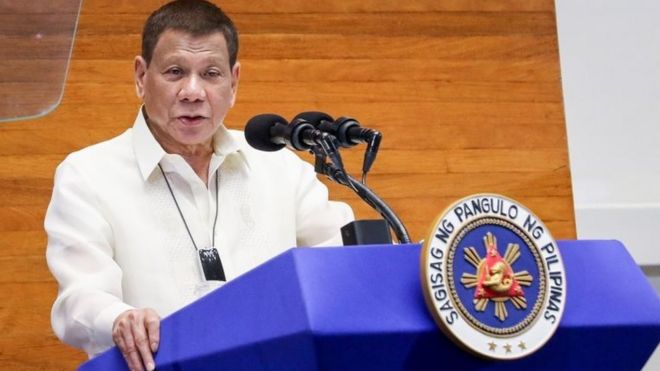
Mr Duterte gave a state of the nation address earlier this week, before his latest comments
Mr Duterte giving a state of the nation address    EPA
"Together, we shall fight this pandemic with the same fervour as our campaign against illegal drugs, criminality, insurgency and corruption in high places and entrenched parochial interests."
"What I said is true. Just go to the gasoline station, and then have some drops, that's disinfectant."
"I am not joking. That is true. You think I am just kidding."
"They [critics] said, 'Duterte's insane.' Stupid! If I'm insane, you should be the president, not me."
"What I've said was true. If alcohol isn't available, especially for the poor, just go to a gasoline station, and use [gas] to disinfect."
"I am not joking. I am not joking. You… you try to get inside my brain."
"At the end of the day, hang [the mask] somewhere and spray it with Lysol if you can afford it."
"For people who don't [have Lysol], drench it in gasoline or diesel... just find some gasoline [and] dip your hand [with the mask] in it."
President Rodrigo Duterte, Manila, Philippines
"You cannot use gasoline as disinfectant."
"Inhaling it may cause harm and could lead to more problems like respiratory disease."
Jose Santiago, president, Philippine Medical Association

"I can't believe that after four years of him as president, you still don't know [him]."                                                                                                                      "[It's only a] joke. Why would we use gasoline for washing?"                                                    Presidential spokesman Harry Roque

Thousands of people in the Philippines have been arrested by authorities for breaching curfew. Authorities have interrupted charity and relief operations and taken those suspected of violating quarantine rules to crowded facilities. Illogically those who flaunt the rules of mask-wearing and social distancing, are placed in crowded holding areas where social distancing is impossible to maintain. But the law is the law and it must be upheld

Police, the Philippine military and officials of neighbourhoods have all been authorized by President Duterte to shoot anyone defying lockdown restrictions. The Philippines, by order of the president, has enforced one of the globe's longest, most stringent lockdowns. Tactics in enforcement include mass arrests alongside threats of state violence. Methods well known to have been put in place in the president's war on drugs, methods deadly to drug dealers, users and innocents mistakenly taken for both.

Health professionals in the Philippines recommend soap and water to be used for cleansing reusable cloth masks. And that proper disinfection of surfaces require the use of 70 percent ethyl or isopropyl alcohol. The Philippine president has made the suggestion of using gasoline on masks on several occasions, eliciting shock from medical professionals as well as from some of his political opponents appalled at the dangerous advice he is propagating to a public that still awards him high approval ratings for his handling of the COVID-19 pandemic.

"DON'T TRY THIS AT HOME", tweeted Senator Risa Hontiveros. "FACT CHECK: Gasoline and diesel should not be used in disinfecting." President Duterte's response to his opponents is to defend his recommendations, emphasizing that his government's response had succeeded in preventing up to 3.5 million infections. The official government figure for the infection rate is 90,000, a figure generally held to be substantially under-counting cases.

No one in the Philippines may take the liberty of not wearing a mask; their use has been mandatory since March. Official figures admit to over 2,000 deaths caused by the SARS-CoV-2 virus causing COVID-19. For a second straight day on Friday, the country reported Southeast Asia's largest daily rise in new coronavirus cases. Restrictions meant to control the spread have been extended. The president has promised that by December the country would return to normal.

The second occasion on which Duterte repeated his singular advice for the use of gasoline or diesel to clean masks, medical experts were quick to override his comments, emphaszing that mask-cleaning tips by the president were not recommended. It's the kind of advice that places him in league with U.S. President Donald Trump's musing over whether injecting or drinking bleach might be effective in killing the virus. And his continued insistent recommendation of the use of a malarial drug as an effective vaccine for COVID.

Philippines
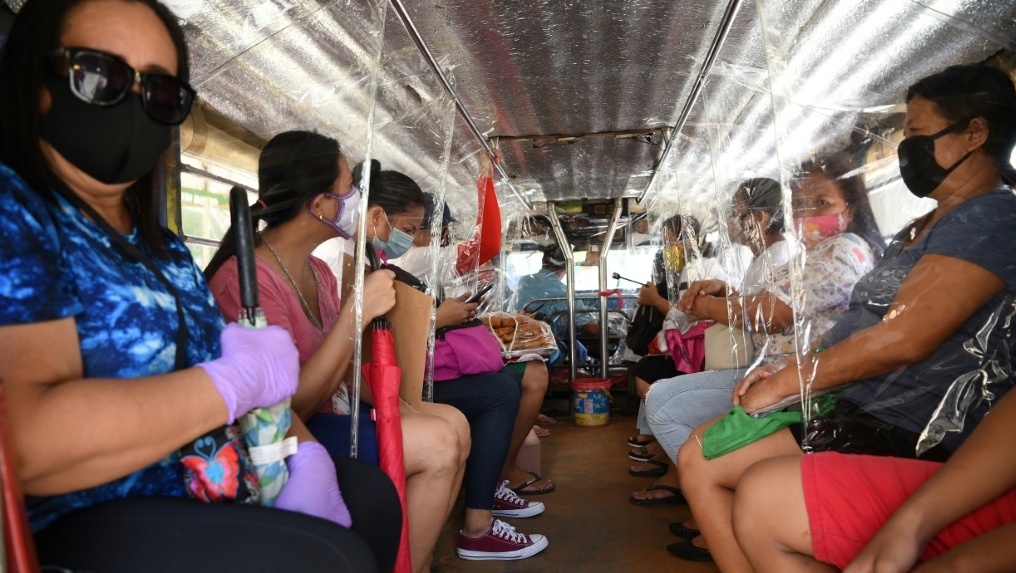
Passengers travel on a jeepney with seat dividers to ensure social distancing in Manila. Residents of Navotas, one of the poorest areas of the capital, will go back into lockdown following a spike in new coronavirus cases. (AFP

Labels: , ,

Thursday, April 25, 2019

Justin Trudeau's Canada: Environmentally Green-Green-Green

"I want a boat prepared. I'll give a warning to Canada maybe next week that they better pull that thing out or I will set sail."
"I will advise Canada that your garbage is on the way."
"Prepare a grand reception. Eat it if you want to."
"Let's fight Canada. I will declare war against them." 
Philippine President Rodrigo Duterte

"Currently, a joint technical working group, consisting of officials from both countries, is examining the full spectrum of issues related to the removal of the waste with a view to a timely resolution."
"In 2016, we amended our own regulations around hazardous waste shipments to prevent such events from happening again. We are committed to working collaboratively to ensure the material is processed in an environmentally responsible way."
"[Things are looking good for a resolution within weeks, not months, which] will most probably require Canada to take back the waste."
"Beyond the comments from the president, I don't think there have been any indications that there may be potential diplomatic ramifications. We are very hopeful that's not the case."
Sabrina Kim, spokeswoman, Environment Canada

"It's really the remittance angle [Filipinos living in Canada sending money back to the Philippines], so personal angle, that is the most important and the most vulnerable in the relationship. They [Philippine government] don't want anything upsetting remittance flows."
"[Duterte is being political by] standing up to Canada [rhetorically]. Taking a shot at Mr. Environment, Mr. Global Green Go-To Guy, taking [Trudeau] down a peg internationally isn't the worst thing that could fall into Duterte's lap."
Carlo Dade, trade expert, Canada West Foundation
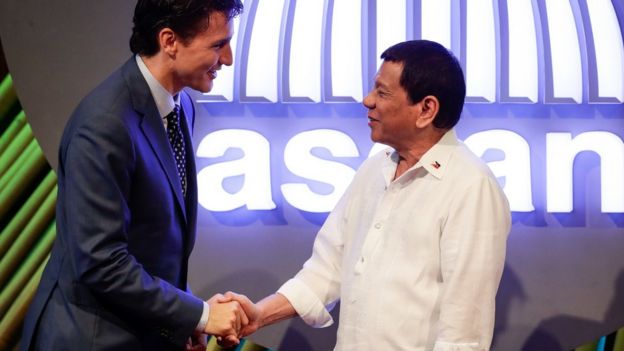
Canada's Prime Minister Justin Trudeau shakes hands with Philippine President Rodrigo Duterte in Manila in November 2017
Canada's Prime Minister Justin Trudeau shakes hands with Mr Duterte in Manila in 2017  Getty Images
So, let's see now...what's all the fuss about? Dozens of shipping containers full of household and electronic waste, sitting in a port near the Philippine capital Manila, rotting, stinking, an eyesore that infuriates Filipinos. As it would Canadians if the Philippines sent its garbage to Canada for disposal. Those shipping containers were supposed to be full of recyclable plastic waste. Shipped to the Philippines in a private contract.

One hundred and three shipping containers left Canada in 2013 and 2014, ostensibly full of plastics, and labelled thus. When they arrived for recycling, Filipino customs inspectors determined that debris from Canadian trash bins filled the containers, not plastic. Government-to-government, Canada has been persuading the Philippines to dispose of the garbage, over a six-year period of failing to take action. In 2016, a Filipino court ordered the trash returned to Canada. Canada paid no heed.

On trips to the Philippines in 2016 and 2017 Prime Minister Justin Trudeau was specifically asked to settle the matter; Canada had no legal means to force the company that shipped the waste to take it back, he said on the first trip. Then in 2017 he assured the Philippines that Canada was working on a solution; that "theoretically" it was possible for Canada to take steps to reclaim the trash. Possible? "Theoretically"? 

The Victoria-based Pacific Centre for Environmental Law and Litigation last week issued a legal opinion that Canada's actions related to the shipments violate parts of the Basel Convention, a treaty preventing countries from shipping hazardous waste to the developing world without the consent of the receiving country. Well, the Philippines consented to no such shipment on their soil or in their waters, but those containers sit there, rotting, toxic materials included.

The Canadian shipping company is no longer in business, having denied sending anything other than plastic to begin with, for what that's worth, and on the evidence, not much. Under the Basel Convention, should an agreement between parties not be feasible, the matter can be taken to the International Court of Justice. Should Canada not act now in good faith and retrieve what should never have been sent to a developing country, this is precisely what the Philippines should do.

Filipino environmental activists wear mock container vans filled with garbage to symbolize the 103 containers of waste that were shipped from Canada to the Philippines two years ago, outside the Canadian embassy south of Manila, Philippines on May 7, 2015.  THE CANADIAN PRESS/AP, Aaron Favila

Tough-talking, irascible, volatile Rodrigo Duterte has threatened "war" with Canada. One of the issues mentioned and promised during his campaign for election to the presidency was that the stinking pile of trash would finally be removed, at his insistent overtures to the government of Canada. The issue is one that infuriates Filipinos and with good reason; no nation appreciates another, more developed and wealthy nation treating their own as a trash receptacle.

The Philippines exports $1.3 billion in trade goods to Canada, double the $626 million Canada exports to the Philippines, There are also over 558,000 Filipino-Canadians, born in the Philippines and emigrated to Canada to become landed immigrants and citizens; an insult to the Philippines is an insult to that Canadian demographic of hard-working, tax-paying people. Those Philippine-born Canadian residents send back to their original country of residence $1.2 billion in remittances.
"This case is garnering so much attention because it’s an example of what the environmental justice movement has been saying for a long time — pollution flows according to a power gradient, from the most powerful to the least powerful."
“It’s on us, really. It’s our garbage, it’s poisoning people around the world and now it’s on us to fix."
Dayna Scott, associate professor, environmental law, Osgoode Hall Law School, York University
Officials check a shipping container holding garbage from Vancouver in Manila in this undated, handout photo. (Philippines Bureau of Customs/Canadian Press)


Labels: , , , ,

Tuesday, January 29, 2019


The Religion of Peace At It Again

"You see him on his Facebook profile and he’s smiling."
"It’s infuriating because you think to yourself, he shouldn’t be allowed to smile. He’s a killer, right? But there he is."
"[His name can be seen written on the base of his ammunition, which] would be typical of officers of the Philippine National Police worn by the Special Counter Insurgency Operation Unit, or SCOUT] being responsible for their issued kit."
"With that congruence of factors going on we have strong reason to believe that he was at some point a police officer within the PNP. And we’ve got nothing to refute that at this time." 
"[SCOUT training] would put him in an ideal position for a leadership role within Abu Sayyaf. Everything that you would need to know to attack Abu Sayyaf, now you have this member within Abu Sayyaf that can counter all of those different things that are happening to them."
So it’s a really significant finding in terms of our investigation and it also points to the difficulty that the Philippine army is having in trying to stop, get rid of, remove Abu Sayyaf."

"I think, like all Canadians, we were shocked by what was taking place. And having our skill set and knowing that Abu Sayyaf was very active on social media, we saw an opportunity to see if there was any way that we could provide input or gather intelligence on the group ourselves.
And so when the initial hostage videos, the ransom videos, came out, we started to monitor Abu Sayyaf on primarily Facebook."


"The fact that he stepped forward to be the executioner in both John Risdel and Robert Hall’s murders, there’s a reason for that. He’s looking to take on a broader role. And having that skill set, that SCOUT training, would also accelerate him up the ladder."


Jeff Weyers, senior analyst,Waterloo, Ontario-based iBrabo, Global News, December 18, 2018
Facebook photo believed to show Abu Sayyaf militant Bhen Tatuh wearing a Philippine National Police uniform.
Facebook photo believed to show Abu Sayyaf militant Bhen Tatuh wearing a Philippine National Police uniform
The RCMP is aware of the independent report.""We continue to work with our international partners regarding the ongoing criminal investigation into the deaths of Canadians John Ridsdel and Robert Hall in the Philippines."Sgt. Marie Damian, spokesperson, Royal Canadian Mounted Police
Facebook photo of Behn Tatuh, with ISIS flag behind him.
iBrabo
That was then, when Canadians anxiously read news reports of the two kidnapped Canadians for whose release the Islamist terrorist group now associated formally with Islamic State, was demanding millions. That was when newly-installed Prime Minister Justin Trudeau stated firmly that Canada does not pay ransom to terrorists. Of course, Canada has done so, through intermediaries in the past, it is why it came about that two former Canadian diplomats, Robert Fowler and Louis Guay taken hostage in Niger by al-Qaeda in the Islamic Maghreb (AQIM) were finally released, though then-Prime Minister Stephen Harper denied having paid ransom.

More latterly, the Cathedral of Our Lady of Mount Carmel on Jolo island where Abu Sayyaf militants have continued to carry out kidnappings, beheadings and bombings was attacked as devout Catholic Filipinos were at prayer on Sunday. Window panels were blasted out by the force of the first bomb that hurled humans and debris across the town square in the provincial capital of Sulu. In response to this latest atrocity Philippine President Rodrigo Duterte, ordered his troops to hunt down and crush the Abu Sayyaf group. 

They've done a bang-up job with drug traffickers, not so great with Islamist terrorists. "This is an act of terrorism. This is not a religious war", confusingly stated the Philippine Defence Secretary Delfin Lorenzana, identifying Abu Sayyaf commander Hatib Sawadjaan as being responsible for the attack. This is the commander of the group that beheaded the two Canadians back in 2009, when the ransom demand went unfulfilled. His base is the jungles close to the town of Patikul near Jolo. 


The minority Muslim population in predominantly Roman Catholic Philippines had endorsed a new autonomous region in the southern Philippines to put an end to close to five decades of separatist rebellion in which 150,000 people had been killed. Most of the Muslim areas had approved autonomy, while those in Sulu province chose to reject the deal. 

Typical of Islamic State, there were two suicide bombers involved, wearing explosive belts. One of the bombers detonated his explosives at the gate, and while wounded parishioners began to flee the interior of the cathedral, and armed forces personnel were rushing in, the second suicide bomber detonated his explosives in the parking lot. The death toll was twenty, while another 111 people were wounded; five troops and 15 civilians made up the death count.

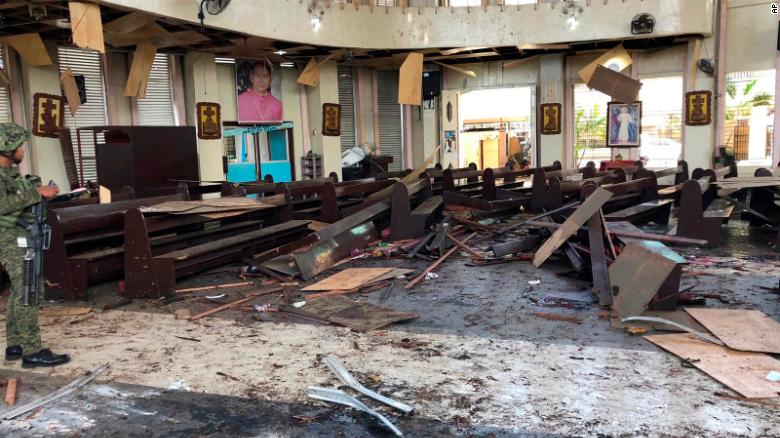
In this photo provided by WESMINCOM Armed Forces of the Philippines, a soldier views the site inside a Roman Catholic cathedral in Jolo, the capital of Sulu province in the southern Philippines after two bombs exploded Sunday, Jan. 27, 2019. The Philippine government says it will "pursue to the ends of the earth the ruthless perpetrators" behind bomb attacks that killed over a dozen people and wounded many more during a Sunday Mass at a cathedral on the restive southern island. (WESMINCOM Armed Forces of the Philippines Via AP)
A soldier views the site inside a Roman Catholic cathedral in southern Philippines after two bombs exploded Sunday.
"As we convey our sincerest condolences to the families and friends of the victims and offer our sympathy to the peace-loving people of Sulu who are severely affected by this dastardly act, we assure our people that we will use the full force of the law to bring to justice the perpetrators behind this incident."
"[People should] remain calm and avoid spreading panic in our respective communities to deny terrorism any victory."
Philippine Defence Secretary Delfin Lorenzana
Even in the Philippines, with tough-guy Duterte at the helm, authorities take exquisite care not to rile the sensibilities and besmirch the 'honour' of Islam by speaking words such as Islamist terrorists, lest the beast be bestirred to even greater and more horrendous atrocities; not that President Duterte would mind all that much being accused of 'Islamophobia'.
 

Labels: , , , , ,

Tuesday, December 26, 2017

Mindanao, Philippines, Islamist Insurrection

"A further extension of the implementation of martial law ... will help quell completely and put an end to the ongoing rebellion in Mindanao and prevent the same from escalating to other parts of the country."
Philippine President Rodrigo Duterte

"The reason we live under a red alert is that the Maute can look like civilians. We worry that they may come here [Iligan City]. We fear that they are already among our population."
"That is why we support martial law. We know that Duterte does this for our own safety."
Daryl Lugatiman, clothing designer, Philippines

"We call the Maute terrorists because of the destruction they have caused in our place [Marawi, Mindanao]. They claim they are jihadists and are suddenly calling themselves Islamic State, but that is branding. They do not even know what jihad is."
"What they really are is extremists. What they are doing is un-Islamic. They have taken Islamic principles and misinterpreted them."
Nassib Sambaco, former Marawi councillor

"[The Maute were] inspired by ISIL central, ideologically and tactically."
"[However], the group built] their narratives based in a local context of perceived or real government discrimination, a slow-moving peace process and the hard approach taken by President Duterte."
Ahmad Elmuhammady, Islam International University, Malaysia

"Is there not an alternative to air strikes? They have become an effective tool for the Maute to recruit in reaction]."
"The Maute are like a bacteria. They exist in parts of the body that are sensitive. But they are only one percent of the population, if it is even that high. This must be stopped but in the right way."
"[The people of Marawi do not support extremism], but what happens in Iraq and Syria means that our hearts and minds can be easily manipulated."
"This happens because of globalization. It is so easy now to exchange ideas and information. Young people and even some older people here can see extremist videos that were made in the Middle East. They like these videos because they believe that they tell them about Islam. The truth is that this is not Islam at all."
Abdullah Ahmad-Ali, lawyer, Marawi, Mindanao

"There was shooting and burning everywhere, the main campus of the University of Mindanao was badly damaged and the Maute were warning people to leave or they might die."
Marjana Sagusura, student, Marawi

"To see the planes flying is good. There has to be bombing because that is the terrorists' stronghold."
"I am not angry with Muslims, but I wonder why they make trouble. We must be vigilant to keep our own city [Iligan City] peaceful and safe."
Ricardo Naboyng, duty guard
In a press conference, presidential spokesperson Harry Roque said Duterte this week will receive the Armed Forces of the Philippines’ recommendation on whether military rule in Mindanao must be prolonged. AP/Bullit Marquez

If jihad is not Islam, then it would be most instructive to the world at large to know what Islam is. Muslims claim it to be a religion of peace. The Koran and the Hadiths have the duty of believers writ  large in their obligation to engage in jihad, one of the vital pillars of Islam. The 'extremists' are simply exercising their obligation as believers to follow the instructions of the Koran. To state ad infinitum from various points of the globe from among the ummah that this is not Islam is beyond disingenuous.

The Christians living in Iligan believe that the people of Marawi, Philippine Muslims, deserve what is happening to their city for their tacit complicity in support of the Islamist groups, the Maute, Abu Sayyaf and Islamic State. Of the 100-million population of the various islands that comprise the Philippines, 80-million are devout Roman Catholics. They are willing to live with the Muslims in their midst, but not, obviously, when the 'extremists' among them are violently abusive, threatening stability and causing death and destruction.

It is a small percentage of the ten-million Muslim Filipinos admittedly, that are wreaking this damage to the larger community of the Philippines by attacking villages and cities to claim them for Islam, and by kidnapping foreigners, holding them for ransom, and when none is forthcoming, placing the Philippines in international news headlines by beheading the captives. The Islamist opposition to the central command of the federal government is not viewed kindly by its president, a man who never hesitates to employ violence when he is opposed.

The martial law imposed when the Maute clan and their allies, foreign fighters and Abu Sayyaf invaded Marawi in a five-month conflict remains in place despite the military having brought order and control to Mindanao killing the elite of the militant terrorists. Because the threats yet continue martial law has been extended through the coming year. Fears that the deadly conflict from Muslim Marawi could spread to Christian Iligan City ensures that support for Muslims is muted.
In this June 2, 2017 photo, President Rodrigo Duterte visits the 102nd Infantry Brigade Headquarters in Ipil, Zamboanga Sibugay. PCOO/Released

Even so, in Iligan City thousands of Philippine troops pass one another, the battle-weary ones passing in the opposite direction of the fresh troops heading toward the fight as Vietnam-era helicopters whomp overhead and PA-50 warplanes carrying rockets and bombs stream forward to the southern battle zone. In the besieged city of Marawi, police and army checkpoints create a gauntlet of restricted passage. In the last general election that elevated Duterte to the presidency, Marawi voted for Duterte.

In most of Mindanao the man remains popular and trusted to put down these violent insurrections, yet his air strike war on Marawi has understandably undercut his support from Muslims. Central Marawi is destroyed thanks to the air bombing campaign. In the ruins of Marawi, the Maute/AbuSayyaf/Islamic State fighters were able to hold out by hiding and fighting in its ruins even while vastly outnumbered and outgunned by Philippine forces.

A situation that "lifted the prestige of the Philippine fighters in the eyes of ISIS central [and] has inspired young extremists from around the region to want to join [them]", wrote the Jakarta-based Institute for Policy Analysis of Conflict. Only a strong government determination to rebuild the destroyed city will give Filipino Muslims in Mindanao the comfort to believe the government views their needs as equal to those of the Christian population.

"I don't like Muslims because they make trouble for Christians by bombing and ambushing them. Some of them are traitors who hate Christians. My feelings are so strong that I can't really talk about them, although I know that some Muslims aren't bad", stated Pentecostal Merlinda Halisbas, as she mulled the future of the country and her president's challenge once the restoration of peace has been accomplished.

Labels: , , , ,

Wednesday, November 15, 2017

Engaged With Justin Trudeau - Smile!

"I also mentioned human rights, the rule of law and specifically extrajudicial killings as being an issue that Canada is concerned with."
"I impressed on him the need for respect for the rule of law, and as always offered Canada's support and help as a friend to move forward on what is a real challenge."
"The president was receptive to my comments and it was throughout a very cordial and positive exchange."
Canadian Prime Minister Justin (Sunny Ways) Trudeau, ASEAN summit, Philippines

"I will answer the fisherman and the farmer and I will explain to them patiently why it is so, but I will never, never allow a foreigner to question why it is so."
"I said I will not explain. It is a personal and official insult. It angers me when you are a foreigner, you do not know what exactly is happening in this country."
"You don't even investigate. I only answer to the Filipino. I will not answer to any other bullshit, especially foreigners. Lay off."
Philippine President Rodrigo Duterte
Prime Minister Justin Trudeau, left, say he spoke with Philippines President Rodrigo Duterte on human rights in Manila on Monday.
Prime Minister Justin Trudeau, left, say he spoke with Philippines President Rodrigo Duterte on human rights in Manila on Monday.  (Adrian Wyld / THE CANADIAN PRESS)

The rough-and-ready, unabashed tough-guy president of the Philippines made it clear long ago how he feels about outside interference in the manner in which he governs his nation. It seems that his orders to shoot first, ask questions later, has the approval of the electorate, sick of lawlessness, the challenges posed by Islamists' threats and depredations in a basically Roman Catholic country, along with the incidental scourge of drug trafficking and addiction.

President Duterte rode to victory during the general election where he was voted in as a president who vowed to clean up the mess in the Philippines. He had his stint as mayor in a trouble-ridden city to prove he could and would make good on his election promises. On ascending to the seat of government he lost no time in unleashing police and the military to the task of cleaning up both drug traffickers, users, and Islamist threats, though both remain, albeit in diminished form.

His methodology is not for the weak-of-heart, and humanitarian organizations were quick to condemn the man who boasts of his own forays into sweeping up crime and personally killing perpetrators. He is proud of his exploits and enjoys shocking those who disapprove, and they are legion, though they are not the electorate, but outsiders. Outsiders like Canada's Prime Minister who is no one's understudy as a proudly boastful self-promoter. His own popularity with his electorate has plunged in reflection of his administration's mismanagement on every file save self-aggrandizement.

Justin Trudeau no doubt reminded Mr. Duterte of his visceral dislike of Barack Obama whom he referred to unflatteringly as a "son of a bitch" who could "go to hell" for chiding him over his methodology in fighting crime, urging instead that the drug war in the Philippines be tackled "in a way that's consistent with basic international norms", in so doing earning Duterte's eternal scorn and derision. But there's a new President now in the United States and the two men, Donald Trump and Rodrigo Duterte have common characteristics, notably that of thuggish temperaments.

"Countries around the world know that when you engage with Canada you will hear about human-rights concerns and we are the first to mention that we are not perfect, either", gloated Trudeau. Certainly, he takes credit for much, having shouted out to the world at large that "Canada is back!" when he was elected Prime Minister. As for Trudeau and his political party admitting to occasional 'imperfections' that would be a pleasant surprise to most Canadians, as their Prime Minister's election promises appear to have failed one after another while his government forges ahead in their implausible mismanagement.

A different story emerged from President Trump's performance with the irascible Duterte, as the two-of-a-kind duo met and discussed issues of mutual interest and import to both countries. President Trump declared that he and Duterte "had a great relationship", and simply took to another subject when he was asked whether he had raised concerns over human rights. Duterte's spokesman, on the other hand remarked that no human rights or extralegal killings were mentioned during the Trump-Duterte discussion; rather they spoke at length of the Philippines' war on drugs.

A joint statement issued in the aftermath of their discussion declared that they "underscored that human rights and the dignity of human life are essential, and agreed to continue mainstreaming the human rights agenda in their national programs". So isn't that grand? Could be that Duterte is scheming how he might disinvite Trudeau from taking a seat at an ASEAN East Asia Summit, as the first time that Canada has been invited to sit at that Summit, the host being displeased with the manners of his guest.

Labels: , , , , ,

Sunday, August 20, 2017

The Mountain Whom All Approach in China

"Since the start of last year, eight ministries and four organizations directly under the State Council, China's cabinet, have been given new chiefs."
South China Morning Post

"He [Xi Jinping] stood still, long arms slack, hair pomaded, a portrait of take-it-or-leave-it composure that induced his visitor to cross the room in pursuit of a handshake."
Evan Osnos, New Yorker, Xi profile
"He's a very talented man. I think he's a very good man. He loves China, I can tell you. He loves China. He wants to do what's right for China."
"Just left China’s President Xi where we had an excellent meeting on trade & North Korea."
"So much for China working with us - but we had to give it a try! While I greatly appreciate the efforts of President Xi & China to help with North Korea, it has not worked out."
U.S. President Donald Trump
China's President Xi Jinping waits to meet with outgoing Hong Kong Chief Executive Leung Chun-ying at a hotel in Hong Kong, China, June 29, 2017.
One-man rule. (Reuters/Dale De La Rey)

The world is immersed in a period of political dictatorships. The trend seemed to begin in Russia with Vladimir Putin deciding that two terms as president of Russia just wasn't satisfying enough for his self-conceived role as the new czar, so he and Dmitri Medvedev did a little twist on the child's game of musical chairs and exchanged positions. Circumventing the Russian constitution that deems two terms at the helm more than sufficient; a legal clause that most nations' constitutions reflect.

The next step was to give himself increased power that would enable him to change the constitution, to cleanse it of the offending stipulation that two terms would serve nicely to bring in fresh blood. Mr. Putin spilled more than his share of blood in erasing his critics' irritating dissents, and now he is able legally in Russia to rule for as long as he wishes. His successful ruse inspired Turkey's Recep Tayyip Erdogan to follow suit, and  he too despite opposition that he made quick work of, succeeded.

Then along came Venezuela's Nicolas Maduro determined to do the very same. Only protest in Venezuela is far more robust than it was in both Russia and Turkey, mostly because the country is in a state of perilous downfall, its economy in free fall, unemployment rife, violence on the rise, and food and medicine and oil in steep decline. No matter, if Putin, Erdogan and other aspiring dictators could succeed so could Maduro.

Next in line surely would be the Phillippines' Rodrigo Duterte, whose inflexibly violent 'war on drugs' will warrant that he will be the only political leader in that torn country battling its very own Islamist insurgency entitled to rule the country. Despite all its horrendous dysfunction courtesy of Islam, drugs and Duterte, popular support of the population will ensure that they will obligingly support the prospect of his continued unforgiving iron command.

No one could rightfully claim that Donald J. Trump pirated the American presidential election to crown himself with the pompous self-regard he showers on himself. It was the decision of an overwhelming number of American voters that brought President Trump to the White House. The nation was already deep in the throes of political polarization which thrived under his predecessor, the redoubtable Barack Obama. This is a nation increasingly at war with itself.

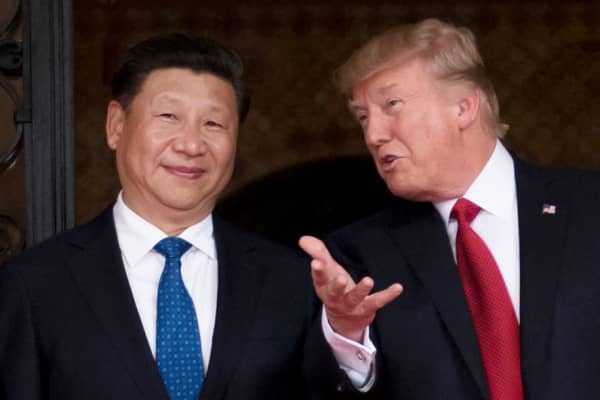
U.S. President Donald Trump (R) welcomes Chinese President Xi Jinping (L) to the Mar-a-Lago estate in West Palm Beach, Florida, on April 6, 2017.
Still from video; G20 Summit

But the biggest fish to fry is now consolidating his influence in the world's most populous nation. If it is considered difficult to administer the affairs of a country whose population originated from all parts of the world and whose politics reflect the full spectrum from left to right, radical to moderate, it [the U.S.] is still merely one-quarter of the size of the population ruled by the Communist Party of China's Politboro and its leader.

The reformist who came to office as an insider with a moderate agenda also undertook like Trump, to 'clean out the stable' [one of the tasks of srongman Hercules, to clean out the gigantic Aegean stable] of the entitlement of the political elite to the additional emoluments of corruption. To make the country run more effectively, efficiently, increase prosperity, become more responsible to its people, that kind of thing. And so, Xi Jinping set out to cleanse the leadership of the corrupting influences of his predecessor.

The 19th National Congress is scheduled for the fall and there it is that China's latest dictator will shine, his keynote address paving the way for re-writing the constitution of the Communist Party of China. This leader of the People's Republic is attuned to winning another, his second five-year General Secretary term. And when that one is completed, there's the third term which the current constitution disallows, but which, like Russia's and Turkey's, in capable hands can will be re-written.

All the preliminaries have been taken care of; he did have five years to install those friends in the party's upper echelons, as well as reorganize the military. Critics were charged with inharmonious activities harmful to the welfare of the state and duly prosecuted. With President Xi flattery and sycophancy goe a long way to please this very amiable man. And intelligent. And literate. As head of the seven-member national committee in any event, it is exceedingly unwise to challenge his authority.

He is on track to lead his nation toward the "great rejuvenation of the nation"; prosperity, unity and strength. And who could criticize the relaxation of the one-child policy, or the elimination of "re-education through labour" camps, after all? As for the modernization and technical advances brought to the country, helping to increase the numbers of the middle class; high-speed rail and all manner of technical and scientific advances the equal of any first-world country, and more, express China's potential and its present.

Issues such as human rights, independent judiciaries and constitutional democracy Western-style, are simply not the Chinese way. Chinese lawyers who specialize in promoting human rights are actively practising anti-Chinese values, resulting in lack of harmony and social, economic and poliical stability which in and of itself challenge forward-looking success.

No, we haven't forgotten North Korea's Kim Jong-Un. He is in a category of his own. Sharing space with the Islamic Republic of Iran.

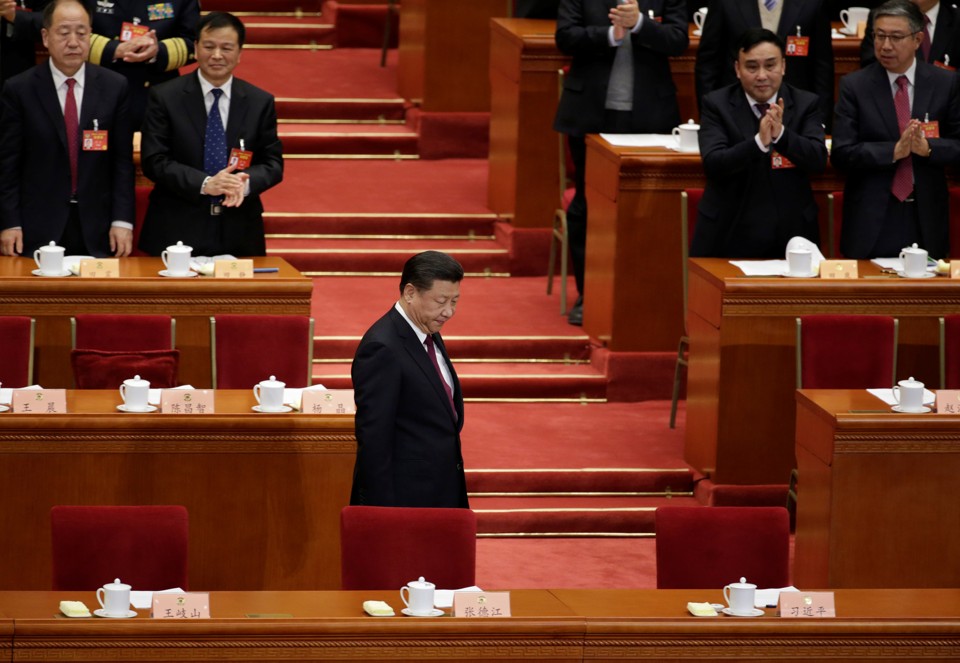
Chinese President Xi Jinping arrives for the opening session of the Chinese People's Political Consultative Conference (CPPCC) at the Great Hall of the People in Beijing, China, on March 3, 2017.
Chinese President Xi Jinping arrives for the opening session of the Chinese People's Political Consultative Conference (CPPCC) at the Great Hall of the People in Beijing, China, on March 3, 2017   Jason Lee, Reuters

Labels: , , , , , ,

Monday, December 26, 2016

The Philippine War on Drugs

"I witnessed bloody scenes just about everywhere -- on the sidewalk, on train tracks, in front of a girls' school, outside 7-Eleven stores and a McDonald's restaurant, across bedroom mattresses and living room sofas. I watched as a woman in red peeked at one of those grisly sites through fingers held over her eyes at once trying to protect herself and permit herself one last glance at a man killed in the middle of a busy road."
"I have covered wars in Iraq and Afghanistan. What I experienced in the Philippines felt like a new level of ruthlessness: police officers summarily shooting anyone suspected of dealing or even using drugs. Vigilantes taking seriously Mr. Duterte's call to 'slaughter them all'."
Journalist Daniel Berehulak: Witnessing Slaughter in Duterte's Philippines, The New York Times

"We in the slums of Manila who have been living in constant fear for the past ten-plus years because of the denial of the previous administration that we are becoming a narco state feel safer. You do not have the right to tell that you don't feel safe if you haven't experience[d] violence from drug infested areas!!!
Ann Mendoza, Philippines

"I'm living in the Philippines, and yes one of my family got killed because of this campaign, but I still and the rest of my relatives support this campaign because since the administration changed we feel more safer. And about his efforts, we, most of Filipinos are very satisfied to his [Duterte's] works."
Jhudie Rap Ram-Jo, Philippines
President Rodrigo Duterte has ordered a nationwide crackdown on drugs criminals. Since he became president in June 2016, more than 3,000 are thought to have died.
President Rodrigo Duterte has ordered a nationwide crackdown on drugs criminals. Since he became president in June 2016, more than 3,000 are thought to have died. Photograph: Bullit Marquez/AP

Last year Rodrigo Duterte, who had garnered a reputation as a brutally fearless law-and-order, coarse-speaking politician who had cleaned up his own crime-ridden city in the Philippines in his stint as its mayor, ran for the office of president of the country, boasting he would rid his country of terrorists and drug dealers to bring justice to bear and remediate the quality of life of the people of his nation. And he was handily elected to office. Immediately on assuming the presidency he launched a war against drugs.

Since President Duterte formally unveiled his war on drugs, urging everyone to become involved, he has inspired extrajudicial killings committed by vigilantes or just plain thugs to take place without consequences or question let alone trial and justice, the administration content to allow the situation to unroll as it would, with the police, the military and the public becoming involved. The police essentially have license to kill anyone they feel is a suspect.
Residents stand behind a police line, observing the two dead bodies of alleged drug dealers following a drug bust operation that turned into a gunfight in Manila in July. Nearly 1,800 people have died, police said, since the government launched a crackdown on illegal drugs after Rodrigo Duterte won a landslide presidential election victory in May with a vow to kill criminals.       Noel Celis/AFP/Getty Images

President Duterte would not shed a tear for the hundreds, perhaps thousands of people killed, satisfying his determination to cleanse the country of the presence of users and dealers alike. "Suspect Cruz ran inside the house then pulled a firearm and successively shot the lawmen, prompting the same to return fire in order to prevent and repel Cruz's unlawful aggression" one police report stated. Obviously exculpatory reason to act as they did.

But an exonerating tale that was not supported by the eyewitness account of Florjohn Cruz's wife. Who told her own story of her 34-year-old husband busy fixing a transistor radio owned by his 71-year-old mother. Armed men clattered their way into the living room and shot Mr. Cruz dead, a man who was not a drug dealer but who used methamphetamine. Police knew where he lived because months ago he had, like tens of thousands others, 'surrendered' in response to a presidential decree.

Which had included an opportunity while turning oneself in to authorities, to take advantage of a drug treatment program presumably available to anyone who registered as either a drug dealer or a user of drugs, but failed to materialize. Joselito Jumaquio was one of those users, a pedicab driver who surrendered to the authorities. His end came when 14 masked men entered the shantytown where he lived and dragged him down an alley, calling to neighbours to stay inside their homes.

They exited after two shots were fired, and then another four, to find Mr. Jumaquio's bloodied body. A plastic bag of amphetamines beside his handcuffed hands, along with a gun, in an operation that the subsequent police report described as a "buy-bust operation". There are so many bodies of those summarily executed that they are piled like firewood in morgues for eventual burial in mass graves.

Benjamin Visda was at a food outlet eating cake when he was taken by eight men. He lived for another 20 minutes, after which his body was dumped outside a police station. Crisostomo Diaz, 51 years of age, had nine children with his wife Nellie. He worked at odd jobs and was a drug user who had turned himself in to authorities. His wife wanted him to stay with relatives, but missing his family he returned, to sleep at home. And was murdered there.

According to Mr. Diaz's 19 year old son, a man in a motorcycle helmet kicked in their front door, two others behind him. The helmeted man said "Goodbye, my friend", while his companions held guns at the chests of the boys gathered in the house, and Mr. Diaz was shot point blank in the chest. As he sank to the floor he was shot twice more, in his head and his cheeks. The children watched as the three men left, laughing.

Over 35,600 people have been arrested in anti-drug operations the government has named Project Tokhang, a Cebuano language phrase meaning "Knock and plead". In poor districts police seize teenage boys and men directly off the street, make arrests after running background checks, but sometimes shooting to kill. Over 3.57 million residences have had government forces knock on their doors.

More than 727,600 drug users and 56,500 dealers have surrendered to the police, leading to massively overcrowded prisons. President Duterte is usually seen smiling in public. He is fulfilling his election promise.
CRIMINALS KILLING CRIMINALS? This photo shows a placard reading 'Do not follow me, I am a drug pusher and my house is a drug den,' next to victims who were shot dead by unidentified gunmen in Manila on July 28, 2016. Photo from EPA

Labels: , ,

Thursday, August 04, 2016

Fighting Crime . . . Pulling Out All The  Stops

"We will not stop until the last drug lord, the last financier and the last pusher have surrendered or been put behind bars or below the ground, if they so wish."
"There you are [photo of the distraught wife of a 29-yer-old rickshaw driver in Manila, shot to death as a drug dealer] sprawled on the ground, and you are portrayed in a broadsheet like Mother Mary cradling the dead cadaver of Jesus Christ. That's just drama."
Philippine President Rodrigo Duterte
Jennilyn Olayres hugs her partner, Michael Siaron, on the street where he was shot. Next to him is a placard which reads "I'm a pusher."

"These are not the wealthy and powerful drug lords who actually have meaningful control over [the] supply of drugs on the streets in the Philippines."
Phelim Kine, deputy director, Human Rights Watch, Asia

When President Duterte was long-time mayor of Davao City he enacted Draconian laws to combat rampant crime and corruption in the city. A record he is proud of. There was a strict curfew, a smoking ban, a zero-tolerance of drug users and sellers. It took time, but by the time that Mr. Duterte left his job as mayor after a twenty-year stint, the city had become a safety zone in a region that violence has long plagued.

Last year, Rodrigo Duterte campaigned on a promise of stifling crime and making the Philippines a country safe for its residents, that the growing reality of Islamist violence, as well as the drug-inspired crime wave would be dramatically reduced under his firm command. He offered to negotiate with Islamists as long as they pledged peace, but when they spurned his offer, he withdrew it and no holds will now be barred in that direction.

The International Drug Policy Consortium representing a network of non-governmental organizations forwarded a dispatch to the United Nations urging its drug control agencies "to demand an end to the atrocities currently taking place in the Philippines", and to further condemn extrajudicial killings that "do not constitute acceptable drug-control measures".

During Mr. Duterte's twenty years as mayor of Davao City, through his auspices in the effort to defeat drug-dealing and crime, an estimated one thousand people lost their lives. This is a number and an episode in his past governance that he is proud of, and is not averse to stating and re-stating that his government-sanctioned death squads led to those deaths which in the end led to a pacified city. He even boasts of having been personally responsible for some of those deaths, at his own hands.

Now, since formally assuming the presidency a month ago, his tough-on-crime agenda has been rolled out for the entire country. He has given free reign to the police and the military with instructions to kill drug suspects, and that has resulted in 420 people in that space of time losing their lives, according to tallies by local news media relying on police reports

When he addressed Congress a week ago, President Dutarte repeated his instructions to police, ordering them to "triple" efforts to combat crime. The families of many of those who have been killed claim their dead were poor Filipinos with no hand in the drug trade, simply shot down in the streets without a trial. Their president has responded with the statement that human rights "cannot be used as a shield to destroy the country".

Police patrol a shanty community at night during curfew on June 8, 2016 in Manila. Philippine police have been conducting frequent night raids and revived a curfew for minors that has not been enforced for years.
Police claim the arrest of over 2,700 people charged with using or selling illegal drugs. Crime nationally has fallen 13 percent since the election, to 46,600 crimes reported in June, down from the May number of 52,900. The president's crackdown is hugely popular with most Filipinos, sick of years of violent crime and corruption, inefficient law enforcement and despair for the future. All of which led them to laud the man and give him an overwhelming mandate.

Labels: , , ,

() Follow @rheytah Tweet