Politic?

This is a blog dedicated to a personal interpretation of political news of the day. I attempt to be as knowledgeable as possible before commenting and committing my thoughts to a day's communication.

Wednesday, May 26, 2021

Bomb On Board

A Belarusian dog handler checking luggage from a Ryanair flight at Minsk International Airport on Sunday.
   Credit...Onliner.by/Agence France-Presse — Getty Images
Belarus made use of a ruse to convince the pilot of a Ryanair flight en route from Greece to Lithuania that it would be in the best interests of all on board to cut the flight short by landing in Minsk with the claim there was a security threat aboard the plane and there was no time to be lost. For good measure, a Belarusian MiG was scrambled to intercept the passenger flight headed to Vilnius. All for the purpose of apprehending a Belarusian journalist who had run afoul of Belarus's President Alexander Lukashenko by disputing the legality of a discredited 2020 election that resulted in mass street demonstrations by outraged Belarusians. 
 
The young journalist aboard the Ryanair flight, along with his girlfriend, a Russian photographer, had also been involved in organizing some of those demonstrations and in editing an online magazine critical of the longtime Belarusian dictator. Roman Protasevich, 26, was charged with being a 'terrorist', becoming a wanted man, which convinced him to leave Belarus and redomicile himself safely in Lithuania. Sofia Sapega was attending university in Vilnius. So much for the best-laid plans of mice and men, and journalists who run afoul of tyrants.

Minsk air traffic control, according to transcripts acquired by Reuters, informed the plane's pilot that a bomb was aboard his plane, to be activated over Vilnius.
Pilot: Standby
Pilot: OK, could you repeat the message?
ATC: I say again, we have information from special services that you have bomb on board. That bomb can be activated over Vilnius.
Pilot: Roger that, standby.
ATC: For security reason we recommend you to land at UMMS [ICAO code for Minsk airport].
Pilot: OK ... that ... it ... understood give us alternate please.
Pilot: The bomb ... direct message, where did it come from? Where did you have information about it from?
ATC: Standby please.
Pilot: Go ahead.
ATC: Airport security staff informed they received email.
Pilot: Roger, Vilnius airport security staff or from Greece?
ATC: This email was shared to several airports.
Pilot: Did you say that your recommendation? 
ATC: Advise your decision please.
Pilot: I need answer the question: what is the code of the [unreadable] green, yellow or amber, red.
ATC: Standby.
ATC: They say code is red.
Pilot: Roger that. In that case we request holding at present position.
ATC: Roger, hold over your position, maintain FL390 turns at own discretion.
Pilot: OK holding at our discretion at present position maintaining FL390.
Pilot: We are declaring an emergency MAYDAY, MAYDAY, MAYDAY RYR 1TZ. Our intentions would be to divert to Minsk airport.
ATC: RYR 2TZ MYDAY, Roger. Standby for vectors.
And so, when the pilot announced on the plane's intercom that the plane was being diverted to Minsk, the reaction from the journalist was instant for he, among all the passengers who panicked over the highly unusual, inexplicable sudden change in destination, fearing the plane's physical integrity to have been compromised through some kind of emergency, knew otherwise. The emergency was his alone. And he visualized his arrest, incarceration, questioning, torture, sentence. Death sentence for 'treason'. 
"Belarus is Europe's last dictatorship, this continent's last country that has still not managed to shrug off the dark legacy of the Soviet regime, to overcome the terrible traumas totalitarianism brought upon our nation."
Belarusian-Canadian Ivonka Survilla, head RADA Belarusian government-in-exile
 
"[The exiled government is a] non-material relic of sorts."
"[The Belarusian government-in-exile almost gave its blessing to the country's first post-Soviet government in 1990, but did not because] the signs of how the present regime would come into being were already evident."
"We can only give the mandate once. That's why it is necessary to wait for the moment when full-fledged and independent democratic institutes are set up [in Belarus]."
Ales Cajcyc, RADA Information Secretary
 
"He [Roman Protasevich] said that he was treated lawfully [speaking from an unknown prison in a video released to the public by Belarusian authorities], but he's clearly beaten and under pressure."
"There is no doubt that he was tortured. He was taken hostage."
Exiled Belarusian opposition leader Sviatiana Tsikhanouskaya
Roman Protasevich being detained by  police officers in Minsk, Belarus, in 2017.
  Credit...Sergei Grits/Associated Press

Labels: , , , , , ,

Tuesday, January 29, 2019


The Religion of Peace At It Again

"You see him on his Facebook profile and he’s smiling."
"It’s infuriating because you think to yourself, he shouldn’t be allowed to smile. He’s a killer, right? But there he is."
"[His name can be seen written on the base of his ammunition, which] would be typical of officers of the Philippine National Police worn by the Special Counter Insurgency Operation Unit, or SCOUT] being responsible for their issued kit."
"With that congruence of factors going on we have strong reason to believe that he was at some point a police officer within the PNP. And we’ve got nothing to refute that at this time." 
"[SCOUT training] would put him in an ideal position for a leadership role within Abu Sayyaf. Everything that you would need to know to attack Abu Sayyaf, now you have this member within Abu Sayyaf that can counter all of those different things that are happening to them."
So it’s a really significant finding in terms of our investigation and it also points to the difficulty that the Philippine army is having in trying to stop, get rid of, remove Abu Sayyaf."

"I think, like all Canadians, we were shocked by what was taking place. And having our skill set and knowing that Abu Sayyaf was very active on social media, we saw an opportunity to see if there was any way that we could provide input or gather intelligence on the group ourselves.
And so when the initial hostage videos, the ransom videos, came out, we started to monitor Abu Sayyaf on primarily Facebook."


"The fact that he stepped forward to be the executioner in both John Risdel and Robert Hall’s murders, there’s a reason for that. He’s looking to take on a broader role. And having that skill set, that SCOUT training, would also accelerate him up the ladder."


Jeff Weyers, senior analyst,Waterloo, Ontario-based iBrabo, Global News, December 18, 2018
Facebook photo believed to show Abu Sayyaf militant Bhen Tatuh wearing a Philippine National Police uniform.
Facebook photo believed to show Abu Sayyaf militant Bhen Tatuh wearing a Philippine National Police uniform
The RCMP is aware of the independent report.""We continue to work with our international partners regarding the ongoing criminal investigation into the deaths of Canadians John Ridsdel and Robert Hall in the Philippines."Sgt. Marie Damian, spokesperson, Royal Canadian Mounted Police
Facebook photo of Behn Tatuh, with ISIS flag behind him.
iBrabo
That was then, when Canadians anxiously read news reports of the two kidnapped Canadians for whose release the Islamist terrorist group now associated formally with Islamic State, was demanding millions. That was when newly-installed Prime Minister Justin Trudeau stated firmly that Canada does not pay ransom to terrorists. Of course, Canada has done so, through intermediaries in the past, it is why it came about that two former Canadian diplomats, Robert Fowler and Louis Guay taken hostage in Niger by al-Qaeda in the Islamic Maghreb (AQIM) were finally released, though then-Prime Minister Stephen Harper denied having paid ransom.

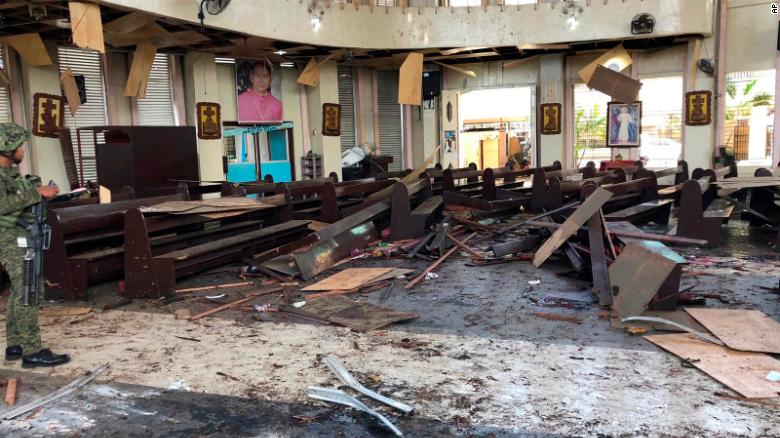
More latterly, the Cathedral of Our Lady of Mount Carmel on Jolo island where Abu Sayyaf militants have continued to carry out kidnappings, beheadings and bombings was attacked as devout Catholic Filipinos were at prayer on Sunday. Window panels were blasted out by the force of the first bomb that hurled humans and debris across the town square in the provincial capital of Sulu. In response to this latest atrocity Philippine President Rodrigo Duterte, ordered his troops to hunt down and crush the Abu Sayyaf group. 

They've done a bang-up job with drug traffickers, not so great with Islamist terrorists. "This is an act of terrorism. This is not a religious war", confusingly stated the Philippine Defence Secretary Delfin Lorenzana, identifying Abu Sayyaf commander Hatib Sawadjaan as being responsible for the attack. This is the commander of the group that beheaded the two Canadians back in 2009, when the ransom demand went unfulfilled. His base is the jungles close to the town of Patikul near Jolo. 


The minority Muslim population in predominantly Roman Catholic Philippines had endorsed a new autonomous region in the southern Philippines to put an end to close to five decades of separatist rebellion in which 150,000 people had been killed. Most of the Muslim areas had approved autonomy, while those in Sulu province chose to reject the deal. 

Typical of Islamic State, there were two suicide bombers involved, wearing explosive belts. One of the bombers detonated his explosives at the gate, and while wounded parishioners began to flee the interior of the cathedral, and armed forces personnel were rushing in, the second suicide bomber detonated his explosives in the parking lot. The death toll was twenty, while another 111 people were wounded; five troops and 15 civilians made up the death count.

In this photo provided by WESMINCOM Armed Forces of the Philippines, a soldier views the site inside a Roman Catholic cathedral in Jolo, the capital of Sulu province in the southern Philippines after two bombs exploded Sunday, Jan. 27, 2019. The Philippine government says it will "pursue to the ends of the earth the ruthless perpetrators" behind bomb attacks that killed over a dozen people and wounded many more during a Sunday Mass at a cathedral on the restive southern island. (WESMINCOM Armed Forces of the Philippines Via AP)
A soldier views the site inside a Roman Catholic cathedral in southern Philippines after two bombs exploded Sunday.
"As we convey our sincerest condolences to the families and friends of the victims and offer our sympathy to the peace-loving people of Sulu who are severely affected by this dastardly act, we assure our people that we will use the full force of the law to bring to justice the perpetrators behind this incident."
"[People should] remain calm and avoid spreading panic in our respective communities to deny terrorism any victory."
Philippine Defence Secretary Delfin Lorenzana
Even in the Philippines, with tough-guy Duterte at the helm, authorities take exquisite care not to rile the sensibilities and besmirch the 'honour' of Islam by speaking words such as Islamist terrorists, lest the beast be bestirred to even greater and more horrendous atrocities; not that President Duterte would mind all that much being accused of 'Islamophobia'.
 

Labels: , , , , ,

Sunday, June 26, 2016

Living Amidst Constant Islamist Threats

"Even at night it's O.K. here, it's safe. It's not safe there [ island of Samal]. That's not Duterte [controlled]."
Irish Ricaforte, 19, college student, Davao City, Philippines

"In Manila, there are all these crimes and problems."
"We don't have that here."
Patrick Seldar, 20, student, Davao City
Video screengrab shows a number of jihadist groups pledging allegiance to the so-called Islamic State group
Abu Sayyaf is one of several groups in the Philippines to have pledged allegiance to the Islamic State group -- Abu Sayyaf

Davao City, with its 1.6-million population has been a peaceful place of relative prosperity since it came under the influence of its former long-time mayor, and now President-elect of the Philippines, Rodrigo Duterte. The majority religion of the Philippines is Roman Catholic. And there is a restive relationship with the minority Muslim population of the country.

Mr. Duterte, in his time as mayor of Davao City, brought law and order to bear. Strict rules of civil order are enforced. Smoking is generally banned, and bars must close at a specific hour. People under 18 cannot be on the street in the absence of an adult companion between the hours of ten p.m. and five a.m.

From the vantage point of Davao City's waterfront Magsaysay Park, the island of Samal can be seen in the distance. That's where Islamic rebels make their home, among sympathetic Muslims  populating the island located on the coast of Mindanao in the southern Philippines. Loyalty can be assured, since money the rebels make through extortion is shared with villagers.

Violent unrest takes place with firefights between police and military and gangs specializing in kidnap-for-ransom. Through much of Mindanao roadside bomb attacks and firefights take place, but not in Davao City, thanks to the law-and-order agenda that Rodrigo Duterte brought as mayor. His is a tough persona, and he has been accused of crimes reflective of those of the Islamists.

He claims to be prepared to destroy the violent Islamist groups and will do the killing himself, if he has to, to succeed in ridding the Philippines of the scourge of their presence. His targets are killers and drug dealers. The Islamist group Abu Sayyaf, specializing in kidnapping and extortion are his particular target for having brought world attention to their latest atrocities.

The abduction, threats, extortion attempts and finally beheading of two Canadian men whom they had kidnapped last fall along with the Philippine companion of one of the men and the Norwegian operator of a southern Samal island sailing resort. Demands of $8-million each were made for the release of all four who were abducted, and videos circulated of the kidnapped pleading with their governments for intervention.

Filipina Marites Flor, the fiancee of Robert Hall, who had been the second of the two Canadians to be beheaded, was recently released. Earlier, in April, John Ridsdel had been beheaded when the demanded ransom hadn't changed hands. "It's so painful because I saw them moments before they got beheaded. They [Abu Sayyaf jihadigs] were watching it [the beheadings'] and they were happy."

Site Intelligence
Site Intelligence   A second video ended with a new demand for money from Abu Sayyaf or it vowed it would murder Hall, his Filipina girlfriend, Marites Flor and a Norwegian, Kjartan Sekkingstad.

She was herself threatened and beaten just as the others had been. "They told me, 'Robert's head has been chopped off. You're next. They treated us like dogs, like children." All together approximately two dozen people had been kidnapped by the Abu Sayyaf group in the space of a year, including Indonesians whose tugboat had been raided.

It seems likely now that Kjartan Sekkingstad, the Norwegian, may also have been released with the government of Norway surrendering to the demands of the Islamists. The release of Marites Flor appears to have been negotiated by the government of the Philippines which has a firm 'no negotiations with terrorist kidnappers' policy.

In the case of Canada's similar position, with Prime Minister Justin Trudeau repeating ad infinitum that his government does not and will not negotiate to release Canadians, the words of an unidentified kidnap security professional speaks volumes: "Sometimes  you pretend to negotiate before you take them out. Sometimes you pay and then you kill them. Sometimes you pay ... and all  you can do is pray. But you never telegraph your options."

Labels: , , ,

Friday, June 03, 2016

Bleak Desperation on Jolo Island

"Reading the tea leaves, I see no noticeable developments."
"[President-elect Duterte] presumably vowed to go after Abu Sayyaf. But we don't see anything specific that makes us believe that any new operation is likely to come before the deadline [for ransom, before the hostages are killed]." 
"I wish we had been able to find out more about Mr. Hall. I am singularly impressed at his ability to remain cool in the videos. He has carried himself with great calm and presence of mind. Any of us who could begin to imagine being put in such a position would be hard-pressed to do the same."
Mark Singer, director, business intelligence, Pacific Strategies and Assessments Inc., Manila

"[Duterte is] the only person with the added leverage in Mindanao, through his connections with different rebel groups, to help the hostages."
"He has given Canada assurances that he will do his utmost to help the Canadian hostage."
[The president's] primary concerns are law and order, so related issues such as hostages and terrorism are at the top of his agenda. I would not take Duterte's word lightly."
Richard Heydarian, political scientist, De La Salle University, Manila
Manman Dejeto / AFP, Getty Images
Manman Dejeto / AFP, Getty Images    Philippines' president-elect Rodrigo Duterte gives a press conference in Davao City on June 2, 2016.

Canada's new Prime Minister asserts with confidence that his decision not to surrender to the demands of kidnappers demanding hefty ransom for the release of foreign nationals that they abduct in what amounts to a business venture to keep themselves in good financial health to be enabled to buy more arms and whatever else it takes to pursue their jihadist agenda in the Philippines, is the right one, because, as he says, 'it's the right thing to do'.

On an objective plane it most certainly is. Subjectively, not so much, given that human lives hang in the balance. Justin Trudeau can afford to be smugly righteous about his decision, one he claims is not new with his administration, but which has been Canadian policy for a long time under other administrations. Stated policy it is indeed, but there have always been ways through subterfuge in which negotiations could be undertaken while muting the presence of the government, and rescues have occurred.

Outgoing Philippines president, Benigno Aquino, spoke of the military operations within the Philippines structured "to constrict" Abu Sayyaf, the jihadist group operating on Jolo Island on the Celebes Sea. He emphasized that the "most elite forces" had been tasked with spearheading the mission to rescue the captives and destroy the terrorist group and its stronghold. Indeed, his successor has a well-earned reputation for facing up to terrorists with venomous violence equal to their own.

The problem appears to be that the mountainous, forested area represented by the jihadists' stronghold are confusing to those elite forces who made some initial headway then found themselves unable to proceed with the dispatch that was originally anticipated. The Abu Sayyaf terrorists, on the other hand, are intimately connected with the terrain, and know it well, making them elusive to confrontation, despite the intent of the 'elite' troops.

The beheading of John Ridsdel in Mindanao effectively delivered the message that Abu Sayyaf is not averse to using the same shocking methods of Islamic State to which it has claimed affiliation, and which are mandated under Islam as due punishment for many offences against Islam. Another deadline had been issued for June 13 for a $8-million ransom for Robert Hall, with no word over whether with his ransom Marites Flor and Kjartan Sekkingstad would also be released.

Photo published for Abu Sayyaf releases 'final' hostage video
Abu Sayyaf released a 'final' video of hostages pleading for release - SITE Intel Group

Moreover, President Aquino, while speaking of the elite troops' struggle in the difficult terrain to track down the Abu Sayyaf jihadis and their prey, spoke also of the local community that was, he said, "very heavily influenced" by the fact that Abu Sayyaf has in the past shared ransom payments with them when they have succeeded in extracting millions in ransom from other national sources for the release of their hapless nationals. We call them terrorists, the locals view them as liberators.

"The incoming government is trying to help. People from here are communicating by phone with people from the top. But there are others involved now who confuse the situation. I think that they are the families of the kidnap victims."
Abdusakur Tan, Sulu province deputy governor, Maubo Beach

Labels: , , ,

Monday, May 16, 2016

God Is Great!

"I appeal to my government and the Philippine government, as I have appealed before, for help."
Robert Hall, Canadian abductee, southern Philippines


"We say to the governments of Canada and the Philippines not to play games, for we are determined to slaughter all the captives if you do not comply with our demands."
"We are not scared of you or your soldiers or airplanes."
"Allahu Akbar!"
Masked Abu Sayyaf jihadists


The price levied as ransom for the three remaining hostages in the wake of the beheading weeks ago by John Ridsdel after an earlier warning that the abductees would be killed if the ransom was not forthcoming, is the same. The price for the release of Norwegian Kjartan Sekkingstad and Robert Hall is $16-million. The video spoke only of the release of the two men whose head-tax would be $8-million apiece; no word of the release-for-payment of their companion, Filipina Marites Flor, all four taken by the terrorist group in a raid of a marina operated by Mr. Sekkingstad near the city of Davao.

After the grisly death of an exhausted and hope-drained John Ridsdel, when his ransom had not been forthcoming at the stated due date, the Philippines government was resolute in stating its intention to finally clear out the Islamist group affiliated with Islamic State of Iraq and the Levant to give their abductions-and-consequences greater gravitas. Although the military has been dispatched with the intention to accelerate their operations against Abu Sayyaf, their difficult-to-access hideouts in thickly forested mountainous terrain has succeeded in concealing their presence.

The Site Intelligence Group had come across the video posted a day earlier, alerting the governments concerned. The Government of Canada relies on the time-worn fiction that it will not deal with the demands of terrorists, for to do so only encourages them to continue abducting foreign nationals for profit, while financially fueling their jihad. While negotiations by key intermediaries are ongoing in an effort to satisfy the demands of the abductors in a reasonable effort to rescue increasingly desperate hostages, the situation does not appear to have moved forward.

Robert Hall, a native of Calgary and an independent businessman and entrepreneur, sold all his possessions in 2014, and bought a 35-foot sailboat named the Renova. It is a kind of dream shared by many people who imagine a carefree life with a boat that will take them to exotic places and transform their lives. With his ship Mr. Hall sailed across the Pacific. And it seems he found the Philippines to represent the Eden he was in search of. Until it turned into a Hell-on-Earth he would much prefer to be done with in a hoped-for release from the hands of Islamist jihadists more interested in extortionate wealth than faith, even while declaiming "God is Great!".


Labels: , , , ,

Monday, May 02, 2016

The Kidnap Playbill

"Kidnapping is the easiest crime in the world to commit. And everybody knows it. Organized criminals know it. Terrorists know it. Guerrillas, they know it as well."
"Countries around the world where it was never sort of threatening, they're becoming dangerous because every single little organization is affiliating itself with ISIL and trying to outdo it or do exactly what it did with their brutality."
"If I went and got kidnapped, I know no one is going to agree to pay $5-million for me in the first month. The negotiation is going to go back and forth, back and forth until you get down to $1.5-million. And that could take six months or a year."
"Every time someone makes a phone call, particularly in isolated locations, if you have the right satellite or aircraft, you're going to pick it up. So they [kidnappers] realize that they've got to be pretty careful about this, and so they don't use the phone or even a radio because they'll be tracked."
"This vision you see in Hollywood movies where they get on the phone and the kidnap victim is sitting in the corner, that never happens because they realize  you may catch the negotiators, but you're not going to get the kidnap victims back."
"If they kidnap somebody and there's a negotiation and they actually get what they asked for, they release the kidnap victim. They don't kill them. Because otherwise next time they do it, nobody is going to negotiate with them."
Alan Bell, former British special forces operative, Globe Risk International, Toronto

"The fact that they [ten Indonesian sailors] were released is very good news. The Moro National Liberation Front was involved and there was also military persuasion. As for the paying of ransom, I oppose it because they will not use these funds correctly. When they are paid, they buy more arms and that means the war can be worse."
Deputy governor, Abdusakur M. Tan, Sulu, Philippines
Indonesian sailors get off the plane upon their arrival in Jakarta.
The Indonesian hostages disembark a plane upon their arrival in Jakarta.

Almost a week after Canadian hostage John Ridsdel was beheaded by Abu Sayyaf on Sulu Island -- when negotiations for ransom had hit a roadblock and the final date before the threatened death of one of four abductees; two Canadian men, a Filipina woman and a Norwegian man passed -- ten Indonesian sailors were released when ransom was paid as demanded. The employer of the sailors, Patria Maritimes Lines, agreed to pay $1-million for the 20 men.

The same Islamist jihadis had demanded over $8-million for the release of each of the four hostages in the group including Mr. Ridsdel, a huge discrepancy between that demand and the $130,000 extorted by the terrorists for each of the lives of the Indonesian sailors. It is well established, however, that Abu Sayyaf makes far heftier demands for the release of Western hostages than for Asians whom they abduct for profit.

"I can assure you that government [of Canada] is deeply aware of the situation" of negotiations for the release of the two Canadians, their Filipina companion and the Norwegian man who operated the marina that all four were taken hostage from in a surprise attack, said Rommel Banlaoi, executive director of the Philippine Institute for Peace, Violence and Terrorism.

Most of the Philippines' seven million Muslims live in the south, with many different Islamist groups spread among hundreds of islands. The Moro National Liberation Front is one of them. When it seized hostages in the southern Christian city of Zamboanga in 2013 the army counter-attacked, killing 205 Islamist insurgents. Among the security forces there were 25 losses, along with the death of 13 civilians.

When they were abducted last month in waters near the Abu Sayyaf stronghold on Sulu Island last month the Indonesian sailors had been aboard a tugboat towing a barge to the Philippines from Indonesia. They were then taken to the same jungle area where Ridsdel and Robert Hall, and the two others abducted with them, had been taken to. And where, over the months that have passed since their abduction, they have grown progressively more gaunt and tormented by their situation.

They are among many others elsewhere in the world who have been kidnapped by similar Islamist groups, considered easy pickings for easy profit. In fact companies with employees placed in vulnerable positions such as the Philippines, Pakistan or Indonesia are now taking out ransom insurance. Mr. Bell, expert at these transactions, says that if payment is agreed to too quickly, or too much of it, it triggers an increase in demand.

On the other hand, if negotiations go on for too long, hostages can be killed. Which can be said to have happened to John Ridsdel, the horribly deadly conclusion to his long, miserable incarceration.

Labels: , ,

Thursday, April 28, 2016

Negotiating With Islamist Terrorists

"You [Abu Sayyaf, Philippine-based Islamist jihadi group linked to Islamic State in Iraq and the Levant] have chosen only the language of force, and we will speak to you only in that language."
Brig.-Gen. Allan Arrajado, Jolo Island, Philippines
The April 6 clash with Abu Sayyaf on the island of Basilon was the largest single-day combat loss by government forces in Mindanao this year [AP File Photo]
The religiously Roman Catholic Philippines has struggled for years with the separatist ambitions of a minority Muslim Filipino population on Jolo Island, a heavily forested mountainous region of the country. The jihadi group formerly aligned with al-Qaeda and more recently identifying themselves with ISIL has all the trappings of a group of violent thugs covering themselves with the religious mantel of Islamist jihad.

Their business is to murder and to pillage, and for relief from those heavy duties, kidnapping of foreigners and Philippine citizens alike for profit. Europeans abducted by Abu Sayyaf are usually freed on receipt of the demanded ransom. Unless they're from Britain which has a rock solid policy of having no truck with terrorist demands, or the United States which also does not fund terrorist action through transferring funds for the release of its nationals.

Militant Video via The Associated Press
A militant video shows Canadians John Ridsdel, right, and Robert Hall being held captive. AP

Several days ago, Canadian former journalist and oil and mining executive, John Ridsdel became one of those unfortunate abductees who, no ransom forthcoming, was summarily beheaded as threatened. Although a representative of the government of Canada was involved in negotiations for the release of four captives of his group, two Canadians, a Filipino and a Norwegian, agreement evaded, the deadline passed, and Mr. Ridsdel became another gruesome statistic of jihad.

His head, stuffed in a plastic bag, was tossed from a motorcycle where children were playing in Joli city near the town hall. His torso, yet to be officially identified, was discovered in a forested area. "Our primary objective is to rescue the [remaining] hostages and ensure the safety of the civilian population", said Philippine President Benigno Aquino, adding that the murder was meant to terrorize all Filipinos.

Handout
Handout   A poster showing Rudullan Sahiron, a senior leader of the Abu Sayyaf terrorist group responsible for the murder of Canadian hostage John Ridsdel in the Philippines.

"[The situation] is a problem because of the sizeable force surrounding [Radullan] Sahiron [leader of the 400-strong Abu Sayyaf group] and the captives, but it is also an opportunity because smashing these forces is within our grasp. What has to be of utmost importance is neutralizing the criminal activities of Abu Sayyaf", stated Mr. Aquino, whose government will not under any circumstances negotiate with the jihadists.

They point out that to do so is to fund terrorist activities and to encourage them to keep on abducting people to extract additional hostage rescue funding from nations who surrender to their demands. "Aside from state sponsorship of terrorism, ransom payments are the greatest source of terrorist funding today. These ransom payments are used to fuel the whole cycle of terrorist activities, including inflicting indiscriminate harm", noted David S. Cohen, U.S. Treasury Department undersecretary for terrorism and financial intelligence.

"Improving the international effort against kidnapping-for-ransom is an urgent challenge", he stated. His Treasury Department calculated that ransom payments to terror groups added up to $165- million in total for the period 1998 to 2014. Two years ago an investigation undertaken by the New York Times showed that al-Qaeda and its affiliates had received approximately 125 million of that total alone, most of it coming from European governments.

A United Nations analysis estimated separately that ISIL had earned a likely $45-million from ransoms for the release of kidnapped foreigners just in 2014. Adding substantially to their income from bank robbery, extortion, oil and antiquities smuggling and other rackets. UN member states were directed to prevent the payment of ransoms through a 2009 resolution passed by the UN Security Council.

An Al Jazeera investigative unit exposed a number of Italian concessions and coverups when a Syrian group was paid around $4-million for the release of an Italian and a Belgian journalist. Another $11-million went to the Syrian al-0Qaeda affiliate Jabhat al-Nusra for the release of two aid workers, while $525,000 was paid in ransom for the release of a man and woman who had been kidnapped by Somali pirates. Kidnapping represents an easy income for Islamist terrorists.

The fact that some of those kidnapped were not exchanged for cold hard cash, but instead were used as horrific props in the Islamist propaganda machine appalled a world not yet grown accustomed to seeing people cowering in fear before having their heads sawn apart from their bodies. Not a clean sweep by a sharp scimitar, but the prolonged agony of unspeakable pain and gory aftereffect, the penalty of being an American journalist or aid worker.

Labels: , , ,

Wednesday, April 27, 2016

Canada To The Rescue -- Or Not

"I always admired John [Ridsdel, abducted, beheaded] ; he was a free spirit and he found a rich, full life in the bigger world outside Canada. He was also well aware of the risks he faced in making life choices and lived a well considered life knowing those risks."
"I also know John would be appalled that his passing and the manner in which it happened would be used to close doors to international understanding, our relation to the Muslim community or our ideas about immigration. He embraced culture diversity and international understanding and had immense pride in the roles his daughters were playing in their chosen fields."
Bob Foulkes, Vancouver consultant

"He [Canadian Robert Hall, abducted by Abu Sayyaf along with John Ridsdel, for ransom] talked about the people being amazing and it being such a beautiful place. He just raved about it."
"I asked him, 'Will you come back to Canada?' And he said, 'I don't think so. I love it'. And then this happened and you go, oh my goodness. All your hopes and dreams."
Yvonne Coccio, British Columbia

"I appeal to my family, the Philippine government, and the Canadian government. My specific appeal is to the Canadian government who I know has the capacity to get us out of here. I wonder what they are waiting for."
Robert Hall, 50, Canadian adventurer
A still image captured from video footage of the kidnappers and their victims is shown in this SITE Intelligence Group video made available to Reuters. File photo

"Canada does not and will not pay ransom to terrorists, directly or indirectly."
"Obviously, this is a significant source of funds for terrorist organizations that then allow them to continue to perpetrate deadly acts of violence against innocents around the world."
"But more importantly, paying ransom for Canadians would endanger the lives of every single one of the millions of Canadians who live, work and travel around the globe every single year."
Prime Minister Justin Trudeau
And there are plenty of them, those Canadians "who live, work and travel around the globe". Almost 59 million trips were made by Canadians in 2013 to foreign parts. And almost 2.8 million Canadians live overseas. They can be found in remote and dangerous locations; some, like John Ridsdel in exploration for undiscovered mineral reserves. And then there are aid workers and missionaries feeling morally driven to offer their help to people in developing countries.

Canadians, in the past several years, have been abducted by criminal and terrorist groups across Asia, Africa and the Caribbean. Experts feel that these abductions are a rising phenomenon as terrorist groups realize they can be useful in raising funds for their operational expenses. Canadians, however, cannot reasonably expect their government to be able always unfailingly to rescue them when they find themselves in these dire situations.

And while there is a limit to what governments can do, and many governments prefer to do nothing officially in shared reflection of the declaration of Mr. Trudeau's statement, the avenue of negotiating with terrorists remains open conducted by private groups, skilled professional negotiators representing families of the abducted. Which is how Canadian diplomats Robert Fowler and Louis Guay were released by a West African terrorist group, though it is generally held that government money paid for their release.

That didn't stop former diplomat now retired Robert Fowler from excoriating the government for being laggardly in their release, despite other countries' and their diplomats' interventions in concert with the government of Canada. Former Prime Minister Stephen Harper came in for some contemptful and contemptible criticism from Mr. Fowler who felt his choice to place himself in potential danger warranted an all-stops rescue effort from his country.

Had Stephen Harper ever publicly expressed the bald views now aired by his successor, he would have been publicly pilloried as a heartless politician with an overt agenda, pleased to leave unfortunate victims of circumstances to their own devices, and if that included beheading, then so be it. Trudeau, on the other hand, is able to say whatever he wishes, and no one seems to care to consider he could have said less.

In Mr. Hall's case, it seems that the southern Philippines held an especial attraction for this man because of its lawlessness. Courting danger has its moments, no doubt, but once an abduction takes place and a defenceless person is surrounded by dangerous, surly, armed jihadis, the idea of placing oneself in such a personally compromised position may lose much of its lustre. Certainly, Mr. Hall, in his videoed statement seemed to feel, like Mr. Fowler, that Canada has let him down.

"He's an adventurer. He's just always looking for the next thing", stated his stepmother. He planned to ship out from the Philippines and go on to Thailand before his abduction on September 21, 2015 along with Mr. Ridsdel, a Filipino friend and the Norwegian manager of the isolated marina they all had their boats moored at, while they enjoyed the beautifully lush natural surroundings.

The shock of 68 year-old Canadian John Ridsdel's beheading by a Philippines' terrorist cell is still reverberating, with many Canadians who have a penchant for visiting exotic places of the world where threats to their existence in the form of jihadist groups like Abu Sayyaf are becoming an increasing potential no doubt giving second thought to their plans.

Travelling to world hot spots because they are exciting and romantic has its attractions; somewhat modified by the knowledge that danger also lurks.


Labels: , , , ,

() Follow @rheytah Tweet