Politic?

This is a blog dedicated to a personal interpretation of political news of the day. I attempt to be as knowledgeable as possible before commenting and committing my thoughts to a day's communication.

Monday, January 28, 2019

The Canadian Voice of Islamic State

"[He had been the one to] translate and read the productions and news reports of the Islamic State in the English language."
"This hero did not surrender, did not flee, and did not deliver himself to the [Kurdish] militias, nor did he search for a way out to return to Canada."
"Instead he remained, fought, and waged jihad with his voice and weapon until the last moment."
Al Muhajireen Foundation, ISIL-linked
A man caught fighting with the Islamic State during a firefight with the Kurdish forces in eastern Syria says he's a Canadian from Toronto named Mohammad Abdullah Mohammad.   Kurdish forces video
The Middle East Media Research Institute also known by its acronym, MEMRI, is well known for its surveys of the Internet to capture video events and statements by Islamists all over the world, translating their speeches and comments and interviews into English which the monitor later makes available to a wider, English-speaking audience to familiarize them with terrorist communications, alerting authorities to risks and occurrences and the public to an ongoing threat.

MEMRI recently picked up a statement issued in Arabic praising a Canadian of Ethiopian extraction who had joined Islamic State and whose voice became familiar to the world at large as he narrated various Islamic State videos which were triumphantly released for propaganda purposes to an audience all over the world, fascinated and at the same time horrified by the atrocities mounted by the terrorist group, extolling their degraded enthusiasm over torturing and slaughtering their opponents.

MEMRI had picked up a poster in praise of an Islamic State "hero", published on Sunday by the Al-Muhajireen Foundation, linked to ISIL. A photograph was featured on the poster bearing a strong resemblance to a man who had identified himself, during interrogation by his Kurdish captors a short while ago, as Mohammad Abdullah Mohammad, from Toronto, captured January 13 during a gunfight with the Syrian Democratic Forces, a coalition of militias supported by the U.S. and dominated by Kurdish fighters.

MEMRI had also translated this complaint, following its posting of the above:
"In their folly they publish publications which serve the Crusaders and the enemies of the (Islamic) State."
"We see what the dogs and donkeys, the (Islamic) State’s enemies, publish regarding the martyrs, the prisoners and their families, whether via photos or video clips."
"Since publishing these kinds of photos serves the interests of the media, they publish for you things which would make children’s hair turn gray. However, there is no benefit in publishing these things. On the contrary, their harm vastly exceeds their benefit."
"The fact that it diminishes the brothers’ morale is enough (to deem these publications harmful). Therefore, we ask these foundations to focus on that which raises morale, and on what benefits media activities, rather than the opposite."
Qadih, a prominent voice in pro-ISIL Telegram groups, likely connected to the ISIL central media department
The Canadian man in question, known as the fighter Abu Ridwan Al-Kanadi has been identified as the masked host and gunman in the notorious ISIL execution video where a group of men identified as captured Syrian soldiers were surrounded by ISIL fighters who ordered them to dig what appeared to be a trench, but which became their graves as the ISIL fighters, including the narrator, gunned the victims down, and they fell into the graves they had themselves dug under duress.

That same masked narrator appeared in a number of other videos, some of which were meant to claim responsibility for a variety of deadly terror attacks in the West, including the November 13, 2015 attacks on the Bataclan Concert Hall and sport arena in Paris.That same voice is heard on multiple video claims for additional ISIL-inspired terrorist attacks.
A frame grabs from a notorious ISIL propaganda video distributed in 2014 which features an English-speaking, masked ISIL soldier narrating and apparently participating in a mass execution of prisoners in Syria. A terrorism expert alleges the man is Mohammed Abdullah Mohammed, a Toronto man captured Sunday by Kurdish forces.

The man behind the voice spoke in a video released by the Kurds who had taken him prisoner: "I was captured by them [Kurdish forces] after attacking one of t heir points and entering into a gun battle with them. After they called me to surender, I surrendered myself", he states. It was in the shrinking areas that remain under ISIL controlin the Middle Euphrates Valley of eastern Syria, close to the Iraq border where this man was taken prisoner.

He joined the jihadi group Jaysh Al Muhajireen Wal-Ansar after he left Canada in 2013, travelling through Turkey to Syria. The group, he said, led by Chechen jihadi Abu Omar Al-Shishani which had sworn allegiance to Islamic State, later moved to Raqqa, the 'capital' of the Islamic State where they remained for a few years before retreating east in response to the presence of coalition forces closing in on Raqqa to liberate it from the terrorist group.

A frame grab from a notorious ISIL propaganda video distributed in 2014 which features an English-speaking, masked ISIL soldier narrating and apparently participating in a mass execution of prisoners in Syria. A terrorism expert alleges the man is Mohammed Abdullah Mohammed, a Toronto man captured Sunday by Kurdish forces.

Labels: , , ,

Thursday, January 03, 2019

Rewarding Loyalty : Canada and Iraq's Peshmerga Stalwarts

"The CAF [Canadian Armed Forces] delivery and distribution of equipment on the ground would ensure increased accountability and control while allowing for better synchronization of intended training efforts with equipment delivery and issue."
Briefing document, July 2016

"The list of equipment comprised of small arms, ammunition and optical sights that has been acquired was originally intended to equip a force of between five to six hundred Kurdish security force soldiers."
Dan Le Bouthillier, spokesman, Department of National Defence, 2018
A Peshmerga soldier returns fire as his convoy drives through an area exposed to a sniper on November 8, 2016 in the town of Bashiqa, during street battles against ISIL.ODD ANDERSEN/AFP/Getty Images

Prime Minister Justin Trudeau stated in February of 2016 that Canada was prepared to, and would provide weapons to the Kurdish fighting forces representing the sole regional, reliable and credible fighting force diminishing the advance of the Islamic State of Iraq and the Levant in Iraq. The then-government of Iraq made it known that it opposed providing weapons to the Kurds, despite their front-and-centre combat viability against ISIL.

Arrangements were made to filter the equipment and weapons through the government of Iraq which would then provide them for use of the Kurds. However, it was an open secret that the Kurds intended at some future date to secede from Iraq. Kurdish leaders themselves openly admitted that the equipment awaiting receipt from Canada had a double purpose; fighting ISIL, and eventually defending an independent Kurdish state at some time in the near future.

The issue is fairly straightforward. Turkey, Iran, Iraq and Syria became beneficiaries under French and British colonial rule of historically heritage land that was Kurdish and which was, in fact, promised by the colonial powers would be returned to them. However, that's not how reality played out; Turkey, Iran, Iraq and Syria were awarded the land promised to the Kurds, a large ethnic group comprised of approximately six million people.

Ever since, the Kurds have bemoaned the loss of their ancestral land, and hoped that by some miracle it would be restored to them. After the U.S.-led invasion of Iraq to remove Saddam Hussein, the only stable, forward-looking and responsible part of Iraq was in fact Kurdistan, which had suffered horribly under Saddam, where villages were razed, people were gassed, and a general upheaval took place of countless homeless and countless more slaughtered.

With the Kurdish Peshmerga dominating the offensive against Islamic State it was only reasonable that hope would be rekindled and they would be enabled to declare themselves independent, ensconced on their native homeland. But because of politics and the sensitivity of NATO countries to the wishes of the three Arab and one Aryan country squatting on Kurdish land, the promised equipment was never delivered.

C6 general purpose machine guns and C8 carbines, used by the Canadian Forces are among the military equipment being withheld from the Kurds, promises be damned. The Canadian military planned to use the Canadian Commercial Corporation to buy equipment which the Canadian Forces would be the "exporter of record" for. Non-lethal equipment was provided to the Kurds, such as helmets, clothing, bulletproof vests and bomb-hunting robots.
A Kurdish Peshmerga fighter runs to take position as the Iraqi Kurdish forces pushed deeper into 
the town of Bashiqa during street battles against ISIL on November 8, 2016. 
ODD ANDERSEN/AFP/Getty Images
Iraqi authorities seized an aircraft bearing weapons for Canadian special forces on a training mission with the Kurds, in Kurdistan. That was the result of anti-western conspiracy theorists commanding Iraqi politics. The arms sit now in a military warehouse in Montreal, no plans underway to distribute the equipment either to Canadian forces or the Kurdish militias.

Canadian special forces were to have distributed the weapons to Kurdish soldiers whom they were dispatched to train in the active conflict against ISIL. A military aircraft was to have transported the weapons to Kurdistan for that purpose. The arms, estimated to be worth around ten million, got as far as the Canadian Forces Supply Depot in Montreal, and there they still are.

The .50 calibre sniper rifles equipped with silencers, 60 mm mortars, Carl Gustaf anti-tank systems, grenade launchers, pistols, carbines, thermal binoculars, cameras, scopes and medical supplies. No plans, according to an official with the Department of National Defence exists at present to distribute the weapons in Iraq for the federal government has not yet determined what to do with it all, and it doesn't seem that they will decide, any time soon.

Two years ago Kurdistan held a referendum for independence which was overwhelmingly passed despite some concerns of a backlash. The backlash brought those sovereign aspirations to a shuddering halt. And the plans of a future independent Kurdistan have been once again put on hold. With the hope that eventually justice will prevail.


Kurdish leader Masoud Barzani’s decision to hold an independence referendum has triggered a humiliating reversal of fortunes for Iraq’s Kurds. (SAFIN HAMED/AFP/Getty Images)

Labels: , , , ,

Tuesday, February 20, 2018

Collegial Cooperation in Conflict : Syria

"February 19 was the one of the worst days that we’ve ever had in the history of this crisis."
"I opened his mouth [one-year-old baby with blue skin and faint pulse] to put in a breathing tube and I found it packed with dirt."
"This is just one story from among hundreds of wounded."
Abu al-Yasa, doctor, Eastern Ghouta

"Since this morning the bombing has not stopped."
"I was in the street and twenty rockets hit houses around me. The people are living as if they are dead."
Abu Jihad Darawi, Ghouta resident
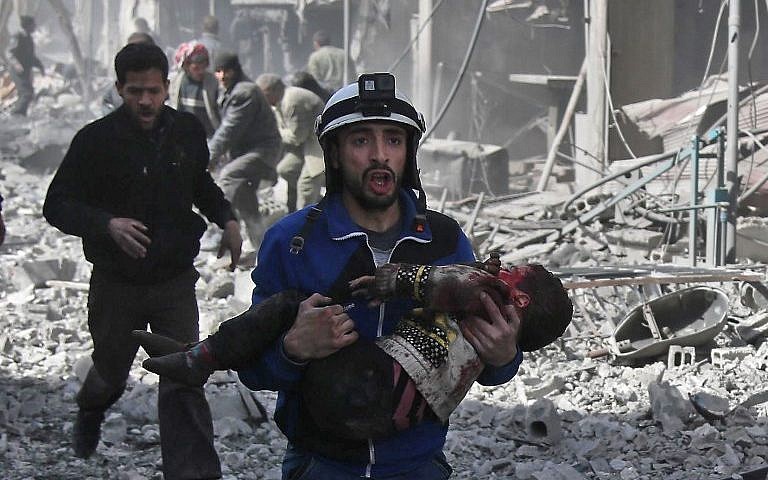
A Syrian civil defense member carries an injured child rescued from between the rubble of buildings after a government bombing in the rebel-held town of Hammuriyeh, in the besieged Eastern Ghouta region on the outskirts of the capital Damascus, on February 19, 2018. (AFP Photo/Abdulmonan Eassa)
"We no longer have the words to describe children’s suffering and our outrage."
"Do those inflicting the suffering still have words to justify their barbaric acts?"
UNICEF statement
Over 400,000 people live in Eastern Ghouta. An enclave of Damascus, in the hands of the Sunni Syrian rebels whom Syrian President Bashar al-Assad contemptuously calls "terrorists", for spurning his Shiite-centric regime. The enclave has been surrounded by government troops since 2013, in a siege tactic meant to starve out the residents, forcing them to live with inhumane privation. Food, medicine, the very basic necessities of life have been denied the population.

In the hands of a variant array of rebels, some of them jihadists, zones of control have been claimed in Eastern Ghouta. There is also a Kurdish minority living there, but all have been denied humanitarian aid, punishment for having among them the presence of rebel militias, defiant of the rule of the Alawite regime whose assaults upon the civilian populations of Sunni Syrians have proven to be equally atrocious to the humanity-debased attacks of Islamic State whose dread slaughters have garnered it global disgust.

The latest attacks on Eastern Ghouta for three days straight have intensified the civilian death toll; "spinning out of control" is how the United Nations described the situation in the rebel area. Rocket and artillery fire, air strikes and an absolute dedication to cleansing the area of its fighters has battered the enclave in an apparent softening up of the area preparatory to a large ground onslaught planned for the besieged and suffering region.

According to the Syrian Observatory for Human Rights, about 200 civilians have died, a quarter of them children.

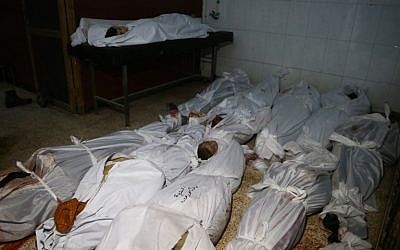
The bodies of civilians who were killed in Syrian army bombardment on the town of Hamouria in the rebel-held enclave of Eastern Ghouta are seen lying on the ground at a make-shift morgue the morning after the attacks on February 20, 2018. (AFP PHOTO / ABDULMONAM EASSA)

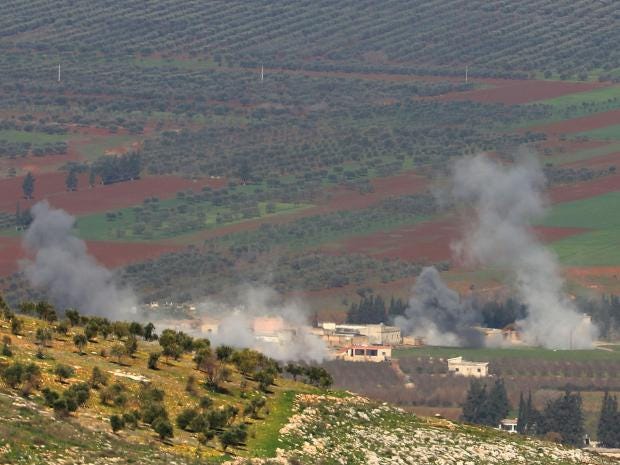
Syrian state media claims that pro-regime forces were making preparations to move onward toward the Kurdish pocket of Afrin in northern Syria where Turkish forces were ordered by their president, Recep Tayyip Erdogan, to cleans the area of Kurdish YPG fighters whom he claims are aligned with the Kurdish PKK resistance fighters in Turkey. State media in Syria describe regime fighters prepared to fight alongside Kurdish troops from the People's Protection Units to "join the resistance against the Turkish aggression".
Free Syrian Army fighters head towards Afrin as part of the Turkish operation [AP]

"If the regime is entering Afrin to oust the YPG, there is no problem. But if they are entering to protect the YPG, then no one can stop us", warned, Mevlut Cavusoglu, Turkey's foreign minister. Turkey's air and ground offensive against Afrin controlled by the Kurdish YPG has encountered a level of resistance from Afrin's Kurdish defenders far surpassing Turkey's expectations. However, Erdogan defended the slow progress of the operation, claiming to be cognizant of the need to avoid placing the lives of Turkish troops and Kurdish civilians at needless risk.

In the meanwhile, informing parliament in Ankara that Turkish troops alongside their Syrian rebel allies are preparing to lay siege to Afrin "in the coming days". According to Erdogan, the Kurdish People's Protection Units which control Afrin are a "terrorist" offshoot of the Kurdistan Workers' Party and he detests them all, and can think of no more appropriate punishment for them that they be routed by his troops, relinquishing the territory he aims to use as a protective ring along the border between Syria and Turkey.

Turkey has given warning it plans to open fire on regime forces should they fight alongside the Kurds, risking the prospect of a direct confrontation between Turkish and Syrian troops, with Russia apparently on the sidelines preparing to leap into action to put a stop to the situation if it appears to burgeon out of control. Moscow seems more than comfortable with Russian troops attacking Eastern Ghouta alongside the regime's forces, but draws the line at its two ostensible allies coming to blows between them.
Many of the dead were children as the regime stepped up its attack on the Damascus suburb
Many of the dead were children as the regime stepped up its attack on the Damascus suburb Credit: Khaled Akasha/Anadolu Agency/Getty Images

The rows of small bodies of Syrian children bombed to death in the last several days, wrapped in their burial shrouds, does not appear to unduly faze Moscow or give it second pause, while the prospect of Turkey and Syria ferociously engaging on the battlefield targeting one another rather upsets Russian plans for everyone to get along together.
"Ghouta is of major symbolic importance to the regime because it is so close to Damascus and it matters for economic and security reasons,."
"If the regime takes it, they can tell their supporters that the war is almost over and the opposition only controls some pockets in the north, east and south but not in what the regime calls ‘useful Syria’ in the west."
"Everyone is interested in reaching a deal: the regime, the Kurds, the Turks, the Russians. I think the question now is what that deal will look like but I don’t think the parties are interested in fighting each other."
Ibrahim al-Assil, fellow, Middle East Institute
Turkish-backed Syrian rebel fighters fire from the town of Salwah, less than 10 kilometres from the Syria-Turkey border, towards Kurdish forces from the People's Protection Units (YPG) in the Afrin region. AFP/Getty

Labels: , , , , , ,

Friday, November 03, 2017

Kurdish Valour and Independence

"We have achieved our goal, which was to pound the strongholds of [Islamic State] terrorism in its [Raqqa] capital, liberate women, and restore honour to Yazidi women by liberating dozens of slaves."
Nisreen Abdullah, Women's Protection Units, YPJ, Kurdish female militia

"The city is in ruins, it needs time. And it needs prospects that are beyond ours, our energy."
Hassan Mohammad Ali, civilian council for rebuilding Raqqa

"I'm expecting to see a new Hiroshima."
"I'm trying to be mentally prepared when I go. I'll be lucky if I see one of my house's walls still standing."
Dr. Mohammad Ahmed Saleh, Raqqa resident, working in Tal al-Abyad hospital
Fighters of Syrian Democratic Forces in Raqqa [Rodi Said/Reuters]

The Kurdish militia comprised of women fighters is determined to continue liberating women from Islamic State in the wake of their successful collaboration freeing Raqqa in northern Syria from the terrorist group. In Paradise Square where Islamic State infamously carried out public punishment by killing those who failed to cooperate with their rule in the city they made their capital, Nisreen Abdullah of the Women's Protection Units stated their intention to go on rescuing women from the grasp of Islamic State, and they are mostly Yazidi women and girls.

As part of the U.S.-backed Syrian Democratic Forces, the women lost 30 of their fighters throughout the four-month liberation of Raqqa battles. Hundreds of women and girls, captured and forced into sexual slavery still await rescue. Buildings and tunnels were still being cautiously checked to ensure they are cleared of the presence of Islamic State fighters; in their stead were left explosives to greet the inquiring eyes of the YPG and Syrian Democratic Forces coalition.

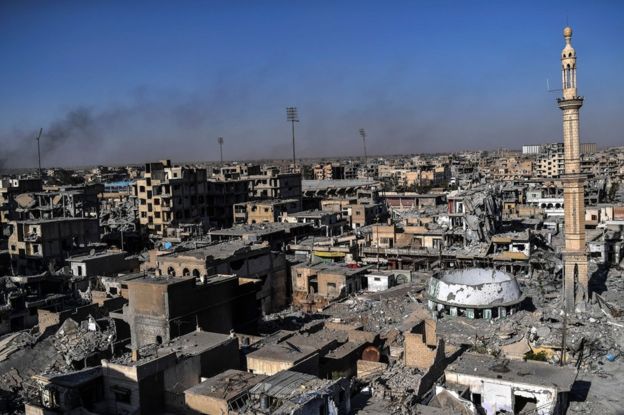
The city lies in ruins. Saudi officials are involved in discussing how the Kingdom will establish its "prominent role in reconstruction" before the estimated 300,000 former residents can be expected to return to a cratered, bombed-out city with no running water, no electricity, no schools, no hospitals. The SDF was anxious to declare the city void of extremists after it was  held by them for the last four years as the capital of their 'caliphate', the women within forced to veil themselves, and death by stoning deemed punishment for those whose behaviour shamed Islam.

Despite that ISIL has suffered significant losses of territory, including important cities such as Mosul in Iraq and now Raqqa in Syria, its leader, Abu Bakr Al-Baghdadi was impressively persuasive in bringing tens of thousands of Muslims, from Europe and North America to the region to fight as 'soldiers' of his caliphate. Convincing them to destroy ancient ruins in Palmyra and Hatra, and to establish themselves as loyal martyrs to the universal cause of Islamofascist conquest.

While the caliphate has been significantly reduced with ISIL looking for new redoubts in Libya and Afghanistan and Africa, it continues as well to incite Muslims living in Europe and North America to recognize their duty to Islam by engaging in jihad, ISIL-style. When ISIL fighters evacuated Raqqa over the four months of siege, they  took their heavy equipment with them, prepared to continue to launch attacks and to secure the territory left to them, in the deserts of Syria and Iraq.

U.S.-led airstrikes have been largely responsible for the city's devastation. Over 3,000 bombs hit the city since January, in the process destroying schools, hospitals and residential buildings. Less than one percent of the city's prewar population of 300,000 was still in the city when it fell to the SDF.
According to the Syrian Observatory for Human Rights, up to 3,250 people were killed in the months leading to Raqqa's liberation, a third of them civilians, with hundred more missing, presumed buried under collapsed buildings.

The SDF advance came at the cost of those lives, resulting from the intense air strikes by the U.S.-led coalition, despite strict targeting processes meant to minimize civilian risk. And nor can it be overlooked that the deliberate use of civilians as human shields by ISIL resulted in more casualties, including those shot by the terrorists, as they attempted to evacuate the embattled city.

Area surrounding municipal stadium in Syrian city of Raqqa on 16 October 2017
The municipal stadium was one of the last ISIL positions held in Raqqa to fall     AFP
As it stands today, Raqqa will in all likelihood remain unlivable for its former residents for years to come. Where the funding for its reconstruction will come from has not yet been established. And although it was the background establishment of the U.S. held to be responsible for most of the bombing damage. the U.S. government states quite baldly that it is not in the market for other than defence; reconstruction is another matter entirely. Washington spent massively on defence and has no intention of matching those funds for reconstruction. 

No funds have been allocated for areas requiring reconstruction in Syria; not while $13-million is being spent on a daily basis to operate Operation Inherent Resolve. U.S. Secretary of State Rex Tillerson stated during a meeting of the 68-nation coalition in March: "As a coalition, we are not in the business of nation-building or reconstruction." 

However, months later, Brett McGurk, special presidential envoy for the Global Coalition to Defeat ISIS, also stated that his country is committed to "stabilization" in Raqqa. Which would include de-mining, rubble removal, perhaps the restoration of basic electricity, sewage, water, to enable the basic essentials to be provided for the hundreds of thousands of refugees to "come back to their home"

More than 3,000 bombs have landed on Raqqa since January [Rodi Said/Reuters]
And while the SDF initially declared that the population of the majority Arab city should make their own determination of how their future would proceed "within the framework of a decentralized, federal, democratic Syria" and the Kurdish-led SDF made a pledge "to protect the frontiers of [Raqqa] province against all external threats", handing control to a city civil council, Damascus has its own plans, arranged with the connivance of Iran, for it considers Raqqa to be "occupied" until such time as the Syrian army is in control there. 

While Syrian Kurds might also have been considering including Raqqa in Rajova, the Democratic Federation of Northern Syria (DFNS) initially, it has since stated its intention to declare independence, and it is clear that Damascus has no intention either of permitting Raqqa to be absorbed into Rajova, or to allow the Kurds to retain part of Syria as their sovereign territory, just as in Iraq Baghdad has been punishing Kurdistan for the impertinence of believing it was high time to recognize the need for Kurdish independence.

Labels: , , , , ,

Monday, January 09, 2017

Joining the YPG, Fighting Islamic State

Handout
Handout   Martyrdom poster of Nazzareno Tassone, a Canadian, released by the YPG militia on Tuesday
". . . [May 2016] Starting the process to try and get over there [Syria]."
" . . . Officially cleared to go by the YPG. [Not informing family] they would have a heart attack."
"More than a bit scared that's for sure. . . Funds are just sketchy right now We don't get paid 'cause that would be illegal."
"If people don't do something then those pigs are gonna run free and it's just a matter of time till something really really bad happens."
"[July 11] They [Turkish war jets] hit us for four hours. Sorry about that [interruption in communication]. ISIS decided to make sure we were awake."
"[July 13] Lost a friend last night. Just after I got off guard. Suicide bomber from what I was told. He was [a] good guy. Not sure what to feel. Just numb."
"[September: In Manjib taking the city from ISIL], a turning point. Seen a lot of shit here already. But what I've seen has made me truly realize . . . we have to win."
"[October 1] Hoping to get a new weapon. Looks like we might be going on another big offensive."
"Fractured my toe and the guy in front of me is dead [December 6]."
"Leaving in two days for Raqqah so probably be gone for another two months. Worried about this one my friend. It's going . . . bad."
Nazzareno Tassone, Canadian fighting with Kurdish YPG militia in Syria
Handout
Handout   Nazzareno Tassone, left, with Ryan Lock. Both were killed in Syria on Dec. 21, according to the Kurdish YPG

Raqqah was where fighting with Kurdish forces against Islamic Syate of Iraq and the Levant, the premonition that young Nazzareno Tassone felt, became reality on December 21. He had planned to return to Canada for a brief rest, before returning again to Syria. His rest has become permanent. His family would like to retrieve his body for burial and ISIL, holding his body along with that of a British YPG recruit, Ryan Lock, and other fellow Kurdish fighters would like to extract a ransom for the exchange.

The messages above were  sent to a friend in Canada whom he kept informed of his movements and his experiences in Syria. His friend, Mike Webster, knew that Tassone was anxious to possess some body armour, and was in fact in the process of trying to get funding to him so he could acquire an armour plate for his combat vest. And then it was discovered that it was too late.  

                            Nazzareno Tassone, 24, no longer had need of that armour plate.

Back in the spring of 2016, he had managed to make contact with a YPG recruiter to begin the process of accepting him as a volunteer fighter so he could plan his travel itinerary. He kept his intentions from his family knowing how that knowledge would upset them at the thought of his placing himself in such danger in a deadly war zone. He ventilated his concerns to his friend, a former reservist.

Before leaving for Syria, he sold his Lee Enfield rifle for cash. He was in need of funding, but he felt compelled to go, regardless. In June he travelled to Istanbul and from there flew on to Iraq. His first message to his friend back in Canada was on July 11, when he described the situation there as "bloody. Extremely". But he had been given a Kalashnikov rifle to use. He needed body armour but hadn't the funding for it.

His group was attacked while in the mountains by Turkish jets. And two days later he wrote that one of his friends was dead. Then, on July 30 he wrote to his friend that an American and a British fighter with the YPG had been killed in the past two weeks when ISIL blew up a fuel truck beside a YPG base. Still, he felt from his perspective that ISIL was losing ground.

And then in mid-August Manbij was taken from Islamic State by the YPG. Two weeks later Nazzareno was back from the front, with the YPG within 45 kilometres of Raqqah. He was still using the AK rifle provided to him, but it was a 1939 bolt-action rifle he mostly used. Turkey's assaults concerned him. Turkish bombing of the YPG convinced him that it was working alongside ISIL.

He was also worried,  he said, that if his unit was attacked again by Turkish forces he would be forced to fight back, and against a member of NATO, a situation he felt might impact the neutrality with which fighters like him were viewed in Canada. "It's a predicament", he wrote to his friend. By this time he was an RPG gunner, still without armour for his combat vest.

His personal concerns were ended two weeks later. ISIL's propaganda instrument Amaq posted photographs of two Westerners killed by ISIL attacks in a village just west of Raqqah; one of Nazzareno, the other of British volunteer Ryan Lock.

Labels: , ,

Wednesday, August 31, 2016

Turkish Indignation

"No one has the right to tell Turkey to 'fight this terror organization but don't fight that terror organization."
"Turkey is a sovereign state, it is a legitimate state. To suggest it is on a par with a terrorist organization and suggest there are talks between them, that a deal has been reached between them, this is unacceptable."
Turkey's EU Affairs Minister Omer Celik

"Turkish operations will continue] until terror organizations such as Daesh, the PKK and its Syrian arm, the YPG, cease to be threats for our citizens."
Turkish President Recep Tayyip Erdogan

"Operations will continue until all terrorist elements have been neutralized, until all threats to our borders, our lands and our citizens are completely over."
Turkish Prime Minister Binali Yildirim
Map showing control of northern Syria - 31 August 2016

When Islamic State was occupying and fighting the Syrian Kurds just over the border from Turkey in Kobane, and Turkish troops and mechanized war vehicles were stationed close enough to be able to view the action in living colour, Turkey refrained from aiding the Kurdish fighters, in effect aiding Islamic State by its non-involvement. Not surprising, given the fact that Turkey still hosts ISIL cells operating out of Turkey to conduct their business in Syria and Iraq, while Turkey gets on with the fiction that it has joined the fight against ISIL.

Turkish tanks in Syria -- Al Jazeera

It does so only reluctantly, with its major focus on Syrian Kurds as the enemy for its links with the PKK. But the YPG is allied with NATO and the United States, trained, armed and supported as the single most effective fighting force against Islamic State. Erdogan has vowed to complete Turkey's military operation within Syrian borders, disinterested in whatever Washington has to say about pulling back, let alone urging its NATO ally about refraining from targeting the YPG.

The Syria Democratic Forces, backed by the United States, is their attack focus, as much as the Sunni Syrian rebels are the focus of attacks, as purported 'terrorists' by the Syrian regime and by Russian air strikes with their own pretense at battling Islamic State. To Washington's concerns, Turkish officials insist Kurdish forces withdraw east of the Euphrates as the only way in which Turkey can be persuaded to refrain from targeting the Kurdish U.S. proxies.

Their advance, named "Euphrates Shield" has succeeded in dispersing both the Kurds and the Islamic State, clearing villages of loosely-named "terrorist entities", for the major purpose as far as the Turks are concerned, of clearing the border between Syria and Turkey of the presence of Kurds who have meant that corridor to represent an extension of their planned future state. Kurdish and Arab Syrian fighters used US coalition air strikes to help them drive ISIL fighters from Manbiji.

Now that the Turkish forces have marched into Syria, that is being undone. "After seizing control of the border town of Jarablus, the FSA fighters moved under Turkish air cover to control villages such as Amarna, Yousef Beq and Ain al-Baida within hours, But their main target is to take over Manbij. YPG fighters maintain a significant presence along that area with their local allies", reported Al Jazeera's Hashem Ahelbarra,  from Gaziantep on the Turkish side of the Syria-Turkey border.

Ankara, celebrating its clearing of border towns, referring to the Kurds as 'terrorists', exults in the numbers it claims to have killed. A situation alarming the United States which continues to call on Ankara to desist "We want to make clear that we find these clashes - in areas where ISIL is not located - unacceptable and a source of deep concern", said Brett McGurk, US special envoy for the fight against ISIL.


Labels: , , , ,

Thursday, November 05, 2015

Differentiating The Good Guys From The Bad

"To Mosoud, the dog, how many attempts will it take before you will know your ability. You should know that if you were to gather your forces with all the airplanes in the world, we will still defeat you and we shall conquer Erbil soon."
Islamic State video 

"We are aware of the arrest of a Canadian citizen in Iraq. Canadian consular officials at the embassy of Canada in Amman, Jordan, are providing consular assistance as required."
Rachna Mishra, spokeswoman, Foreign Affairs

"He joined YPG because he was sick of ISIS. Just a bloke there to do what he could."
Colin Rutterford, Briton, Iraq

"[Western fighters with the YPG are thought of as] potential problem makers. As a result I think the volunteers are getting caught up in events which are bigger than them and over which they have no control."
Michael Stephens, Research Fellow for Middle East Studies, Royal United Services Institute

Members of the Kurdish People's Protection Units, or YPG, stand guard near a check point in the outskirts of the destroyed Syrian town of Kobani in this June 20 photo. A Canadian man arrested in Iraq reportedly had volunteered with the YPG.
Members of the Kurdish People's Protection Units, or YPG, stand guard near a check point in the outskirts of the destroyed Syrian town of Kobani in this June 20 photo. A Canadian man arrested in Iraq reportedly had volunteered with the YPG. (Ahmet Sik/Getty Images) 
"They have very good reasons to detain individuals like that. You need to make sure that indeed he is not a guy who fought with Islamic State, you do need to make due diligence on that and for that, we as Canada or the U.S. wouldn’t disagree with that. Beyond that, even if there’s reasonable grounds to believe that his story is true, that he was fighting against IS and not with IS, Iraqi Kurds are still unhappy about him doing that so they’re not going to make it easy for him."
"There’s very good reasons for that request. These guys who go to fight IS with the Kurds, they don’t make a difference on the ground, they don’t positively effect the balance of power and they represent trouble."
Thomas Juneau, assistant professor, University of Ottawa, former Department of Defence Middle East analyst
American authorities have formally requested that Iraqi Kurds not welcome foreign fighters. They view the possibility of having to launch rescue operations when a westerner is taken by ISIL and threats are issued that they will be slaughtered unless certain conditions are met; anything from demands for the release of their own captured fighters or bounty, to buy their release. The YPG, felt to have links with the PKK, Turkey's Kurdistan Worker's Party, has no such scruples and welcomes foreigners willing to fight in their ranks.

The YPG in fact is — and actively recruiting —  encouraging and accepting Western foreign fighters into their ranks to fight alongside regular Kurdish fighters against ISIS, leaving Western countries with the burden of responsibility to provide consular assistance when things go wrong. It is not known why the man was arrested but the Kurdish regional government in northern Iraq does not allow Western foreign fighters to use its territory as a base from which to enter Syria.

Relations between the autonomous Kurdistan region of northern Iraq, controlled by President Masoud Barzani's Kurdish Democratic Party and the Syrian Kurdish factions appear to be strained by rivalry. Iraq's border with Syria has been seen as off limits to Westerners. Foreign fighters returning from Syria have been detained for weeks at a time. An American ex-Marine was arrested in Iraq after three months with the YPG and he and another American were imprisoned in Erbil together with suspected ISIL members.

"Conditions were very bad. We were released because the United States consulate worked very hard with the Asayish [Iraqi Kurdish security agency] in order to clear our names and to prove our innocence to the Barzani government", he explained. A woman from Vancouver once again back fighting with the women's brigade of the Kurdish forces, described the arrested Canadian as a volunteer with the People's Protection Units [YPG], the Syrian Kurdish militia. "Yes, he's YPG", she affirmed.
Courtesy of Hanna Bohman
Courtesy of Hanna Bohman   Hanna Bohman of Vancouver is fighting with Kurdish forces.

In custody along with a Swede, two Spaniards and two Americans, one a doctor, he is awaiting his release. Volunteers like this man are smuggled across the border to enable them to join the Kurdish fighters. It is on their return to Iran intending to continue on home and entering Iraq illegally that the Kurdish government takes them into custody for security reasons, until it can be verified that they are not ISIL sympathizers. A not completely unreasonable explanation, given the numbers of Westerners who have travelled to Syria to fight with Islamic State, and the far fewer numbers who make the trip to fight against Islamic State.

Kurdish fighters fighting against ISIL in Syria, November 2014.
Ahmed Deeb/AFP/Getty Images   Kurdish fighters fighting against ISIL in Syria, November 2014

Labels: , , ,

Thursday, October 16, 2014

Kurdish woman leads fight against ISIS in Kobane

Women traditionally form a major part of Kurdish fighting forces, and they are well represented among Kurdish forces in neighboring Turkey and Iraq. (File photo: AFP)
A Kurdish woman fighter is leading the battle against Islamic State of Iraq and Syria (ISIS) jihadists in the Syrian battleground town of Kobane, a monitoring group and activists said Sunday.

“Mayssa Abdo, known by the nom-de-guerre of Narin Afrin, is commanding the YPG in Kobane along with Mahmud Barkhodan,” Syrian Observatory for Human Rights head Rami Abdel Rahman told AFP.

The secular and left-leaning Kurdish People’s Protection Units (YPG) group has been defending Kobane, on the border with Turkey, since ISIS fighters launched an assault on September 16.

The group, the de facto army of the Kurdish regions of north and northeast Syria, is the armed wing of the powerful Kurdish Democratic Union Party (PYD).

As is the custom for Kurdish fighters, Mayssa, 40, uses a pseudonym, with hers coming from the Afrin region where she was born that is located like Kobane in Aleppo province.

“Those who know her say she is cultivated, intelligent and phlegmatic,” said Mustefa Ebdi, a Kurdish activist from Kobane.

“She cares for the mental state of the fighters and takes interest in their problems,” he said.

Women traditionally form a major part of Kurdish fighting forces, and they are well represented among Kurdish forces in neighboring Turkey and Iraq.

On October 5, young Kurdish woman fighter Dilar Gencxemis, identified by the YPG by the nom-de-guerre of Arin Mirkan, blew herself up outside Kobane in an attack which reportedly killed dozens of IS militants.

She became the first Kurdish woman suicide bomber since the 2011 start of Syria’s conflict.

Since the withdrawal of government forces from Kurdish areas of Syria in mid-2012, the PYD has set up local councils for Kurds to run their own affairs, with women filling 40 percent of seats.
 

Labels: , , ,

() Follow @rheytah Tweet