Politic?

This is a blog dedicated to a personal interpretation of political news of the day. I attempt to be as knowledgeable as possible before commenting and committing my thoughts to a day's communication.

Monday, June 29, 2026

On Tenterhooks of Suspense: Israel ... 27 October 2026

"Surviving the Israeli political scene for so many years has taught him a number of tricks, and he is, once again, like him or dislike him, a survivor."
"[In Israel's multi-party parliament, disparate factions reach delicately balanced compromises, where] simply somebody sneezing can make a coalition crisis."
"Netanyahu has faced probably dozens, if not hundreds, of coalition crises in his career."
"He knows the Israeli political scene like the back of his hand."
Ira Robinson, professor emeritus of Jewish Studies, Concordia University 
 
"The civilian leadership is putting the blame on the military, whose job and task it is to protect the borders of the nation on any given day."
"There is a leadership, a national leadership under whose watch this tragedy [7 October 2023] happened and under whose watch the successive wars have unfolded, so it's in this context that the MOU between the United States and Iran is coming."
"There are no major pieces of legislation that could be associated with him, or, or even opposing some, but people will judge him as on his record as a former IDF chief, and in Israel that matters a lot."
"[Bennet has no established party organization behind him and is a] one man show. To do well and to succeed well in Israeli politics in the long run, you need a party organization, because it's a very party-centred and party-oriented political system." 
Csaba Nikolenui, political science professor/director, Azrieli Institute of Israel Studies, Concordia 
 
"There is much overlapping between the public who prefer, for example, Eisenkot or Bennett or even [Avigdor] Lieberman. The division lines are not clear, and there is no agreement between these leaders who is going to become prime minister if they will eventually get more votes than the other side."
"He [Bennett] does have failure written under his name, but he seems to be a good compromise for people who would like to have someone of the moderate right who is capable of really managing things."
"Unless there is some dark horse around the corner [Netanyahu is seen as] irreplaceable [by his supporters]."
"[Ben-Gvir] is really pushing Netanyahu into making decisions and taking actions that were unthought of. Netanyahu doesn't like him, nor Smotrich, but he didn't have any other possibility [to form government]."
"In order to replace them, he should bring over party leaders from the other side, and [it] doesn't look as if he is going to get it."
Tamar Hermann, senior fellow, Israel Democracy Institute 
https://www.pewresearch.org/wp-content/uploads/sites/20/2016/03/PF_16.03.08_IsraelSurveyPromos_feature640x320.png?resize=640,320

Deep gulfs among Jews, as well as between Jews and Arabs, over political values and religion’s role in public life   Pew

 
Israel's system of government voting is guaranteed to make election outcomes difficult, and they always are, with much uncertainty and a great deal of negotiations taking place between the parties that generate the most popular vote and those that bring up the rear. It's not just that Israel is wedded to proportional representation, it's also that Jews themselves are culturally and habitually among the most argumentative people on Earth. Complicated yet further by the divisions in society of religious devotion in the Judaic tradition. Secular Jews dominate society in Israel, but there are large blocs of Orthodox and Ultra-Orthodox Jews and divisions in between.  
 
And to complicate matters yet further, although Israel is a democratic Jewish nation, it also incorporates into its citizenry Arab Muslims, Christians, Druze, Bedouin, Circassians, Kurds, B'hai, and other minority groups, all of whom have voting rights and for the most part exercise them. Israel's standing army, the Israel Defense Forces is mostly staffed by Jews, but also include Druze and Israeli Arabs in the military. It is the Ultra-Orthodox Jewish element in Israel from among whom resistance to join the military ensues. For non-Jews, military service is generally not a requirement, but is volunteer-driven as loyal Israelis. Not so for the ultra-religious. Israel is a complex country.

 
Protesters supporting the conscription of ultra-Orthodox men into the military block a road in the Haredi city of Bnei Brak, central Israel, clashing with locals, on June 26, 2026. (Avshalom Sassoni/Flash90)
 
And it is set to go to the polls by October 27 when a divided electorate will make the decision with their votes whether or not Benjamin Netanyahu will continue on as Prime Minister. The man is both popular and disdained among segments of the population. It is not an easy task to govern a nation that is so perpetually politically, socially, culturally divided. The 7 October assault by thousands of Palestinian terrorists and ordinary Palestinians, led by the Hamas terrorists who govern Gaza traumatized Israelis in the scope of its savage brutality and sadistic fury.
 
The much-vaunted Israeli intelligence services, and the IDF, much less the government-of-the-day -- Netanyahu's, failed to detect suspicious activities leading up to the horrors of that day; this, despite the fact that border guards had reported alarming and potentially dangerous actions taking place, only to have their concerns set aside by government authorities. And that undeniable failure haunts the government to this day. As with any responsible governing authorities -- the buck stops at the top. The succeeding wars with Hamas in Gaza, Hezbollah in Lebanon, the Islamic Republic and the Houthis have all been inconclusive, largely given U.S. White House interference.
 
Benjamin Netanyahu has the hearts of many Israelis as well as diaspora Jews, while others loathe him. He has been a resolute, courageous leader of a people facing international opposition, left to fend for themselves against forces of violent opposition both regionally and globally, emanating from both foes and purported allies. That he has also been under indictment in a corruption trial ongoing for six years has been an additional burden -- for him personally and for Israelis wanting to see that put behind them. The corruption charges represent an excess perhaps linked to personal political vendettas. 
"[Netanyahu] is cautious not to push this draft issue on the agenda, because he doesn't want to alienate the ultra-Orthodox, and the ultra-Orthodox are strong."
"So long as he has that, and the support of the religious Zionist community, which is kind of unshakable, because these parties have nowhere else to go -- they will never support anyone to the left of Netanyahu -- Netanyahu kind of has them, has that corner fairly, fairly well guaranteed for him."
Csaba Nikolenyi 
Mr. Netanyahu has been forced by the Israeli political voting system to make a governing coalition with groups he would normally prefer to have no relationship with; their agendas are not necessarily his. The system demands compromises, some manageably attainable and others painful, the result of  awkward collaborations to maintain a government in power. Israelis, according to a recent poll, anxious as always for national security accept that war must be waged to secure that security. Israel has never known any other way of life, since 1948 with successive waves of military onslaughts from neighbours, then proxy militias of the Islamic Republic. 
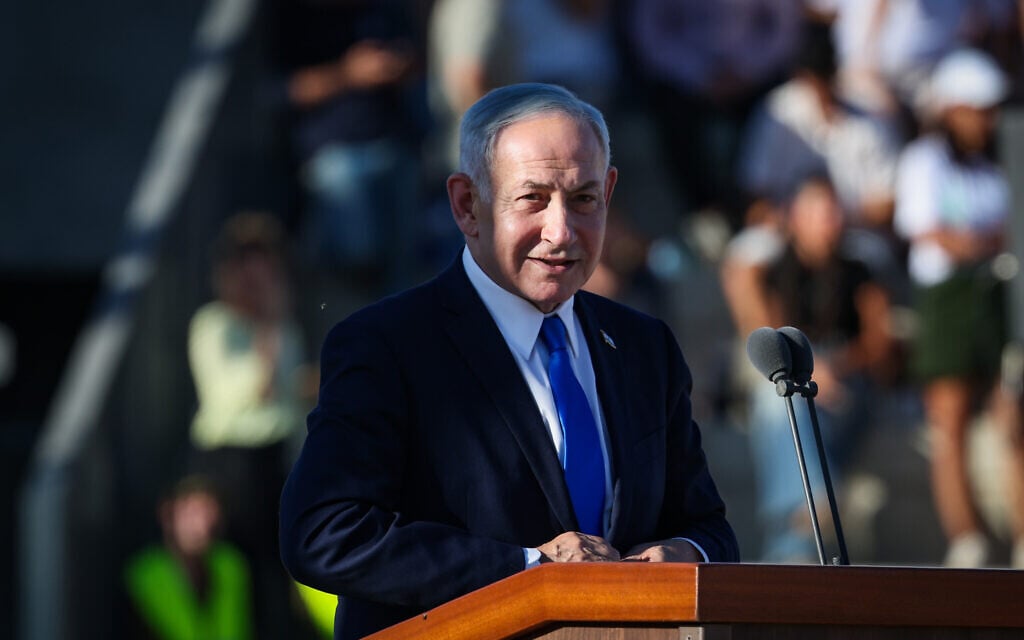
 
Israeli Prime Minister Benjamin Netanyahu at an IDF officers’ graduation course in southern Israel, June 25, 2026. (Flash90)
 
As for PM Netanyahu's coalition government; none other was available for him to maintain his government. In the current administration, Finance Minister Bezalel Smotrich has overseen a surge of settlement construction in the West Bank where mounting violence has emanated from. These are the leaders of the extreme rightwing parties serving in Netanyahu's government. The second is Itamar Ben-Gvir as national security minister, convicted of anti-Arab incitement in 2007. 
 
In this era, there has been no Israeli party capable of winning an outright majority to enable it to govern according to its distinct political views, without being forced to resort to coalition-making to preserve its government with the understanding that its coalition partners' support will last only as long as their demands are met in reflection of their own political agendas. As it is, Netanyahu's government lost two of its ultra-Orthodox parties when he refused to legalize exemptions from mandatory conscription for religious students. 
"The major small parties that you would want or probably need in a coalition are the religious parties, and that's a very volatile issue."
"And these parties will tell whoever it is, be it Netanyahu, be it Eisenkot, whoever it is -- 'You've got to give us what we want', and now the negotiation becomes, do you get 100 percent of what you want? Do you get 80 percent of what you want? What are the parameters."
"That's all backroom politics and Israelis are used to it."
Ira Robinson 
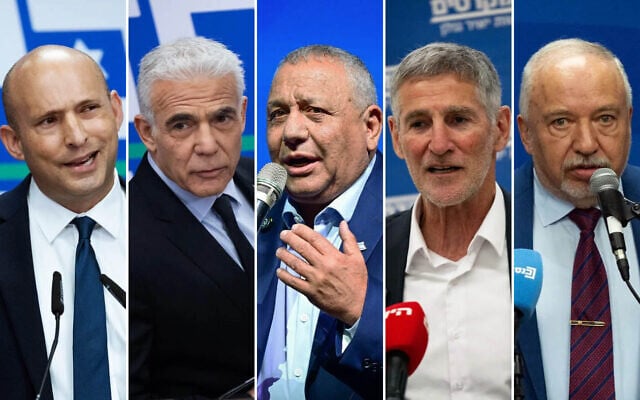
Left to right: Former prime minister Naftali Bennett speaks during a press conference at the Knesset in Jerusalem, May 20, 2026. (Yonatan Sindel/Flash90); Opposition Leader Yesh Atid MK Yair Lapid leads a faction meeting at the Knesset on May 25, 2026 (Yonatan Sindel/Flash90); Gadi Eisenkot, head of the Yashar party, speaks during a conference at Tel Aviv University, May 12, 2026. (Avshalom Sassoni/Flash90); Leader of the Democrats party Yair Golan leads a faction meeting at the Knesset in Jerusalem, on May 25, 2026. (Yonatan Sindel/Flash90); Yisrael Beytenu chair Avigdor Liberman leads a faction meeting at the Knesset on May 25, 2026. (Yonatan Sindel/Flash90)


Labels: , , ,

Sunday, September 04, 2022

Russian Solutions To Dissent and Opposition

"I think the circumstances of his death are extremely suspicious. Whenever someone who is in a negative view of the Putin regime dies suspiciously, one should rule out foul play, not rule it in."
"He [Dan Rapoport’s fall from a luxury apartment building on the night of Aug. 14] was a well-known critic of Putin in the West and had been an effective critic."
"He was also an open supporter of [jailed opposition leader] Alexei Navalny. And he had all these connections in the elite of Washington, D.C."
"The immediate response of the Washington, D.C. police, I think, is a premature and unhelpful conclusion."
Anti-Putin critic Bill Browder
 
"[We call for the] soonest termination of the armed conflict. [And extend our] sincere empathy for all victims."
"We strongly support a lasting ceasefire and a settlement of problems through serious negotiations and diplomacy."
Ravil Maganov, chairman, Lukoil, March
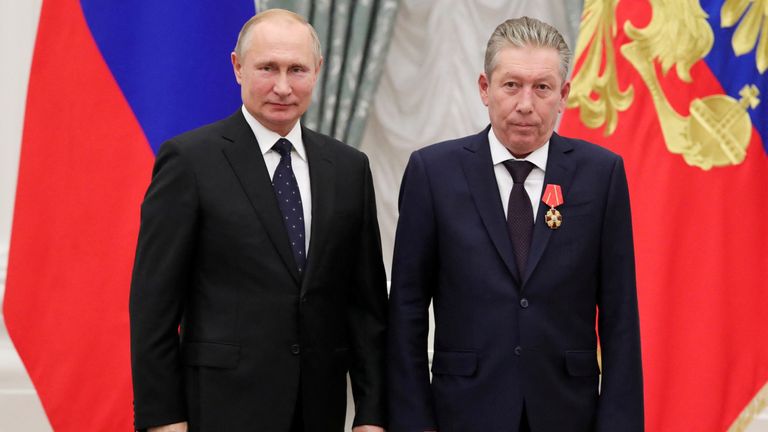
Ravil Maganov, right, with Russian President Vladimir Putin in 2019
Ravil Maganov (right) with Vladimir Putin. A Russian news site suggested Maganov slipped from a balcony when smoking. Photograph: Mikhail Klimentyev/Sputnik/AFP/Getty Images

 Slipped from a balcony while he was smoking. An inadvertent mis-step. Not a suicide, of course not a suicide. He was not a suicidal man, his colleagues, friends and family attest. But that's the thing about nicotine, it's a deadly substance. If it doesn't kill you with lung cancer, it'll sneakily cause you to miss a step and slither over a balcony -- however awkward that may be -- to your death. Those who snidely suggest Mr. Maganov's abandoned friendship with Mr. Putin and support for his regime was behind his death; what can we say?

On the other hand, a friendship and support that becomes a critic of a disastrous, bloody invasion of another country, now that could be a problem. Russia is special and it has become even more special under Vladimir Putin. Assassinations have always been a dime a dozen in high government circles almost everywhere, but particularly in Russia where it's a blood sport. And there are so many resourceful final solutions to choose from!

In this particular instance, defenestration, an oft-used method, tried and true. But then, there's also poisoning and it has proven to be quite successful, though not always. But then, those who manage to survive their poisoning ordeal can be punished for that kind of effrontery added to their insuperable criticism of Mr. Putin, by long and extended prison sentences. Stabbing works well, but not quite as efficiently as sharp-shooters. They are all, however options seeking the right time and place -- and suitable targets. 

But goodness, these events are popping off one after another, fast and furious. Perhaps that is the result of a furious Mr. Putin demanding of his henchmen that they dispatch themselves, fast and successfully. The Central Clinical Hospital in Moscow this week was a very busy place. It's where world-celebrated former Soviet leader Mikhail Gorbachev breathed his last. And just incidentally where Mr. Maganov chose to slip on a balcony to fall to this death. A six-storey fall is always lethal  unless you're a rubber ducky.

Latbian-born American businessman, Dan Rapoport, a critic of Mr. Putin, only two weeks previously happened to fall from the window of his Washington, D.C. luxury apartment after he left Kyiv following the Russian invasion. Reports out of Russia that he died a suicide have been denied by his wife, awaiting a visa to join him in the U.S. fron Denmark.

And then there's Yegor Prosvirnin who founded the Sputnik and Pogrom news website who had the misfortune to fall from the fifth storey of a residential building in Moscow in 2021. The very day that neighbours heard "screaming and swearing" from his room. Another critic of Vladimir Putin, who predicted a collapse of the Russian Federation as a result of civil war.

Novatek natural gas firm former board director Sergei Protosenya hanged himself in a Spanish villa in Costa Brava where his wife and daughter were discovered hacked to death. A theory is being pursued by investigators that the man slaughtered his wife and daugher with an axe and knife then committed suicide, though no fingerprints were found on the murder weapons and no blood was found on him.

61-year-old Alexander Tyulyakov, former Gazprom deputy, found hanged near St.Petersburg in a cabin, a suicide note beside him. Head of Gazprom's transport service Leonid Shulman died of a suicide in January, in the bathroom of a cabin in the Leningrad area. A note left behind complaining his leg was broken. The knife he used to kill himself with multiple stab wounds lay in a bathtub but out of his reach.
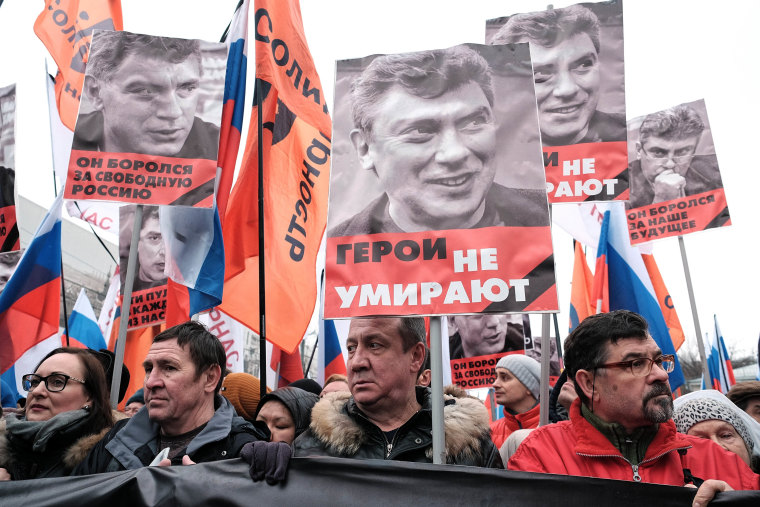
Mourners March After Russian Opposition Politician Boris Nemtsov Shot Dead
People march in memory of Russian opposition leader and former Deputy Prime Minister Boris Nemtsov on March 1, 2015 in central Moscow.  Epsilon / Getty Images file


Labels: , , , ,

Sunday, September 19, 2021

Democracy ... Kremlin-Version

"Authorities have sent a very clear message: we're jailing Alexei [Navalny]. We're banning your activity."
"The risks have skyrocketed."
"People here [Novosibirsk] were deeply traumatized by what happened [poisoning of Navalny]."
"I know for sure that I won't be able to run for any office as long as Putin is alive and in power."
Sergei Boiko, local councillor, Novosibirsk, Siberia

"People have become angrier with authorities."
"They're afraid [the repression] is going to get to them too."
"That fear is very strong."
Andrei Zhirnov, candidate, Communist Party

"People are scared of taking a public stand against the authorities: People get jailed left and right."
"You repost something online -- and you get time."
Denis Pervuninsky, 24, cook, Novosibirsk
 
"For us, this campaign is a megaphone."
"What Andrei was striving for is that as many people as possible understood that they shouldn’t vote for United Russia, that the elections are unfair."
"... Now we have a legitimate opportunity to talk to people about it all."
Tatyana Usmanova, Russia of the Future Party
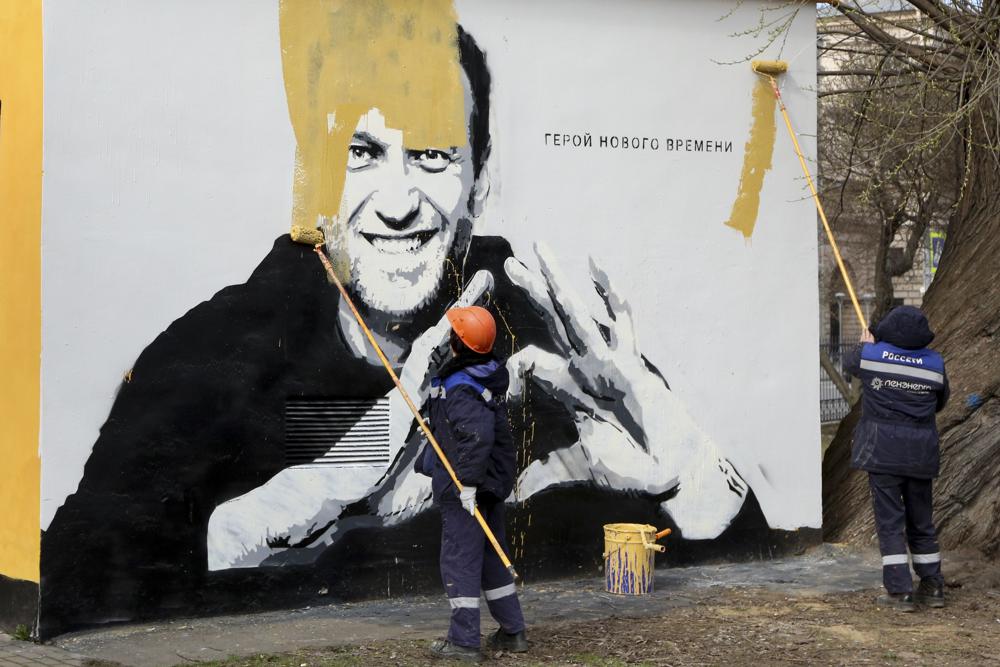
FILE - In this April 28, 2021, file photo, municipal workers paint over an image of Russia's imprisoned opposition leader Alexei Navalny in St. Petersburg, Russia. In the months before the Sept. 19 parliamentary election in Russia, authorities unleashed an unprecedented crackdown on the opposition, making sure the best-known and loudest Kremlin critics didn’t run. Navalny, Putin's biggest critic who dented United Russia's dominance in regional legislatures in recent years, is serving a 2½-year prison sentence for violating parole for a conviction he says was politically motivated. (AP Photo/Valentin Egorshin, File)
 
"We still want to take a lot of seats away from the United Russia so that a lot of сandidates not approved (by the authorities) become State Duma deputies and members of regional legislatures."
Leonid Volkov, top ally of imprisoned opposition leader Alexei Navalny
 
"Putin loves to maintain uncertainty and make decisions at the last minute."
"No one will know until the last minute what he will do in 2024. Will he run himself once again or put forward a successor? … Will it be another constitutional reform, or will a new cabinet need to be approved, or election laws need to be changed?"
"… All roads must be open to Putin, he must feel that his options are not limited by anything. For that, the parliament must be absolutely obedient."
Abbas Gallyamov, political analyst, former Kremlin speechwriter
 
"They took my aunt, found some alleged 6-year-old debt she owed for a rented basement, added me to the case, arrested the two of us for two days, and made it clear that if I don’t drop out of the election and don’t leave the country, they will imprison me and my aunt."
Dmitry Gudkov, prominent Kremlin critic, former lawmaker 
The September 2021 Russian general election is in session. In Russia's 'managed' democracy there will be no voter tenterhooks, wondering who will win the election. The election is geared unerringly toward a United Russia Party sweep of the polls; as inevitable as day follows night. An engineered election, where, as in the Islamic Republic of Iran, all candidates are pre-vetted, as are their parties, and if they fail to meet the standards of the ruling party's leader -- in this case Russia's Vladimir Putin -- why laws can be enacted to exclude them from legitimacy under pretext of foreign interference and their candidates nullified.
 
Even in Siberia, where in the city of 1.5 million, Novosibirsk once a relaxed area of relative democratic freedom, things have changed under a hitherto-unprecedented crackdown by the Kremlin determining who may stand for office under which political banner. In 2020's election the city saw a turnout in favour of Sergei Navalny -- a stubbornly courageous critic of Vladimir Putin and his United Russia Party -- voting in candidates for his Russia of the Future Party. Most displeasing to President Putin, running askance of his future plans as president-for-life.

Since the shocking attempt to kill opposition leader Alexei Navalny and his subsequent imprisonment on trumped-up criminal charges, a steady stream of arrests of other activists and the enactment of sanctions against independent media has been the order of the day. The ruling United Russia Party has no intention of awarding any further open opportunities for its opponents to challenge their dominance in this weekend's parliamentary polls.

Those few activists who campaign irrespective of the political danger, have received anonymous death threats. Daria Artamonova, 19, and a student, has been knocking on doors for the past two months, handing out leaflets and speaking to residents. Several weeks ago her parents were surprised when a funeral wreath was delivered to their home. "There was a ribbon with the names of my parents on it: "We're mourning Daria with you".

"I'm young", explained Daria, "and this is my main asset: I'm not scared of saying something wrong, and I don't have much to lose." Given the example of the man whose message she has heeded and for which man and message and the future of Russia she has gone out of her way to uphold, she does stand to lose much; her life and her future. If a popular public political figure like Navalny can be poisoned in a transparent plot to remove him as a major irritant, an obscure young student can expect no less.

Sergei Boiko who in Novosikirsk's mayoral race was runner-up and is now a municipal councillor, as an ally of Navalny, is no longer in contention. He is now banned from running, thanks to a new law, just like anyone else who has worked to support Navalny. Several dozen allies of Navalny and opposition figures have fled Russia, fearful of arrest after having been the targets of police raids and potential criminal charges. Likewise some of the most prominent independent media in Russia struggle to survive, having been branded "foreign agents".
 
Alexei Nikolsky/Russian Presidential Press and Information Office/TASS

 Not only is Boiko banned from standing in the current election but in any vote for the next five years, once the network representing Navalny's party was officially declared "extremist". The three-day vote, ending Sunday, has seen United Russia, the Kremln-backed party dominating the State Duma, polling at less than 30 percent. The party is blamed by Russians for declining living standards and a stagnant economy. With a lack of genuine opposition candidates, United Russia will still win the election backgrounded by apathy and fear.

There was no point in voting, shrugged 22-year-old waitress Margarita Monchenko. Her grandmother is an election official in their village, regularly falsifying turnout figures and, she believes, the United Russia vote share. "My single vote is not going to change anything. United Russia always wins", she shrugs. A candidate for the Communist Party, one of few tolerated by the Kremlin, Andrei Zhirnov, 47, notes a change in the voting public's mood since the 2016 Duma election: fear and trepidation for the future, their future.

A project of Navalny's called "Smart Voting" encourages supporters to support any candidate with the best chance of defeating United Russia in their voting district. Apple and Google on Friday removed the Smart Voting app from their online stores in Russia -- surrendering to pressure from the Kremlin.  Voter coercion reports began emerging on Friday as polling stations opened and media and election observers reported polling places with an abnormally high morning turnout; an indirect confirmation of reports the Kremlin got state-paid employees to vote early.

Navalny supporters have been permitted only to stand for suburban town council elections in Novosibirsk. Twelve out of 17 prospective candidates even then were barred, resulting from charges of alleged "extremism". 
 
Russia election
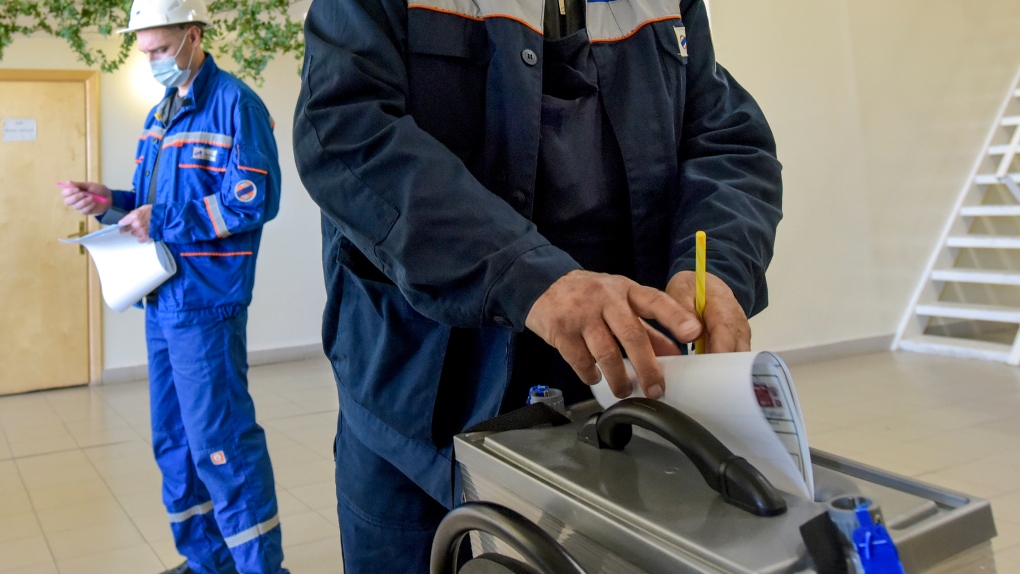
An employee casts a ballot during early voting at the Mutnovskaya geothermal power plant in the Elizovsky district, 60 km (38 miles) south of Petropavlovsk-Kamchatsky, the capital of Kamchatka Peninsula region, Russian Far East, Thursday, Sept. 16, 2021. (AP Photo/Alexander Petrov)

Labels: , , , , ,

Monday, August 23, 2021

The Imminence of Afghanistan's Civil War

"We want to make the Taliban realize that the only way forward is through negotiations. We do not want a war to break out."
"They [supporters and members of the newly-formed National Resistance Front of Afghanistan [NRF] want to defend, they want to fight, they want to resist against any totalitarian regime."
Ahmad Massoud, leader NRF
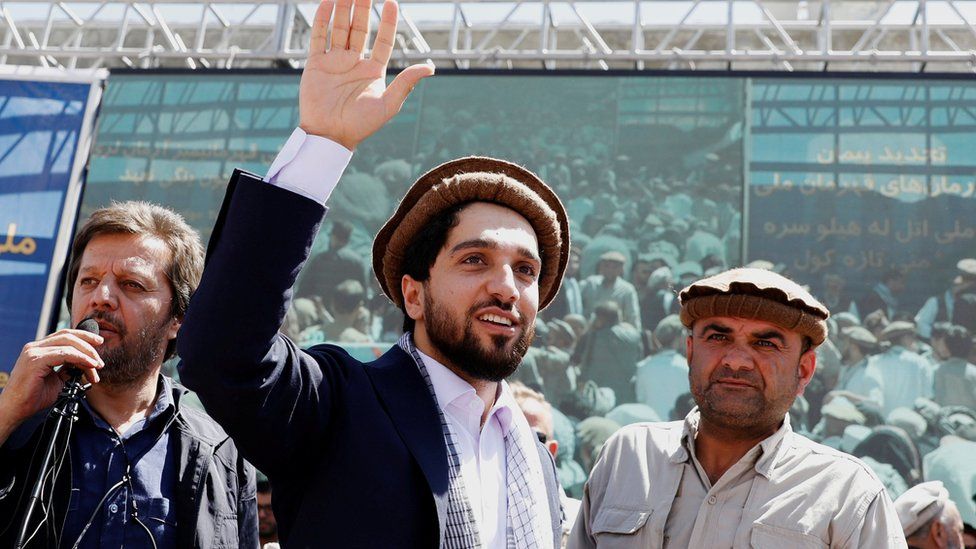
Ahmad Massoud, pictured in 2019
Ahmad Massoud, the son of resistance icon Ahmad Shah Massoud, founded the NRF   Reuters
"[We want to pursue peaceful negotiations, but] if this fails... then we're not going to accept any sort of aggression."
"[We have] thousands of forces ready for the resistance. However, we prefer to pursue peace and negotiations before any sort of war and conflict."
"The NRF believes that for lasting peace we have to address the underlying problems in Afghanistan. Afghanistan is a country made up of ethnic minorities, no one is a majority. It's a multicultural state, so it needs power sharing - a power-sharing deal where everyone sees themselves in power." 
"[Having one group dominating politics will lead to] internal warfare and the continuation of the current conflict."   
"We prefer peace, we prioritize peace and negotiations. If this fails - if we see that the other side is not sincere, if we see that the other side is trying to force itself on the rest of the country - then we're not going to accept any sort of aggression."  
"And we've proven ourselves, our track record in the past [40 years] has shown that no-one is able to conquer our region, especially the Panjshir Valley."   
"The Red Army, with its might, was unable to defeat us... I don't think any force right now in Afghanistan has the might of the Red Army. And the Taliban also 25 years ago... they tried to take over the valley and they failed, they faced a crushing defeat."
Ali Nazary, head, foreign relations, National Resistance Front of Afghanistan (NRF)
 
"There is the risk of a renewed civil war in Afghanistan."
"Of course, no one intends to interfere in these events."
"[The current situation poses] an additional danger and threats."
Dmitry Peskov, spokesman, Kremlin
Russian President, Vladimir Putin and Taliban
Russian President Vladimir Putin and Taliban   peoplesgazette

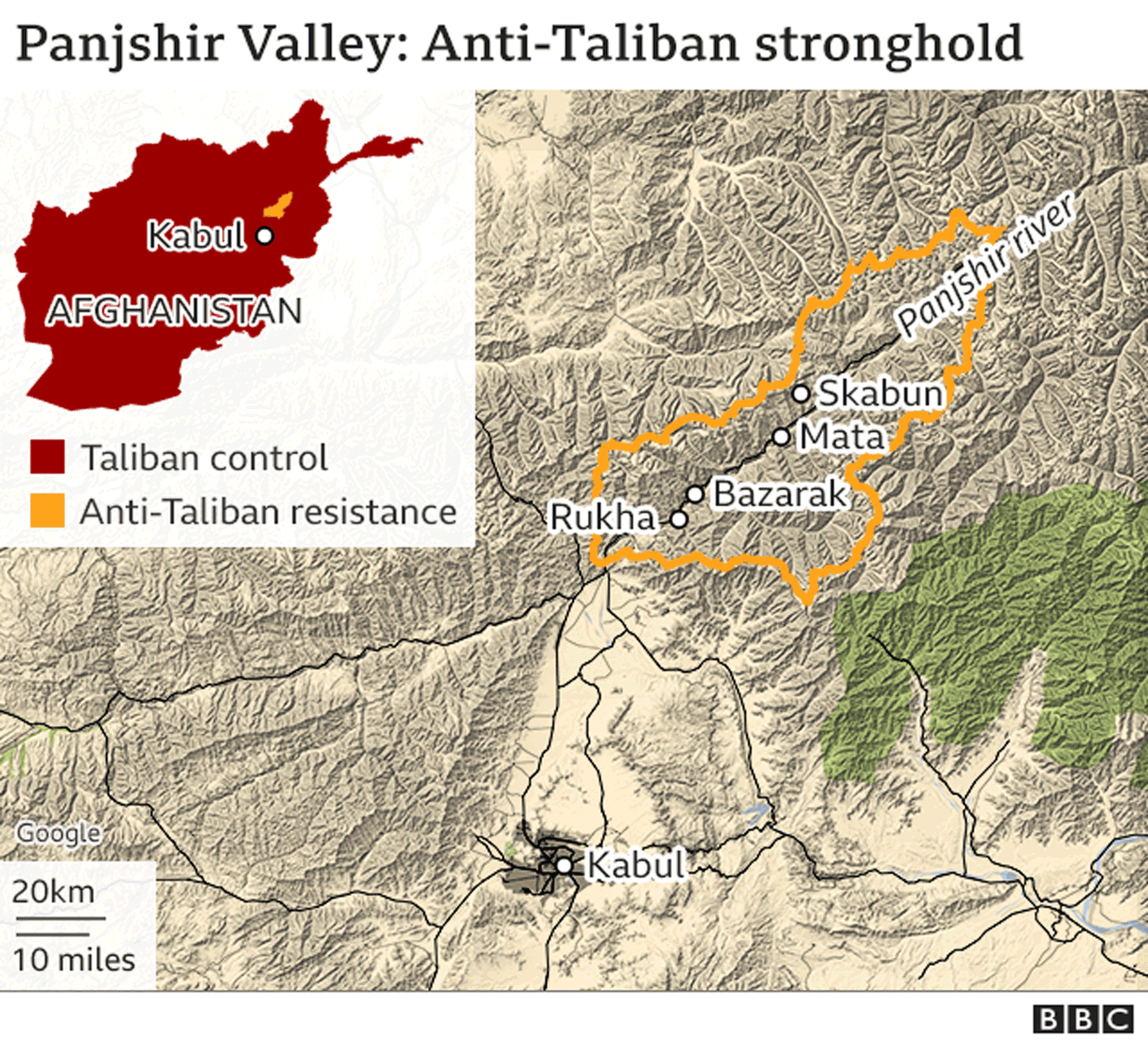
Unlike President Ashraf Ghani who fled Afghanistan to avoid 'bloodletting" and taking with him over a hundred million in treasury and is now installed in Qatar, while promising to return at some date, his vice-president, Amrullah Saleh had pledged not to leave the country and he is now in Panjshir, an area northwest of the capital where the Taliban do not rule, held by a recently-formed resistance group by the son of the Afghan patriot who fought the Soviet invasion until it withdrew in 1989, then turned to opposing the Taliban when it ruled the country in the 1990s.
 
Under control of the NRF, founded by the son of the deceased champion of Afghanistan Ahmad Shah Massoud, the region stands firmly in opposition to the Taliban. Ahmad Massoud leading the movement he founded, is holding out the hope that the Islamist Taliban will agree to holding talks to hear out the position of the NRF in the interests of avoiding a civil war. It may be difficult to give credence to this faint hope, given the relentless advance of the Taliban and their quick and brutal disposal of any who oppose their control of the country.

Men opposed to Taliban totalitarian rule of the country have travelled to the region where the NRF boasts of forces comprised of parts of the country's regular army units and special forces along with local militia fighters. And although both spokesmen for the group spoke of avoiding conflict it seems highly unlikely that this will be possible. A widely distributed Taliban statement declared that hundreds of its fighters were on the march toward Panjshir after local state officials refused to hand it over "peacefully".

With the statement came a short video showing a column of trucks emblazoned with the identifying markers of the ousted national government, and the white Taliban flag in prominent view advancing along a highway toward Panjshir. Should Taliban forces, warns Massoud, attempt an invasion of the valley, his fighters were prepared to fight.  A Taliban official claimed an offensive was launched on Panjshir, but a Massoud aide revealed no signs the column had yet entered the narrow pass leading to the valley, and no reports of conflict.
 
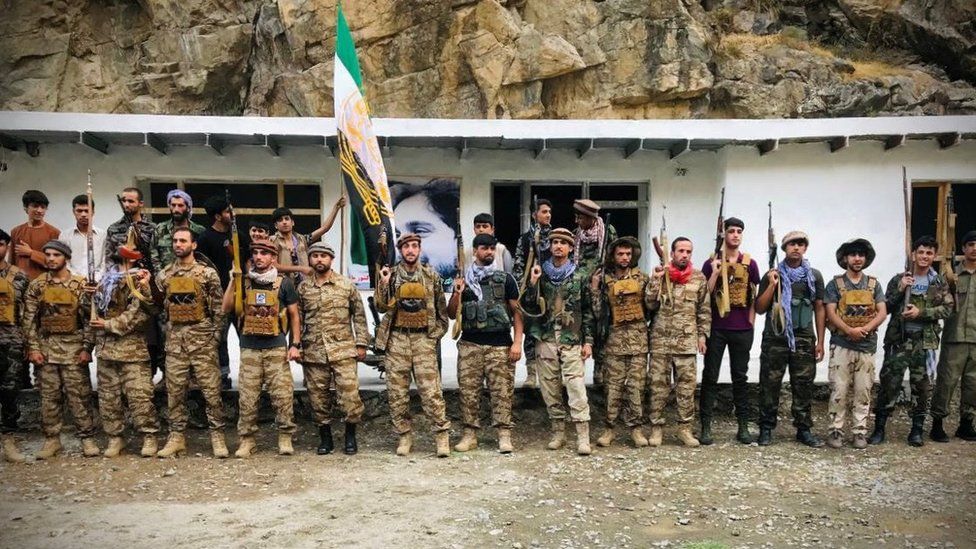
Resistance fighters in Panjshir
The NRF says it wants to pursue peaceful negotiations before fighting   Reuters
 
The very presence of a narrow pass having to be negotiated by columns of fighters before access to the valley, conjures up pictures of a complete route of any invaders by opposition fighters alerted to their entrance by sentries, a classic pincer attack of an almost impregnable area, vigilant to the emerging presence of an enemy. There was indeed instances of forces opposing the takeover of the Taliban that took place recently.

In the northern province of Baghlan which borders Panjshir, anti-Taliban forces restored to themselves three districts -- an operation that Massoud claimed not to have himself organized but which had been carried out by local militia groups in reaction to "brutality" on the part of the Taliban, carried out in the area. Which itself speaks volumes of the potential for ongoing conflict flaming into an overall civil war that could possibly spell the end of the Islamic Emirate of Afghanistan, despite its formidable reputation.

In calling for an inclusive, broad-based government in Kabul meant to represent all of the country's various ethnic groups, Massoud emphasized that the international community should forbear from recognizing a "totalitarian regime". His region leading the way, the examples of the war-torn country's past defence of its autonomy and traditional values can be seen in the presence of wrecked Soviet-era armoured vehicles still dotting the valley. 

Optimism never faltering, the practicality of an assumed force numbering some 6,000 fighters however determined and motivated they may be in defence of an Afghanistan freed from the shackles of the Taliban, Massoud speaks of the need for international support to enable his group to succeed in its mission, should large-scale conflict break out. And in view of the current withdrawal of some 51 foreign national troops anxious to finally leave the "Graveyard of Empires" after two decades of stalemate, how likely is that scenario?           

Map

Labels: , , , , ,

Tuesday, May 25, 2021

State AirJacking and Abduction

"The captain suddenly banked and went downward, then he came on the intercom and said, 'Unfortunately, we have to land in Minsk', for reasons he did not explain."
"He [air passenger] suddenly stood up and tried to give  his phone and his laptop to the woman who was with him. And he began to tell the people around him, 'No, we can't land in Minsk, they will arrest me'."
Ryanair flight 4978 from Athens to Vilnius, Lithunia, passenger

"They took the boy aside and shook his belongings on to the runway. We asked him what was going on."
"He said what it was and added, 'The death penalty awaits me here'."
Passenger, Ryanair flight 4978
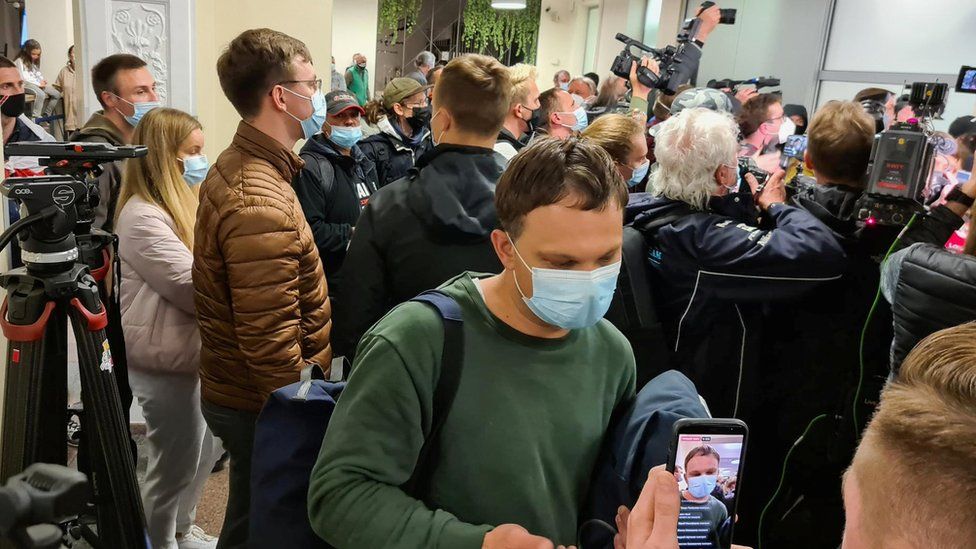
Passengers of Ryanair flight FR4978 arrive at Vilnius airport
Lithuanian passenger Mantas (centre, front) said Mr Protasevich "made a mistake" giving his laptop to his girlfriend   Reuters
 
A regularly scheduled flight, a low-cost passenger flight popular among middle-class people in Lithuania, budget-driven tourists who plan a holiday on the Mediterranean. Among the 126 passengers on board Sunday's flight from Athens to Vilnius was a young pair living as refugees from Belarus, in Vilnius. He, Roman Protasevich, 26, a journalist, and she, 23-year-old Sofia Sapega, a professional photographer studying at the European Humanities University. Returning from an assignment where they decided to use the opportunity to take a break in the sun.

The journalist was a hunted man. Designated by the Belarusian military government of Alexander Lukashenko as a terrorist. The sham election that 're-elected' Lukashenko in a hugely unlikely landslide, back to the presidency last summer after 26 years in dictatorial power, occasioned large, vociferous opposition and ongoing street protests. Harshly and violently put down, until protests were exhausted of their furious oxygen. 
 
And Roman Protasevich was a protest organizer and news editor as well as journalist, placing him in very bad odour with the Lukashenko government. He was acutely aware that the political leader of Belarus was interested in apprehending him. It was why he left Belarus. The pair had accompanied the Belarusian self-exiled (for self-protection) opposition leader Sviatiana Tsikhanouskaya to the Delphi Economic Forum on assignment in early May. 

When the plane's pilot gave no explanation for his decision to divert the plane to land in Minsk, the Belarusian capital, the plane passengers were stunned and alarmed, many fearing a bomb aboard the plane, others that something had gone mechanically wrong and they were in deep trouble. Only Mr. Protasevich knew what was happening: "We can't land there. They are going to arrest me"!, he was heard to exclaim.
 
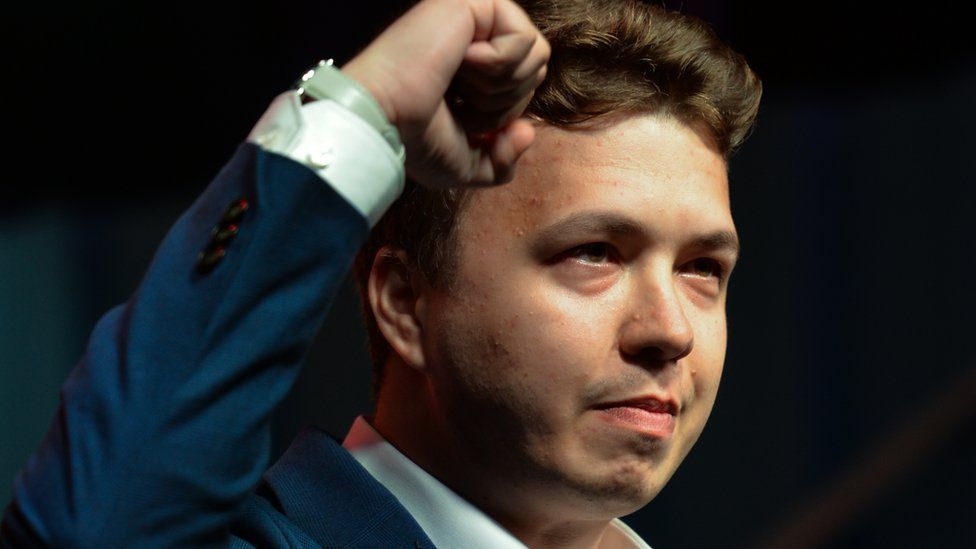
Roman Protasevich addresses the crowd next to a famous Gdansk's Shipyard Gate number 2 on August 31, 2020 during 'Free Poland To Free Belarus'
Mr Protasevich was charged with terrorism and inciting riots after covering the events of the 2020 Belarus presidential election  Getty Images
 
He had, in fact, spoken with a friend about the potential dangers of overflying Belarus, with his wanted status in mind. It was only when he and  his girlfriend were in the act of boarding the plane back to Vilnius that he experienced the first of a series of peculiar incidents; each one a warning signal. Standing at the check-in queue behind him was a Russian-speaking man who used his phone to quickly photograph the journalist's documents as he presented them to the check-in, and then quickly disappeared.
 
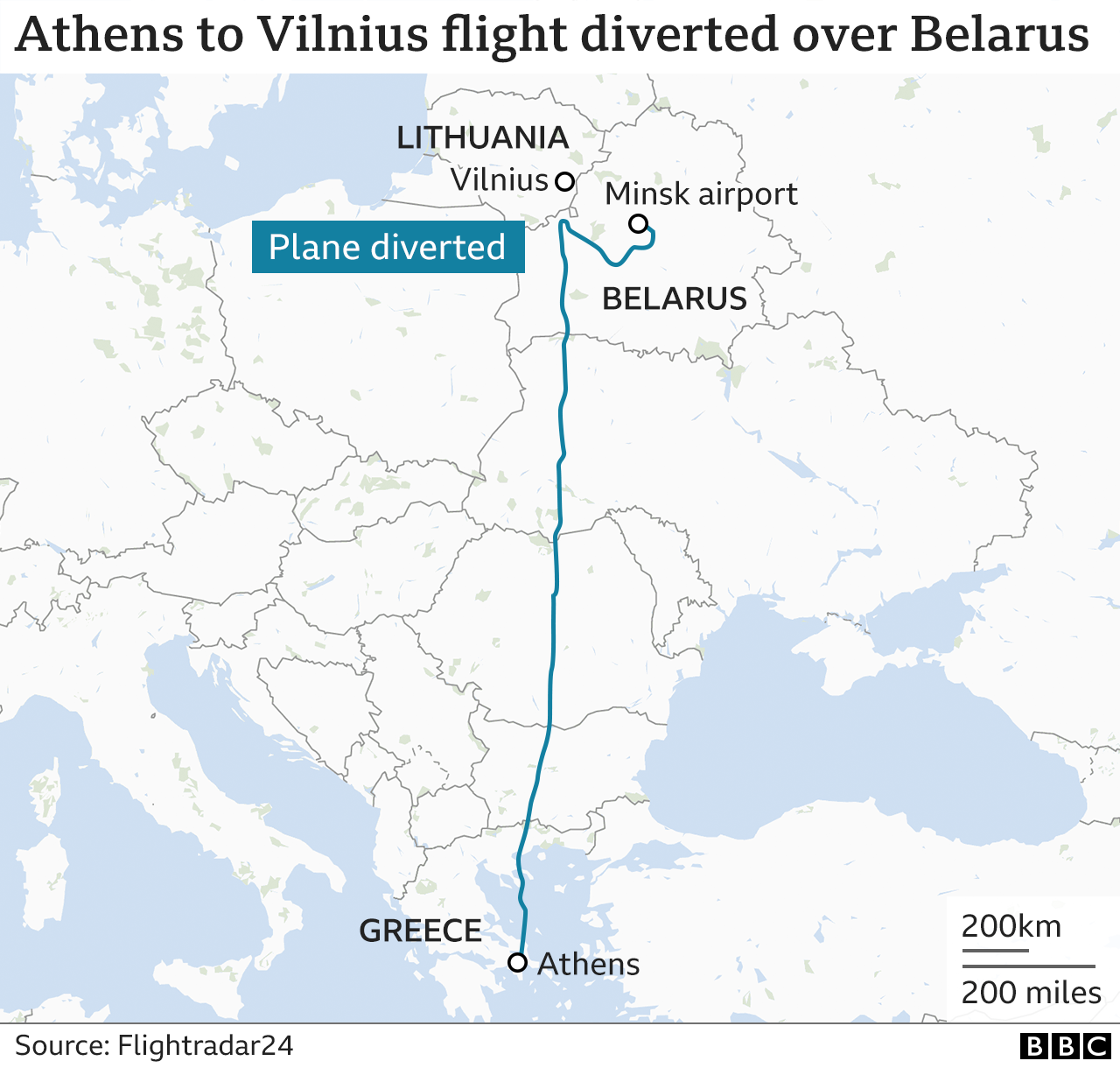
Others remained in the queue, silently watching, taking note of everything; Belarusian KGB agents. In flight, the aircraft continued at cruising altitude, maintaining speed at a point in time when it would generally have started its descent to Vilnius. Two minutes before entering Lithuanian airspace where it was scheduled to land in Vilnius in another ten minutes, there was an abrupt turn. If it was an emergency landing, Vilnius was a lot closer than Minsk, where the pilot now headed the aircraft toward.  
"We all on the plane had panicked because we thought we were going to crash."
"This was a sudden dive, changing the altitude very drastically. It was very violent. I've never felt this on an airplane. Everybody was in shock."
Lithuanian passenger Raselle Grigoryeva

While passengers excitedly speculated between themselves what might have occasioned the swift decision to deviate from the expected route, they were unaware that a Belarusian MiG-29 had ordered the change of course as it intercepted the Ryanair flight. When that happened, the young journalist leapt into action, desperately attempting to persuade the crew to return to its original flight pattern, to no avail. 

Once landed in Minsk and everyone deplaned, both young people, the journalist and the photographer were seen in loose custody, while the KGB authorities made an effort to divert attention from an obvious kidnapping taking place by making a show of document-checking all passengers despite the security officers having no obvious interest in the other passengers. "It was obviously not why we landed", remarked a passenger.

Journalist and photographer were soon closely escorted out of sight where each was placed in a waiting SUV. Six hours on, the passengers and crew were given permission to leave, landing in Vilnius 35 minutes later. It was noted that three other passengers had remained behind in Minsk and speculation that they were Belarusian or Russian KGB agents that followed the couple was rife. 

The plane was diverted on an emergency basis reflecting orders from a missive authorities had received warning of a bomb ostensibly placed on board by the terrorist group Hamas. according to Minsk authorities. Hams, no less. Whoever thought that one up was evidently flailing around for anything that might sound feasible, despite that the group their imagination conjured up, was anything but likely to be involved. 
 
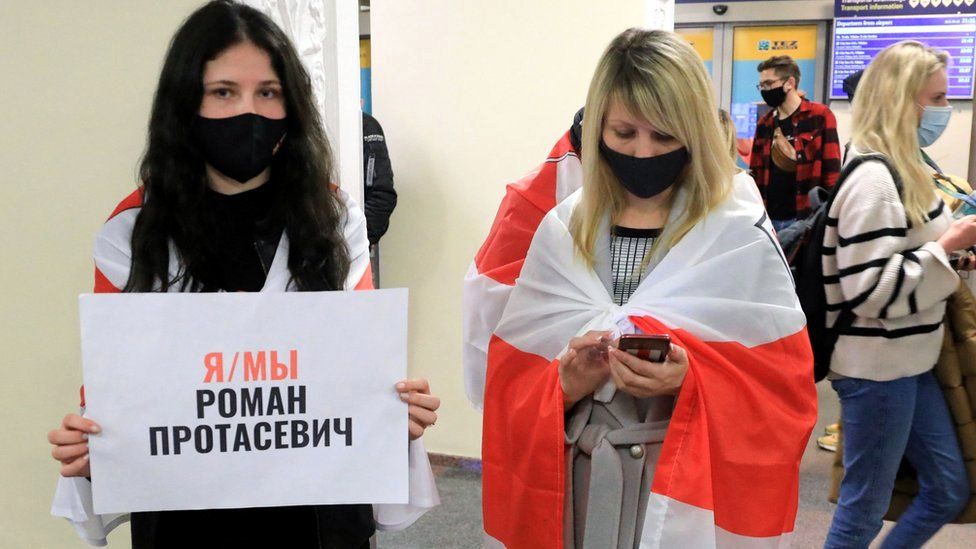
A young woman stands with a poster reading: "I am, we are Roman Protasevich" and the Belarus flag as passengers disembark from a Ryanair passenger plane from Athens, Greece
Supporters of Mr Protasevich await him at Vilnius airport with a sign reading: "I am, we are Roman Protasevich"    PETRAS MALUKAS/GETTY IMAGES
 
Whoever posited that scenario felt, with good reason, that revealing that the Belarusian tyrant had given explicit orders to divert the plane else it would be shot down, would not go down well. Inspired, perhaps by the Ukrainian passenger jet that had been shot down by the Islamic Revolutionary Guard Corps as it left the airport in Tehran, Iran. Or the Malaysian passenger jet shot down by ethnic Russian rebels in eastern Ukraine.
 
Tyrants of all stripes care little of what the world thinks of them.

A video was posted online on Monday where Roman Prostasevich is seen to assure he is in good health, although no one knows where he is being held. In the video he speaks of having played a role in organizing mass protests last year in Minsk. That he is under duress is beyond doubt. As for Ms.Sapega, she is being held, it is believed, at the notorious Okrestina prison in Minsk, and what will  happen to them both is now anyone's guess.

Map

Labels: , , , , ,

Wednesday, September 09, 2020

Belarusian Tyrant-for-Life

 "Their whereabouts are unknown. Obviously such methods are illegal and cannot lead to any result other than the aggravation of the situation in the country, a deepening of the crisis and further growth of protests." 

"The kidnapping of Maria Kolesnikova, Anton Rodnenko and Ivan Kravtsov is an attempt to disrupt the work of the Coordination Council. But this will not stop us."
Coordination Council, Belarus opposition
Alexander Lukashenko, the president of Belarus, sixth term in office. Photograph: Vasily Fedosenko/Reuters
 
Belarus is in turmoil, its president is determined by all means at his disposal as a dictator, to continue ruling the country and bringing it ever closer to the orbit of the Russian Federation. Of all the former satellite countries captured by the wide Eastern Europe net of the USSR, it is, in any event, the closest to mirroring the style of the Kremlin, and if President Vladimir Putin could alter Russia's constitution to enable him to rule ad infinitum, Belarus President Alexander Lukashenko sees no reason why he cannot do the same.

Before the corrupt election that brought him a purported 80 percent of the vote, Mr. Lukashenko was concerned that there would be Russian interference in how he conducted his August 9 election, and detained dozens of Russian private military contractors days before the vote, amidst escalating tensions between the two neighbours, convinced that Belarus's independence from Russia was being contested. When the election results came in and the opposition cried foul, Mr. Lukashenko suddenly decided he needed to be closer to Russia and appealed for its help in shutting down the protests.

Tens of thousands of Belarusians have taken to the streets in Minsk in protests since the election in support of the opposition who claim the victory should be theirs, and waving signs that Lukashenko should leave the presidency. Their efforts have brought out the military response that has seen hundreds arrested and which led to the departure of major opposition leader Svetlana Tikhanovksaya to seek haven in Ukraine with her children. Her husband remains in prison. Since then the protests have continued and the government response has been even harsher.
A woman covers herself with an old Belarusian national flag as opposition supporters gathered in front of Independence Palace, the residence of President Alexander Lukashenko in Minsk, on Sept. 6. (The Associated Press)
 
Two days ago, Maria Kolesnikova, one of three women who ran the opposition campaign as a top organizer was detained at the border with Ukraine, reflecting the targeting of the leaders of the protests against the 26-year authoritarian rule of the president-who-will-not-leave. According to Ukrainian officials and opposition activists the official Belarus plan was to expel Ms.Kolesnikova and two leading colleagues who were forcibly taken to the frontier by security forces, where Ms.Kolesnikova shredded her passport, climbing out a window of the vehicle she was conveyed in, and was arrested.
 
According to Lukashenko, in his explanation to Russian media, the three members of the unified opposition coordination council planned to leave Belarus illegally during the night. On Sunday rallies in the capital Minsk grew to about 100,000 people, despite which the Belarusian president has indicated no intention of giving concessions to opposition demands to call a new election. Presidium member Kolesnikova and spokesman Anton Radniankou along with executive secretary Ivan Krautsou were reported missing by the coordinating council, after they had been abducted in Minsk.

From Kyiv, Krautson and Radniankou later explained that they had been detained by Belarusian security agents, threatened with prosecution if they failed to cooperate in a scheme to force Kolesnikova to leave the country, and under duress they agreed. At the neutral zone between Belarusian and Ukrainian border posts they were placed in Krautsou's vehicle to cross to Ukraine. That was when security forces shoved Kolesnikova into the back seat and she tore up her passport, refusing to leave Belarus, climbed out the back window and Belarusian agents detained her.

Opposition politician Maria Kolesnikova.  SZH via REUTERS
Kolesnikova's whereabouts are unknown, thought to be in the custody of the Belarusian KGB security service. Western powers, declares Lukashenko, are responsible for the turmoil and dissension in his country, interfering in the affairs of the nation, in an effort to cause chaos and dissatisfaction with his rule. He is confident, however, that with the support of Vladimir Putin who has agreed to send in Russian security forces should matters get really out of hand in Belarus, everything will settle down peacefully.

In the meanwhile, security forces and police have been busy arresting hundreds of people, and handling protesters none too kindly, while Lukashenko has taken to strutting about in armoured gear, hefting an automatic rifle, the true picture of a patriotic hero of Belarus that the citizens of the country are only too happy to support in perpetuity.

Riot police detain a protester in Minsk, Belarus. Photo: 10 August 2020
Protesters clashed with riot police in Minsk   EPA

Labels: , , , , ,

Friday, August 21, 2020

From Putin, With Malevolence

"We assume that Alexei was poisoned with something mixed into his tea -- Doctors say the toxin was absorbed faster through the hot liquid. Alexei is now unconscious."                                                                                                       "They [doctors] are clearly playing for time and are not saying what they know."  Kira Yarmysh, Alexei Navalny, Russian Opposition Leader's spokesperson 

"Doctors are really working on saving his life right now. There is no certainty that the cause is poison but this is one potential version."                                          "The patient's condition is stable."                                                                           Anatoly Kalinichenko, Omak Hospital deputy head

Russian opposition leader Alexei Navalny attends a rally in Moscow, Russia February 24, 2019
Mr Navalny fell ill during a flight on Thursday  Reuters

"[It was] like something was switched off - like medicine mode off, cover-up operation mode on - and the doctors refused to co-operate any more, refused to give any information even to Alexei's wife."                                "The doctors who were helping to do the paperwork to make the transportation of Alexei to Charité possible started to say that he's not any more transportable, he's not any more stable, contradicting themselves."            Mr Navalny's aide Leonid Volkov

Russian President Vladimir Putin is not known to take aggressively loud and conspicuous opposition to his one-man rule of Russia kindly. Coincidentally, Russian Opposition Leader Alexei Navalny was left "fighting for his life" in an induced coma on Thursday as a result of a targeted poisoning, according to his closest colleagues. A flight to Moscow from Tomsk, Siberia went awry when Mr. Navalny suddenly was afflicted with pain to the extent that the pilot made an emergency landing so emergency medical treatment could be found for a robust, healthy man who instantly became an unconscious patient. 

His spokeswoman, Kira Yarmyah, explained that Mr. Navalny had eaten nothing, and had been refreshed with a cup of hot tea at the Tomsk airport prior to boarding his flight. "At the start of the flight he went to the toilet and didn't come back. He started feeling really sick. They struggled to bring him round and he was screaming in pain", related a fellow passenger on the flight, Pavel Lebedev.

He was taken to the Omsk hospital for treatment where a hospital representative explained he had been placed on a ventilator in intensive care and was considered to be in stable, albeit serious condition. His wife Yulia, was permitted to enter the ward to see her husband after initially being informed she could not, but the hospital would not permit his personal physician to visit his patient.

With memories evoked of previous strange occurrences afflicting other critics of Mr. Putin and the Kremlin; the 2006 shooting death of journalist Anna Politkovskaya over her sharp criticism of Mr. Putin's role in the Chechen conflict, the death of Alexander Litvinenko, poisoned with a radioactive substance in London the same year, and the attack on Sergei Skripal and his daughter in Salisbury in 2018, there's a sense of deja vu at play.

The heavy police presence at the hospital only served to increase a sense of impending doom. Which no doubt helped to lead Germany and France to offer medical care to Mr. Navalny, which his wife grasped at. Plans to move the critically ill man to a hospital in Europe saw no enthusiasm among Russian officials, and the doctors at the hospital balked at moving the patient, claiming to do so would be inimical to his survival.

Medical experts from Germany arrive at hospital in Omsk
Medical experts from Germany were allowed to see Mr Navalny Reuters

Despite which, a team of specialists in treating coma patients with an air ambulance was dispatched from Germany to bring the unconscious Mr. Navalny for treatment abroad, even as Kremlin spokesman Dmitry Peskov insisted that Mr. Navalny was being given emergency treatment by the most skilled doctors, and police were not investigating poisoning as a possible cause of his sudden collapse.

Mr. Navalny's criticism of Vladimir Putin, loud and to the point is popular among Navalny supporters which certainly explains why he had been barred from running in the most recent presidential election and for his impudence had been imprisoned on a number of occasions as penalty for organizing anti-Kremlin demonstrations. Other penalties were also exacted against him when he experienced an acute allergic reaction his doctor felt might have been caused by a "toxic agent".

Alexei Navalny is moved into an ambulance to be be driven to the airport in Omsk, 21 August 2020
Navalny was taken by ambulance to the airport in Omsk on Saturday morning  Reuters

He was too ill to be moved, according to the doctors treating him in Omsk, but later Friday they allowed that his condition was sufficiently stable for the planned flight to Berlin when the medically equipped plane ordered by the German NGO Cinema for Peace, who had arranged for the flight to Berlin and treatment at the Charite hospital took action. "Alexei Navalny has been loaded into an ambulance and they are taking him to the airport", Kira Yarmysh announced early Saturday.

Labels: , ,

Saturday, May 04, 2019

Saving Venezuela from Maduro : What Happened?

"The opposition took a step backward with the military."
"Guaido appearing with Lopez at a single point in the city with a few dozen soldiers and no major firepower showed their weakness."
Rocio San Miguel, president, Control Ciudadano watchdog group

"Many of us thought, as the weeks went by, that it was astonishing Maduro hadn't discovered it already but that may be because so many on the inside wanted it to succeed."
"They believe Maduro began to get an understanding of what was happening on the 29th and they had to move on the 30th or it would all collapse."
Unnamed authority

"I spent two years in complete isolation at Ramo Verde [prison]."
"It was not easy. I was tortured. I don't want to go back to jail, because jail is hell."
"But I'm not afraid of jail, just like I'm not afraid of Maduro."
Leopoldo Lopez, Venezuelan political prisoner

"[Any attempt to detain Guaido would be] highly inflammatory."
"From Maduro's perspective, it might be better to simply dismiss Guaido as a mere nuisance and a U.S. stooge, thereby undermining Guaido's faltering movement and -- once again -- splintering the fractious Venezuelan opposition."
Eileen Gavin, senior Latin American analyst, Verisk Maplecroft, global risk consultancy
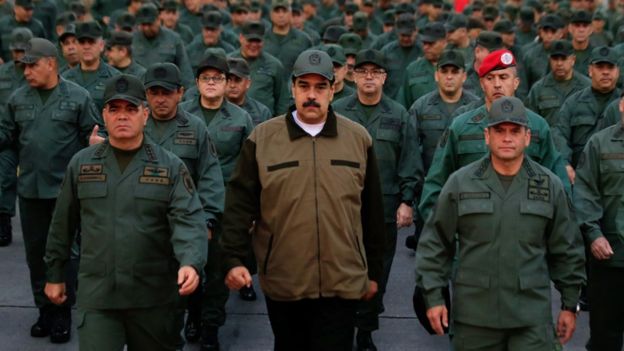
Venezuelan President Nicolás Maduro flanked by military official in Caracas. Photo: 2 May 2019
President Maduro (C) appeared alongside military forces   EPA

When plans hang on a thread, that constitutes a very thin grip on Madame Fortune's game of chance. And by chance despite the high popularity of both Venezuelan opposition leader (acting president) Juan Guaido and his mentor, high-profile political prisoner and political agitator Leopoldo Lopez their co-appearance at a rally to persuade Venezualans to rise en masse in demonstrations to leave no doubt that the days of disastrous misgovernance by current Venezuelan Nicolas Maduro must end, ended instead in disaster for the move to unseat him from power.

All the niggling little details of persuasion and agreement had been meticulously seen to. The birds were all in hand and prepared to leave the nest. Until the nest, though uncomfortable and past its useful prime appeared more secure for the present than flight into the unknown. It took two months to cajole and plead with principles close to President Maduro to abandon a man whose abysmal administration of a once-prosperous and proud nation had sent it reeling into dysfunction.

But it worked; in theory and expectations of fruition. Until, as one Venezuelan involved in the 'transfer of power', blamed Lopez for "unilaterally" demanding to appear in public alongside Juan Guaido, who agreed. Lopez himself informed reporters that he had been negotiating for weeks with "commanders, generals, representatives of different branches of the armed forces and police". Presumably while still under house arrest.


And it was the understanding of the White House authorities involved behind the scenes that Defense Minister Vladimir Padrino Lopez, Maikel Moreno, president of the Venezuelan supreme court, and Ivan rafael Hernandez Dala, head of both the presidential guard and of military counter intelligence were prepared and committed to aid in the transition, ushering Maduro off stage and Guaido to centre stage. But that seeing Mr. Lopez onstage threw them off, identifying him as a "trouble-maker".

U.S. Secretary of State Mike Pompeo blamed Russia for intervening at the final moment when Maduro had finally realized what was going to happen, and feeling himself besieged rushed to a banker with plans to escape in a flight to Cuba the following day. The Kremlin assured him that all would be well, that he must maintain his position in Venezuela.

On the other hand, speculation has it that Defence Minister Lopez while part of the negotiations informed Maduro, the Russians and Cuban allies of the plot. The plot began when elite officials in the Maduro regime thought it time to dialogue with opposition figures to create bridges to rescue the country mired in hyperinflation, unemployment, food and energy and medical shortages, and millions of Venezuelans leaving to take up residence as refugees in neighbouring countries.

Over fifty countries now recognize Guaido as interim president of Venezuela, in reaction to the rigged re-election of Nicolas Maduro last year. "A majority of the high command were talking with the Supreme Court and Juan Guaido about a change in government with the departure of Maduro and with guarantees for the military", Elliott Abrams, U.S. State Department special envoy for Venezuela stated on Wednesday.

The following day, a court in Caracas issued a warrant for the arrest of Leopoldo Lopez, revoking house arrest, ordering that he spend the balance of his 13-year sentence, with eight years left on his conviction of arson and instigating violence against the state. He and his family lost no time in seeking asylum at the Spanish embassy which vows to protect him.

"You only get to play this card once, and now that it's been played it's hard to see what else can be done", pronounced Fernando Cutz who until recently led U.S. policy at the National Security Council in Washington.

Yet, the reality is that Maduro's regime is loathed by most of the Venezuelan people. He is responsible for the decay of a once-great nation now belching its frantic population across the border as refugees as those within the country face starvation and the total disintegration of civil democracy into military rule.
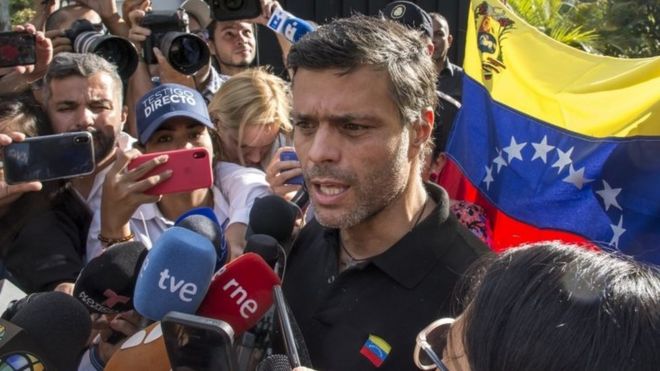
Opposition figure Leopoldo López speaks to reporters at the gate of the Spanish embassy in Caracas, Venezuela. Photo: 2 May 2019
Leopoldo López sought refuge at the Spanish diplomatic mission after Tuesday's dramatic events   Getty Images

Labels: , , , ,

Thursday, May 02, 2019

Removing a Socialist Dictator - Or Not

"People of Venezuela, the end of usurpation has arrived. At this moment, I am with the main military units of our armed forces, starting the final phase of Operation Liberty."
"People of Venezuela, we will go to the street with the armed forces to continue taking the streets until we consolidate the end of usurpation, which is already irreversible."
"The armed forces have taken the right decision. With the support of the Venezuelan people and the backing of our constitution they are on the right side of history."
Venezuelan opposition leader and declared President, Juan Guaido

"Steel nerves."
"I have talked to commanders in all the regions of the country and they've manifested their total loyalty to the People, the Constitution, and the Homeland."
"I call for maximum popular mobilization to ensure the victory of peace."
"We will win!"
Nicholas Maduro, contested Venezuelan president

"If Guaido and Lopez fail to split the military and rally top brass to their cause, then a big question is what happens to them personally, and to the opposition cause more broadly."
"They could end up tonight in jail or worse. They are taking a huge leap today."
Shannon O'Neil, Venezuela expert, Council on Foreign Relations
Venezuelan opposition leader Juan Guaidó greets supporters in Caracas, Venezuela, Tuesday. He took to the streets with a small contingent of armed troops and called for the military to rise up and oust President Nicolás Maduro.
Fernando Llano/AP

Opposition leader and head of Venezuela's national assembly Juan Guaido, who has declared himself the true president of the country, and whose claim has been supported by neighbouring countries along with an estimated 50 other national heads of state worldwide launched a military-backed challenge to reigning Nicolas Maduro. He has called on Venezuelans to take to the streets in mass popular demonstrations against Maduro.

Those majority members of the military who remain loyal to the socialist Chavista government have responded with rubber bullets and tear gas. Local hospitals have been busy in response. A video captured an armoured vehicle in Caracas running into a crowd of protesters and people were being detained, taken away on motorcycles by military personnel. "Operation Liberty" has drawn the attention of the world community.

"There is no other way out of this", Hamilton Mourao, vice-president of Brazil noted, other than that either opposition leader Guaido and the Venezuelan Defence Minister Vladimir Padrino Lopez would "be prisoners" or Maduro "would be leaving". Surrounded by armed men in military uniforms, Guaido urged other troops to join Operation Liberty, to enable the opposition to force Maduro from power.

Leopoldo Lopez, Guaido's political mentor, the opposition leader placed under house arrest had, with the help of the military personnel guarding him, escaped to stand beside Guaido, a powerful support from a popular opposition figure. "I want to tell the Venezuelan people: This is the moment to take to the streets and accompany these patriotic soldiers", he announced, even while Maduro claimed the military was loyal to him.
An anti-government protester walks near a bus that was set on fire by other protesters during clashes between rebel and loyalist soldiers in Caracas, Venezuela, on Tuesday.
Fernando Llano/AP

Cuba has denied American claims that it has dispatched 20,000 of its own military to Venezuela in aid of Maduro, instead it said the 20,000 figure was correct, but they were all Cuban medical personnel. And if so, they'll have their work cut out for them in hospitals where equipment has failed and basic drugs and items as elemental as bandages and anaesthetics are in critically short supply.

Moscow has warned Washington to stop meddling in Venezuela's affairs. "This is our hemisphere. It's not where the Russians should be interfering. this was a mistake on their part", responded national security adviser John Bolton, raising the potential of sanctions. The Kremlin responded by accusing America of supporting an attempted "coup", that Washington's interference represented a "gross violation of international law".

At the street gatherings mostly young men armed themselves with makeshift shields and tossed rocks at state security forces. It was expected that Guaido's stirring cries to the populace would result in a number of high-ranking defections to ultimately loosen Maduro's grip on power, while some analysts predicted Maduro would emerge more emboldened, even as the chief of Venezuela's intelligence agency broke ranks, while others remained with Maduro.

According to John Bolton, Venezuela's defence minister, the chief justice of the Supreme Court and head of the presidential guard were preparing to usher the peaceful transfer of power to Guaido; none of those defections, however, took place. Leopoldo Lopez took refuge in the Spanish embassy, along with his family. A number of Venezuelan troops applied for asylum in the Brazilian embassy.

A rumour circulated that Maduro planned to leave the country, that an airplane had been in readiness on the tarmac, but that Russia convinced  him to remain. The Russian foreign ministry characterized the rumour as "absolute disinformation and fake news", something that Russia knows a great deal about.

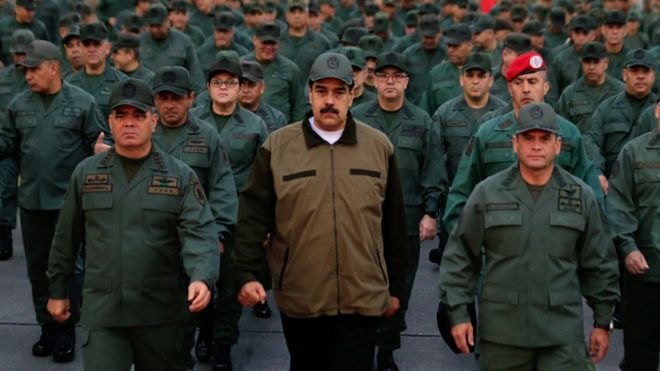
This handout picture released by Miraflores Palace press office shows Venezuela's President Nicolas Maduro waving military troops accompanied by Defense Minister Vladimir Padrino (L) at the "Fuerte Tiuna" in Caracas, Venezuela on May 2, 2019
The armed forces did not appear to heed Mr Guaidó's call to defect    EPA

Labels: , , , ,

() Follow @rheytah Tweet