
Politic?

This is a blog dedicated to a personal interpretation of political news of the day. I attempt to be as knowledgeable as possible before commenting and committing my thoughts to a day's communication.

Wednesday, November 12, 2025

Brutalizing Banshees

"Each time we were told to resubmit our applications, adjust our speaker lists, and revisit our security protocols."
"Each time, the university found a reason to say no [to holding private, planned events on campus]."
Liat Schwartz, president, Students Supporting Israel, Toronto Metropolitan University
 
"Students Advocating against the genocide of Palestinians have been subjected to Zionist violence for the last two years."
"We will not rest until our academic institutions hold war criminals and their racist mobs accountable."
Students for Justice in Palestine, TMU
https://www.vmcdn.ca/f/files/torontotoday/images/education/colleges-and-universities/20240822torontometropolitanuniversitysignka02.jpg;w=960
TMU campus, downtown Toronto   Photo: Toronto Today
 
Triggered From Combat to Campus features Israeli soldiers who have fought against either Hamas or Hezbollah in the last two years in the wake of the 7 October 2023 mass atrocity perpetrated by Palestinian terrorist groups in southern Israel. These combat-tried members, reservists in the Israel Defense Forces, travel on invitation to speak before student groups throughout the United States and Canada. 
 
On November 5, one such private event took place on the campus of Toronto Metropolitan University, at a closed-door session to which only people known to the campus group Students Supporting Israel were invited in a discreet attempt to ensure that no unwanted others would appear as so often happens. Yet somehow the student group Students for Justice in Palestine became aware of the event and purposed to disrupt it.
 
Any campus Jewish groups that plan to stage events for their own enlightenment and mutual support are very well aware that news of any of their events are certain to alert their plans to hostile, masked, accusing and threatening 'pro-Palestine' protest groups. On this occasion as on so many others a group of 40 masked demonstrators showed up at the private venue where Jonathan Karten, an IDF reservist was due to speak.
 
IDF reservist Karten speaks frequently at similar such venues. His uncle, Sharon Edri was an Israeli soldier taken hostage by Palestinian terrorists and murdered by Hamas in 1996. Finding entrance doors locked, the intruders, one of whom was carrying a drill bit, shattered the glass window of one of the doors restraining their entrance. The event participants soon found themselves in the presence of screamers naming them genocidal war criminals.
 
After police arrived on scene to restore order and security disrupted by the intruders, all of them masked, all of them hysterically accusing the Jewish students of murder, five were arrested and taken into custody while the others were dispersed. Prior to the police arrival, however, Jonathan Karten had 'escorted' some of the intruders forcefully through the door they had smashed, raising them by their elbows and ejecting them.
 
They all held phones, recording the chaos they had precipitated, while charging Mr. Karten with 'brutalizing' them. In fact, he  had been brutalized by their violent actions, sustaining deep lacerations to his forearm by the shattered window. "You're moving, everyone's moving", said the bleeding Karten as he lifted and ejected a number of the trespassers, bundling them out of the venue. 
 
 
Posting an Instagram message to urge their members to an emergency rally to intercede in the November 4 event, Students for Justice in Palestine branded the event, its attendees and the guest speaker as "Zionist war criminals" and "Zionist murderers". Alongside their message they posted images of IDF servicemen with red Xs covering their eyes.
 
The Jewish civil rights group Tafsik Organization is involved in trying to identify who it was, among the intruders that broke the window, calling on Canadian universities to delist branches of Students for Justice in Palestine, given that "their conduct constitutes violent extremism and organized intimidation".
 
Adding: "We will also be engaging with members of Parliament to formally request that SJF be reviewed for designation as a terrorist-affiliated organization."  
"It was supposed to be a moment of dialogue, a chance to share my story as an IDF veteran, to talk about the war, and about my uncle, Sharon Edri, who was kidnapped and murdered by Hamas."
"But instead of a conversation, we were met with violence. Masked terrorists broke through the glass door and charged at us. One came at me with a drill bit."
IDF reservist Jonathan Karten 


Labels: , , , , , ,

Thursday, October 08, 2020

The Gruesome Murder With No Leads

The Shermans were found dead in the basement of their north Toronto home on Dec. 15, 2017. (James Morrison-Collalto/CBC)

"Nobody knows anything about this case, that we know of. Nobody knows the motive, nobody knows the assassins' names."
"Just because the police officer is unaware of a risk doesn't contradict the assertion of the Shermans."
Justice Russell Brown, Supreme Court of Canada
 
"A reasonable person would report a risk to the Toronto police."
"If there is some risk that was never reported to the police and that the Shermans have not put forward evidence of, they don't get a sealing order. That's just not good enough."
Iris Fischer, lawyer representing news media challenge
 
"[The murders must have been] committed by a very sophisticated organization, at least it has those hallmarks."
"[This was the commission of] a very, very sophisticated crime."
Justice Michael Moldaver, Supreme Court of Canada
 
"When we look at the likelihood of it happening [risks of harm to the estate beneficiaries], it might be low, but the likelihood of the Shermans being murdered was also low."
"The magnitude, the gravity, the graveness of the potential consequence is something that should be taken into account by the court."
"[The] risk of harm is foreseeable and the foreseeable harm is grave."
Chantelle Cseh, lawyer, Sherman estate
Honey and Barry Sherman. (Photo by Liora)
 
The surprising original theory of the Toronto Police investigating the double murder of a billionaire Toronto couple known for their philanthropy was that this was a case of murder-suicide. The family of the murdered couple reeled in disbelief at the hasty, pre-investigative conclusion, and were so demoralized and furious that they took steps to engage their own private investigation into the gruesome killing of their parents. Barry Sherman was the chairman and chief executive officer of Canada's largest pharmaceutical firm, Apotex.

The couple, one of the country's wealthiest families, part of high society as business giants and philanthropists, he age 75 and she 70, was found dead by a real estate agent who had been engaged to sell their mansion. He came upon their bodies seated side by side, tethered by their necks with belts to a railing at the edge of their indoor pool, located in the basement of their home. Police eventually changed their conclusion, to announce a targeted double homicide. Cause of death: "ligature neck compression".

Their December 2017 murder remains unsolved. Neither the police nor the specially engaged private investigative firm succeeded in discovering the identity or identities of those involved in the couples' death. As the founder of pharmaceutical giant Apotex, it was speculated that this crime somehow may have involved a business competitor, with dark hints of enemies of Barry Sherman having plotted his murder. A ten-million-dollar reward failed to elicit any information from any source that might help to solve the sinister mystery of their deaths.
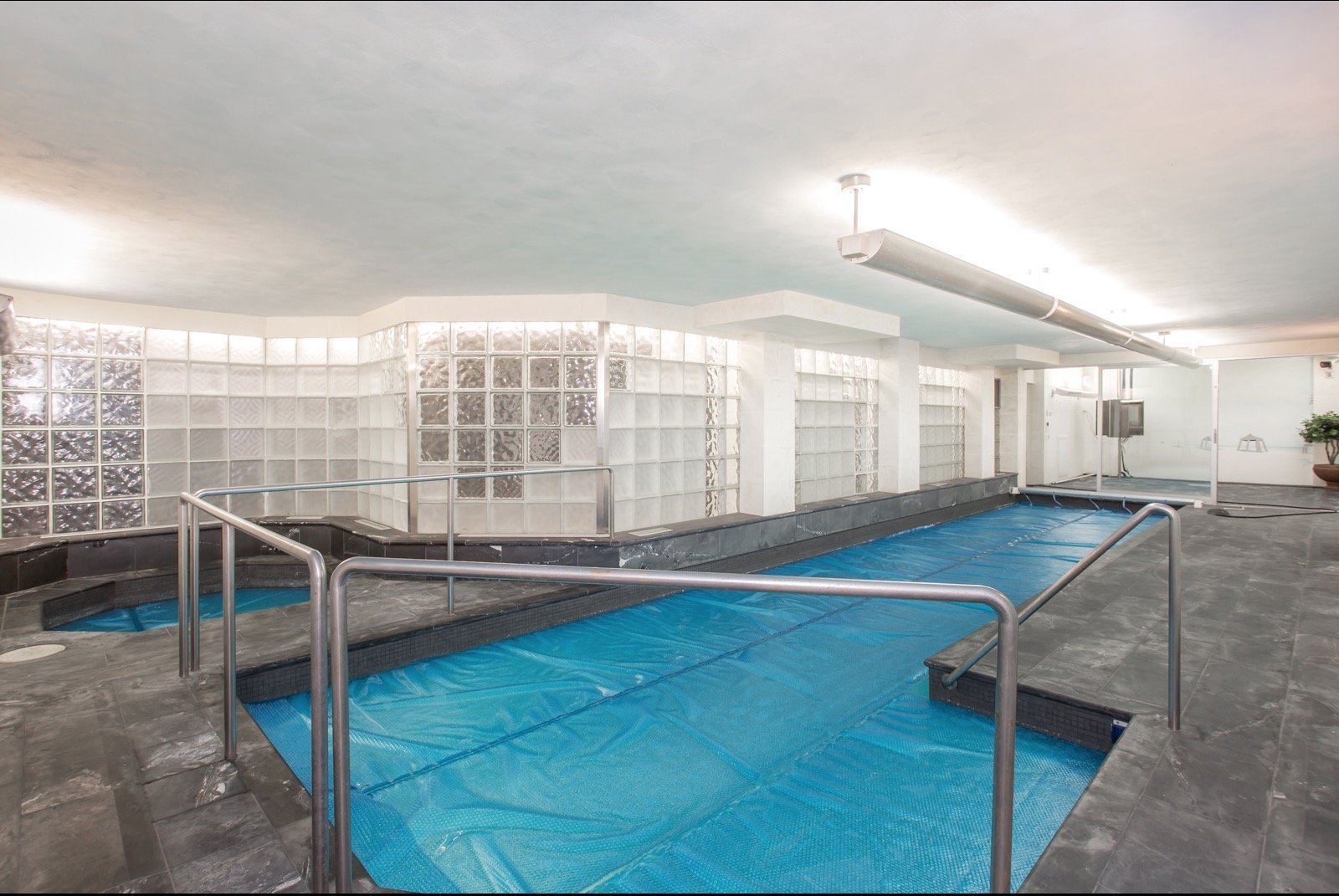
There was great public interest in details of the ghastly event, and news media were anxious to gain all the information they could mine to satisfy public curiosity relating to the case and its prolonged and failed search for answers. They meant to publish details of the Sherman estate, their wills and inheritance proceedings, only to discover the files had been sealed by a judge's order at the family request for privacy.
 
The swimming pool  - Houssmax.ca photo
What has transpired is an appeal of the sealing order by an investigative reporter to overturn the order which succeeded, leading the Sherman family to appeal to the Supreme Court of Canada, hoping for the restoration of the files' sealed position. The justices heard lawyers for the estates arguing against the decision of the appeal court which "disregards the increasing emphasis on privacy in Canadian law, and fails to recognize the constitutional protection afforded to privacy and the pressing public interest in safeguarding it in the digital age".

The media, they charged, were interested merely in light of the "wealth and the circumstances of their death", of the Shermans; that the sealed files should remain "a private matter". Since the files contain names and addresses of innocents, including children, and "also provide a link between certain of the affected individuals and the Shermans which would not otherwise be apparent", they should remain closed to public scrutiny, the Sherman lawyers argued.

It is not beyond belief, they stressed, that given the gruesome murder of the Sherman parents, the beneficiaries and trustees may face a serious risk to their security and safety. Lawyers for the media on the other hand, claim the position of the Shermans runs counter to the open courts principle, asking the court to consider new evidence, including the testimony of Det.Sgt.Dennis Yim, the single homicide officer assigned full time to the case who is unconcerned that unsealing the files could jeopardize the investigation.
 
The Sherman children chose not to sell their parents' mansion. The horror of the deaths is a haunting one. They chose to have the building demolished.
This Jan. 6, 2018 photo shows police crime scene tape marking off the property belonging to Barry and Honey Sherman, who were found strangled inside their home on Dec. 15, 2017. Since that time, investigators have scoured the 12,000-square foot home, hauled away the couple's cars and even checked the sewers in one of Toronto's most exclusive neighborhoods for clues. But police haven't made any arrests, announced the search for any suspects or said practically anything publicly about the deaths of the drug company founder and his wife. (AP Photo/Rob Gillies)


Labels: , ,

Saturday, November 19, 2016

The Hallucination of Strategic Jihadi Intervention

"It makes perfect sense [to use community safety hubs across the city and more across Canada to try to apprehend violent extremism] because we already have these mechanisms that respond to situations of risk."
"At the heart of it, it's about connecting people to services to reduce the risks that they face, whether it's extremism or something else."
Scott McKean, City of Toronto 

"For a certain proportion of people who are moving into that radicalized space, I think that what the Toronto Police Service is doing will catch and hopefully help to re-engage those people on a different trajectory."
"We're all flying by the seat of our pants right now based on a small number of studies, and growing the knowledge base is so important to getting this right."
Sara Thompson, associate professor, Ryerson University Department of Criminology

"It's an issue that our citizens, our communities, are concerned about and that we recognize is out there. It's no different than the concern that their child may be starting to get into drugs. Maybe they need a mentor to help them navigate what they're going through."
"We don't have all the answers. We're putting what we think is a good initiative forward. We may have to tweak it along the way or make some changes as we move forward, but I think we've done our due diligence."
"I think it has huge potential. Everybody is watching to see what happens."

Det.Sgt.Kelly Gallant, 30-year police veteran, firearms instructor, tactical team member, negotiator
Jack Boland / Toronto Sun / QMI Agency
Jack Boland / Toronto Sun / QMI Agency      James Ramer speaks at Police HQ.

Violent radicalization has surfaced as a problem just about everywhere in the world, with Islamist jihad proving to be an attractive provocation in inciting interest among young Muslim men and women eagerly subscribing to the ideology of a reborn Islam, returning to its roots of triumphant coersion through violent conquest; from the 7th Century of its inception to the 21st Century of its reinvention as a barbaric tool of religious conversion.

Canadians in significant numbers have taken to travelling abroad for combat training in the Islamist hotspots of the world -- from North Africa to the Middle East and places in between. Although al-Qaeda had its attractions, impelling Muslim men to make the trek in obeisance to the call to jihad, it took the advent of a caliphate calling itself the Islamic State of Iraq and the Levant which proudly and with the aid of social media celebrated its public relations agenda of wanton slaughter through inventive atrocities to rally the minds and hearts of recruits.

Recruits who have involved themselves in terrorist plots, who have been arrested and placed on peace bonds, who have been apprehended from travelling outside Canada to join terrorist groups, or those who have returned to Canada after having received terrorist training and gained experience on the jihadist battlefield championing violent Islamist triumphalist conflict. They will remain the concern of the RCMP. The Toronto Police Service decided it would absorb a counter-extremism function into a standing community safety program to address the problem of emerging jihadists.

Deputy Police chief James Ramer tasked  two officers, Sgt. Donald Locke and Det.Sgt. Kelly Gallant on their return to Canada in 2014, from mentoring women police officers in Kundiz province, Afghanistan to formulate a protocol to address the concerns of Toronto residents recruited into Al Shabab, Hezbollah, al-Qaeda, Islamic State, the Tamil Tigers and the Ku Klux Klan. The team of two initiated their assignment by attending American conferences, by consulting academics, by reading research papers and visiting interventionist programs in countries like Britain.

They concluded through that research that often people became radicalized through their own vulnerable mental health issues, personal identities, or family problems. A program to address similar problems began in Glasgow, Scotland, was picked up by Saskatchewan as a working model, and the Toronto team saw fit to emulate it, extending what had basically been a tool to tackle guns, drugs and gangs into an extended project to encapsulate Islamist terrorism as well.

People at risk were to be identified and intervention to take place at weakly "situation tables" involving police, the city and the United Way community services agencies. Each case was studied and strategies devised to counter addiction, social housing, education, employment and other issues which might be involved in helping to divert people from the alternate paths they choose leading to societal isolation, resentment, crime and radicalization.

Ottawa Citizen
Ottawa Citizen     A tourist shot this photo of Michael Zehaf-Bibeau during his attack near Parliament Hill.

"Misfits", "wannabes", "hangers-on", on the cusp of committing to extremism considered to reflect a proportion of those being radicalized were to be identified by members of the associated community; anonymity was guaranteed to community members to give them confidence that coming forward to police to report concerns about extremists would be kept confidential in the process of bringing the cases to the situation tables. Concerned individuals could convey their impressions of radicalization to police without fear of community identification.

"I don't think it's a panacea", doubtfully commented Stephanie Carvin, an assistant professor specializing at Carleton University, School of International Affairs. Equating issues underlying those representative of drugs and gangs with those of extremist Islamist jihadists simplifies the concerns of terrorism by normalizing it into a common stream of criminality, when it is far more than that; a vicious, threatening existential threat, no mere societal non-convention.

Even while cases are initially screened to ensure that any who have committed criminal or terrorist activity are excluded from the program of hoped-for rehabilitation and referred directly to the RCMP for investigation: "We are not going to send somebody like that to the hub", stated Deputy Chief James Ramer reassuringly. Experts are divided on the potential effectiveness of the police program for intervention.

To the present time, although the interventionist team has been in service for well over a year there has been a total of two events they have been involved with, one respecting parents worried their child was fixated on viewing ISIL videos. The outcome of that investigation was the conclusion that mental health issues were involved. The second, the case of a girl missing from home, and found to have crossed at Fort Erie into the United States. In her possession was an Pakistan-bound airline ticket.

Like her gullible counterparts in the United Kingdom and elsewhere, she was en route to meet an utter stranger who had romantically convinced her via social media that she could join him in the jihadist camp to become his wife. Instead, the chagrined young woman was returned by authorities, to the care and custody of her parents.
Postmedia News
Postmedia News    Fighters with the Islamic State of Iraq and the Levant — also known as Daesh — are seen in an undated photo
"So you're basically treating the two populations [drugs and gangs, and jihadist-attracted youth] as being very similar. And it's not a good fit, at least not in a Canadian setting, for violent radicalization."
"This is all a work in progress. We're going to see if it works."
Phil Gurski, former investigator, Public Safety Canada

Labels: , , , , ,

() Follow @rheytah Tweet