Politic?

This is a blog dedicated to a personal interpretation of political news of the day. I attempt to be as knowledgeable as possible before commenting and committing my thoughts to a day's communication.

Sunday, December 10, 2017

Back to Square One in Iraq

"Honourable Iraqis, your land has been completely liberated. The liberation dream has become a reality. We achieved victory in difficult circumstances and with God's help, the steadfastness of our people and the bravery of our heroic forces we prevailed."
"The flag of Iraq is flying high today over all Iraqi territory and at the farthest point on the border."
"I urge everyone to refrain from returning to the inflammatory and sectarian discourse that empowered gangs to occupy our cities and villages. Our people have paid a dear price. We must turn this page forever."
Iraqi Prime Minister Haider al-Abadi

"All Iraqi lands are liberated from terrorist Daesh gangs and our forces completely control the international Iraqi-Syrian border."
Lt.Gen. Abdul-Amir Rasheed Yar Allah, Iraqi military commander

"[The United States offers] sincere congratulations to the Iraqi people and to the brave Iraqi Security Forces, many of whom lost their lives heroically fighting [Daesh]."
Heather Nauert, U.S. State Department spokesperson
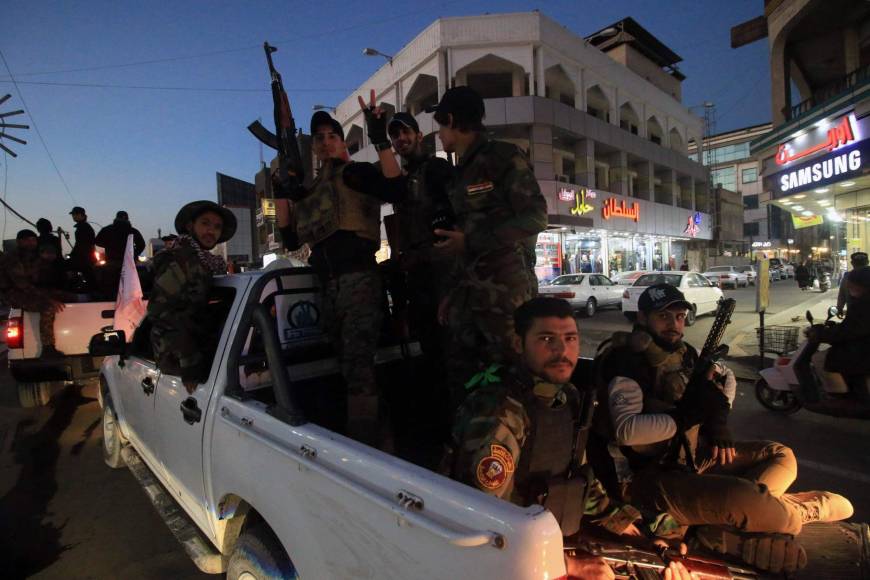
Iraq forces stage victory parade to mark defeat of Islamic State
Members of the Iraqi forces flash the victory gesture as they ride in the back of a pickup truck on a street in the southern city of Basra on Sunday amid victory celebrations after Baghdad declared victory in the war against the Islamic State (IS) group. | AFP-JIJI

Three years ago the courageous Iraqi military fled in panic as Islamic State of Iraq and the Levant jihadists neared Mosul, their fiercely barbarian reputation for atrocities preceding them. In their desperate haste to leave the city of two and a half million people to fend for itself, they left behind a treasure trove of American-supplied military vehicles and arms caches for the jihadis to take advantage of. ISIL was also, in the absence of the Iraqi military, able to loot the Mosul main bank of a billion dollars to advance their agenda.

Mosul's Sunni population initially might have welcomed the Sunni terrorists feeling living under them could not be any worse and might improve on the oppression they lived with under the Shiite government. They were soon to learn otherwise, as ISIL turned to enforcing life in their version of Sharia upon the majority Sunnis in Mosul, once they had finished with the Shias, the Christians and the Yazidis and the city became accustomed to capital punishment meted out in public squares to any deemed to be delinquent in their ISIL-type Islamism.

Prime Minister Abadi's conciliatory words to Iraqis, his urging that sectarian differences not flare up again is no doubt aimed at Iraqi Sunnis and at Kurds; with his now-secure alliance with Iran and the Iran-backed Shiite militias and the re-empowerment of Syria's regime with its Hezbollah back-up, there is obviously no need of remediation of the ruling Shiites in their persecution of the Sunnis. A situation which led to the former Saddam Hussein-era military commanders becoming ferocious ISIL leaders.

The Prime Minister's speech was notable for the deliberate absence of any mention of the Peshmerga. It would be strange, that omission, since it was the Kurdish Peshmerga whose fighting spirit and courage protected Iraq's minority populations, and who were in the forefront of the fighting, meeting ISIL in battle that the Iraqi forces shrank from, but not viewed through the lens of denial of sovereignty. Without the U.S. air power nothing would have been accomplished in ridding Iraq of the terrorists. And without the Peshmerga forces the United States would have been absent a fighting ally they could depend upon.

The Kurds had their reward when they assumed that after all their sacrifices and their proven record in establishing an egalitarian and welcoming society based on universal human values along with their heritage traditions and their sheer ethnic numbers augmented by their aspirations to have their ancestral homeland finally recognized for the sovereign nation it is, the Iraqi Prime Minister sent in those brave Iraqi troops backed by Shiite militias to quell the hopes raised high after a referendum that saw the vast majority of Kurds voting for independence.

Baghdad's central government is determined, like that of Erdogan's Turkey, al-Assad's Syria and the Ayatollahs' Iran to deny the 40-million Kurds in their collective territory the recognition they deserve.
To that end, Abadi snubbed the Kurds entirely, praising in his speech the Iranian trained and backed Popular Mobilization Forces loyal to Iran, prepared at the drop of a hat to persecute Iraqi Sunnis, and not averse to threatening Kurds, while withholding any mention whatever of the peshmerga's role in defeating ISIL, a backhand slap at the Kurdistan Regional Government.

NabihVerified account @nabihbulos
#Kurd-ish troops cheer when they see an explosion among the #Iraq-i ranks. A sad day for what's left of the country's unity.
In his speech the Iraqi Prime Minister deftly laid out another position which no doubt has been the cause of much discussion in the Shiite cabinet, that the state should have a 'legitimate' monopoly on arms: "Weapons should only be in the state’s hands. The rule of law and respect for it are the way to build the state and achieve justice, equality, and stability". That would have great resonance with Iraqi Kurds in their recall of the devastation that Saddam Hussein carried out with his deadly chemical attacks on Kurdish towns and villages.

"The joy of victory is complete with Iraq’s unity after it was on the verge of division. The unity of Iraq and its people is the most important and greatest accomplishment", he waxed self-congratulatorily, the man responsible in large degree for the rise of the terrorist opposition of Sunni Iraqis left out of any positions of equality in the sectarian atmosphere of traditional suspicion and hatred between Iraqis.


Labels: , , , , , ,

Sunday, November 19, 2017

It's The Arab Culture

"It's not about us -- we have no power to stop this war. Even if the international community ... provides millions of dollars, Yemen will not recover unless the war stops."
"It's so painful to see hopeless families. I've met some who are all infected with cholera or other diseases. Can you imagine a father, whose eight children who are infected and he is so poor?"
"People are very pessimistic. I think we will be neglected slowly by the international community and the world."
Sadeq Al-Ameen, aid worker, Sanaa, Yemen

"We're looking for this simple, over-arching narrative and this idea of a proxy war is something people can understand -- group X backs these guys and group Y backs these guys."
"The reality is you've got a multiplicity of different groups, each with different agendas working and fighting on the ground against one another." 
"They've gone from literally 25 guys in the mountains 13 years ago to thousands if not tens of thousands of men operating on the ground in control of all these resources. They're being told, you're on the back foot and it's time to give up, which to my mind if you look at their history, their trajectory, it just doesn't compute."
"Lots of different groups control lots of different parts of the country and that control allows them to tax trade. We end up in this situation where it becomes self-fuelling, where guys who have taken up arms, maybe for ideological reasons, maybe for local politics, now have money and power they didn't have before the war ... They're not being talked to, so what incentive do they have to give up their arms and newfound resources and power?
"The lesson the Saudis have learned is that they can get away with a great deal when it comes to Yemen. They can really do things that if another country were doing it in another context there would be international outcry, there would be action at the Security Council level, but in this case that's just not happening because of the value western and other states place on their relationship with Saudi Arabia."
Peter Salisbury, Chatham House paper author

"I do think Syria has exhausted resources, personal and governmental. I'm not surprised given the extent of the war there."
"But I also think if Yemen preceded Syria, nothing would change. Yemen is jut not a country that western nations and peoples think of -- hardly on their radar."
Kamal Al-Solaylee, Yemen born, Toronto author, professor
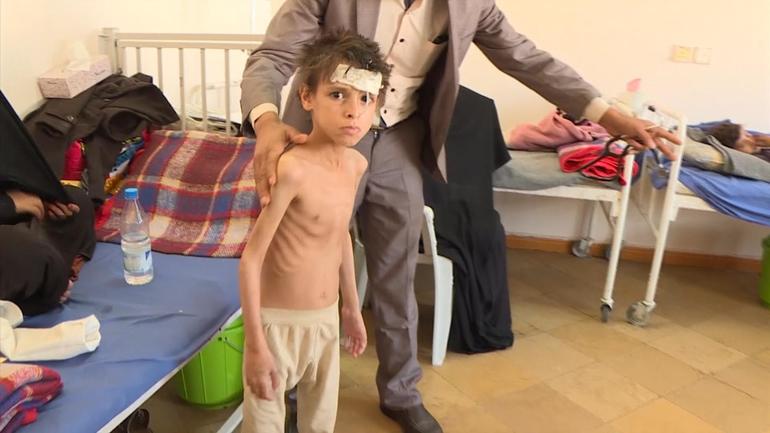
yemen-child-3.jpg
A child in Yemen     CBS News

The war in Yemen is indeed a proxy war between Saudi Arabia and the Islamic Republic of Iran, one an Arab state the other Aryan, both Muslim-majority countries, the former Sunni, the latter Shiite. Saudi Arabia views itself as a leading power in the Middle East, not least because it is the custodian of the two most sacred sites in Islam, Mecca and Medina. The challenge by Iran which imagines itself once again reflecting influence and power from the historical era of the Persian Empire threatens the eminence of the Saudi majority in the Middle East -- and world wide which consider Shia Islam illegitimate.

Since 1979 and the transformation of Persian Iran into the Islamic Republic it is now, modernity and moderation have taken a back seat to the fundamentalist Ayatollahs' mission to assume the mantle of the Middle East power and influence, to bring Shia Islam to the fore and to achieve that goal it has gone out of its way to form, train and arm Shiite militias, to support what are undeniably terrorist groups, to launch terrorist attacks against perceived enemies both in the Middle East and abroad while enlarging its sphere of influence.

Iran's mission to arm its military with medium- and long-range ballistic missiles, its steady work toward manufacturing nuclear bombs and its overt hostility toward the majority Arab Sunni community hugely alarms that community, no less than it does the only other non-Arab state in the Middle East, Israel. The threats emanating from Iran toward Israel, to wipe it from the map of the Middle East are overt, while the threats against the Sunni states are covert and implied, but no less real.

The Yemeni Houthi rebels practise a brand of Shia Islam linking them to Iran, which has encouraged the Houthis to overwhelm the Western- and Saudi-approved Abd-Rabbu Mansour Hadi who took the helm of Yemen after the Arab spring 2011 protests rid the country of Ali Abdullah Saleh, an autocratic ruler not beloved by his people, similar to what had occurred in Tunisia. But the Houthis aligned themselves with Saleh, attacking the capital and wresting it from the Hadi government.

The rise of the Houthis as a rebel group with a fierce fighting reputation is similar in type to that of the Islamic State of Iraq and the Levant; while one is Shiite, the other Sunni, each was a persecuted minority in their countries ruled by a sectarian majority. Saudi Arabia gathered a coalition of Sunni states to launch a war against the Houthis to return their candidate to power though it is mostly Saudis bombing Yemen to achieve that end. And more refugees are added to the world total, an amazing number of which are of Arab origin.
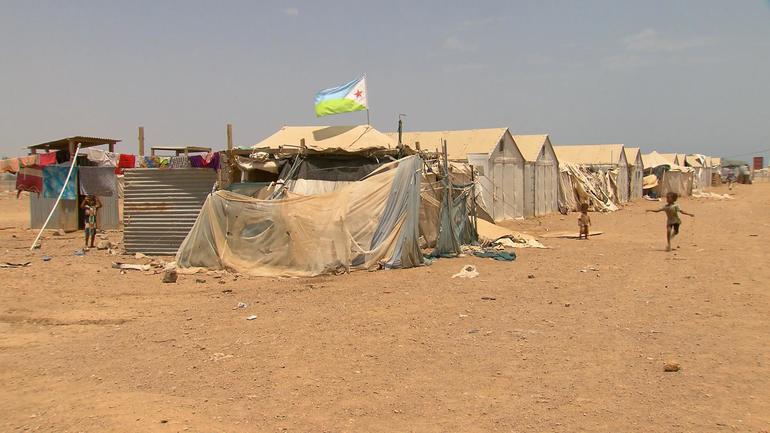
djibouti-refugee-camp.jpg
Yemeni refugees in a Djbouti refugee camp    CBS News
And if the observation has been made that the Saudis can get away with bombing a poor country like Yemen, helping to cause a downspiral of food scarcity, medical impoverishment and an out-of-control cholera epidemic where disease and starvation stalk the country, this immunity from blame and lack of censure from the United Nations sees a complementary version in the Palestine Liberation Organization which incites Palestinians to violence against Israeli Jews, and consistently refuses to work toward a settlement with Israel leading to peace.

As long as it is sectarian Islam in conflict with itself the 57-member states of the Organization of Islamic Cooperation will do nothing, say nothing, fail to apply pressure on either Iran or Saudi Arabia to cease and desist and allow Yemen to save itself from even greater destabilization if such a thing is even remotely possible. This is the Arab and Muslim world, after all. It is not only the Houthis who are in conflict against their sectarian rivals in Yemen, for al-Qaeda and Islamic State have also positioned themselves there, all jostling to achieve their own goals.

Labels: , , , , , ,

Wednesday, July 19, 2017

But Are They Salvageable?

"With the fall of Mosul and as the fight in Raqqa [the de-facto Islamic State capital in Syria] intensifies, we are definitely going to see some foreign fighters or women try to surrender."
"So, [the report] is not entirely surprising."
"There are some Canadian women who travelled to Syria and Iraq together, so it might be that they tried to leave together as well [to return to their home country on the defeat of Islamic State in Mosul]."
"There's this assumption that women are travelling just to get married or something, which is sometimes true, but mostly false [driven by ardent religious fundamentalism]."
Amarnath Amarasingam, researcher, radicalized Islam, Dalhousie University, Halifax, N.S.

"I recently spoke with a mother whose child is there [in Iraq]. The parents are worried. There are some parents who haven’t had any news from their children since the bombing of Mosul began. It’s a time of desperation right now."
"There are some parents who have maintained communication with their children, who give them updates from time to time. But in the last four or five weeks it has been radio silence."
"We have young people and those who have lived through horror. We also have children who have been born over there. The problem is larger than we think."
"I think Canada has to have a greater presence. We have to take this seriously because there are still about 200 Canadians in Syria and Iraq."
Herman Okomba-Deparice, director, Centre for the Prevention of Radicalization Leading to Violence, Montreal, Quebec
Some 300 Islamic State of Iraq and the Levant fighters remain in the small patch of territory still controlled by the group in Mosul’s Old City, a senior Iraqi commander said on July 5. HurriyetDailyNews       

"Some of it [incentive for Canadian women to respond to Islamic State's invitation to young women to join them in Iraq as 'wives' of the Caliphate] is for the glory of caliphate, some of it 'Because I was bored', some of it 'Because these guys were kind of hunky'."
"But ... the one thing we have learned: we never saw females going to Somalia, we never saw females going to Afghanistan, we never saw females going to Bosnia in the '90s. This is a real new phenomenon."
Phil Gurski, former Canadian Security Intelligence Service analyst

5 Germans incl 16yo girl reportedly among 20 female ISIS fighters captured in Mosul

The Iraqi military and police are enjoying a belated revenge. In a country dissolved and rent by sectarian violence, the Iraqi military represent the majority Shiite demographic whom their Sunni minority counterparts once dominated under Saddam Hussein. They are delighted to turn the tables. Even more so to turn around their inglorious scampering away to safety when the Islamic State of Iraq and the Levant militias first entered Mosul years earlier to loot and dominate the geography as a competing religious-political force whose feared reputation for savagery cowed the Iraqi military.

The women, particularly those hailing from Muslim communities in Europe and North America who responded to the siren call of ISIL through social media accessed on laptops, smartphones and tablets with their sophisticated public relations formula, and boastful claims of being in possession of sweeping areas in Syria and Iraq in which they were preparing to administer a bold, brave and exciting new world of crystal-pure Islam whose doctrine fed in a straight, unadulterated line from Mohammad to ISIL, obviously thrilled women, eager to join this brave new world.
Picture allegedly showing a 16-year-old German Isil member after being captured by Iraqi forces
Picture allegedly showing a 16-year-old German Isil member after being captured by Iraqi forces     Credit: Twitter
Captured now, in the ruins of the Old City of Mosul, surrounded by gloating Iraqi Shiites who view Sunnis like the young 16-year-old ISIL 'wife' from Germany, those women have reason enough to be fearful. They cannot communicate, with no Arab-language proficiency with their captors, and can only be grateful that there is U.S. oversight to ensure that they are handed over to American military personnel. Tales will eventually ensue of these women's handling by Shiite militias loyal to Iran who are settling into Mosul for good, to weight the mostly Sunni population in Mosul in favour of Shiite domination.

Canada has been informed that two of the Islamic State 'wives' rounded up in a maze of tunnels among caches of weaponry are Canadian. They are admittedly Canadian citizens, but they are as 'Canadian' as the results of living within Canada in the midst of a close-knit Muslim community where mosque attendance ensures that readings of Koranic scriptures emphasize duty to Islam including strict separation of the faithful from the infidels, and prayers invoking jihad and the primary duty of killing unbelievers. The message from ISIL had no need to be more persuasive than to guarantee that joining them would fulfill those obligations.

These foreign conscripts to Islamic State who left the comfort of their family homes to set out on a journey of their own into a future of idealized Islamic splendour and punishment of the most lethal kind for those spurning the opportunity to join the collective of the faithful, not only travelled to become wives and mothers for ISIL, but were indoctrinated into the arts of warfare, attending combat classes, learning how to use weapons and use them well.

Perhaps the most potent weapon in their arsenal however, would not be lethal devices to kill, but the will to use the same public relations methodology that ensnared them into the ideology of Islamic State, bringing to practical life the Hadiths reminding faithful Muslims of their duties to Islam. Not only are Canadian prisons rife with Islamists sentenced to incarceration for petty criminal activity, and doing their part to convince other prisoners, Muslim and those who are convinced enough to convert, to subscribe to the Islamic State ideal; they are now joined by returning jihadis.

Within society, released back into the social contract of Islamic societies that they know so well, the returned Canadian women and those from elsewhere can go about their self-assigned promulgation of the splendid virtues of Islamic State's caliphate, describing it in the calculated, admirable terms they are familiar with, to exert influence on those ripe to join the group's ideological struggle for a unified Islam and a defeated host country.

Social media images alleging to show an Isil sniper believed to be 16-year-old German Linda W
Social media images alleging to show an Isil sniper believed to be 16-year-old German Linda W    Credit: Twitter
And should any of the Canadian ISIL "brides", repatriated by an understanding and concerned-for-their-welfare Canadian government, turn out to have been in their formative-adult years when they pledged themselves to Islamic State, the current Liberal-led government of Justin Trudeau will then have the opportunity to demonstrate to the rest of the non-Muslim world just how forward-looking and "feminist" Canada is, by enriching the returnees through a cash settlement of millions, while rehabilitating their reputations by apologizing to them on behalf of furious and non-assenting Canadians.


Pity the children they've borne to Islamic State, to populate the caliphate, obeying yet another Koranic injunction. Those that survived the massive assaults on Mosul in bombed buildings, collapsing on the children whose plaintive cries of pain alerted to their presence. And the babies found abandoned while their parents pursued their obligations to martyrdom. 
A little girl named Amina was found by Iraqi Army soldiers when they heard her cries from the rubble. 
A little girl named Amina was found by Iraqi Army soldiers when they heard her cries from the rubble.  Credit: Rex


Labels: , , , , , , ,

Friday, December 16, 2016

Cold Comfort and Abandonment

"What is happening in Aleppo is tragic and it needs to change."
"Our [Canadian government] focus has always been in in Iraq and that is our focus now. Right now we have no plans to be militarily involved in Syria."
Canadian Defense Minister Harjit Sajjan: London meeting of defence ministers fighting ISIL
Protesters in Jerusalem, 16 December
Reuters -- Israelis protested about the war in Syria in Jerusalem
"We slept in the streets [through rain, freezing winter temperatures]. It's shameful. Where is the world?"
"You don't know if it's an airplane [overhead] or shelling or rockets. You never know."
Unnamed east Aleppo Syrian, weeping in fear and despair, leaning on crutches

"It took four thousand years to build Aleppo -- hundreds of generations. One generation managed to tear it down in four years."
"We feel all strongly that the history of Aleppo through this war will be a black chapter in the history of international relations."
"[Aleppo] gave to world civilization, and world civilization was not there to assist the people of Aleppo when they needed us the most."
Jan Egeland, UN humanitarian aid co-ordinator for Syria

People walk as they gather to be removed from a rebel-held sector of eastern Aleppo, Syria, on Thursday
People walk as they gather to be removed from a rebel-held sector of eastern Aleppo, Syria, on Thursday (Abdalrhman Ismail/Reuters) 

Meekly seeking official agreement that the United Nations would be authorized by the Syrian regime to aid in the evacuation plans of east Aleppo, it has instead found itself locked out while pro-government forces prevent aid vehicles from entering the rebel-held districts from where an estimated 50,000 people have managed to flee. Precluding witnesses to summary killing of civilians, to detaining of young men.

The Syrian state news agency SANA reported that 985 "terrorists and their families" had been evacuated through the auspices of the regime, sending its infamous green school buses, re-purposed to transport fear-dazed residents of east Aleppo who show up at checkpoints out of the city systematically destroyed by their government in its determination to demolish any hope of opposition survival.
"According to several sources, an Iranian-backed militia blocked a road that the evacuees would be using to reach the Aleppo countryside. It then started firing."
"According to the reports, they were protesting against this evacuation deal, which would see the villages of Fua and Kefraya evacuated in a similar way east Aleppo was."
Al Jazeera reporter

Laying siege, starving out the residents, refusing to permit humanitarian aid to deliver medicines and medical assistance along with potable water, offering safe passage to those wishing to leave, permitting rebel fighters to leave to travel to rebel-held territories, making arrests, disappearing hundreds of young men, imprisoning and torturing others, never to be heard from again. Others yet forcibly conscripted into the military. And repeat and repeat where necessary.

Bashar al-Assad is jubilant. "History is being made. What is happening is bigger than congratulations", he exulted, describing it on a scale of world-class historical events, comparable to the birth of Christ and the Prophet Mohammad's introduction of Islam's Qur'an to warring Bedouin tribes. The buses that are assigned to pick up anguished Syrians to deliver them to rebel-held territory in Idlib, bear Assad's portraits displayed prominently.

According to Mohammed Abu Jaafer, head of the enclave's forensics department a "tremendous crowd" appeared at a pre-designated collection point to be evacuated by bus on Thursday. He estimates that 70,000 civilians are yet awaiting evacuation. The Turkish news agency Anadolou was informed by a Turkish official that Syrian government forces had taken at least 800 people into custody before the latest ceasefire agreement was suspended and with it, the evacuations.

An injured girl from east Aleppo sits in a hospital bed near Idlib, 16 December
Some injured children are being treated in a field hospital near Idlib -- Associated Press

Once government forces had retaken most of east Aleppo, some six thousand civilians and rebels are said to have since left. Among them an estimated 2,700 children, according to an UN agency report. Tens of thousands of cold and hungry people remain stranded in the east of the city, awaiting their turn to leave that immense graveyard of civilization. In Idlib and Aleppo provinces whee the rebels still hold ground, finding housing for the evacuees has become a high priority, many of them consigned to camps.

But the rebel-held areas are precisely where the evacuated Syrians out of east Aleppo choose to go, where they are at least temporarily safe. Until such time as the regime completes its command of east Aleppo, though rebel commanders state that thousands of rebel fighters remain there and intend to fight to the end. Once the end arrives, the regime will inevitably turn its attention to restoring other rebel-held positions to itself, through siege, bombardment, starvation, privation, barrel bombs.

Buses are seen during an evacuation operation
Buses evacuate rebel fighters and their families from rebel0held neighbourhoods in the Syrian city of Aleppo. A convoy of ambulances and buses left rebel territory Thursday in the first evacuations under a deal for opposition fighters to leave the city after years of fighting. Karam al-Masri/AFP/Getty Images
The evacuated civilians who remain in Idlib and Aleppo provinces know that their agony is not over, merely suspended.

Labels: , , , , ,

Monday, November 21, 2016

Refugee Liberation

"In Syria, because of the family and social pressures, I submitted to him. But here [in a Lebanon-based refugee camp supervised by international humanitarian groups], the circumstances we've passed through made me stronger. Here, I feel independent."
"He was behaving like he was God, controlling my life. And when I took this decision, that's the first point I started feeling independent from him."
Samar Hijazi, Bekaa Valley village

"This is against God's will."
"If you divorce, you'll have problems with your children. God will be against you. God won't bless you. Will you reconsider?"
Sunni Sharia court judge
Samar Hijazi, a Syrian refugee in Lebanon, greets her grandson Hamza on Oct. 22, 2016, as she returns to the Bekaa Valley camp where she lives after a judge granted her a divorce.
Kristen Chick for The Washington Post

Samar Hijazi was firm in responding with a resounding "no". And all it took was the judge's pronouncement that she was summarily divorced to free her from a 33-year marriage. She was all of twelve years old when she was married to a man who would domineeringly control every aspect of her life for the following 33 years. Immediately upon her marriage she gave birth in swift succession to six children. Just as she was under her husband's thumb, so were the children.

She is now 45 years of age, and for the first time since age twelve responsible for herself. Her home is now a tidy, tiny prefabricated structure within a dusty refugee camp where she has a small bed along one wall, her clothing and suitcases neatly placed on shelves, and little else. But it's her home and hers alone, and it is where she is confident and comfortable. She now has grandchildren of her own, and she hopes their lives will be far different than her own.

While the Syrian conflict has created millions of displaced Sunni Syrians within the country, an estimated seven million more have become refugees finding shelter outside Syria. They chose to leave Syria because they could no longer live under threatening intimidation, regime bombing and the fear that the next barrel bomb or chemical bomb attack would end their lives and those of their families. This woman insisted that her family leave their home in a suburb of Damascus.

She had mustered enough strength of purpose and conviction to feel that death awaited her and her family, remaining in Syria. She had lived for 33 years under the brutal domination of her husband who beat her and her children and never would give her permission to exit their home if he did not accompany her. Early in the marriage she had tried to escape by running back to her parents. Who then turned her back over to her husband.

The war that created such a massive upheaval that one-half of the entire Syrian population became homeless -- and Europe was invaded by masses of Syrians desperate, along with migrants from Libya and North Africa, hoping to escape poverty, sectarian conflicts and degraded life conditions of oppression that offered no economic stability -- created as well the opportunity for this woman and others like her, influenced by the support given them by humanitarian agency workers to shed their traditional custom of submitting to male coersion.

The degree of personal autonomy they have gained since leaving Syria as a matter of existential duress has had the effect of increasing their quality of life. Not in the area of personal possessions, certainly, but in personal development, happily taking on the responsibilities that were before denied them, with the familiar social constraints shoved aside through their exposure to the promotion of women's rights thanks to the aid groups' influence.

Labels: , , , ,

Tuesday, October 25, 2016

First Revenge, Then Subordination

"In the beginning, there will be revenge. But then it will be better."
"[When ISIL militants arrived in our village], we were all deceived by their appearance. We thought they were Muslims. [Once they began punishments for petty crimes and extorted residents], we realized they had nothing to do with Islam."
Ali, 40, Sunni Iraqi driver

"The whole village received me. They all like me. They cried for me [when she left her husband. She began to brace herself for recriminations from her husband’s affiliation with Islamic State]."
"It wasn’t my fault. I’m not guilty. Why should we [her wailing children] be displaced?"
Khowla, Sunni Iraqi woman, wife of Islamic State fighter
Ahmad Al-Rubaye/AFP/Getty Images
Khowla fled with her six children from her village to seek refuge in one of the many camps set up by the United Nations to hold the tens of thousands of Iraqi Sunnis expected to flee from Mosul and surrounding towns and villages as the Iraqi military, the Kurdish Peshmerga and Iran-allied Shiite militias establish themselves on the perimeter of the country's second-largest city with its remaining 1.4-million inhabitants, nervously awaiting the battle set to enter Mosul itself.

Those in the camps are guarded by armed men allied with the Iraqi regime. The camp doesn't offer much; no electricity, only tents set up where children play in the dirt while their mothers wonder where the food to feed them all will come from. In Khowla's instance, the camp has been placed close to her home village. She is not permitted to enter the village, to go to her home, already being used by another family. She is kept in the camp awaiting interrogation by Iraqi officials interested in her husband.

Gradually, thousands of Sunni Iraqis have begun their exit from their home villages, as the 30,000-strong allied Iraqi forces move closer into Mosul's surrounding perimeter preparatory to recapturing the city ruled by Islamic State for the past two years. The Sunni Iraqis sitting in the camps await questioning from authorities to explain their own activities during the time they lived under the Islamic State jihadis. Uncovering any links they may have had with ISIL appears a primary objective.

Human rights groups have reported executions, torture, arbitrary arrests of Sunni Iraqis by the militias and Iraqi security forces. Any with family members who had joined ISIL are barred from a return to their villages by local officials, by tribal authorities, or by vengeful neighbours. East of Mosul another camp holds dozens of young men behind a padlocked gate, separate from families. Some of the men had been sequestered for 40 days, with no indication when, or if they might be permitted to leave.

"We fled a prison for another prison", Mohamed Asad said, sitting among a  group of young men.

Labels: , , , ,

Friday, October 21, 2016

In the Collective Opposition to Islamic State, Iraq's Shiite Military and Militias Consider Themselves the Alphas, Degrade the Equality of Iraqi Sunnis

"The killings and abuses committed by ISIL fighters when they captured Mosul in 2014, and the horrors they have subjected its inhabitants to ever since, should leave us in no doubt as to the risk civilians face."
"[There remains] a grave danger that ISIL fighters will not only use such vulnerable people as human shields but may opt to kill them rather than see them liberated."
Zeid Raad Al Hussein, UN High Commissioner for Human Rights
Newly displaced people wait to receive food supplies at a processing center for displaced people In Qayyara, south of Mosul, Iraq October 21, 2016
So far, only 'modest' numbers of people have fled Mosul, the UN says -- Reuters
Islamic State fighters have prodded, threatened and herded hundreds of Iraqi Sunni families out of their towns and villages on the Nineveh plain, on the eastern edge of Mosul, to walk the considerable lengths from their villages into the city of Mosul. This move transcends mere threats -- when civilians are seen to be on the verge of altering their allegiance to the Sunni caliphate they likely welcomed when two years earlier the Islamic State jihadis overran the area -- the threats turn to violence and killings. The United Nations is citing this forced march of civilians into Mosul as proof that ISIL refuses to permit families to flee the area to seek haven in territory now held by the Iraqi army.


This interpretation of events relating to the Iraqi civilians in the area, caught between their oppressors loyal to ISIL, and the onslaught of the Iraqi, mostly Shiite military, may be illusory in nature. There is no trust whatever between Iraq's Sunni civilian population and the Shiite-led government of Iraq. And that situation prevails precisely because the Shiite-led government has chosen to give equal recognition to its Iraqi Sunnis short shrift. The civilians living in the now-largely-evacuated villages have turned instead to protection from Iraqi Kurds.

Islamic State is fighting back as only they appear to be capable of; or, at the very least reflective of the ideological passion of hatred that demands live sacrifices to appease the rage of militant Islam. They have been reported by witnesses to have executed by deadly fire, 284 men and boys in a paroxysm of vengeance as Iraqi troops begin to enter Mosul. The bodies were scooped by a bulldozer into a vacant building in the north of the city, once the need to use that group of men and boys as human shields was trumped by the more urgent need to massacre them, symbolically.

And with the escaping Mosul residents streaming out of the city and into Kurdistan, have inevitably been some ISIL fighters. They mounted an attack in Kirkuk, yesterday, attacking government buildings and a power station under construction, killing thirteen employees and at least six police officers. This was meant to be a counter-attack to demonstrate that the jihadis have not been defanged, the attack "clearly aimed at diverting the Iraqi army" from Mosul, according to the BBC's Richard Galpin, in northern Iraq.

However, in the aftermath of the attack, the governor of Kirkuk, Najm al-Din Karim, claimed that Peshmerga fighters and counter-terrorism forces were completely in control of the situation, blaming the attack on Islamic State sleeper cells.

Iraq’s troops fly Shiite flags in Mosul fight against ISIS, stoking tensions
Iraqi soldiers stoking tensions with Sunni Iraqis by flying Shiite flags -- wsj.com

In this most unconventional of conflicts, complications and distractions are everywhere in a region beset with tribal, ethnic and sectarian grudges. The very Iraqi soldiers engaged in the conflict to retake the largely Sunni city of Mosul from Islamic State have taken to mounting Shiite flags on their vehicles and raising them atop buildings. It takes no genius to realize that by doing this, they are stoking the often-violent sectarian divisions that Iraq’s government has sworn it intended to repair.

Affixed onto tanks or hoisted over government checkpoints and homes in reclaimed Sunni villages, these flags reflecting Shiite Muslim symbols often dwarf the Iraqi flags next to them. The flags' flagrant presence not only rankles Iraqi Sunnis but the Kurdish Peshmerga fighters taking part in the assault, as well. Sunnis regard the flag display as having the practical effect of undermining the Iraqi government's message of national unity against Islamic State, serving instead to reinforces their long-held impression that they are not accepted in Iraq’s state and security structure.

A Shiite religious flag hangs on the front of an Iraqi army vehicle in Khazer, Iraq, on Monday.
A Shiite religious flag hangs on the front of an Iraqi army vehicle in Khazer, Iraq, on Monday. Photo: Andrea DiCenzo for The Wall Street Journal
Under the agreement conceded by the coalition and approved by the U.S., only Iraq’s military, Federal Police and Sunni tribal fighters were to enter the city of Mosul, while the Iranian-linked Shiite militias and allied armed groups such as Kurdish Peshmerga forces would remain on the outskirts to hold regained ground. Allowing the fiction that Mosul should remain in Iraq's possession, even while the Peshmerga see it as part of their autonomous region, and Turkey insists that the city must remain a majority Sunni enclave.

The Peshmerga as usual have borne the brunt of the confrontations with Islamic State, leading operations north and east of Mosul since Monday, while U.S. helicopter strikes give coverage to the Iraqi military, giving short shrift to the need of the Peshmerga for that same type of air cover. The Peshmerga fly the flag of their semiautonomous regional government on their vehicles. They consider that the use of the Shiite flag in lieu of flying only the Iraqi flag confrontational and divisive.

The brother of the Kurdistan Regional Government President Masoud Barzani, Peshmerga Gen. Sihad Barzani, noted that in his opinion the Shiite Hussein flags represented a questionable omen for Iraq’s future. "That flag doesn’t represent the whole Iraqi people. The Iraqi flag is important because it represents everyone", whereas the flag being flown essentially indicates that the Iraqi army and the Shiite militias rule the enterprise, represent the totality of the opposition to Islamic State, and equate with the domination and conquest by Shia forces of Sunni interests.

Labels: , , , , , ,

Tuesday, October 18, 2016

Crediting the Iraqi Military

Barzani said the joint Iraqi force are launching the offensive from south and east of Mosul [Reuters]

"[The offensive to be led by Kurdish Peshmerga] Then they will stop. We'll [Iraqi military] start after them and move after them to support them."
"The operation [to retake Mosul] will take much longer because of this [the large presence of well over a million Iraqi civilians]."
"For their safety, but it also means each neighbourhood needs to be surrounded and searched as we clear it."
Brig.Gen. Haider Obaidi, Iraqi special forces commander

"We do provide our intelligence capability, we provide our logistics, these are capabilities that the coalition has that are singularly distinctive. We are very capable in these areas, and it is a big help to the Iraqis as they move into position," he said. 
"The plan is for the Iraqis to liberate Mosul, They are going to be the ones that will move in to the city."
Colonel John Dorrian, spokesman, U.S. forces

"Today is a turning point in the war against terrorism. This is the first time that Peshmerga forces and Iraqi army have cooperated and fought in the same area,"
"We are hopeful that this operation will be successful and that Mosul will be liberated. But this does not mean that the terrorist threat is over."
Kurdistan President Masoud Barzani
Barzani said the joint Iraqi force are launching the offensive from south and east of Mosul [Reuters]
Kurdish leader Masoud Barzani said the joint Iraqi force are launching the offensive from south and east of Mosul [Reuters]

Restoring the honour of a demoralized military, which, though trained and equipped by the U.S., turned and ran the very instant they became aware that Islamic State fighters were marching to enter Mosul and take the city from the command and protection of the Iraqi military. Rather than face the enemy whose ruthless reputation for slaughter and shedding blood in the most medieval-engaged atrocities, Iraqi forces, from commanders to enlisted men, chose to turn tail and decamp in such a panic that they left all their advanced military gear in their barracks, gifting Islamic State with up-to-date technically advanced arms and vehicles.

The staging for the retaking of Mosul has been in the planning stages for well over a year. Islamic State has been in possession of the city of over two million Iraqis -- of mostly Sunni Muslims, bordering on Kurdistan by Islamic State, considering it their Iraqi capital just as Raqqa is considered the Syrian capital of the caliphate -- for over two years. It is starkly obvious that the Iraqi military would be incapable of mounting an offensive for the return of Mosul on its own. Without the air- and fire-power of the U.S.-led coalition, and significantly, of the Peshmerga, Mosul would remain in ISIL possession.

The estimated 30,000 assembled forces of Peshmerga, Iraqi troops, Shiite militias representing tribal warlords, target an ISIL opposition of an estimated three to four thousand fighters. This unequal contest on a battlefield might readily be seen to be heavily in favour of the larger contingent of adversaries. But in a city the size of Mosul with its huge remaining population of over a million residents, with all the buildings and houses, the underground tunnel system, the IED-rigged buildings and back-alleys, the complications are diverse and numerous. With ISIL well ensconced and familiar with their surroundings, using explosives-laden vehicles in suicide attacks, their threat is ominous.

They will exact a steep price for the privilege of retaking Mosul from their grasp. In their wisdom, the United States persuaded the Peshmerga and Iranian backed Shiite militias to remain on the perimeter of Mosul, enabling the Iraqi army's counter-terrorism special force, Iraqi federal police and local tribal fighters to initiate and conduct house-to-house fighting in Mosul. The purpose, to ensure that sectarian violence is kept to a minimum once the battle for Mosul has succeeded and ISIL ousted.

Considering that Mosul's population is mostly Sunni, with a smattering of ethnics such as Arameans and Armenians, and the Islamic State occupation was likely comprised of no more than several thousand administrator/fighters, the city of two million might conceivably have put together a core group of opponents to oust ISIL. But for the majority Sunni Iraqis in Mosul there is no love lost for the Iraqi government comprised mostly of Shiites in an unequal sharing of national trusts. Many of the dismissed former Saddam Hussein military commanders came from Tikrit and Mosul.

And the core group of leaders of Islamic State were represented by many of these former Saddam-loyalist Sunni Iraqis. It stands to reason there was sympathy in Mosul for the Islamic State and its defense of Sunni Iraqis. With the incursion of Shiite militias and the Iraqi military comprised largely of Iraqi Shiites there will be an eventual reckoning meted out to the Sunni population of Mosul. Many of whom will be vacating Mosul as expeditiously as possible, leaving the UN to settle them in refugee camps for their own protection.

The resumption of Iraqi government control of Mosul will be months in the making while ISIL fighters are being routed from the city. The need to ensure that the terrorists do not infiltrate the tens of thousands of fleeing Sunni civilians will most certainly be a time-consuming and fraught affair. And when the city is finally freed from the talons of ISIL, other situations will erupt; that Kurdistan claims Mosul for its own, and that Turkish president Recep Tayyip Erdogan insists that Mosul remain a Sunni enclave, under the protection of Turkey, not Iraq. Even while local warlords and Shiite militias argue violently that Mosul is their heritage.
"This is the first time the Peshmerga and Iraqi forces have worked together against Daesh [ISIS] … we hope this will become a concrete foundation for our future relations with Baghdad."
"The liberation of Mosul is not an end to terror and terrorism but this was a good lesson so in the future we will resolve our differences through understanding and working together. We reassure the people of Mosul that both the Peshmerga and the Iraqi army will do everything not to cause any loss to the people and no revenge killing will take place."

Kurdistan President Masoud Barzani

Labels: , , , , , ,

Friday, August 19, 2016

Horror Stories? Aplenty!

"The catalogue of horror stories featured in this report depicts in gruesome detail the dreadful abuse detainees routinely suffer from the moment of their arrest, through their interrogation and detention behind the closed doors."
"This journey is often lethal, with detainees being at risk of death in custody at every stage."
"With tens of thousands of people forcibly disappeared in detention facilities across Syria, the real figure is likely to be even higher."
"For decades, Syrian government forces have used torture as a means to crush their opponents. Today, it is being carried out as part of a systematic and widespread attack directed against anyone suspected of opposing the government,"
Philip Luther, director, Amnesty International Middle East and North Africa program


"One man said that when he arrived at Damascus' Saydnaya Military Prison with 60 other people, the beatings were so brutal that by the time he reached his cell, he heard that 20 men had been killed."
Nicolette Boehland,  Amnesty researcher

"They treated us like animals. They wanted people to be as inhuman as possible."
"I saw the blood, it was like a river ... We used to always say here that there was no justice in Syria but I never imagined humanity would reach such a low level."
Samer, Syrian lawyer

Ah well, Amnesty International is describing a fundamental pathology afflicting the Middle East when he speaks of  "a systematic and widespread attack directed against anyone suspected of opposing the government". It is a time-honoured institutionalized methodology that is generic to the region and beyond, from Egypt to Saudi Arabia, Turkey to Qatar, Pakistan to Iran and on to the Palestinian Territory and Gaza; quite simply, it really does come with the territory.

Back in March of 2011 when the peaceful protests by Sunni Syrians began and their president, Bashar al-Assad, confidently informed U.S. interviewers that the protesters were 'terrorists' and 'scum' hardly worth noticing, he took note when a teen-age schoolboy wrote an anti-regime message on the wall of his school, was arrested, tortured and died in custody before being returned to his aghast family. And that seemed to set the tone for what was to become routine.

The protesters who began the civil war never in their wildest nightmares might have believed that their quiet protests against the regime's discriminatory treatment of the majority Sunni population of Syria, would result in the government's bitterly vicious crackdown. They became criminals in short order of having criticized Assad, hunted down, arrested, interrogated, tortured, and occasionally murdered; sometimes released from prison, battered but unchastened.

In the years since the beginning of the civil uprising responding to the regime's contempt of dissent and its method of dealing with an insurgency that was meant initially to be a reproach with the confidence that some workable arrangement leading toward equality could be reasonably agreed upon, the dissenters became outlaws to be hunted down, shot by snipers and by artillery, by helicopter gunships and bombed, their neighbourhoods razed and emptied of all but the dead.


Inmates are seen behind bars in Aleppo's main prison on May 22, 2014. Amnesty International says tens of thousands of people in Syrian prisons have been tortured and nearly 18,000 have died since March 2011.
Inmates are seen behind bars in Aleppo's main prison on May 22, 2014. Amnesty International says tens of thousands of people in Syrian prisons have been tortured and nearly 18,000 have died since March 2011. (George Ourfalian/Reuters)

In the five years that the conflict has raged while the destroyed country has been invaded by Islamist jihadis and terrorist groups who saw as opportunists an opening for themselves to become ensconced on an regime-abandoned territory, Sunni Iraqis too moved in to join, then split with al-Qaeda to present to an incredulous world the spectre of an atrocity-loving caliphate. In the five years since the conflict began, Bashar al-Assad has himself been just as hideously barbarous as Islamic State jihadis.

Almost a half-million Syrians have died at his hands, with the support of Iran's al Quds Republican Guard Corps, Lebanon's Hezbollah, Iraq's Shiite militias and Russian warplanes. Over half of the entire country's population has been internally displaced, and under constant threat of bombardment, starvation, privation, and death. Four million Sunni Syrians and Christians have fled the country; the Sunnis from the regime's threat of total obliteration, the Christians from the Islamic State threats.

Human rights violations taking place in Syria's prisons are simply yet another reflection of murderous malice on the part of the Syrian government, its Shiite allies and the Russian desire to retain and expand a firm foothold once again in the Middle East, with the abrogation of the former role of the United States in the region. In the Middle East, with its deadly tribal antipathies, its sectarian hatreds and violence, there does not appear to be any 'right' or 'wrong' kind of intervention hoping to deter Arabs and Muslims from slaughtering one another.

But all is not yet lost with foreign interventions hoping to move one crisis after another to a humane conclusion. Russia and the United States are undergoing diplomatic manoeuvring. With the understanding that Russia would be expected to persuade Assad to halt his offensives. Good luck! And in exchange the U.S. is to persuade Syrian rebels to sever any relationship with Nusra. Good luck!

Good luck, good luck, good luck.

Labels: , , , , , , ,

Wednesday, June 01, 2016

Iraq, Sundered

"When the attack on Fallujah started, ISIL forced us to leave our homes and kept moving us from one damaged, deserted house to another"
"All the time we were exposed to the exchange of fire."
"The afternoon of our last day there, the fighting became too fierce; they were shooting above our heads."
"I was carrying Hana [two-year-old daughter], and I quickly ran to reach the other families. My husband and other children were behind us all the time, trying to catch up with us, as he can't run as he's injured. That's how we left, taking nothing with us, not even our money. I even forgot to take my cellphone."
Suad Hadad, refugee camp, Lebanon

"The leading role played by radically sectarian, Iranian-controlled militias in the operation to 'liberate' Fallujah means that there will be parts of the Sunni population that see ISIL as the lesser evil."
"ISIL has local support and there are suggestions it is higher now than it was before the city was captured."
Kyle Orton, Middle East analyst, Henry Jackson Society, Britain

"It's going to be hard for the Iraqis to hold such a large area. And ISIL will not just let the city go -- they will continue to try to undermine the army however it can."
Tim Eaton, researcher, Chatham House, London

Iraqi counterterrorism forces face off with Islamic State militants in the Nuaimiya neighborhood of Fallujah on Wednesday. Very few families have managed to flee the city since the offensive started more than a week ago. Iraqi counterterrorism forces face off with Islamic State militants in the Nuaimiya neighborhood of Fallujah on Wednesday. Very few families have managed to flee the city since the offensive started more than a week ago. Photo: Associated Press

The presence of Islamic State of Iraq and the Levant in Fallujah, a mere hour from Iraq's capital Baghdad, allowed ISIL the too-frequent opportunity to bomb areas of Baghdad, which the Iraqi government, with its straitened control and influence over the geography that was once its own, would like to believe is impregnable to attack. This is a hopeful conceit difficult to maintain when ISIL uses suicide bombers to inflict the horrors of bombing raids in a capital city presumed to be 'safe' from incursion.

Fallujah's proximity to Baghdad mandated that the Iraqi government, with considerable help from Iranian-backed Shiite militias wrench the city of mostly Sunni Iraqis away from Islamic State. Its success in convincing Sunni Iraqis that their future could advance under the regime where sectarian  hostilities have been the order of the day, will likely hinge on how persuasive the government can be. Many Sunni leaders in the city claim to indifference; not particularly favouring ISIL, waiting to determine which way they should lean.

The Iraqi military's offensive has garnered some advances in its three-directional attack, gaining entry into the city finally. Air support from the U.S.-led coalition has been valuable in allowing the army to recapture what they claim is 80 percent of the towns and villages surrounding Fallujah, waiting now to see success in their "final push" to free the city from ISIL's clutches. The army is battling no more than 1,500 jihadists in the city centre.

They have had two years in which to secure the city, and bombs planted everywhere are testament to that. The use of suicide car bombings and the rockets they aim at the army have them holding on, despite superior numbers utilized by the regime and their more advanced weapons. "They are dug in. We think they will fight to the last", General Abdul Wahab al-Saadi said of the jihadists who had carried out a string of car bombings in Baghdad killing dozens, as a diversionary tactic.

The city that once held 350,000 people represents one of the most important strongholds for ISIL next to Mosul, the two large urban centres still in the hands of the terrorists, part of the "caliphate" since early 2014. General Sean MacFarland, commander of U.S. forces and allies in Iraq has warned that some Fallujah residents were "early adopters" of ISIL. "You could have a fairly large percentage of a fairly large city that's hostile to us", he commented, countering the claims of the city's leaders.

On the other hand, should the Iraqi army of Shiites, along with their Popular Mobilisation Forces (al-Hashd al-Shaabi), and local tribes, realize success as they mean to, routing the Islamic State fighters, the Sunni residents of Fallujah may not be too pleased that Iran-backed militias have taken their city, an important religious site for the Sunni minority. The city was front and centre of the insurgency against the Iraqi Shiite government.


Labels: , , , ,

Wednesday, March 02, 2016

All Is Forgiven

"[Rebels who surrender their arms will be given] full amnesty."
"Just to give up your armament, whether you want to join the political process or [are] not interested about the political process."
"This is the only thing that we ask. We don't ask for anything. As I said, we give them full amnesty."
Syrian President Bashar al-Assad
Syrian President Bashar al-Assad (left) is pictured answering questions during an interview with German public broadcaster ARD in the Syrian capital Damascus yesterday. He offered 'full amnesty' to Syrian rebels

What a good man, what a sterling character, what a role model for all embattled and empathetic heads of state faced with revolts from disaffected citizens. He has made it clear that 'moderate' rebels who are, he has always asserted, 'terrorists', could expect clemency from him. They would be restored to their former status as Syrian civilians. The most critical aspect, he asserted is that citizens cannot be permitted to have machine-guns and 'hurt people'.

Of course not. This is a man who cares deeply about prevention, about using all means at his disposal not to 'hurt people'. Needlesss to say people have been 'hurt'. Hundreds of thousands, in fact, hurt beyond the capacity to feel any more pain, having been sent to their untimely deaths, by rocket fire, by helicopter gunship fire, by deadly chemical-filled rocketry, by barrel bombs, and by deliberate starvation and privation, trapped by the military and allied Shiite militias along with Hezbollah in their enclaves.

This is the reasonable president of Syria who emulated and then went far beyond what his father ever visited in malevolent atrocities upon his people. Who brooked no dissent, even of the 'moderate' type that began as a popular protest among Sunni Syrians wishing to be granted the same civil privileges as their Shiite counterparts. Mr. Assad's immediate reaction was arrest, torture, death, irrespective of age, adult or child.

In his vehemence against the disloyal citizens of Syria who wished for their human rights to be recognized, he destroyed great swathes of Syria's major cities, towns and villages. But he is a much misunderstood individual, evidently, whose directives and actions have simply been misread, for he is a man of peace, a reasonable person who will sit down at a table with his enemies to bargain for peace, as long as they accept their defeat and the status quo.

Oh yes, and believe that he will be true to his word.

The rebel forces of Syria, however, are a stubborn, grim lot who have previously rejected their president's generous offers. They have sacrificed too much in blood, sweat, tears and foregone lives to simply return to the oppressive lives of subjugation that had been forced upon them by the benevolence of the Alawite leader of Syria who has, after all, Moscow, Tehran and Hezbollah in his corner.

Labels: , , , , , , ,

Tuesday, January 19, 2016

Restoring Ramadi To A Semblance of Civility : Good Luck

"Listen, I am a son of this land. My house was destroyed by someone I know. He was my friend, my neighbour. In cases like this, you need to be able to provide people with something [government assistance in rebuilding]."
Brig.Gen.Muhammad Rasheed Salah, Anbar provincial police

"We will never kill our way out of the Daesh problem. We cannot bomb our way to peace here. The key to defeating this enemy and making it stick is the reconciliation and the stabilization process."
U.S. Army Col. Steve Warren

"We're doing the best with the money we have, but it's not enough. Anytime you have mass destruction like [in Ramadi], particularly if you have mass destruction of private houses and large-scale infrastructure, this is where the costs really start to add up."
Lise Grande, UN deputy special representative to Iraq

"The best way to secure any area and protect it against the return of Daesh is for the local residents and the local police to return to their areas and rebuild their lives."
"In order for residents to support local security [forces], they need to see them doing a good job."
"We have a long way to go [raising the required funding for rebuilding]."
Muhannad Haimour, spokesman, Governor of Anbar province, Iraq
Iraqi security forces clear houses of Islamic State fighters in Ramadi, 70 miles (115 km) west of Baghdad, Sunday. Ramadi, once home to 500,000 people, lies largely in ruins after months of air bombardment and the scorched-earth practices of Islamic State fighters in retreat. The U.S-led coalition acknowledges the importance of rebuilding, but actual money for the effort falls far short. | AP


This is the Iraqi version of a scorched-earth policy. By commission, not necessarily design on the part of the United States, while it does indeed reflect the sensitivities of the Islamic State of Iraq and the Levant for any town, village, city or suburb they lose in their caliphate conflict against the infidels and the turncoats abetting them. The ferocity of the Islamic State determination to wreak horror and vengeance is of course matched in degree by Shiite militias backed by the Republic of Iran.

One can only wonder how swiftly Saddam Hussein would have gone about demolishing the kind of insurgency they represent.

But he is absent from the scene and in his stead we have the very forces that removed his ferocious control of dissent bombing the Islamist militias that arose when Saddam's Sunni generals were dismissed summarily and Iraq's Sunni tribal sect left to simmer with resentment when the Shiite majority took the ascendancy. The City of Ramadi, formerly home to a half-million people, was taken by Islamic State, then finally retaken by the Iraqi military, but not without the assistance of US.-led aerial bombing missions.

The bombs nicely levelled over three thousand buildings with over 60 percent of the provincial capital destroyed in equal measure by constant U.S. air bombardment and the retreating Islamic State fighters bombing whatever the air missions missed to leave a concrete-cratered desolation. Lip service is given as it always is under such circumstances viewing the fallout of destroyed civilization with dismay, that funding must be raised for reconstruction, even as operations are still ongoing in wresting north and east neighbourhoods from retreating ISIL.

Smoke rises during an air strike in Ramadi city, December 26, 2015. Picture taken December 26, 2015.  REUTERS/Stringer
Thomson/Reuters

While the city was being fought over, government buildings, bridges and highways took the massive brunt of heavy artillery and airstrikes. In the final assaults to retake Ramadi, airstrikes aimed to target residential areas since this is where the fighters for ISIL ensconced themselves when the city was overrun in May and the central government complex was destroyed. Civilian homes were used as ISIL bases and operations centres, with fighters living out of the barracks that homes were transformed into. Including Brig.Gen. Salah's home.

Officials estimate the cost of rebuilding in the hundreds of millions, and that seems fairly optimistic. The bulk of the funding won't come from the Government of Iraq suffering its own economic hardships due to the falling price of oil. The central government has shuffled responsibility to the provinces out of existing budget allocations which in turn requires provincial governors to beg, turban in hand, for international aid.  The United States itself which has spent $280 million each month on fighting ISIL, has pledged $15.9 million to stabilizing the situation. Won't that go far?

Bringing Ramadi back to a state of stability is critical, emphasized the governor's spokesman. Re-establishing the rule of law to convince citizens they may return in safety to view the ruinage of their city and their personal possessions will do little to bring stability back to the region. Without funding how can local security [forces] be seen to be doing a good job of ensuring the future? They do indeed have a long way to go.

Iraq Iraqi Security Forces Soldiers RamadiAP Photo/Osama Sami   Iraqi Security forces enter the heavy damaged downtown Ramadi, 70 miles west of Baghdad, Iraq, Sunday, Dec. 27, 2015.

As for putting an end to the tribal vengeance, the sectarian vendettas now that Ramadi is liberated from ISIL, that too looms as an even larger problem. Reconciliation? An end to sectarian hatred and viciousness? Good luck on that one. Anbar police general Salah has said tersely that there is no amount of funding from the government sufficient to prevent him from pursuing those he suspects to have been responsible for destroying his home.

"No matter what, I will have my revenge." Got that?

Labels: , , , , , ,

() Follow @rheytah Tweet