Politic?

This is a blog dedicated to a personal interpretation of political news of the day. I attempt to be as knowledgeable as possible before commenting and committing my thoughts to a day's communication.

Sunday, February 01, 2026

Autocratic Regimes

"[Havana] aligns itself -- and provides support to numerous hostile countries, transnational terrorist groups and malign actors adverse to the United States [including Russia, China and Iran]."
"[The communist government provides] defense, intelligence and security assistance to adversaries in the Western Hemisphere [while violating the human rights of its citizens]."
"[Cuba] will be failing pretty soon. They got their oil from Venezuela. They're not getting that anymore."
"[I will impose tariffs on any country that] directly or indirectly provides oil to Cuba."  
U.S. President Donald J. Trump 
 
"We did not touch on the topic of Cuba [during their 40-minute telephone conversation], and in the evening then this [executive order] came out."
"The imposition of tariffs on countries that provide oil to Cuba could create a far-reaching humanitarian crisis [severely impacting the operations of hospitals, the electrical grid and the food supply]." 
"[Cuba is currently] going through a difficult moment [but Mexico cannot be put] at risk in terms of the tariffs."  
Mexican President Claudia Sheinbaum  
https://i.cbc.ca/ais/74cb9521-b1dd-4f6b-b086-64f47ac356a2,1769814708002/full/max/0/default.jpg?im=Crop%2Crect%3D%280%2C0%2C3339%2C2268%29%3BResize%3D796
A drone view shows the Pajaritos terminal of Mexico's state-owned oil company Pemex, in Coatzacoalcos, Veracruz state. (Angel Hernandez/Reuters)
 
An executive order was signed on Thursday by U.S. President Donald Trump when he declared Cuba represented an "unusual and extraordinary threat" to U.S. national security for which tariffs would be imposed on all U.S. imports from any country supplying Cuba with oil. In the wake of the lightning military raid on Caracas in mid-January that took Venezuela's President Nicolas Maduro into U.S. custody for trucking with drug cartels, Mr. Trump turned his attention directly on Cuba.
 
Subsequent to the raid, the Trump administration now controls Venezuela's oil exports and took the occasion to block deliveries of oil to Cuba, long reliant on its regional ally in Venezuela to supply it with petroleum. Mexico, under critical trade duress found it necessary to cancel its latest scheduled delivery for the month to Cuba, taking into account the looming renegotiation of Mexico's free-trade pact with the United States and Canada.
 
Under these constraining issues, the sobering 'sovereign decision' was made to temporarily halt Mexican oil shipments to Cuba. Earlier in the day following the Trump order appearing on the White House website, the Cuban government attempted to rally Latin American and Caribbean neighbours to its rescue. "The peace, security and stability of Our America are in danger", Cuban Foreign Minister Bruno Rodriguez stated in a social media post, denouncing the U.S. for imposing "peace through force".
 
In an appearance before the Senate Foreign Relations Committee the day before, Secretary of State Marco Rubio -- of Cuban descent -- was asked whether he would rule out forcing "regime change" in Cuba. "I think we would like to see that regime change", responded Mr. Rubio. "That doesn't mean that we're going to make a change, but we would love to see a change. There's no doubt about the fact that it would be of great benefit to the United States if Cuba was no longer governed by an autocratic regime"
 
Long dependent on Venezuelan supplies of oil which it trades for security and medical personnel with Venezuela under Maduro and previously Hugh Chavez, Cuba produces little oil of its own. Imports averaged 37,000 barrels daily, the bulk of which arrived from Venezuela in 2025. Cuba is now left with a mere 15 to 20 days of oil, according to the Financial Times. Island-wide blackouts are common and frequent, impacting basic human services like drinking water.
 
https://i.cbc.ca/ais/bea02522-c182-4e02-8a34-e15e9940e365,1769814792500/full/max/0/default.jpg?im=Crop%2Crect%3D%280%2C0%2C6049%2C4032%29%3BResize%3D796
Preparing dinner during a blackout in Havana on Wednesday, as Cubans from all walks of life hunker into survival mode, navigating seemingly interminable blackouts and soaring prices for food, fuel and transport as the U.S. increases pressure on the communist‑run nation. (Reuters)
 
Signing a new defence co-operation pact with Havana last fall, Moscow pledged $1 billion in investment over the next five years in efforts to retain a hemispheric foothold. Diplomatic support has emanated to Cuba by both China and Russia. The determination of the U.S. to direct oil supplies away from Cuba along with a fleet of navy and coast guard ships in the Caribbean for operations against Venezuela tasked to stop drug smuggling, the oil blockade of Cuba was next on the agenda.
 
Seven sanctioned oil tankers carrying Venezuelan crude have been seized by the U.S. to date -- blockading legitimate shipments to Cuba risks global criticism of violating international law, according to maritime experts. In response to questions in the immediate aftermath of the Caracas raid, the U.S. president responded that he felt no additional actions were required against Cuba, since lacking oil from Venezuela, "Cuba looks like it's ready to fall"


Labels: , , , , , ,

Wednesday, January 07, 2026

Venezuela's Military Alliances

"The things they said were plausible and they were consistent with more than 15 years of engagement with China, Russia and Iran. [But] not everything that they claimed by showing a satellite image was necessarily proven by that image... It's not nothing, but I don't regard it as a significant 'Ah-hah!"
"Venezuela now for literally more than two decades has been one of the biggest strategic challenges to the U.S. To me the drugs the U.S. is currently going after are only the tip of the iceberg of a broader, longtime, multi-dimensional threat."
Dr. Even Ellis, research professor, U.S. Army War College 
 
"There were several times when I was confounded by what he [Lee Wheelbarger, former U.S. army technology developer] presented to me, and then it  blew my mind when I validated it was accurate: 'Holy crap, OK, cool'."
"One thing I've learned is he's not going to put his word on the line unless he feels he can back it up. He will substantiate everything he has."
Michael Torres, retired U.S. air force colonel
Satellite photos show impact of Trump's strikes on Venezuelan  neighbourhoods | The Independent
Satellite show images of Trump's strike on Venezuelan neighbourhoods, The Independent 
 
According to Dr. Ellis of the Army War College, military ties that Venezuela has with Russia, China and Iran are of long standing. Venezuela purchased $12 billion in defence materiel from Russia starting in 2006 that was inclusive of a fleet of Sukhoi-30 fighter jets, helicopters, numerous S-300 anti-aircraft missiles and armed vehicles. A Russian fleet of war-vessels visited both Cuba and Venezuela last year. At least 27 of its K-8 fighters have been supplied to Venezuela by China, along with radars and associated equipment, while the Republic of Iran sourced Venezuela with a number of fast-attack boats, trained Venezuelan special forces members and collaborated on the production of drones. 
 
Intelligence experts are mulling over a report arguing that satellite images reveal a launch site in Venezuela that has the potential to aim ballistic missiles at Washington, D.C., produced by a group of amateur intelligence analysts. The report was released just prior to the dead-of-night surprise American military raid that captured Venezuela's president Nicolas Maduro and his wife Cilia Flores, taking them back to the United States to stand trial in New York for drugs and weapons charges deemed to be criminal offences in the United States, but not necessarily in Venezuela.
 
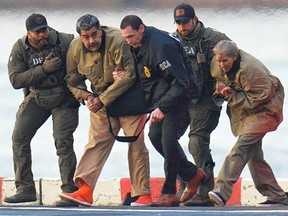
Five people walking along the a dock
 
According to the group's report, it was in fact, not drugs but military developments in Venezuela alongside Russian, Chinese and Iranian troops stationed nearby that persuaded the Trump administration to make their strike, despite that the U.S. military dismissed that contention as "speculative". "I don't think it [scooping up the Venezuelan president and his wife] has a damn thing to do with the drug boats. I think the drug boats are completely irrelevant. That's an excuse", stated Lee Wheelbarger, who led the group investigation whose findings, including a video compilation of satellite picture were presented to a defence-oriented think tank meeting, the Mackenzie Institute, in Toronto.
 
A spokesman for the U.S. Southern Command covering South America contended that the organization makes no comments on "speculative reporting or unverified premises. Our mission remains focused on supporting regional stability, combating illicit activities, and working with our partners to address shared security challenges". Yet according to a Russian lawmaker, Russia considered supplying its new Oreshnik ballistic missiles to Venezuela, requested by Nicolas Maduro along with other equipment from Russia, China and Iran.
 
It has been confirmed that Venezuela has close military ties with the three countries, as well as with Hezbollah out of Lebanon, the Iranian proxy militia. The images collected by Wheelbarger's group and the analyses produced led to conclusions explaining the sudden midnight action by the U.S. against Venezuela. Action culminated from the threatening appearance of American warships, including an aircraft carrier patrolling the region, even as the U.S. destroyed dozens of boats claiming they were carrying drugs to end up in the United States. Deadly incidents decried as extrajudicial executions by those purportedly involved in drug trafficking who would normally face arrest and trial.
 
Wheelbarger, for several years a senior technologist with the U.S. army -- was a contractor developing night-vision equipment, communications gear and an advanced technological protocol enabling battlefield medics to transmit images to military hospitals, and then receive instructions on a video display -- was lauded  with claims that "Wheelbarger's electronic creations have extended the eyes and ears of America's intelligence network", by the History Channel's Modern Marvels program, in 1999. 
 
According to the man himself, he engages in the collection of publicly available images from 28 satellites operated by Maxar Technologies, Planet Labs, Airbus Defence and Space, BlackSky, Capella Space,     ICEYE, SkyFi, European Space Imaging, Apollo Mapping, Satellite Imaging Corp., and L3 Harris Geospatial; also accessing images from ground cameras, along with another video method that remained unexplained, to glean information from global human sources. He possesses three-dimensional  renderings of military hardware that can be placed over satellite images to match shape and size aiding in identifying specific equipment. 
 
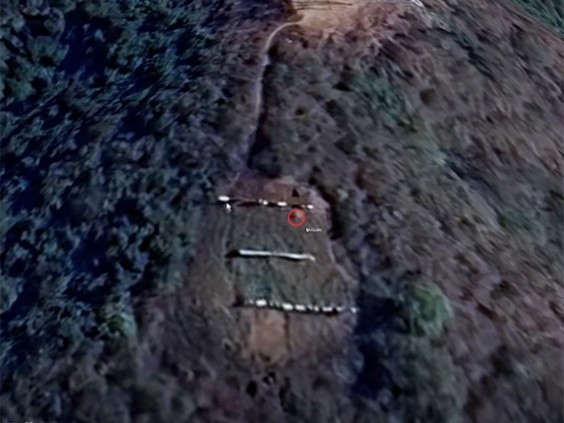
https://smartcdn.gprod.postmedia.digital/nationalpost/wp-content/uploads/2026/01/Venezuela-satellite-1.jpg?quality=90&strip=all&w=564&h=423&type=webp&sig=SzD5GWC_Qv_Um3aQQsO-Og
 
In his Toronto presentation video he identifies images close to Caracas including a Russian base complete with 94 T-72 and T-74 tanks. Impressively, he points to a mountain hollowed out in the creation of a subterranean military complex with openings cut into the hill surrounded by rebar suggesting creation of a massive concrete facade with "millions of cubic yards" of excavated dirt piled nearby. The mountainside features an area with three parallel, straight lines of holes which Wheelbarger and  his colleagues identify as tubes to fire intermediate-range ballistic missiles from, basing their theory on matching underground launch sites located in Iran.
 
Jeff Nyquist, writer and geopolitics blogger who collaborates with Wheelbarger, notes that intermediate-range missiles could reach north to the U.S. capital. The Cuban airfield images cigar-shaped objects at a runway's end, identified by the analysts as Kitchen missiles. Russian weapons travelling at almost five times the speed of sound that can destroy naval ships, usually fired from aircraft, generally the Tu-22 bomber, not seen in the images, but readily disassembled and smuggled into Cuba on larger cargo planes, according to Wheelbarger. 
 
Satellite images raise question about Venezuela's military ...
A stun­ning U.S. raid to cap­ture Venezuela’s pres­id­ent came after a group of ama­teur intel­li­gence ana­lysts argued that satel­lite images reveal a Venezuelan launch site that could send bal­listic mis­siles as far north as Wash­ing­ton, D.C.  National Post
 

Labels: , , , , , , ,

Tuesday, February 26, 2019

Canadian Diplomats Suing Their Government

"Throughout the crisis, Canada downplayed the seriousness of the situation, hoarded and concealed critical health and safety information, and gave false, misleading and incomplete information to diplomatic staff."
"[Global Affairs] actively interfered with the plaintiffs' attempts to receive proper health care, including going so far as instructing hospitals to stop testing and treating them."
"Despite knowing of the risks of Havana Syndrome early on, Canada continued to put its diplomats and their families in harm's way by sending them to Havana and requiring them to stay there despite becoming aware of the high and growing risk that they would sustain the brain injuries associated with Havana Syndrome."
Statement of Claim, $28-Million Lawsuit

"We knew there was something [happening] but we just couldn't figure out what was going on. Living in Cuba [as diplomatic staff] we understood that our houses were bugged."
"It just hit me, 'Holy crap, this [symptoms such as nausea, headaches, nosebleeds, hearing and eye problems from an unknown source] is going on in my house'."
"At the low point, I thought I was going to throw up. I was nauseous like you wouldn't believe. I don't know whether I went back to sleep or passed out."
Diplomat Allan (names withheld)

"My belief 21 months later is that decisions were made that simply did not prioritize us, not our health, not our safety and not that of our families."
"I am angry, yes. I am disappointed and I am sad. I am sad because there is no justification for not having considered the personal and lifelong impact this was going to have on us."
Diplomat Baker (generic names used for anonymity)
A view of the Canadian Embassy in Havana, Cuba, on Thursday, Oct. 29, 2009. (Franklin Reyes/Associated Press)

Five Canadian diplomats assigned to posts in Cuba, and 14 of their family members have filed a law suit against the federal government resulting from the mysterious illness they suffered while posted to Cuba and living in Havana. According to the suit the Canadian government which is responsible for the well-being of all Canadians and in particular their staff abroad, failed to inform, protect, treat and support them at a time of need.

Canadian families in Havana, the lawsuit states, "have been targeted and injured, suffering severe and traumatic harm by means that are not clear but may be some type of sonic or microwave weapon". And nor have Canadians been the sole targets. In fact American diplomats have been exposed and have suffered identical symptoms and injuries in their posting to Cuba. The affliction they all suffer from is now known as Havana Syndrome.

The government of Cuba claims to be just as mystified regarding the source of the syndrome as the U.S. and Canadians. Co-operation between all three governments to find the source of the problem has been welcomed, but no answers to the questions have resulted. The United States decided to dramatically reduce the number of diplomatic staff until such time as the matter can be more fully understood. It took Canada quite a while longer to decide not to permit family members to accompany diplomatic staff assigned to Cuba to accompany them.

Two years ago healthy diplomatic staff and their family members were beginning to experience peculiar symptoms; nosebleeds, headaches that appeared to have no explanation. Excruciating headaches would afflict them upon waking in the morning followed by nausea and problems with vision. The Allen family received no warning or information from the embassy or from Global Affairs, but a neighbouring U.S. diplomat who knew of the problem and whose own experience echoed that of the Allens, disclosed the situation to him.

Their feelings of fear, extreme irritability, nausea, headaches, nosebleeds had an unknown cause, but the situation was known to those who had earlier gone through the trauma. At the point when Allen was informed he was also told that a dozen Americans had been evacuated from Havana once it was ascertained that something strange was causing them to suffer those headaches, nosebleeds, hearing and eye problems. The Americans too were sworn to secrecy about the issue.

Eventually the Allen family was sent to the University of Miami for testing. A doctor there had examined about twenty Americans with similar symptoms, who had also been based in Havana. He diagnosed all four members of the Allen family with traumatic brain injuries similar to symptoms from concussions, recommending the children not return to Cuba: "They need to be away from Cuba for awhile".

Yet according to the lawsuit the Canadian embassy refused to send the Allen children back to Canada. The very fact that the Canadian diplomatic staff who knew about the situation were ordered to be silent about the issue, not to discuss anything with other staff newly arrived, knowing nothing of what was transpiring, did not impress these newly-diagnosed Canadians very positively.

Another diplomatic family, Diplomat Davies, wife and two young children were experiencing strange things in their house in Havana in the spring and summer of 2017 where the young daughter was increasingly unable to concentrate at school, suffering from nausea, tinnitus, sensitivity to light, visual impairment and sudden nosebleeds. Mrs. Davies lost her sense of balance, reported hearing high-pitched sounds. "I no longer knew where was up and where was down", she informed her husband after a strange fall.

She was diagnosed with damage to her vestibular system; parts of the inner ear and brain that process sensory information, was hypersensitive to light and noise, suffered from headaches, dizziness and muscle twitching. By all these accounts it is manifest that the government of Canada has failed in its obligation to its employees, to keep them safe from harm and to respond to their needs. The diplomats and their families are now undergoing tests at Dalhousie University's Brain Repair Centre.

The research and tests there have pointed out leakages in their blood brain barriers consistent with symptoms of concussions. When Global Affairs appeared to hesitate about the need to ensure that these people were given swift medical attention, several of the families travelled to University of Pennsylvania after officials there had offered to assess and treat Canadians, but the offer was turned down by the federal government.

All sound reasons to demand attention and remedial action, even if it was recognized that such would only be forthcoming through the compelling action of a lawsuit.

Labels: , , , , , ,

Saturday, December 01, 2018

A Peculiarly Aggravated Hardship Post

"[Their symptoms are comparable to head injuries suffered as a result of a car crash] where you have gone high speed to stopping instantly with airbags deploying."
"I know many different things can cause injury to the brain ... however, this sounds and looks like trauma. It looks like a concussion. What caused it, I have no idea."
"I am interested in the cause. Normally the trauma is easy to identify. It helps me with prognosis. With this I can't even speculate, I just don't know the trauma."
Dr. Shawn Marshall, medical director, Acquired Brain Injury Rehabilitation Program, The Ottawa Hospital
A man walks beside Canada's embassy in Havana, Cuba. Desmond Boylan/The Canadian Press

A year and a half ago it was revealed that American and Canadian diplomats serving their countries' embassies in Cuba had been struck by a series of conditions mysteriously contracted. There was no detectable physical force that assailed them, rather some mentioned that they became conscious of strange sounds impacting their hearing for which they were unable to account, and soon afterward stranger symptoms occurred in a range of effects from dizziness to forgetfulness, extreme fatigue and generalized unwellness.

Medical attention was required and it was given but the source of the illness much less its impact continued to puzzle doctors. People suffering various symptoms still remain affected a full year and more on. Some are unable to return to work. Tests indicate that they have suffered brain trauma of some kind from some unknown source. But the answers remain elusive. And the two missions remain operational. Now Canada's Department of Foreign Affairs has announced that another -- the thirteenth Canadian -- diplomat has returned to Canada struck with the same symptoms.

Both governments continue to study the situation, trying to understand just what is now being referred to as "Havana syndrome" is. There have been few answers that can be relied upon to explain the nature of the attacks and who is responsible for them. The government of Cuba attests that it is as puzzled as any of those affected and has stated its willingness to cooperate in any way it possibly can with the U.S. and Canadian investigators. Speculation has gone further afield, to China or Russia.

Given the Russian Federation's penchant for mischief it seems likely, though logically improbable, that Russian President Vladimir Putin who enjoys nothing more than causing consternation to the global community by his volatile and disturbingly violent moves is likely to be involved. A man who walks away from sanctions imposed because he orders another country's territory invaded and its border altered to benefit Russia, who sends military personnel and weaponry to support insurgents, who dispatches assassins to another country, and whose chief of secret service suddenly dies is capable of anything.

Both the U.S. and Canada believe their diplomats have been targeted using an unknown technology, and both the FBI and RCMP are investigating. Some feel microwaves causing sonic attacks are involved, an advanced technology not known to researchers. The attacks all occurred at homes where diplomats were living in Havana. Canada made changes at the mission after 12 of its diplomats and family members including children were attacked; for one thing Havana was changed to an "unaccompanied" post; family members no longer encouraged to join diplomats.


Some of the victims describe a strange sound they likened to "sheet metal in the wind", and then their noses began bleeding. Some struggle to cope with daily life and others have returned to work, but all reported a range of symptoms known to occur with traumatic head injuries; dizziness, difficulty walking, headaches, lack of concentration. These are the types of symptoms ordinarily associated with post-concussion syndrome, despite an absence of physical trauma.

Dr. Marshall has been treating some of the affected diplomats posted to Havana and returned to Canada. Though American researchers point to microwaves as unconventional weapons possibly the cause of the trauma, nothing has been confirmed. Dr. Marshall is in touch with researchers in the U.S. himself intrigued and anxious to know the cause. Moreover, Dr. Marshall believes that among those he is treating some were exposed more than once.

These were strange incidents occurring at night when the diplomatic staff and their families were in their private residences. Afterward they began experiencing difficulty walking, stumbling, unable to tolerate light and noise and had problems sleeping. Though the syndrome still affects some of his patients dramatically, Dr. Marshall is encouraged that others are improving. Therapies include pain medication for headaches and difficulties with sleep; counselling for irritability and mood problems; vision therapy and physiotherapy.


Sources within the government state that of the dozen Canadians previously affected, one reported feeling a sensation of waves or pulses arriving strangely through the atmosphere before symptoms occurred whereas in all other instances, those affected became aware of their injuries only when they began to experience symptoms. In the latest case, the individual was unable to recall any particular incident that might have triggered his symptoms.
A view of the Canadian Embassy in Havana, Cuba. A 13th person has reported 'unusual health symptoms' while stationed there. (Franklin Reyes/Associated Press)

Labels: , , , ,

Wednesday, September 13, 2017

Death and Destruction on an Island Paradise

"The storm was massive. Not only high-intensity, but it was massive in area. It ran along the north coast, but it was felt along the entire island."
"People are a little bit stunned by the impact that Irma had, even here in Havana, which was not as hard hit as other areas."
"The coastal communities were devastated by the winds. Houses have lost their roofs. Trees are down. The electricity is off just about everywhere. There are some communities that even today are under feet of water."
"When people return home, they may find their house might not have a roof. Their possessions might be lost."
"We're looking at a minimum of ten thousand people we want to get to in the immediate aftermath."
Richard Paterson, CARE Canada worker, Havana, Cuba
Water battered the city's pier and flooding some low-lying areas of Havana on Saturday.
Water battered the city's pier and flooding some low-lying areas of Havana on Saturday.    CNN

In the Cuban countryside some plantations were completely destroyed; crops devastated. Agricultural yield on the island, highly dependent on its own natural resources, has lost three or four months of production, at the very least. In the broader perspective, getting back on track to normalcy croplands may only recover in three or four years from the catastrophic effect of the hurricane.

Cuba is anything but a wealthy country; it gets by. The storm that struck Florida after it had moved through the Caribbean as a Category 5 storm had weakened considerably, to a 4, then a 3-1/2 Category, still packing whopping powerful winds and drenching rains, causing destruction and flooding. The U.S. will recover far more quickly from its costly ordeal than the islands in the Caribbean, that are much more vulnerable to such catastrophic weather events.
More than 5,000 tourists were evacuated from the keys off Cuba’s north-central coast, where the government has built dozens of resorts in recent years.
More than 5,000 tourists were evacuated from the keys off Cuba’s north-central coast, where the government has built dozens of resorts in recent years.  (YAMIL LAGE)

As a Category 5 storm striking the eastern tip of Cuba last Friday, the shore was pounded for 800 kilometres before the storm turned north heading for the Florida Keys. The popular resort town of Varadero was one of those catching the greatest impact, with about 14,000 tourists hunkering down for its duration, experiencing a drama they hadn't bargained for when they contemplated the sun and the sand and a getaway holiday in an island paradise reserved for tourists.

The island's trees were stripped of their foliage, left gaunt and skeletal, an eerie counterpart to destroyed buildings. Sea water surged inland for half a kilometres in certain places; even on some Havana streets rivers of muddy water ran deep and swift. Many communities with all power lines downed, will lack electricity for weeks on end, and because of shortages of fuel, travel isn't much of an option.

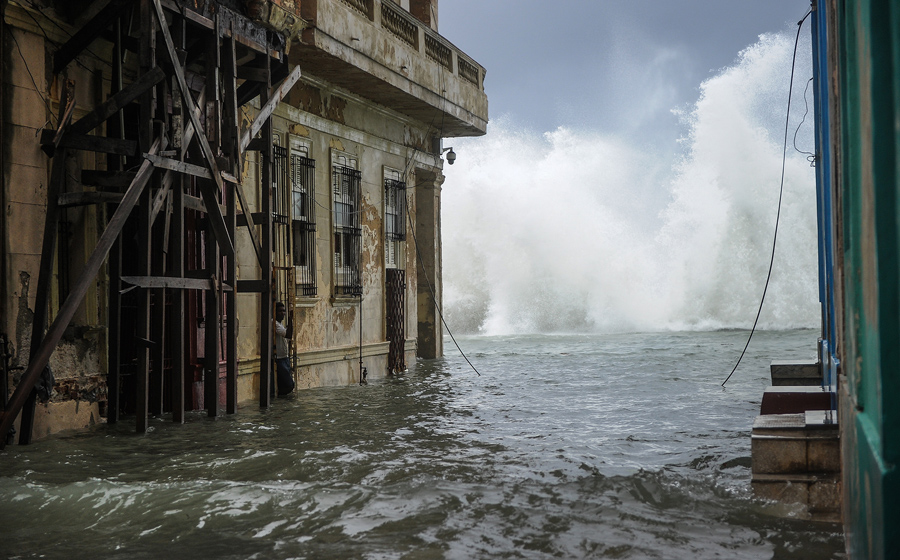
A flooded street near the Malecon in Havana, Cuba, on September 10, 2017. Deadly Hurricane Irma battered central Cuba on Saturday, knocking down power lines, uprooting trees and ripping the roofs off homes as it headed towards Florida.
Yamil Lage / AFP / Getty

Labels: , , ,

Tuesday, February 07, 2017

Mexico's Crises

"Mexico is facing two crises right now . There’s the situation with Trump and the United States, but then there’s an internal crisis. Gas prices, corruption, the degradation of institutions."
"[While Mexicans are upset over the Trump messages the price of gas] gets Mexicans into the streets  [to march in protest]."
Lorenzo Meyer,  Mexican historian

"I’d like to stand up and have my voice heard [by the U.S. and Mexico] as a migrant worker, [but there’s more outrage currently around issues like gas prices]."
"The thing is, if people in my community can’t go to work legally in the U.S. and send back remittances, or if there are mass deportations from the U.S., people will return here and see there is no work. There is no way to make money. The price of gas won’t matter if no one has any money."
Adareli Ponce, migrant worker, Hidalgo state 
Henry Romero/Reuters   Demonstrators march against a \fuel price hike in Mexico City, January 31, 2017

But if the United States and particularly under its new president, is concerned about the presence of millions of illegal migrants, and is focusing on Mexico as a source of much of the illegal presence as underground workers whose presence is a boon to the economy, despite their undocumented status, complicated by the fact that many of those illegals have settled in the U.S. and lived there for decades, often longer; raise families whose children know no other country, for whom Mexico is foreign, there is another, ignored reality, that Mexico itself is struggling to cope with an influx of migrants.
"It's worrying us. How Mexico can handle that [Haitian, Central American and Cuban migrants] is going to be a whole new area of concern. I don't think the absorptive capacity is there."
Christopher Gascon, chief, Mexico office for the International Organization for Migration
Pipeline to America
Genaro Molina / Los Angeles Times

Shelters crowded with Haitian migrants and Cubans have been popping up in Tijuana, Mexico in churches, community centres, and wherever else homeless people can be sheltered in temporary accommodations on their arrival in Mexico, planning to go on to the United States. In Mexico, they await the opportunity to persuade U.S. visa officers to grant them the visas they need to enter America. The city is a crossroads at the border, crammed with so many migrants private citizens have taken to opening their doors, to feed, clothe and house them.

Now that President Trump has issued directives that the border between America and Mexico is to be tightened and that immigration is being restricted while deportations will be stepped up, a new crisis is emerging in towns and cities along the border throughout Mexico. People have been arriving steadily from Central America in flight from violence and poverty. Close to 409,000 people were apprehended as they attempted to cross the southwestern border illegally last year into the United States.

Earlier, the Obama administration had altered American policy, contributing to the desperate backlog of Haitian migrants, along with Cubans, thousands of whom had been stranded in Mexico and Central America when the previous (Obama) administration decided to end the policy favouring Cuban entry into the United States. While Cubans had been welcomed if they made the journey across land to the U.S. those who made the journey by sea were regularly repatriated. Now, however, Cubans must obtain a visa before entry, just like anyone from anywhere else in the world wishing entry to the U.S.

That change in a longstanding policy has resulted in thousands of Cubans left stranded. The situation for Mexico, a country struggling on a number of fronts, now hit with the threat of a massive tariff of goods exported to the United States, to pay for a restraining wall Mexico abhors and the United States' new president favours, has seen between 400,000 and 500,000 undocumented migrants transit every year through the country, according to the International Organization for Migration.

Haitians experienced few problems crossing into the United States, for quite a while, since U.S. authorities permitted undocumented Haitians to enter under the umbrella of a  humanitarian provision recognizing the 2010 earthquake disaster and resulting upheaval. They would wait for weeks for appointments scheduled with U.S border officials. Until the Obama administration in September announced its intention of resuming deportation of Haitians to dissuade more Haitians from undertaking the migration.

But the migration route into Mexico has widened; not only from Haiti, but from India, Bangladesh and parts of Africa — all of them intending to enter the U.S. Baja California saw 15,000 migrants coming from outside Latin America pass through in 2016, five times greater than the number in 2015.
Many of the migrants chose the long, arduous and dangerous route to Mexico as an alternative to the equally difficult passage to Europe, crowded now with refugees and migrants from the Middle East and Africa.

The sounds of French and Haitian creole mix with Spanish and English in Tijuana's shelters which a year ago were filled with migrants from Central America and Mexicans recently deported from the U.S.   Photo by Genaro Molino


Labels: , , , , , ,

Friday, December 09, 2016

Cuba, Then and Now

1958
A Havana casino.
Image: Francis Miller/TimeLife Pictures/Getty Images

"We suspect that overall health-care outcomes would not have been much different given the remarkably low levels of infant mortality in Republican Cuba."
"Since current living standards appear to be below the levels of the late republic, it is hard to visualize any scenario where the republic would not have out-performed the revolutionary economy by a considerable margin in terms of living standards."
Marianne Ward-Peradoza, John Devereux, researchers
By the late 1950s, Cuban drove American cars, owned TVs, watched Hollywood movies and shopped at Woolworth's Department Store [Cuba today]. All the while, though, a revolution brewed. Teresa Eng

These [above] two researchers put together a comprehension picture of social development for Cuba after the Cuban revolution, using data relating to Costa Rica and Argentina for comparison. They calculated that consumption levels in 2000 for Cuba were 52 percent of 1955 levels at a time when Cuba was reeling from the collapse of the Soviet Union and suffered a significant loss of support, as a result. Cuba's per-capita consumption by 2007 arrived at 72 percent of its 1955 pre-revolution level.

Cuba was known to be close to the top of development in its geographic region before the revolution. It, in fact, led the region in low infant mortality from 1953 to 1958, according to data gathered by Carmelo Mesa-Lago, Cuba specialist and professor emeritus, University of Pittsburgh. As for life expectancy, Cuba was in fourth place in the mid-1950s, advancing to third place from 2005 to 2007. Literacy was high; in the 1950s it stood in fourth place, advancing to second place from 2005 to 2007.

"Cuba probably has the best-educated population in the region, but the considerable investment in human resources is partly lost due to the low wages paid and lack of incentives that force professionals to emigrate or stay but abandon their state work and shift to private non-professional activities that allow them to survive", wrote Mesa-Lago.

Published in the Journal of Economic History in 2012, a research paper found that Cuba lagged significantly behind its counterparts in the region during the rule of Fidel Castro. Roads, railways and hotels were built with U.S. investments, pre-revolution. The per capita income in 1955 was between 50 to 60 percent of western European levels, roughly equal to Italy's per capita income at the time. As a share of gross domestic product, Cuba's consumption was rated fairly high.

September 1958
President Batista's palace in Havana.
Image: Central Press/Getty Images

Income and wealth gaps between the rich and the poor after the revolution were narrowed. There was an expansion, not a new introduction, of free national public education and the same held true for the already-existing free public-health system with the number of rural hospitals increasing from one to 62, a substantial improvement. Cubans enjoy opportunities for regular health check-ups thanks to the emphasis that the Cuban health-care system places on preventive medicine.

But capital formation, industrial production and key measures such as cars per person, for example, saw Cuba falling from the top ranks to last place in terms of GDP, post-revolution. Cuban hospitals are ill-equipped and pharmacies have sparse stock, with antibiotics available only through the black market. Reality reflects that Cuba's revolutionary education and health care were already well established before Fidel Castro came to power. Greater access has been given to the poor.

But another reality that cannot be overlooked is that without resorting to dictatorship or communism, other Latin American countries succeeded in establishing even more dramatic improvements in their societies in the past six decades. Overall living standards, measured by GDP, calorie consumption and allied measures declined notably under Cuba's communist rule.

1944
A cane cutter and his family standing in front of their home.
Image: George Skadding/The LIFE Picture Collection/Getty Images


Labels: , , , , ,

Monday, November 28, 2016

Polarized Similarities and Comradeship

"Since 1980 Cuba has become the most thoroughly militarized nation on earth. According to the authoritative London-based International Institute of Strategic Studies, the Cuban regular army numbers 145,000 men, most of them conscripted privates who serve for three years. They are backed up by at least 110,000 ready reserves, who are trained forty-five days or more annually. This force has been lavishly armed by the Soviet Union and boasts an astonishing 300 T-62 and 650 T-54/55 main battle tanks (MBTs). By way of comparison, Canada, with two and a half times the population, infinitely more wealth, and serious NATO commitments, relies upon a regular army of only 22,500, with 114 antiquated MBTs. Cuba's army also has 1,400 major artillery pieces, 60 light and amphibious tanks, and 650 other armored vehicles, as well as 600 anti-tank guns."
"The Cuban Navy, with 12,000 men, maintains three submarines, two modern guided-missile frigates, and a large number of patrol craft and minesweepers. Canada makes do with an equal number of submarines and twenty-three assorted anti-submarine-warfare vessels; its navy has only 10,000 men. The Cuban Air Force (whose previous chief, General Rafael del Pino, defected to the United States in 1987) is a very potent one. Its strength is 18,500 men(including the Air Defense Command), with 250 combat aircraft, mostly MiG-21, -23, and -27 models. Significantly, it possesses only seven troop-carrying Tupolev TU-154 transports, severely restricting Castro's ability to intervene on his own. Canada, with 23,050 airmen, has only three fighter squadrons, or roughly forty-five planes, to defend its skies. The Cuban military machine is considerably more powerful than that of any other Latin American nation-including Brazil, which has a population of 142 million, fourteen times Cuba's."
John Hoyt Williams, The Atlantic, 1988

"Fidel Castro was a larger than life leader who served his people for almost half a century. A legendary revolutionary and orator, Mr. Castro made significant improvements to the education and healthcare of his island nation." 
"While a controversial figure, both Mr. Castro's supporters and detractors recognized his tremendous dedication and love for the Cuban people who had a deep and lasting affection for "el Comandante."
"I know my father was very proud to call him a friend ..."
Canadian Prime Minister Justin Trudeau
Justin Trudeau gets a hug from Cuban President Fidel Castro at the arrival in front of Notre Dame Church prior to the funeral of Pierre Trudeau.
Montreal Gazette-Pierre Obendrauf    Justin Trudeau gets a hug from Cuban President Fidel Castro at the arrival in front of Notre Dame Church prior to the funeral of Pierre Trudeau.

"El Comandante", that benevolent tyrant, didn't mind imposing economic hardships on his beloved Cubans. Cuba was and remains a fairly impoverished nation, but when it came to lavishing state funds on arms and a huge standing army disproportionate both to its population and its treasury, there was no question that was the priority in decision-making. Justin Trudeau loves describing himself as a liberal-progressive, his beaming countenance speaks of himself as a dedicated feminist, he argues on behalf of the LGBTQ2 community, he plans to legalize marijuana in Canada, he is a flower-power poster child.

But this man whose experience as a private school drama coach and a lecturer on snowboarding, both of which certainly prepared him to administer the affairs of a nation, a man who demanded lavish fees from charitable organizations as a public speaker coasting on his father's name-recognition burnishing his aura of the dauphin of a royal family, comes by his attraction to power in any guise in which it presents itself fairly naturally. He has in the past expressed admiration for the Chinese Communist Party government's ability to turn its economy "on a dime". As for the Iranian theocracy, there is the matter of moral relativism.

He and his brother view the Castro dynasty as a gift to the world.

Where Canada's previous, Conservative-led government under Prime Minister Stephen Harper diplomatically condemned Russia for its Ukraine-Crimea outrages, and Iran for its terrorism affiliation and nuclear aspirations, Mr. Trudeau, spurred by his great store of global wisdom and his belief that "sunny ways" can win over the most grudging, malevolent tyrant, is opening doors to renewing diplomatic relations with Iran, with China, with Russia to restore them to Canada's good graces and trade opportunism.

Castro visits Vietnam.

Fidel Castro may be Justin Trudeau's idea of a great man, a revolutionary of distinction, a leader of sturdy idealism, a romantic personage and an orator unmatched but by U.S. President Barack Obama, his other very good friend on the opposite spectrum more closely aligned to Trudeau's own, but that Castro was an unrepentant tyrant who turned his countrymen into guns-for-hire was undeniable. Cuba is famous for its doctors sent abroad to give medical aid anywhere it is needed, but the polar opposite was also true, that the Cuban military was busy in Africa and the Middle East, training and fighting  and doing what Castro defined to himself as a world of good.

A Cuban tank crew in Angola in 1987. Tens of thousands of Cuban soldiers fought in that country's civil war during the 1970s and 80s. A Cuban tank crew in Angola in 1987. Tens of thousands of Castro’s soldiers fought in that country’s civil war during the 1970s and 80s

Castro dispatched a Cuban mission to Ghana in 1961, and two years later its military forces were in Algeria. African nations became the stage for a thousand soldiers and military advisers by 1966 to strut the Cuban expertise in guerrilla warfare. Cuban combat units fought in Guinea-Bissau against Portuguese colonial rule. Eritrean rebels in their secessionist war against Ethiopia warranted training instructors among them. South Yemen saw the appearance of hundreds of Cuban military, and Dhofai guerrillas destabilizing Oman were also trained by the Cuban military.

Hundreds of Cuban tank crews took part in the 1973 Arab Israel War.

Castro send 500 Cuban tank commanders to Syria where they died fighting the Yom Kippur War launched by combined Arab states against Israel. Castro must have viewed it as an imperative that its combat troops not disappoint their oppressed Arab friends in the Middle East when Syria and Egypt plotted that very special surprise for Israel, an attack invasion in 1973, fighting alongside Iraq, Morocco, Kuwait, Saudi Arabia. Why station Cuban troops in the Middle East in support of Arabs fighting colonialism and ignore the presence of a Western intruder, after all? Which required that 4,000 combat troops along with tank commanders, helicopter crews be co-located with those battling that symbol of Western imperialism.

Fidel Castro and the House of Assad
Castro and Hafez al-Assad pictured attending a 1979 Non-Aligned Countries Summit meeting [Getty]
What, in all of this history, is there not to elicit the most profound admiration and gratitude for the presence in Cuba of a dedicated revolutionary, a protector of the underdog, an unerring guide to the future of the Cuban people, where education, medicine, and a society equal in its desperate need for the most basic goods to help make a life of general privation tolerable, worshipped its leader who sent off his conscripts to all parts of the world languishing in need of the Cuban military to define their futures.

And, of course, led countless tens of thousands of other Cubans to set off in whatever would float, to abandon their beloved country to Castro and his minions, while they either drowned in the effort, or made a new life for themselves and their families in the United States which gave them safe harbor. Miami is Cuba, Cuba is not Miami. Contenders for the presidential election were represented by Cuban-Americans. Castro and all that he represented was scorned and hated by Cuban-Americans; how very unreasonable of them, but there is simply no accounting the manner in which people make their peculiar alliances....

Labels: , , ,

Sunday, May 17, 2015

International Standards

Interesting, isn't it, that the world insists that Israel surrender lands it captured from Jordan and Egypt which represented Jewish settlements in ancient times when Judea was the homeland of Jews in the Middle East, when a collection of invading Arab armies time and again attacked the State of Israel to destroy it and return the land it occupies to Muslim possession. Jews were re-united in 1967 with their holiest of sacred Judaic places, the Temple Mount, when Israel achieved victory over the combined Arab armies that set out to annihilate Israel and its Jewish population.

Now, the Palestinians who had depended on their Arab brethren to liberate the land from Israel and return it to their possession (although previously neither Jordan nor Egypt nor any other Arab country was interested in seeing Palestinians the masters in their own house) insist that East Jerusalem must be the capital of a Palestinian state. And that Israel must vacate the land that it won by defending itself against a planned conquest. In no other place on Earth has this occurred; land taken by defence or offence always remained with the victor.

Israeli youth hold their national flag as they take part in the "flag march" through Damascus Gate in Jerusalem's Old City during celebrations for Jerusalem Day on May 17, 2015. (AFP Photo/Jack Guez)
Jerusalem Day celebrations in the Old City, 17 May 2015

Israel, however, is held to a far different standard than any other country on Earth. Jewish homelessness has never stricken too many hearts in the international community but for a brief period post World War II when the mass annihilation of six million Jews through careful planning and execution by Nazi Germany left the global community temporarily aghast. Recovery was swift enough and sympathy turned from the Jewish Holocaust to the plight of Palestinians, Arabs whom no other Arab country would deign to accept as migrant-citizens, even as those same Arab countries expelled a like number of Jews who had lived for millennia among them.

Here, then is another example of a country of powerful assets, reputation, size and antecedents having control of another country's geography. The island of Cuba which had been under the American thumb during the reign of Fulgencio Batista still is not shed of an American presence, despite Batista's successors, the Castro regimes expressing the determination to recover its sovereign territory.

The Northeast Gate at the Guantanamo Bay U.S. Naval Base. (Bob Strong/Reuters)
Guantanamo Bay in Cuba takes up 117 square kilometres, has over a thousand buildings and two airfields. It is a self-contained American military facility. On the base is a grocery store, a movie theatre, a church and a golf course. The Cuban-American treaty dates back to 1903 initially when the terms of the lease agreement placed an annual rental fee at two thousand U.S. gold coins. The current fee is set at $4,085 annually dating from 1934.

The U.S. interpretation of the 1934 Lease Agreement is one of perpetuity, for use as a naval station. It is a station with geographic strategic importance to the United States with value as a naval training facility. The United States has far less legitimacy in its attachment of this territory that the Cuban people and their government wish to recover than has Israel which had to defend itself from the deadly onslaught of enemies that would not be placated other than by its defeat.


Map of Cuba showing location of Guantánamo Bay on the southeastern coast

Labels: , , , , ,

() Follow @rheytah Tweet