
Politic?

This is a blog dedicated to a personal interpretation of political news of the day. I attempt to be as knowledgeable as possible before commenting and committing my thoughts to a day's communication.

Monday, June 29, 2020

China's Universal Game of Territorial Gain

"There's no trust right now."
"Nobody is going to buy this idea anymore that greater economic engagement is going to alleviate political strains [between India and China]."
Tanvi Madan, director, India Project, Brookings Institution, Washington

"If you consider the division of labour, then China is certainly on the winning side [of the two countries' trade imbalance]."
"[Particularly in two key areas -- telecoms and pharmaceuticals -- the government] must put in place a medium-term strategy to get out of this kind of dependence [on China. It is] absolutely imperative."
Biswajit Dhar, former Indian trade negotiator

"[China is] trying to change the status quo unilaterally in the Est China Sea, the South China Sea, at the Indian border and in Hong Kong."
"Our fighter jets scramble against Chinese airplanes almost every day.  ...Their armed ships are trying to violate our territorial waters."
Taro Kono, Japanese Minister of Defence
A Japanese military plane flies over the Senakuku/Diaoyu islands in this file photo.
A Japanese military plane flies over the Senakuku/Diaoyu islands

China has named 50 underwater geographic features located in close proximity to islands whose sovereignty has long been disputed between Japan and China in the East China Sea. China obviously is in the mood to prove the old adage that 'possession is nine-tenths of the law'. Tokyo has interpreted Beijing's move as an "alarming" leap in advancing Chinese territorial claims; recognized as but one of a number of provocative events in flashpoints in the Asia-Pacific region based on fears of military escalation.

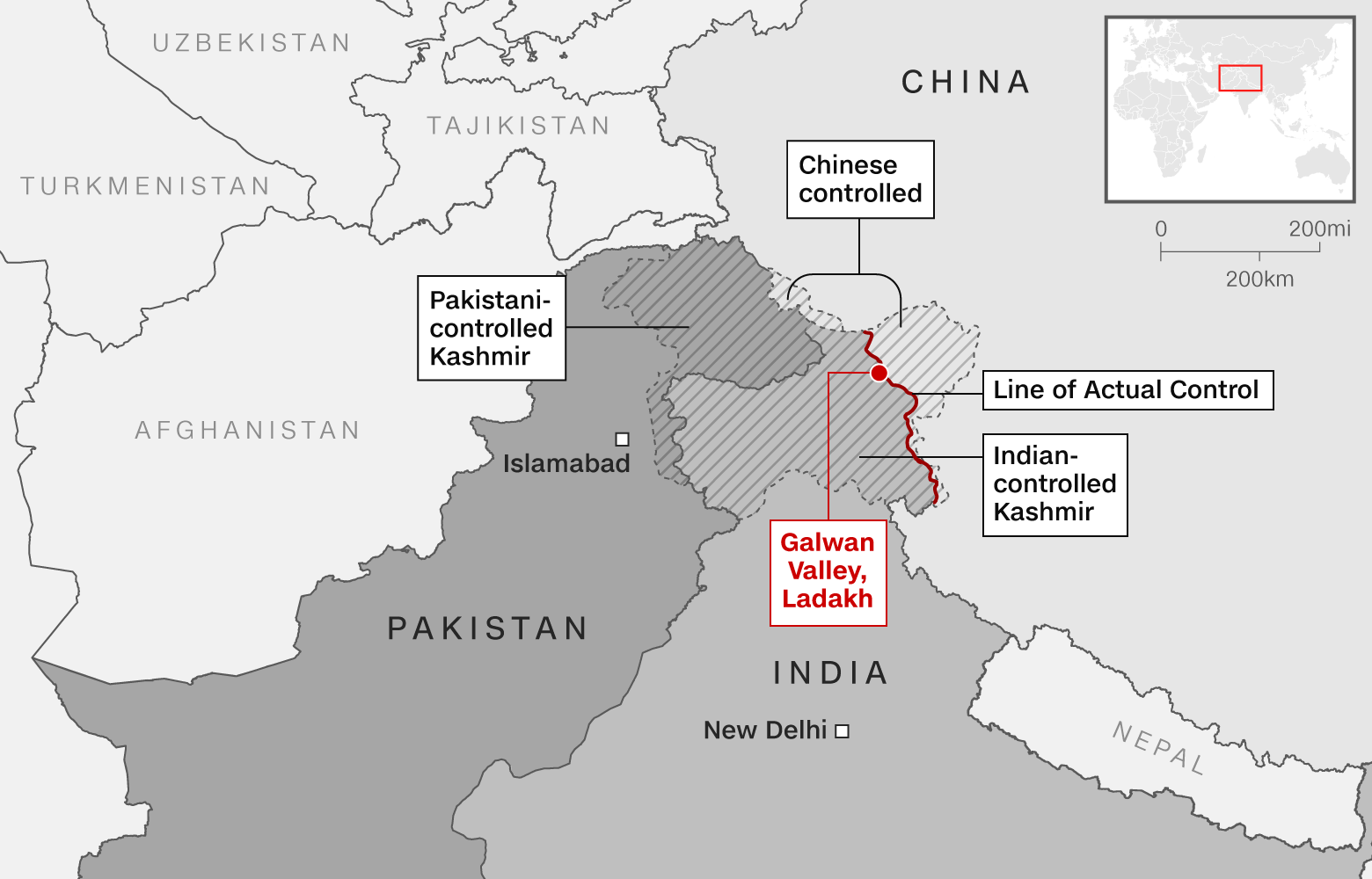
Events between China and India have become even more obviously fraught where disputed territory between the two giant nuclear nations in the Himalaya has seen Beijing's departure from the cold diplomacy its neighbours rely upon to blatant military violence in claiming geographical points within India's boundaries. In a May 15 physical altercation between unarmed Indian and Chinese troops, over 20 Indian soldiers were beaten to death in a violent melee. China has not divulged the numbers of its own losses.

Beijing has given orders for its military to move forward beyond China's territorial borders and into India's. It has surreptitiously erected army posts where no Chinese should venture, within the borders of India's sovereign territory high in the Himalaya. There has been a troop buildup on both sides; China belligerently prepared to advance its interests, and India just as prepared to protect its own from a predatory neighbour. And though both sides had long ago agreed that their military would not carry arms to prevent bloodshed in case of a skirmish, both resorted to improvised weaponry.
https://s2.reutersmedia.net/resources/r/?m=02&d=20200623&t=2&i=1523169294&r=LYNXMPEG5M0LI&w=1600
An Indian Army convoy moves along a highway leading to Ladakh, at Gagangeer in Kashmir's Ganderbal district June 18, 2020. REUTERS/Danish Ismail

China's latest move is to send martial art trainers to their outposts on the Tibetan Plateau -- itself representing a geographical territory torn from Tibetan sovereignty over Chinese claims that Tibet is part of China which it appropriated a century ago, formally annexing it in 1951 with the claim that Tibet formed part of China 800 years ago. Chinese soldiers stationed in their mountain redoubts will now become proficient in the martial arts, though even without them they had hurled an Indian commander to his death off the side of the mountain.

Analysts of satellite imagery confirmed that despite its diplomatic "mutual consensus to disengage" with India over the disputed territory, it had taken no action to remove the posts it had constructed inside Indian territory, nor had it withdrawn its troops stationed there in the Galwan valley. Indeed it has fortified the area in dispute. "India will reduce its dependence on imports", stated Prime Minister Modi. "We [will] become [the] biggest exporters of the commodities that we now import", he declared.
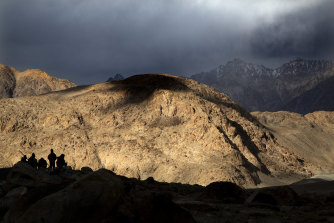
The treacherous terrain of the Ladakh region.
The treacherous terrain of the Ladakh region.Credit:AP

Unfortunately, just like all other nations within the international community, India too has over the years become a nation dependent on Chinese trade, intertwined with its own, a huge trade imbalance in China's favour the result of acquiring cheaper goods, ranging from household items to high-tech communications and personal protection equipment during a time of global economic breakdown caused by a ferociously infectious virus out of China.

Most nations including those whose natural resources China is steadily depleting, and who will never be able to repay the immense infrastructure loans made by Beijing to emerging economies, to bring them into China's "one road, one belt" orbit to capture an even greater share of the world market already mortgaged to China, seek to ingratiate themselves with the power that is behind Beijing, fearful of enduring its wrath should they be seen to defy Chinese directives.

The irony is that the country that gifted the global community with an economy-wrecking, social disaster-wreacking, death-delivering zoonotic, is the very same country that produces a huge proportion of the world's disinfectant chemicals, respirators, medical masks and gowns, ensuring that the stricken world remains dependent on China and in the process, semi-vassals of Beijing. India, with its uneasy political and trade relations with China, finds itself in a bind.

India exports raw materials and imports intermediate and final products of higher economic value; the traditional short-end-of-the-stick in trade. It accesses raw material that China produces; high performance polyethylene, to produce its bulletproof vests for Indian paramilitary and police forces.  Bulletproof jackets for the Indian army relies on materials imported from China. India will henceforth make a strenuous effort to wean itself away from Chinese products.

As a worldwide pharmaceutical producer in the global generic drug industry, India is deeply dependent on China, since around 70 percent of the active ingredients required by drugmakers emanate from china, according to Ashok Kumar Madan, executive director of the Indian Drug Manufacturers' Association. Decreasing that reliance on China is a goal that India has long eyed and found frustratingly difficult to attain.

Taking a leaf, as it were, over China's preferred method of punishing nations that dare to defy the advances of the Chinese Communist Party in Beijing India will nonetheless begin the process of withdrawal. Where China bullies other nations when they run afoul of Beijing's wishes, by punishing them through imposing high tariffs on their products or finding reason to discontinue accessing their products for Chinese consumption, as it has done with Canada and Australia. A trade war is less destructive than a military war.
https://cdn.cnn.com/cnn/.e/interactive/html5-video-media/2020/06/16/Kashmir_Map_WIDE_June15_Galwan_Valley_Ladakh_mediumx2.png

Labels: , , , , , , , ,

Wednesday, February 01, 2017

Reading Israel The Riot Act

"Israel's Supreme Court has ruled that Amona must be demolished because it is built on private Palestinian land."
"Hundreds of activists threw stones at police and resisted officers as they moved in to enforce the court order. Injuries were reported on both sides. The removals started on Wednesday and continued into the night."
"Hours earlier, the Israeli government approved plans to build 3,000 new homes at settlements in the West Bank. It is the third such announcement since the inauguration 12 days ago of US President Donald Trump, who has hinted he will be more sympathetic to settlement construction than his predecessor."
BBC News online
Protesters set furniture on fire during an operation to evacuate the unauthorised settlement outpost of Amona in the occupied West Bank (1 February 2017)
Protesters set fire to furniture and building materials as police officers moved in   AFP
It is certain to make headlines all over the world when Israel announces its intention to create more homes at settlements considered illegal by the world community, and censored unremittingly. The Palestinian Authority uses the supposedly 'illegal' status of new buildings in settlements in East Jerusalem and the West Bank -- which Israelis refer to as Judea and Samaria using their biblical names to identify the geography that was Judean, historically Jewish geographic areas from ancient times to the present -- to heighten global indignation.

The legend that these settlements and their expansions represent an internationally illegal occupation promoted by the Arab and Muslim world and gravely emphasized by the United Nations, then slavishly echoed by the world community has little basis in actual legal terms. Palestinians aspire to claim the West Bank as their own, they now state, of an opportunity they spurned before Israel became a state in 1948 when the United Nations proffered their Partition Plan.

From that time forward the other nations of the Middle East have variously declared war on Israel and manipulated the United Nations to view the Israeli presence as illegal. All the more so as they feel they have a legal footing from the time that Israel successfully defended itself from extermination by the last assault conducted by combined Arab armies. The assaulting nations lost territory instead of gaining it; Egypt its Sinai Peninsula and Gaza, Syria the Golan Heights, and Jordan the West Bank and East Jerusalem.

Jordan was an unauthorized occupying power. From the Golan Heights looking down upon Israel, Syria launched countless attacks against the tiny nation below. Egypt eventually agreed to a peace with Israel and recouped the Sinai, including the developments that Israel had made there. As long as Syria remains a threat to Israel, the Golan Heights will never be returned. And East Jerusalem and the West Bank were never Jordan's to claim, much less the Palestinians. Israel unilaterally returned the Gaza Strip to the Palestinian Authority only to have Hamas and Islamic Jihad, two terrorist groups, launch incessant rocket attacks into Israeli towns and villages.

The Muslim Arab nations in which oriental Jews had lived for thousands of years in the Middle East and North Africa, expelled their Jews and confiscated their properties as soon as Israel declared its statehood. Those Jews were never compensated; indeed, most of those countries will not permit entry to any Jews, having made themselves Judenrein in response to having to live with a Jewish state in their midst, simply unthinkable in a geography dedicated only to the presence of Islam. Yet, those same countries can employ the trope of Israel as an apartheid state.

The UN Charter Article 1 sets out a key United Nations purpose: "To develop friendly relations among nations based on respect for the principle of equal rights ... of peoples ..." Article 59 of the Fourth Geneva Convention, Paragraph 6 states: "The Occupying Power shall not deport or transfer parts of its own civilian population into the territory it occupies", and in direct contravention to this declaration there was the Soviet settlement of Russians into Baltic territories post-WWII,. Even after their 1990 independence, the Baltics were discouraged from removing those settlers. And it is those nativist Russians whose presence Vladimir Putin now uses as an insinuating threat. Witness Ukraine.

Turkey invaded Northern Cyprus to settle Turkish farmers there, leading to conflict between Turkey and Greece, and continued and ongoing hostility in Cyprus between the Turks and the Greeks, after much blood had been shed. But no condemnation ensued against Turkey's hostile, violent act. And then there is China and its usurpation of Tibet's legitimacy as a sovereign nation. Tibet has been in an occupied status for many decades -- almost 70 years -- yet there is no UN condemnation of this permanent member of the UN Security Council. Double standard, needless to say.

More than that, it is an act of acute anti-Semitism when any body or anybody singles Israel out for condemnation as an occupying power of its ancient heritage. That 'occupation' occurred under great duress, after Palestinians refused to accept the portion of the shared geography that the UN offered, when it chose to wait out the destruction of the nascent Israel in favour of claiming the entire area for itself. When that did not succeed, the Palestinians, with neighbourly concurrence and aid, set about attacking Israel and its citizens through violent plane and ship hijackings and suicide bombings.

Article 49, meant to apply to Jews in the ancient Hebrew city of Hebron, the equally ancient Jewish Quarter of Jerusalem including population blocs around Jerusalem, belied the historical and current facts that Jews lived there for thousands of years and never stopped living in land sacred to them. The entire Jewish population was attacked, killed or scattered from the area in 1929. These Arab pogroms against Jews vastly pre-dated the creation of the State of Israel. Simply put, Muslims reacted in typical Arab tribal, religious response by resorting to lethal violence to alter the demographic.

When Jordan took the walled city of Jerusalem in 1948 after Israeli independence, the Jews who had lived there since Biblical times were slaughtered or displaced and the area cleared of any Jewish presence. And nor were Jews permitted to access their most sacred religious sites, which Jordan placed off limits to Jews, with access only to Muslims and limited access to Christians.  "Our basic objective will be the destruction of Israel", declared Egyptian President Nasser in 1967 when Egypt, Jordan, Syria and other Arab armies marched together on Israel.

Security Council Resolution 242 of November 22, 1967 spoke of a post-1967 peace settlement securing Israel an enlarged, " ... secure and recognized boundaries, free from threats or acts of force", a specific wording in an agreed framework meant to forestall any future attempts to destroy the Jewish state. Contemptuous descriptions of "occupied territory" versus "Palestinian territory" holds Israel to a standard that no other country is expected to respect. Conventionally, when a country is attacked and successfully defends itself by routing its attacker to safeguard its territory, additional territory is often claimed and made part of its own.

Unless it's Israel under discussion.

Labels: , , , , ,

Sunday, May 31, 2015

Territorial Contests

"The militarization of the situation would make it very clear that the Chinese objective is to impose physical control over some of the most sensitive international waterways in the world."
"It would show China's long-term intention, which is a permanent, physical, military presence in these waterways."
"We are moving to a far more dangerous phase where the Chinese are not merely asserting their claims, but cementing them in military terms."
Jonathan Eyal, head, international security studies, Royal United Services Institute, London
Chinese dredging vessels are purportedly seen in the waters around Mischief Reef in the disputed Spratly Islands in the South China Sea in this still image from video taken by a P-8A Poseidon surveillance aircraft provided by the United States Navy May 21, 2015.
U.S. Navy/Handout via Reuters  Chinese dredging vessels are purportedly seen in the waters around Mischief Reef in the disputed Spratly Islands in the South China Sea in this still image from video taken by a P-8A Poseidon surveillance aircraft provided by the United States Navy May 21, 2015.

China's claim to ownership of 90 percent of the South China Sea, believed to be a wealth of oil and gas, and its claim to the Spratly Islands overlap with similar claims of its neighbours; Brunei, Malaysia, the Philippines Vietnam and Taiwan. Though the archipelago is over 1,2000 kilometres from the Chinese coast some of the world's most important shipping lanes are involved, and China's ambitions are making all concerned extremely alarmed.

Concerned enough to have reached the belief that the recent projects that China has embarked upon, building artificial islands inside the Spratly chain has a military purpose, though the Communist Party has spoken of the projects as being no different than any other country's investment in simple road-building and access to areas hitherto overlooked. It is simply land reclamation, something that many countries involve themselves in.

"The critical question now is what China does next. - Will it continue to build? Will it seek to expel other claimants to these islands -- perhaps putting down runways and aircraft here? Or will it stop"? asks Jonathan Pollock, specialist on U.S.-China relations at the Washington-based Brookings Institute.

All of the above, it seems. U.S. surveillance has detected two large artillery vehicles on one of the artificial islands in the South China Sea. The land reclamation projects appear increasingly to reflect military purposes. While China and the United States through president-to-president consultation on items such as climate change appear to be seeking a spirit of cooperation, the events of land reclamation and military outposts seem to belie normalization.

U.S. defence officials describe the sighted weapons as self-propelled artillery vehicles posing no threat to the United States or any American territories. Though, of course, if they pose a threat to U.S. allies, the United States is obligated to honour its promises to those allies by contesting Chinese claims to territory clearly not its own.

According to Mira Rapp Hooper, director of the Asia Maritime Transparency Initiative, analysts have identified artillery on at least two of the Chinese land reclamation sites.

In its annual report on China's military power in early May the Pentagon issued warning that five outposts are emerging that could be useful to China for the placement of surveillance systems, harbours, an airfield and logistical support. To keep apprised of the situation, the U.S. has been flying surveillance in the region, leading China to file a formal complaint when a Navy P-8A Poseidon flew over one of the sites.

Labels: , , ,

Sunday, May 17, 2015

International Standards

Interesting, isn't it, that the world insists that Israel surrender lands it captured from Jordan and Egypt which represented Jewish settlements in ancient times when Judea was the homeland of Jews in the Middle East, when a collection of invading Arab armies time and again attacked the State of Israel to destroy it and return the land it occupies to Muslim possession. Jews were re-united in 1967 with their holiest of sacred Judaic places, the Temple Mount, when Israel achieved victory over the combined Arab armies that set out to annihilate Israel and its Jewish population.

Now, the Palestinians who had depended on their Arab brethren to liberate the land from Israel and return it to their possession (although previously neither Jordan nor Egypt nor any other Arab country was interested in seeing Palestinians the masters in their own house) insist that East Jerusalem must be the capital of a Palestinian state. And that Israel must vacate the land that it won by defending itself against a planned conquest. In no other place on Earth has this occurred; land taken by defence or offence always remained with the victor.

Israeli youth hold their national flag as they take part in the "flag march" through Damascus Gate in Jerusalem's Old City during celebrations for Jerusalem Day on May 17, 2015. (AFP Photo/Jack Guez)
Jerusalem Day celebrations in the Old City, 17 May 2015

Israel, however, is held to a far different standard than any other country on Earth. Jewish homelessness has never stricken too many hearts in the international community but for a brief period post World War II when the mass annihilation of six million Jews through careful planning and execution by Nazi Germany left the global community temporarily aghast. Recovery was swift enough and sympathy turned from the Jewish Holocaust to the plight of Palestinians, Arabs whom no other Arab country would deign to accept as migrant-citizens, even as those same Arab countries expelled a like number of Jews who had lived for millennia among them.

Here, then is another example of a country of powerful assets, reputation, size and antecedents having control of another country's geography. The island of Cuba which had been under the American thumb during the reign of Fulgencio Batista still is not shed of an American presence, despite Batista's successors, the Castro regimes expressing the determination to recover its sovereign territory.

The Northeast Gate at the Guantanamo Bay U.S. Naval Base. (Bob Strong/Reuters)
Guantanamo Bay in Cuba takes up 117 square kilometres, has over a thousand buildings and two airfields. It is a self-contained American military facility. On the base is a grocery store, a movie theatre, a church and a golf course. The Cuban-American treaty dates back to 1903 initially when the terms of the lease agreement placed an annual rental fee at two thousand U.S. gold coins. The current fee is set at $4,085 annually dating from 1934.

The U.S. interpretation of the 1934 Lease Agreement is one of perpetuity, for use as a naval station. It is a station with geographic strategic importance to the United States with value as a naval training facility. The United States has far less legitimacy in its attachment of this territory that the Cuban people and their government wish to recover than has Israel which had to defend itself from the deadly onslaught of enemies that would not be placated other than by its defeat.


Map of Cuba showing location of Guantánamo Bay on the southeastern coast

Labels: , , , , ,

Saturday, April 11, 2015

The Colossus Stretches Its Sea Legs

"[China has created] over four square kilometres of artificial land mass; a great wall of sand."
U.S. Admiral Harry Harris Jr., commander, U.S. Pacific fleet

A March 16 satellite image from the CSIS Asia Maritime Transparency Initiative shows one of China's artificial islands in the South China Sea.
A March 16 satellite image from the CSIS Asia Maritime Transparency Initiative shows one of China's artificial islands in the South China Sea.    CSIS Asia Maritime Transparency Initiative/DigitalGlobe

Admiral Harris intimates that Beijing's intentions in the area are unknown but certainly suspected and there may be serious consequences; certainly serious questions exist to which serious answers have not been identified. Speculation, however, is rife, and the threats emanating from China's actions are making its neighbours extremely alert to the very real potential of their own territorial integrity under threat.

As it is China has laid claims to some 85 percent of the South China Sea. And since it has recognized, unilaterally, that those areas as China's alone to do with as it will, Beijing is in the process of building artificial islands based on stony outcroppings, atolls and reefs in the Spratly Archipelago. Seaborne dredges of immensely monstrous size are scooping sand and coral from the ocean floor, bulldozing it to surface lumps of geology.

Six of these outposts, part of a chain of over 700 islets rising four metres above sea level, have so far surfaced. Those promontories are closer geographically to the Philippines, Malaysia, Vietnam and Brunei than they are to China, but for the disadvantaged neighbours of China's bellicose claims to ownership of areas traditionally linked to them, what they are viewing is a loss whose cause and outcome they may be helpless to respond to.
The submersible Jiaolong

Admiral Harris's comments represent intolerably obnoxious meddling, according to Beijing, comfortable in its neighbourhood, resentful of a foreign presence interfering with the giant country's rights, with no obligations on their part to consult with neighbours. As for those areas that appear to be contested; wrong, China has always conceived of them as belonging to its sovereign territory, close proximity to the shoreline of Philippines regardless.

And it has the proof, in ancient Chinese maps and scrolls artfully showing where Chinese vessels have sailed and landed historically, long before the uninvited European powers "discovered" the region so far from their own geographical locations. That its neighbours claim their own ancestors long used these same islets and waters is irrelevant. They are mites to China's might.

Areas clearly within the 200-mile exclusive zone of the Philippines, Malaysia and Vietnam, clearly must surrender to the ages-old truism that 'possession is nine-tenths of the law'. Which law that represents is also crystal clear. Maritime law itself is unclear about when or if a bit of rock rising above the ocean's surface can be viewed legitimately as part of a country's sovereign territory by artificial expansion.

What else? Beijing has plans to build the world's largest amphibious aircraft, no fewer than sixty of them. The Jiaolong has a range of 5,500 km, enabling its operation above and in the South China Sea and certainly much beyond. So why such a push for territorial expansion; who, after all will live on these new Chinese possessions? Who could live on such isolated islets?

As it happens, the Spratly Archipelago, the Paracel Islands and Scarborough Shoal represent a colossal pool of oil and gas, ripe for exploitation, surrounded by teeming fishing waters right on the world's busiest shipping lanes. What potential...! In 2013, the Philippines' President Benigno Aquino, sent a warship to defend the Henderson Shoal whose nearby hydrocarbon resources were viewed as critical for the country's expanding economy.

A two-month standoff ensued when that lone warship was surrounded by Chinese patrol vessels. So that's the South China Sea. And then there's the East China Sea, parts of which are claimed by Japan and South Korea. Where Chinese warplanes ply reconnaissance, and where China had declared in 2013 its "air defence identification (no-go) zone". Further attracting the intense admiration of its neighbours. Those oceanic plenitudes are named, after all, "China".

New icebreaker planned by 2016: officials
Chinese scientists onboard the Xuelong takes samples of the Antarctic atmosphere. Zhang Jiansong / Xinhua

China's Xue Long (Snow Dragon) icebreaker showed up off Tuktoyaktuk in Canada's Arctic. Hello there, could you give us prior notice next time around? The very same ship appeared in Antarctic waters where China has established four research facilities. Australia also wonders why its coast is so attractive to China. But China's "sphere of influence" has expanded from Hawaii to the Gulf of Aden and the Mediterranean Sea.


Labels: , , , , ,

() Follow @rheytah Tweet