Politic?

This is a blog dedicated to a personal interpretation of political news of the day. I attempt to be as knowledgeable as possible before commenting and committing my thoughts to a day's communication.

Monday, May 17, 2021

Havana Syndrome

"I was a zombie, basically. They sent me back with a damaged brain. They exposed me twice. I should not have been sent back there."
"People who were normal came back abnormal. I am not the same person."
"It seems almost certain that we were the victims of targeted attacks. There is no other plausible explanation."
"The fact that they can sit in a big meeting and blatantly tell us that everything is fine and they have a great system at hand for dealing with people, it is a brazen denial of our experience."
Unnamed 35-year Canadian diplomat

"[It's hard to say why the diplomats] aren't getting the respect they deserve from their government."
Lawyer Paul Miller
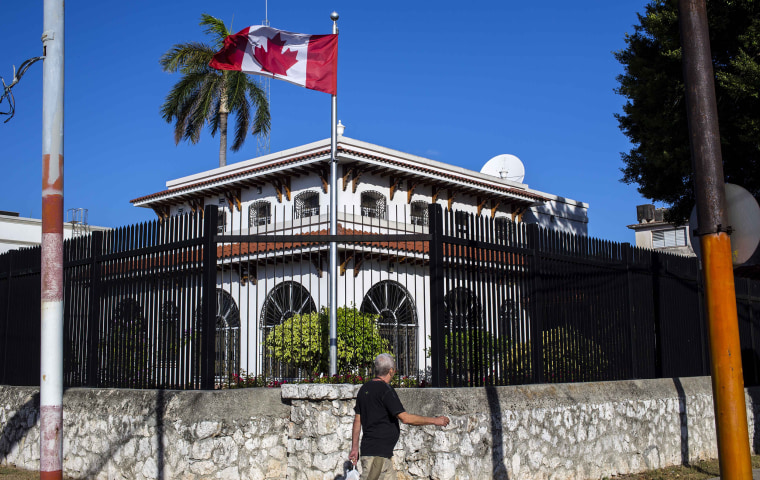
Image: Canada Embassy in Cuba
Canada's embassy in Havana, Cuba   Desmond Boylan / AP file

Eight Canadian diplomats who were posted to Cuba with their families and who experienced sudden, strange inexplicable 'attacks' of unknown origin that left them in a state of psychological and brain-physically imbalance have decided to take the Department of Foreign Affairs to court, joining a $28-million lawsuit against the Government of Canada. For neglect, among other issues, for lack of concern, lack of action, lack of full disclosure, lack of practical support when they were left vulnerable and ill, unable to live their normal lives because of exposure to a peculiar and unknown 'weapon' aimed strategically at American and Canadian diplomats posted to Cuba. 

Dalhousie University in Halifax took the lead in examining the diplomats' symptoms in an effort to understand and discover what it might have been that attacked them and affected their brains in the process. The government itself through its Department of Foreign Affairs (renamed Global Affairs by this government) did nothing to investigate the issue and even seemed to doubt the credibility of the sufferers, and nor did they arrange for medical treatment and follow-up for any of the diplomats or their dependants.

Leaving the diplomats and their families that accompanied them to Havana and shared the horrible experience, to fend for themselves, to seek out medical treatment in an effort to identify the problem and find a solution to their illness. In the experience of the diplomat quoted above who had requested anonymity, he was re-posted to Havana after being tested at Dalhousie University's Brain Repair Centre. A report was sent to Foreign Affairs on his condition, but it was never divulged by Foreign Affairs to him personally.

Instead, he was re-posted to Cuba. His formerly mild symptoms worsened considerably while he was in Cuba until he reached the point where he could no longer function at the Canadian Embassy in Havana due to the severity of the illness he finally succumbed to; memory loss, cognitive difficulties, dizziness. When he contacted the Canadian government for medical assistance he was returned to Canada and sent back to Dalhousie for urgent testing. A letter confirming him to be case No.15 in the Havana syndrome file of the government reached him.
 
What is 'Havana Syndrome"? - Stellar IAS Academy
Stellar IAS Academy
 
His neurological and other medical symptoms were originally reported back in 2016, when the syndrome first appeared, targeting American and Canadian Embassy staff. Diplomats concerned sent a letter to the Minister of Foreign Affairs last month, which pointed out that the department's actions worked "to diminish and distort what happened to Canadian diplomats for an agenda unconnected to their or their families' well-being". A meeting they had was "a disheartening reminder of the delays, mismanagement, half-truths and empty promises we have faced since 2017".
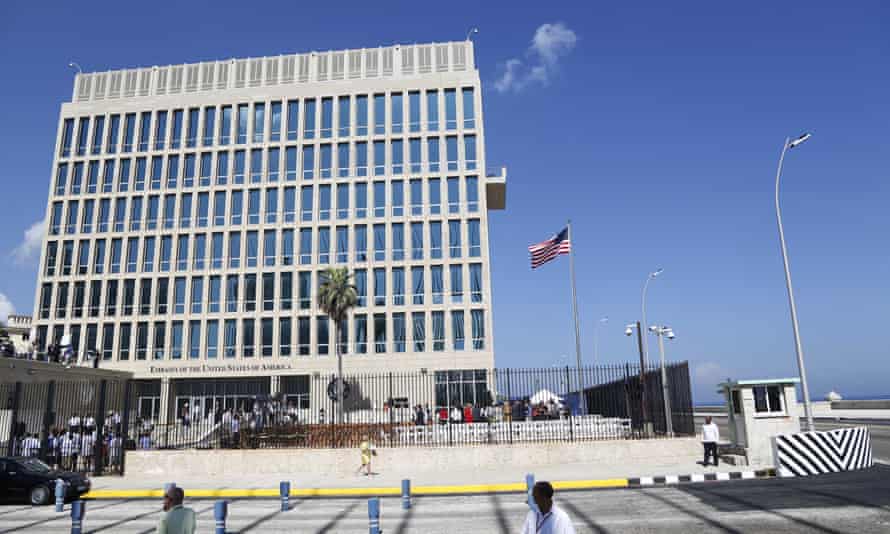
 
A US flag flies at the embassy in Cuba, where cases of Havana syndrome were first reported.
A US flag flies at the embassy in Cuba, where cases of Havana syndrome were first reported. Photograph: Desmond Boylan/AP
 
In the United States, authorities have aggressively investigated their cases of Havana syndrome among U.S. diplomats and other staff, including the CIA. U.S. numbers affected were put at 130, which included cases out of Europe, Asia and Cuba, according to a recent New York Times report. One American report concluded that the mysterious neurological and hearing symptoms were likely targeted microwave attacks, a find not shared by the Government of Canada.

A Dalhousie University study from 2019 suggested neurotoxins might have been involved, used to fumigate diplomats' housing, a suggestion rejected by the diplomats, that there is no research to support the theory and nor does it clarify why other nationals were not affected. Pesticides was rejected by the National Academy of Science in the U.S., as a possible cause. Another theories is that of mass hysteria, none of them having the credibility of microwave attacks being the source of the inexplicable illness with its neurological symptoms.

The unnamed diplomat continues to struggle with cognitive and memory issues, along with tinnitus and sleep problems, taking medication for cognitive impairment. His cognitive deficit is between 25 to 30 percent, he explains, and his career has been "put on a shelf", while he now prepares to retire. As far as he and other diplomats are concerned, the only explanation that makes sense is that put forward by the U.S. National Academy of Science report, that directed energy is the likely cause of Havana syndrome.

The group action lawyer, Paul Miller,  points out as well that children posted with their parents to Cuba who suffer similar symptoms have received no substantial testing or treatment, their families left largely to fend for themselves; that despite being employees along with their families of the Department of Foreign Affairs -- which incidentally recently posted notice of its intention to expand in Cuba, despite not yet solving the dilemma causing brain injuries suffered by diplomats and their families -- the situation has left them in a quandary and feeling "abandoned"..

Diplomats sue Canada over 'Havana Syndrome' from sonic attacks - UPI.com
"Since the beginning of the health incidents, the health, safety and security of our diplomatic staff and their families remains a priority."
"Global Affairs Canada maintains a strict security protocol to respond immediately to any unusual events affecting Canadian diplomats or their families posted to a mission abroad."
Global Affairs Canada spokesperson Christelle Chartrand

Labels: , , , ,

Tuesday, February 26, 2019

Canadian Diplomats Suing Their Government

"Throughout the crisis, Canada downplayed the seriousness of the situation, hoarded and concealed critical health and safety information, and gave false, misleading and incomplete information to diplomatic staff."
"[Global Affairs] actively interfered with the plaintiffs' attempts to receive proper health care, including going so far as instructing hospitals to stop testing and treating them."
"Despite knowing of the risks of Havana Syndrome early on, Canada continued to put its diplomats and their families in harm's way by sending them to Havana and requiring them to stay there despite becoming aware of the high and growing risk that they would sustain the brain injuries associated with Havana Syndrome."
Statement of Claim, $28-Million Lawsuit

"We knew there was something [happening] but we just couldn't figure out what was going on. Living in Cuba [as diplomatic staff] we understood that our houses were bugged."
"It just hit me, 'Holy crap, this [symptoms such as nausea, headaches, nosebleeds, hearing and eye problems from an unknown source] is going on in my house'."
"At the low point, I thought I was going to throw up. I was nauseous like you wouldn't believe. I don't know whether I went back to sleep or passed out."
Diplomat Allan (names withheld)

"My belief 21 months later is that decisions were made that simply did not prioritize us, not our health, not our safety and not that of our families."
"I am angry, yes. I am disappointed and I am sad. I am sad because there is no justification for not having considered the personal and lifelong impact this was going to have on us."
Diplomat Baker (generic names used for anonymity)
A view of the Canadian Embassy in Havana, Cuba, on Thursday, Oct. 29, 2009. (Franklin Reyes/Associated Press)

Five Canadian diplomats assigned to posts in Cuba, and 14 of their family members have filed a law suit against the federal government resulting from the mysterious illness they suffered while posted to Cuba and living in Havana. According to the suit the Canadian government which is responsible for the well-being of all Canadians and in particular their staff abroad, failed to inform, protect, treat and support them at a time of need.

Canadian families in Havana, the lawsuit states, "have been targeted and injured, suffering severe and traumatic harm by means that are not clear but may be some type of sonic or microwave weapon". And nor have Canadians been the sole targets. In fact American diplomats have been exposed and have suffered identical symptoms and injuries in their posting to Cuba. The affliction they all suffer from is now known as Havana Syndrome.

The government of Cuba claims to be just as mystified regarding the source of the syndrome as the U.S. and Canadians. Co-operation between all three governments to find the source of the problem has been welcomed, but no answers to the questions have resulted. The United States decided to dramatically reduce the number of diplomatic staff until such time as the matter can be more fully understood. It took Canada quite a while longer to decide not to permit family members to accompany diplomatic staff assigned to Cuba to accompany them.

Two years ago healthy diplomatic staff and their family members were beginning to experience peculiar symptoms; nosebleeds, headaches that appeared to have no explanation. Excruciating headaches would afflict them upon waking in the morning followed by nausea and problems with vision. The Allen family received no warning or information from the embassy or from Global Affairs, but a neighbouring U.S. diplomat who knew of the problem and whose own experience echoed that of the Allens, disclosed the situation to him.

Their feelings of fear, extreme irritability, nausea, headaches, nosebleeds had an unknown cause, but the situation was known to those who had earlier gone through the trauma. At the point when Allen was informed he was also told that a dozen Americans had been evacuated from Havana once it was ascertained that something strange was causing them to suffer those headaches, nosebleeds, hearing and eye problems. The Americans too were sworn to secrecy about the issue.

Eventually the Allen family was sent to the University of Miami for testing. A doctor there had examined about twenty Americans with similar symptoms, who had also been based in Havana. He diagnosed all four members of the Allen family with traumatic brain injuries similar to symptoms from concussions, recommending the children not return to Cuba: "They need to be away from Cuba for awhile".

Yet according to the lawsuit the Canadian embassy refused to send the Allen children back to Canada. The very fact that the Canadian diplomatic staff who knew about the situation were ordered to be silent about the issue, not to discuss anything with other staff newly arrived, knowing nothing of what was transpiring, did not impress these newly-diagnosed Canadians very positively.

Another diplomatic family, Diplomat Davies, wife and two young children were experiencing strange things in their house in Havana in the spring and summer of 2017 where the young daughter was increasingly unable to concentrate at school, suffering from nausea, tinnitus, sensitivity to light, visual impairment and sudden nosebleeds. Mrs. Davies lost her sense of balance, reported hearing high-pitched sounds. "I no longer knew where was up and where was down", she informed her husband after a strange fall.

She was diagnosed with damage to her vestibular system; parts of the inner ear and brain that process sensory information, was hypersensitive to light and noise, suffered from headaches, dizziness and muscle twitching. By all these accounts it is manifest that the government of Canada has failed in its obligation to its employees, to keep them safe from harm and to respond to their needs. The diplomats and their families are now undergoing tests at Dalhousie University's Brain Repair Centre.

The research and tests there have pointed out leakages in their blood brain barriers consistent with symptoms of concussions. When Global Affairs appeared to hesitate about the need to ensure that these people were given swift medical attention, several of the families travelled to University of Pennsylvania after officials there had offered to assess and treat Canadians, but the offer was turned down by the federal government.

All sound reasons to demand attention and remedial action, even if it was recognized that such would only be forthcoming through the compelling action of a lawsuit.

Labels: , , , , , ,

() Follow @rheytah Tweet