When Belligerent Push Comes to Dangerous Shove
When Belligerent Push Comes to Dangerous Shove
"There will be confrontation, this will be the next step, [previously banned weapons] will appear from our side. They don't exist now, we have a unilateral moratorium."“They believe they can act as they need, to their advantage, and we simply have to swallow all this and deal with it. This is not going to continue. Our response will be military.""If NATO sticks with the position not to negotiate about a deal, then we will certainly see Russia deploy the Screwdriver missile at its very western border.""Currently, [these banned weapons] do not exist; we have a unilateral moratorium. We call on NATO and the United States to join this moratorium. They just don’t respond to our proposals.""There’s basically no trust in NATO. Therefore, we’re no longer playing this kind of game and don’t believe NATO’s assurances."Sergei Ryabkov, Russian Deputy Foreign Minister"We are convinced that Russia is actually preparing for an all out war against Ukraine. It's an unprecedented event probably since the Second World War."Gabrielius Landsbergis, Lithuanian Foreign Minister
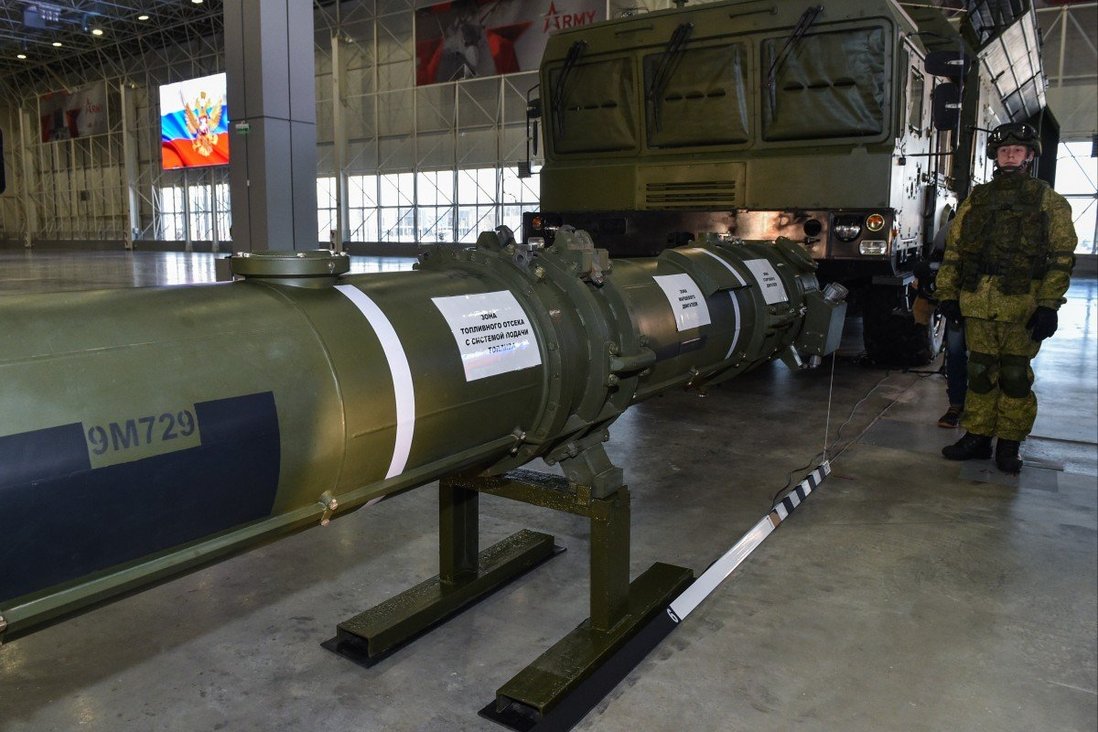 |
IMAGE SOURCE: AFP Russian defence officials show off the 9M729 cruise missile in Moscow. |
To
state that matters between the West and Russia are growing increasingly
tense is to understate the situation. Moscow feels it has been pushed
too far, and it is not -- and never will be -- in the mood to be pushed
around and meekly assent to directions and determinations made elsewhere
than in the Kremlin; certainly not any order issued through NATO
directed by the United States. And while it denies strenuously that
there is any intention of invading Ukraine to achieve reunification with
Russia, it also portrays itself as a misunderstood victim of U.S.-led
machinations.
Moscow
doesn't like being pushed around and it just isn't going to take it any
more. The discussions that took place between Vladimir Putin and Joe
Biden, frank though they may have been without unleashing dire threats
to claims and counter claims left Mr. Putin unsettled at the arrogance
of the West presuming they could dictate to Russia whom it could
intimidate and enfold into the Russian Federation; a temporarily-strayed
geographic satellite obsessed with U.S.-directed visions of
sovereignty.
But
the nerve of NATO's actions on Russia's near-abroad rankled and
festered and grew to a warning that enough was enough, for Moscow.
Warning NATO that it would never countenance the placing of missiles on
east European soil facing Russia as a threat to its own stability and
future plans for imperial Russian rebirth, Russia which recently boasted
that its stable of advanced technological hypersonic weaponry is
unmatched by any other country now advises its intentions to employ
missiles facing Europe.
Intermediate-range
nuclear missiles with a top range of over 3,000 miles, feasibly capable
of striking European capitals. This, in response to NATO should it
refuse to pledge to Moscow's satisfaction that it would never make use
of its nuclear weapons. These are the same missiles banned in a treaty
signed in 1987 between Russia and the US, which Washington's Trump
administration chose to leave the agreement in 2019, claiming Russia had
breached the treaty.
And
no, Russia is definitely not in the planning stages of an invasion
against Ukraine. It has the sovereign right, after all, as Mr. Putin
pointed out archly, to move its troops anywhere it chooses on Russian
soil. But Moscow is prepared to "respond militarily" should NATO
continue its eastward expansion; above all offering to admit Ukraine as a
member of the military alliance of the North Atlantic Treaty
Organization. Which should remain focused on North Atlantic nations of
the west, its original intent.
NATO's
military allies on the other hand are growing increasingly fearful of
Russia's intentions to send the troops it is continuing to mass on its
border with Ukraine, in a massive invasion with the purpose to repeat
the 2014 annexation of Crimea. Leading U.K. Prime Minister Boris Johnson
to state once again with EU chiefs that Moscow would face "serious
consequences" should it encroach further within territory clearly part
of Ukraine's sovereignty.
What
Moscow is engaging in is an entitlement game that has led EU foreign
ministers to agree to sanction targets linked to the Wagner Group, the
private Russian military firm, now hit with punishing sanctions in
response to destabilizing Ukraine and parts of Africa. Founder Dimitry
Utkin, a former Russian special forces commander, along with a handful
of others with ties to the mercenaries have asset freezes and travel
bans imposed on them.
Russia's
Federal Security Service, the successor to the dreaded KGB, of which
Vladimir Putin was once an intelligence operative, claimed to have
arrested 105 supporters of a Ukrainian neo-Nazi youth group which it
asserts planned attacks and mass murders, along with proposed attacks on
educational institutions. All of which Ukraine labels as information
warfare. It is when violent words migrate toward violet action that the
world should shudder.
 |
Labels: Belligerence, European Union, Invasion, NATO, Russia, Sanctions, Threats, Ukraine, United States
posted by Pieface | 8:58 PM
|
0 comments


/cloudfront-us-east-1.images.arcpublishing.com/tgam/POQVJVUKJVACPD22XCSJBA2ACE.JPG)