This is a blog dedicated to a personal interpretation of political news of the day. I attempt to be as knowledgeable as possible before commenting and committing my thoughts to a day's communication.
"The Azrieli Foundation is a passive minority shareholders of the Azrieli Group. As a responsible investor, based on our knowledge and information, we can confirm that the Azrieli Group's activities are entirely within Israel's internationally recognized borders."
"I am particularly saddened that ongoing attempts to disparage the Foundation have impacted many of the artists, creators and organizations that we have supported over the years in Canada."
Naomi Azrieli, Azrieli Foundation chair
"[It's up to the Giller if it's] interested in rebuilding any sense of trust with writers and readers."
"We imagine some authors who have boycotted might submit their works again, and others might not."
CanLit Responds organizer Michael DeForge
Protesters gather in Toronto to demonstrate against the Giller Award ceremony in November 2024. (Eduardo Lima/The Canadian Press)
Once again pro-Palestinian propaganda groups that promulgate a version of history and reality that is their very own perception, unreflective of reality, has succeeded in wearing down the sponsors of the Giller Prize group through a literary event boycott. Their mission is to wreak havoc within any group that hints of a relationship with Israel, portraying them as complicit in the suffering of Palestinians at the hands of the Israeli government.
That Palestinian leaders have for generations incited the Palestinian population to view Israel and Jews -indigenous to the land -- as enemies, as usurpers of Palestinian land, colonists who have no right to claim land as theirs, thus depriving the Palestinians of what is rightfully theirs, and in the process teaching their population from childhood forward that to desire martyrdom in the cause of achieving Palestinian statehood where Israel sits and beyond, is the greatest of aspirations in honour of the Islamic faith. That heroic status of martyrdom theirs, with the commission of murder of Jews.
This is the ideology of victimhood that supporters of the 'Palestinian cause' celebrate, support, and choose to harass and persecute Canadian Jews, their organizations and very presence in support of. That Israel exists on its own ancestral land, that Jews gratefully accepted a Partition Plan proffered by the United Nations and the Palestinians rejected that offer, is of no concern to Western apologists for Palestinian terrorism, who prefer to portray them as victims of Israeli 'occupation'. An 'occupation' necessitated by constant Palestinian lethal attacks, random or organized, on Jews in Israel.
The equivalent of the lethal attacks in the Middle East verbally now take place regularly in the West, with slanderous accusations of 'genocide' levelled against Israel and the IDF in its retaliation for the worst slaughter of Israelis carried out in southern Israel by terrorist groups from Gaza, led by Hamas. That would be the Hamas which, though on Canada's official terror list, is considered a liberating army by the persecutors of Canadian Jews and their organizations.

A prestigious
Canadian literary prize halted its partnership with Scotiabank
after nearly 20 authors pulled their books from consideration to protest
the bank's investment in an Israeli defence contractor. CBC
CanLit Responds is one of those groups, proud of its efforts to demonize Israel and by extension any group or organization or individual in Canada with links to Israel. CanLit Responds, comprised of like-minded anti-Israel haters, a literary group of Canadian writers who have in the past benefited from association with the Giller Prize, blackballed the Giller to the point where it now announced no sponsorship ties to Scotiabank or the Azrieli Foundation, through an announcement from its executive director Elana Rabinovitch.
At the same time, Indigo Books, which has also been a target of pro-Palestinian groups for its charitable arm in Israel that offers higher educational opportunities for Israeli soldiers, foreign volunteers without family in the country, has been identified as well in the Giller announcement to the effect that it was never a sponsor, only a promotional partner, by highlighting Giller-prize authors on shelving displays highlighted in their stores.
CanLit Responds claimed to represent hundreds of writers when they launched their boycott in 2024 over Giller sponsors' links to Israel. Scotiabank had been the naming sponsor of the $100,000 prize for two decades, but when protests surfaced in 2023 after the October 7 massacre of Israelis by Palestinian terrorists over its subsidiary's investment in an Israeli arms manufacturer, Scotiabank and the Giller Foundation delinked their association.
That alone failed to satisfy the CanLit organizers who insisted that the boycott would remain in place as long as the Giller Prize was linked to either Indigo or the Azrieli Foundation, taking issue with Indigo's charity of scholarships for former IDF soldiers. Giller, responded Rabinovitch, "has never received money" from Indigo. Citing the Azrieli Foundation's connection to Israeli real estate company Azrieli Group, with minority holdings in Bank Leumi, it was also in the CanLit crosshairs.
It was later explained by Rabinovitch that the Azrieli Foundation's contract with the Giller ended in 2025. The foundation and prize continued to operate in 2025, she stated, with "a one-time 'bridge' gift and two smaller donations from individuals and foundations who wish to remain anonymous", allowing the Giller to carry on for the 2026 prize event.
Pro-Palestinian
activists are calling for a national day of action and boycott against
businesses tied to Israel's actions in the occupied West Bank and Gaza.
Supporters of Israel call the movement antisemitic.
"The Azrieli Foundation remains deeply committed to supporting arts and culture in Canada and we are proud of our collaboration with the Giller Prize."
"It was not ended because of pressure from activist groups. In fact, we remain open to new opportunities to collaborate in the future."
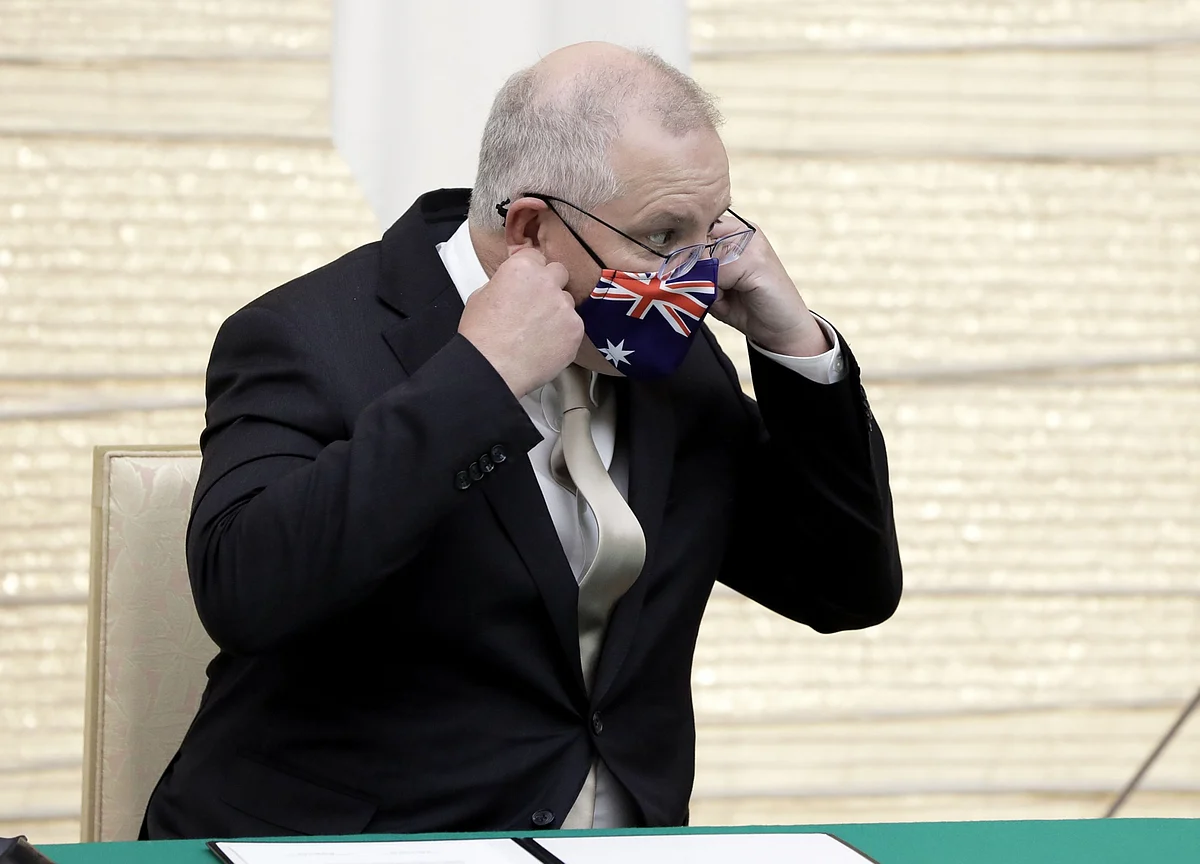
"We won't be compromising on the fact that we'll set what our foreign investment laws are, or how we build our 5G telecommunications networks, or how we run our systems ... that are protecting against any interference."
"We will always set our own laws and our own rules according to our national interests -- not at the behest of any other nation, whether that's the U.S. or China or anyone else."
Australian Prime Minister Scott Morrison
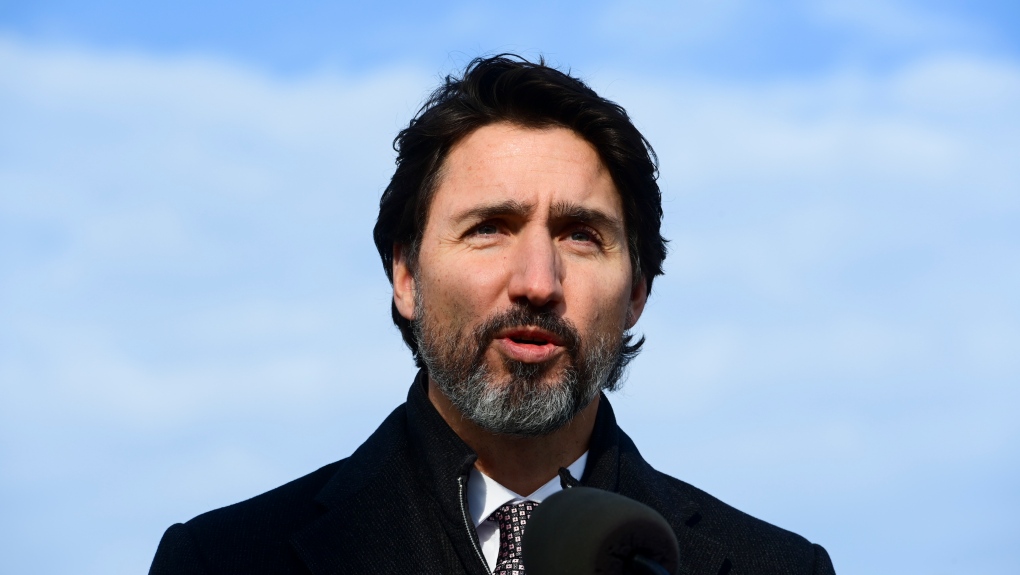
Prime Minister Justin Trudeau CP/Sean
Kilpatrick
"Do I regret that Canada followed its laws? Do I regret that Canada lived up to a long-standing extradition treaty with our closest ally? Absolutely not."
"Canada is a country of the rule of law. And obeying those laws can't just be when it's convenient or when it's easy. If you're a country of the rule of law, if you're a country of values, you need to stick up for those. And that's exactly what we're doing."
"In the face of pressure and increasingly coercive moves by one of the world's great powers, I think that really highlights at which point we need to be working together as allies, as neighbours, as friends, as countries."
"Very few countries could stand up on its own to a superpower, to a great power. But working together in alignment, we can make sure there is a recognition that the path that China is choosing to take right now is probably not going to be as effective -- even for them -- as they think it will."
Canadian Prime Minister Justin Trudeau
"[The government must] make a decision on Huawei's involvement in Canada's 5G network within 30 days [and] develop a robust plan, as Australia has done, to combat China's growing foreign operations here in Canada and its increasing intimidation of Canadians living in Canada [within 30 days]."
House of Commons Opposition Conservatives
"We are aware that China is, and will remain, an important commercial partner for Canada."
"China is also a significant source of tourists and students to Canada, and brings economic and enriching social benefits across our nation."
Foreign Minister Francois-Philippe Champagne
Sing4DemocracyHK protest outside the Court of Final Appeal in Hong Kong (Anthony Wallace/AFP/Getty Images)
Australia and Canada have displeased China mightily. China awaits both countries to come to their senses and that would entail sincerely apologizing to Beijing for their intransigent wrong-headed views on China regarding many issues, inclusive of Hong Kong, Uighurs, Huawei, Chinese benevolence, Chinese cyber espionage, copyright infringement, and above all, COVID-19. Beijing's release this week of a list of 14 grievances with Australia put matters out in the open down under when a Chinese official spoke on record to an Australian reporter: "China is angry. If you make China the enemy, China will be the enemy."
According to Australian sources the list of grievances includes instigating an investigation in the United Nations regarding the spread of COVID-19 at the turn of 2020, cancelling Chinese student visas as a COVID-aversion safety measure, blocking Chinese investments in Australia, leading international focus on violation of human rights by China and the banning of Huawei from contributing to the Australian 5G telecommunications network upgrade. All hostile actions guaranteed to poison relations between China and Australia; the latter the aggressor, the former the victim.
Australia's Prime Minister made it abundantly clear that Australia's sovereign decisions are not up for discussion much less explanation or apology to the world's number one natural resources-hoarder, trade colossus, and cybertheft expert. Australia puts its words into action and lives with the consequences, unwilling to be bullied and coerced into pleasing or pleading with the Chinese Communist Party for concessions and forgiveness.
G20 Leaders photo, Riyadh on Friday.Getty Images
Canada's Prime Minister enjoys grabbing the limelight as a victim whose defence of justice and the rule of law has occasioned Beijing's wrath and imprisoned two innocent Canadians for the past two years, charged with threatening China's security, in retaliation for the detention of Meng Wanzhou, CFO of Huawei, on a U.S. extradition request. Canada has appealed to other APEC nations to support Canada in a joint rejection of Chinese bullying in the hopes that Xi Jinping would be confronted at this weekend's G20 Saudi-hosted virtual gathering.
But is Canada prepared to go it alone, to stand up for its sovereign rights as its Prime Minister boasted? It remains the only Five Eyes intelligence-sharing nation to leave open the question of whether Huawei will be included in Canada's 5G telecommunications upgrade, fearful of Beijing's explosive wrath, whereas Australia, New Zealand, the United Kingdom and the United States have all clearly stated their positions to shut out Huawei citing obvious security reasons.
Canada, on the other hand, saw fit to award a standing offer for conveyor-style X-ray machines to Nuctech, a Beijing based company partially owned by the Chinese government, once operated by the sun of the former General Secretary of the Chinese Communist Party. Canadian, American and British companies all competed for the standing offer, but it was Nuctech who won the tender including delivery, installation, operator training and software training at Canadian embassies located world-wide.
It was only when a national newspaper broke the news of the contract that the federal government committed to a review once the contract was exposed, and ultimately decided not to buy Xray machines for Canadian embassies from the controversial Chinese firm. But it turns out that the Canadian Border Services Agency had already bought and installed Nuctech X-ray machines:
"We have a number of mitigating interventions that we put in place around this technology. One of the first ones is obviously to keep it disconnected from our networks and from any Government of Canada networks ... the second is (anyone) affiliated with any of our suppliers would be screened through security processes and would be escorted on site if they were present in our facilities", explained the vice-president of the CBSA;s intelligence and enforcement branch.
Why go through all this rigamarole necessitated by the use of the machines to begin with? To do otherwise, it would seem, would be to offend Beijing. Who could easily retaliate as they have done with holding two Canadians they've charged with espionage as hostages to force the release of the Huawei executive. China also flexed its trade muscles when it refused Canadian pork exports and canola products, both commodities that enjoyed a heavy trade prior to the Huawei affair.
All of this in light of Canada's Communications Security Establishment's Canadian Centre for Cyber Security releasing a new report in which Russia, North Korea, Iran and China are listed as cybersecurity threats to Canada. An earlier report by the National Security and Intelligence Committee of Parliamentarians pointed out that China and Russia are using their diaspora, undercover agents and
groups based on Canadian campuses as part of "significant and sustained"
foreign interference campaigns in Canada, according to a redacted
intelligence report.
"The committee believes that these states target Canada for a
variety of reasons, but all seek to exploit the openness of our society
and penetrate our fundamental institutions to meet their objectives."
"They
target ethnocultural communities, seek to corrupt the political
process, manipulate the media, and attempt to curate debate on
post-secondary campuses."
"Each of these activities poses a significant
risk to the rights and freedoms of Canadians and to the country's
sovereignty: they are a clear threat to the security of Canada."
"[This] so-called genocide [is] a rumour and a farce
fabricated by some anti-Chinese forces to slander China."
"Its
groundless statement [committee report] is full of lies and disinformation. {Parliamentarians would do well to] avoid doing any
further damage to China-Canada relations."
"This is blatant
interference in China's internal affairs and reflects those Canadian
individuals' ignorance and prejudice. China firmly deplores and rejects
that."
"[The installations are] vocational training and education
centres [where religious] extremists [are educated in the] national
common spoken and written language, legal knowledge, vocational skills
and de-radicalization."
"The aim is to eliminate the root cause of terrorism and extremism."
Zhao Lijian, spokesperson, Chinese foreign ministry
In this photo, a guard tower and
barbed wire fence surround a detention facility in the Kunshan
Industrial Park in Artux in western China's Xinjiang region. (Ng Han Guan/AP Photo)
Australia’s and China’s flags Mike Bowers/The Guardian
"[Australia had been a great beneficiary of China's economic growth, but] as countries develop they have a responsibility to uphold a stable, prosperous strategic balance in our region."
"China's economy is stronger because they have access to high quality energy, resources, agricultural goods and increasingly services from Australia."
"And our economy is stronger because we have access to high quality manufactured goods from China."
Australian Prime Minister Scott Morrison
"Chinese companies do not buy Australian commodities, goods or services because they want to do this struggling little island nation a favour -- they do it because it's good value, good quality."
"So much of the Australian business community, faced with criticism or a difference of opinion between Australia and China, will side with China."
"[But], there has been an awakening."
Former Australian Prime Minister Malcolm Turnbull
"Obviously he [Australian home affairs minister Peter Dutton] must have also received some
instructions from Washington requiring him to cooperate with the US in
its propaganda war against China … [calling for an international inquiry into China's handling of the SARS-CoV-2 virus] Some Australian politicians parroted
what those US forces have said and followed them to launch political
attacks on China. Their move reveals the former’s ignorance and bigotry
as well as a lack of independence, which is sad."
"It is well known that recently some people in the US including
high-level officials have been spreading anti-China ‘information virus’.
Their aim is to shift blame and deflect attention by smearing China."
Chinese Embassy official
"I think in the long term ... if the mood is going from
bad to worse, people would think, ‘Why should we go to such a country
that is not so friendly to China?’ The tourists may have second
thoughts. The parents of the students would also think whether this
place which they found is not so friendly, even hostile, whether this is
the best place to send their kids here. It is up to the people to
decide. Maybe the ordinary people will say, ‘Why should we drink
Australian wine? Eat Australian beef'?"
China’s ambassador to Australia, Cheng Jingye
People walk past a tree with a mask and eyes stapled on it, in Melbourne, on 20 April 2020. (William West/AFP)
Australia has a free trade deal with its largest trading partner to which it exports substantial amounts of coal, natural gas, wine and agricultural products, China's prosperity affects Australia's as it exports its goods to the number two economy of the world. The two countries had good diplomatic relations and two-way trade was robust. Not so much in the diplomatic sphere right at the moment, however, and as for trade, it remains integral to both countries' ongoing march into the future, but it's wobbling slightly.
Among other things, China's aggression toward its neighbours and its assertions of geographic hegemony have startled those neighbours, Australia among them as it debates around the cabinet table how best to preserve sovereignty while fending off efforts on China's part to interfere in Australian politics. Australians have been warned of an increase in cyberattacks, and a national security test for foreign investments has been introduced accompanied by a dramatic rise in defence spending with a focus on the Indo-Pacific region.
The government of Australia is decidedly nervous over Beijing's efforts to undermine democracies through its disinformation campaign, and the Chinese Communist Party's move to impose its security law on Hong Kong has done nothing to reassure Canberra. What has set China and Australia on a collision course however, was the move by Canberra to lobby world leaders for an inquiry into the origins of the global pandemic. Within the UN 137 member-nations saw fit to co-sponsor a resolution at the World Health Assembly for an investigation.
Beijing's immediate reaction was trade diplomacy in the form of sanctions on Australian products, suspending beef imports on a technicality and blocking barley trade with Australia; a process very well known to Canada which also mightily displeased Beijing with its adherence to an extradition request by the U.S. for Chinese technology giant Huawei's CFO. China's foreign ministry called on Australia to "abandon the Cold War mentality". At stake is the two-way trade with a value of $172 billion annually, and a $51 billion trade surplus for Australia.
Iron ore has not yet been slapped with any inappropriate protectionist trade measures as punishment and for a good reason, with the ore-hungry behemoth receiving 60 percent of Australian iron ore, critical to support an economy struggling to get back to full capacity. "China is never going to impose any economic measures against Australia which damage its own interests", pointed out former Labour prime minister Kevin Rudd, also realistically admitting that Beijing can target imports beyond iron ore, unessential to China. An example: Cheng Jingye's threat to boycott Australian wine, beef and tourism.
Australian public sentiment toward China has been sourly diminished as pointed out by an annual Lowy Institute poll which found trust in China plunged to 23 percent in comparison to a 2018 survey when it stood at 52 percent. Not helped when Beijing refused recognition of a 2016 international court ruling that it had no historical claim over disputed islands in the South China Sea -- when the Turnbull government rebuked China alongside Washington. And nor does a growing awareness of Chinese infiltration of Australian business interests.
When Australia became the first country to officially ban Chinese tech giant Huawei from its next-generation 5G telecom network based on grounds of national security it signalled other countries in the 'Five Eyes' western alliance of Great Britain, the United States, Australia, New Zealand and Canada, to do likewise. Only one now remains to make its decision public.
“Australia is always there, making trouble. It is a bit like chewing gum stuck on the sole of China's shoes."
"Sometimes you have to find a stone to rub it off."
Hu Xijin, the Global Times editor
Royal Australian Navy helicopter frigate HMAS Parramatta (top right)
conducts officer of the watch manoeuvres with amphibious assault ship
USS America (top middle), guided-missile destroyer USS Barry (top left)
and guided-missile cruiser USS Bunker Hill (right) in the South China
Sea, as pictured in this photo taken on 18 April 2020. (Australia
Department Of Defence/Handout via Reuters)
"The Chinese Communist Party's political persecution and arbitrary detainment of these two Canadian citizens [Michael Kovrig and Michael Spavor], while Canada continues to uphold the rule of law in the case of Meng Wanzhou, only reinforces the international community's concerns about the CCP's complete disregard for individual rights and the fair and just application of the law." "[China must] immediately release and drop all charges] against the two, arbitrarily detained for over 550 days on spurious charges of espionage]. [Their] arbitrary detention and confinement in inhumane conditions is deeply troubling." U.S. Senators from Idaho, New Jersey, Colorado, Delaware
"What I learned also is that China doesn't adhere to the Geneva Convention on the treatment of prisoners. And so I'm not surprised to hear also that just from watching the news that maybe the two Michaels are not getting that sort of attention as well." "My husband wouldn't have had consular assistance because he was a Chinese citizen. However, the Stephen Harper government was very good. They received the campaign letters that were being sent to them and then his office would forward them to the office of the ambassador to China from Canada at the time, which [sic] was David Mulroney. And he was amazing." Karen Patterson, ex-wife of previous Chinese detainee
People hold signs calling for China to release Canadian detainees
Michael Spavor and Michael Kovrig during an extradition hearing for
Huawei Technologies Chief Financial Officer Meng Wanzhou at the B.C.
Supreme Court in Vancouver March 6, 2019. (Lindsey Wasson/Reuters)
Seized by Chinese authorities in December 2018, in response to the arrest of Huawei chief financial officer and daughter of the technology giant's founder on a U.S. extradition warrant in a clear act of political retaliation in a matter of law and justice, the two Canadian men are being kept incommunicado, unable to contact their families, denied access to lawyers and consular services as well, while being subjected to psychological torture. While Huawei executive Meng Wanzhou, on bail, lives in either of her two Vancouver mansions, awaiting eventual extradition.
The Liberal government of Prime Minister Justin Trudeau has been tripping over eggshells ever since the two men's arrest and the death sentences meted out to two other Canadians accused of drug smuggling, Beijing's pressure tactics, along with the halting of imports of Canadian Canola products into China, and the imposition of onerous duties on other agricultural products, punishment for Canada's insubordination to China's entitlements. Canada's Prime Minister expressed his "disappointment" last Friday in the wake of official espionage charges laid by Beijing.
Rather than imposing counter-measures to counteract China's bullying, the Trudeau government has trod lightly, fearful of provoking Beijing into ever more egregious offensives. "It has been obvious from the beginning that this was a political decision made by the Chinese government, and we deplore it and have from the very beginning", Trudeau finally stated. Yet no measures were even taken to match those of Beijing in punishing Canada for honouring its extradition agreement with the United States.
A Chinese foreign ministry spokesperson in Beijing, Zhao Lijian, responded to Justin Trudeau's milquetoast demeanor: "China urges the relevant Canadian leader to earnestly respect the spirit of the rule of law, respect China's judicial sovereignty and stop making irresponsible remarks"; righteously insulting scolds that Beijing is so clumsily addicted to, in its sanctimonious belief that the entire world owes it obeisance, and should apologize for all the underhanded mischief that Beijing imposes on the world order.
Calling for Canada's justice minister to intervene in the case, saying that "discretion" is "expressly codified" in the
Extradition Act, a Toronto lawyer retained by Michael Kovrig's wife urges Ottawa to release Meng Wanzhou to have the two Michaels freed thus acceding to Beijing's demands: "This shows that the Canadian government can actually handle this
incident in a just manner according to Canadian law. Once
again we urge the Canadian side to earnestly respect the spirit of rule
of law, treat China’s solemn position and concerns seriously, stop
political manipulation, immediately release Ms. Meng and ensure her safe
return to China", Zhao iterated.
India is currently facing another kind of challenge that China regularly imposes on its neighbours in its never-ending focus on expanding its territorial imperatives to seize land, water and airspace that is shared by neighbouring countries or actually within the sovereign territory of other nations. From the South China Sea to the Himalaya, Beijing extends its malevolent reach, threatening, and bullying while making unsubstantiated claims to ownership of areas not their own. Indian border guards came under attack by their Chinese counterparts last week in the disputed Galwan Valley.
The video, published first by ThePrint, shows troops first
engaging in a close quarter fist-fight and then hurling stones at each
other.
Twenty-three Indian soldiers were killed, and one captain was hurled to his death down the mountainside in a deadly skirmish when the Indian military made an effort to protect its territory from the encroachment of China. Chinese troops annexed 60 square kilometres of land in early May in Ladakh, the cause of the hand-to-hand combat by troops using improvised weaponry, having been disarmed to prevent just such a violent event, through mutual agreement by both nations.
"There is a lot of land which has been annexed by China, not only this time in the Galwan Valley but all along the LAC [Line of Actual Control]. I have been raising my voice, and even meeting with the local administration. They know about it, but neither the government nor the media have raised their voices about it", maintained Urgain Chodon, a councillor for the ruling Bharatiya Janata Party in Ladakh. India's Prime Minister Narendra Modi is left little leeway for action; a military response being interpreted as a battle cry, with the prospect of the two most populous nuclear-armed nations on earth at war.
China prepares itself for all such scenarios. In its bid to match the Global Positioning System of the United States, it has now completed its BeiDou satellite navigation system. Should the U.S. and China ever enter a conflict, the U.S. would now not be able to disable Chinese military systems by blocking access to GPS, since it now has its own. "We are moving from being a major nation in the field of space to becoming a true space power", boasted Yang Changfeng, chief designer of China's $10 billion 3D satellite network.
China has successfully put into orbit the final satellite in its
BeiDou-3 navigation system, further advancing the country as a major
power in space Getty Images
"Recently, certain self-serving political actors who do not hesitate to collude with foreign anti-Chinese powers, luring young extremist activists to be their cannon fodder, have continuously violated the peace of Hong Kong..." The Council of Newcomer Organizations Chinese Canadian Times
"Our taxpayer money should have never been used to fund such organizations and activities." "By doing so, our government is using taxpayers' money to enable CCP [Chinese Communist Party] influence and infiltration into our society and politics." "This is a total betrayal of Canadian voters." Ivy Li, spokeswoman, Canadian Friends of Hong Kong
Chinese Consul General in Toronto, Han
Tao, references the 70th anniversary of the founding of the People's
Republic of China at the 2019 Toronto Dragon Fesitval. Youtube
"[It is] very troubling [that Ottawa helped pay for an event — the Dragon
Festival — that marked a totalitarian state’s anniversary]." "[The Chinese consulate] should be funding the whole thing, and then they can make whatever
speech they want." Cheuk
Kwan, Toronto Association for Democracy in China
Canada has a huge expatriate Chinese-Canadian community, many of whom arrived in the country as early as a century and a half ago, to establish themselves as Canadian citizens, becoming railway workers, small shop owners of dry cleaning establishments, restaurateurs, variety stores, fruiterers, and others. They faced prejudice and oppression but determinedly made their home in Canada, their heritage and culture becoming integrated within the wider Canadian culture, while retaining their heritage.
Canada now hosts thousands of Chinese exchange students more recently entering Canada, as well as more recent immigrants from China whose links to their place of birth remain strong. In the recent (months-long) protests taking place in Hong Kong, the Chinese community has been divided, with many supporting the passion for Hong Kongers's independence, and others intolerant of this view and challenging it, to the extent of considering those supporting the Hong Kong protests against China's full sovereign control, as traitors.
China's global reputation is not quite of benign sterling value. From its exploitation of other nations' natural resources, to its imbalanced trade accounts, and its occupation of other ethnic groups' territories claiming it as their own, to harassing and imprisoning religious groups in China, complete with accusations of organ harvesting and imprisoning of millions of Chinese Uyghurs and Fallon Gong members.
Huawei research and development centre at Dongguan, China.Andy Wong/AP
More latterly, Canada and China, erstwhile partners in trade, have fallen out diplomatically with Canada detaining the CFO of Huawei Technologies on a treaty warrant for extradition issued by the U.S. State Department, to which Beijing responded by arresting two Canadians for 'espionage', and another two Canadians charged with drug smuggling from lengthy prison sentences to death sentences. It has also used a sledgehammer against Canadian export to China of canola products, pork and beef. While threatening 'consequences' should Canada refuse to allow Huawei to partner with Canada's 5G upgrade.
Canada has meekly made representation to Chinese authorities on behalf of the two detained Canadians, Michael Spavor and Michael Kovrig, both held under brutally demeaning prison conditions and 'soft' torture. Canada's unwillingness to react more forcefully under Beijing's bullying where its top government agents studiously ignore overtures from their Canadian counterparts, strikes a sour note when it is revealed that arms of the Canadian government use taxpayer money to help fund official China's activities in Canada.
China practices its indisputable own public diplomacy, advocating abroad for its interests within the global community. And despite the souring of relations between the two countries, over $130,000 in federal funds was awarded a Chinese Canadian group which published an advertisement condemning democracy protesters in Hong Kong in a reflection of Beijing's Hong Kong policy. Clearly this does not sit well with Canadians fuming at the shabby treatment Beijing is doling out to Canadian citizens.
Chinese-Canadian backers of the Confucius
Institute rally SayNo ToCI/Youtube
The supposedly "non-political" Council of Newcomer Organizations which has received Heritage Canada funding was heavily involved in the celebration of the 70th anniversary of the founding of the People's Republic of China with a multicultural grant of $62,000 to the "Dragon Festival" festivities through the Canadian Association of Chinese Performing Arts. To be sure, Heritage Canada proffers similar funding to other Canadian ethnic groups, but none others are as hostile to Canadian values as is China.
The head of the newcomer council founded by Liberal Member of Parliament Geng Tan was invited alongside the head of the performing arts group to fly to Beijing to attend the founding celebration in the Chinese capital. The Newcomers Council executive chairman stated that he wept while witnessing the military parade of China's latest weaponry and marching military through Tiananmen Square in the realization of how much he "loved the motherland". Which is fine, why not? But remember also loyalty to his current country and its democratic values and normatives.
The issue here is that China is engrossed in soft-power outreach, and has no need for Canadian taxpayers to finance its outreach diplomacy. Particularly when it is so insulting to Canadian justice and the values held dear by Canadians. China has its own huge financial resources to support campaigns spearheaded by the United Front Work Department whose activities have come under scrutiny in Canada. It foments unrest between the pro-democracy and the pro-Beijing groups in Canada and spurs the Beijing-supporting groups to harass and threaten the others.
A float with a giant portrait of China’s
President Xi Jinping passes by Tiananmen Square in Beijing on Oct. 1,
2019, to mark the 70th anniversary of the founding of the People’s
Republic of China.Greg Baker/AFP/Getty Image