Politic?

This is a blog dedicated to a personal interpretation of political news of the day. I attempt to be as knowledgeable as possible before commenting and committing my thoughts to a day's communication.

Tuesday, April 09, 2019

Murder ... Is Murder   Justice ... Is Justice

"There is no right to a jury roll of a particular composition, nor to one that proportionately represents all the diverse groups in Canadian society. Courts have consistently rejected the idea that an accused is entitled to a particular number of individuals of his or her race [on a jury or in a jury pool]."
"[If the state] deliberately excludes a particular subset of the population [then rights are violated]."
Justice Michael Moldaver, Supreme Court, Kokopenace decision

"These exclusions [for jury selection: criminal convicted, sitting federal, provincial and municipal politicians, current and former judges and lawyers, medical examiners, police officers all excluded] are acceptable because, in the legislature's reasonable view, there is a substantial possibility that persons in those categories would not be impartial as between an accused person and the Crown."
"The disproportionate effect of the impugned exclusion in the case of Indigenous Canadians points to a shameful feature of modern Canadian society, but it does not cause a jury selected through the application of that exclusion to be unrepresentative; rather, it serves to promote the impartiality of such a jury."
Judge Brian Burrows, Alberta Court of Appeal
Inset: victim of deadly beating, John Hollar on Edmonton LRT, 2012
When an Indigenous man from the Grassy Narrows reserve in Ontario was convicted in 2008 of manslaughter, there were no Aboriginals on the jury, leading the Ontario Court of Appeal to order a new trial. The Supreme Court of Canada overturned the appeal, and reinstated Clifford Kokopenace's manslaughter conviction. This week the Court of Appeal of Alberta referred to that decision when it turned down the appeal of an Indigenous man's murder conviction that he had been denied a fair trial by a representative jury of his peers.

Jeremy Newborn, who mercilessly beat a fellow passenger on the Edmonton LRT in 2012, leading to victim John Hollar's death two days later, appealed his conviction, his lawyer, Simon Renouf, claiming that Mr. Newborn's constitutional rights had been abridged. That being so because anyone with a criminal record is prohibited from sitting on a jury. And that being the case, Aboriginals are disproportionately excluded owing to the simple enough fact that they are disproportionately represented in Canadian prisons.

Aboriginals, making up 3.8 percent of the Canadian population, represent 23.2 percent of the federal inmate population. The jury composition system, insisted lawyer Renouf, is unfair to Aboriginals at trial for criminal offences since the disproportionate number of Indigenous Canadians have criminal records. Back in 2012, 29-year-old John Hollar was a passenger on a transit bus in Edmonton. He was suddenly attacked by Jeremy Newborn, then 32. The attack was viciously unrelenting and led to Mr. Hollar's death.
Jeremy Newborn File

And while Jeremy Newborn pleaded guilty to manslaughter, he pleaded not guilty to second-degree murder, which the Crown refused to accept, and proceeded with criminal charges to trial. Newborn was born with fetal alcohol syndrome resulting in an intellectual disability and he had drug and alcohol addictions, a band member of the Alexander First Nation. His case went to trial in 2014; the jury pool consisted of about 180 people. None among them was Aboriginal.

Newborn's lawyer, Mr. Renouf, objected to the jury makeup, calling a statistician as an expert witness in 2015 following an adjournment permitted to appeal the disparity in the makeup of the jury. Given the population of the city of Edmonton and its Indigenous component, it would be expected that of a group of 178 randomly selected people, approximately nine would be Indigenous, according to the statistician. The trial was re-scheduled as soon as Justice Burrows denied the motion for objection.

The trial proceeded and Newborn was convicted in 2017, given a life sentence without possibility of parole for 15 years. An appeal to the Court of Appeal of Alberta followed, argued on two grounds, one of which focused again on the jury exclusion. The provincial appeal court depended on the Kokopenace decision to reach their own, with the three-judge panel deeming it "an unfortunate consequence" referring to the exclusion of convicted Aboriginals sitting on a jury.

"Even if there is such an indirect effect (on Indigenous people), there is no basis to say it is deliberate", the decision rationalized in its judgment.
A screen shot from an Edmonton Transit System video that was played for the jury at the second-degree murder trial of Jeremy Newborn, 32, and showed the accused repeatedly punching victim John Hollar, 29, as shocked passengers looked on and moved away. Supplied


Labels: , , , ,

Wednesday, March 27, 2019

Defying Islamist Control : Saudi Women Activists

"She wanted to go back and kind of pay back to the women in Saudi Arabia because she had been able to come to Canada, travel, live abroad, gain a new understanding of the world."
"I've kind of been ... in awe."
"She's been charged on a bunch of, in our opinion, bogus charges. And we're obviously getting more and more worried."
Urooba Jamal, freelance journalist, British Columbia
Vancouver-based friends of UBC graduate Loujain al-Hathloul held a photo shoot last fall to show their support for her and other detained women’s rights activists in Saudi Arabia. Pictured in the foreground from left to right are Ayendri Ishani Riddell, Narissa Diwan and Rauza Khan. In the back are Urooba Jamal and Atiya Jaffar. Doaa Jamal

"We know that some of the women [activists] were charged with promoting women's rights and calling for the end of the male guardianship system."
"The women were also charged with contacting international organizations, foreign media and other activists, including their contact with Amnesty International."
Jacqueline Hansen, spokeswoman, Amnesty International Canada

"Loujain told us she has been beaten, electrocuted and sexually harassed."
"During a recent visit, we learned from Loujain that her captors had taken her to a psychologist to help her recover from torture she had endured. But she fainted from the trauma of reliving her experiences."
"On her second visit to the psychologist she says she was blindfolded and duct taped to a wheelchair."
Walid al-Hathloul, Toronto, brother 

"Even today, I am torn about writing about Loujain, scared that speaking about her ordeal might harm her."
"But these long months and absence of hope have only increased my desperation to see the travel bans on my parents, who are in Saudi Arabia, revoked and to see my brave sister freed."
Alia al-Hathloul, sister

"We are concerned by the detention of women rights activists, including Loujain al-Hathloul."
"Canada remains committed to advocating for the detained activists in their struggle for gender equality and human rights. We have raised this situation with Saudi officials and will continue to do so, alongside our international partners."
"Canada will never hesitate to defend human rights and we believe that this dialogue is critical to international diplomacy."
Global Affairs Canada
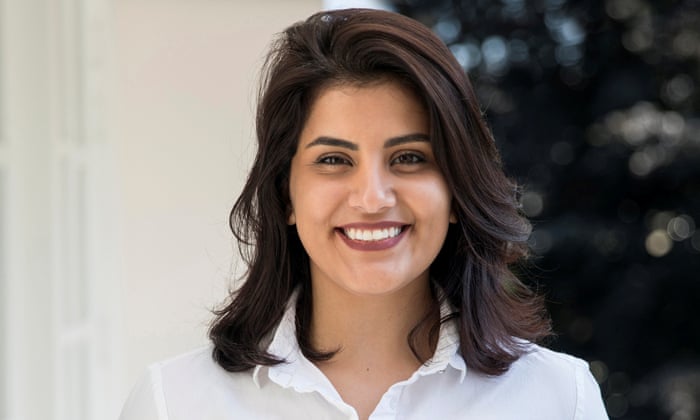
Rights campaigner Loujain al-Hathloul is on trial for unspecified charges in Riyadh. Photograph: Reuters

Saudi national Loujain al-Hathloul was permitted to leave Saudi Arabia to attend university in Canada, at the University of British Columbia, where she studied several years ago and made fast friends with other foreign students. Urooba Jamal, who became her friend, was an executive of the Pakistani Students' Association at the university and Loujain al-Hathloul had become active in the group, one year helping to organize relief efforts when Pakistan was struggling with dreadful flooding conditions.

Loujain al-Hathloul (centre, next to the woman in the pink hijab) is pictured with other members of the UBC Pakistani Students’ Association in 2012. She graduated from UBC in 2014. Hiba Rajpar

After graduating in 2014, al-Hathloul returned to the Kingdom of Saudi Arabia and quickly made headlines after she videotaped herself defying the country's ban on women drivers, which resulted in imprisonment for 70 days. A year later, she was among the first women in Saudi Arabia to run for elected office in municipal elections, the only level of government newly-open to women to compete in.
Screen capture from a Nov. 30 2014 video made by Loujain al-Hathloul as she drove towards the Saudi border from the United Arab Emirates. AP Photo/Loujain al-Hathloul, File

However, things have not gone well for al-Hathloul, 28. Since early 2018 she has been in detention together with a number of other Saudi women's rights activists cast as "traitors" in Saudi media. Friends, family and human rights groups are demanding that Western nations make more of an effort to persuade Saudi authorities to release the women as they prepare for a hearing in criminal court today. On March 13 al-Hathloul and another ten women appeared for their first court hearing in Riyadh.

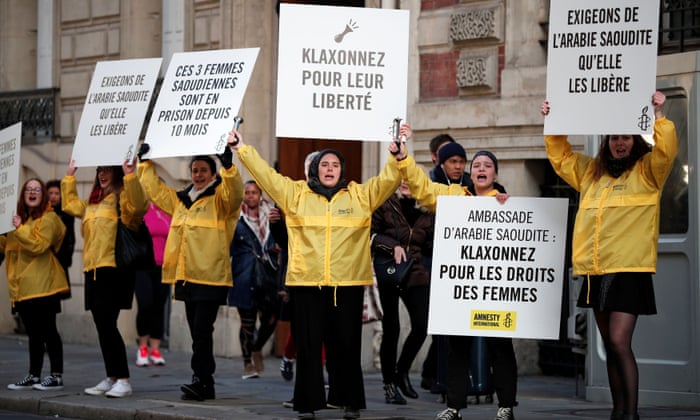
Demonstrators from Amnesty protest outside the Saudi Arabian embassy in Paris to release the jailed female activists. Photograph: Benoît Tessier/Reuters

None of the women were given access to legal representation, leading human rights groups to call for international monitors to enter the country in the wake of accusations that Saudi interrogators have tortured some of the women, denied by Saudi officials. Held incommunicado, al-Hathloul was finally permitted a visit from her family. Al-Hathloul was nominated for a Nobel Peace Prize by foreign affairs critic Helene Laverdiere, Member of Parliament, quoted as saying: The Trudeau government needs to "walk the talk"; to halt a $15-billion arms sale to Saudi Arabia.

On a previous occasion, Saudi Arabia reacted in an unexpectedly ferociously-explosive manner to posts by Foreign Affairs Minister Chrystia Freeland calling for Saudi Arabia to release Samar Badawi, activist sister of imprisoned and flogged Saudi blogger Raif Badawi, along with other women activists, from prison leading the Kingdom to expel Canada's ambassador, suspend trade and investments, and call home thousands of Saudi students studying at Canadian universities.

According to Rex Brynen, professor of political science at McGill University: "There's always the risk that it [public condemnation of Saudi Arabia] has the opposite effect [of that intended]; that is, that Riyadh doubles down on repression to prove it can't and won't be pressured. On the one hand, it might make Global Affairs Canada more cautious. On the other hand, given that Saudi Arabia has already retaliated for past criticism of their human rights record, maybe there isn’t all that much more they can do to us."

International rights groups and governments have called for the activists to be released [File: Benoit Tessier/Reuters]

Labels: , , , , ,

Saturday, November 24, 2018

Rooting Out Nazi War Criminals


"It is uncontested that [Helmut] Oberlander obtained his Canadian citizenship by false representation or by knowingly concealing material circumstances by failing to disclose involvement in the SS at the time of his immigration screening."
"There is no doubt that to have done so would have resulted in the rejection of his citizenship application." 
Federal Court Judge Michael Phelan, Ottawa 
Oberlander

Helmut Oberlander says he was forced to join a Nazi death squad. He never disclosed this activity when applying for Canadian citizenship


Ukrainian-Canadians mounted a funding campaign and a resistance toward the Government of Canada's eventual decision to root out Nazi war criminals who had entered Canada post-
WWII, enabled to do so by withholding admissions of their war-year activities. Ukraine-born Oberlander, now 94, arrived in Canada in 1954, becoming a citizen six years later. He had been a member of the Nazi death squad Einsatzkommando 10a (Ek10a). Since being identified as a war criminal he has asserted his exculpatory youth and forceful induction into the death squad.

As far as the Canadian Ukrainian nationalists are concerned, the war is long past, and bygones should be bygones. They, like Polish Canadians, cite the fact that under Nazi occupation, Ukraines and Poles suffered as well, somehow able to bypass the horrendously deadly reach into the existence of European Jewry in a formidable bid by Nazi Germany to exterminate them entirely. Neither ethnic groups willingly admits that their countries were hotbeds of anti-Semitism and were complicit in the Nazi death machinery. Jews, with their centuries of experience, bid otherwise.
Former Nazi death squad member Helmut Oberlander is seen in this undated file photo,
Former Nazi death squad member Helmut Oberlander is seen in this undated file photo,   CIJA / Handout
Einsatzkommando 10a  was responsible for killing about 100,000 prisoners, most of whom were Jews. The government revoked the retired businessman's citizenship in 2017 -- for the fourth time since the mid-1990s. Now, through his lawyers Oberlander has launched yet another challenge to his loss of citizenship and imminent deportation on the basis that he lied to Canadian authorities on his immigration application, making him ineligible for entry to the country. A Federal Court judge had ruled the government acted responsibly in the case, limiting his appeal capacity.
"With his [accused, 95-year-old Hans Werner H.] service as a guard he aided or at least made easier the killing of many thousands of inmates."
"[In his role as guard he would have] known about the various methods of killing as well as the disastrous living conditions of the imprisoned people."
"[As a guard he would have] been aware that a large number of people were killed with these methods and that the victims could have only been killed with such regularity if they were being guarded by people such as himself."
Martin Steltner, Berlin prosecutor

"In a sense it gives a certain very nice closure that someone like this is brought to justice, which I'm sure would have been Simon's [Wiesenthal] dream."
Efraim Zuroff, Nazi hunter, Simon Wiesenthal Center, Jerusalem

ap050217027809.jpg
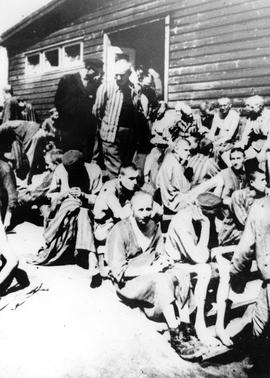
Emaciated prisoners sit outside the hospital barrack in Nazi Germany's Mauthausen concentration camp during World War II. This undated photograph taken at great risk by Swiss prisoner Kurt Zalud, was later used as evidence in the Dachau war crimes trial.   jad/str/Kurt Zalud/AP
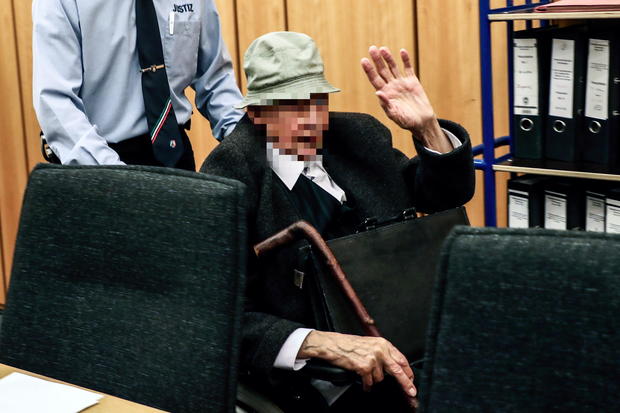
 For reasons known only to German justice, the last name in recognition of privacy regulations has been withheld of Hans Werner H., accused of serving as an SS guard in Mauthausen concentration camp and complicit in tens of thousands counts of accessory to murder. During the time of his service in northern Austria from 1944 to 1945, 36,223 people were murdered at Mauthausen, mostly by gassing, but also through lethal injection, shooting, starvation or exposure, according to meticulously kept Nazi-Germany's record-keeping, and cited by Berlin prosecutor Martin Steltner.
Image result for berlin, hans werner h. mauthausen
Nazi guard Hans Werner H. charged over 36,000 deaths at Mauthausen concentration camp - CBS News

Roughly 95,000 prisoners are believed to have died in the Mauthausen camp system among whom were 14,000 Jews -- along with Soviet prisoners of war, Spaniards fighting General Francisco Franco, and others viewed as enemies of fascism. As a member of the SS Rottenfuehrer accused of serving in the outer perimeter of the camp as well as within, guarding prisoner work details at a nearby quarry, he is held responsible in the deaths for the part he played as a guard.

Legal reasoning in Germany has advanced recently, holding that former Nazi camp guards may be charged with accessory to murder whether or not evidence exists that they personally took part in any specific deaths, an argument that has been upheld by Germany's highest criminal court, leading to a number of successful prosecutions. At this juncture, a court must review the charges to determine whether the man is held to be medically fit for trial. According to the prosecution, however, he is considered to be fit to stand trial.

Teil 5 der Serie: Weil er "arbeitsscheu" war, brachten die Nazis Otto H. ins KZ.
KZ Mauthausen: Häftlinge auf dem Appellplatz   Foto Archiv BV


Labels: , , , , ,

Wednesday, March 28, 2018

Taking Citizenship Lightly

"[Vujicic] failed to disclose his conviction for manslaughter in his application for permanent residence, knowing that he had been found guilty and sentenced for that offence in 1998."
"His conduct is consistent with an intention to deceive Canadian immigration officials."
Federal Court Justice James O'Reilly
Bozidar Vujicic arrived in 2002 and was granted permanent residence status and then Canadian citizenship. He swore his citizenship oath in 2006.  John Moore / The Canadian Press
Failure to disclose a criminal record when applying for a visa to enter Canada leading to residency and Canadian citizenship is grounds for revocation of that citizenship and removal from the country. The Federal Court of Canada ruled that Bozidar Vujicic, a resident of British Columbia, fraudulently obtained residency through the concealing of his conviction of manslaughter. He had shot another man in the heart during a drunken brawl that turned deadly, in Bosnia.

Bosnian Vujicic took steps to apply for permanent residency to Canada in 1999 while in his country of origin. When his application was reviewed by immigration officials who interviewed the man, no mention was made that he had been found guilty of murder and was awaiting the next move of the justice system on his sentence. Immigration officials granted him permission to move to Canada where he arrived in 2002 and was granted permanent residence status followed by Canadian citizenship in 2006.

After the passage of three years, officials came into possession of information about Mr. Vujicic's background in Bosnia, information that caused them to begin the process of citizenship revocation. Translated court records derived from Serbia describing a drunken brawl that took place in southern Serbia in 1995, in Leskovac were examined by the Federal Court, where Vujicic was named as being one of several men involved in a violently lethal episode.

Named as an instigator of a nighttime fight with a number of other men, some later charged along with him, Vujicic had been drinking heavily on that occasion. Evidence from Serbia did not excuse charges of manslaughter levelled against Vujicic on the basis of his inebriated state, holding rather that his level of intoxication was not seen as preventing him from fully understanding the significance of his actions.

As the brawl was proceeding, Vujicic fired a gun in the direction of Dragan Stojanovic. When a bullet hit Stojanovic in the heart, he bled to death, according to court records. The Serbian court rejected Vujicic's claim of self-defence. Forensic evidence relating to the gunshot wound failed to support his explanation of innocence and he was convicted of manslaughter in1994. There was a second conviction after a 1998 retrial, but he was not taken into custody immediately.

When he left court he soon afterward made application to emigrate to Canada. Vujicic claimed the fact he hadn't been taken immediately to prison left him confused, uncertain what had occurred in court, he testified at the recent hearing into his case in Canada. He hadn't 'realized' the court had convicted him of manslaughter, nor was he conscious of any sentencing that would impact on his Canadian citizenship status.

He failed to consider it useful to discuss his uncertainty with his trial lawyer, choosing instead to come to Canada. Presenting two official certificates both of which indicated he had no criminal convictions against him; one from Bosnia, the second from Montenegro -- neither from Serbia where his conviction took place -- he had been accepted into Canada.

He thought, he claimed, that the certificates were ample confirmation that he had not been convicted. Nor that he had to serve the 8-year prison sentence brought down by the Bosnian court.

Bozidar VujicicBozidar Vujicic, School of Engineering Science
Simon Fraser University

Labels: , , ,

Thursday, November 30, 2017

Impelled to Intervene

"There's at least two really tough things about this [case]."
"Philosophers are really comfortable taking for granted complete knowledge and certainty about a situation. In some ways, this case touches on literally everything I've ever studied."
"Imagine what an enormous difference it would make in this case if what had really been happening was a bunch of high school students had been filming a 'make-it-yourself' horror movie and across the street hidden was someone with a camera."
"In Massachusetts you'd be getting a ticket and maybe a point off your license. I'd be getting two-and-a-half to 15 years in prison."
Fiery Cushman, assistant professor of moral psychology, Harvard University 

"If it is in our power to prevent something bad from happening without thereby sacrificing anything of comparable moral importance, we ought, morally, to do it."
Peter Singer, Australian philosopher

"Usually I will go and stay in the shelter, but this time something told me ‘no, stand at the bus stop don’t go to the shelter'."
"When I see this gentleman coming towards me, I don’t think [anything] because I meet all kinds of people in the morning."
"I’m screaming and I see cars passing by, nobody stopped. I was calling for help."
"And I hear this thing, ‘boom!’ behind me. I just crossed my arms, and I said ‘I’m dead, I’m not going to see my grandchildren and my kids'."
"A few seconds later I open up my eyes and I can feel that I was in a lot of pain. I have no idea what had happened."
"You’re my angel, you saved me! [she remembered shouting]. He’s the only one who put his family on the side to save me, to do something for me."
"I’m 59, I feel like 80 now. I have sweats, I wake up sweating, I have to have someone around 24/7."
"I owe my life to him He has four children, and it’s not fair to charge this man."
Alicia Aquino, Toronto
Alicia Aquino says she was attacked at a TTC bus stop last month and only the intervention of a passing driver saved her.
Alicia Aquino says she was attacked at a TTC bus stop last month and only the intervention of a passing driver saved her.   (Steve Russell / Toronto Star)

With a name like Anthony James Kiss, how could any individual, as an onlooker to a violent crime taking place, fail to act? Mr. Kiss rose to the occasion. But in so doing it cannot be claimed that he was not conflicted; should he, or shouldn't he? What he was witnessing was a man suddenly attacking a woman, violently and with obvious vicious intent. He was himself driving by, so he was in possession of a lethal weapon, one he aimed squarely at the attacker.

In that moment of action when he was propelled by his conscience to save a life, he killed a man. For which act he was charged with manslaughter. Oh, and impaired driving causing death. He had been drinking, and he was returning home and he passed a bus shelter. Beside the shelter was a woman. The scene caught his attention as he drove by, that something sinister was about to happen.

And it did. He saw a man suddenly attack the woman at the bus stop and when she ran screaming, the man chased her, brandishing a knife. Mr. Kiss stepped on the accelerator and hit the rampaging man and did so because  he was convinced he was watching a murder taking place, that a woman was in mortal danger and if he, the only other person present did nothing, he would be morally responsible for her death.

So he did what his conscience propelled him to do. Under interrogation he denied he had been impaired, despite several beers. This occurred in downtown Toronto on June 7, 2017, when Anthony James Kiss deliberately struck and killed Dario Romero, on Eglinton Avenue, a major thoroughfare, at 4 a.m. And this incident led, naturally, to a criminal court case, since charges of manslaughter and impaired driving causing death are not trifles.

It might be  held that Mr. Kiss's reaction saved a woman's life, and the life that he saved was that of Alicia Aquino for whom Anthony Kiss is an "angel" because he saved her life. The man who set out without warning to attack and stab her was a family man with mental illness issues whom his family described as loving and generous.

What was not at all in Mr. Kiss's favour was the fact that he failed to remain at the scene. After hitting Mr. Romero, he sped off. He drove away instead of waiting for the arrival of police, and was later arrested on his way home, driving north of Toronto. So, is he a killer, or is he a hero? When is it permissible for such an intervention? The devil is in the details. Mr. Kiss is firm in his conviction he had no choice; he saved a life and in the process took one.

A week ago the Crown dropped the most serious of the charges brought against Mr. Kiss, including manslaughter. The court was informed that the prosecutor felt there was no reasonable chance of a conviction on these counts. The other charges; impaired driving, dangerous driving and failing to remain at the scene of an accident remain. Of course, however things turn out, he will always have it on his conscience that he killed a man.

A crown prosecutor felt it should be known shortly whether the case will proceed to trial, or would be resolved, possibly through a plea. This entire incident presents as a dilemma. How would and should anyone similarly witnessing such a scene of frightening violence react?
Anthony James Kiss stands outside Finch court Thursday during a hearing his hit and run case.
Bernard Weil / Torstar News Service 
Anthony James Kiss stands outside Finch court during a hearing on his hit and run case.

Labels: , ,

Tuesday, September 19, 2017

Getting Away ... With Murder

"This question is really the only question in this case."
"Did Mohamed Sail cause Jeremy Cook's death? There sits within this question the identity of Jeremy Cook's killer."
Justice Peter Hockin

"Mohamed Sail -- in finding Jeremy Cook's cellphone, decided to shoot him dead instead of simply giving it back."
"It [the first shot] didn't kill him. It was the shot to the chest that killed him."
"[The autopsy revealed that the second bullet that hit Cook destroyed the blood vessels to the heart].
Jeremy wouldn't be able to cry out after second shot."
"[Half a kilometre away, Jeremy's sister Kayla was frantic. She dialed 911 as she chased after Jeremy and the car. When police found her, the app was still tracking her brother's phone, showing its exact location...]"
"Police recovered it [the iphone] between two houses near a downspout."
Middlesex County Deputy Crown attorney Fraser Ball
Jeremy Cook was shot and killed after using an app to track down his lost smartphone in London, Ont.
Jeremy Cook was shot and killed after using an app to track down his lost smartphone in London, Ont. (London Police Service)
Imagine you're 18, and you've left your cellphone inadvertently on the backseat of a taxi. It was never returned. Someone obviously picked it up. So Jeremy Cook of Brampton, Ontario decided to see if he could discover who had his cellphone. He enlisted the help of his older sister Kayla after the phone had been tracked. Kayla drove her brother to a McDonald's restaurant where a car at the pick-up window had been identified by an online tracking app as the current venue of the cellphone.

The siblings, brother and sister, approached the car. They were certain that once confronted, whoever had the phone would simply hand it over. Kayla entered her brother's phone's security code when Mohamed Sail 26, refused to surrender the phone. As soon as she did that, Sail's companion who was driving the Mazda, Muhab Sultan, 23, stepped on the gas. While Kayla fell backward her brother, hanging on to the car was carried along as it sped off, his feet skidding the pavement.

Arriving at another nearby parking lot, Jeremy Cook's arms still around the car's central pillar, Sultan stopped, shut the engine and seconds later two gunshots rang out and someone was heard to shout, "drive, drive". Muhab Sultan, as it happened was known to police, with a long criminal record. And one of the men in that Mazda had a .40-calibre, semi-automatic handgun, prohibited in Canada. Jeremy Cook bled to death where he fell.
Mohamed Sail
Mohamed Sail, 23, leaves the London, Ont., courthouse following Monday's not-guilty verdict. When asked for his response to the verdict he said: 'I would like to thank God.' (Colin Butler/CBC)
Two weeks later, police were still searching for the men. The Mazda had crashed soon after the shooting. And Sultan went into hiding in Ottawa. Two weeks following the killing of Jeremy Cook, Muhab Sultan was pursued by police as he drove toward the Rideau River. He left the car he was driving and dove into the river, and there he drowned. Leaving Mohamed Sail as the remaining suspect.

Mohamed Sail walked from where the crashed Mazda was left right after Jeremy Cook had been shot to death, and he was seen by witnesses. He turned himself in to police after a warrant for his arrest was issued in London, Ontario. And for the past two years he has been in custody. In a London courthouse his 11-day trial on a charge of second-degree murder of Jeremy Cook took place. His defence lawyer argued that Muhab Sultan was the shooter.

Yet Mohamed Sail was heard in a police phone intercept a few months earlier while living in Calgary with his mother, attempting to buy a "Glock 40" -- a .40-caibre handgun. And Crown attorney Ball argued at trial that the physical evidence painted with certainty a scenario where Sail held the gun and killed Jeremy Cook. The bullets originated from the passenger side of the car.

The casings, he explained would have expended to the right, while a man that witnesses said resembled Sultan was outside the car and was seen to have no gun in his possession. Sail was not heard from at his trial, his defence team relying on portraying Sultan as the shooter, not their client. "He was the shooter and he was running for his life", attempting to avoid police in the car chase that ended when he leaped into the river and drowned.

The jury at Mohamed Sail's trial deliberated for two hours. In the final analysis the jury comprised of six men and six women felt that there was insufficient evidence to incriminate Sail, and found him not guilty, to the incredulity of Jeremy Cook's family. As Mohamed Sail walked out of the courtroom, found innocent of the charge of murder and free to go in the company of his mother, she proclaimed "Justice has been made", while her son was preoccupied, speaking on his cellphone.


Supporters of Jeremy Cook's family gather on the steps of the Ontario Superior Court of Justice Monday where the second-degree murder trial of Mohamed Sail is taking place.
Supporters of Jeremy Cook's family gather on the steps of the Ontario Superior Court of Justice Monday where the second-degree murder trial of Mohamed Sail is taking place. (Colin Butler/CBC News)

Labels: , ,

Wednesday, April 19, 2017

Holocaust - Prosecution of Nazi Criminals

"It was unknown that the Allies prepared prosecutions of Adolf Hitler and the rest of the Nazis for the death camps in Europe while the Nazis were still in power and while they were still running occupied Europe."
"There are many such dossiers [in the files of the UN War Crimes Commission] of legally prepared indictments of Hitler and other Nazis for many of their crimes, including the extermination of the Jews, and these were drawn up long before D-Day."
"You  can't say that people didn't know. They did know and still didn't act."
"There was a great deal more evidence and a great deal more that could have been done to prosecute than was done."
"The commission's files contained indictments against thousands of Nazis who were then allowed to go free."
"[The UN files contain evidence of war crimes which] provides a whole hardware store of nails to hammer in the coffin of Holocaust denial. This is a huge trove of prosecutions of the Holocaust from during World War II, legally authorized documentation."
"They [the UN War Crimes Commission] had a very effective, low-cost system for prosecuting low-level perpetrators, and we badly need something like that today."
"If they could be taking evidence from people escaping from under the jackboot of the SS, why aren't we doing the same when it comes to people escaping from Syria?'
Dan Plesch, historian, Human Rights After Hitler
A group of children at the Auschwitz Nazi concentration camp on Jan. 27, 1945, just after the liberation by the Soviet army.
A group of children at the Auschwitz Nazi concentration camp on Jan. 27, 1945, just after the liberation by the Soviet army. The Associated Press

For one thing, what would come of the scrupulous accumulation of damning anecdotal evidence that interlocutors could obtain by questioning Syrians escaping from the death-clutches of Syrian dictator Assad? The United Nations, from its earliest years when in 1945 it inherited the mantle of the League of Nations to the present, has acted as a nonchalant conscience to the world. The United Nations acts as witness to world events, lauding itself as a force for peace in the world, but because its member-states act always in their own interests, and a majority of the members give short shrift to human rights, the institution is feeble and incapable.

The civilized world's heart bleeds at the prospect of children suffering, facing deadly harm, tortured and mutilated, and slaughtered. A great uproar of indignation is heard, but nothing of any real significance beyond the rhetoric of politicians making speeches to impress listeners with the mistaken belief that help and rescue are all possible. A process that soothes the public. And then the plight of the helpless and the vulnerable is soon forgotten, placed high on a shelf too troublesome to reach for to re-ignite resolve should frustrating new indications of such abuses recur.
Photos of Jewish children in the Auschwitz concentration camp.
Photos of Jewish children in the Auschwitz concentration camp. (Credit: De Agostini/G. P. Cavallero/De Agostini Picture Library /Getty Images)
It is not as though this historian discovered something absolutely never before known. Hitler's plan to exterminate the Jews, and the steps taken to carry it forward were no secret. Even before the infamous Kristallnacht took place the Third Reich and its propaganda machine had formulated the pattern whereby Europe's Jews were marginalized, dispossessed, dehumanized, ghettoized, then sent to work camps and to death camps. As for what happened in the death camps, escapees and survivors spread the word.

Disbelief met their claims, but that soon enough turned to grim acceptance of what was occurring. Still, the Allies decided they couldn't spare the ammunition it would take to bomb the transport mechanism whereby Europe gave up its Jews to collection points from which they could be gassed and their bodies incinerated, although the German military felt it could spare the rolling stock, the fighting men and the vital reserves to pursue its genocidal goal. Even before the League turned into the UN the institution had fairly full knowledge of what was happening.
The United Nations War Crimes Commission meets on May 6, 1945, in the Royal Court of Justice in London with members of a U.S. Congressional Committee that had just completed a tour of German concentration camps.
The United Nations War Crimes Commission meets on May 6, 1945, in the Royal Court of Justice in London with members of a U.S. Congressional Committee that had just completed a tour of German concentration camps. (Credit: Photo12/UIG/Getty Images)

What is new is that though Mr. Plesch, director of the Centre for International Studies and Diplomacy at University of London discovered that the Allied leadership and the United Nations was set to undertake a wide prosecution of those who aided and abetted and made possible the extermination of six million Jews, the determination to follow through was lacking, other than for the formalities of the Nuremberg Trials to set an example for the world that evil has its payback consequences.

The world gasped in collective horror at the liberation of Auschwitz and Treblinka and all the other countless death camps where living corpses were freed from their fate and a wide distribution of the news of what had taken place was released worldwide. But the victors made their accommodations with the vandals of humanity. Not only did work to regenerate Germany take place, but Nazi scientists, war criminals themselves, were given haven in the United States where those like Wernher von Braun helped America design rocketry munitions that Hitler had instructed them to create for Germany.

The West knew very well long before the war came to its end that there was a window before the Final Solution went into overtime whereby they could rescue Jews from fascist death agonies planned for them. The SS.St.Louis whose German captain did his utmost to help save close to a thousand German Jewish men, women and children, was met with refusals from a cross-section of the free world, from Cuba to the United States to Canada and Great Britain. No Jews need apply for haven, and so the ship limped back whence it had come.

But Canada, the United Kingdom and the United States worked feverishly to see that justice would prevail in the creation of the UN War Crimes Commission (UNWCC), co-operating to investigate 36,000 international criminal cases -- until an American decision to turn its attention from punishing Nazis to fighting communism ended up shuttering the UNWCC; a low priority, after all. Leading to American intelligence officials urging the UNWCC files to be prohibited from public access.

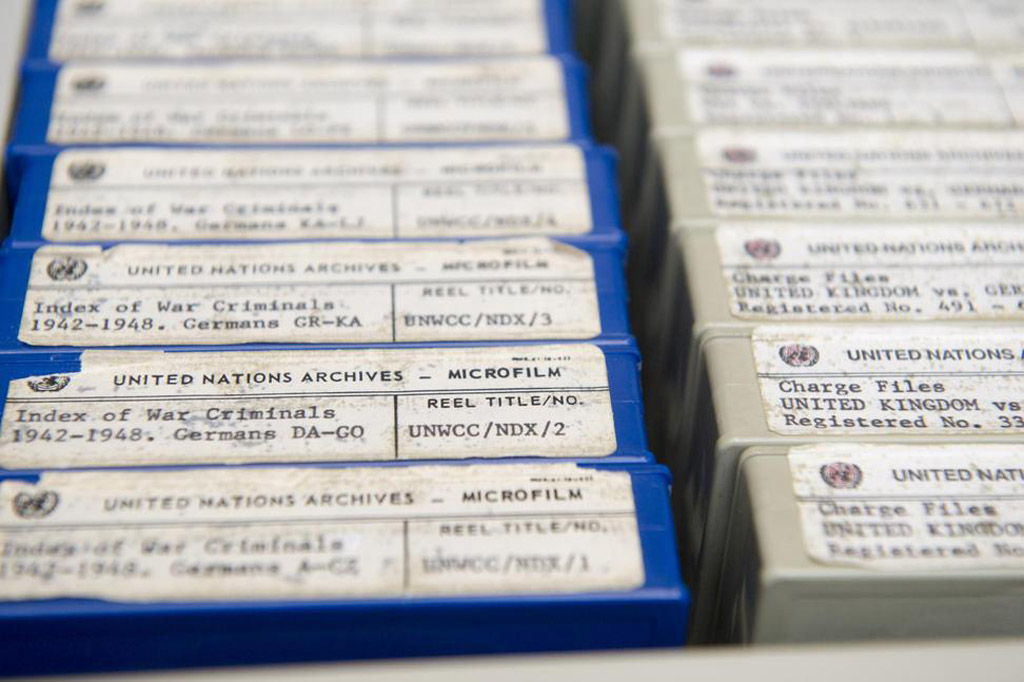
It was a UNWCC form whereby Canada outlined charges against SS commander Kurt Meyer, convicted of ordering the murders of 20 Canadian prisoners of war in 1944 that led Mr. Plesch to the vast archive and a subsequent effort on his part to persuade UN authorities that the secret material should be released.

Microfilmed documents, part of the UN War Crimes Commission Records (1943 – 1949), at the United Nations Archives in New York.
Microfilmed documents, part of the UN War Crimes Commission Records (1943 – 1949), at the United Nations Archives in New York. (Credit: UN Photo/Mark Garten)

Labels: , , , , ,

() Follow @rheytah Tweet