Politic?

This is a blog dedicated to a personal interpretation of political news of the day. I attempt to be as knowledgeable as possible before commenting and committing my thoughts to a day's communication.

Saturday, February 29, 2020

Canada in Danger of Dissolving?

"This is one of the few polls that I just looked at -- and I've been doing this for 30 years, so I did polling around the Oka Crisis -- I was astonished when I saw some of these numbers, but I'm not surprised."
"People are truly frustrated with the inability of their leadership to come together and recognize that human beings are being affected by their decisions and that they're not simply voters."
John Wright, pollster, DART

"A lot of the blame has been centred on the prime minister and the Liberal government."
"There was some form of void. The government left the impression -- at least many people came to the conclusion -- that there was no one really in charge of the situation [of rail blockades]."
Daniel Beland, director, McGill Institute for the Study of Canada

"Canada is not broken. Canada's institutions are broken."
"In 1867 [year of Confederation], the concern was to protect Canada against democracy, not to protect regional interests."
"Until we have an institution that can speak on behalf of the regions, we are going to have a problem."
Donald Savoie, Canada Research Chair, Public Administration and Governance, University of Moncton

A nation united? Appears not; more accurately, a nation acutely polarized. The West -- blessed by natural resources which resulted in wealth, has enabled, through tax transfers via the federal government to dole out 'equalization' payments to the 'have-not' provinces to ensure that all Canadians regardless of where they live are equally endowed in social services -- has been left by the central government in Ottawa to flounder. Its resource sector, the source of much of Canada's wealth, has been hit by the Liberal government's commitment to its environmentalist backers.

Demonstrators in London blocked several intersections as they made their way toward RCMP offices on Dufferin Avenue. (Sofia Rodriguez)

A government which has done all it possibly can to place roadblocks in the way of investment and development of petroleum resources, causing tens of thousands of job losses, and the firesale of Canadian energy at steeply reduced rates exported abroad, for lack of pipeline delivery stymied time and again through legislation and the courts doing the bidding of the Liberal government of Justin Trudeau. A prime minister whose agenda is reconciliation with Canada's First Nations and meeting environmentalists' demands of shutting down the conventional fossil fuel energy sector.

Both coming together in a sudden and stunning shutdown of Canada's national rail system, both freight and passenger, through sometimes violent, and always illegal blockades launched by five Wet'suwet'en ancestral chiefs, defying the agreement of 20 Wet'suwet'en elected chiefs and the majority of the Wet'suwet'en who signed an agreement of cooperation meant to result in employment and profit through the operation of the northern B.C. Coastal GasLink project.

The transport of critical perishables, production parts, chemicals and heating products across Canada has been halted. This, at a time when Canada is preparing for a possible epidemic of COVID-19, the novel coronavirus that has devastated China, and has emerged as an epidemic in South Korea, Japan, Iran and Italy, and now infects people in over 50 countries globally, and growing. The poll results indicating that a majority of Canadians now feel strongly that the country is not being governed well, is indisputable.

While the country's prime minister was jetting abroad in Africa to drum up support for his legacy project of having Canada elected to a two-year stint on the United Nations Security Council, Aboriginal and environmentalists' protests have virtually shut down cross-country transit. Shipped goods have been piling up on docks awaiting transfer to rail for distribution throughout the country. For two weeks and counting the government urged patience and failed to see that the law went into action to shut down the illegal and dangerous blockades of rail across the nation.

Hundreds of Londoners joined an Indigenous-led demonstration in solidarity with opponents to a pipeline in Wet'suwet'en territory in northern B.C. The demonstrators marched toward RCMP offices in downtown London to show their opposition to the arrests of protesters. (Sofia Rodriguez/CBC)

Now that Justin Trudeau has finally declared that Canada has waited long enough for protest leaders to agree to discussing the issues with government leaders, giving clearance to federal, provincial and municipal police to act, and a few of the blockades have been shut down, others spring up in their place, with 'activists' lighting tires on fire on rail tracks, and setting up blockades that engines narrowly miss hitting. Some activists have taken to standing on tracks, moving out of the way at the last moment.

A full 62 percent of those polled feel Justin Trudeau's promise to Canada's Indigenous people has failed on delivery. Two-thirds of respondents are not averse to supporting one-time payments to Indigenous Canadians for immediate acquisition of "food, clean water and housing" for the "necessities of life", which in actual fact, does go out regularly to Indian reserves throughout the country for those very purposes, and more.

What the agreement that the Wet'suwet'en elected chiefs signed with the Coastal GasLink project would have done was provide dignity through employment, and independence through the share of gasline profits. The current situation has led to another project, in Alberta, for a giant mine investment by Teck Resources, a Canadian firm prepared to invest $20 billion and having reached similar sharing agreement with Aboriginals, being cancelled in view of the ongoing roadblocks, including a decision whether to approve the project expected in days from the Trudeau government.

Over 80 percent of Canadians believe politicians have a greater care for their partisan interests than to do the work they were elected for on behalf of all Canadians. This feeling is supported at 90 percent in Alberta. The federal government under Justin Trudeau and his Liberals has alienated Canada's Western provinces, leaving the country worryingly polarized and increasingly leaderless, while a small minority of Canadian 'activists' and unwanted visitors from the U.S. work to shut Canada down.
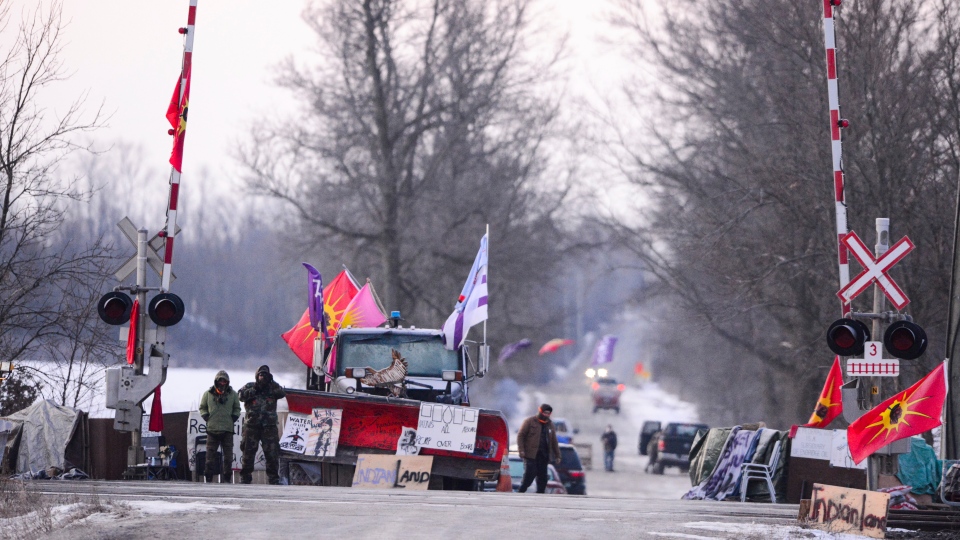
Wet'suwet'en protests
Protesters in support of the Wet'suwet'en hereditary chiefs stand near the entrance to the blockade of the commuter rail line in Kahnawake Mohawk Territory, near Montreal, Thursday, Feb. 27, 2020. THE CANADIAN PRESS/Ryan Remiorz


Labels: , , , , , ,

Tuesday, February 25, 2020

The Reasons for Failure in Canada's Resource Extraction and Management Many; Consigning Aboriginals to Dismal Expectations for their Future

"There is a well co-ordinated, well-funded machine shutting down Canada. The agenda is basically anti-fossil fuel, but also forestry and mining. This machine has set back Aboriginal reconciliation by twenty years."
"The [Aboriginal] communities know full well what LNG [liquid natural gas] is all about. They approved it. They signed onto it. They wanted the training. The media is not telling the whole story."
"They [outside interests interfering and spreading false messages] leave us to pick up the pieces. People have no idea how crazy this can be."
"Why celebrate the right to title if we can't make use of it? What good does it do if I'm on welfare, or going to commit suicide?"
"So when projects [pipeline, LNG plants] came to town, we had, for the first time, a tool to say we want to be part of the economy and benefit from the project..."
"We would have the opportunity to get jobs, real training and take proceeds back into our village for kids, seniors, fund ourselves and not have to beg for everything anymore."
"People talk about [Aboriginal issues] that have no idea what it's all about. They don't know what it's like to live up here."
"Anybody with a job has a better chance of learning better values, getting an education, helping his family, having a meaningful life. They shouldn't become an alcoholic, like I did. They shouldn't be committed to walking around on drugs on a reserve like I did."
"This is especially hard for men. I felt badly when I couldn't provide for my family."
"This is about U.S. interests sending money into our country, making sure that we Canadians destroy our own country. This is corporate warfare on a global scale and I don't think Canada understands we're in this game and being outplayed. We ship crude at a discount [due to pipeline shortages] and will be shipping gas to them at a discount for their LNG projects."
"This machine will get braver and braver. It's not going to stop, why would they stop?"
Indigenous leader, Liberal British Columbia MLA Ellis Ross
Anti pipeline protesters are arrested after blockading E Hastings and Clark Dr. , in Vancouver, BC., February 25, 2020. NICK PROCAYLO / PNG

MLA Ellis Ross is a former chief councillor for the Haisla Nation. His activism has brought him to the forefront of issues respecting resource development and Aboriginal rights in British Columbia. He speaks from his years of personal experience, both as an Native Canadian reflecting the struggles known only to Aboriginals, as well as what he has seen and discovered through his time in political office. The current standoff between a handful of Wet'suwet'en chiefs in northern B.C. protesting the GasLink project is one he attributes more to the influence of outsiders than lack of solidarity between and within Indian communities.

Because of the blockades set up by supporters of the hereditary chiefs who have denounced the GasLink project that all the democratically elected chiefs and the Wet'suwet'en tribal members signed with the GasLink project meant to share profits, employ aboriginals and generally help to lift the communities into financial independence through exploitation of heritage lands, a crisis has arisen where railways, ports, highways and ferries have been shut down while the federal and provincial governments fruitlessly sought discussions with the five hereditary chiefs.
Supporters of the Wet'suwet'en hereditary chiefs perform a round dance at a blockade west of Edmonton on Feb. 19.  Jason Franson/The Canadian Press

That twenty First Nations had given their approval to the project, following a decade of discussions between them and the gas line developers to bring a $6.7 billion pipeline into service piping gas to an LNG plant in Kitimat, B.C. has seen provincial and federal police looking for guidance from government on how to proceed against the protest camps. Court injunctions ordering the removal of the camps and the blockades have accomplished nothing, because police have hesitated to act without government approval.

While Mr.Ross points a finger of blame at American interests, he also speaks of environmental organizations originating in the States, whose aim is similar; to shut down any further exploitation of fossil fuels, to challenge the industry by influencing decision making and spurring environmental supporters to campaign to tie both government and industry hands through opposition claiming to speak in support of the rights of Canadian First Nations once again abridged by Canadian corporate interests and foreign investors.

At this juncture there will be no more concerns about the plans of foreign investment in development of Canadian energy resources, among the largest in the world. The current federal government has implemented as many regulations as they can possibly conceive of, to slow down and discourage any such further investments, themselves supporting a green agenda that has effectively shut down the energy sector in Canada.
Anti-pipeline protesters block East Hastings and Clark Drive during the morning rush hour in Vancouver, BC., February 25, 2020 NICK PROCAYLO / PNG

Indigenous Canadian communities have long suffered from social dysfunction, problems such as chronic unemployment, given that they tend to live on remote, sometimes inaccessible traditional lands where there exist no employment opportunities save for those working for band councils. On reserves, people live subsidized lives paid to band councils through general taxation. Substandard housing, poor educational opportunities, and high unemployment complete the trifecta that leads to drug and alcohol abuse, child neglect, and violence within the communities.

Aboriginal children in care represent far greater numbers than their non-Aboriginal counterparts, as do Aboriginals within the prison population, far outweighing their numbers in the general population. Projects such as the GasLink and the recently abandoned Teck mine project in Alberta awaiting affirmation from the federal government that would have rejected the giant billion-dollar mine htat would have given opportunities to First Nations populations have in effect, abandoned First Nations to their plight, consigning them to continue their blighted way of life.

A member of the Mohawk community stands at a rail blockade south of Montreal on the Kahnawake reserve on Feb. 10. The blockade was erected in solidarity with the Wet'suwet'en hereditary chiefs after RCMP arrested people on their territory this month. Graham Hughes/The Canadian Press

Labels: , , , , , , ,

Sunday, February 23, 2020

Arresting Canada

"Trucks are the branches. They reach out in all directions, delivering food to distribution centres and then on to your local grocery store. But the trunk of the tree is rail. That's where the heavy volumes are moved."
"It can get complicated because of how intermodal logistics has become -- cargo goes from ship to truck to train to truck to van, so do you count that as rail or truck?  But the rail contribution to our food supply is big. I don't have an exact number, but as much as 50 percent wouldn't surprise me."
"DCs -- distribution centres -- always have some stock on hand, in case of inclement weather or a traffic jam. But the food industry has moved more to just-in-time delivery. If you're near a source of food production, or a border crossing, or if you have good local trucking assets, you'll hold out longer. But that's not everywhere in the country. Atlantic Canada has particular supply challenges."
Karl Littler, Retail Council of Canada

"February is slower. Diesel is cheap, the Canadian dollar is stable -- this is letting us absorb some of the impact. But food prices could still spike 30 to 50 percent. This is a food security issue for low-income families."
"I've already noticed some items missing from shelves [in Atlantic Canada]. I can't link them [food shelf shortages] to the blockades because the distribution system is complex."
"I don't think we're there [emergency situation] yet. But in another two weeks? this will hit a critical point."

Sylvain Charlebois, professor, expert on food production, distribution and security, Dalhousie University, Halifax, Nova Scotia
Tyendinaga
A protester looks through a pair of binoculars from the closed train tracks in Tyendinaga, near Belleville, Ont., on Sunday, Feb.23, 2020. The rail blockade is in support of the Wet'suwet'en who oppose work on a pipeline in northern B.C. (THE CANADIAN PRESS/Sean Kilpatrick)

Atlantic Canada will be paying a huge, painful price for a situation that began clear across the country in northern British Columbia where the first of the now-nationwide rail blockades began in protest by a handful of hereditary Wet'suwet'en First Nations chiefs against the plans of TC Energy Corp's plans to build its Coastal GasLihnk pipeline through traditional Wet'suwet'en territory in rural British Columbia. This, mind, after a decade of consultations between TC Energy and the elected Wet'suwet'en chiefs reached agreement that eventual profits would be shared with the First Nation, and employment of their members would be assured.

So while band members and their elected councils have signed on to the agreement, satisfied that their needs and their right to profit from such enterprises on their hereditary lands will be fully recognized, the hereditary chiefs have balked and refused their assent, calling on the need for further consultations, even while the company has already started its pipeline assets construction. The demands of the five dissenting chiefs has been taken up by environmentalists and other non-aboriginal supporters, leaving the country in a hostage position moving into its third week where Canadian National freight train delivery has been stopped and its passenger Via Rail contingent brought to a halt.

The federal government, while deploring the situation, has been calling for patience, refusing to order a stop to the blockades until several days ago. The federal, provincial and local police have had no direction from government, and although the courts have issued injunctions against the blockades, police have been loathe to take action to forcibly break up the protest/blockages and arrest the leaders who simply rip up the court orders they're served with. To take action against the protesters is to risk being labelled a 'colonialist' and a 'racist', not merely by the protesters but by government itself.

It is not just internal rail deliveries that have been disrupted, where needed manufacturing parts, propane for heating, chlorine for water treatment and all manner of goods have been stopped from being delivered to the sources awaiting them, halting production, but rail links outside Canada and Canadian ports, where containers have been unable to be transferred to freight trains and are left to sit and pile up on docks. U.S. container lines have begun diverting ships elsewhere than Canada after their valuable cargo has been stranded on docks for weeks.

At this juncture, Prime Minister Justin Trudeau finally deciding to intone: "The barricades must come down, now" appears a little after the fact. When the leader of the official opposition in Parliament urged the government to take action several days earlier, he was frozen out of a meeting to discuss the emergency, attended by lesser opposition leaders becuse the prime minister characterized his statement as injudiciously unhelpful; now two days later he is echoing the opposition leader because his very own inaction was obviously injudiciously unhelpful.

And now that the federal government has finally taken a stand, noting that overtures by federal ministers to meet with the discontented chiefs in an effort to reach an understanding have been ignored, through repeated requests, and the chiefs have instead insisted that the RCMP must leave the site of the Coastal GasLink where the protests are continuing, before they may or may not decide to meet with the federal government, is a fair indication of the tail continue to wag this very particular donkey.

Supporters of Wet'suwet'en hereditary chiefs Edmonton, Feb. 19.Reuters/Codie McLachlan

"Aboriginal people are already in grocery stores getting confronted by people that just want to go back to work, they don’t like to see their lives disrupted. And these average Aboriginals, they’re not political. They don’t have an opinion on pipelines or blockades.They want to get on with their lives just like regular Canadians."
"[The] political rhetoric [from those who claim to support some of the Wet’suwet’en hereditary chiefs opposed to the natural gas pipeline ignores the] tremendous amount of work [done over the last 15 years among B.C. First Nations to get companies to consult and accommodate them on projects]."
"You’re trying to de-stabilize these communities and you’re trying to de-legitimize the work that collected band leaders and hereditary leaders have done over the last 15 years, not only to provide jobs or employment as a way out of poverty, but also to breathe life into the word reconciliation."
"I’m pretty sure Aboriginals across B.C. do not want to see those blockades, they don’t want to see it escalate to the point where Aboriginals are actually getting accosted on the streets. I mean, this is setting back reconciliation 20 years."
B.C. Liberal MLA Ellis Ross, B.C. politician and First Nations leader
OPP liaison officers leave after speaking with Tyendinaga Mohawk members at the railway blockade on Sunday, Feb. 23, 2020.   Lars Hagberg/The Canadian Press

Labels: , , , ,

() Follow @rheytah Tweet