This is a blog dedicated to a personal interpretation of political news of the day. I attempt to be as knowledgeable as possible before commenting and committing my thoughts to a day's communication.
"I wanted my language to be a monument to my people -- especially those who died."
"I wrote it [And the World Remained Silent ... Night] -- for the other survivors, who found it difficult to speak and I wanted to tell them, Really ... you must speak."
"I have tried to fight those who would forget."
"Because if we forget, we are guilty, we are accomplices."
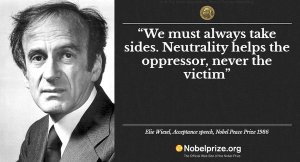
"We must always take sides Neutrality helps the oppressed, never the victim."
Elie Wiesel, Holocaust Survivor
"My father clearly articulated that the antisemite will always hate, even if they mask that hate as anti-Zionism -- as though it were something separable from antisemitism."
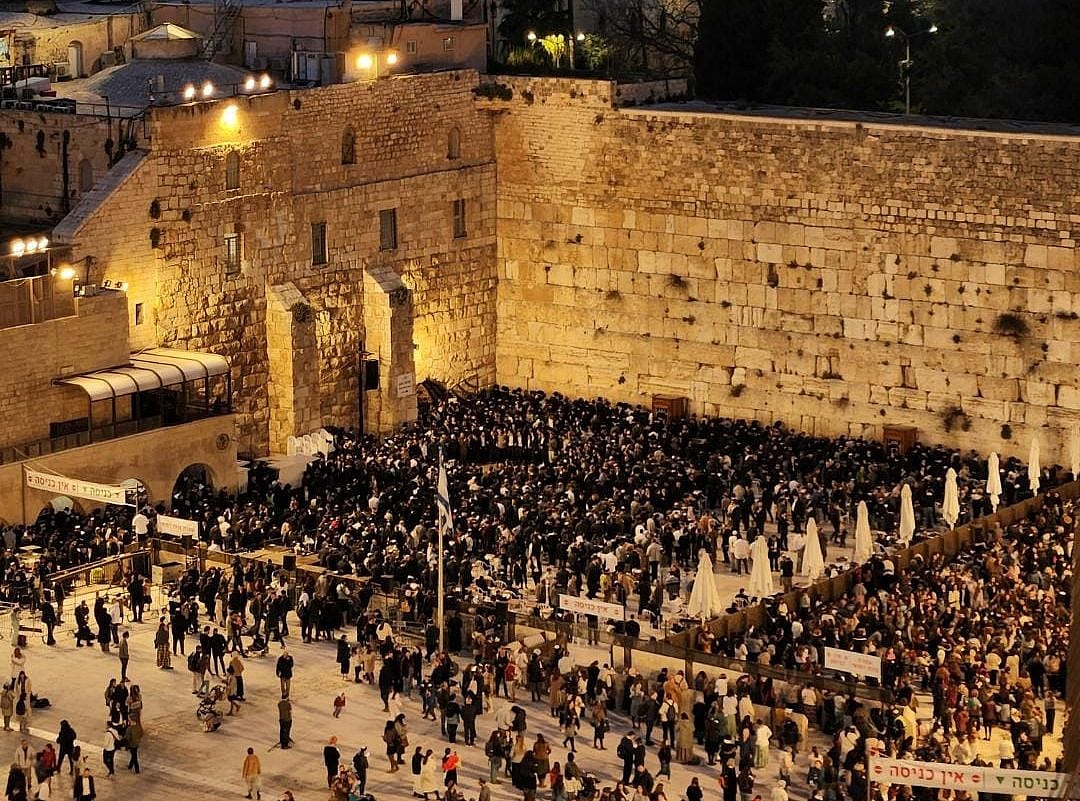
"Our object as Jews is to keep embracing our Jewish faith and heritage and our connection to our over seven million Jewish brothers and sisters in Israel."
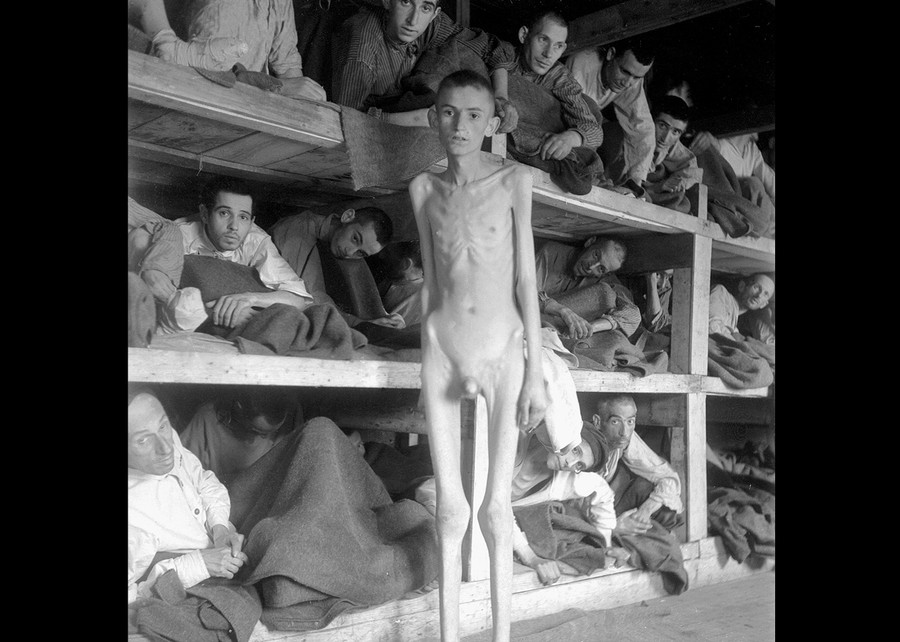
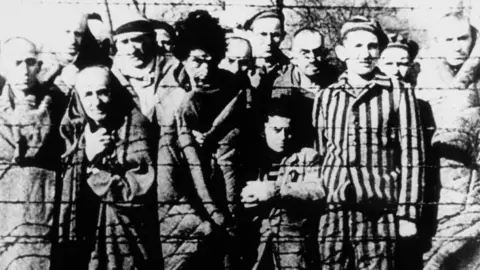
Jewish survivors in Buchenwald concentration camp, after the liberation of the camp in 1945 AFP/Getty
Holocaust Remembrance Day is held each year on January 27. This year, Elie Wiesel: Soul on Fire, premieres at the Montreal Holocaust Museum. Elisha Wiesel, 53, will speak of his father and his mission to ensure the world 'never forgets'. Elisha Wiesel is chair of the board of the Elie Wiesel Foundation for Humanity. Along with his mother, Marion Wiesel, a Holocaust survivor, the Foundation was launched after the death in 2016 of father-and-husband, to continue the work Elie Wiesel dedicated his life to.
Directed and written by Oren Rudavsky the 90-minute film addresses the personal story and legacy of a man known as one of the world's most respected Holocaust survivors, known as well as a prolific author, humanitarian, passionate educator and Nobel Peace Prize laureate.
Eliezer Wiesel was a boy of 15 when he was deported from Sighet, Romania with his parents and three sisters in May of 1944 to Auschwitz-Birkenau where his mother and younger sister Tzipora were killed on their arrival at the death-and slave labour camp. Elie and his father were selected to go to the slave labour component of the notorious death camp.
By early 1945, as Germany was losing the war and emptying the camps by forcing starving, skeletal inmates on death marches, Elie and his father were sent on a march to the Buchenwald concentration camp where his father later died. In April of that year the camp was liberated by American soldiers. The Jewish orphans in the camp, Elie among them, were transported to France, where his sister Hilda recognized him in a French newspaper photograph.
The siblings reunited, along with their sister Beatrice who moved eventually to Montreal. Working as a journalist in France, Wiesel studied at the Sorbonne. "He overcame trauma by becoming a witness", noted a family friend. His memoir of a young boy's reaction to Auschwitz, originally published in Yiddish in 1945 was a 846-page recollection of pain, loss and suffering. Abridged and translated to French, it was published as La Nuit in 1958, and in 1960 as Night, in English.
Night sold over six million copies in 30 languages, and he went on to write many more books. Moving to New York in 1956, Wiesel became a writer, teacher and academic, teaching at City College of New York, then at Boston University in 1976, as Andrew W. Mellon Professor in the Humanities. "Your suffering is not what defines you, but it can inform you. It shapes you and then it is your job to make it the best tool you can", a former student added of her own mental journey under his tutelage.
Having suffered the most inhumane circumstances and losses in his young life, Elie Wiesel matured a determined human rights upholder, refusing to stand silent in the face of immoral human rights abuses, speaking up and bringing attention to some of the modern world's most shameful human rights atrocities. His trauma led him to undertake action of moral outrage against wrongs committed against the vulnerable. Human rights violations that took place in Rwanda, Cambodia, the Sudan and the former Yugoslavia engaged his moral outrage and his propensity to speak loudly, publicly, determined to move others to do the same.
"[My father] never failed to stand up for Israel, asserting that only Israelis can best decide how to reach their goals of living in peace and security in an extremely hostile neighbourhood."
"And lastly, he insisted that we never relinquish our desire to have a positive impact on the world as a whole."
"He strongly resisted isolationism as a principle."
The Cynical Hypocrisy of the International Community
"Relatively many people survived, which for example barely happened in sites which didn't have such a forced labour component."
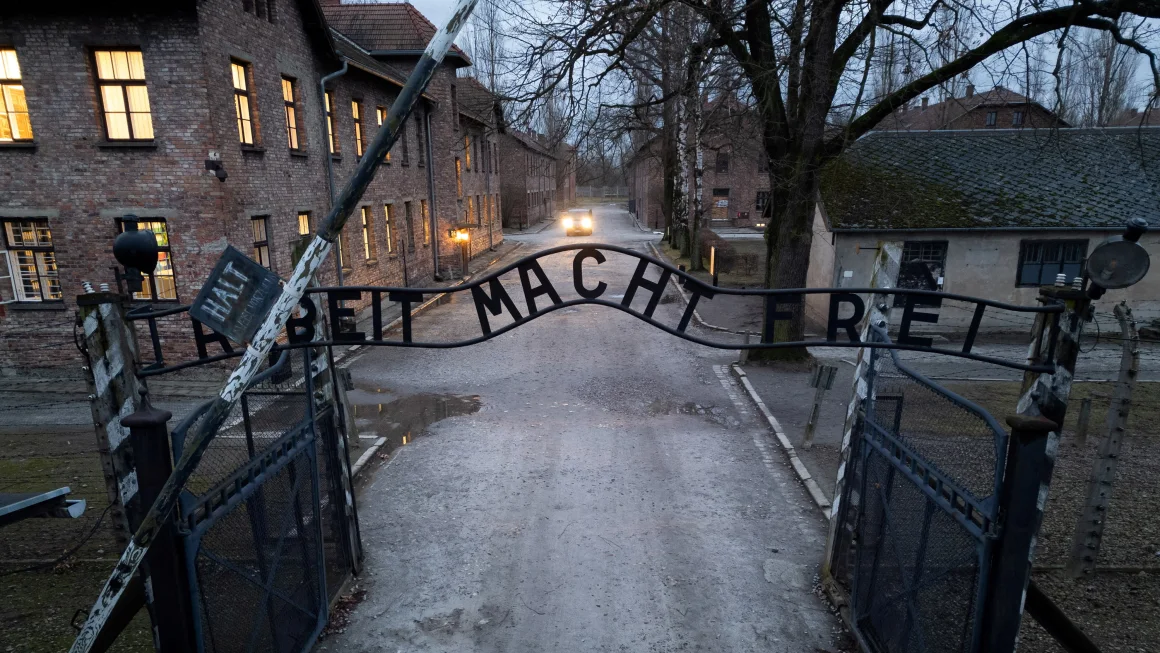
"[As testimony to the past purpose of Auschwitz, maintaining the death camp as a memorial site has its value]: You have the gate [Arbeit Macht Frei], you have the wagon [transport]. You have the incredibly long railway platform which leads to the former crematoria and gas chambers."
Thomas Van de Putte, scholar specializing in Holocaust memory, King's College London
"I saw thousands of tortured people whom the Red Army had saved -- people so thin that they swayed like branches in the wind, people whose ages one could not possibly guess."
Boris Polevoy, Pravda correspondent, eyewitness to Soviet liberation of Auschwitz Jan.27, 1945
"This is the anniversary of liberation. We remember the victims, but we also celebrate freedom."
"It is hard to imagine the presence of Russia, which clearly does not understand the value of freedom."
Auschwitz Museum director Piotr Cywinski
The entrance gate to the former Nazi German concentration and extermination camp Auschwitz pictured on January 10. Kacper Pempel/Reuters
The world is set to mark the 80th anniversary of the most dreadful mass atrocity that a country at war designed in an orgy of hatred against an ethnic population drawn from the countries of Europe whose citizenry included millions of diaspora Jews forced in antiquity from their ancestral homeland for exile abroad by a Roman occupation of the holy land that implacably put down an insurrection of Judean origin in a paroxysm of violence that millennia later was replicated with more modern and equally savage technological means of broader dimensions.
It is highly doubtful that Romans of the period felt it incumbent upon themselves to harvest the hair, skeletal remains, attire, gold dental fillings, marriage rings, to enrich themselves and produce stuffing for pillows, the production of soap from the remains of their victims as Nazi Germany felt disposed to do. The slaughter of children, women and men of all ages may be a casualty of war anywhere at any time when civilian populations bear the brunt of conflict that uproots and victimizes them in loss of home, necessities of life and life itself, but Nazi Germany brought its obsession with the extermination of Jews to a fine art.
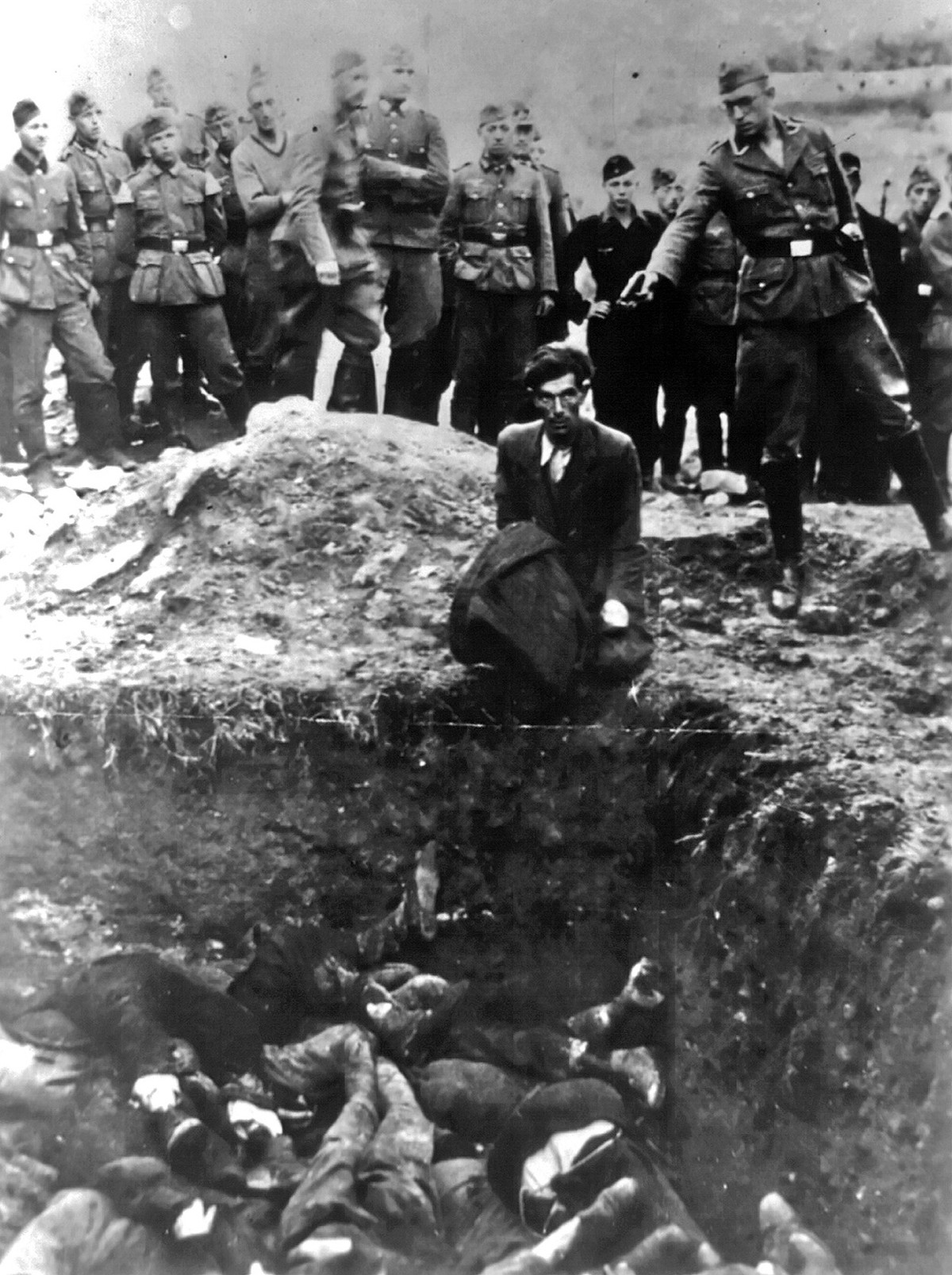
This photo provided by Paris' Holocaust Memorial shows a German
soldier shooting a Ukrainian Jew during a mass execution in Vinnytsia,
Ukraine, sometime between 1941 and 1943. This image is titled "The last
Jew in Vinnitsa", the text that was written on the back of the
photograph, which was found in a photo album belonging to a German
soldier
It took an orgy of mass dementia to organize round-ups, persuade populations that a nest of vipers lived amongst them that German authorities prepared to save them from, infesting those non-Jewish citizens with a suspicion and loathing of Jews they had lived among for centuries to convince them that the goal of extermination would make for a more refined, pure society once the presence of Jews was eliminated. People adapted nicely and deliberately turned their faces away from the putrid agonies of exclusion and humiliation their fellow Jewish citizens suffered, glad when they suddenly vanished into slave labour camps since out of sight, out of mind was a great relief,
Now, generations after the Holocaust for most people inhabiting our familiar world the memory of mass annihilation is beyond faint and growing fainter. Just as the thousands of Jews who managed miraculously to survive have grown old and are growing older, their witness status soon to fade itself, in and out of history. To be sure, others besides Jews died; political prisoners, Poles, Roma, Sinti, Soviet prisoners of war, homosexuals, but it was Europe's Jews that comprised the target focus.
This year, on the 80th anniversary memorializing the Holocaust, an estimated 50 survivors are expected to be present, and they will speak to the world once again of their loss, their ordeal, their endurance, their unforgettable memories. Two-thirds of the Jews of Europe perished in that orgy of hate and demonic destruction of human life. They were murdered in the death camps established all over Europe, places like Treblinka, Majdanek, Stutthof, Auschwitz, Buchenwald, Dachau, Mauthausen and Bergen-Belsen among a plethora of others.
There were survivors at Auschwitz for the simple reason that though it was a death camp it also was a labour camp. Where those who survived the journey to Auschwitz in crowded train transports were separated on arrival into groups deemed sufficiently healthy to work, the others directed to groups who would enter the 'shower rooms' where they were gassed to death with Zyklon B, their remnants cremated in giant furnaces, their ashes belched out of massive chimneys to nurture the surrounding soil.
Presidents, royalty, ambassadors, politicians, rabbis and priests will be among those in attendance to memorialize the fixation of a nation and a continent on the destruction of a tiny ethnic/cultural/religious group that had lived among them for generations, enriching those countries with their presence as artists, scientists, teachers, factory workers, lawyers, doctors, justices, soldiers, entertainment figures, industrialists, bankers and journalists, bakers and cobblers.
The royalty, presidents, ambassadors, politicians and priests of the time who failed to exert their moral outrage over the persecution, then the demonization, then the isolation, then the ghettoization, then the imprisonment and finally the murder of six million Jews were in a very real sense complicit with the perpetrators of the vast act of genocide. Their present day counterparts are in a very real sense not much different than those during the Holocaust who couldn't be moved to make an effort at prevention and deterrence.
The rising tide of antisemitism which bears such an uncanny resemblance to that of the 1930s and 1940s and the growing calls of accusations against a tiny Jewish state established in its ancestral geography to restore pride in Judaic heritage but above all to give strength to the cry of "Never Again!" by its pledge to protect and guide Jews into the future is once again under existential threat. Collegial nations of the West, supporters of the Jewish state, have managed to remain on the sidelines once again, leaving Israel and Jews to their own defense.
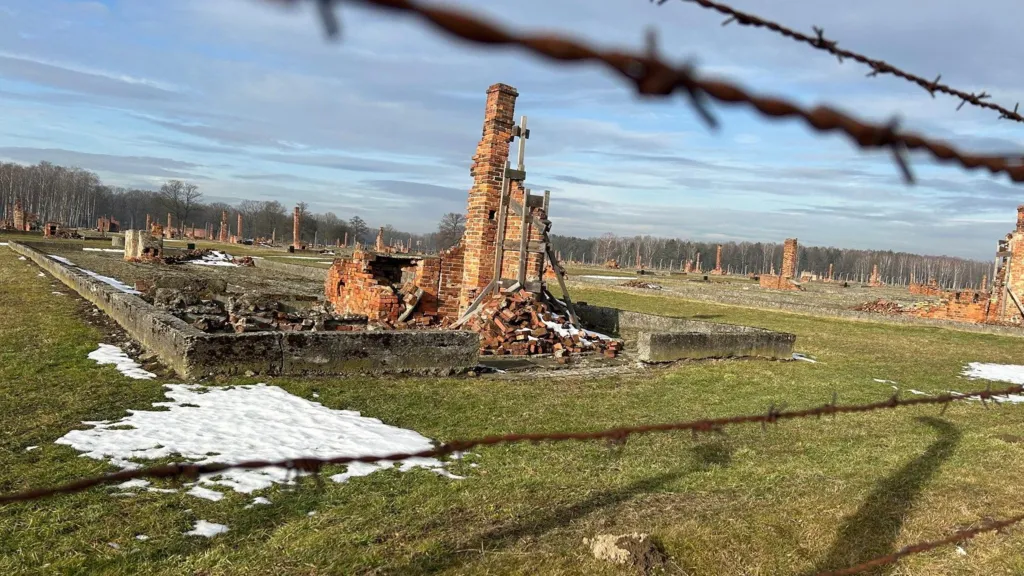
The ruins of the sprawling Birkenau site stretch far into the distance
"I had no idea where we were. It was unreal and beyond my imagination."
"After
being tattooed [133628] and inducted as a prisoner and losing my
identity, I thought this was hell on Earth, from which I had little or
no hope of getting out. I was in total despair."
"Only my father's presence gave me some hope."
Nate Leipciger, 96, from Sosnowiec, Poland
"[The
artifacts, augmented by survivors' recorded testimonies], are the
traces of genocide, the remnants of a murdered people, and the material
evidence of crimes against humanity."
"They are what remain despite the perpetrators' attempts to conceal their crimes."
Paul Salmon, curator, exhibit catalogue, "Auschwitz. Not long ago. Not far away"
"It's not easy to go to a museum to learn about the particular story of
Auschwitz, but sometimes the things that are more difficult are the ones
that are more necessary."
"We knocked on many doors. I never got no for an answer."
Luis Ferreiro, director, Musealia, Spain
"[The
Royal Ontario Museum's mission is] to help people understand the past,
make sense of the present, and come together to shape a shared future."
"[With the Auschwitz exhibit], we could not imagine an exhibition that more materially fulfilled our mission."
"[There is a deliberate attempt to avoid] gratuitous depictions of violence."
Josh Basseches, museum director and CEO, ROM
Jews from Lubny, Ukraine, shortly before their
murder by an Einsatzgruppe, 1941. This photo is one of the items in the
exhibit Auschwitz: Not long ago. Not far away.Photo by Musealia
In
2008, Luis Ferreiro, director of his family's Spanish company Musealia,
in mourning after the death of his 26-year-old bother, read
psychotherapist and philosopher Viktor Frankl's book, Man's Search for Meaning.
It gave him comfort. Viktor Frankl was a survivor of Auschwitz. It was
there that his pregnant wife, parents and his brother perished in Nazi
Germany's campaign to extinguish all Jewish life in Europe. The book's
story of survival and finding purpose in life despite the worst possible
circumstances, resonated with Mr. Ferreiro.
Although not a Jew, he took inspiration from the writer's message and decided to pursue "a moral necessity to do something. It was always about Auschwitz for me".
He collaborated with the Auschwitz Museum and spent time tracking down
other potential involvement in a long but rewarding process to showcase
human survival in the most obscene, inhumane period of modern human
history. His decision to dedicate himself to this project gave purpose
to his own life, through his grief.
The
end product of his research and organizing of an exhibit to feature the
Auschwitz death camp during the years of the Holocaust, in the Second
World War, opened in 2017 in Madrid. Since then the exhibit has toured
in New York, Kansas City the Ronald Reagan Library in Simi Valley,
Malmo, Sweden, and Boston. Between 1.4 and 2 million people have viewed
the exhibit, according to Mr. Ferreiro's estimation. During his search
for collaborators for his project, Mr. Ferreiro discovered Robert Jan
van Pelt, professor at the University of Waterloo, among the world's
leading experts on Auschwitz, who became the exhibit's chief curator.
At
Birkenau, the largest of the nearly fifty sub-camps collectively known
as Auschwitz, 96-year-old Toronto resident, Nate Leipciger, Holocaust
survivor, who has over the years dedicated himself to educating the
public about the Holocaust, had lost his mother and sister, murdered
along with eight other members of his extended family. Their lives were
taken in the gas chambers of Birkenau.
Of
the Nazi death camps scattered throughout Europe, Auschwitz was the
largest, most notorious and deadliest. At liberation, photographs of
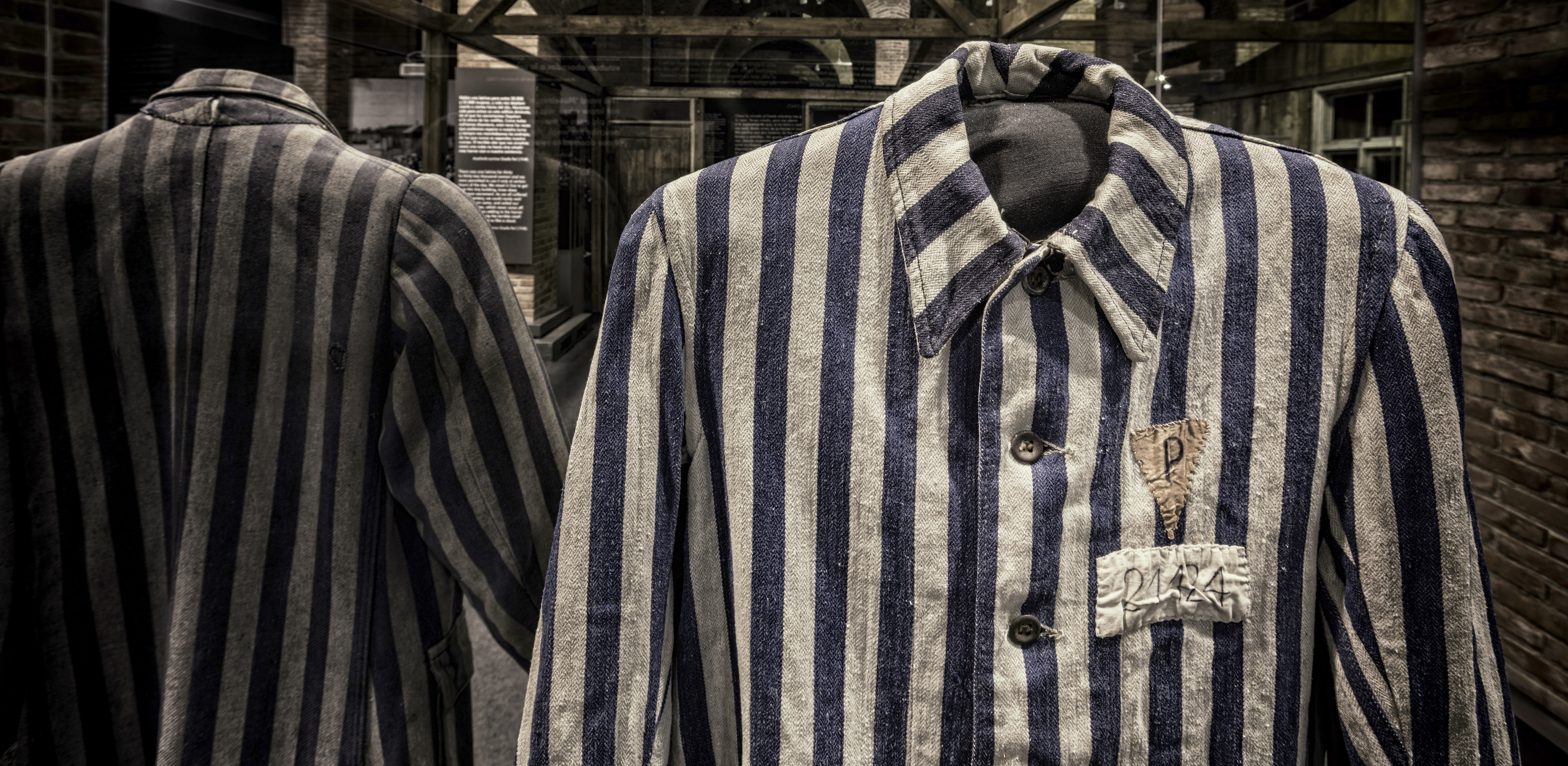
skeletal inmates in striped uniforms and dazed eyes, many too weak to
rise from their serried bunks, were seen worldwide as examples of the
Nazi atrocities perpetrated against Europe's Jews in the slaughter of
six million of Europe's Jewish communities.
Details like crammed boxcars, crematoria, belching chimneys of human ash, barbed wire enclosures, a gate whose legend read "Arbeit Macht Frei"
have become symbolic of the Holocaust. 1.3 million people were deported
to Auschwitz in the four years of 1940 to 1944; 1.1 million were Jews.
900,000 were gassed soon after their arrival in packed rail boxcars.
Others were used for slave labour until they died of exhaustion and
malnutrition. Some 75,000 non-Jewish Poles, 21,000 Roma, 14,000 Soviet
prisoners of war and up to 15,000 of other categories including
criminals, homosexuals, Jehovah's Witnesses and "undesirables", were
also murdered there.
On January 10, preceding the 80th anniversary of the camp's liberation on January 27 (annual International Holocaust Remembrance Day),
the exhibit will open at the Royal Ontario Museum in Toronto. Over 500
original artifacts, along with hundreds of photographs, charts,
drawings, correspondence and diagrams will be shown at the exhibit, most
of them on loan from the Auschwitz-Birkenau Memorial and Museum, and
from over 20 other institutions.
Among
many other items are receptacles that once contained Zyklon B pellets.
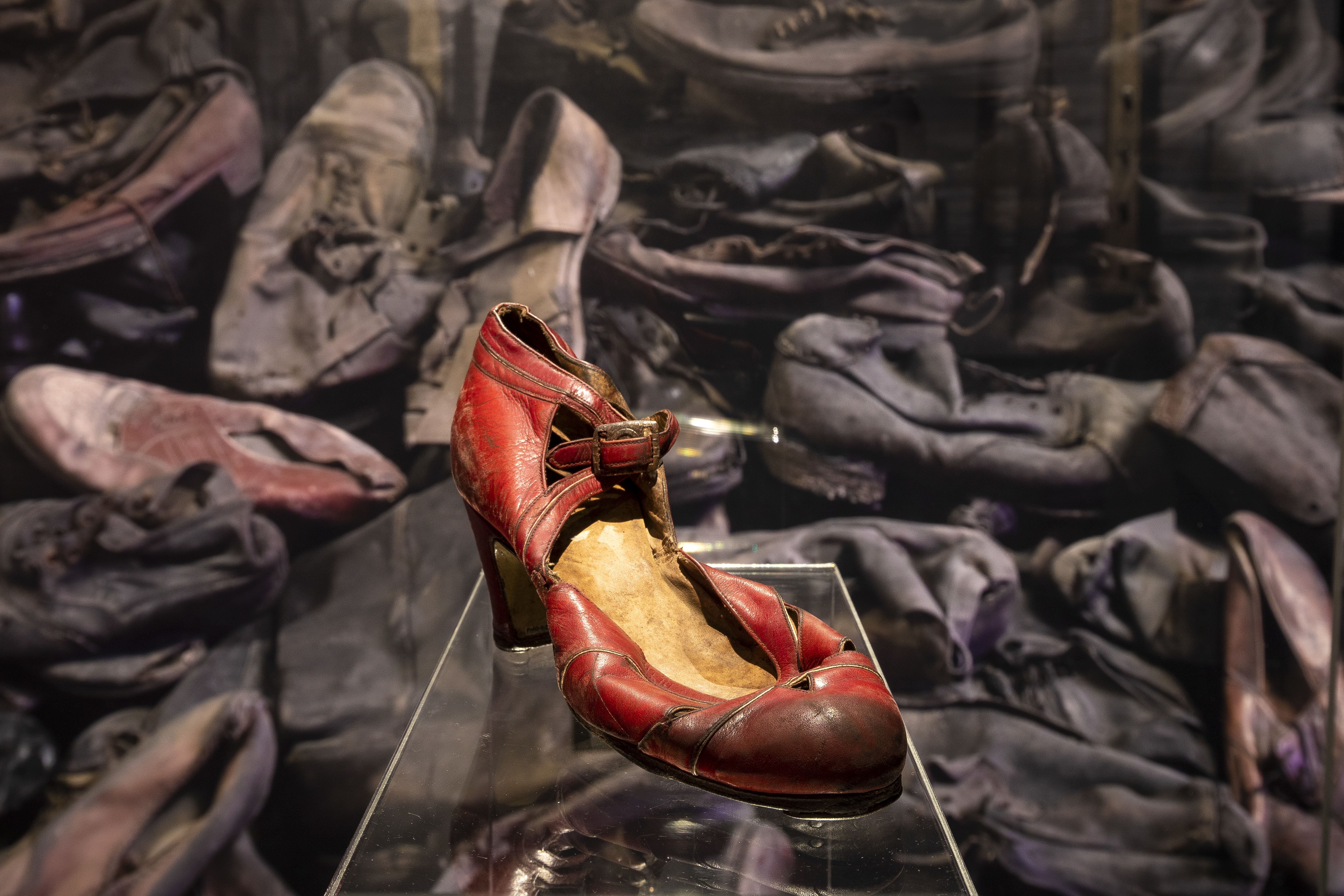
Belongings of newly-arrived prisoners of the time, are heaped within a
large glass case, comprised of everyday common personal items such as
shaving material, perfume bottles, eyeglasses, hair brushes, bowls and
buttons. Personal property items of the victims were in such abundance
they were stored within 30 barracks, referred to as "Kanada", a country
imagined to be brimful of wealth.
During
the Holocaust an estimated 1.5 million Jewish children were murdered or
died of deprivation. At a time of steeply rising antisemitism all over
the world, a time when knowledge of the Holocaust is fading, the exhibit
strives to reawaken a disinterested world's memory and conscience. The
exhibit will be on display until September 1. The ROM is its only
Canadian destination. The museum has suspended an admission charge for
Grades 6 - 12 students in organized school visits.
"We
never had the opportunity to lay a flower for any of our beloved ones
who died here. But we will mourn them today. Their souls in heaven will
always be with us."
"He
[his father Jack Pomeranc] had tremendous anxiety and regrets and fear.
[He was] crying and apologizing to his family that he wished he [had]
saved them, and he could have but he didn't and should have."
"And
at that time, I understood very well that this was something I needed
to put closure to for him, since he was traumatized all his life from
it."
Today we bring closure to this chapter in our lives."
Michael Pomeranc, son of Holocaust survivor
After
many long years of planning, Michael Pomeranc and his close relatives
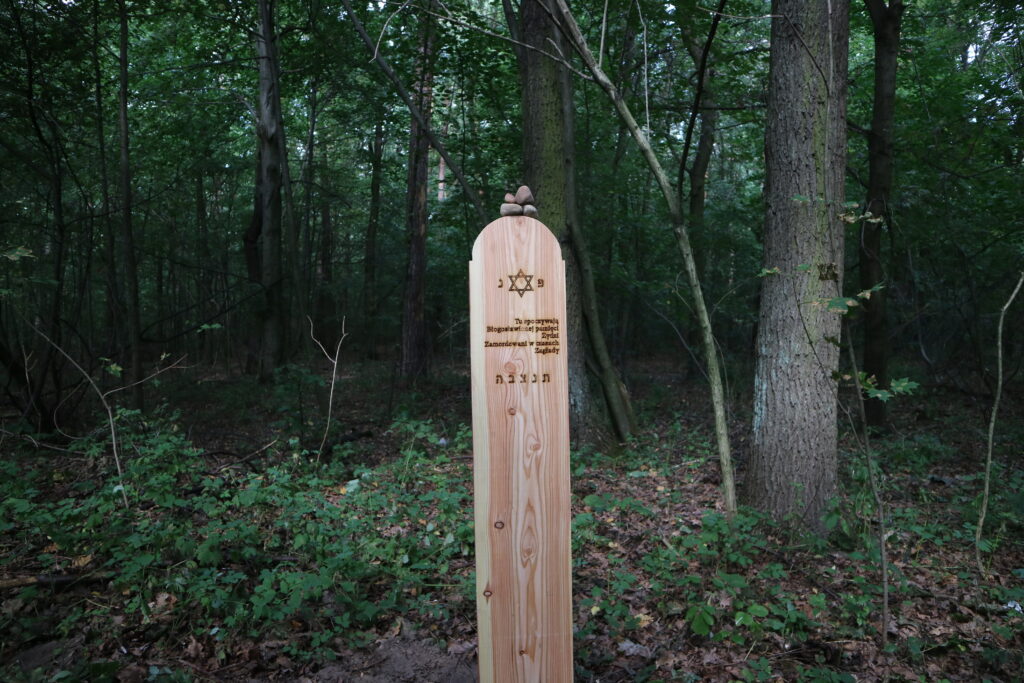
fulfilled a personal mission when they took part in a ceremony to unveil
memorials to murdered Jews during the Second World War. The venue was a
forest in Poland. And the memorial was to honour the Jews murdered by
German forces. Dozens of Michael Pomeranc's relatives among them, at a
little-known German labour camp named Adampol.
During
the dedication ceremony, Pomeranc spoke of his childhood in the United
States. Where there were no cemeteries that held the remains of his
family members, no graves to visit that held the remains of his
predecessors in his family tree. Jews were forced to work as slave
labourers in fields nearby the Nazi labour camp. Once their usefulness
was over, when they became too weak, too ill to continue labouring, they
were murdered, in 1943.
Poland,
under Nazi German occupation, was the site of many such labour and
death camps where Jews had value as slave labourers and when they could
no longer perform the labours assigned to them they were scheduled for
mass extermination in the death camps. Auschwitz is the most well-known
of all such death camps, but it was only one of many, although it was
responsible for the extermination of over a million Jews of all ages.
Women in the barracks at Auschwitz, Poland, January 1945. Photo taken by
a Russian photographer shortly after the liberation of the camp.
The
event was attended by local schoolchildren in the presence of
descendants of Holocaust survivors who witnessed it far from Poland, via
livestream. Two living survivors of Adampol are left to contemplate
their living hell during that time. Too old and frail to make the trip
to Poland. New York city hotelier Pomeranc visited the site 25 years
earlier with his father Jack Pomeranc. His father had been imprisoned
there but was able to escape, to join Jewish partisans and took part in
blowing up Nazi-occupied buildings and train tracks in efforts at war
sabotage.
Jack,
whose Yiddish name back then was Jankiel, along with a brother and two
sisters managed to survive, but his parents and two little sisters, age 3
and 4, along with aunts, uncles and cousins were all murdered. At the
commemoration a memorial with the names of 73 of over 600 victims were
included; the only identification so far of those who perished. The
organizers' goal is the restoration of identities of as many victims as
possible to preserve their memories.
The
event is part of a more expansive effort by the Polish Jewish community
to commemorate sites of mass murder of Jews during the Holocaust,
neglected and unmarked a lifetime after the Second World War. Of the 3.3
million Jews who lived in Poland before the 1939 German invasion, most
wee murdered. Polish Chief Rabbi Michael Schudrich along with a group
named Zapomniane (Forgotten) aided by non-invasive technologies have succeeded in systematically locating sites of mass burials to mark them for posterity.
So
far, witness testimony of local people and technology have aided
researchers in identifying over 20 possible mass grave sites in Adampol,
verified by a forensic archaeologist who has carried out years of
research at the site.
Illustrative photo of electric fences with concrete posts and insulators
surrounding the barracks where deportees where held at the Auschwitz
concentration and death camp established by the Nazis. (Jack Guez/AFP)
Moral Indignation Over Reality Does Not Expunge It
"It is appalling that the Canadian government could attempt for no good reason to subject innocent Canadians, their family members and descendants to public scorn."
"When the announcement is made, we will have to be ready to go to the Federal Court challenging the government's authority to ignore Justice [Jules] Deschenes' [Commission of Inquiry on War Criminals, February 1985] ruling on confidentiality. To do so, we need to prepare now."
"All alleged war criminals, regardless of their ethnic, religious, racial or cultural origin, or where or when they committed their crimes should be bought to trial in Canada under Canadian criminal law."
"If evidence of wartime criminality by any person found in Canada exists, that information must be communicated to the proper authorities for investigation."
Ihor Michalchyshyn, CEO, executive director, Ukrainian Canadian Congress
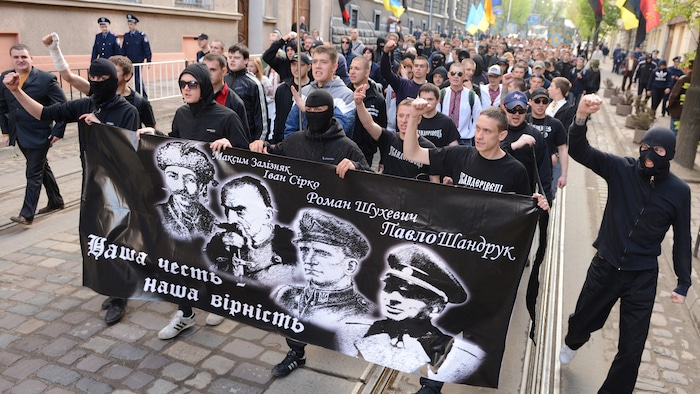
Ukrainian
ultra-nationalists, carrying a banner with a portrait of Ukrainian
Insurgent Army (UPA) Roman Shukhevych (second from the right), march in
the centre of the western city of Lviv on April 28, 2013. The march
commemorated the 70th anniversary of 14th Waffen SS Galicia Division
made up mostly of Ukrainian volunteers. Photo: (YURIY DYACHYSHYN/AFP/Getty Images)
When then-prime minister Brian Mulroney was lobbied by Jewish groups to conduct an investigation into the infamously well-known refuge that Canada had become post World War II for Nazi war criminals, he appointed Justice Jules Deschenes to head the Commission of Inquiry on War Criminals, back in 1985. Previous administrations were disinterested in examining the situation whereby known and unknown war criminals were living ordinary lives in Canada, protected by their postwar-acquired Canadian citizenship.
The Commission created several documents, one titled Master List of Alleged War Criminals Resident in Canada with a List of Sources. 774 appeared on the list. Additional names of alleged war criminals, including Nazi scientists and technicians who arrived in Canada not as fugitives but as immigrants entitled to entry as landed immigrants simply because the immigration department appeared to find it unnecessary post-war to investigate backgrounds for war-incriminating evidence, brought the total closer to 900 names.
The documents were labelled secret and conveniently shelved, despite Jewish groups which had lobbied to have the investigation take place, then demanding that the result of the inquiry be made public. Justice Deschenes, having done his duty, felt it appropriate and declared his studied opinion that the Inquiry documents be withheld from public scrutiny. Among the large groups of named individuals a smaller number on the list are believed to be Ukrainian in origin, or people hailing from other eastern European nations, complicit with Nazi crimes.
Requests for the release of the documents have never been stilled under Canada's access to information law. It is Library and Archives Canada which must make the critical decision to release the documents. Or not. In June a secret meeting/consultation whose participants were present by specific invitation to attend; described as a "discrete group of individuals or organizations" were present to offer their opinion whether the list should be made public.
Given the Jewish communities' urging over the years for the documents' release, it might have been thought they would be among those receiving invitations to attend. They were not. Given the reality that it was Jews in horrendous numbers that were the designated fascist victims of Nazi Germany's 'Final Solution', that Jewish groups, knowing of the presence in Canada of their persecutors, had a fully vested interest in having their presence revealed, thus finally forcing the government of the day to finally act.
To divest recognized war criminals of their Canadian citizenship, to ensure, despite the passage of years, that their crimes, if proven in law, merited final accounting for.
Neither Holocaust survivors nor Holocaust scholars all of whom had advocated for full release of the documents, including the list of alleged Nazi war criminals, were included to attend the 'consultation' respecting the potential of releasing clearly incriminating documents. In the lead-up to Library and Archives releasing its final decision on the matter, the Ukrainian Canadian Congress, which had been among the invitees, is seeking funding to finance a legal challenge in Federal Court.
As a declared representative of the Canadian Ukrainian community comprising one and 1/3 million people, the organization is encouraging its contacts within the Ukrainian community to donate to a fund that would aspirationally be in the neighbourhood of $150,000 to launch their legal challenge against the release of the documents with the intention of sparing humiliation, ignominy, harassment and possible charges against those of the Ukrainian community named in the documents.
Canadians in general have hugely supported doughty Ukraine in its epic existential battle against the modern equivalent of the Soviet Union, against a tyrant who will stop at nothing to achieve his aims at dominating a smaller neighbour that has no wish to be other than fully independent of Russia, its ideology and grasping territorial ambitions. Russia and its president, Vladimir Putin have been recognized in the commission of war crimes in Ukraine. The conflict continues and so does Russian disinformation. Yet Ukraine itself and its expatriates must also recognize reality of the past.
Another issue identified was the awkwardness of the Soviet involvement in the Second World War; first as an Axis ally of fascist Germany, and later as a member of the Allied forces following Moscow's invasion of Russia. The Soviet Union, loathed by most countries in eastern Europe for its stranglehold on their sovereignty, capturing them all in a forced wide web of enforced 'socialism' within the United Soviet Socialist Republic. During the War and Holocaust years voluntary recruits from some of those nations augmented the Nazi SS, fighting alongside them, participating in deathly carnage.
Russia, before and after its invasion of Ukraine, had infiltrated Canadian news through social media to sow divisions between various groups in Canada, particularly through statements both unofficial and official alluding to Ukraine as 'fascist', and a 'neo-Nazi' state. Since Ukraine had ousted its former Russian-oriented President who represented the interests of Russian-Ukrainians in Eastern Ukraine and Moscow, to release itself from Russia's imposed bondage, a campaign of Russian propaganda has painted Ukraine as fascist.
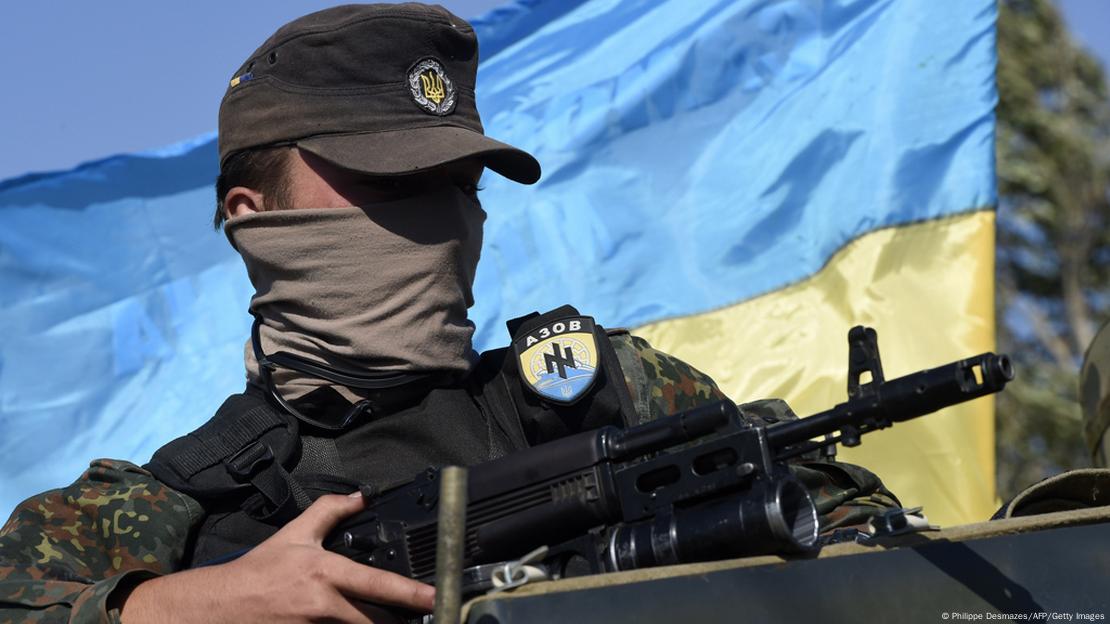
Russia's top prosecutor has asked the Supreme Court to designate the Azov Regiment, seen here in 2014, as a terrorist group
Ukraine most certainly had its fascism-inclined demographic that saw more in common with Nazi Germany than its Soviet occupier. And no one could argue that Ukraine was free from the ancient virus of antisemitism. And the fact that the infamous Azov Battalion was comprised largely of fascists infected with the virus of acute antisemitism. Attention was riveted on the issue of Canadian war criminals when in 2023, Canadian Members of Parliament offered two standing ovations to a 99-year-old war veteran, a Ukrainian-Canadian living in North Bay.
Until it was revealed that Yaroslav Hunka, hailed as a wartime hero in the Canadian Parliament, had done voluntary service in a Ukrainian Waffen SS unit, fighting for and with the Nazis. Canada was the involuntary, disinterested, oblivious recipient of large numbers of soldiers from a Ukrainian Waffen SS division following the war. Jewish groups and the Polish government made it clear that Hunka's unit was involved in war crimes; massacres of women and children.
In the final analysis, the Commission reached the decision that claims of large numbers of war criminals entered Canada were exaggerated, yet as a result of inadequate government screening post-war, it also stated that: "it would be rash to assume that significant numbers of war criminals and Nazi collaborators did not enter Canada". Investigations into the hundreds of individuals alleged to have been war criminals did not fall under the purview of the Deschenes Commission.
According to Professor Jared McBride, an American who had been a fellow with the U.S Holocaust Memorial Museum, his researchers made use of declassified American government records alongside other materials, to compile a list of 275 alleged war criminals held to be most likely to be included in the Canadian records, although his research is expected to add more names as their own investigation proceeds.
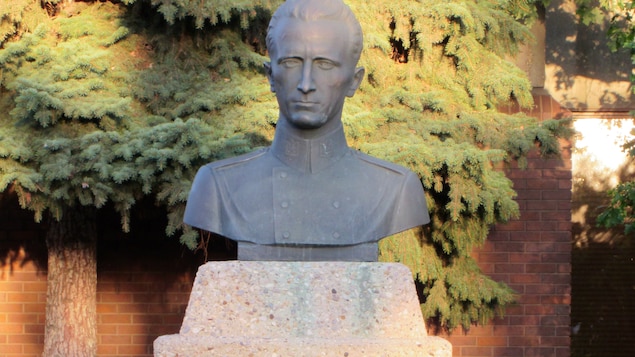
The
monument to Roman Shukhevych, commander of the Ukrainian Insurgent Army
from 1943 until his death in 1950, at the entrance of the
Ukrainian Youth Unity Complex in North Edmonton, Alberta, since
mid-1970s. Critics of the monument say it glorifies a Nazi henchman who sided with
Germany in hopes of winning independence for Ukraine. Photo: (Photo courtesy of John-Paul Himka)
"Whether Library and Archives Canada [LAC] likes it or not, these names are going to be released to the public."
"Instead of moving toward a path of openness and transparency about its record on allowing war criminals into the country and its failure to prosecute them, the Canadian government held a secret meeting to discuss the secret names from the secret report from 40 years ago that still has not seen the light of day."
"Moreover, they invited to this meeting the same people who helped to keep the report under wraps four decades ago."
Professor Jared McBride, specialist, Ukrainian Nazi collaborators, UCLA, U.S. Holocaust Memorial fellow
"A few stakeholders were concerned that the release of the report would result in new legal action [criminal prosecution, citizen revocation, or otherwise] being brought against the individuals named in the report."
Library and Archives Canada (LAC) report summary
"[Library and Archives Canada had received three requests under the Access to Information law for the Deschenes document and as a result] undertook targeted consultations with external stakeholders."
"As of today LAC is still refining and concluding its analysis to respond to the Access to Information requests received."
LAC spokesperson Richard Provencher
"We know many survivors that feel very strongly about this issue and would have wanted the opportunity to speak."
"Why were they not included? Do they not have a right to be heard on questions related to the investigations against Canadians who may have been involved in committing acts of genocide against their families?"
"The idea that Canadians should be worried about the embarrassment or privacy of war criminals is obscene. We know that individuals involved in implementing the genocide of six million Jews during the Holocaust have been living peacefully in Canada for decades and it is well past time that all the facts come to light."
Jaime Kirzner-Roberts, Friends of Simon Wiesenthal Center for Holocaust Studies, Toronto
Screenshot from a 1987 news report by CTV News—based on the information that was public at the time.
"In view of the large numbers of people involved in the perpetration of
war crimes who merged with the DP [post-war 'displaced persons'] and general immigration stream; in
view of the inadequacy of the screening performed by international
agencies and Canadian officials during the postwar years; and in view
of the Canadian government’s policy of ethnic immigration and of
concentration… on weeding out Communists, it would be rash to assume
that significant numbers of war criminals and Nazi collaborators did not
enter Canada."
Historian Alti Rodal
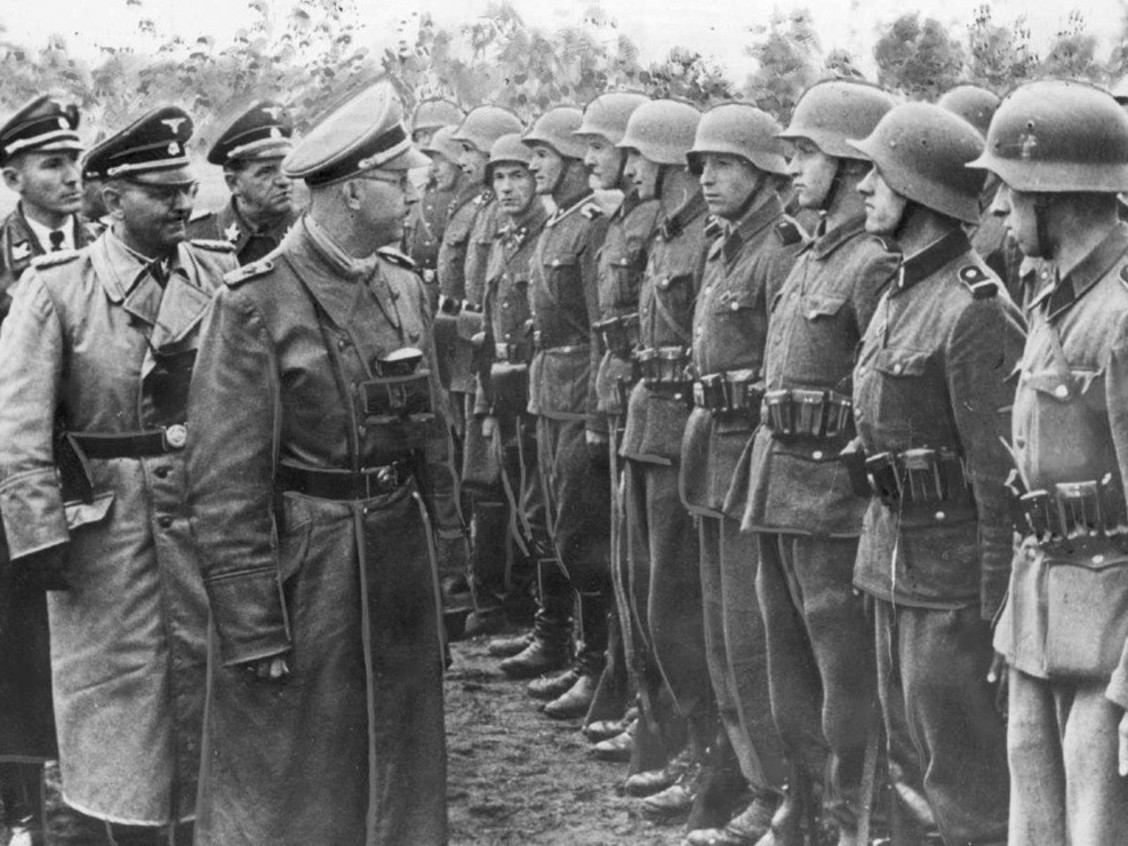
Nazi
SS leader Heinrich Himmler inspects volunteers of the Ukrainian Waffen
SS division during the Second World War. Library and Archives Canada is
now reviewing whether to release the names of alleged Nazi war criminals
who fled to Canada after the war.Photo by Archive photo
The 1986 war crimes commission headed by Justice Jules Deschenes was tasked to look into the issue of the presence of Nazi war criminals living in Canada. People who fought with and acted for the Fascist Nazi Third Reich. Canada, of course, has rules and regulations on admitting foreigners into Canada as immigrants or refugees; they are inadmissible if they have a criminal record, and particularly a link of any kind with a national military involved in war crimes.
Despite which it has been known since the end of World War II that many war criminals entered Canada and lived there freely. There were 900 names on a list of war criminals living in Canada, compiled for inclusion with the Deschenes Report.
The report, named the Commission of Inquiry on War Criminals in Canada, commissioned by the government of Brian Mulroney long after the conclusion of the war -- the only prime minister who could be persuaded to look into the issue -- clarified the issue, yet its contents were never revealed, and it was shelved for decades. Alternately called the Deschenes report, it compiled a list of 900 names of war criminals living in Canada.
Finally the government of the day released a 618-page report in February written by historian Alti Rodal which investigated how Nazi war criminals entered Canada after the Second World War.
Now, it seems that in June and July, Library and Archives Canada undertook consultations with "discrete groups of individuals or organizations" on whether the list of names should be made public. Members of Canada's Ukrainian community were among those consulted, and it was from among members of the Ukrainian community that Nazi collaborators during the war years found their way to Canada, entering with no trouble at all.
Notably, those most affected by the Nazi years in power, victims of the Holocaust and Jewish-Canadian groups were not made aware of the consultations, not invited to participate; their vested-by experience interest completely ignored.
Those who were consulted expressed grave reservations over the prospect of the information contained being made public knowledge; arguing against releasing any of the information. Warning that to do so would be embarrassing in its revelations, or might lead to prosecutions of those alleged to have been war criminals. In other words, naming those who are considered to have been war criminals could unobligingly lead to their past catching up to the present with consequent criminal charges. Not to be conceived....
Prior to the consultations, Library and Archives Canada had thought to release information to the public at some time between September 16 and September 20. Unknown is the number of names that might be released to the public. LAC withheld to the present specific details on the individuals involved and organizations that had been consulted on the issue. As to why Holocaust survivors were excluded from the discussions remained unanswered. Friends of the Simon Wiesenthal Center for Holocaust Studies had not been advised nor invited to the advisory meeting.
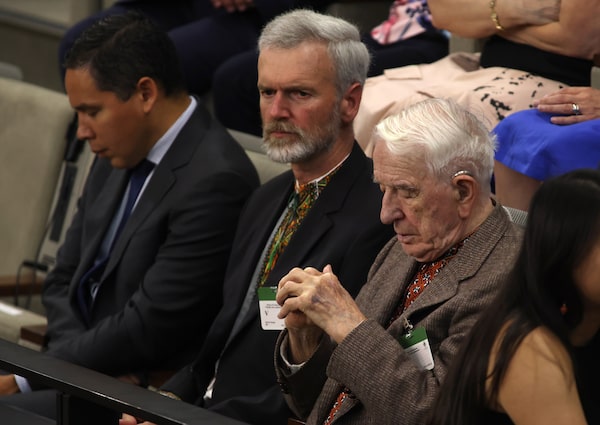
In February 2023, B'nai Brith advocacy group pointed out to a House of Commons committee on Access to Information that the Canadian government's attitude toward Nazi collaborators had been marked with the "intentional harbouring of known Nazi war criminals", along with "deliberate inaction". That was the year that an invitation went out to a Ukrainian veteran, Yaroslav Hunka, to appear in the House of Commons during a visit by Ukrainian President Volodymyr Zelenskyy. Hunka, 98, a former member of the Waffen SS was given a standing ovation by parliamentarians.
Canada’s parliament applauds Yaroslav Hunka, a former member of the
Waffen-SS. Canada’s Chief of Defence Staff General Wayne Eyre is on the
far left.
None thought for a moment that they were applauding a Nazi collaborator, but they were, and they did. From parliamentarians to Canadian military members, all lauded a Nazi collaborator, not instinctively realizing that anyone who fought against the Soviets for Germany after 1941 was part of the Axis, their units like Hunka's division, the 14th SS Galicians, had sworn allegiance to Germany and Hitler, and taken part in the extermination of Jews and Poles. And Canadians responded writing angry notes to the government, to the prime minister pointing out the gross stupidity of hailing Hunka as a war hero.
Yaroslav Hunka (front center) among Nazi Waffen-SS Galicia Division troops.[Photo: Ivan Katchanovski/Twitter or X]
"Canada has a really dark history with Nazis in Canada."
"There was a point in our history where it was easier to get in as a Nazi than it was as a Jewish person."
"I think that's a history we have to reconcile."
"Those who suffered under Nazi Germany and their descendants want
transparency when it comes to this shameful chapter in our history. This
is what led to the creation of the Deschênes Commission almost 40 years
ago, and why we took this step to make the vast majority of the Rodal
Report publicly available. More can and should be done to provide
transparency."
Canadian Immigration, Refugees and Citizenship Minister Marc Miller
"Why did I survive? I question that myself. I was in second grade before the war and out of 30 classmates, only two of us survived. Why am I so special? I don't know the answer. I believe in God and I'm still here. To all survivors, I say be happy."
"I realized it was a selection [Auschwitz-Birkenau concentration camp] to kill us. I used to put sand in my shoes to make myself [appear] a little taller. Mengele came to me and asked, 'How old are you?' I said, 'I'm 14'. He said, 'You're a liar', and took his gloves and hit me over the face."
"He told me to drop my pants and my shirt and told me to turn around. He than asked, 'How come you're so dark?' I said, 'I only have one shirt. When it's a hot day the sun is out. I want to preserve that shirt, so I remove it and this is how I got a suntan'."
"I don't know if he liked my suntan, or if he liked my answer. I have no idea. He just passed me by and took the guy next to me to be killed."
91-year-old Holocaust survivor, Dr. Arnold Clevs
“To all survivors, I say, be happy,” says Holocaust survivor Dr. Arnold Clevs, left, with Zikaron BaSalon host Eylon Levy.Photo by Aviva Engel
Dr. Clevs was eight years of age when he, his parents and six-year-old sister were forced to relocate to the ghetto in their town in Lithuania. The family employed a live-in housekeeper, a young Lithuanian women who Dr. Clevs described as having grown up with the Clevs children. One day she appeared with a Lithuanian collaborator who came into the house and selected whatever was there that appealed to him. The young woman accommodated her companion. Dr. Clev's mother asked of her 'Could you bring us some bread?'. But they never saw her again.
There are approximately 149,000 Holocaust survivors living in Israel. Among them many were children, or babies born during the war. Monday will see the commemorative arrival of Yom HaShoah, Holocaust Remembrance Day. On this occasion, a ritual ensued where survivors and others seeking to honour the millions of Jewish children, men and woman who perished as a result of Nazi Germany's institutionalized killing apparatus visit the death camps, a solemn occasion to look back while simultaneously looking forward.
Although 80 years have passed, the memory of those whose lives were extinguished burns bright in the hearts, minds and souls of the survivors. Memorial candles will be lit in millions of Jewish homes, in memory of those who died so prematurely because they were Jews. On October 7 of 2023, some of those Holocaust survivors experienced a scenario reminiscent of what they had lived through generations earlier when the terrorist group Hamas that governs Gaza flooded into Israel to torture, murder and kidnap civilian Israelis.
A group called Zikaron BaSalon meaning Remembrance in the Living Room dedicated to helping Holocaust survivors in their adjustment to normal life, spring into action when incidents occur that overwhelm the survivors with past memories leading to uncertainties and re-emergence of the trauma they suffered. The group knew that in the follow-up to October 7 they would be needed to help heal more recent wounds as Israelis mourned their dead and were tormented about the fate of the hostages, among them their loved ones; children, the elderly, women and men.
"When the war broke out, we realized that we were not dealing with the typical scenarios that the country is used to -- this was something different. The first group that needed our attention were the survivors, whom we knew would not only be fearful, but likely also reliving their childhood traumas. I spoke to a 93-year-old-survivor who said, 'Get me a uniform and a weapon and I'm going in'. But for the most part, Holocaust survivors were really, really traumatized like the rest of us by what they were seeing."
"These Holocaust survivors have endured the absolute worst of humanity, yet they have rebuilt their lives, created families, communities and businesses, and contributed to the establishment of the State of Israel."
Sharon Buenos, global director, Zikaron BaSalon
The immediate action undertaken was to establish an emergency call centre offering emotional support and assistance with food, shelter, medication and transportation to medical appointments for the Israelis who were left homeless after October 7, evacuated from the southern Israel area, from the towns and kibbutzim where their homes were destroyed their belongings looted, their friends murdered. The displaced Israelis were in a state of shock, particularly the children, some of whom had witnessed unbelievable savagery and loss.
Survivors of the Nova music festival and children from the regions across the border from Gaza, attacked on October 7, were connected by Zikaron BaSalon with Holocaust survivors for mentoring and a unique type of emotional assurances. A living room was set up at the Dan Acadia Herzliya Hotel for child evacuees of a community on the Gaza border that suffered agonizing casualties. Currently living at the hotel with their families, the children interacted with Holocaust survivor Hannah Gofrit who at the age of four until she was ten suffered under the Nazis.
Dr. Clevs spent two years in 11 different slave labour and concentration camps. After liberation, he was reunited with his mother and sister. He raised a family in Chicago where he practised dentistry, and eventually moved to Israel. A fellow survivor who had been in Auschwitz-Birkenau with Dr. Clevs as a 16-year-old, now living in Sderot, southern Israel, is 97. Asked how he managed, living in a town with missiles arriving sporadically, he responded: 'It's a hell of a lot better than Birkenau'.
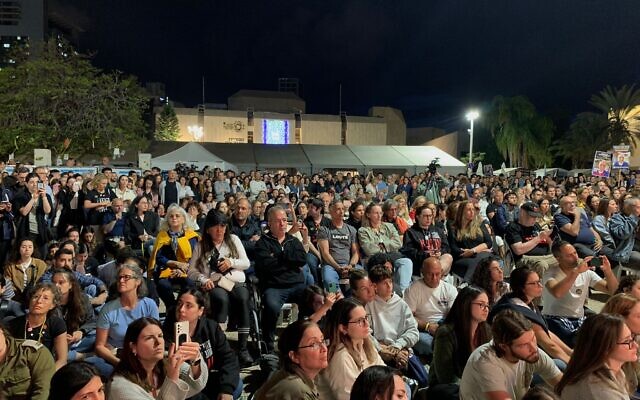
Crowd of thousands gathers in Tel Aviv's Hostages Square to hear
testimonies from Holocaust survivors and hostage families on May 5,
2024, the eve of Holocaust Remembrance Day. (Charlie Summers/Times of
Israel)
"I don't understand this upside-down universe where people here admire the Waffen SS and somehow that's OK."
"It
doesn't embarrass the people at my university very much that they have a
[group] that has been laundering Waffen SS reputations and funds for
years now."
Karyn Ball, professor, Holocaust scholar, University of Alberta
Yaroslav
Hunka, right, waits for the arrival of Ukrainian President Volodymyr
Zelenskyy in the House of Commons in Ottawa on Sept. 22. The University
of Alberta is returning endowment funds from the family of Hunka, a
Ukrainian man whose military service was linked to the Nazis.Patrick Doyle/The Canadian Press
After
professors at University of Alberta lodged complaints that the
University continues to engage in white-washing Nazi crimes, a panel
scheduled to discuss the Waffen SS was quietly cancelled. A number of
online discussions have been held at the university since an episode
involving Ukrainian-Canadian veteran Yaroslav Hunka who served in the
Waffen SS was invited to the House of Commons on September 22 on the
occasion of Ukraine's Jewish President addressing Parliament. The-then
Speaker of the House, ignorant of the Nazi connection, invited the man,
characterizing him as a Ukrainian 'hero'.
Despite
reality, speakers at the online discussions claim that the 14th Waffen
SS Galicia was never involved in Nazi war crimes, attributing such
claims to Russian disinformation. When, once again the Canadian
Institute of Ukrainian Studies at the university planned another online
discussion for October 14, university professors launched yet another
protest. Complaints were filed to the university's administration
charging the CIUS in whitewashing Nazi collaborators and war crimes.
The
Hunka family had endowed the organized event with $30,000, before it
was cancelled. The Waffen SS Galicia was involved in massacres of
civilians during the Second World War, and used as well by the Nazis to
crush an uprising in Slovakia. The university's vice-president of
academics announced the Hunka family funding would be returned to them. "On
behalf of the university, I want to express our commitment to address
antisemitism in any of its manifestations, including the ways in which
the Holocaust continues to resonate in the present", she stated.
Laurie
Adkin, a political scientist at the university, called for an
investigation of funding and activities of the Canadian Institute of
Ukrainian Studies. Recently an article in media outlet Progress Report revealed
that the university took money from Hunka, as well as from other Waffen
SS members, accepting as well funds from the estate of Volodymyr
Kubijovyc, a Nazi collaborator who founded Waffen SS Galicia, advocating
for ethnic cleansing, for a Ukraine without Jews or Poles.
Monument to the people slaughtered by the 14th Waffen-SS at Huta Pienacka. Image via Stako
Another
veteran of the Waffen SS Galicia division, Peter Savaryn, had served at
the University of Alberta as chancellor from 1982 to 1986. He helped to
fund the CIUS and had been awarded the Order of Canada in 1987. Among
nationalist Ukrainian-Canadians, members of Waffen SS Galicia are viewed
as heroes, reflecting their battles against Soviet forces, at that time
in the war fighting the Nazis with the Allied coalition. Oakville,
Ontario and Edmonton, Alberta both host monuments in honour of the
Ukrainian SS troops.
There
is a sharp distinction from that group to the 40,000
Ukrainian-Canadians who were members of Canada's military, fighting the
Nazis, for whom no monuments have ever been erected in honour of their
loyalty to democratic values and Canada. A 1980s study of war criminals
in Canada found 600 former members of SS Galicia still resident in
Canada. "The Division was an SS division and technically all of its officers and senior NCOs are liable for trial as war criminals", a 1948 British government report noted.
"The University of Alberta says
it is reviewing other donations it has received after returning $30,000
from the family of Yaroslav Hunka, a Waffen SS veteran who got a
standing ovation in Parliament during a visit by Ukrainian President Volodymyr Zelensky last month."
"The
university is facing calls to return hundreds of thousands of dollars
in endowments in the names of Ukrainians linked to the Waffen SS Galicia
division, who were admitted to Canada after the Second World War. They
include an endowment of about $430,000 in the name of Volodymyr
Kubijovych, who played a key role in the SS unit’s establishment in
1943."
The Globe and Mail
Left image: Peter Savaryn (left standing) and Volodymyr
Kubijovyč (center sitting) pictured here at the 1976 contract signing
between the Canadian Institute of Ukrainian Studies and Shevchenko
Scientific Society of Europe to collaborate on the Encyclopedia of
Ukraine. Right image: Volodymyr Kubijovyč (circled in red) gives a Nazi
salute at the 14th Waffen-SS recruitment ceremony in 1943.
"Canada has a really dark history with Nazis in Canada."
"There was a point in our history where it was easier to get in [immigrate to Canada] as a Nazi than it was as a Jewish person."
"I think that's a history we have to reconcile."
Immigration Minister Marc Miller
"What little we know of their [SS members] war record is bad."
"We're still hoping to get rid of the less desirable Ukrainian PoWs either to Germany or to Canada."
British Home Office official Beryl Hughes, 1948
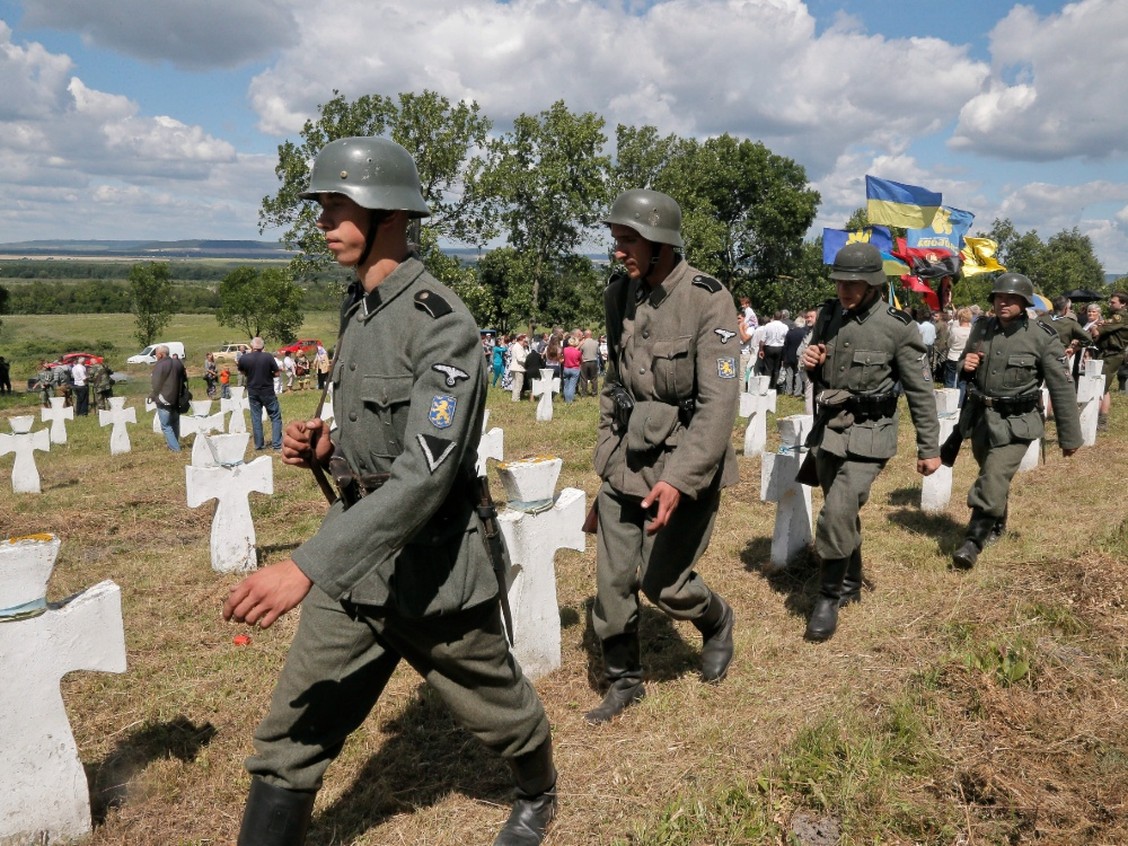
Ukrainians
dressed in SS Galicia Division uniforms march past graves during a
re-burial ceremony at the SS Galicia Division cemetery near the village
of Chervone, Ukraine, in 2013.Photo by Efrem Lukatsky/AP/File
Documents compiled by a commission set up in the 1980s to scrutinize Canada's record in permitting members of the Nazi SS into Canada through government-sanctioned visas, including members of the Ukrainian collaborationist special ethnic SS-linked divisions meant to work with German SS units in
rounding up Jews in massive pogroms of shooting deaths -- part of the Holocaust's 'Final Solution', a priority with Nazi Germany while it was prosecuting World War I --, have never been made available for public scrutiny.
In the wake of a public scandal where a North Bay Ukrainian military veteran was invited to parliament to meet with visiting Ukrainian President Volodymyr Zelenskyy who was to address the House of Commons, where the entire House inclusive of parliamentarians and diplomatic guests rose on the introduction of the 98-year-old, a former volunteer serving with a Ukrainian SS division, Jewish groups in Canada are now demanding the release of the documents, unredacted.
The 40-year-old report along with allied documents that contain details relating to Nazi war criminals residing in Canada remains in a 'secret' category. It represents a second portion of a 1986 government-commissioned report on Nazis who were permitted to enter and settle in Canada. Another 1986 report was heavily censored, one that examined how it was that Nazis were enabled to enter Canada to begin with, post World War Two. That commission was struck in the wake of years of Jewish groups urging the government to investigate and extradite Nazi war criminals known to be living in Canada.
Over 600 pages of the document finally obtained through the country's Access to Information law, was censored. B'nai Brith is now demanding the release of RCMP and Department of Justice files on Nazi war criminals in Canada. "We've run up against a brick wall", commented David Matas, counsel for the Jewish advocacy organization ... in view of the government's ongoing decision to withhold such records from public view. A ray of hope shimmered briefly when Canada's Immigration Minister Marc Miller allowed that the government might reconsider whether the records could be released.
Canada's track record, he commented pointedly, with Nazi criminals was notoriously poor. B'nai Brith pointed out in a submission to the House of Commons committee on Access to Information in February that the government's approach to Nazi war criminals reflected its "intentional harbouring of known Nazi war criminals" along with "deliberate inaction".
And that historical puzzle has now been resurrected since MPs in the House of Commons a week ago honoured a Canadian-Ukrainian who had served in a Nazi SS division. Two standing ovations from those present were awarded Yaroslav Hunka, sparking outrage on social media, prompting the resignation of the House of Commons Speaker Anthony Rota on whose invitation to the man living in North Bay, arrived at the House of Commons, with no one apparently aware, despite that House security and Canadian intelligence services were to have scrutinized the man's background prior to his entrance.
Yaroslav Hunka, right, waits for the arrival of
Ukrainian President Volodymyr Zelenskyy in the House of Commons in
Ottawa last Friday.Photo by Patrick Doyle /The Canadian Press
The now-98-year-old had volunteered to fight with the 14th Waffen-SS Division Galicia, a Nazi military unit recruiting Ukrainians to fight alongside German SS groups, and more to the point, help in the extermination of Europe's Jews. Poland, along with Jewish groups denounced the infamous division, citing its role in killing civilians in grouped massacres during the war. Poland, in fact has petitioned Canada for the man's extradition as a war criminal.
Large numbers of SS soldiers and other Nazi collaborators from eastern Europe settled after the war in Canada. Jewish refugee-survivors who had also come to Canada, spoke in shocked whispers to one another when they recognized on the streets of Toronto, German SS members they had last seen in the ghettos and death camps. Many of the records sought have links to the 1986 war crimes commission that was led by Justice Jules Deschenes.
The International Military Tribunal had declared the SS a criminal organization, including units of the Waffen SS, like the Galicia division that Yaroslav Hunka had fought with. There are nationalist Ukrainian-Canadians today, who view the 14th Waffen Division as heroic for battling Soviet forces who at that time were allies with the US, Canada and Britain after Russia was invaded by Germany despite Russia having begun the war as part of the Axis group.
The release in Britain in 2005 of documents from British archives outlined concerns relating to the members of SS Galicia along with intentions to ship them to Canada. "The Division was an SS division and technically all of its officers and senior NCOs are liable for trial as war criminals", noted one report for the British government. In another report dated 1948 there were discussions on sending SS members to Canada. And they did.
"We wanted to show that we're still here -- that we're accepted, that we weren't ended in 1933."
"I've been there from the first day. I never imagined that we -- as a Jewish team -- would ever be playing a Cup game against a Bundesliga team. So for us, and for me personally, it's a huge joy."
"I have many German friends, Christian friends. I never speak about it. Perhaps his father or grandfather was in the SS, for me everything is open."
"It was 80 years ago. It's past. Now, we try to be accepted as Jews."
Marian Wajselfisz, co-founder, Makkabi Berlin
"This is something we're extremely proud of. We're here and whoever is ready to play for us, and is also open to playing for a club with Jewish origins and some sort of Jewish culture, we're absolutely happy to integrate people into our teams."
Makkabi Berlin Board Member Michael Koblenz
"Sometimes I feel tired, but when I see the kids, I forget about the tiredness, I'm happy."
"It doesn't matter about religion, or what you are. It's not important."
"The only important thing is that you like to come and play football."
Senegalese defender Papa Alpha Diop, 36-year-old Muslim
The Makkabi Berlin team pose for a photo before a practice match, in Berlin, July 26, 2023. (AP Photo/Ciaran Fahey)
In 1898 the Bar Kochba Berlin sports team was founded for the specific purpose of promoting participation in sports for Jews living in Germany. At its peak there were over 40,000 club members. Jewish athletes were forced to play in separate competitions when National Socialist Party (NAZIs) came to power. By 1938 they were banned outright from playing as a Jewish team. And needless to say before long, Jewish players of any sport were banned from playing altogether.
Makkabi Berlin, founded in 1970 as a successor to Bar Kochba Berlin by Holocaust survivors who wanted to revive the tradition of Jewish team sports, lost its 1971 match played in Berlin in a score of 15-1. That was then. Today, Makkabi represents the first Jewish club to play in the season-long tournament for 64 of Germany's best professional and amateur football clubs in the German Cup.
Back in 1935 when the annual competition was initiated under fascist Germany, Jews were forbidden from being involved. Now, fifth-tier Makkabi will be playing against top-tier Wolfsburg. Marian Wajsefisz, one of Makkabi Berlin's co-founders, survived the Holocaust along with his immediate family members, thanks to a Polish couple who gave them haven, hiding them for close to two years in the cellar of their home.
Makkabi Berlin co-founder Marian Wajselfisz points to the date below an
old photo of the team during an interview with The Associated Press, in
Berlin, July 26, 2023. (AP Photo/Ciaran Fahey)
Other Makkabi clubs exist in Germany -- Munich, Frankfurt and Dusseldorf -- as well as other Jewish sports and social clubs worldwide. With its 550 members teams are fielded in a number of sports by the Berlin club, that includes basketball and volleyball. There is no mistaking the identity of the Makkabi Berlin club; its mission as a Jewish club remains central to its identity, featuring the Star of David on its crest. Membership, however, is open.
The soccer team has welcomed players with a number of religious faiths, from fifteen countries. Membership includes Jews, Muslims and Christians. Papa Alpha Diop joined the Makkabi Berlin 2017, a Muslim from Senegal. He has taken on duties above his team activities, overseeing the club's youth wing, coaching its under-ten team where children as young as five are able to join its activities.
The Wolfsburg team Makkabi is competing against on Sunday won the German Cup in 2015. It competes in the Bundesliga against teams such as Bayern Munich. Makkabi qualified for this year's German Cup through its win of the Berlin Cup in June for the first time, earning promotion to the fifth tier through winning the Berlin league last season.
The normal sports ground for Makkabi is named after former national team player Julius Hirsch, whose grandson was invited to the match. His grandfather fought for Germany in the First World War. Julius Hirsch won club championships with Karlsruher FV and Furth, playing for Germany at the 1912 Olympics. The final chapter of his life excised his loyalty to Germany and his war heroism. His reward was delivered at Auschwitz, where he was murdered because he was Jewish.
"The popularity, visibility and success of Jewish sports clubs symbolizes the growth of established Jewish life in Germany and the world", was a statement issued by the World Jewish Congress, "delighted and proud" to acknowledge Makkabi's sporting achievements.
Volkswagen owns the Wolfsburg team, the very auto manufacturer that Hitler was so proud of, 'the people's auto', and which used forced labour in its manufacturing during World War II; Jewish slave labour. German antisemitism went underground for quite a while, following the war's end and the full revelations of Nazi Germany's annihilation of Europe's Jewish population. But it has seen a resurgence.
Makkabi Berlin coach Wolfgang Sandhowe instructs his players before a
practice match, in Berlin, Wednesday, July 26, 2023. When Makkabi Berlin
takes the field on Sunday Aug. 13, 2023, the soccer club founded by
Holocaust survivors will become the first Jewish team to play in the
German Cup. (AP Photo/Ciaran Fahey)
"If anyone has any problem with us or has any antisemitic background, we're open to discuss, we're open to inform."
"But we don't want to hide and just be in the victim's role. We want to be active."
"And I think that's also a huge part of the success."