Politic?

This is a blog dedicated to a personal interpretation of political news of the day. I attempt to be as knowledgeable as possible before commenting and committing my thoughts to a day's communication.

Tuesday, January 28, 2025

Auschwitz, "The Largest Hungarian Mass Grave"


"I must not forget."
"In my subconscious, I can never get over the possibility that a six-pointed star could be placed on my gate again at any moment."
"It is always in my mind."
"[Hungarian society] refuses to face its part; [collaboration with the Nazis remains within the country's consciousness]."
"It's just a matter of time before we get to a moment where people think the time has come to hate someone again."
Tamas Lederer, Budapest artist

"We carry in our genes what our grandparents' or our parents' generation went through."
"I think that in order for us to happily observe Jewish holidays or to have Jewishness in our homes, what they experienced must remain a fresh memory and that memory has to be part of our lives."
"[For Jews, preserving the memory of the Holocaust is a way to] commit ourselves to showing the world that learning from the events of the past, we will not allow anything similar to happen to anyone else."
Tamas Vero, Budapest rabbi
https://english.news.cn/20250128/b4d0f85b4d52452288a6eca56f2881f8/f7d41cd54c5a4d0cb8bd07e589fb4bcc.jpg
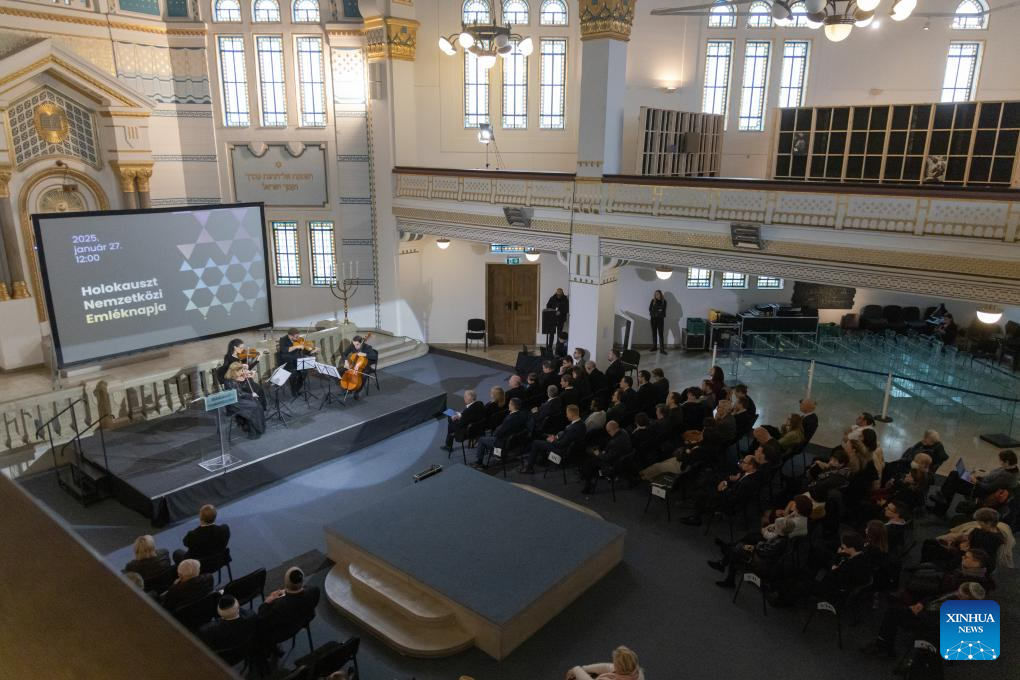
People commemorate the International Holocaust Remembrance Day at the Holocaust Memorial Center in Budapest, Hungary on Jan. 27, 2025.
 
In Auschwitz-Birkenau -- both a slave labour and a death camp complex -- close to a half-million Hungarian Jews were systematically murdered. And Tamas Lederer, born in Budapest in 1938, is haunted by the inner conviction that the horrors of the 20th century committed by Nazi Germany may yet be repeated; he feels that the world has failed to respond to that signal lesson in genocidal intent. His experience is one of survival; he evaded deportation to German camps hidden in Budapest basements after his parents tore the Jew-mandatory symbol from his clothing, of a yellow star.
 
After Auschwitz was liberated by the Soviet Red Army 80 years ago, on January 27, 1945, the 87-year-old's thoughts turn to the risks inherent in growing hate-full violence against Jews, completely unsettling him. Close to ten percent of the 6 million Jews killed by the Nazis were Hungarian Jews. Of the 1.1 million people who died at Auschwitz-Birkenau, over 90 percent of whom were Jews, roughly 435,000 of them were of Hungarian origin, a toll of Hungarian Jews that exceeded those of any other nationality.

Although Hungary made common cause with Germany, becoming part of the German Axis, and Hungary was also the first country in Europe to pass anti-Jewish laws in 1920, the government under its then-leader, Regent Miklos Horthy, while cooperating with Adolf Hitler throughout the war, also resisted German demands to deport the large Jewish population of Hungary. Hitler ordered the invasion of Hungary in March 1944, fearing that Horthy might defect from the Axis to join the Allies.

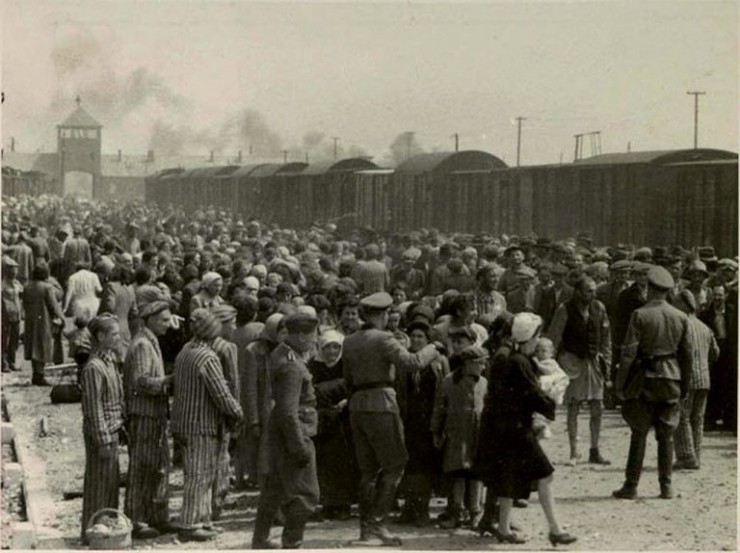
With the invasion, mass deportations swiftly took place. Between March and May of 1944, in less than two months, 435,000 Hungarian Jews, mostly rounded up from countryside cities and villages, were deported to Poland where they were incarcerated at Auschwitz. On arrival, most of the Hungarian Jews were ordered directly to the gas chambers. As war's end approached, thousands of other Jews still in Hungary were murdered by the Hungarian fascist Arrow Cross Party death squads, shot en masse in Budapest, into the Danube River.

Rabbi Vero on Monday and others gathered in Budapest at the Holocaust Memorial Centre for International Holocaust Remembrance Day for prayers, where a handful among the attendees were  Holocaust survivors. Dr. Andras Zima, director of the centre, spoke of Auschwitz as "the largest Hungarian mass grave".
https://english.news.cn/20250128/b4d0f85b4d52452288a6eca56f2881f8/2d10f966d41348d49a7ff02d55cd3368.jpg
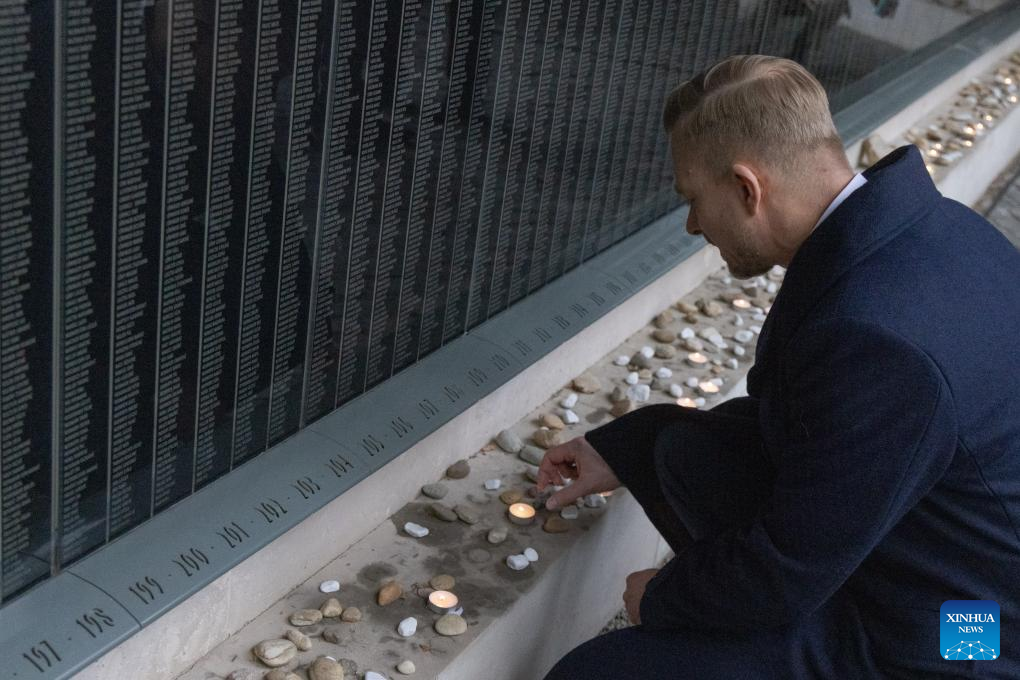
A man lays a candle in commemoration of Holocaust victims at the Holocaust Memorial Center in Budapest, Hungary on Jan. 27, 2025. Hungarian Minister of Regional Development Tibor Navracsics described the Holocaust as the "indefensible, inexplicable low point of European civilization" during a commemoration in Budapest on Monday. The event at the Holocaust Memorial Center marked International Holocaust Remembrance Day and the 80th anniversary of Auschwitz's liberation. (Xinhua/Attila Volgyi)

Labels: , , , , ,

Friday, January 10, 2025

"Auschwitz. Not long ago. Not far away"

"I had no idea where we were. It was unreal and beyond my imagination."
"After being tattooed [133628] and inducted as a prisoner and losing my identity, I thought this was hell on Earth, from which I had little or no hope of getting out. I was in total despair."
"Only my father's presence gave me some hope."
Nate Leipciger, 96, from Sosnowiec, Poland
 
"[The artifacts, augmented by survivors' recorded testimonies], are the traces of genocide, the remnants of a murdered people, and the material evidence of crimes against humanity."
"They are what remain despite the perpetrators' attempts to conceal their crimes."
Paul Salmon, curator, exhibit catalogue, "Auschwitz. Not long ago. Not far away" 
 
"It's not easy to go to a museum to learn about the particular story of Auschwitz, but sometimes the things that are more difficult are the ones that are more necessary."
"We knocked on many doors. I never got no for an answer."
 Luis Ferreiro, director, Musealia, Spain
 
"[The Royal Ontario Museum's mission is] to help people understand the past, make sense of the present, and come together to shape a shared future."
"[With the Auschwitz exhibit], we could not imagine an exhibition that more materially fulfilled our mission."
"[There is a deliberate attempt to avoid] gratuitous depictions of violence." 
Josh Basseches, museum director and CEO, ROM
Auschwitz
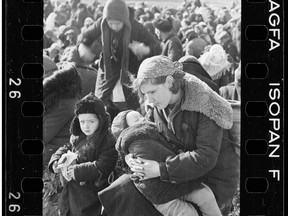
Jews from Lubny, Ukraine, shortly before their murder by an Einsatzgruppe, 1941. This photo is one of the items in the exhibit Auschwitz: Not long ago. Not far away. Photo by Musealia

In 2008, Luis Ferreiro, director of his family's Spanish company Musealia, in mourning after the death of his 26-year-old bother, read psychotherapist and philosopher Viktor Frankl's book, Man's Search for Meaning. It gave him comfort. Viktor Frankl was a survivor of Auschwitz. It was there that his pregnant wife, parents and his brother perished in Nazi Germany's campaign to extinguish all Jewish life in Europe. The book's story of survival and finding purpose in life despite the worst possible circumstances, resonated with Mr. Ferreiro.

Although not a Jew, he took inspiration from the writer's message and decided to pursue "a moral necessity to do something. It was always about Auschwitz for me". He collaborated with the Auschwitz Museum and spent time tracking down other potential involvement in a long but rewarding process to showcase human survival in the most obscene, inhumane period of modern human history. His decision to dedicate himself to this project gave purpose to his own life, through his grief.
 
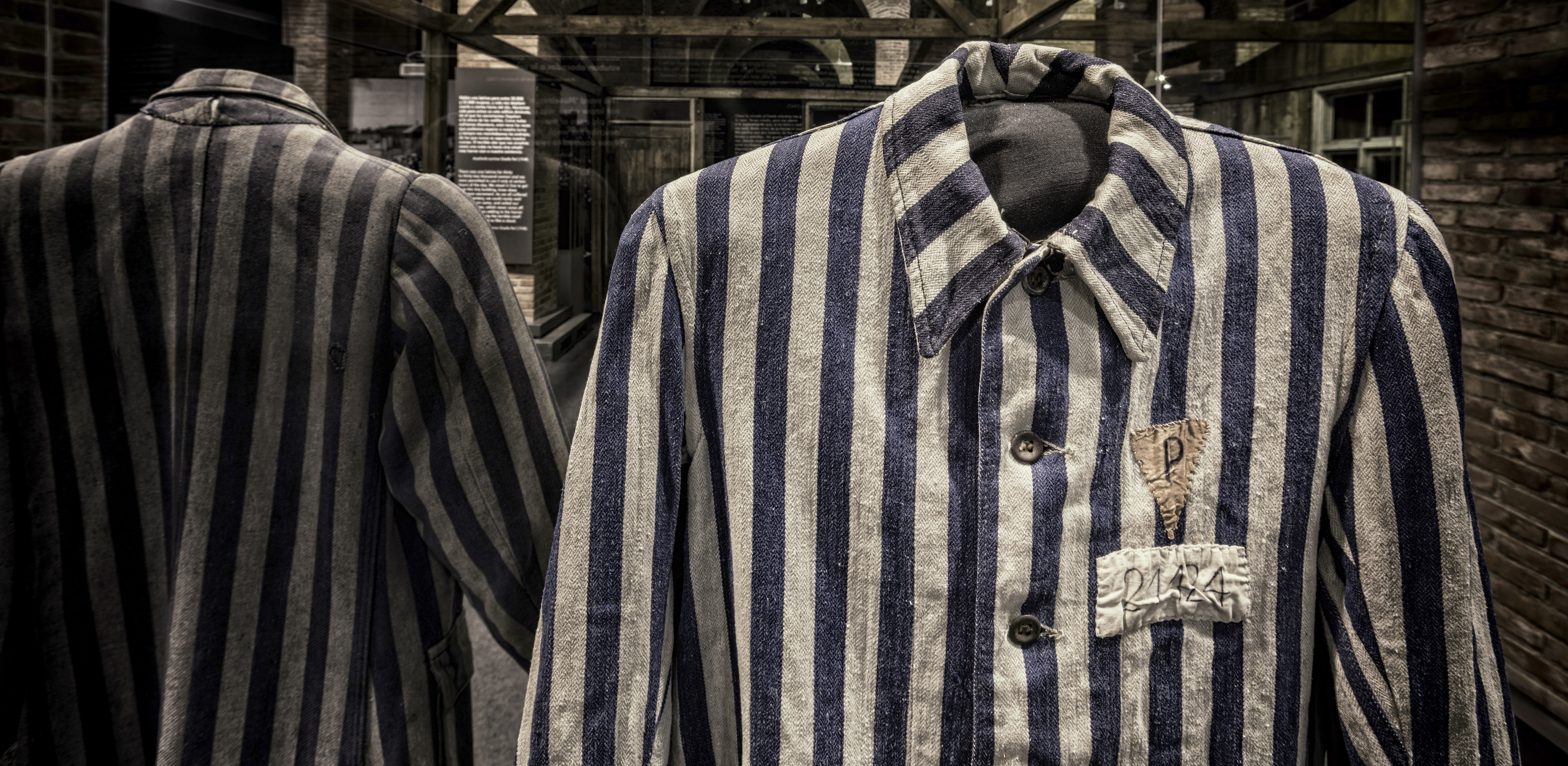
A blue and white striped uniform jacket. There is an upside-down triangle with the letter P on it stitched onto the left breast.

The end product of his research and organizing of an exhibit to feature the Auschwitz death camp during the years of the Holocaust, in the Second World War, opened in 2017 in Madrid. Since then the exhibit has toured in New York, Kansas City the Ronald Reagan Library in Simi Valley, Malmo, Sweden, and Boston. Between 1.4 and 2 million people have viewed the exhibit, according to Mr. Ferreiro's estimation. During his search for collaborators for his project, Mr. Ferreiro discovered Robert Jan van Pelt, professor at the University of Waterloo, among the world's leading experts on Auschwitz, who became the exhibit's chief curator.

At Birkenau, the largest of the nearly fifty sub-camps collectively known as Auschwitz, 96-year-old Toronto resident, Nate Leipciger, Holocaust survivor, who has over the years dedicated himself to educating the public about the Holocaust, had lost his mother and sister, murdered along with eight other members of his extended family. Their lives were taken in the gas chambers of Birkenau.

Of the Nazi death camps scattered throughout Europe, Auschwitz was the largest, most notorious and deadliest. At liberation, photographs of skeletal inmates in striped uniforms and dazed eyes, many too weak to rise from their serried bunks, were  seen worldwide as examples of the Nazi atrocities perpetrated against Europe's Jews in the slaughter of six million of Europe's Jewish communities. 

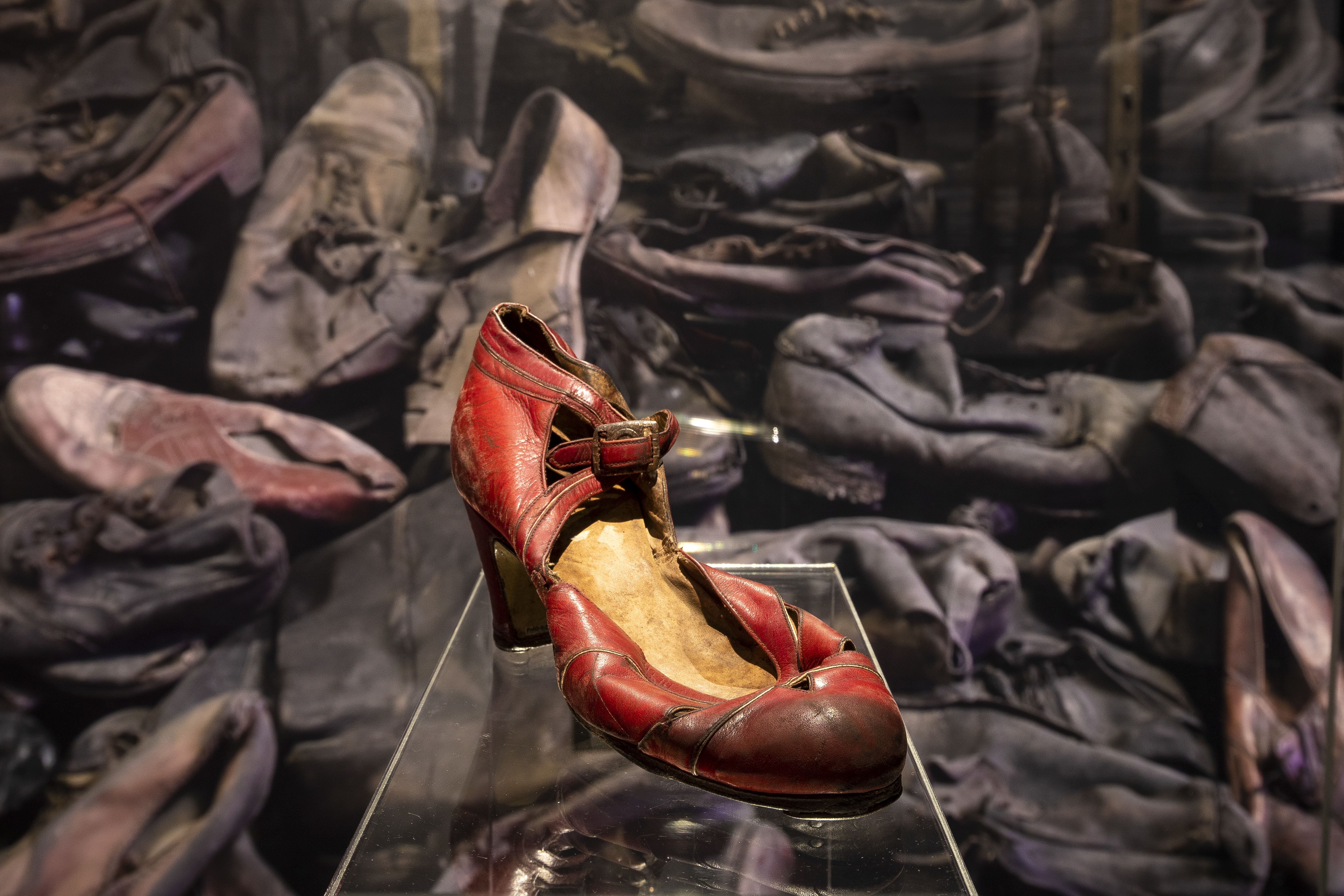
A battered and worn red high-heel shoe, shown in front of a pile of hundreds or other shoes.

Details like crammed boxcars, crematoria, belching chimneys of human ash, barbed wire enclosures, a gate whose legend read "Arbeit Macht Frei" have become symbolic of the Holocaust. 1.3 million people were deported to Auschwitz in the four years of 1940 to 1944; 1.1 million were Jews. 900,000 were gassed soon after their arrival in packed rail boxcars. Others were used for slave labour until they died of exhaustion and malnutrition. Some 75,000 non-Jewish Poles, 21,000 Roma, 14,000 Soviet prisoners of war and up to 15,000 of other categories including criminals, homosexuals, Jehovah's Witnesses and "undesirables", were also murdered there.

On January 10, preceding the 80th anniversary of the camp's liberation on January 27 (annual International Holocaust Remembrance Day), the exhibit will open at the Royal Ontario Museum in Toronto. Over 500 original artifacts, along with hundreds of photographs, charts, drawings, correspondence and diagrams will be shown at the exhibit, most of them on loan from the Auschwitz-Birkenau Memorial and Museum, and from over 20 other institutions.

Among many other items are receptacles that once contained Zyklon B pellets. Belongings of newly-arrived prisoners of the time, are heaped within a large glass case, comprised of everyday common personal items such as shaving material, perfume bottles, eyeglasses, hair brushes, bowls and buttons. Personal property items of the victims were in such abundance they were stored within 30 barracks, referred to as "Kanada", a country imagined to be brimful of wealth.
 
During the Holocaust an estimated 1.5 million Jewish children were murdered or died of deprivation. At a time of steeply rising antisemitism all over the world, a time when knowledge of the Holocaust is fading, the exhibit strives to reawaken a disinterested world's memory and conscience. The exhibit will be on display until September 1. The ROM is its only Canadian destination. The museum has suspended an admission charge for Grades 6 - 12 students in organized school visits.
 
 https://www.rom.on.ca/sites/default/files/styles/hero_image_xl_x2_2812x1580/public/2024-08/AUSCHWITZ_CARTEL_FLAT_CMYK_AF_Web.png?h=1c57675e&itok=_fF7L0mE


Labels: , , , , , , ,

Saturday, October 09, 2021

Grim Memorial to a Living Sentiment

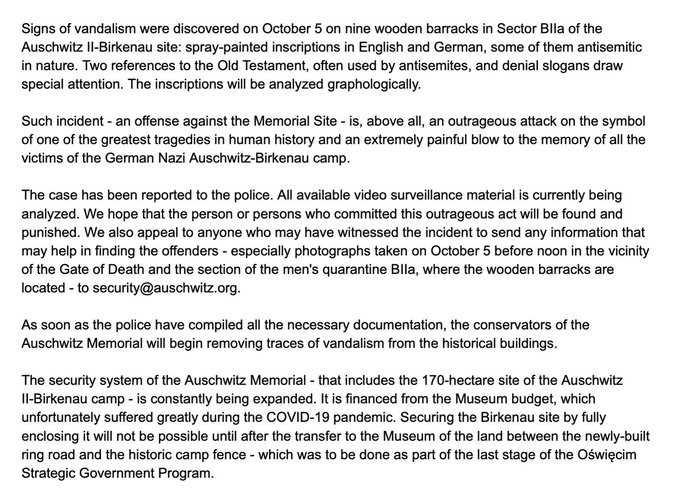
"An offense against the Memorial Site – is above all, an outrageous attack on the symbol of one of the greatest tragedies in human history and an extremely painful blow to the memory of all the victims of the German Nazi Auschwitz-Birkenau camp."
Auschwitz death camp memorial site statementImage
"[Security at the 420-acre site, which is] constantly being expanded [has become difficult as of late. The security is financed through the museum’s budget, which has been impacted by the reduced number of paying visitors during the pandemic]."
"[The graffiti is to remain on the barracks until police] have compiled all the necessary documentation."
"We hope that the person or people who committed this outrageous act will be found and punished."
Auschwitz Museum statement
Auschwitz-Birkenau Memorial and Museum, in Oswiecim, Poland. Photo credit: Oscar Gonzalez/WENN.com

During the Holocaust years of organized national institutional genocide against Europe's Jews, no one ostensibly was aware of the lethal menace facing Jewish lives. Despite the very public campaign of de-humanization of Jews, their disenfranchisement, their public humiliations, public beatings and killings, the mass round-ups, incarcerations and public proclamations, the truck and freight-train transports to slave labour camps and death camps, no one knew what was happening. 

Those relative few that did take notice, under threat of lethal punishment themselves, tried to shield a few Jews as their commitment to human dignity and the right of existence. So long after the liberation of Auschwitz by the Soviets freeing the paltry few political prisoners, military prisoners of war, conscientious objectors, Roma, homosexuals and Jews -- mostly Jews -- left alive in skeletal condition, there is no one on this Earth who could not know what happened in the barracks and the crematoria. 

Yet there remain and there always will be those who continue to thoroughly approve of the Final Solution to rid the world of the presence of Jews. Among them those who stigmatize world Jewry further by claiming the Holocaust was a pretext, that Jews themselves were involved in its management, that it is used as a crutch to manipulate world opinion. But those who vandalized the Auschwitz barracks knew the Holocaust was real and they would repeat it, if they could.

The world is no friendlier to Jews today than it was in 1939-45; a renaissance of Jew-hatred has once again blossomed into full view, and now that the world Jewish community has a country and a military of its own for legitimacy and protection the diaspora breathes more freely, but it too is a symbol of universal hatred toward Jews: still Jews albeit Israelis. The extermination site's barracks wee spray-painted in a sign of despicable lethality. The message that the unspeakable can be repeated.

Anti-Semitism -- responded 81 percent of young Jewish Europeans to a survey conducted by Europe's Agency for Fundamental Rights -- is an issue in their respective countries. Of that number of respondents, 44 percent claimed to have been targets of anti-Semitic harassment in the 12 months leading up to the survey. The time of the global pandemic has seen an inexplicable rise in anti-Semitism, linking a Jewish conspiracy to SARS-CoV-2, loosed on the world by reprehensible Jews.

Controversially, the yellow Star-of-David forced on European Jews as a demeaning symbol to set them apart from all others during World War 11 under Nazi occupation, was co-opted by anti-vaccination conspirators protesting protective-mask wearing during COVID-19 and societal closures as victimization by health agencies, equating public measures to control the virus with Nazi fascism. Mocking the hell-on-earth for Jews as commensurate with public unease over health measures.

Holocaust museums and memorials during the last two years have been defaced in many American states, as with other areas in Europe. A surge of online activity with hateful content was found and reported by the European Commission, particularly in France and Germany, on Facebook, Twitter and Telegram, with a sevenfold increase in French and 13-fold in German. Resulting in the EU announcement it plans to unfold a new strategy in combatting anti-Semitism.

The Auschwitz 11-Burkenau vandalism marked the barracks with phrases in both German and English, with "two references to the Old Testament, often used by anti-Semites, and denial slogans", stated museum representatives of the nine barracks used to house male prisoners that were defaced.

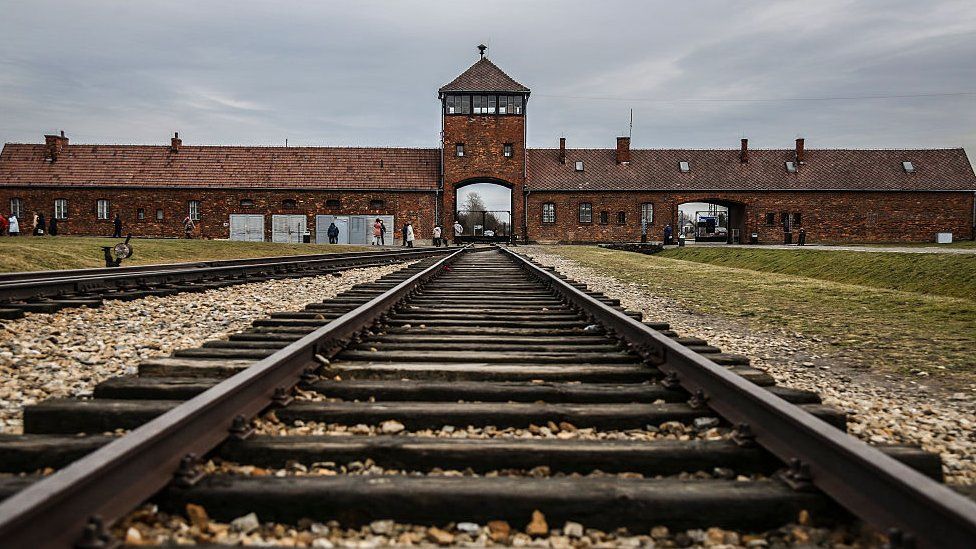
Entrance to the Auschwitz concentration camp
Most of those who died in the complex of camps at Auschwitz died at the Birkenau extermination camp   Getty Images

Labels: , ,

Tuesday, January 28, 2020

Auschwitz-Birkenau ... Horror Tourism

"The realities of mass tourism that is destroying Venice and Amsterdam are destroying Auschwitz."
"Where do you put the public toilets at Auschwitz? People always complain about Auschwitz as a tourist site and, of course, with so many people wanting to visit, it cannot be anything but a tourist site. This is the reality of mass tourism."
"We are entering the last decade of having survivors with us who are able to testify as eyewitnesses. Along with losing the eyewitnesses, the site itself, in its present, sprawling form, cannot be maintained forever. We are losing another touchstone of authenticity."
"One of the problems with the success of Auschwitz is that other places of the Holocaust are suffering. Dachau, for example, has too few visitors and Auschwitz has too many. It would be good if the wealth could be spread."
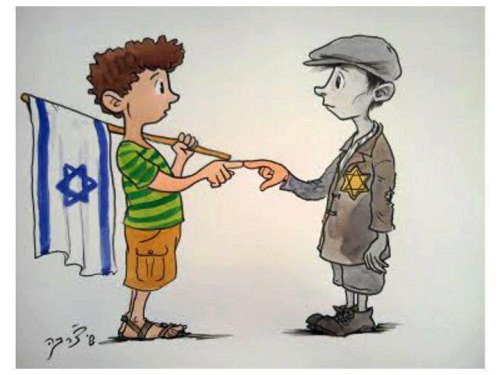
There are buildings that are really fragile ruins and you really don't want anyone to step on those ruins and there are always people who will ignore it. You see from time to time groups of Israeli students climb on the roof of the crematorium to wave a flag. It really is problematic from the point of view of preserving those ruins."
"We have no other comparable catastrophe, if there is any comparable catastrophe, that we have so many artifacts with personal stories attached to them. The Holocaust is, in general, still the best-documented genocide in world history."
Robert Jan van Pelt, architecture professor, University of Waterloo
Image
"In a few years there won't be a single survivor of the camps left, there is no getting away from that."
"While we remain alive, as eyewitnesses, we have to testify to what has happened and to the importance of it."
"Everybody comes out of there [Auschwitz] a changed person. History is the greatest teacher. We need to remember history. We cannot hide history."
"It's not for the past. It's for the sake of the future."
Auschwitz survivor Paul Herczeg, 90, Montreal resident

"Auschwitz has been a relatively manageable symbol for Germany after the Second World War, significantly reducing the actual scale of the evil done."
"The gates and walls of Auschwitz can seem to contain an evil that, in fact, extended from Paris to Smolensk."
"Yet while Auschwitz has been remembered, most of the Holocaust has been largely forgotten."
Timothy Snyder, historian, Black Earth
Auschwitz gateway
A focal point for visitors today, the gateway sign says "Work Will Set You Free," a monstrous lie told to the men, women and children imprisoned there. (Maciek Nabrdalik)
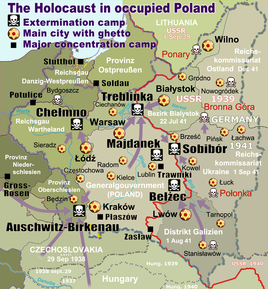
 Unlike Auschwitz, points out Mr. Snyder, in the death camps at Treblinka, Sobibor, Belzec and Chelmno no Jews survived. Those were camps dedicated to total annihilation. Whereas at Auschwitz there was also slave labour, enabling some Jews to survive. And he writes as well of other realities; Jews throughout eastern Europe forced to kneel in front of an open pit while mobile killing squads machine-gunned them, positioning them just so that the impact would throw them into the pits, ridding entire villages of their Jewish populations.

WW2-Holocaust-Poland.PNG


This survival of Auschwitz inmates went beyond piecing together the carefully contrived mechanism of state murder of millions. Most of the Holocaust-era destruction of European Jewry, points out Mr. Snyder took place even before Auschwitz-Birkenau set out to systematically, methodically and swiftly finish that Final Solution genocide meant to spare none whatever. Forced labour and death camp, both, the complex camps that are part of Auschwitz are less than an hour's drive from Poland's second largest city, Krakow, once home to 68 thousand Jews.

According to the Auschwitz-Birkenau State Museum, over 2,320,000 visitors came to the world-renowned site in 2019. The guard towers, gates and crematoria serve as testament to the agony and anguish of the inmates and the fierce determination of the Third Reich to destroy their presence for posterity. Among the inmates, Roma, gays, political prisoners, dissenters, Russians and Poles but mostly Jews marked for destruction. It is where an estimated 1.1 million people were gassed and incinerated; almost a million of them Jews. It is the survivors who bring to agonizing life the trials of those who perished. They, in their aged sorrow, stand witness to history.
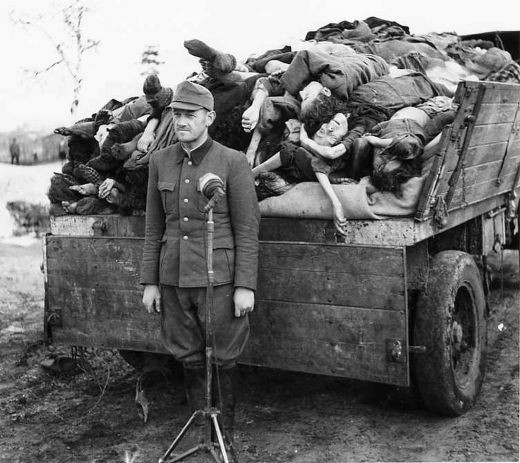
 auschiwtz-photos-bodies
Bodies of victims

In 1944 when the camp was operating at peak efficiency it covered 40 square kilometres with sub-camps extended beyond that acreage. Private hands today hold much of the property, outside the state museum. Some of the old barracks that once held starving prisoners being worked to death are now in people's gardens. "There is enormous pressure of development all around the site. Private business is very much exploiting the economic opportunity that comes from 2.3 million visitors", explained Mr. van Pelt.

"It is a very important historical site and for the last five or six years there has been construction around it. People are developing their property. Now you are in a neighbourhood. Inside Birkenau, there is only a barbed-wire fence. There is incredible transparency You can see what is happening on the other side. You can see the parking lot, you can see the reception centre, the businesses."

Auschwitz Birkenau, a tourist site, a business opportunity, a Polish 'world heritage' site.

 auschwitz-photos-transport
Arriving at Auschwitz

Labels: , ,

Sunday, January 26, 2020

Project Final Solution

"It is obvious that the war which Hitler and his accomplices waged was a war not only against Jewish men, women, and children, but also against Jewish religion, Jewish culture, Jewish tradition, therefore Jewish memory."
"Never shall I forget those moments that murdered my god and my soul and turned my dreams to ashes."
"After Auschwitz, the human condition is not the same, nothing will be the same."
Nobel Laureate Elie Wiesel, Night
Soviet soldiers arriving at main gate of Auschwitz during liberation (REUTERS:HO AUSCHWITZ MUSEUM REUTERS).JPG
Soviet soldiers arriving at the gates of Auschwitz in 1945.
REUTERS:HO AUSCHWITZ MUSEUM REUTERS

It is now 75 years since Soviet soldiers liberated Auschwitz, opened the gates and met the sight of gaunt, starved prisoners who had managed to survive their years in the concentration and death camp, while others, of a total count of 1,100,000 were sent to the gas chambers, their bodies then incinerated in giant furnaces whose smoke stacks belched black ashes over Poland. It is fitting that liberation of the camp came at the hands of Russian soldiers, since Auschwitz originally functioned as a prisoner-of-war camp for Soviet prisoners of war whom the Germans captured.

Most of those Russian prisoners did not survive their internment in Auschwitz. The camp was later transformed to an extermination camp for Jews. Auschwitz itself was a number of 'camps' linked together, and it also had a slave-labour component camp as well, where relatively healthy and still-strong prisoners (forced laborers) worked in mines and rock quarries or road building until they died of overwork, starvation or disease; in other concentration camps, there were factories producing armaments for the Nazi war effort.
Children who survived
Children who have lived to be liberated by the Red Army from the Auschwitz concentration camp on January 27, 1945.
TASS via Getty Images

At Auschwitz at the present time, maintained as a museum, there are pavilions housed on site; one primary exhibition details the Shoah. Others curated by a number of countries; a Polish pavilion, and a Russian pavilion among them. Poland, during the Second World War, was occupied by Nazi Germany. The Soviet Union, which first signed a non-aggression pact with Germany, was later invaded by Germany, the two consumed in a massive conflict which Russians endured at the loss of millions of the Soviet Red Army, and millions of citizens. The Soviet victory over the Nazis on the Eastern Front effectively broke the back of the Third Reich, and the Allied victories in the West finished the job.

Nazi death camp of Auschwitz I, in Oswiecim, Poland   AP

But not before close to a million Jewish corpses were fed into the giant maws of the ovens, the greatest number of Jews exterminated in any of the countless death camps strewn all over Europe which succeeded in demolishing the lives of six million European Jews. The Auschwitz site has been preserved as a memorial ground despite calls for its destruction as a 'cursed' place, after the end of the Second World War. It was the demand of the survivors that led to its preservation as a place of remembrance.

Under communist rule, Poland lacked the financial resources to maintain the camp, though the Polish government in 1947 had declared the site would be preserved forever, by law. Lack of resources made it difficult to preserve barracks, barbed-wire fences, watchtowers and gas chambers fallen into ruin. Prisoner artefacts seen to be critical in showing visitors the scale and dehumanization of the atrocities carried out in the Auschwitz-Birkenau camp were difficult to maintain without resources.
Jewish children at Auschwitz
Jewish children, survivors of Auschwitz, with a nurse behind a barbed wire fence, Poland, February 1945.
Galerie Bilderwelt/Getty Images

The inventory of personal remnants of the millions who passed through those infamous gates declaring "Arbeit Macht Frei" has among its sad treasures of the past, 110,000 shoes, 3,800 suitcases, 12,000 pots and pans, 40 kilograms of eyeglasses, 470 prostheses, 570 pieces of camp clothing, and several tons of women's hair, sheared from the heads of prisoners by the Nazis. These are what is left of the millions of personal effects the Nazis took from helpless prisoners, along with more valuable items including gold pried from teeth, marriage bands, jewellery, to help the Nazi war effort.

The Auschwitz Museum regularly consults with conservationists, historians and heritage experts on preservation and reconstruction with a view to preserving the site as it was at the time. The risk being that alteration of the site might support claims of Holocaust deniers that the reality of the Holocaust has been embellished beyond its actual occurrence, supporting their denials and their claims that the program of genocidal extermination had never taken place.

Poland is where Auschwitz was established and where the Polish pavilion was organized as The Struggle and Martyrdom of the Polish Nation 1939 - 1945. Claiming for itself the place of first victim of the Nazis, emphasizing Polish resistance in occupied Poland. Its focus is on Polish losses, not on the number of Polish and other European Jews who were gassed, their ashes fertilizing the countryside. The Russian pavilion too emphasizes its role, with the theme of Tragedy, Valour, Liberation.
soviet soldiers with liberated prisons in 1945 (REUTERS:HO AUSCHWITZ MUSEUM).JPG
Soviet soldiers with survivors of Auschwitz in 1945.
REUTERS:HO AUSCHWITZ MUSEUM

The world now views Auschwitz as the symbol of Nazi depravity in its vicious extermination of Jewish lives. Before Poland liberated itself from the stranglehold of the USSR, visitors to Auschwitz came mostly through representatives of Soviet satellite countries, with 400,000 annual visits. The turn of the century has seen an increase in the number of yearly visitors to 1.3 million by 2009 and over two million by 2017. The largest number of visitors at the present, come from the United Kingdom, United States, Italy, Spain, Germany, Israel and France.

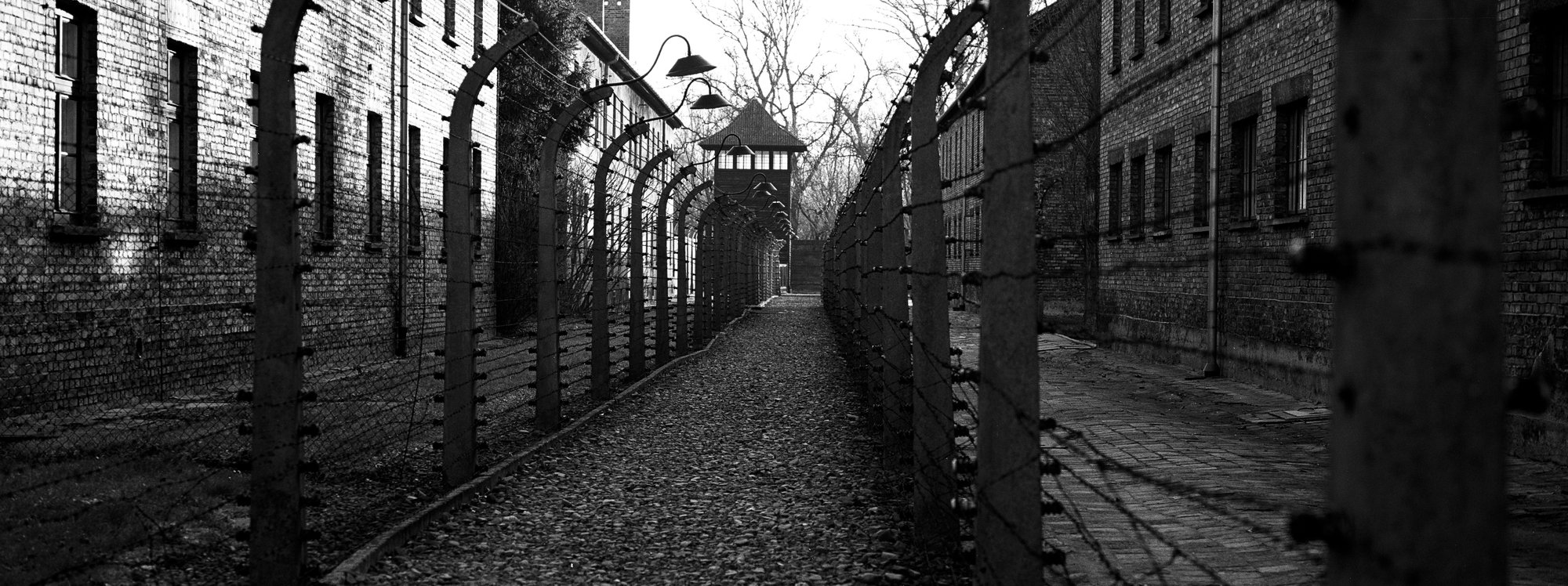
A pathway leading to an observation and security tower between what were electric barbed wire fences inside the former Nazi death camp of Auschwitz I in Oswiecim, Poland, Sunday, Dec. 8, 2019. (AP Photo/Markus Schreiber)

Labels: , , , , ,

() Follow @rheytah Tweet