
This is a blog dedicated to a personal interpretation of political news of the day. I attempt to be as knowledgeable as possible before commenting and committing my thoughts to a day's communication.
"I don't understand this upside-down universe where people here admire the Waffen SS and somehow that's OK."
"It
doesn't embarrass the people at my university very much that they have a
[group] that has been laundering Waffen SS reputations and funds for
years now."
Karyn Ball, professor, Holocaust scholar, University of Alberta
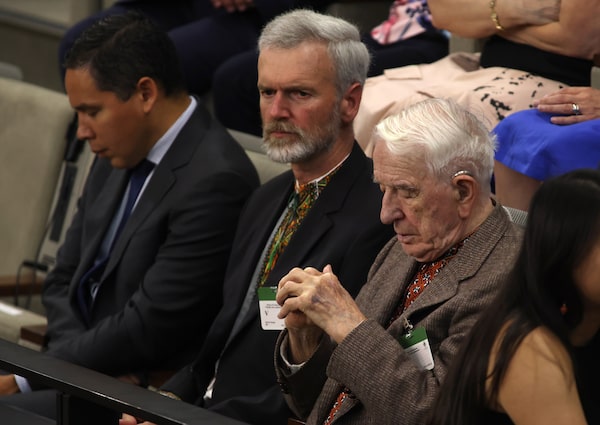
Yaroslav
Hunka, right, waits for the arrival of Ukrainian President Volodymyr
Zelenskyy in the House of Commons in Ottawa on Sept. 22. The University
of Alberta is returning endowment funds from the family of Hunka, a
Ukrainian man whose military service was linked to the Nazis.Patrick Doyle/The Canadian Press
After
professors at University of Alberta lodged complaints that the
University continues to engage in white-washing Nazi crimes, a panel
scheduled to discuss the Waffen SS was quietly cancelled. A number of
online discussions have been held at the university since an episode
involving Ukrainian-Canadian veteran Yaroslav Hunka who served in the
Waffen SS was invited to the House of Commons on September 22 on the
occasion of Ukraine's Jewish President addressing Parliament. The-then
Speaker of the House, ignorant of the Nazi connection, invited the man,
characterizing him as a Ukrainian 'hero'.
Despite
reality, speakers at the online discussions claim that the 14th Waffen
SS Galicia was never involved in Nazi war crimes, attributing such
claims to Russian disinformation. When, once again the Canadian
Institute of Ukrainian Studies at the university planned another online
discussion for October 14, university professors launched yet another
protest. Complaints were filed to the university's administration
charging the CIUS in whitewashing Nazi collaborators and war crimes.
The
Hunka family had endowed the organized event with $30,000, before it
was cancelled. The Waffen SS Galicia was involved in massacres of
civilians during the Second World War, and used as well by the Nazis to
crush an uprising in Slovakia. The university's vice-president of
academics announced the Hunka family funding would be returned to them. "On
behalf of the university, I want to express our commitment to address
antisemitism in any of its manifestations, including the ways in which
the Holocaust continues to resonate in the present", she stated.
Laurie
Adkin, a political scientist at the university, called for an
investigation of funding and activities of the Canadian Institute of
Ukrainian Studies. Recently an article in media outlet Progress Report revealed
that the university took money from Hunka, as well as from other Waffen
SS members, accepting as well funds from the estate of Volodymyr
Kubijovyc, a Nazi collaborator who founded Waffen SS Galicia, advocating
for ethnic cleansing, for a Ukraine without Jews or Poles.
Monument to the people slaughtered by the 14th Waffen-SS at Huta Pienacka. Image via Stako
Another
veteran of the Waffen SS Galicia division, Peter Savaryn, had served at
the University of Alberta as chancellor from 1982 to 1986. He helped to
fund the CIUS and had been awarded the Order of Canada in 1987. Among
nationalist Ukrainian-Canadians, members of Waffen SS Galicia are viewed
as heroes, reflecting their battles against Soviet forces, at that time
in the war fighting the Nazis with the Allied coalition. Oakville,
Ontario and Edmonton, Alberta both host monuments in honour of the
Ukrainian SS troops.
There
is a sharp distinction from that group to the 40,000
Ukrainian-Canadians who were members of Canada's military, fighting the
Nazis, for whom no monuments have ever been erected in honour of their
loyalty to democratic values and Canada. A 1980s study of war criminals
in Canada found 600 former members of SS Galicia still resident in
Canada. "The Division was an SS division and technically all of its officers and senior NCOs are liable for trial as war criminals", a 1948 British government report noted.
"The University of Alberta says
it is reviewing other donations it has received after returning $30,000
from the family of Yaroslav Hunka, a Waffen SS veteran who got a
standing ovation in Parliament during a visit by Ukrainian President Volodymyr Zelensky last month."
"The
university is facing calls to return hundreds of thousands of dollars
in endowments in the names of Ukrainians linked to the Waffen SS Galicia
division, who were admitted to Canada after the Second World War. They
include an endowment of about $430,000 in the name of Volodymyr
Kubijovych, who played a key role in the SS unit’s establishment in
1943."
The Globe and Mail
Left image: Peter Savaryn (left standing) and Volodymyr
Kubijovyč (center sitting) pictured here at the 1976 contract signing
between the Canadian Institute of Ukrainian Studies and Shevchenko
Scientific Society of Europe to collaborate on the Encyclopedia of
Ukraine. Right image: Volodymyr Kubijovyč (circled in red) gives a Nazi
salute at the 14th Waffen-SS recruitment ceremony in 1943.
Seeking Out all Mechanical Vulnerabilities to the Transmission of COVID-19
"We want to save lives, let's cut right to the chase." "There are so many, many buildings ... This affects absolutely everybody. Billions of people. If we are able to cut down the transmission rate by a percent, that's a lot of people." "This has been on people's radar for quite a while. Somebody on a different floor sneezes ... The particle can stay airborne long enough to go all the way through the [air conditioning] system and then pop out in somebody else's office." "While it’s not the most powerful method of transmission, it’s certainly
one that makes people worry because we have a difficult time
controlling it." "People are spending most of their time indoors these days. And for
places with air pollution, it’s even more important because the clear
air is indoors in these highly-polluted megacities." Professor Brian Fleck, scientific study, University of Alberta
"It is highly likely that the SARS-CoV-2 virus also spreads by air, [requiring] all possible [action in response, including modifications in ventilation systems]." "The fact that there are no simple methods for detecting the virus in
the air does not mean that the viruses do not travel in the air." "We predict that ... failure to immediately recognize and acknowledge the importance of airborne transmission and to take adequate actions against it will result in additional cases." Chinese and Australian air-quality experts
"[The effort represents a] non-pharmaceutical intervention [that, if successful, could avoid] extensive consequences. It’s just as valuable as vaccine research." "Improving ventilation systems in high-occupancy structures could be a
critical way to contain the pandemic… This work has the potential to
impact millions of people living and working in these buildings." "[The research will unfold in three parts: a systematic review of research
on air circulation and viruses, determining an effective strategy and
then testing out that strategy on buildings at the Edmonton campus] to
create a real-world model of what should be done." Lexuan Zhong, engineering professor, University of Alberta
An African restaurant is closed off along with other businesses in
Guangzhou's Sanyuanli area, where a neighborhood is in lockdown after
several people tested positive for the novel coronavirus disease
(COVID-19), in Guangdong province, China April 13, 2020. -
REUTERS/David Kirton
Engineering professor Lexuan Zhong is leading a project involving the university's civil engineers funded by the Canadian Institutes for Health Research at the University of Alberta, consisting of three phases; systematically reviewing literature on air circulation and viruses, determining the strategies that would be effective, and finally conducting a detailed audit of all buildings on the Edmonton campus with the intention of creating a real-world model of what should be done in response to their conclusions.
Their interest in the possible role that building HVAC systems (heating, ventilation and air conditioning) may play a role in the transmission of the novel coronavirus stemmed from a case in Guangzhou, China detailed in a U.S.Centers for Disease Control online journal. Researchers had reached the conclusion that flow from an air conditioner moved over three occupied tables in the restaurant, carrying virus droplets from an infected patron at the middle table to the far table, then back to diners closer to the air conditioner.
It was a puzzle at first how eight diners at the restaurant all were infected with the coronavirus. A visitor from Wuhan, the coronavirus epicentre, suspected of being the vector had travelled to the Guangzhou region and happened to enter the restaurant. A team of local scientists came to a conclusion that tiny particles of virus had floated around on currents created by the restaurant's air conditioning, despite the prevailing view that the coronavirus is transmitted solely by heavier 'droplets'.
Now, the civil engineers at the University of Alberta have taken up the intriguing concept, one they are familiar with, hearking back to Legionnaire's Disease, a bacterial pneumonia transmitted in a hotel setting through the air conditioning system. Engineers are well acquainted with building ventilation systems as efficient distributors of viruses and other pathogens. They have set out to prove that COVID-19 falls into the same category. What now consumes their interest is conceiving of practical ways to curb infection risk; a "non-pharmaceutical" intervention.
"The HVAC system in most non-medical buildings play only a small role in infectious disease transmission, including COVID-19", responded the American Society of Heating, Refrigerating, and Air-conditioning Engineers, in defence of their product and their livelihood. The smaller, lighter aerosol particles capable of spreading through a ventilation system is still questioned by some: "the truth is that we still don't really know if the (COVID-19) virus can be spread by aerosols", virus expert Matthew Miller at McMaster University responded.
However, in a paper published earlier in the month, Chinese and Australian air-quality experts basing their hypothesis partly on the SARS experience, argued in their own study that as droplets from an infected person begin evaporating, the resulting smaller particles indeed may become airborne; evidence that passengers confined to their cabins on cruise ships was cited such that they may have been infected through the air ducts of the vessels.