Politic?

This is a blog dedicated to a personal interpretation of political news of the day. I attempt to be as knowledgeable as possible before commenting and committing my thoughts to a day's communication.

Saturday, January 08, 2022

Iran's Influence on International Affairs

"The first thing that comes to your mind is that this was not a mistake. This could not have been a mistake."
"This is a plane leaving the airport and three minutes later it's shot down."
"I never gave [my brother] a strong hug at the end because I was not very emotional. I was thinking 'He is going, I will see him shortly'."
"I couldn't really believe what had happened. I took the phone and tried to call the airport to see if there was another Ukrainian airliner. The person I talked to said, 'No, there was only one flight.' I was just shaking."
Ali Pourzarabi, bereaved brother of Ukraine Airlines PS752 doomed flight, Iran
 
"I think this is a new low they went to."
"To be able to ruthlessly sacrifice a planeload of people in the worst possible way, subject them to the pain and agony for three minutes on a plunging plane ... that's just unimaginable."
"I told her [his mother] I'm really getting worried."
"She said, 'No, you'll see me tomorrow, you'll pick me up at the airport." 
"All the hopes I had were shattered. I could not even cry because I was so shocked."
Amir Alavi, Iranian-Canadian, bereaved son, Toronto
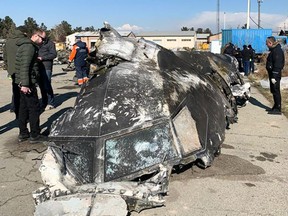
People analyze the fragments and remains of the Ukraine International Airlines plane that was shot down by Iran on Jan. 8, 2020.
There was a total of 167 passengers, 58 Canadian citizens, 30 permanent residents of Canada and another 53 returning to Canada for studies. Others aboard were from the UK,Ukraine, Afghanistan, and Sweden. They had flown to Iran to visit relatives, to celebrate the season, to get married, two years ago. "Full takeoff thrust", Captain Volodymyr Gaponenko, the 50-year-old pilot of the Ukraine Airlines plane said. "Eighty knots" responded First Officer Serhii Khomenko, 48, the Boeing 737-800 lifting off from Iran's Imam Khomeini Airport on 8 January, 2020.

"Good morning", Khomenko greeted the air traffic control: "On board, on course". Six minutes after takeoff the plane plummeted to earth, flames from its fuselage lighting its way in the pre-dawn darkness. The airliner hit a park gazebo, plowed across a soccer field and finally exploded in a fiery ball, breaking the jet into pieces. No living soul could survive that inferno and its disastrous crash. Passengers' possessions were strewn everywhere, the passengers themselves, torn to pieces, were as well.

Iran's Republican Guard Corps had in the early morning hours moved a mobile anti-aircraft battery near the airport six hours previously. Tehran was on high alert, after missiles had been shot off into Iraq to hit two American bases in retaliation for a U.S. missile strike that hit a vehicle carrying the senior head of the al-Quds division of the Iranian Republican Guard Corps, Brig.-Gen.Qasem Soleimani, whose function was to act for the state abroad. 
 
In anticipation of a response strike from the U.S. the IRGC was on high alert. Nevertheless no one in command, nor the government in Tehran closed their air space to commercial traffic At least four other commercial flights took off from the airport in a trajectory similar to that of PS752, unaware of the tense situation, but suffering no consequences. 
 
The cockpit voice recorder of the downed airliner recovered after the crash had picked up "a strong and short impulse similar to a detonation" at 6:15 a.m.; an altitude warning tone sounding in the cockpit. "I have a strong feeling about [a] bad event", the instructor pilot said in the recording. "What is this?! the captain responded. And seventeen seconds later the recording stopped: 6:16 a.m.

The Ukrainian jet had taken off from the airport at 6:12 a.m. and for three minutes all was calm as it headed toward Kyiv, a three-and-a-half-hour flight. At 6:16 a.m. the pilot of an incoming flight of Iran's
Aseman Airlines reported to air traffic controllers an unusual sighting: "A series of flares ... like that of a missile ... Is there anything like this over there?" Not that the controller knew of. But he attempted for the following two minutes to repeatedly raise the Ukraine International flight, but had no response.
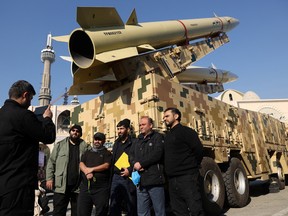
Iranians take photos during an exhibition displaying missiles of the kind used during Iran’s retaliatory strike on the U.S Ayn al-Asad military base in 2020 are seen on display at Imam Khomeini Grand Mosalla in Tehran Jan. 7, 2022.
Iranians take photos during an exhibition displaying missiles of the kind used during Iran’s retaliatory strike on the U.S Ayn al-Asad military base in 2020 are seen on display at Imam Khomeini Grand Mosalla in Tehran Jan. 7, 2022. Photo by Majid Asgaripour/WANA (West Asia News Agency) via REUTERS
 
"It was an explosion sir; we saw a huge light over there. I wonder what it was really!", the approaching Aseman pilot said, when the flight controller asked just exactly what was seen. The IRGC crew of the TOR M1 air-defence system spotted they decided, not an airliner full of passengers at 6:14 a.m. but an infinitely smaller, faster cruise missile, assuming the U.S. military deployed it. It took 39 seconds and the crew fired their first SA-15 missile, hitting the plane. A second missile was dispatched 12 seconds later.

The PS752 flight path shows the pilots making a desperate attempt following the first blast to turn around to fly back to the airport. Engulfed in flames the 737 crashed near Khalajabad instead, southwest of Tehran. Amateur video showed a massive explosion lighting up the still-dark sky. A video that would be played all across the world, while the government of Iran denied they had any involvement it what they claimed was a 'technical' crash.
 
Soon after the crash of PS752, Tehran, refusing to admit it had any hand in the catastrophic collision between a passenger jet and two missiles fired by the IRGC, deliberately destroying the airliner and all those within, photographs taken of the site of the vast debris field showed bulldozers shovelling up debris, completely and deliberately destroying any vestiges of the crash that might be helpful to investigators into its cause. People were seen in the area, looting pieces of the plane along with the personal belongings of its passengers.
"Iran contends that its decision to keep its airspace open and its corresponding airspace management decisions were justified and based on sound risk assessment. Iran’s risk assessment, as presented in the Final Report, failed to address contradictory information suggesting that risk levels were much higher. Iran’s air defences represented a clear and present danger. Its military was on high alert and tasked with monitoring airspace where multiple civilian aircraft would be present. Iran implemented a single mitigation measure that required military pre-authorization for flights before take-off from Imam Khomeini International Airport (IKA). Iran’s determination that the risk was “low,” the decision to keep its airspace open over Tehran, and the implementation of only one preventative measure were all flawed decisions. It is the Forensic Team’s assessment that this fell short of internationally recognized standards in place to ensure airspace safety."
"Furthermore, Iran did not provide official notification of the increased risk to airlines and pilots before Flight PS752 departed or adequately explain why this basic measure was not implemented. Iranian military authorities were the only ones who were aware of the recent military activities and high alert resulting from Iran’s launch of missiles into Iraq. Only they knew that SAM units had been deployed in proximity to an international airport. Despite having knowledge of International Civil Aviation Organization guidance from 2018 with respect to “conflict zones,” Iran chose not to notify airlines of this danger. This lack of pertinent threat-related information deprived airlines (such as Ukraine International Airlines) of the full and up-to-date picture of conditions necessary to determine whether it was safe to fly."
Forensic Examination and Assessment Team, Government of Canada
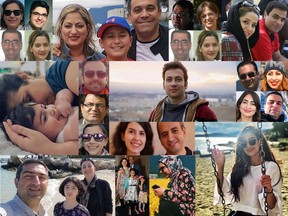
Some of the Canadian victims of Ukraine International Airlines Flight PS752, which was shot down by the Islamic Revolutionary Guard Corps shortly after takeoff from Tehran on Jan. 8, 2020, killing all 176 aboard.
Some of the Canadian victims of Ukraine International Airlines Flight PS752, which was shot down by the Islamic Revolutionary Guard Corps shortly after takeoff from Tehran on Jan. 8, 2020, killing all 176 aboard. Photo by Handout

Labels: , , , , ,

Monday, August 24, 2020

Fateful Seconds of Living Hell, Then Death

"Nineteen seconds after the first missile hit the plane, the voices of pilots inside the cockpit indicated that the passengers were alive ... 25 seconds later the second missile hit the plane."                                                                                 "Therefore, no analysis of the performance and effects of the second missile was obtained from the aircraft's black box.”                                                                 "The data analysis from the black boxes should not be politicized."                           "What is evident is that Iran has accepted the responsibility for the mistake and therefore the country is ready for negotiations on paying full compensation."       Touraj Dehghani-Zanganeh head, Iranian Civil Aviation Organization

In this file photo from January 8, 2020, authorities stand near the wreckage of a Ukraine International Airlines plane that Iran said it accidentally shot down near Imam Khomeini airport in Tehran, killing all 176 people on board.
In this file photo from January 8, 2020, authorities stand near the wreckage of a Ukraine International Airlines plane that Iran said it accidentally shot down near Imam Khomeini airport in Tehran, killing all 176 people on board. © Abedin Taherkenareh / EFE

Flight PS752 was struck when two missiles 25 seconds apart hit the plane just moments after it left Tehran's main airport on January 8, with 176 passengers and crew aboard. After initially denying that it was responsible for the downing of the passenger jet heading for Ukraine on a regular route, Tehran finally had little option given the evidence, but to admit an 'accident' had occurred and indeed members of its al Quds branch of the Revolutionary Guard Corps shot down the plane.

They had been on high alert for incoming missiles from the U.S. military it was explained and mistook the airliner for a threat. No one survived the destruction of the civilian airliner. That very night Iran had launched a ballistic missile attack against a U.S. base in Iraq, responding to a U.S. targeted drone strike killing Qassem Soleimani on January 3 in Baghdad. A great hero in Iran for his terrorist exploits against the Islamic Republic of Iran's 'enemies', his death might be seen as a preventive against further attacks such as he had engineered.

Iranian citizens demonstrated their anger at the  shooting down of the airliner with its massive loss of life by taking to the streets and vociferously blaming the regime and the IRGC. Most of the victims were Iranian civilians of whom 55 of the total were Iranian citizens of Canada, others Iranian students travelling to Canada to take up academic studies at Canadian universities. Other nations, Ukraine and France among them, lost citizens and await compensation from Iran to go to the families of the bereaved.

What is staggeringly beyond belief is that the regime's elite command military could have been so oblivious to the danger they were placing a commercial airliner and its passengers in, so consumed with its enactment of vengeance attacks they failed to take common-sense precautions, the most elemental of which would have been to close their air space to civilian aircraft at a time of such high tensions between Iran and the U.S., instead of placing so many lives in jeopardy.

Rescue workers search through the charred wreckage of an aircraft.
Investigators at the scene of the wreckage.(AP: Ebrahim Noroozi/File)

The second missile to bring down Flight PS752 hit the aircraft mere seconds after the first had struck. the gap of time between the two hits, estimated at 19 seconds captured on the black box recordings reflecting the damage the jet sustained from the first missile hit. Difficult to contemplate is the conclusion that the passengers were all alive after the airliner was struck by the first missile. The second one that was dispatched for whatever reason, extinguished all lives. It is the brief intermission between the two strikes that expresses the horror that would have struck all aboard with the realization that their lives were over.

"Our important questions regarding the reason for the delayed takeoff and the pilot's communications within that hour, which should have been included in the report of the black boxes, have also been left conspicuously unanswered." Association of Families of Flight PS752 Victims

The flight crew of the aircraft consisting of two pilots and an instructor travelling in the cockpit had exerted a desperate, last-minute effort to maintain control of the plane -- until the last possible moment, pointed out the Iranian spokesperson. United Nations aviation rules that call for investigations whose aim is solely to prevent future accidents separate from any judicial process, represents the guidelines under which Iran's investigation is being carried out. 

The Civil Aviation Organization of Iran on Sunday published a report on the downloaded data from the Boeing 737 flight and voice recorders which emerged as a focal issue to fully comprehend the prevailing circumstances at the time Flight PS752 was shot down. According to the report released through the French investigation, the recorders had but 19 seconds of conversation following the first explosion, despite the second missile -- according to Dehqani-Zangeneh -- hitting the plane 25 seconds afterward.

People are seen in the background working as the main piece of wreckage belonging to a Boeing 737 sits in the foreground.
Two missiles hit the plane, less than half a minute apart.(AP: Ebrahim Noroozi)

Labels: , , , , , , , ,

Friday, July 31, 2020

The Canadian Military Evacuating Iraq

The Canadian Military Evacuating Iraq

"For Canada and a number of the other nations, some of the soldiers that were retrograded in March will not be coming back because there is no longer a requirement for them to do the more hands-on, tactical-level tasks that they were performing."
"There is still very much a requirement to work at the higher levels, to work at the operational level and the strategic level. But for the low-level tactical training, that is no longer required. Which should be the normal progression for any capacity-building mission."
"[ISIL has become a] low-level insurgency [despite concerns late last year that the militants had been allowed to regroup in Syria]."
"Is there still a threat? Yes. But they tried to play up through media that they were increasing their tempo in May and June, and all evidence points to the contrary."
Brig.-Gen.Michael Wright, commander, Joint Task Force Impact
canadian military
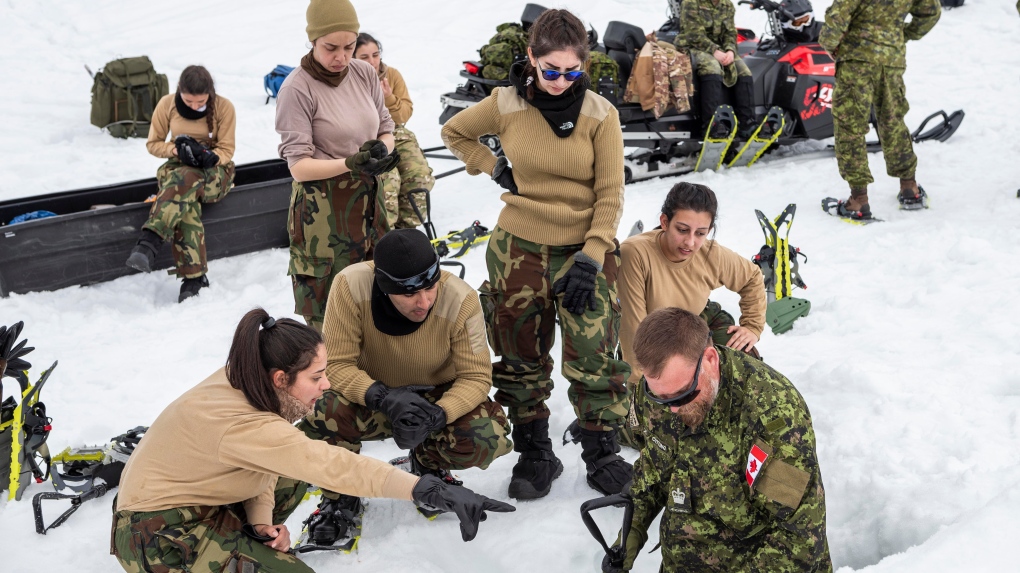
Warrant Officer Gord Cutting, an instructor of the Winter Mobile Training Team, assists the soldiers of the Lebanon Border Regiment with the construction of their snow shelters in the Bcharre region of Lebanon on February 19, 2020. (THE CANADIAN PRESS/HO-Department of National Defence-Cpl. Nicolas Alonso)

Up to 850 personnel of the Canadian Armed Forces have been stationed in the Middle East since 2014 focused on helping to defeat the presence in Iraq and Syria of the Islamic State of Iraq and the Levant, hundreds representing Canadian military trainers, tutoring the basics of military practise to Iraqi forces representing a part of the global fight against ISIL. In March when the global pandemic became a universal health threat, the Canadian Military moved half its contingent back to Canada, resulting in a temporary halt to military exercises.

Most of those who had been returned to Canada were expected in the near future to return to the Middle East as needed. Since then plans have undergone a change. The military command feels it unnecessary to return, a reflection of allied commanders having decided the Iraqi military now stands trained and prepared to fight on their own against the terrorists. Unsaid, but a reality is that the Islamic Republic of Iran's al Quds division of the Republican National Guard Corps and Hezbollah, its Lebanon-based militia, now well integrated into the government of Lebanon, form a Shiite triangle in Iraq.

This has, for the most part, been a sectarian war, Sunni terrorists groups challenging Shiite terrorist groups. And the most organized and powerful of the terrorist Shia groups is Iran itself, an Aryan power seeking conquest within a greater Arab presence, that has succeeded in amassing a Shiite clique, a triangle of command encompassing, Iran, Syria, Iraq, Yemen, Lebanon and Qatar as the honourary part of the group though a Sunni majority country.

In January the United States targeted the head of the Iranian al-Quds division of the IRGC for assassination, an event that caused friction between the U.S. and Iraq with Iraqi legislators calling for the U.S. to leave Iraq. Iran had retaliated over the loss of Brig.-General Qassem Soleimani, launching ballistic missile attacks against two U.S. military bases, one of which was also used by Canadian special forces. Western forces have overstayed their welcome in Iraq, where the country has had to juggle its dependence on both Iran and the U.S.-led coalition.

Canada's experience with Iran has not been without its pain. A Canadian-Iranian photojournalist had been imprisoned in Tehran and murdered there. Canada had under a previous government, cut off diplomatic relations with Iran. During the time of the Iranian Revolution many Iranians sought refugee status in Canada, and there is now a sizable Canadian-Iranian population. The IRGC shot down a Ukrainian passenger jet in January -- in the belief it was an incoming U.S. war plane --  killing all 176 passengers and crew; among the dead 57 Canadians.

Cpl. Brenna Baverstock of the Winter Mobile Training Team conducts a snowshoe lesson for the soldiers of the Lebanon Border Regiment in the Bcharre region of Lebanon, on February 17, 2020. Canada's war against the Islamic State of Iraq and the Levant has quietly entered a new phase, resulting in plans to keep fewer troops in the Middle East even after the COVID-19 pandemic passes. THE CANADIAN PRESS/HO-Department of National Defence-Cpl. Nicolas Alonso MANDATORY CREDIT
In very fact, the Middle East has always been a quagmire of intrigue and violence, with tribal and religious sectarian hatred easily fired into conflagrations. Syria, a more recent case in point of a dysfunctional, violent Alawite Shiite government preying on its majority Sunni Syrian population, committing countless atrocities to still a civil insurrection. The only nobility of defensive and protective forces arose from among the embattled Kurdish militias, fighting the Islamic State and protecting targeted Yazidis and Christians.

The decision to withdraw Canadian forces represents a permanent reduction in the Canadian military footprint for the first time in years. Mired in Afghanistan, in Iraq and in Syria, it is past time to allow these Islamic nations to find peace with one another and to man their own barricades against those who seek war, not peace. All Western forces are set to retire their military troops and return whence they came. Iraqi militias loyal to Iran are on the rise.

Doubtless there will remain some selected Canadian military staff to continue training senior Iraqi commanders.There are ISIL cells remaining in northern Iraq where special forces are aiding to root the local ISIL cells out. Lebanon, Jordan and Kuwait are additional sites where Canadian military teams, albeit reduced, remain. It is past time, however, for the countries comprising the Middle East and Asia to turn their attention to evolving into normal, tolerant nations.


Labels: , , ,

() Follow @rheytah Tweet