Politic?

This is a blog dedicated to a personal interpretation of political news of the day. I attempt to be as knowledgeable as possible before commenting and committing my thoughts to a day's communication.

Tuesday, July 25, 2017

From Mosul to Raqqa

"[Canada's All-Source Intelligence Centre, gathers and analyzes data with the U.S.-led coalition] so we can develop legitimate military targets that need to be defeated."
"[Since ISIL] does not respect international borders, our assessments consider Daesh activity in Iraq and Syria."
"They used small drones -- ones that we would buy commercially -- and know how to drop munitions from those drones. They would use drones for surveillance and monitor the Iraqis and our tactics and strategies."
"[ISIL has] lost more than 65 percent of the land [it had dominated for its caliphate in Iraq and Syria, which had] resulted in the freeing of millions of people and significant reductions in their revenues."
"The key part is that Daesh is on the defensive. [But despite their defeats ISIL forces] are not surrendering in great numbers. That is not the way they operate."
Brig.-Gen.Daniel MacIsaac, Kuwait


How then, do they operate? As jihadists whose end goal really is the end in the sense that they court the status of shaheeds, for that equates with honour, jubilation and adulation in Islam; to become a martyr is the status they seek. Their initial goal when cornered is to escape so they can continue being feared and celebrated warriors of Islam, if at all possible. When that is not feasible, reflecting a situation inimical to survival, they fight to their honourable deaths.

This is the barbaric ideology that celebrates its gloating penchant for gruesome atrocities that make for such eye-capturing, heart-thumping attention in gory theatre that they excel in; videos of terror-in-action atrocities that gained them their notoriety and fear-factor so irresistible to the recruits their mastery of social media has gained them over the years.

With their defeat on the battlefield, outnumbered but not outfoxed, their public relations machinery has undergone an expert turn in convincing recruits to remain where they are; simply operate from wherever they happen to be. Use any weapons at hand. Any action, any attempts serve to strike fear into the minds of their targets, irrespective of meeting with success or failure.

Their proficiency both in the geographic field, mining territory to slow down the advance of their enemies, holding civilian populations hostage, killing those no longer of any practical use, or suspected of abandoning the sinking ship, and ensconcing their fighters and sharpshooters underground in expansive tunnelworks used to cache weaponry, reflects sharp minds at work, skilled in the tactics of underground guerrilla warfare.

A car bomb exploding next to Iraqi army vehicles during fighting to liberate Mosul
A car bomb exploding next to Iraqi army vehicles during fighting to liberate Mosul Credit:  Felipe Dana/AP
Threat assessments and targeting information for Islamic State targets are now turning from Iraq to Syria where the focus is being transferred. The future of Raqqa and of Islamic State hang in the balance. Even with the certainty that defeat on the battlefield will represent only a hurdle, not the end of the practised killing machine that ISIL represents. As a Sunni militia it can still learn a few techniques from a Shiite counterpart, in the Syrian regime.

The nine-month battle in Mosul close to completion, Raqqa, the ostensible ISIL headquarters, beckons.

As for the All-Source Intelligence Centre, different branches of the Canadian military are represented from intelligence, artillery and communications systems experts to geomatic engineers capturing and interpreting data from cameras, remote sensors and global navigation satellites. The maps they create from those data sources are analyzed by the coalition to identify potential threats and to select attack targets.

"Daesh command and control centres as well as combatants, installations or anything else that is essential to Daesh operations", represent the typical targets the units identify, according to Brig.-Gen. McIsaac. "Fairly routinely" the Royal Canadian Air Force operates reconnaissance and refuelling flights over Syria where the airspace is complicated with the presence of Russian and Syrian fighter jets, along with the threat from Moscow that U.S.-led coalition aircraft may be targeted.

Crews on the RCAF CP-140 reconnaissance aircraft were "significantly involved" identifying targets for allied warplanes striking Mosul "until a few months back, when we shifted to another area", that area unspecified for obvious reasons. Canada's propeller spy plane has flown ten-hour missions, equipped with cameras and sensor arrays where on-board analysts at consoles behind the cockpit search for places where enemy fighters may establish themselves in a compound, a neighbourhood, an industrial area, making bombs.

Under Brig.-Gen. McIsaac's command is also a military surgical hospital in Erbil, Iraq, treating coalition troops and civilian workers, and a small helicopter detachment, along with a recently added RCAF C-130J Hercules aircraft to transport cargo and personnel between coalition bases. Brig.-Gen. McIsaac emphasizes that ISIL is "not only brutal. It is intelligent and creative", citing vast quantities of rockets, mortars and improvised explosive devices it produces, as well as armoured cars turned into vehicular IEDs.

Worse, its adoption of unmanned aerial devices in the hands of a terrorist organization. An estimated 4,000 ISIL fighters remain in Iraq, so along with the 20,000 estimated ISIL fighters in Syria, it may take quite a while to wrap up the conflict with Islamic State.

Labels: , , , , , , ,

Wednesday, July 19, 2017

But Are They Salvageable?

"With the fall of Mosul and as the fight in Raqqa [the de-facto Islamic State capital in Syria] intensifies, we are definitely going to see some foreign fighters or women try to surrender."
"So, [the report] is not entirely surprising."
"There are some Canadian women who travelled to Syria and Iraq together, so it might be that they tried to leave together as well [to return to their home country on the defeat of Islamic State in Mosul]."
"There's this assumption that women are travelling just to get married or something, which is sometimes true, but mostly false [driven by ardent religious fundamentalism]."
Amarnath Amarasingam, researcher, radicalized Islam, Dalhousie University, Halifax, N.S.

"I recently spoke with a mother whose child is there [in Iraq]. The parents are worried. There are some parents who haven’t had any news from their children since the bombing of Mosul began. It’s a time of desperation right now."
"There are some parents who have maintained communication with their children, who give them updates from time to time. But in the last four or five weeks it has been radio silence."
"We have young people and those who have lived through horror. We also have children who have been born over there. The problem is larger than we think."
"I think Canada has to have a greater presence. We have to take this seriously because there are still about 200 Canadians in Syria and Iraq."
Herman Okomba-Deparice, director, Centre for the Prevention of Radicalization Leading to Violence, Montreal, Quebec
Some 300 Islamic State of Iraq and the Levant fighters remain in the small patch of territory still controlled by the group in Mosul’s Old City, a senior Iraqi commander said on July 5. HurriyetDailyNews       

"Some of it [incentive for Canadian women to respond to Islamic State's invitation to young women to join them in Iraq as 'wives' of the Caliphate] is for the glory of caliphate, some of it 'Because I was bored', some of it 'Because these guys were kind of hunky'."
"But ... the one thing we have learned: we never saw females going to Somalia, we never saw females going to Afghanistan, we never saw females going to Bosnia in the '90s. This is a real new phenomenon."
Phil Gurski, former Canadian Security Intelligence Service analyst

5 Germans incl 16yo girl reportedly among 20 female ISIS fighters captured in Mosul

The Iraqi military and police are enjoying a belated revenge. In a country dissolved and rent by sectarian violence, the Iraqi military represent the majority Shiite demographic whom their Sunni minority counterparts once dominated under Saddam Hussein. They are delighted to turn the tables. Even more so to turn around their inglorious scampering away to safety when the Islamic State of Iraq and the Levant militias first entered Mosul years earlier to loot and dominate the geography as a competing religious-political force whose feared reputation for savagery cowed the Iraqi military.

The women, particularly those hailing from Muslim communities in Europe and North America who responded to the siren call of ISIL through social media accessed on laptops, smartphones and tablets with their sophisticated public relations formula, and boastful claims of being in possession of sweeping areas in Syria and Iraq in which they were preparing to administer a bold, brave and exciting new world of crystal-pure Islam whose doctrine fed in a straight, unadulterated line from Mohammad to ISIL, obviously thrilled women, eager to join this brave new world.
Picture allegedly showing a 16-year-old German Isil member after being captured by Iraqi forces
Picture allegedly showing a 16-year-old German Isil member after being captured by Iraqi forces     Credit: Twitter
Captured now, in the ruins of the Old City of Mosul, surrounded by gloating Iraqi Shiites who view Sunnis like the young 16-year-old ISIL 'wife' from Germany, those women have reason enough to be fearful. They cannot communicate, with no Arab-language proficiency with their captors, and can only be grateful that there is U.S. oversight to ensure that they are handed over to American military personnel. Tales will eventually ensue of these women's handling by Shiite militias loyal to Iran who are settling into Mosul for good, to weight the mostly Sunni population in Mosul in favour of Shiite domination.

Canada has been informed that two of the Islamic State 'wives' rounded up in a maze of tunnels among caches of weaponry are Canadian. They are admittedly Canadian citizens, but they are as 'Canadian' as the results of living within Canada in the midst of a close-knit Muslim community where mosque attendance ensures that readings of Koranic scriptures emphasize duty to Islam including strict separation of the faithful from the infidels, and prayers invoking jihad and the primary duty of killing unbelievers. The message from ISIL had no need to be more persuasive than to guarantee that joining them would fulfill those obligations.

These foreign conscripts to Islamic State who left the comfort of their family homes to set out on a journey of their own into a future of idealized Islamic splendour and punishment of the most lethal kind for those spurning the opportunity to join the collective of the faithful, not only travelled to become wives and mothers for ISIL, but were indoctrinated into the arts of warfare, attending combat classes, learning how to use weapons and use them well.

Perhaps the most potent weapon in their arsenal however, would not be lethal devices to kill, but the will to use the same public relations methodology that ensnared them into the ideology of Islamic State, bringing to practical life the Hadiths reminding faithful Muslims of their duties to Islam. Not only are Canadian prisons rife with Islamists sentenced to incarceration for petty criminal activity, and doing their part to convince other prisoners, Muslim and those who are convinced enough to convert, to subscribe to the Islamic State ideal; they are now joined by returning jihadis.

Within society, released back into the social contract of Islamic societies that they know so well, the returned Canadian women and those from elsewhere can go about their self-assigned promulgation of the splendid virtues of Islamic State's caliphate, describing it in the calculated, admirable terms they are familiar with, to exert influence on those ripe to join the group's ideological struggle for a unified Islam and a defeated host country.

Social media images alleging to show an Isil sniper believed to be 16-year-old German Linda W
Social media images alleging to show an Isil sniper believed to be 16-year-old German Linda W    Credit: Twitter
And should any of the Canadian ISIL "brides", repatriated by an understanding and concerned-for-their-welfare Canadian government, turn out to have been in their formative-adult years when they pledged themselves to Islamic State, the current Liberal-led government of Justin Trudeau will then have the opportunity to demonstrate to the rest of the non-Muslim world just how forward-looking and "feminist" Canada is, by enriching the returnees through a cash settlement of millions, while rehabilitating their reputations by apologizing to them on behalf of furious and non-assenting Canadians.


Pity the children they've borne to Islamic State, to populate the caliphate, obeying yet another Koranic injunction. Those that survived the massive assaults on Mosul in bombed buildings, collapsing on the children whose plaintive cries of pain alerted to their presence. And the babies found abandoned while their parents pursued their obligations to martyrdom. 
A little girl named Amina was found by Iraqi Army soldiers when they heard her cries from the rubble. 
A little girl named Amina was found by Iraqi Army soldiers when they heard her cries from the rubble.  Credit: Rex


Labels: , , , , , , ,

Tuesday, July 18, 2017

The Religion of Peace

"One doctor we spoke to told us that infants as  young as one week old, children and mothers were emerging wounded and covered in dust and soil, some were malnourished."
Hamida Ramadhani, UNICEF deputy representative, Iraq
Amina, thought to be about three, was pulled from the rubble in Mosul after being trapped for days. The little girl is believed to be the daughter of ISIL fighters from Chechnya who died in battle.© Carol Guzy via ZUMA Wire
"Damn them. They killed our families, why should they get to live?"
"Mosul will never be the same again. There's nothing to be optimistic about."
Walid Khalid, 28, Mosul, Iraq

"We had been two days without water. One fighter said you can have water but in exchange I will kill one of your children."
"Another fighter stood by a running hose and said: 'This water is for the brothers only'."
Vehyeh Zekeria, liberated Mosul, Iraq

"The best way is to build a camp outside the city and they [Islamic State families] can all live there together. Their ideology is like a caner and we don't want it infecting us."
"People welcomed Daesh (ISIL) because they suffered so much before when the army was here."
"Right now, because of what they saw under Daesh, the people of Mosul are very happy to see the army again. But if the army goes back to hurting people that could change."
Samir Ahmed Sofi, Sunni Iraqi, liberated Mosul
Sunni Iraqis, after the downfall of Sunni Baathist dictator Saddam Hussein found themselves under the majority Shiite Iraqi government that took power in the same situation that the Shiite were in, beleaguered and discriminated against by the minority Sunni Iraqi government. The dissolution of the Sunni control of Baghdad and the dismissal of all Sunni members of Saddam's military created the initial resurgence of deadly reaction between the sects as each, despite the presence of international troops led by the U.S., began slaughtering one another.

In the failure of the government set up by the U.S. administration to reflect the interests of Iraqi Sunnis, Shiites and Kurds, when the majority Shiites wrenched authority to itself  reflecting its majority status, a viral undercurrent of lethal discontent roiled Iraqi Sunnis leading to a gradual emergence of militias aligning themselves with foreign terrorist groups, then morphing as a new jihadi movement under the banner of the Islamic State of Iraq and the Levant.

In Syria, as in Iraq, ISIL militias ruthlessly embarked on a bloody campaign and swiftly gained a reputation as militarily unbeatable and cruelly murderous, gaining territory as they swept the geography of both countries, claiming for themselves a huge swath of both that they called their Islamic Caliphate. Finally, the Kurdish Peshmerga, defending Kurdistan from ISIL even as the Iraqi military abandoned the second largest city in Iraq to ISIL, led the country to vanquish the jihadis in battle.
The sun sets behind destroyed buildings in the west side of Mosul, Iraq. The nine-month fight to defeat ISIL in Mosul ended in a crescendo of bombardment that damaged or destroyed a third of its historic Old City in just three weeks. AP Photo/Felipe Dana/File

The greater Sunni population in Mosul had at first welcomed the presence of Sunni-led ISIL, but soon realized how devoid of humanity their new overseers were. Now those remaining in Mosul view what remains of their once-proud city, and recount their misery living under the Islamist fist of the Islamic State. While Mosul was being slowly liberated, a central core in the Old City continued to be held by ISIL jihadis many of them foreign fighters dedicated to the Daesh mission.

With them, their families, wives and children, since Mosul became an ISIL centre, its headquarters in Iraq just as Rakka was in Syria. The United States has been giving air cover to the Iraqi military as it entered Mosul along with Iranian Shia militias, as viciously brutal in their hatred as the Islamic State. The Kurds, whose fighting spirit and resilience has been responsible for ISIL defeats, were ordered to remain outside Mosul, so the full glory of the recapture of the city would remain with the Iraqi military which had turned tail at the entry of ISIL, leaving their U.S.-sourced arms and vehicles as gifts to ISIL.

In the bombing of Mosul's Old City to dislodge the Islamic State fighters, buildings are destroyed with their inhabitants within. Rescue missions have been discovering in the ruins of those buildings dozens of children, from infants and newborns upward -- the children of ISIL fighters dedicating themselves to martyrdom in suicide attacks or killed by Iraqi forces and Shiite militias in an orgy of vengeance.

A little girl of three, rescued after several days trapped in the remains of a shattered building, asked where her parents were, responded that they were "shaheeds". Another young boy was eating raw meat from the ground in a state of starvation. Needless to say, the only 'raw meat from the ground' that would be present would represent the remains of people killed by the bombing littering the ruins.

UNICEF has announced an increased number of unaccompanied children at their medical facilities, some of them babies found alone in the debris of the ruined streets, brought in by rescuers. The business of retributive killings and the desire to exact revenge through collective punishment targeting those residents of the city thought to have supported the Islamic State presence, is most certainly underway.

Those who suffered under ISIL rule share their stories of family members killed, of destroyed homes and deprivation. Burnishing their motivation to strike out against whatever is left of the Islamic State authority that made such a misery of their lives.

Labels: , , , , , , , ,

Wednesday, January 04, 2017

Liberating Mosul, Reconciling Sunni Iraqis

"They arrested me while sleeping a friends' house on the east side."
"They suspected me when I showed them my ID that says I live on the other side."
Mohammed Ayad, Mosul, Iraq

"I feel like a third-class citizen, like an Indian who will now have to live in a reservation."
"It is like they jailed us here."
Mosul resident, displaced persons camp

" I really cannot blame them for being apprehensive about the return of government rule."
"It is their right to feel that way. Before Daesh, there was too much corruption and the security forces did nothing to help people."
Military commander, Mosul, speaking anonymously
Iraq's elite counterterrorism forces gather villagers for preliminary investigation before taking them to displaced people camps in the village of Tob Zawa, about 9 kilometers (5.6 miles) from Mosul, Iraq
Everyone speaks on the record, requesting their names be kept off the record, fearing some level of repercussion has been invited when they speak of what they observe, how they feel, and what they face in reality. Mohammad Ayad, 19, revealed his name, having already suffered a beating at the hands of Iraqi troops, insistent that he was hiding the 'fact' that he belongs to the Islamic State of Iraq and the Levant.

This is the fate of Sunni Iraqis, to be held in suspicion by their government, by its military. But it is the Iranian-linked Shiite militias who exercise the noxious spirit of sectarian hatred whose actions spur Sunnis to shudder in apprehension. The mostly Sunni residents of Mosul appear not to have fully appreciated living under ISIL rule, and now that the city is being liberated and they take the opportunity to flee the remaining conflict they are held in suspicion.

But this is not new, by any means, it is an old complaint, that Shiite-dominated security forces view Mosul residents with suspicion, targeting them indiscriminately. At a camp of displaced people south of Mosul complaints are rife of Federal Police refusing them entry to their homes in areas taken from ISIL, that are now supposed to be safe. In areas other than Mosul taken from ISIL, complaints of violent abuse are rife.

As long as ISIL continues to bomb and shoot inside the recaptured areas they have been routed from the military suspects that among the population sleeper cells sympathetic to ISIL operate. "All a Daesh member has to do is take off his clothes and shave his beard and he becomes a regular citizen. That is why we cannot drop our guard", explained the military commander in Mosul.

Men, women and children fleeing Mosul must wait for hours beside a main road outside Mosul for security officials to post their names on a database searching for potential ISIL links before they are permitted to go on to shelter from bitter cold, rain and wind. Once cleared, most are loaded onto army trucks and taken to holding camps.

Since the offensive against ISIL in Mosul began, an estimated 120,000 people have fled, leaving the cash-strapped government of Prime Minister Haider al-Abadi to provide medical care, food, water and heating fuel to residents remaining within Mosul, along with those who have fled. Many people are left without any of the distributed food and water due to chaotic distribution conditions.

Iraqi special forces east of Mosul probed a network of underground tunnels and uncovered a bomb-making facility in a village recently retaken from the Islamic State group as their allies battled the militants in a push toward the city from the south.

Labels: , , , , ,

Sunday, December 18, 2016

Sharia Under Islamic State

"This isn't something we want our children to see [two dead Islamic State fighters lying on the neighbourhood sidewalk, decomposing]."
"I asked them [Iraqi special forces] to please take the bodies away, the smell is terrible."
"We've received nothing [in the way of foreign humanitarian aid]."
"We are so thankful for these soldiers [driving around in black armoured Humvees], but what we really need now is a medical centre."
Muhammad Jassim, eastern Mosul

"We want people to know that this area is safe, that the military is here now."
Lt.-Gen.Abdul Wahab al-Saadi, Iraqi special forces

"I put on everything -- the niqab, the abaya, the gloves, the socks. All I forgot to do is cover my eyes."
"They [morality police] said: 'Where is your husband Does he accept that just anyone can see your face? ' I said: 'But I wasn't showing my face. Only my eyes'!"
Halima Ali Beder, 39, Khazer Camp, Iraq

"To the virtuous women. In modesty [wear] the wide, loose jilbab, stay in your homes and leave them only in cases of necessity."
ISIL 'Bill of the City' governing Mosul
ISIL captured Mosul as part of a 2014 blitz to seize Iraqi territory [Reuters]
The Islamic State set up their police headquarters, commonly called the hisha, wherever they controlled cities; in Syria, in Iraq, in Libya, in pursuit of spreading virtue and modesty. Offenses against the circulated 'Bill of the City' setting out ISIL's expectations for deportment under ISIL's Sharia law, were prosecuted from their bureaucracy, handing out fines, flogging men if their beard was the wrong length, for failure to pray at the sanctioned hours, for possession of tobacco and alcohol, among other moral missteps.

A 39-year-old woman named Wafa living in Mosul described how she had barely lifted the khimar fabric over her face to enable her to bring a spoon to her mouth at a family picnic with her children, when she was overseen by police. She was arrested, taken away by police, and an ISIL judge ordered the punishment of 21 lashes. A woman with a cable of metal spikes at the end, had her kneel: "It's indescribable the pain I felt. I was screaming, crying -- begging -- reciting prayers."
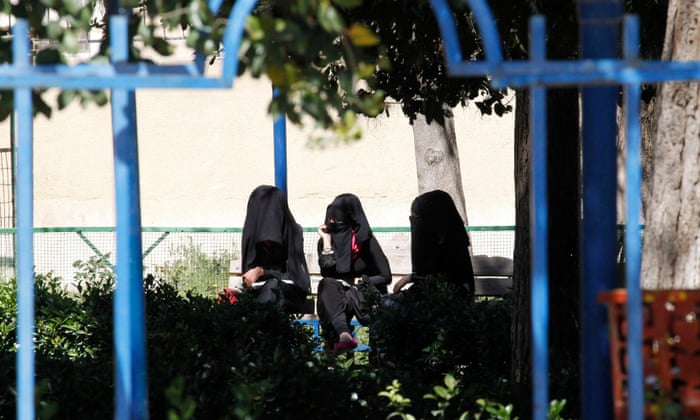
Veiled women sit on a bench in Raqqa. Isis has imposed sweeping restrictions on personal freedoms, and women must wear the niqab, or full face veil, in public or face punishment. Photograph: Reuters


If a woman was caught by the morality and virtue police not adequately observing the ISIL dress code, her husband was expected to appear at a hearing where he was levied a fine, or else he or his wife would be sentenced to be whipped. Mrs. Beder, recounting the restrictive lives led in Mosul under Islamic State rule, said her husband was fined 50,000 dinars, representing a huge portion of the family monthly income.

For Iraqi forces, now that Islamic State fighters have been forced out of much of Mosul, a routine of slow progress inside the city is taking place, even while civilians remain trapped along the front lines. Although Jassim Mishraq's neighbourhood was declared to have been liberated by the Iraqi military a week earlier, the neighbourhood is still too dangerous for humanitarian aid groups to enter and give aid to the residents, since just a few hundred metres away, violent clashes are still ongoing in the effort to roust ISIL from the city.

ISIL counterattacks emphasize for Iraqi forces that they remain a force to be reckoned with, necessitating their slower progress in clashing with the jihadis. Mosul's dense residential neighbourhoods demand more caution. The Iraqi government has no intention of emulating what neighbouring Syria's government is engaged in, bombing civilian enclaves. The initial swift advances in the outskirts and outlying towns of Mosul have given way to slower progress, as the military negotiates its way carefully around traps.

The Iraqi know they remain vulnerable to ISIL suicide attacks  and bombs set to explode where they least expect them.


Labels: , , ,

Thursday, November 10, 2016

ISIL License To Slaughter

"We have the co-ordinates of their bases and tunnels, and we are targeting them from here in order to weaken them so that our forces can reach their targets more easily."
Iraqi Kurdish commander Brig.-Gen.Iskander Khalil Gardi


Entering Bashiqua, Iraq early in the week, Kurdish fighters found at the town east of Mosul, held by Islamic State, a mass grave with an estimated one hundred decapitated bodies. A mass beheading of helpless people, an orgy of butchery, so courageously beloved of the fanatic Islamist jihadis. Likely a video exists of the grimly bloody atrocity as it occurred, that has not yet been revealed to a wider public.

Perhaps the Peshmerga weren't surprised by what they discovered, merely aghast with disbelief at the grotesque reality of a terrorist group defending Islamic historical ideals carrying out a slaughter of that dimension in such a barbaric manner. Part of the broader intention to push Islamic State terrorists out of Mosul; the offensive reclaiming the town of Bashiqa is part of the larger influx of militias confronting ISIL.


The intention on the part of Iraq is to reclaim its territory, and the intention of the Peshmerga to free Iraqi civilians from the brutal occupation that has resulted in such mass killings. A series of massacres are known to have been carried out by Islamic State jihadists since they took possession of large geographic areas of southern and central Iraq in 2014, taking the time to document their fierce barbarism through videos and photographs in the delusional belief it will aid their caliphate.

Those photographs and videos did go a long way to forging an impression of primitive nihilism and the penchant the terrorists displayed in living colour, for distorting the concept of honour as they beheaded those whom they spoke of as worthless dregs of humanity. When Iraqi soldiers advanced into the town of Hamam al-Alil, south of Mosul they too discovered a pit with dozens of decapitated skeletal remains uncovered there, as well.

A Kurdish barrage of heavy artillery, Katyusha rockets and mortar rounds were fired into ISIL positions to provide strategic cover to enable the advance of armoured columns into Bashiqa. Explosions created dark clouds hovering over the city. The town was deserted of civilians, held by dozens of ISIL fighters, located 13 kilometers northeast of the outskirts of Mosul, some 20 kilometres from the city centre.

Backed by U.S.-led coalition airstrikes, government-sanctioned militias were involved in the fighting to drive ISIL from the areas surrounding Mosul, along with Kurdish and Iraqi government forces. Kurdish peshmerga had surrounded Bashiqa for weeks before Monday's decision to advance into the town to finally drive ISIL from its perch. Mortar rounds were launched, along with the firing of artillery to gain headway into the town. 

Labels: , , , ,

Friday, October 28, 2016

The Method to Their Madness

"We fear we are just at the beginning." These villages are 35 to 40 kilometres outside Mosul. The closer you get to the city, the worse it could get."
"We've had reports ISIL are moving people, and we don't know where, but with their history of barbarism, you fear it's somewhere with strategic value for them."
Rupert Colville, United Nations human rights organization

"ISIL’s depraved, cowardly strategy is to try to use the presence of civilian hostages to render certain points, areas or military forces immune from military action, essentially using tens of thousands of men, women and children as human shields."
"In the face of these flagrant violations of international humanitarian law by ISIL, it is even more crucial that government forces and their allies ensure scrupulous respect for these laws."
"Captured (Isis) fighters and those perceived to have supported them must be held in accordance with international law."
UN spokeswoman Ravina Shamdasani

"Daesh detains families or sometimes just young people as they withdraw from an area. My brother was in the village of al-Hood and is one of those that they have taken. We do not know what has become of him."
"When the army attacks any village, civilians are caught in crossfire. We have to decide whether to go to the army side or stay where Daesh is. Daesh considers anyone who leaves the land of caliphate as ‘apostate’ so they force people to go with them as they withdraw towards Mosul."
Jassim, 36, a farmer from Qayyarah

"Congestion is increasing in the city, since the military operation began, hundreds of families from villages around Mosul began to come to the city and they are housed in schools and empty government buildings."
"They live under difficult conditions and we are helping them as much as we can by giving them food, water, blankets and other needs. They are scared."
Issa, a teacher in his 30s
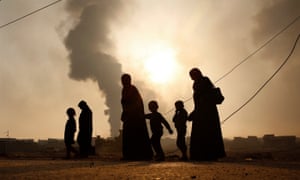
A family walks away from the front line in Mosul, Iraq
A family walks away from the front line in Mosul, Iraq Photograph: Carolyn Cole/LA Times via Getty Images

It is thought that about eight thousand families have been force-marched by Islamic State jihadis into Mosul from outlying villages. Their purpose is obvious enough; to ensure there are sufficient numbers of ordinary Iraqis in all parts of the city so that artillery or aerial bombardments are withheld for fear of inadvertently killing innocents. This tactic is not unique to Islamic State of course, it is one practised by all terrorist militias for whom human life is of negligible value, balanced against their agenda.

Iraqi families trapped in the general vicinity of Mosul are also being shepherded to other places besides Mosul. The town of Hamam al-Ali, once had a population of about 23,000 residents, but since becoming a stronghold for Islamic State, the town's population has been increased to 60,000 and it is not hard to imagine how strained resources are to manage a tripling of the population. The U.S.-led air coalition has been trying to bomb the vehicles sometimes used to transfer villagers, when they are empty of passengers.

The people helpless to defend themselves from being forcefully displaced, arrive to find place for themselves in abandoned buildings, ending up living in dire straits with their human necessities for survival in short supply. A young disabled girl, along with five other people who were unable to keep up with a group forcibly marched from their village, were shot dead by ISIL terrorists just south of Mosul. Their deaths known to everyone, the bodies left in plain sight to ensure that fear motivates others to cooperate.
Internally displaced persons clear a checkpoint in Qayara, some 50 kilometers south of Mosul, Iraq, Wednesday, Oct. 26, 2016. Islamic State militants have been going door to door in farming communities south of Mosul, ordering people at gunpoint to follow them north into the city and apparently using them as human shields as they retreat from Iraqi forces. Witnesses to the forced evacuation describe scenes of chaos as hundreds of people were driven north across the Ninevah plains and into the heavily-fortified city, where the extremists are believed to be preparing for a climactic showdown.  (AP Photo/Marko Drobnjakovic)
Internally displaced persons clear a checkpoint in Qayara, some 50 kilometers south of Mosul, Iraq, Wednesday, Oct. 26, 2016. Islamic State militants have been going door to door in farming communities south of Mosul, ordering people at gunpoint to follow them north into the city and apparently using them as human shields as they retreat from Iraqi forces. Witnesses to the forced evacuation describe scenes of chaos as hundreds of people were driven north across the Ninevah plains and into the heavily-fortified city, where the extremists are believed to be preparing for a climactic showdown. (AP Photo/Marko Drobnjakovic)

While in the same village, ISIL was reported to have tied six civilians to a vehicle by their hands to be dragged about, an honour accorded them in view of the fact they were relations of a tribal leader known to be fighting with Iraqi government forces. This is yet another specialty common to Hamas, in Gaza. Another 70 bodies shot through with bullets was discovered by Iraqi security forces in the village of Tuloul Naser, on October 20.

Fifty police officers held hostage by ISIL were executed outside Mosul on Sunday. Somewhat balancing the ledger on atrocities, are reports of revenge attacks by forces closing in on Mosul, on men and boys believed to have fought for ISIL, surfacing as well.

On its social media sites, ISIL has posted suggestions of plans to retreat to the deserts of Anbar province on a temporary basis, there to rebuild and plan additional atrocities on Iraqis. As it is they have done stupendous harm. Kurdish peshmerga and Iraqi security forces have taken the full brunt of ISIL suicide bombings, killing and injuring a substantial number of those dedicated to releasing Mosul and its million residents from Islamic State.

The roads and hills around Mosul have been littered with IEDs, while snipers with Islamic State have been dispatched to greet coalition militias as they approach Mosul. Execution style killings continue to take the lives of former police officers as ISIL retreats from its Mosul territory.

A man accused of being a Daesh fighter sits before a crowd of newly displaced people near a check point in Qayyara, east of Mosul, Iraq, Wednesday.
Goran Tomasevic, Reuters -- A man accused of being a Daesh fighter sits before a crowd of newly displaced persons at at a checkpoint at Qarayya, east of Mosul.

Labels: , , , ,

Friday, October 21, 2016

In the Collective Opposition to Islamic State, Iraq's Shiite Military and Militias Consider Themselves the Alphas, Degrade the Equality of Iraqi Sunnis

"The killings and abuses committed by ISIL fighters when they captured Mosul in 2014, and the horrors they have subjected its inhabitants to ever since, should leave us in no doubt as to the risk civilians face."
"[There remains] a grave danger that ISIL fighters will not only use such vulnerable people as human shields but may opt to kill them rather than see them liberated."
Zeid Raad Al Hussein, UN High Commissioner for Human Rights
Newly displaced people wait to receive food supplies at a processing center for displaced people In Qayyara, south of Mosul, Iraq October 21, 2016
So far, only 'modest' numbers of people have fled Mosul, the UN says -- Reuters
Islamic State fighters have prodded, threatened and herded hundreds of Iraqi Sunni families out of their towns and villages on the Nineveh plain, on the eastern edge of Mosul, to walk the considerable lengths from their villages into the city of Mosul. This move transcends mere threats -- when civilians are seen to be on the verge of altering their allegiance to the Sunni caliphate they likely welcomed when two years earlier the Islamic State jihadis overran the area -- the threats turn to violence and killings. The United Nations is citing this forced march of civilians into Mosul as proof that ISIL refuses to permit families to flee the area to seek haven in territory now held by the Iraqi army.


This interpretation of events relating to the Iraqi civilians in the area, caught between their oppressors loyal to ISIL, and the onslaught of the Iraqi, mostly Shiite military, may be illusory in nature. There is no trust whatever between Iraq's Sunni civilian population and the Shiite-led government of Iraq. And that situation prevails precisely because the Shiite-led government has chosen to give equal recognition to its Iraqi Sunnis short shrift. The civilians living in the now-largely-evacuated villages have turned instead to protection from Iraqi Kurds.

Islamic State is fighting back as only they appear to be capable of; or, at the very least reflective of the ideological passion of hatred that demands live sacrifices to appease the rage of militant Islam. They have been reported by witnesses to have executed by deadly fire, 284 men and boys in a paroxysm of vengeance as Iraqi troops begin to enter Mosul. The bodies were scooped by a bulldozer into a vacant building in the north of the city, once the need to use that group of men and boys as human shields was trumped by the more urgent need to massacre them, symbolically.

And with the escaping Mosul residents streaming out of the city and into Kurdistan, have inevitably been some ISIL fighters. They mounted an attack in Kirkuk, yesterday, attacking government buildings and a power station under construction, killing thirteen employees and at least six police officers. This was meant to be a counter-attack to demonstrate that the jihadis have not been defanged, the attack "clearly aimed at diverting the Iraqi army" from Mosul, according to the BBC's Richard Galpin, in northern Iraq.

However, in the aftermath of the attack, the governor of Kirkuk, Najm al-Din Karim, claimed that Peshmerga fighters and counter-terrorism forces were completely in control of the situation, blaming the attack on Islamic State sleeper cells.

Iraq’s troops fly Shiite flags in Mosul fight against ISIS, stoking tensions
Iraqi soldiers stoking tensions with Sunni Iraqis by flying Shiite flags -- wsj.com

In this most unconventional of conflicts, complications and distractions are everywhere in a region beset with tribal, ethnic and sectarian grudges. The very Iraqi soldiers engaged in the conflict to retake the largely Sunni city of Mosul from Islamic State have taken to mounting Shiite flags on their vehicles and raising them atop buildings. It takes no genius to realize that by doing this, they are stoking the often-violent sectarian divisions that Iraq’s government has sworn it intended to repair.

Affixed onto tanks or hoisted over government checkpoints and homes in reclaimed Sunni villages, these flags reflecting Shiite Muslim symbols often dwarf the Iraqi flags next to them. The flags' flagrant presence not only rankles Iraqi Sunnis but the Kurdish Peshmerga fighters taking part in the assault, as well. Sunnis regard the flag display as having the practical effect of undermining the Iraqi government's message of national unity against Islamic State, serving instead to reinforces their long-held impression that they are not accepted in Iraq’s state and security structure.

A Shiite religious flag hangs on the front of an Iraqi army vehicle in Khazer, Iraq, on Monday.
A Shiite religious flag hangs on the front of an Iraqi army vehicle in Khazer, Iraq, on Monday. Photo: Andrea DiCenzo for The Wall Street Journal
Under the agreement conceded by the coalition and approved by the U.S., only Iraq’s military, Federal Police and Sunni tribal fighters were to enter the city of Mosul, while the Iranian-linked Shiite militias and allied armed groups such as Kurdish Peshmerga forces would remain on the outskirts to hold regained ground. Allowing the fiction that Mosul should remain in Iraq's possession, even while the Peshmerga see it as part of their autonomous region, and Turkey insists that the city must remain a majority Sunni enclave.

The Peshmerga as usual have borne the brunt of the confrontations with Islamic State, leading operations north and east of Mosul since Monday, while U.S. helicopter strikes give coverage to the Iraqi military, giving short shrift to the need of the Peshmerga for that same type of air cover. The Peshmerga fly the flag of their semiautonomous regional government on their vehicles. They consider that the use of the Shiite flag in lieu of flying only the Iraqi flag confrontational and divisive.

The brother of the Kurdistan Regional Government President Masoud Barzani, Peshmerga Gen. Sihad Barzani, noted that in his opinion the Shiite Hussein flags represented a questionable omen for Iraq’s future. "That flag doesn’t represent the whole Iraqi people. The Iraqi flag is important because it represents everyone", whereas the flag being flown essentially indicates that the Iraqi army and the Shiite militias rule the enterprise, represent the totality of the opposition to Islamic State, and equate with the domination and conquest by Shia forces of Sunni interests.

Labels: , , , , , ,

Tuesday, October 18, 2016

Crediting the Iraqi Military

Barzani said the joint Iraqi force are launching the offensive from south and east of Mosul [Reuters]

"[The offensive to be led by Kurdish Peshmerga] Then they will stop. We'll [Iraqi military] start after them and move after them to support them."
"The operation [to retake Mosul] will take much longer because of this [the large presence of well over a million Iraqi civilians]."
"For their safety, but it also means each neighbourhood needs to be surrounded and searched as we clear it."
Brig.Gen. Haider Obaidi, Iraqi special forces commander

"We do provide our intelligence capability, we provide our logistics, these are capabilities that the coalition has that are singularly distinctive. We are very capable in these areas, and it is a big help to the Iraqis as they move into position," he said. 
"The plan is for the Iraqis to liberate Mosul, They are going to be the ones that will move in to the city."
Colonel John Dorrian, spokesman, U.S. forces

"Today is a turning point in the war against terrorism. This is the first time that Peshmerga forces and Iraqi army have cooperated and fought in the same area,"
"We are hopeful that this operation will be successful and that Mosul will be liberated. But this does not mean that the terrorist threat is over."
Kurdistan President Masoud Barzani
Barzani said the joint Iraqi force are launching the offensive from south and east of Mosul [Reuters]
Kurdish leader Masoud Barzani said the joint Iraqi force are launching the offensive from south and east of Mosul [Reuters]

Restoring the honour of a demoralized military, which, though trained and equipped by the U.S., turned and ran the very instant they became aware that Islamic State fighters were marching to enter Mosul and take the city from the command and protection of the Iraqi military. Rather than face the enemy whose ruthless reputation for slaughter and shedding blood in the most medieval-engaged atrocities, Iraqi forces, from commanders to enlisted men, chose to turn tail and decamp in such a panic that they left all their advanced military gear in their barracks, gifting Islamic State with up-to-date technically advanced arms and vehicles.

The staging for the retaking of Mosul has been in the planning stages for well over a year. Islamic State has been in possession of the city of over two million Iraqis -- of mostly Sunni Muslims, bordering on Kurdistan by Islamic State, considering it their Iraqi capital just as Raqqa is considered the Syrian capital of the caliphate -- for over two years. It is starkly obvious that the Iraqi military would be incapable of mounting an offensive for the return of Mosul on its own. Without the air- and fire-power of the U.S.-led coalition, and significantly, of the Peshmerga, Mosul would remain in ISIL possession.

The estimated 30,000 assembled forces of Peshmerga, Iraqi troops, Shiite militias representing tribal warlords, target an ISIL opposition of an estimated three to four thousand fighters. This unequal contest on a battlefield might readily be seen to be heavily in favour of the larger contingent of adversaries. But in a city the size of Mosul with its huge remaining population of over a million residents, with all the buildings and houses, the underground tunnel system, the IED-rigged buildings and back-alleys, the complications are diverse and numerous. With ISIL well ensconced and familiar with their surroundings, using explosives-laden vehicles in suicide attacks, their threat is ominous.

They will exact a steep price for the privilege of retaking Mosul from their grasp. In their wisdom, the United States persuaded the Peshmerga and Iranian backed Shiite militias to remain on the perimeter of Mosul, enabling the Iraqi army's counter-terrorism special force, Iraqi federal police and local tribal fighters to initiate and conduct house-to-house fighting in Mosul. The purpose, to ensure that sectarian violence is kept to a minimum once the battle for Mosul has succeeded and ISIL ousted.

Considering that Mosul's population is mostly Sunni, with a smattering of ethnics such as Arameans and Armenians, and the Islamic State occupation was likely comprised of no more than several thousand administrator/fighters, the city of two million might conceivably have put together a core group of opponents to oust ISIL. But for the majority Sunni Iraqis in Mosul there is no love lost for the Iraqi government comprised mostly of Shiites in an unequal sharing of national trusts. Many of the dismissed former Saddam Hussein military commanders came from Tikrit and Mosul.

And the core group of leaders of Islamic State were represented by many of these former Saddam-loyalist Sunni Iraqis. It stands to reason there was sympathy in Mosul for the Islamic State and its defense of Sunni Iraqis. With the incursion of Shiite militias and the Iraqi military comprised largely of Iraqi Shiites there will be an eventual reckoning meted out to the Sunni population of Mosul. Many of whom will be vacating Mosul as expeditiously as possible, leaving the UN to settle them in refugee camps for their own protection.

The resumption of Iraqi government control of Mosul will be months in the making while ISIL fighters are being routed from the city. The need to ensure that the terrorists do not infiltrate the tens of thousands of fleeing Sunni civilians will most certainly be a time-consuming and fraught affair. And when the city is finally freed from the talons of ISIL, other situations will erupt; that Kurdistan claims Mosul for its own, and that Turkish president Recep Tayyip Erdogan insists that Mosul remain a Sunni enclave, under the protection of Turkey, not Iraq. Even while local warlords and Shiite militias argue violently that Mosul is their heritage.
"This is the first time the Peshmerga and Iraqi forces have worked together against Daesh [ISIS] … we hope this will become a concrete foundation for our future relations with Baghdad."
"The liberation of Mosul is not an end to terror and terrorism but this was a good lesson so in the future we will resolve our differences through understanding and working together. We reassure the people of Mosul that both the Peshmerga and the Iraqi army will do everything not to cause any loss to the people and no revenge killing will take place."

Kurdistan President Masoud Barzani

Labels: , , , , , ,

Combine and Conquer, Divide and Squabble

"There were less than ten Daesh in the village."
"But they were running around like rats in and out of tunnels and surprising us with suicide attacks and snipers."
Lt. Mehsen Gardi, Kurdish Peshmerga commander


"Daesh is disoriented they don’t know whether to expect attacks from the east or west or north."
"It won’t be a spectacular attack on Mosul itself. It will be very cautious. It is a high-risk operation for everybody."
Hoshiyar Zebari,  senior Kurdish official
Kurdish Peshmerga soldiers fire artillery toward the village of Sharlouki as their troops attacked ISIS there as part of the Mosul offensive
Kurdish Peshmerga soldiers fire artillery toward the village of Sharlouki as their troops attacked ISIS there as part of the Mosul offensive Credit: Sam Tarling for the Telegraph
During the tyranny of Iraqi dictator Saddam Hussein he was fond of describing battles he was engaged in as "the mother of all battles". Something that hasn't changed since his departure is that the current Shiite-lead Iraqi government also chooses to describe the incipient battle against Islamic State for re-possession of the country's second-largest city, populated mostly by Sunnis, as "the mother of all battles", an obvious piece of Iraqi hyperbole, pleased by the image of victorious Iraq, its military central to the fray, challenging the primacy of the Islamic State caliphate, where it had once fled from it.

Courage restored, shored by the U.S.-led coalition that has been responsible for covering fire power from the air, Iraq once again boasts its battlefield prowess. Even as it has pointedly directed Iraqi Kurds -- who have never fled in disarray from any conflict challenge, standing their ground and fighting effectively in a refusal to surrender any of their sovereignty to their heritage lands -- to encircle Mosul and retake small towns around the city along with Iran-loyal Shiite militias, the government has given firm directions that only its forces are permitted to enter Mosul.

And the president of Kurdistan, Massoud Barzani, has lost no time stating with pride on the very first day of engagement with ISIL, that a "turning point to the war against terrorism" has already evidenced itself. He speaks triumphantly of a 200 square kilometre geographic area, along with a half-dozen villages that have been taken from Islamic State of Iraq and the Levant as the initial stages of Mosul liberation becomes a reality.

The complete and speedy ousting of ISIL from its caliphate on the Iraqi portion of a huge swath of land the terrorists have captured over the past several years is being predicted by Iraqi, Kurdish, French, American and Canadian generals in Iraq. They do caution, however, that the initial gains have been occasioned in an open terrain and in villages on the outskirts of the huge sprawl of Mosul with its remaining million or so population. Once entry to the city itself occurs, the situation will be far different.

When deadly ambushes are likelier to occur, when well-placed snipers will take their toll, when passionately barbaric Islamists will celebrate their death by suicide while martyring themselves in the process of bombing government military to achieve the satisfaction of joining the roster of Islamist heroes for the audacity of their vision against tall odds, along with the determination to carry through to a successful conclusion as many deaths as possible.

Islamist terrorists all seem to play from a familiar handbook, one common to Hezbollah and Hamas, as well as Islamic State, not to mention the 'legitimate' government of the Syrian regime, all of whom take great pride in using civilians they hold in thrall, as shields. To that end, just as Hamas ordered Gazans to defy Israeli military leaflets urging civilians to vacate buildings slated to be bombed, it appears that ISIL is doing likewise, only coercing citizens of Mosul to move into buildings known to be bombing targets.

Once the courageous, dauntless Iraqi military has breached the ISIL outer defences to approach the interior of Mosul, the city will present as a ferocious challenge, an tight urban maze of tunnels, booby-trapped buildings, lurking suicide bombers awaiting opportunity, and expert marksmen sitting on rooftops looking forward avidly to the chance to pick off challengers to ISIL supremacy through quick aim and direct, critical hits.

The 30,000-strong combined force of Iraqi military, Shiite militias and Kurdish troops vastly outnumbers the jihadis' fighting strength. The Kurdish Peshmerga fight with confidence and the strength of knowing that what they wrench back from ISIL will fit neatly into Kurdistan, their ancient homeland, not yet fully and legally recognized internationally. They hope their courage on the battlefield will lead to sympathy for their cause that will translate to international pressure on Iraq to recognize the legitimacy of Kurdistan.

Iraqi forces deploy in south of Mosul, as they advance towards the city to retake it from the Islamic State
The Iraqi army is moving on Mosul from the south  AFP
Iraq divides against the natural lines of its residents in any event; wherever Sunnis and Shiites are in the majority, and where the Kurds administer their autonomous region, the country is ripe for division in the hope that peace will ensue when confrontational challenges between the three no longer represent the norm. Splitting the country, resisted by its Shiite command, would also require that the petrochemical resources be split equably as well; another reason for the Shia government to dig in its heels.

In the background is the reality that Shiite militias harbour a deadly hatred for the million or so Sunnis who chose to remain in Mosul while the Islamic State fundamentalists administered it. This alienation from greater Iraq rests at the feet of the Shiite majority who have in effect reversed the situation of Saddam's minority Sunni Iraqi demographic that oppressed their Shiite counterparts, with the current government representing the interests of the majority Iraqi Shias doing the very same to the now-deprived Sunnis of Iraq.

The deposed Sunnis who had the upper hand while Saddam remained in power, now loathe the Iraqi Shiites who have returned the compliment, refusing, even under initial pressure from the United States administration, to apportion equality among the three major groups; Iraqi Sunnis, Iraqi Shiites and Iraqi Kurds, leaving all three suspicious of one another and prepared to exact vengeance at the first opportunity in an inherited display of sectarian dysfunction leading to violence. The coalition battling the Islamic State is just representative of the same syndrome on overdrive.

Mosul map 

Labels: , , , ,

() Follow @rheytah Tweet