This is a blog dedicated to a personal interpretation of political news of the day. I attempt to be as knowledgeable as possible before commenting and committing my thoughts to a day's communication.
"Per capita, we are probably the state that gives the most weapons to Ukraine so that they can fight for us.:"
"When my 90-year-old parents watch the television news, when they see the horrors of the war in Ukraine, the mass graves, the burnt-out buildings, they see the Soviet occupiers again."
"They remember their culture reduced to a folkloric theme, the dozens of thousands of innocent people sent to the Gulag, the Second World War which decimated their people."
"These traumas come to haunt the entire population."
"Putin killed minority rights for Russian speakers by manipulating the issue for expansion purposes."
Nils Muiznieks, former Latvian cabinet minister
"The Russian invasion of Ukraine revives two completely different perceptions of history. For many, it is a continuation of World War Two."
"For Russian speakers, the victory monuments are symbols of their parents and grandparents who liberated the country from the Nazis. For the ethnic Latvians, the Soviet liberation is the beginning of a terrible occupation."
"Until now, we avoided ethnic violence. But the war completely undermined this. What Putin did, played very well in the hands of nationalists."
"It is far from perfect but enormous progress was made. We cannot afford to lose what we have gained."
Boris Cilevics, Russian speaking Latvian community leader, former member of Latvian Parliament
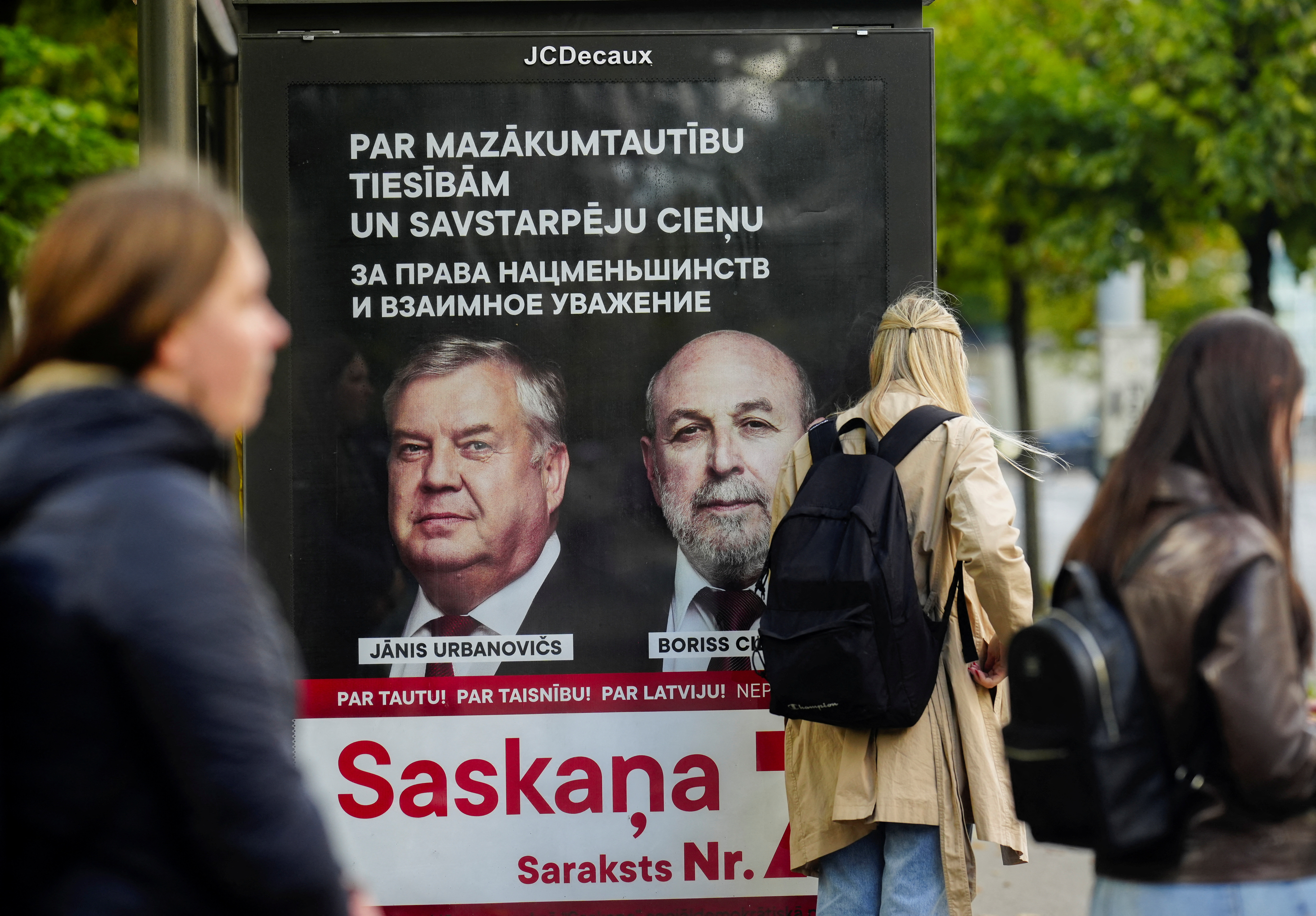
An election campaign poster depicting leaders of Harmony party
is seen in a public bus stop in Riga, Latvia September 28, 2022.
REUTERS/Ints Kalnins
During the time of the Soviet Union's outreach to its satellites, there was a migration of Russians taking up residence in countries that formed part of the USSR. Now, those diverse nations are fully independent of Russia, but all of them -- particularly the Baltic nations -- are, and always have been, acutely aware of their vulnerable position and fear that they will once again be inducted -- violently -- back into what is now the Russian Federation. Vladimir Putin likes to use the fact that those countries host ethnic Russians and thus, Russia has a responsibility to the welfare of Russians living in the near abroad.
He made his point in Georgia when he helped to separate two of its provinces and again in Ukraine when he declared the Crimean peninsula to be part of Russia. More latterly, he has subsumed in theory four huge Ukrainian provinces into greater Russia during the Kremlin's 'special military operation' in Ukraine. Latvia has latterly become extremely aware of its vulnerability with the war raging in Ukraine with Russian and Belarusian borders uncomfortably close to its own.
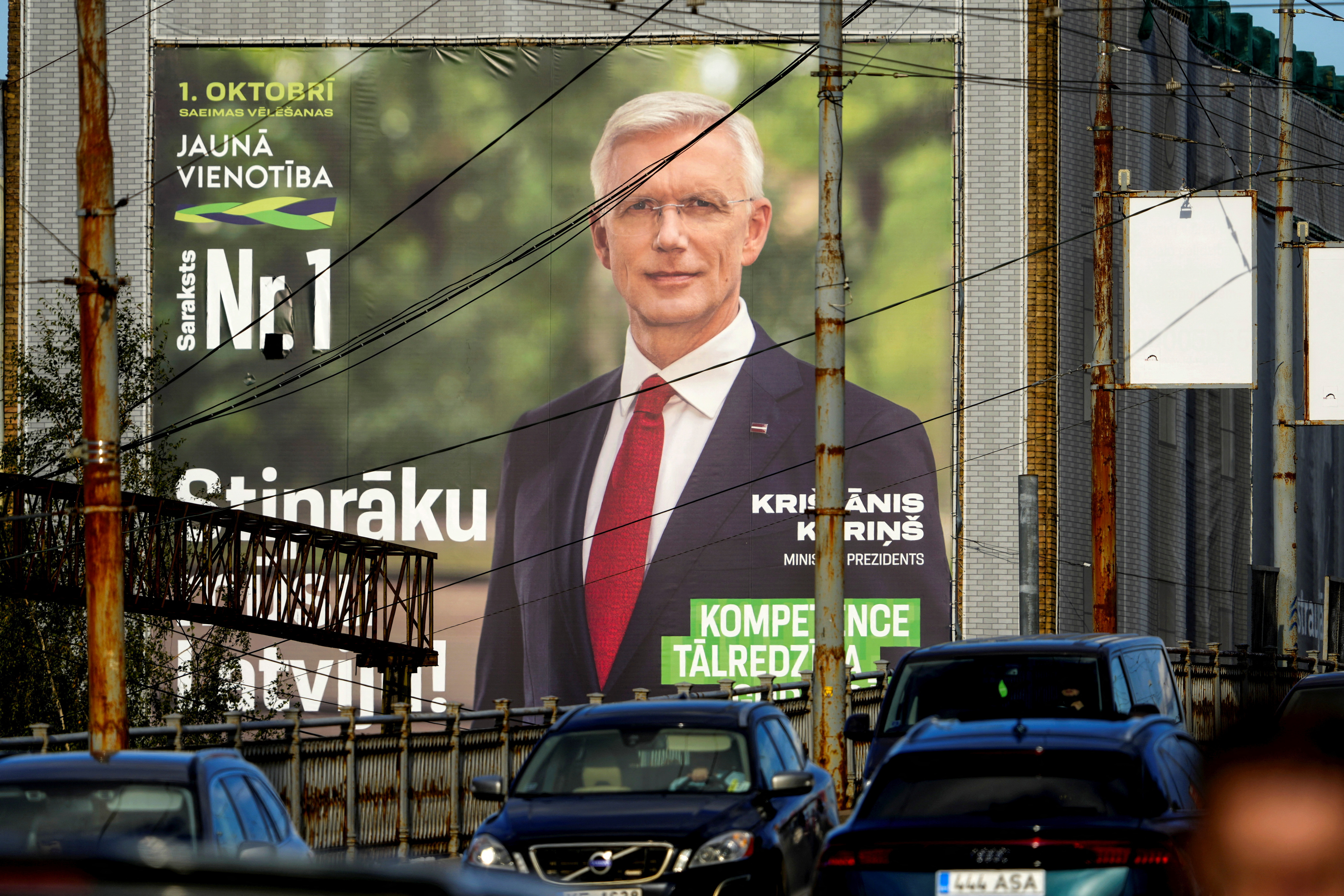
Motorists drive past a giant election campaign poster depicting Latvian
Prime Minister Krisjanis Karins of New Unity party in Riga, Latvia
September 28, 2022. REUTERS/Ints Kalnins
Latvia has the slight comfort of being part of NATO with a Canadian NATO troop presence in the face of an increasingly aggressive Russia. It is also a member of the European Union, but these salutary conditions cannot change its geographic presence as a next-door neighbour to a country whose appetite for domination cannot be appeased.
The brutality of the Russian military in Ukraine, the mentality that sneers at the conventions of war observed by civilized nations that has Moscow ordering the bombing of civilian enclaves, of cities well outside the zone of conflict, of hospitals, theatres, shopping malls, apartment blocks, schools has engendered a lashback within Latvia. A nation of three million people, a Russian speaking minority accounts for a third of the population. Up to the present the two ethnicities have been frostily accommodating.
It hasn't helped that the Russian expatriates have never sought to integrate themselves into Latvian society. Where they inhabit parts of Latvia becomes a Russian enclave with Latvian seldom spoken and Russian language dominating. In the course of the last year, since the Russian invasion on February 24, nationalism has awoken from a slumber. Accommodation of the Russian-speaking minority no longer predominates; 30 years of patience, waiting for that minority to become Latvian has outworn its time.
A poll taken in the summer of 2022 saw 25 percent of Russian speakers opposed to the war, 25 percent supported it, and 50 percent declared themselves undecided, a reflection of Russian propaganda. In the past year over 30 criminal proceedings have been initiated relating to inciting hatred and supporting Russian aggression. The Latvian Parliament passed a law prohibiting the teaching of Russian in schools.
Government websites now appear in Latvian only Television channels originating in Russia are banned. "I am personally against these laws, but my party and I voted for them, social pressure was simply too strong", explained Martin Bondars a former member of the Saeima. TV Dozhd, the sole remaining Russian independent television channel, was shut down after five months on air, accused of showing content sympathetic to the invasion of Ukraine.
The government of Latvia closed off its borders to Russian citizen, inclusive of young men absenting themselves from mobilization -- although Russian dissidents and independent journalists are welcome. These decisions don't come easily, since Latvia is very well aware of the investing power of Russia in maintaining the Latvian economy.
Last August a towering Soviet-era obelisk in commemoration of the Red Army victory over Nazi Germany was toppled in a series of monuments pulled down throughout Eastern Europe as hostility toward Russia grows.
Things did change in Latvia among the ethnic Russian population. Younger generations have become fluent in Latvian; more interested in European capitals than they are in Moscow. A bare fifth of the Russian population could speak some Latvian in 1989, but by 2022, 22 percent of the Russian community was unable to speak Latvian.
The refugee orientation in the auditorium of Middle School 10. The projector is showing the Latvian and Ukrainian flags. Politico
"In the context of this senseless war, I have no moral authority to protest against these anti-Russian measures."
"I met Latvian speakers my own age when my parents sent me to art school in the city centre. I was so shy. I didn't care speak Latvian. It took years before I became fluent."
"I never lived there [Russia]. I am not a Russian citizen. I am a Russophone Latvian, a European."
"Putin is the biggest Russophobe that ever existed."
Igor Gubenko, 37, Russian-speaking philosophy professor, University of Riga
"They are honouring an SS unit whose members were involved in atrocities."
"This year in particular there is an amazing lack of understanding of the damage a march like this does to the unity of NATO and the nations standing for democracy."
Marvin Rotrand, national director, B'nai Brith Canada
"Canada has consistently supported Latvia's freedom and independence, and condemns those who would co-opt those sentiments to promote hatred, extremism, and division."
"To our understanding, these events are neither sanctioned nor attended by the Latvian government."
Global Affairs Canada
"[It is] utterly sad [the parade was back on in Riga, Latvia]."
"That they would this year again be gifted the historic centre of the capital is a folly rife with poor judgment and even poorer ethics."
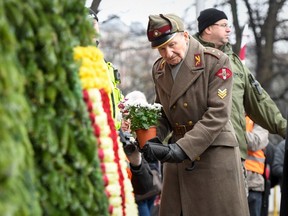
A
veteran of the Latvian Legion, a force that was commanded by the German
Nazi Waffen-SS during the Second World War, places flowers at the
Monument of Freedom in Riga, Latvia on March 16, 2019. Some see the
parade as glorifying Nazism because the Legion, founded in 1943, was
commanded by Germany's Waffen-SS, the armed wing of the Nazi party's
Schutzstaffel SS.Photo by ILMARS ZNOTINS /AFP/Getty Images
It is nothing but heedless at this time when Russia has invaded Ukraine, an East European neighbour of both, under the pretext of rescuing Ukrainians from the 'nazis' and 'racists' and 'right-wing' gangs Moscow claims govern Ukraine. There is also the presence of the Azov Division along with other far-right Ukrainian militia groups who revere their alliance with Nazi Germany as adjuncts to the Nazi SS battalions that fought during the Second World War, and of course, slaughtered European Jews.
The yearly commemoration meant to honour Latvia's seconded citizens to fight alongside regular German SS groups, by veterans and their families and supporters of the ethnic Latvian SS battalions is not an official Latvian event, but the government of Latvia does nothing to deter the yearly celebration, issuing a permit for the parade to proceed, attended by several hundred people. The intervention in the past two years was by nature, when COVID restrictions cancelled the event.
Latvia's SS Legion being honoured to this very day for its dedication to the Nazi ideology, bringing glory in its participation in war and mass murder should be a matter of shame, but evidently it is not. Latvian TV reported the event, attended by hundreds of participants on Wednesday. It is hardly surprising that Jewish groups continue to condemn the yearly support of Hitler's policies and exploits, glorifying those who took part in the Holocaust.
It does give heft to Vladimir Putin's spurious assertions, however, that the Russian military had a moral obligation to invade Ukraine for the purpose of "de-Nazifying" the country. There is also the unfortunate reality that in the years since World War Two ended, eastern European nations saw fit to build monuments to the nationalist leaders who were happy to fight the Soviet Union; many of the leaders being Nazi collaborators, some actively participating in the mass butchery of the Holocaust.
SS units were drawn from the ethnic populations in Lithuania, Latvia, Ukraine and Estonia.
Officials in Latvia praise the SS; their argument is that members of the legion are to be viewed as national heroes for fighting Russia and none among them were involved in the Holocaust. When, in fact, in those countries occupied by Germany during the war, it was not the least bit difficult to find the historical reality documenting deadly mass pogroms carried out by these same groups against their nationals who happened to be Jews.
Photo: Ivans Milovs/Latvijas Televīzija
"The pride of the Latvian people and of the state", was how Latvian Defence Minister Artiz Pabriks referred to his country's SS members. "It is our duty to honour these Latvian patriots from the depths of our soul." A sentiment and statement that Canadian government and military officials decided not to condemn. Even while, through its NATO membership, Canada has a contingent of 540 troops and military trainers in Latvia to 'guard against' any potential Russian plans to invade the Baltics.
In 2019, Global Affairs Canada through its spokesperson stated that Canada was "strongly opposed to the glorification of Nazism and all forms of racism, racial discrimination, xenophobia, intolerance and extremism. That is why we condemn the parade to commemorate the Latvian SS Brigade held in Latvia on March 16th". Now there is silence on the ongoing issue, coinciding with the tension in Europe and beyond, with Russia's military campaign in Ukraine.
The reality is that the Latvian SS Legion was represented by hard-core Nazi collaborators who took their place with enthusiastic pride as helpers in the Holocaust. Viktors Arajs, a Legion officer liked to refer to himself as "Arajs, the Latvian Jew-killer". The best way to kill Jewish babies, according to him, was simply to toss a Jewish child into the air and shoot them in mid-air, avoiding potential ricochets.
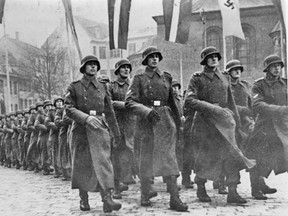
This photo from the Second World War shows Latvian SS members
"Do we have a clear expression of CAF policy toward this group [the Azov Battalion]?"
"This may or may not prompt questions, but
we need to be ready and not come across as being taken by surprise.”
Chris Henderson, then assistant deputy minister for public affair
"In Ukraine, the Azov Battalion has recruited foreign fighters motivated
by white supremacy and neo-Nazi beliefs, including many from the West,
to join its ranks and receive training, indoctrination and instruction
in irregular warfare."
Soufan Report
“Given the fact that the [Latvian SS] fought for a victory of the Third
Reich, the most genocidal regime in history, and that among those
serving in it were active participants in the mass murder of Latvian
Jewry, as well as of German and Austrian Jews deported by the Nazis to
Riga, such comments are incomprehensible, let alone deeply offensive,
coming from a senior minister of a country with full membership in the
European Union and NATO."
Efraim Zuroff of the Simon Wiesenthal Center
A news broadcast by German ZDF station showed soldiers of the Ukraine Azov Battalion with nazi symbols on their helmets.Photo by Files /ZDF station
Once again the Canadian Armed Forces' top brass has been revealed to be strangely oblivious to the fallout of matters they engage in without due thought to appropriate behaviour and their consequences. The Canadian public has been treated to a full-throated cry of desperation from female CAF members who have suffered sexual harassment and violence and when they bring the situation to the attention of military authorities, the issue is set aside, the victims of sexual violence left to steam in frustration, their abusers free to continue their upward trajectory toward leadership.
More latterly, the public has been reminded once again of the unsavoury contacts the Canadian Armed Forces leadership, along with government diplomats engage in through casual and personal contact with self-declared admirers of fascism and neo-Nazis abroad. Canada has a 'special' relationship with Ukraine through Canada's membership in NATO which has pledged to protect Ukraine from the intentions of the Kremlin to re-forge a union with Ukraine which the current government of Ukraine has no interest in and which Moscow has pursued with a vengeance.
Another factor in Canada's commitment to military partnership with Ukraine is the lobbying presence of large number of Ukrainian-Canadians urging a more firm alliance between Canada and Ukraine. An incidental but telling issue took place a few years ago when the Russian Embassy in Canada brought to the light of day, Canada's then-minister of Foreign Affairs and currently deputy Prime Minister and heir apparent to head the Liberal government's Ukrainian heritage. Chrystia Freeland's grandfather, it was revealed, was an ardent Nazi collaborator as the editor of a Ukrainian newspaper during WWII.
In his newspaper, Nazi propaganda found its place, along with vicious anti-Semitic sentiments; in no small measure doing his part in aiding and abetting fascist Germany in its dehumanization of European Jewry on their way to total genocide. So the Ukrainian community in Canada, has great influence in the country. However, since Canada is a country comprised of immigrant populations, a great congregation of people from all over the world, so too do Chinese-Canadians, Indian-Canadians, Italian-Canadians and other ethnic/cultural groups have influence, as they should, as Canadians.
In the latest revelations it would appear that Canadian officials and members of the military met with and were briefed by leaders from the Ukrainian Azov Battalion; neither the officers nor the diplomats involved voiced any objection to the meeting although they were briefed befirehand that they would be meeting with overt Nazi sympathizers. Photographs were taken of the meeting, which were used for propaganda purposes by the Azov Battalion online, stating that the Canadian delegation had expressed "hopes for further fruitful cooperation".
The Canadian Forces have decided, as a result of public embarrassment when an Ottawa newspaper revealing the unsavoury aspects of CAF interactions with foreign military forces, to mount a review of the issue. A review undertaken in response to the latest revelations of Canadian diplomats and military personnel meeting with Azov Battalion members while in Ukraine; a decision that arrived just as a Jewish group in Ukraine circulated a new
video of Ukrainian paratroopers singing a song to honour Stepan Bandera who was an infamous anti-Semite and Nazi collaborator whose group was linked to the mass murder of over 100,000 Jews and Poles during the
Second World War.
These new revelations fold neatly into the near past when senior Canadian Forces leaders took a pass on condemning glorification of Nazi collaborators in Latvia and Ukraine, where Canadian troops are conducting
training sessions. The Latvian Minister of Defence Artis Pabriks publicly
praised members of the Latvian SS who fought for the Nazis, proudly stating them to be "the pride of the Latvian people and of the state" and that his country would not "allow anyone to discredit their memory".
As a friend of Pabriks, then-defence
minister Harjit Sajjan refused to comment, much less to condemn
glorification of the SS unit. Canadian generals saw no reason to break their silence, at the 2019 event and declaration.
The Latvian SS included personnel who took part in the wholesale murder of
Jews during the Holocaust. Members of the unit were among
the last defenders of the Nazi regime in Berlin.
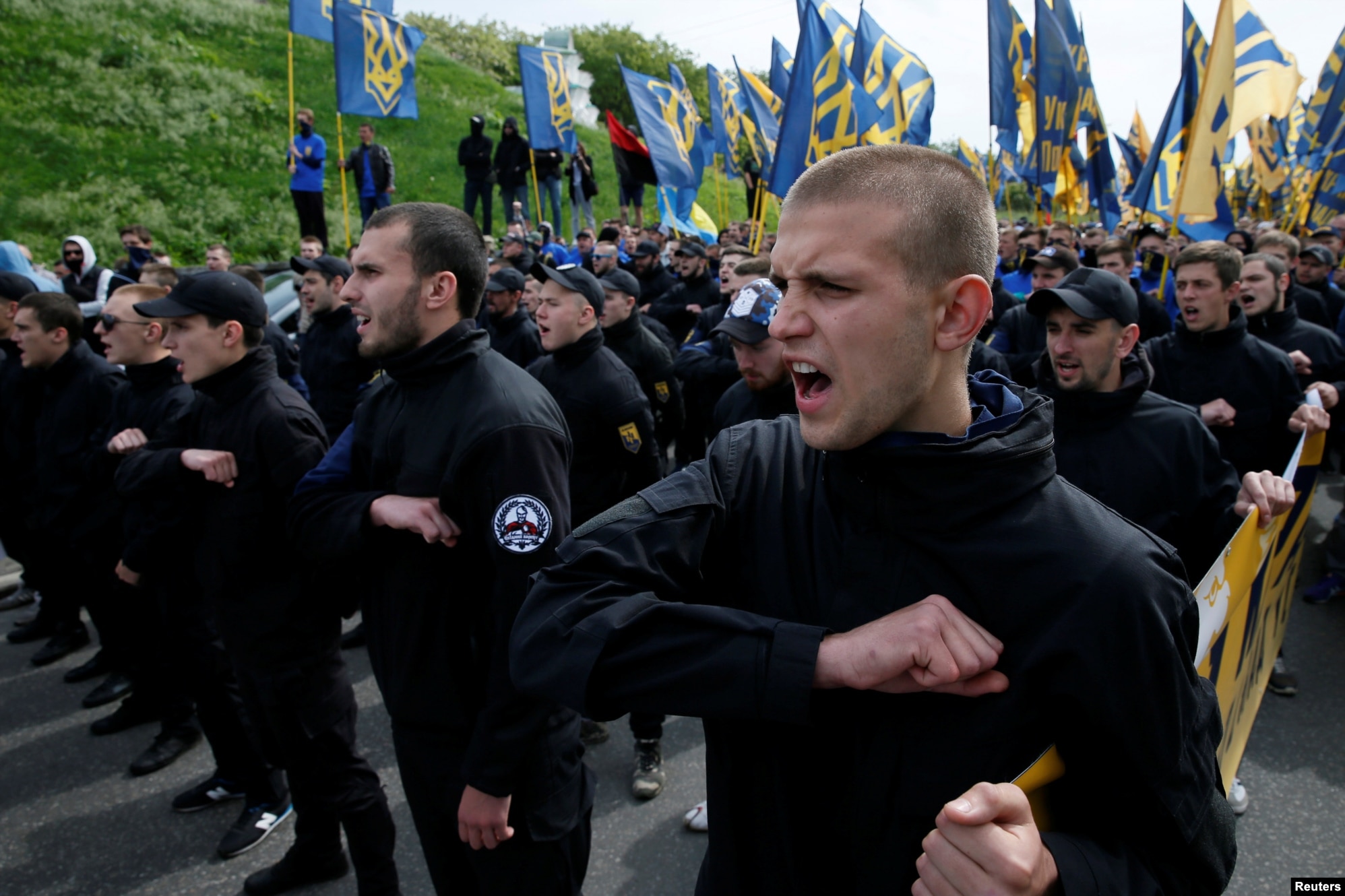
Members of the Azov Battalion attend a protest
against local elections in separatist-held areas of eastern Ukraine in
Kyiv on May 20, 2016. Reuters
Just coincidentally, as though underscoring the lax attitude and moral and ethical failings of the military hierarchy in Canada and government leaders disinterestedly overseeing their conduct in such matters, Canada’s training mission to Iraq was brought under scrutiny when it was revealed that Canadian soldiers complained in 2018
to their commanders that among the Iraqi troops they were training were war
criminals who enjoyed sharing videos of their atrocities, including
executing prisoners and raping a woman to death.
"This is like a nightmare." "This is all happening once again in the lifetime of survivors." "It has to be tearing their hearts out." Bernie Farber, former chief executive officer, Canadian Jewish Congress "[Such events as Ukraine's honouring of Nazi collaborators are] internal issues of Ukrainian politics." "[Israel's decision to condemn such parades is] counterproductive." Gennady Nadolenko, head, Ukraine diplomatic mission, Israel
"We must challenge all those who distort the historical record on governments, military units or organizations that fought with, supported or sympathized with the Nazis during World War II." "This includes government leaders who acquiesce in, or fail to condemn, a process of Nazi glorification that amounts to Holocaust distortion." "Those who glorify the record of such organizations or units cannot dismiss criticism as 'fake news'." Michael Mostyn, CEO, B'nai Brith Canada
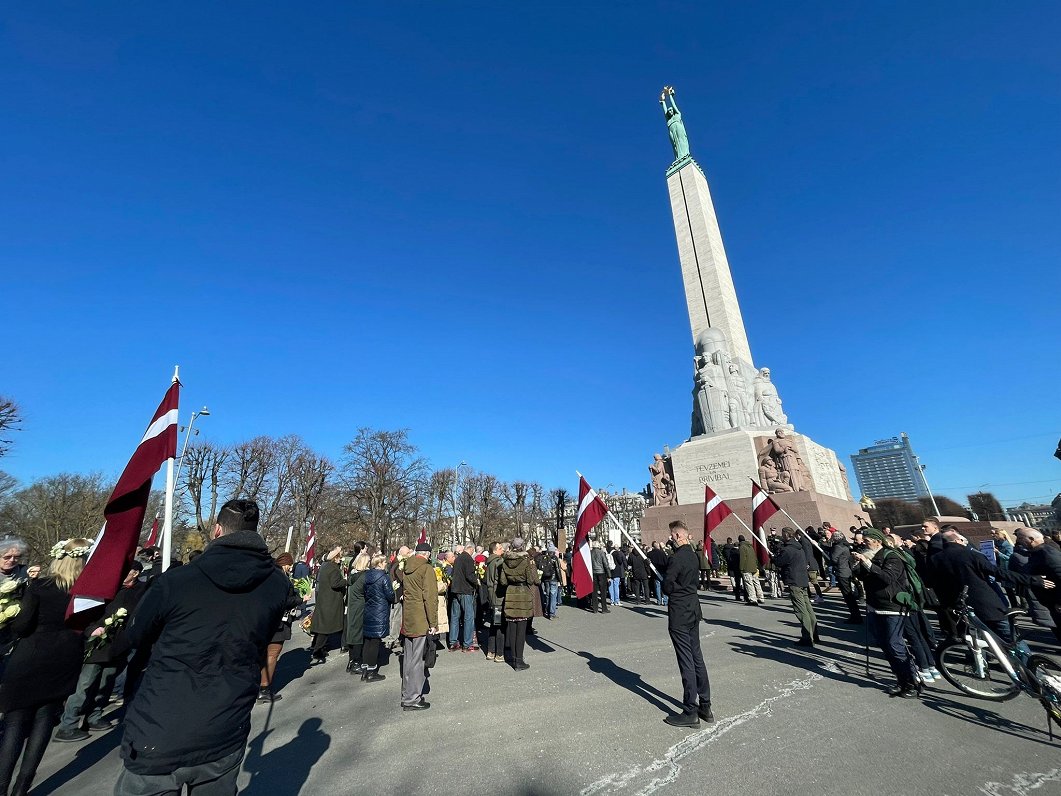
Veterans of the Latvian Legion, a force
that was commanded by the German Nazi Waffen SS during WWII, and their
sympathizers carry flowers as they walk to the Monument of Freedom in
Riga, Latvia on March 16, 2016 to commemorate a key 1944 battle in their
ultimately failed attempt to stem a Soviet advance. Jewish groups,
Moscow and some in Latvia's ethnic-Russian community see the parade as
glorifying Nazism because the Legion, founded in 1943, was commanded by
Germany's Waffen SS, the armed wing of the Nazi party's Schutzstaffel SS
(Protective Squadron). / AFP / afp / Ilmars ZnotinsILMARS ZNOTINS / AFP/Getty Images
For Jews around the world the 75th anniversary of the Soviet Red Army's liberation of Poland's Auschwitz-Birkenau death camp where Nazi Germany engineered the death of almost a million Jews, along with Roma, Soviet POWs, Polish political dissenters, gays, the very thought that Latvians, Lithuanians, Ukrainians and Poles would in the 21st Century, celebrate their national heroes who were Nazi collaborators is unthinkable.
Yet the reality is that throughout Eastern Europe countries are celebrating their nationals who collaborated with the Third Reich and took active participation in the rounding up and murder of Jews. Torchlight parades were held in a number of cities in Ukraine early this month in honour of Stepan Bandera, a nationalist Ukrainian and Nazi collaborator involved in the killing of thousands of Jews and Poles. Despite which, Ukraine sponsors such events celebrating Nazi collaborators with links to the Holocaust.
A school was named in Lithuania for Jonas Noreika whose own family agrees was involved in the killing of Jews. A Ukrainian diplomat talked about punishing "k----", while posing for photographs with a cake baked in the shape of Hitler's memoir Mein Kampf, and blaming Jews for the Second World War. Once a minor kerfuffle passed, when he was condemned by Jewish groups, he was reinstated to his diplomatic position.
For the approximately 200 Canadian military trainers currently deployed
to Ukraine, it is likely that on the first of January they would have
witnessed a torch lit procession. Throughout Kiev and numerous other
towns in Western Ukraine, thousands of civilians took to the streets –
not to usher in the New Year – but to celebrate the 110th anniversary of
the birth of a man named Stepan Bandera. Scott Taylor, Canadian Military Magazine
Estonia, Latvia and Ukraine have all held parades in honour of those who fought in Nazi SS units. The Latvian SS units who fought for the Nazis in the Second World War were praised by Latvian Defence Minister Artis Pabrike in December, who spoke of them as "the pride of the Latvian people and of the state". One of the unit's officers, Viktors Arajs, participated in the murder of 26,000 Jews with his unit. At a dinner party in Riga he entertained guests with his method of killing Jewish babies.
Throwing the babies into the air, then shooting them would avoid any ricochets that might occur if the babies were shot while lying on the ground. Eastern European nations such as Latvia, Ukraine and Lithuania are involved in rebuiilding their national identities, "rediscovering" individuals from the 1940s to elevate them to the status of national heroes, according to Holocaust researcher, Professor Per Anders Rudling.
Latvian Herbert Cukurs was a key member in the Arajs Kommando, known as the "Butcher of Riga". In 2014, the Israeli government raised concerns relating to a musical performed in Latvia celebrating his life, that of a Nazi war criminal whom Holocaust survivors linked to the murder of Jews. Over 50 members of the U.S. Congress in 2018 condemned Ukraine's efforts to glorify leaders of the Ukrainian Insurgent Army, along with the 14th SS Galizien Division, comprised of Ukrainian volunteers.
"It's particularly troubling that much of the Nazi glorification in Ukraine is government-supported", the letter stated. Poland passed legislation to make it illegal to accuse Poles of any complicity in the Holocaust when the simple reality is that fascist Germany felt confident in placing a number of forced labour and death camps in Poland, knowing there would be no popular outcry from a country where antisemitism was well entrenched.
In Western Ukraine, thousands of civilians took to the streets to celebrate the 110th anniversary of the
birth of Nazi collaborator Stepan Bandera
Lithuania's pro-Nazi government had been involved in the rounding up and murder of Jews, according to well-researched conclusions, yet a new law is under consideration in Lithuania to declare that neither Lithuania nor its leaders had ever participated in the Holocaust. Ukrainians, for their part, push back against Israel's condemnation, insisting that Stepan Bandera had never supported Nazi Germany, just as the Latvian government claims the Latvian SS units hadn't fought in support of Hitler, but to fight the Soviets.
News articles and research relating to Nazi collaborators have been dismissed by officials in Latvia, Estonia, Ukraine and Lithuania, claiming them to be the product of Russian disinformation campaigns meant to cast their countries in a bad light. Canadian officials failed to join Jewish groups condemning Latvian Defence Minister's Pabriks praise of the Latvian SS and two months later, he met with Canadian Minister of Defence Harjit Sajjan, while next month he returns to Ottawa for a defence conference.
Chrystia Freeland, formerly Canada's Minister of Foreign Affairs and in this new Liberal government named as deputy Prime Minister, is of Ukrainian background. She has been banned from entry to Russia. Her grandfather was a Ukrainian patriot who collaborated with Nazi Germany, publishing a newspaper in Nazi-occupied Poland, supportive of the Third Reich and rife with antisemitic tropes. The Ukrainian-Canadian community has always denied that members of the 14th SS Galizien were Nazi collaborators, many of whose members immigrated to Canada.
After Ukraine gained its independence
from the Soviet Union in 1991, their initial collaboration with the
Nazis and participation in the slaughter of Ukrainian Jews prevented
Bandera and Shukevych from being considered national role models.
However, much to the consternation of the Jews, and the Poles – whom
Bandera’s OUN also massacred in the thousands – over the past three
decades history in Ukraine has been revised.
At the time of the Maidan uprising in
2014, the spirit of Bandera was revived by the right wing,
ultra-nationalists, and, just five years later, his past crimes have
been whitewashed to the point where his date of birth is a national
holiday. Scott Taylor, Global-Politics,EU
"We definitely have to get it right. We have to go to Latvia with a strong defensive posture. First and foremost, we recognize cyber as a domain of warfare ... We are constantly under attack." "We will educate our troops about vulnerabilities, because Russia is quite adept in the cyber and information warfare domains." Brig.-Gen.Paul Rutherford, commander, Joint Forces Cyber Component, Canada "When you see how quickly it happened with the Germans, that shows us what to expect. Are they going to try? Yes they will. We fully expect such actions by the Russians." "[In Latvia Canada's military sees a different arena than Afghanistan] where we went in with a war mindset. We will communicate facts and the truth." "We will provide clear and transparent information. If we see inaccurate facts, we will take action." Lt.Col.Richard Perrault, Canadian military
Canadian and Latvian soldiers in Kadaga, Latvia, during Operation Reassurance in September 2015. Photo Cpl. Nathan MoultonDND
rlier this year,
Canada, Germany, the United Kingdom and the United States each committed
to lead a multinational battalion in the eastern part of the Alliance. I
am proud to announce that many other Allies confirmed contributions to
these forces today. Albania, Italy, Poland and Slovenia will contribute
to the Canadian-led battalion in Latvia. Belgium, Croatia, France,
Luxembourg, Netherlands, and Norway will join the German-led battalion
in Lithuania. Denmark and France will contribute to the UK-led battalion
in Estonia. And Romania and the United Kingdom will join the U.S.-led
battalion in Poland,
Read more on UNIAN:
https://www.unian.info/politics/1777512-nato-chief-four-robust-battle-groups-to-be-deployed-in-the-baltics-poland.html
Canada's pledged its support of NATO's request of its members to prepare to send in battle groups and equipment to the Baltics to mount an impressive deterrence presence and to help train their military personnel to the level seen to be required to convince Moscow that any plans to harass, cross borders or send in troops to Latvia, Estonia, Lithuania and Poland is not a particularly good idea and will not be tolerated. Germany, Britain and the United States have volunteered their services in the NATO campaign.
Just as Canada is preparing to forward its 450 Canadian Forces troops as a warning to Russia to respect national borders, Russia in turn is expected to let loose its efforts to disseminate false information for the purpose of creating a distance of suspicion between Latvia and the Canadian troops in their midst. The Kremlin's well organized "fake news" campaigns and cyber attacks have become commonplace, striking various countries with their signature propaganda through information warfare.
Last month when the German military took up their stations in Lithuania, stories began circulating that German troops were on a rampage, raping Lithuanian women. And this type of campaign is precisely what Canadian troops are being warned to be prepared for, and the reason why Canadian "cyber warriors" are being deployed alongside regular troops; to be able to respond to the anticipated dezinformatsiya set to occur in Latvia; blatant attempts to place a wedge between the host country and its defenders.
The cyber warriors' first line of defence will be forestalling efforts by Russian actors to hack into Canadian and Latvian military computer networks, along with turning aside the "fake news" campaign. Russia is not quite as busy in Syria as it has been for the past year and a half, having succeeded in giving Syria's president Bashar al-Assad a lifeline and restoration of some of his territory. The Kremlin's and Vladimir Putin's attention is expected to turn back once again to east Europe.
Former Soviet satellites were assimilated into the USSR sphere and ethnic Russians were tasked with colonizing those satellites. Now, with their sovereignty restored, those ethnic Russians living for generations in former satellite countries represent the foot in the door for Vladimir Putin who uses their presence as the reason Russia is concerned -- for their welfare and dignified treatment.
Should he and the Kremlin deduce that ethnic Russians are being marginalized, as was claimed in Georgia and Ukraine, Russia claims this reason enough for intervention.
Estonia experienced the trauma of having its Internet network shut down by a Russian cyberattack. And Ukraine's electrical grid in the east was interfered with in an effort through a Russian cyberattack to shut it down. Russian interference through cyberhacking in countries of the West is well enough known. Vladimir Putin does not take slights lightly and looks for vengeance as pay-back for Europe and North America interfering in its near-abroad and Russia's entitlement to harass its neighbours.
The Russian involvement in Syria's conflict with its rebellious Sunni citizens created tens of thousands of additional refugees fleeing the conflict and the aerial bombardments that succeeded in giving Syria breathing room from certain collapse. That Europe is being inundated by refugees eager to escape the violent Syrian oppression of its own citizens pleases Mr. Putin mightily. European budgets can be strained in attempting to cope with the refugee influx, just as the Russian economy has suffered in part as a result of the EU-imposed sanctions resulting from the annexation of Crimea.
Canada is readying itself for attempts at destabilization, courtesy of Moscow. The Russian revelation that the Canadian Minister of Foreign Affair's grandfather was a Ukrainian supporter of the Nazi regime in German-occupied Poland, operating a newspaper out of a confiscated Jewish newspaper press, where anti-Semitic propaganda and pro-Nazi news was disseminated certainly represents some manner of malice aforethought, particularly since the revelation is not "false news" but reality revealed of historical antecedents.
An Estonian soldier wears camouflage makeup during the
multinational military exercise 'Iron Sword 16' near Vilnius, Lithuania,
in December. Canadian troops will deploy into Latvia, a neighbouring
Baltic state, in June as part of NATO's deterrence force.
(Olivier Hoslet/EPA)
The Lithuanian ambassador to the United States has revealed that broadcasts from Russia casting aspersions on NATO had the purpose of turning Lithuanians against the NATO alliance. Russian minorities living in the Baltic states are able to tune in to television stations emanating out of Moscow. Their loyalties appear to lie with Russia, not with the nations in which they are citizens. And the situation that Ukraine faced with ethnic Russian Ukrainians violently seeking secession is a prospect that grips the Baltics as well.
The examples of Russian cyber assaults aiming to shut down banks and media in Estonia, along with its Parliament, and a similar assault more recently in Ukraine, informs and reminds all the near-abroad nations of their own vulnerabilities. Additionally, Moscow's interference in upcoming elections from Norway to Italy, echo what it is claimed to have done in the United States more recently.
"Hybrid warfare, [Cyberspace] opens wide asymmetrical possibilities for reducing the fighting potential of the enemy", wrote Valeri Gerasimov, Russia's top general, four years ago in a published article. As well, an announcement was recently made that a new military unit for the purpose of conducting "information operations" was in the creation stages, according to Russian Defence Minister Sergei Shoigu.
It is unclear how Moscow and Russian
President Vladimir Putin will respond to the deployment of Canadian
troops in Latvia. (Reuters)