Politic?

This is a blog dedicated to a personal interpretation of political news of the day. I attempt to be as knowledgeable as possible before commenting and committing my thoughts to a day's communication.

Saturday, November 20, 2021

Occupation By Stealth

"We are going through a particularly bad patch in our relationship because they have taken a set of actions in violation of agreements for which they still don’t have a credible explanation and that indicates some rethink about where they want to take our relationship, but that’s for them to answer."
"I don’t think the Chinese have any doubt on where we stand on our relationship and what’s not gone right with it. I’ve been meeting my counterpart Wang Yi a number of times. As you would’ve experienced, I speak fairly clear, reasonably understandably [and] there is no lack of clarity so if they want to hear it, I am sure they would have heard it."
Indian External Affairs Minister S. Jaishankar  

"Disputed land between #Bhutan & #China near Doklam shows construction activity between 2020-21." "Multiple new villages spread through an area roughly 100 km² now dot the landscape."
"Is this part of a new agreement or enforcement of #China's territorial claims?"
@detresfa, global researcher, The Intel Lab
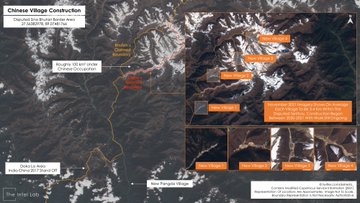
Image
 
"China has undertaken construction activities in the past several years along the border areas, including in the areas that it has illegally occupied over decades."
"India has neither accepted such illegal occupation of our territory nor has it accepted the unjustified Chinese claims."
"The government is committed to the objective of creating infrastructure along border areas for improvement of livelihood, including in Arunachal Pradesh."
India’s External Affairs Ministry spokesperson, Arindam Bagchi
"[The report said that despite ongoing diplomatic and military dialogue to reduce border tensions, China has] continued taking incremental and tactical actions to press its claims at the LAC -- [the Line of Actual Control that divides the two countries]."
"Sometime in 2020, the PRC built a large 100-home civilian village inside disputed territory between the PRC's Tibet Autonomous Region and India's Arunachal Pradesh state in the eastern sector of the LAC. These and other infrastructure development efforts along the India-China border have been a source of consternation in the Indian government and media."
Pentagon annual report: Military and Security Developments Involving the People’s Republic of China
 
"The Chinese are building villages possibly for billeting and locating their civilians or for the military in the future all along the LAC, particularly after the recent face-off that we have had."
"China is India’s main adversary and not Pakistan.A lack of 'trust' and growing 'suspicion' is coming in the way of resolving the border dispute between the two countries."
"India was stocked up for a 'long winter'."
Indian Chief of Defense Staff Bipin Rawat
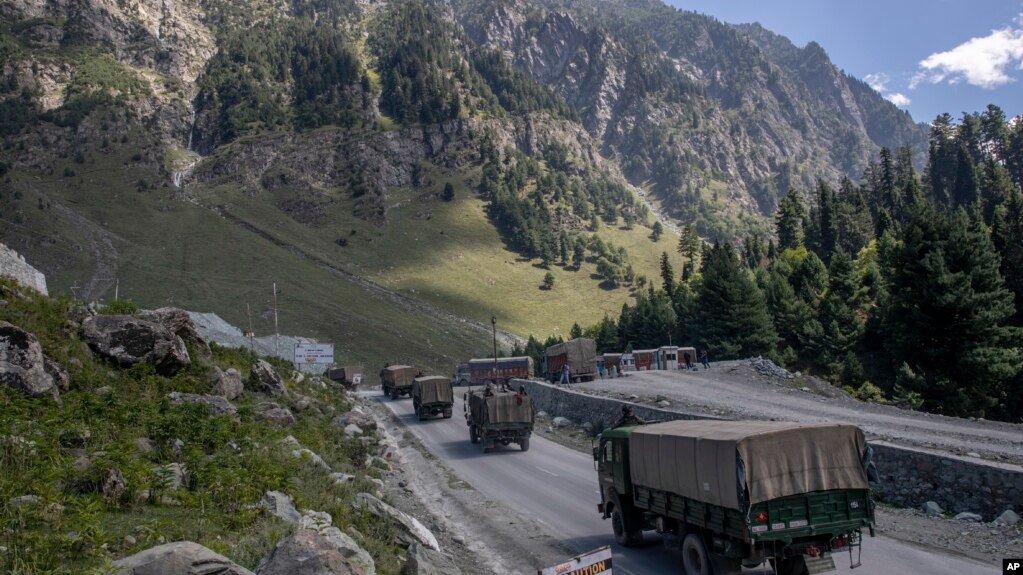
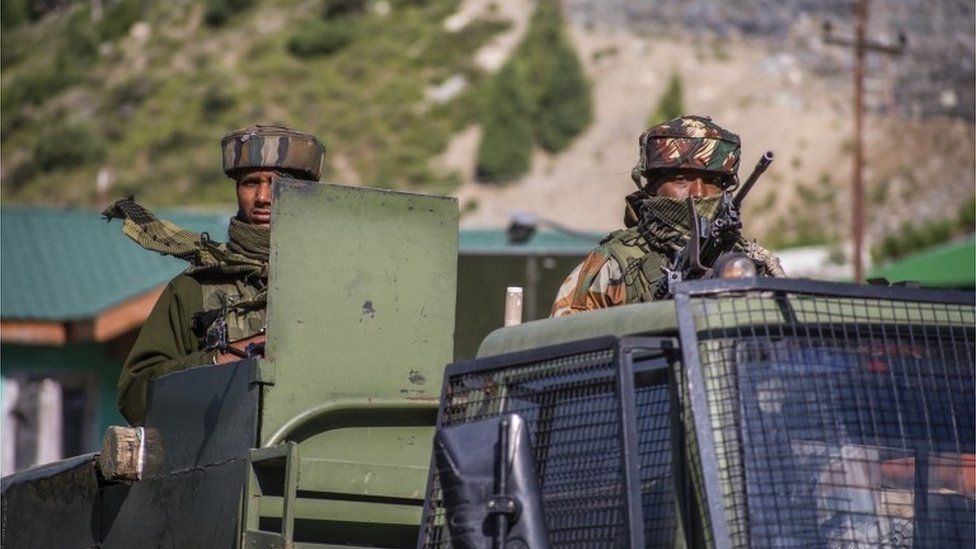
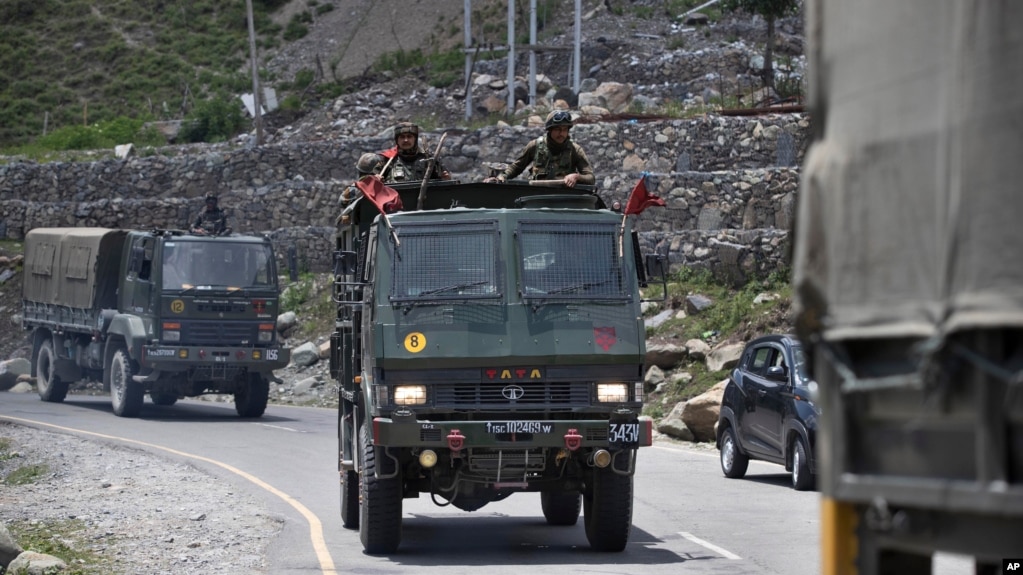
An Indian army convoy moves along the Srinagar-Ladakh highway at Gagangeer, northeast of Srinagar, Indian-administered Kashmir. Control over the Ladakh border region is a key friction point between India and China.

 It has been revealed once again that China has moved with stealth and determination to bypass such irrelevant issues as disputed territory and unresolved lines of territorial sovereignty to grasp land in he high reaches of the Himalaya that is India's and claim it to be part of China's sovereign territory. It represents another land version of the Chinese Communist Party's bold grab in the South and East China Seas, in areas in territorial dispute with Japan, the Philippines, South Korea, Taiwan, Brunei, and Malaysia.
 
Satellite imagery shows a village suddenly appearing which did not exist until 2019, one of the buildings in the village with a flag of China painted on its roof; a novel method of territorial claim. Somewhat reminiscent of Russia planting a flag undersea in the disputed high Arctic. Several villages have appeared as though out of nowhere, one with 60 homes another with 100 in the remote Indian state of Arunachal Pradesh.
 
Just as it has done in East Turkestan, home to Turkic Muslims, mostly Uyghurs, but also Kazakhs and Kyrgyz where Beijing has taken steps to thin out the Uyghur population, sending them elsewhere to work as slave labourers while sending Han Chinese to live in traditional Uyghur territory. China's invasion of Tibet and its hardline suppression of Tibetan culture claiming Tibet as its sovereign territory, also saw Han Chinese being settled in traditional Tibetan areas of habitation. 

Possession, it believes, is nine-tenths of the natural law of ownership. Depriving populations of their heritage geography with claims the territory is in China's possession is a raw adaptation of natural selection by a China that believes it will inherit the world and the global order as the world's first super super-power by persistent and relentless occupation. 

A global researcher with the Intel Lab shared satellite images showing houses built by China in Dongiang, a disputed area with Bhutan. A standoff between the Indian and Chinese armies in 2017 is generally viewed as a prelude to the ongoing border clashes taking place in Ladakh, where dozens of soldiers died and were injured in skirmishes again last year. Tensions between India and China along the Line of Actual Control have arisen, both sides increasing their military presence.
 
Satellite images from last December, left, and from October show China’s construction of a village in territory that the tiny Buddhist kingdom of Bhutan also claims.
Credit...Satellite image ©2020 Maxar Technologies
China must have the advantage and India must back down as far as Beijing is concerned. It has also come to light that a Chinese army research laboratory has been engaged in genetic research with the intention of aiding soldiers to better operate at high altitudes as Beijing seeks to pursue military technology. And as is usual with China, it pursues collaborative efforts with Western sources who have the advantage in research superiority.

Chinese military forces have in the past trained with Canadian military in far north winter survival techniques. China has established a research relationship at a Danish university where Chinese scientist and citizen Guojie Zhang wrote a research paper with a senior officer in the People's Liberation Army focusing on an experiment exposing laboratory monkeys to extreme altitudes hoping to comprehend the effect of low oxygen levels at high altitudes on brains.

The urgency to China of research such as a 2012 genetic research program into the cause of altitude sickness keys directly into its furtive and aggressive advances in the Himalaya regions disputed between itself and India as China seeks to reinforce its military following its Himalayan border skirmishes with India where oxygen levels on the Tibetan plateau at an elevation of some 1,650 feet can be 35 percent lower than what prevails at sea level.

A report published by King's College London and the Harvard Kennedy School of Government in March called for "a full audit of current projects with China" including safeguards to prevent research becoming dependent on cross-funding from tuition fees from international students. Danish universities were warned by Denmark's intelligence agency they could unwittingly become involved in foreign military research.

the logo of chinese gene firm bgi group is seen at its building in beijing china march 25 2021 photo reuters
The logo of Chinese gene firm BGI Group is seen at its building in Beijing, China March 25, 2021. PHOTO: REUTERS

Labels: , , , ,

Tuesday, June 29, 2021

Goliath vs Goliath

"The current situation on the border between China and India is generally stable, and the two sides are negotiating to resolve relevant border issues."
"In this context, the words, deeds and military deployments of relevant military and political leaders should help ease the situation and increase mutual trust between the two sides, not the other way around."
Chinese Foreign Ministry spokesman Wang Wenbin
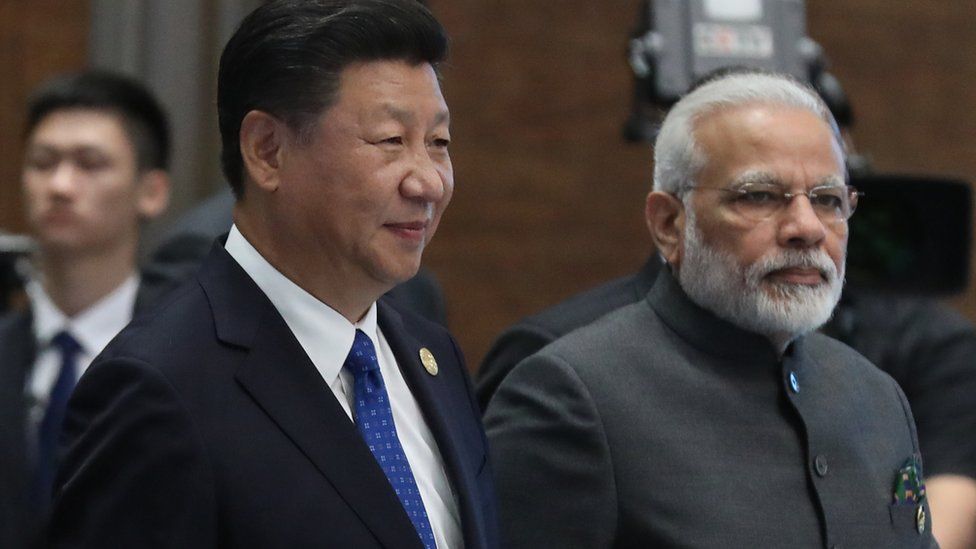
Chinese President Xi Jinping and Indian Prime Minister Narendra Modi attend the Dialogue of Emerging Market and Developing Countries on the sidelines of the 2017 BRICS Summit in Xiamen, south-eastern China's Fujian Province on September 5, 2017
Xi Jinping, left, and Narendra Modi had previously played up a personal bond   Getty Images

"Having so many soldiers on either side is risky when border management protocols have broken down."
"Both sides are likely to patrol the disputed border aggressively."
"A small local incident could spiral out of control with unintended consequences."
Lieutenant-General D.S. Hooda, former Northern Army commander, India
Indian troops near border with China
Indian troops near the border with China   Getty Images

Chinese spokesmen for the government speak reasonably and always portray the Chinese Communist Party ruling Politburo as bearing no ill intentions whatever toward any other country. Peace always uppermost in Beijing's collective mind. Conflict or creating situations that might lead to misunderstandings not their way at all. The sterling quality of 'harmony', within China itself and between the government and its international counterparts represents the goal sought by Beijing.
 
A Beijing that cannot seem to fathom that its insatiable appetite for acquiring the world's natural resources; for excelling in technological advances, achieved in part by pirating advances and formulae and technologies from other international sources which China can then self-produce with a specific Chinese flair and application in proud ownership; a China that cannot abide the thought that its neighbours have an equal right to disputed territories; or that international waters and airspace are to be shared, is one that raises the hackles of those it constantly undercuts and outmanoeuvres.
 
The two nations, restless neighbours, each with immense billion-plus populations, powerhouses of potential in science, technology and academic excellence but with opposing political systems, have long been uneasy with each other's proximity and penchant toward rivalry. Invariably, however, it is China that becomes the aggressor in its hunger for control and possession.  Last summer was a testy one for China-India relations. Border skirmishes in the Himalaya over a tentative border saw India lose control over some 300 square kilometres along the disputed mountain terrain.
 
China's intentions are oblique until they become evidently transparent. The People's Liberation Army brought in forces from Tibet to the Xinjiang Military Command, responsible for patrolling the disputed areas along the Himalayas. Fresh runway buildings, bombproof bunkers meant to house fighter jets and new airfields have appeared along the Tibetan disputed border. Long-range artillery, tanks, rocket regiments and twin-engine fighters have been added in the last few months.
 
Irrelevant to relations between the two countries. Whatever Beijing decides must be done within Chinese territory is of no business to its neighbours. All is well, the border undisturbed, there is no reason for India to leap to conclusions. Neighbours must trust one another's good intentions. The amassing of troops and arms? Negligible training exercises.
 
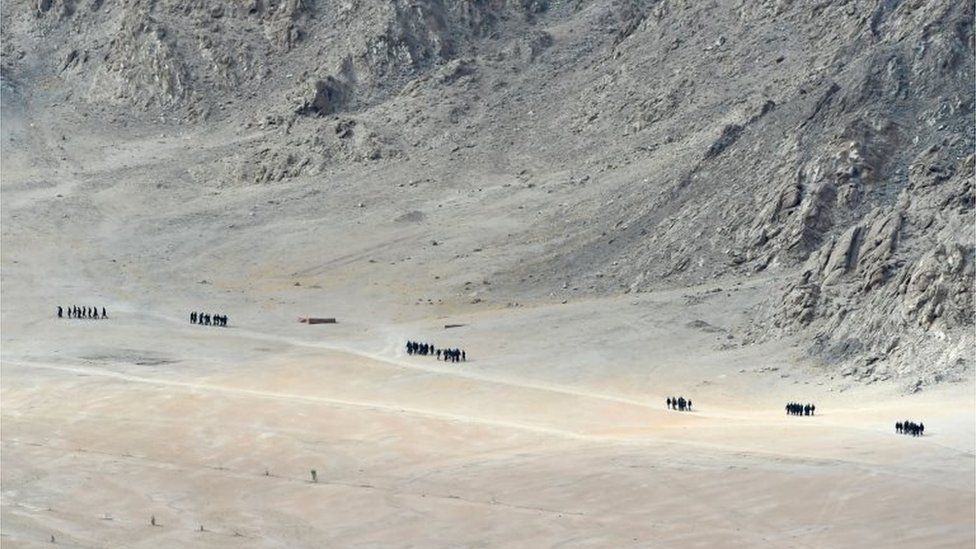
Indian soldiers walk at the foothills of a mountain range near Leh, the joint capital of the union territory of Ladakh, on June 25, 2020.
Indian soldiers on patrol near Leh, in the disputed frontier region of Ladakh   AFP

India, given its experiences with China both in the past and at present, thinks otherwise. It has brought in an additional 50,000 troops to the border; an obvious offensive military move against a neighbour more accustomed to acting out treacherous moves than relying on diplomatic niceties. India has moved its own troops and fighter jet squadrons to three areas along its border with China, to the point where there are now 200,000 Indian troops stationed on the border.
 
In the past, the military presence was directed toward blocking moves China might make; the present redeployment is set to give Indian commanders flexibility in options where they may attack and seize territory in China should it be seen to be necessary; a strategic ploy known as "offensive defence". Where helicopters are assigned to airlift soldiers from valley to valley, as well as artillery pieces like the M777 howitzer. These are not preparations taken lightly.

The recent diplomatic skirmishes representing military-diplomatic discussions with China have seen no progress reaching a return to the decades-old status quo so rudely interrupted by China's acquisitory challenges. The largest increase in troop levels have taken place at the northern region of Ladakh, where the two countries met in brief conflict on several occasions last year. Among India's transferred soldiers are some once involved in anti-terrorism operatons against Pakistan; newly deployed on the border.
 
GAGANGIR, KASHMIR, INDIA - JUNE 19: An Indian army convoy drives towards Leh, on a highway bordering China, on June 19, 2020 in Gagangir, India. As many as 20 Indian soldiers were killed in a "violent face-off" with Chinese troops on Tuesday in the Galwan Valley along the Himalayas. Chinese and Indian troops attacked each other with batons and rocks. This is the deadliest clash since the 1962 India-China war and both have not exchanged gunfire at the border since 1967. Since the recent clash, there has been no sign of a breakthrough. India said its soldiers were killed by Chinese troops when top commanders had agreed to defuse tensions on the Line of Actual Control, the disputed border between the two nuclear-armed neighbours. China rejected the allegations. It blamed Indian soldiers for provoking the conflict, which took place at the freezing height of 14,000 feet. The killing of soldiers has led to a call for boycott of Chinese goods in India. On Thursday, thousands of people attended the funerals of the 20 slain Indian soldiers. To show their anger, Indians burnt Chinese flags and posters of China's President Xi Jinping in many states. (Photo by Yawar Nazir/Getty Images)
 An Indian army convoy drives towards Leh, on a highway bordering China, on June 19, 2020 in Gagangir, India. As many as 20 Indian soldiers were killed in a "violent face-off" with Chinese troops on Tuesday in the Galwan Valley along the Himalayas. Chinese and Indian troops attacked each other with batons and rocks.  Photographer: Yawar Nazir/Getty Images AsiaPac
 
Henceforth, India will have greater troop numbers acclimatized to fight in the high-altitude Himalaya, reducing the number of troops stationed on India's western border with Pakistan. A fragile situation, to be sure. In the more populated area along the southern Tibetan plateau, soldiers with machine guns joined lightly armed paramilitary officers. Most of India's border forces were located in the far eastern state of Arunachal Pradesh, where the1962 India-China war took place, French-produced Rafale fighters armed with long-range missiles are deployed in support of the boots on the ground.
 
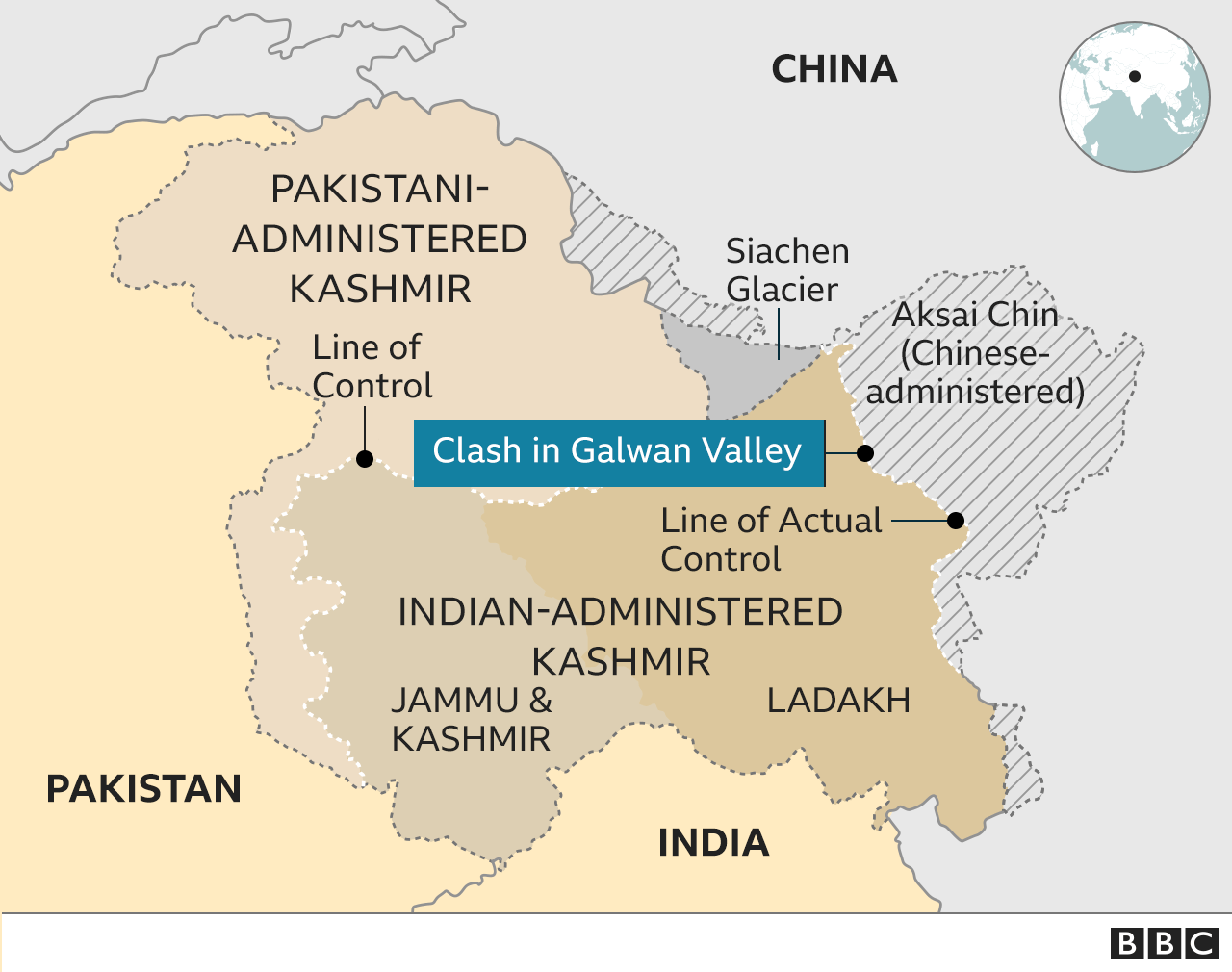
Kashmir map

Labels: , , , , ,

Sunday, May 09, 2021

COVID? It's Everywhere! Mount Everest?!

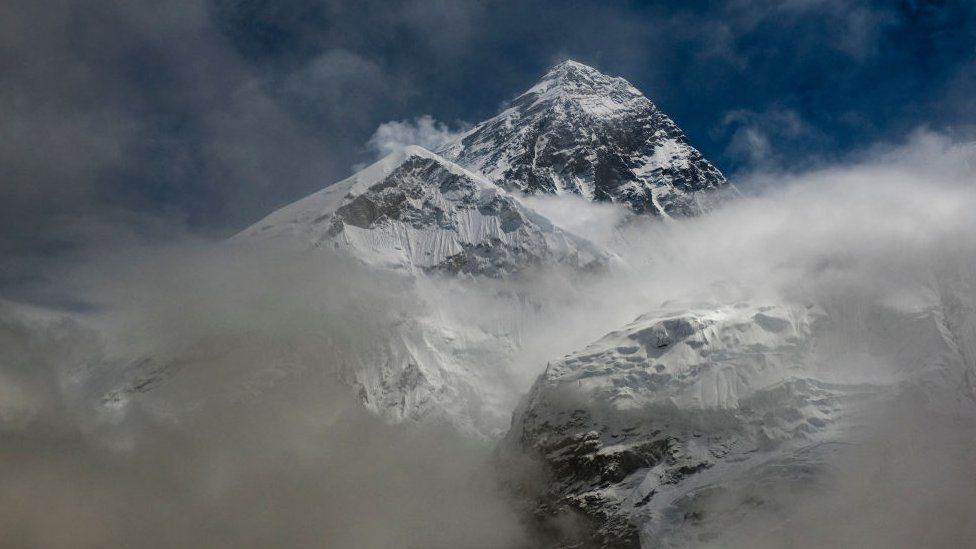
Mount Everest
Everest was closed to mountaineers last year due to the pandemic    Getty Images
"We don't have tests."
"And high altitude makes it difficult to identify COVID from cough and HAPE [high altitude pulmonary edema], which is common here."
"[There is a] dilemma [about whether to cancel the Everest climbing season]. Unventilated camps and camps close [to one another] make it easier to spread [COVID-19] here."
Dr. Prakash Karel, Everest base camp physician

"More than 30 people have already been evacuated to Kathmandu in helicopters with suspected pulmonary edema -- later found to be positive for the coronavirus."
Pawel Michalski, Polish climber

"I have taken a helicopter out of EBC [Everest base camp] back to Kathmandu after one day."
"Once I was in the hospital a COVID test confirmed I was positive and had pneumonia. I've spent four nights in the ICU."
"The COVID situation at EBC is a total s---storm. I had no clue what I was flying into."
Gina Marie Hans-Lee, evacuated climber

"The Nepal Government is still denying there is a COVID outbreak at Everest base camp, despite emerging evidence."
"Why is the government hiding the truth?"
"At camp I saw many sick people. At a gorakshep [small village, last stop on most treks to base camp] hotel, there were [a] few sick climbers isolating, as well."
"I found COVID is so common around the camp people. They took it so easily. One Sherpa told me, 'COVID is just like the flu."
Rojita Adhikari, positive-tested climber, April 19
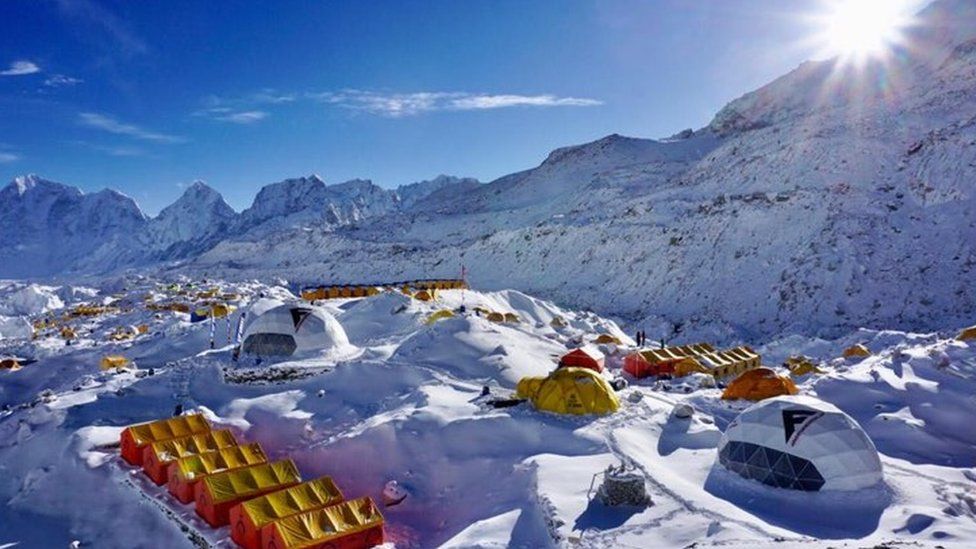
Everest base camp this climbing season
Health officials have warned of rising numbers of Covid-19 cases at base camp     Lukas Furtenbach

Nepal, contiguously bordered with India, where a massive coronavirus wave has spread, has seen itself well on the way to becoming overwhelmed with the pathogen with an average of 6,700 cases reported daily up to May 5, representing an increase from 1,100 a mere two weeks earlier. While the country faces its steepest coronavirus wave yet encountered, it has decided to keep the main tourist attraction -- the Nepali side of Mount Everest -- open for business to foreigners hoping to climb the world's tallest mountain. 
 
The 2020 climbing season during the first introductory wave of the SARS-CoV-2 virus causing COVID-19 had been cancelled. Now, during the second COVID wave, turning out to be far more invasive, intense and worrying, a record number of expedition permits totalling 408 have been issued. Climbers and expedition leaders are left to work out for themselves methods of containing the spread of the virus amidst growing concerns of an outbreak of the coronavirus at the mountain.

The issue of safety on behalf of visiting climbers and locals alike has risen in the wake of multiple people being evacuated from base camp, later tested in hospital for the virus, and found positive. A negative coronavirus test is required by the Nepal Department of Tourism 72 hours prior to entering the country but the government removed a seven-day quarantine requirement in late March, in an effort to revive the country's tourism industry. 
 
At $20-billion, tourism contributes about eight percent of the country's GDP, with Everest expeditions alone contributing over $300 million to the economy in 2019. On the mountain there is no way for climbers to access tests, other than bringing along their own. The Everest base camp clinic has no laboratory permission to test for the virus, leaving guide companies to enact their own precautions.
 
Furtenbach Adventures, as an example, operates "flash expeditions", lasting three to four weeks rather than the classic nine-week trip. Providing climbers with hypoxic tents to help them become acclimated at home with high altitudes, a process normally requiring a four-week stay at base camp. Teams ranging in size from two to 29 members take other precautions during the expeditions, but despite all precautions late April saw the first case of coronavirus confirmed at base camp.
 
After which reports of multiple people testing positive followed. The first climber at base camp to test positive began feeling ill two days before reaching base camp but thought he was suffering from mountain sickness reflecting the high altitude. Mountain sickness can produce symptoms similar to those of COVID. He remained unaware of his true condition until tested three days later at a Kathmandu hospital.This year there is an estimated 1,200 climbers at base camp, making social distancing difficult.
 
Four coronavirus cases were identified by the Nepal Mountaineering Association; one local guide and three climbers. Those numbers are challenged for accuracy by mountaineers' own experiences. Some climbers who tested positive before or after leaving base camp insist that unreported cases remain. One physician working out of the Everest base camp clinic described to the Explorersweb blog, speaking anonymously, the situation at base camp, that "many people" were evacuated with coronavirus symptoms testing positive at the Kathmandu hospital.
 
"Many climbers are isolated in their tents at the moment. In Kathmandu, hospitals are not yet at full capacity, but ICUs are filling up quickly", he said. The base camp Everest ER spoke of a meeting between doctors and expedition leaders discussing managing respiratory illnesses, including "encouraging all to maintain their bubble/discouraging visits between camps, wearing masks even within their camps, sending any members with respiratory illness to see the doctors at Everest ER for further evaluation." 
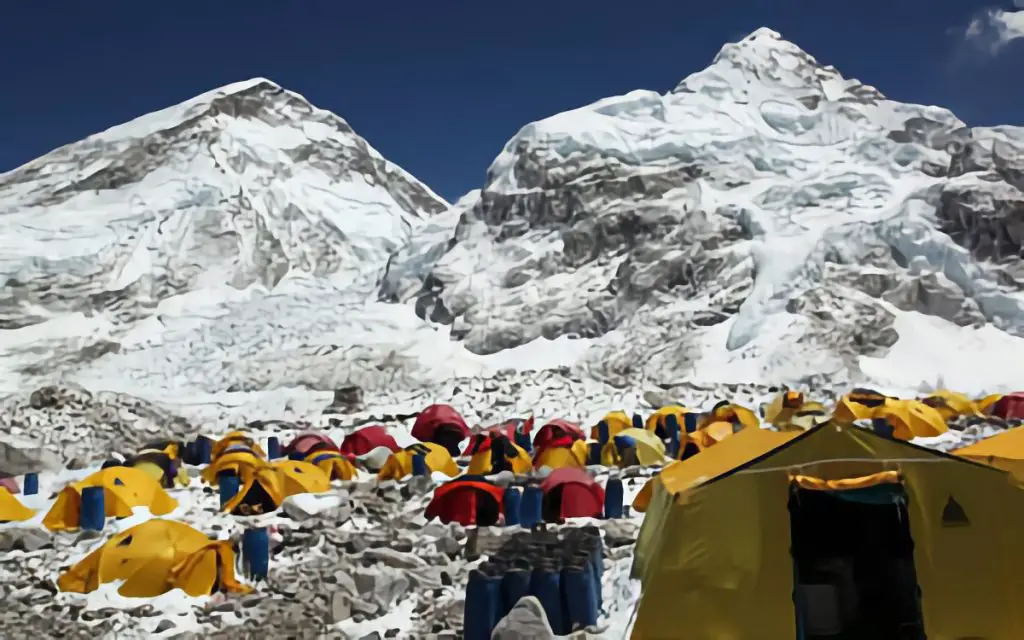
Everest Base Camp
The Adventure Blog
"Normally there's a lot of socializing, events, base camp parties, and teams are visiting other teams and making new friends."
"We all used hypoxic tents at home, we sent them to the clients, and they simulate the oxygen level of higher altitude."
"My guess is there will be more cases. Everyone is concerned about a message coming from the Department of Tourism: 'You all have to go home.'"
"We would expect that the government [would be] confirming these cases, keeping everything transparent, maybe even sending a team to base camp to do a mass test which would find superspreaders."
"I think every operator would be happy to pay for this -- it would probably save the season, because there is the risk if there's more and more cases that [there] could be an early end to this season."
"Your whole body is already working on its limits, so catching COVID would be a real threat to your health and even to your life."
"If the weather's bad and someone's developing problems, evacuation without a helicopter would take days and it's very dangerous. So it would be a big problem if someone infected developed symptoms higher up the mountain."
"If there are more and more cases coming in [at base camp], the authorities in Nepal will have to do something. I think they tried to do the right thing, they tried to save the season. But maybe it's not the right thing."
Lukas Furtenbach, an expedition leader, Mera Peak, Everest
 
"We're getting emails from people on other teams, trying to decide whether to go home, because it seems clear that things are getting quite serious."
"I'm hearing from guides, Sherpas, and one of the helicopter companies about how many COVID rescues they're doing. I've had another major operator write me saying: 'You're so glad you didn't go.'"
"Every single person's respiratory system is struggling, and is working in overdrive, and it's that much more susceptible to upper respiratory illness [climbers face an intense physical battle with each step up the mountain]."
"You can't sleep at altitude, so you have this deep fatigue from days of not sleeping. You can't eat, because your digestive system is considered non-essential -- anything you put in your stomach, you become incredibly nauseous,"
"I think we'll start to see some climbers leaving because they just feel that they're on the wrong side of the moral question, with the Kathmandu outbreak being so strong. They're sitting there with thousands of bottles of oxygen."
Adrian Ballinger, an expedition leader who pulled out of the Everest climbing season over COVID-19 concerns.
Mount Everest
Climbers rejoiced when Nepal decided to reopen its side of Mount Everest this year, but reports suggest even the world's highest peak isn't safe from the spread of coronavirus. (Prakash Mathema/AFP/Getty Images)


Labels: , , , , ,

Friday, June 19, 2020

Beijing, Eternally Busy Causing Strife

"Looking at it in Planet Labs [Earth imaging satellite pictures], it looks like China is constructing roads in the valley and possibly damming the river."
"There are a ton of vehicles on both sides [of the Line of Actual Control -- LAC] -- although there appear to be vastly more on the Chinese side."
"I count 30 to 40 Indian vehicles and well over 100 vehicles on the Chinese side."
Jeffrey Lewis, director, East Asia Nonproliferation Program, Middlebury Institute of International Studies, California

"There is the larger picture of the asymmetries of power." 
"China’s GDP is $14tn, India’s is less than $3tn. China spends nearly $220bn on the military but India spends $52bn."
Srikanth Kondapalli, professor of Chinese studies, Jawaharlal Nehru University, New Delhi
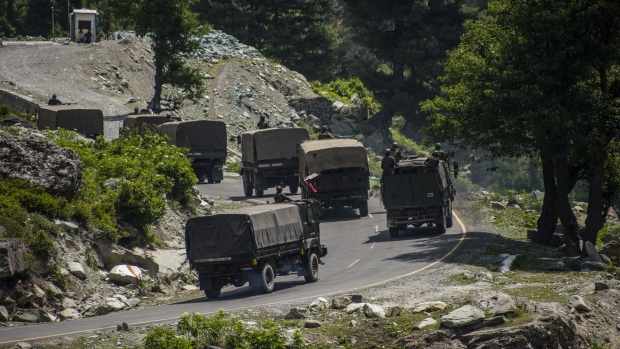
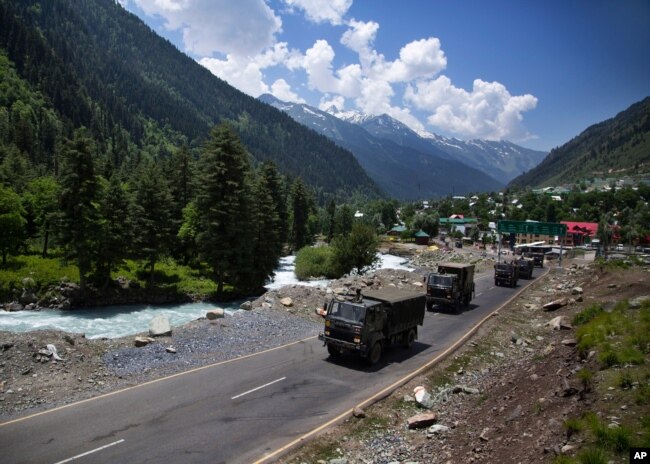
An Indian army convoy moves on the Srinagar- Ladakh highway at Gagangeer, north-east of Srinagar, India, Wednesday, June 17, 2020.

From the South China Sea, where Beijing confronts the interests of its neighbours in disputed territories to claim them as their own, to the magnificent and dangerous heights of the Himalaya, wherever the Chinese Communist Party perceives its interests in enlarging its geographic and political territories, it acts with no regard to the outcome. Two of the most populous nuclear countries in the world share a 4,056-kilometre border that runs past glaciers, deserts of snow and freezing rivers where both countries claim sovereignty beyond the border.

Initial, brief skirmishes where both China and India post army stations at 4,300 metres in the western Himalaya have recently taken place by unarmed soldiers on each side. Unarmed, due to a mutual agreement by both sides to keep the prospect of deadly violence to a minimum. Instead, the military personnel on both sides used clubs and improvised weapons and their fists. And given that they're poised on the side of steep mountains, in some instances brute force to send an adversary to his death below.

India has declared the loss of 20 of its soldiers, while China has chosen not to release any information about its losses. "They [the Indian side] deliberately launched a provocative assault, leading to an intense physical clash that caused death and injury", charged Chinese military spokesman Zhang Shuili, insisting that the Indian military was responsible for the hand-to-hand combat, where reputedly clubs covered in nails or barbed wire were used by the Chinese. Which sounds a lot like premeditation.
Credit...Paula Bronstein/Getty Images
According to military officials from India, hundreds of soldiers came to fierce clashes with fists, stones and wooden clubs at the tense frontier where the border crosses the cold high-altitude mountain ranges within which are territorial disputes. An agreement dating from1993 between the two sides was meant to constrain either side from the use of deadly weapons, leaving soldiers patrolling the area unarmed. According to the Indian side, their soldiers had encountered a Chinese patrol on the border.

On the other hand, satellite images now make it clear that in days leading up to the border clash China had brought in heavy pieces of machinery, had cut a trail into a mountainside and according to satellite imagery, may have dammed a river. Both countries rely on seasonal glacier melt and rivers for irrigation and potable water as it makes its way down the mountainsides to the valleys below. Any such alterations are certain to have an effect on both sides; one positively, the other negatively.

The Galwan Valley, where the altercation took place, is an arid, inhospitable landscape, with soldiers deployed on steep ridges, but vital since it leads to the Aksal Chin, a plateau claimed by India, and controlled by China. Signs of the landscape being altered, with the valley showing tracks being widened, earth being moved and river crossings are evidence of Chinese actions not shared with their Indian counterparts. Yet a Chinese Foreign Ministry spokesman claims to be unaware of anything specific occurring.

Zhao Lijian, speaking for the Chinese Foreign Ministry, reiterated that Chinese territory had been penetrated by the Indian Army in several places, demanding their withdrawal. Two Chinese tents and observation towers had been discovered by an Indian patrol, built on its side of the LAC, according to government sources in New Delhi. Although military officials of both sides had reached an agreement to deescalate on June 6, China had proceeded to erect a 'structure' on India's side of the LAC.

The patrol had arrived at a ridge in verification that the Chinese had moved their troops back from the LAC as claimed. In moving back Chinese troops left behind the two tents and observation posts so the Indian party demolished the towers and burned the tests. According to the satellite images no such structures had been seen the week before, on the ridge. The arrival of a large group of Chinese soldiers confronting the Indian troops led to the deadly melee.

An Indian army convoy moves on the Srinagar- Ladakh highway at Gagangeer, north-east of Srinagar, India, June 17, 2020.


Labels: , , , ,

() Follow @rheytah Tweet