Politic?

This is a blog dedicated to a personal interpretation of political news of the day. I attempt to be as knowledgeable as possible before commenting and committing my thoughts to a day's communication.

Sunday, November 05, 2023

Another Deadly Earthquake in Nepal

"I tried to run, but the whole house collapsed. I tried escaping, but half my body got buried in the debris."
"I screamed, but every one of my neighbours was in the same situation and screaming for help."
"It took nearly an half-hour to an hour before rescuers found me."
Bimal Kumar Karki, Nepal

"I was asleep at night and around ten or eleven at night it started shaking and the house caved."
"So many houses have collapsed and so many people have been buried [alive]."
Tika Ram Rana, Nepal
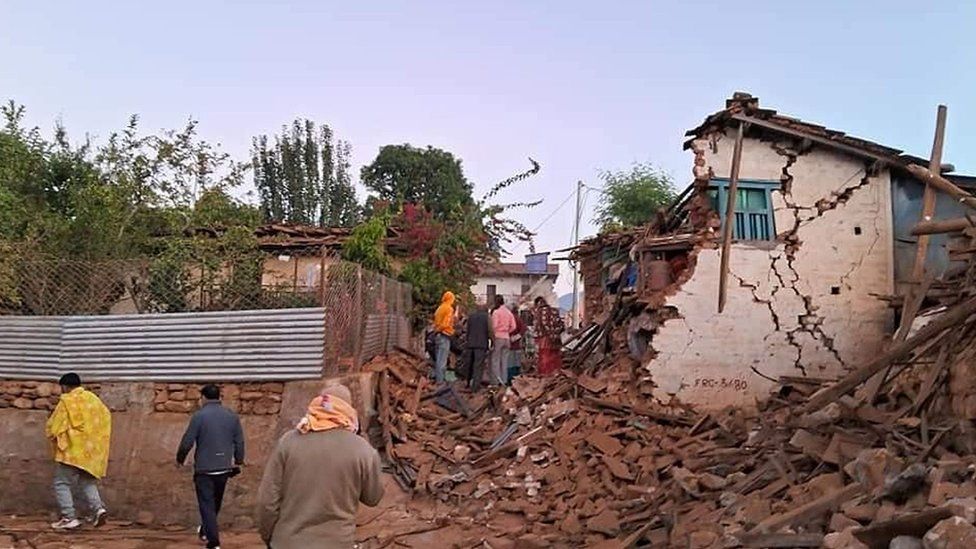
Damaged houses near Jajarkot, Nepal, 4 November 2023.
EPA-EFE/REX/Shutterstock

A strong earthquake struck Nepal's northwest region on Saturday in the middle of the night. Survivors describe sudden earth movement, and then houses collapsing, burying entire families. The early figure of the death toll rose to over 160, but it is assured that the count will rise as collapsed buildings and homes are searched for survivors and the numbers of dead are revealed. Most people were crushed by the debris that resulted when houses -- often stacked rocks and logs -- crumpled under the tremblor's force Friday night.
 
https://i.cbc.ca/1.7018814.1699090806!/fileImage/httpImage/image.JPG_gen/derivatives/original_1180/nepal-earthquake.JPG
Army personnel carry an injured person on a stretcher in Jajarkot on Saturday. (Nepal Army/Reuters)
 
Many of the mountainous villages were approachable only by foot, with approach roads blocked by landslides triggered by the earthquake. Soldiers were seen clearing the blocked roads to enable rescuers to rush aid to the sites. The Nepal government is attempting to provide the affected area with aid, flying in tents, food and medicine.

Thousands of Nepalese are now homeless. The U.S. Geological Survey announced a preliminary magnitude of 5.6 occurring at a 18 kilometre depth. The epicenter was at Jajarkot, about 400 km northeast of the capital, Kathmandu, according to Nepal's National Earthquake Monitoring & Research Center.

Jajarkot district is a mostly agricultural area and there 105 people were confirmed dead. Another 52 were killed in neighbouring Rukum district, officials announced, while another 184 people were injured. Villagers aided by security officials worked through the night to extract the dead and injured from collapsed homes.

It is expected that the death toll will rise since communications were cut off in many areas. Over 100 beds were available at the regional hospital in the city of Nepalgunj, with teams of doctors standing by to provide medical attention to the injured. Small government and military planes, along with rescue helicopters able to land in short mountain strips were used to ferry the wounded to Nepalgunj.

Even in New Delhi, India's capital, the quake was felt, over 800 km away.

https://i.cbc.ca/1.7019033.1699133731!/fileImage/httpImage/image.jpg_gen/derivatives/original_1180/1763951697.jpg
An aerial view shows damaged buildings in Jajarkot on Saturday. (Harihar Singh Rathore/AFP/Getty Images)

Labels: , , , ,

Sunday, May 09, 2021

COVID? It's Everywhere! Mount Everest?!

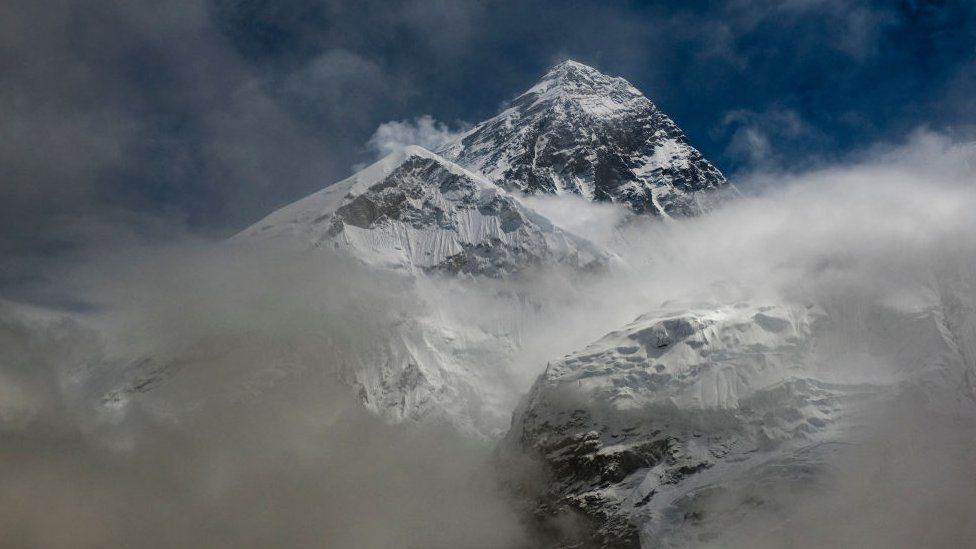
Mount Everest
Everest was closed to mountaineers last year due to the pandemic    Getty Images
"We don't have tests."
"And high altitude makes it difficult to identify COVID from cough and HAPE [high altitude pulmonary edema], which is common here."
"[There is a] dilemma [about whether to cancel the Everest climbing season]. Unventilated camps and camps close [to one another] make it easier to spread [COVID-19] here."
Dr. Prakash Karel, Everest base camp physician

"More than 30 people have already been evacuated to Kathmandu in helicopters with suspected pulmonary edema -- later found to be positive for the coronavirus."
Pawel Michalski, Polish climber

"I have taken a helicopter out of EBC [Everest base camp] back to Kathmandu after one day."
"Once I was in the hospital a COVID test confirmed I was positive and had pneumonia. I've spent four nights in the ICU."
"The COVID situation at EBC is a total s---storm. I had no clue what I was flying into."
Gina Marie Hans-Lee, evacuated climber

"The Nepal Government is still denying there is a COVID outbreak at Everest base camp, despite emerging evidence."
"Why is the government hiding the truth?"
"At camp I saw many sick people. At a gorakshep [small village, last stop on most treks to base camp] hotel, there were [a] few sick climbers isolating, as well."
"I found COVID is so common around the camp people. They took it so easily. One Sherpa told me, 'COVID is just like the flu."
Rojita Adhikari, positive-tested climber, April 19
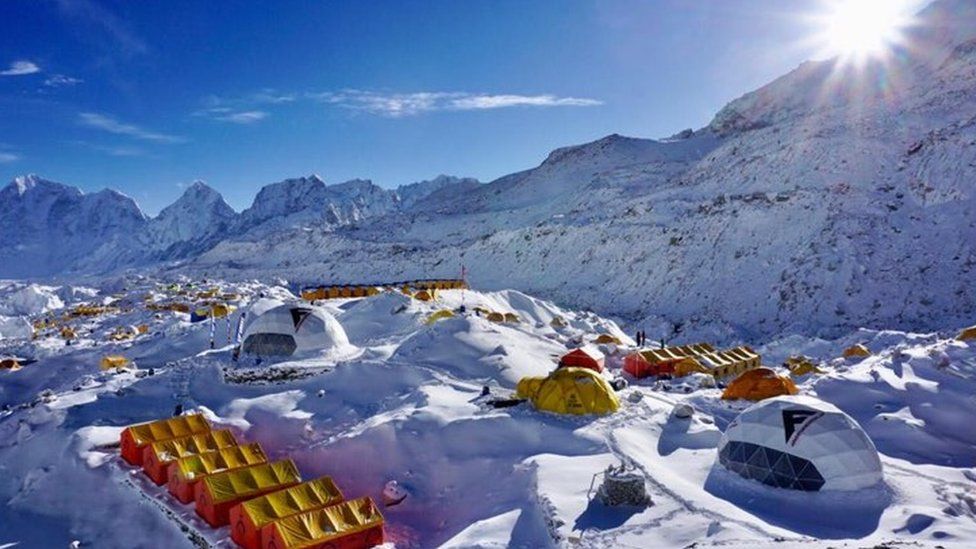
Everest base camp this climbing season
Health officials have warned of rising numbers of Covid-19 cases at base camp     Lukas Furtenbach

Nepal, contiguously bordered with India, where a massive coronavirus wave has spread, has seen itself well on the way to becoming overwhelmed with the pathogen with an average of 6,700 cases reported daily up to May 5, representing an increase from 1,100 a mere two weeks earlier. While the country faces its steepest coronavirus wave yet encountered, it has decided to keep the main tourist attraction -- the Nepali side of Mount Everest -- open for business to foreigners hoping to climb the world's tallest mountain. 
 
The 2020 climbing season during the first introductory wave of the SARS-CoV-2 virus causing COVID-19 had been cancelled. Now, during the second COVID wave, turning out to be far more invasive, intense and worrying, a record number of expedition permits totalling 408 have been issued. Climbers and expedition leaders are left to work out for themselves methods of containing the spread of the virus amidst growing concerns of an outbreak of the coronavirus at the mountain.

The issue of safety on behalf of visiting climbers and locals alike has risen in the wake of multiple people being evacuated from base camp, later tested in hospital for the virus, and found positive. A negative coronavirus test is required by the Nepal Department of Tourism 72 hours prior to entering the country but the government removed a seven-day quarantine requirement in late March, in an effort to revive the country's tourism industry. 
 
At $20-billion, tourism contributes about eight percent of the country's GDP, with Everest expeditions alone contributing over $300 million to the economy in 2019. On the mountain there is no way for climbers to access tests, other than bringing along their own. The Everest base camp clinic has no laboratory permission to test for the virus, leaving guide companies to enact their own precautions.
 
Furtenbach Adventures, as an example, operates "flash expeditions", lasting three to four weeks rather than the classic nine-week trip. Providing climbers with hypoxic tents to help them become acclimated at home with high altitudes, a process normally requiring a four-week stay at base camp. Teams ranging in size from two to 29 members take other precautions during the expeditions, but despite all precautions late April saw the first case of coronavirus confirmed at base camp.
 
After which reports of multiple people testing positive followed. The first climber at base camp to test positive began feeling ill two days before reaching base camp but thought he was suffering from mountain sickness reflecting the high altitude. Mountain sickness can produce symptoms similar to those of COVID. He remained unaware of his true condition until tested three days later at a Kathmandu hospital.This year there is an estimated 1,200 climbers at base camp, making social distancing difficult.
 
Four coronavirus cases were identified by the Nepal Mountaineering Association; one local guide and three climbers. Those numbers are challenged for accuracy by mountaineers' own experiences. Some climbers who tested positive before or after leaving base camp insist that unreported cases remain. One physician working out of the Everest base camp clinic described to the Explorersweb blog, speaking anonymously, the situation at base camp, that "many people" were evacuated with coronavirus symptoms testing positive at the Kathmandu hospital.
 
"Many climbers are isolated in their tents at the moment. In Kathmandu, hospitals are not yet at full capacity, but ICUs are filling up quickly", he said. The base camp Everest ER spoke of a meeting between doctors and expedition leaders discussing managing respiratory illnesses, including "encouraging all to maintain their bubble/discouraging visits between camps, wearing masks even within their camps, sending any members with respiratory illness to see the doctors at Everest ER for further evaluation." 
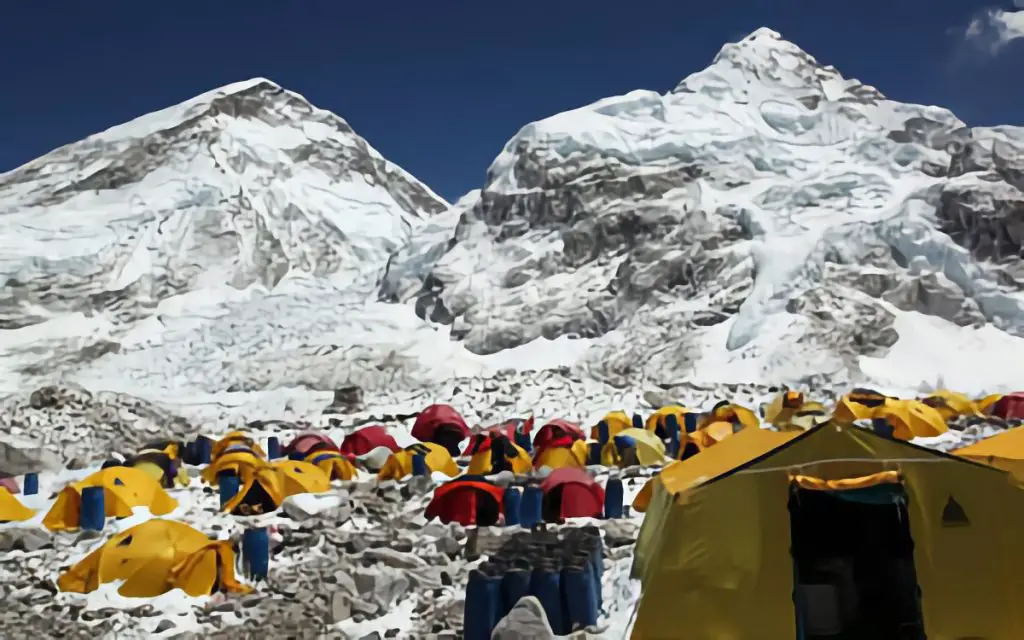
Everest Base Camp
The Adventure Blog
"Normally there's a lot of socializing, events, base camp parties, and teams are visiting other teams and making new friends."
"We all used hypoxic tents at home, we sent them to the clients, and they simulate the oxygen level of higher altitude."
"My guess is there will be more cases. Everyone is concerned about a message coming from the Department of Tourism: 'You all have to go home.'"
"We would expect that the government [would be] confirming these cases, keeping everything transparent, maybe even sending a team to base camp to do a mass test which would find superspreaders."
"I think every operator would be happy to pay for this -- it would probably save the season, because there is the risk if there's more and more cases that [there] could be an early end to this season."
"Your whole body is already working on its limits, so catching COVID would be a real threat to your health and even to your life."
"If the weather's bad and someone's developing problems, evacuation without a helicopter would take days and it's very dangerous. So it would be a big problem if someone infected developed symptoms higher up the mountain."
"If there are more and more cases coming in [at base camp], the authorities in Nepal will have to do something. I think they tried to do the right thing, they tried to save the season. But maybe it's not the right thing."
Lukas Furtenbach, an expedition leader, Mera Peak, Everest
 
"We're getting emails from people on other teams, trying to decide whether to go home, because it seems clear that things are getting quite serious."
"I'm hearing from guides, Sherpas, and one of the helicopter companies about how many COVID rescues they're doing. I've had another major operator write me saying: 'You're so glad you didn't go.'"
"Every single person's respiratory system is struggling, and is working in overdrive, and it's that much more susceptible to upper respiratory illness [climbers face an intense physical battle with each step up the mountain]."
"You can't sleep at altitude, so you have this deep fatigue from days of not sleeping. You can't eat, because your digestive system is considered non-essential -- anything you put in your stomach, you become incredibly nauseous,"
"I think we'll start to see some climbers leaving because they just feel that they're on the wrong side of the moral question, with the Kathmandu outbreak being so strong. They're sitting there with thousands of bottles of oxygen."
Adrian Ballinger, an expedition leader who pulled out of the Everest climbing season over COVID-19 concerns.
Mount Everest
Climbers rejoiced when Nepal decided to reopen its side of Mount Everest this year, but reports suggest even the world's highest peak isn't safe from the spread of coronavirus. (Prakash Mathema/AFP/Getty Images)


Labels: , , , , ,

Monday, May 04, 2015

Coping With Insecurity and Fear

"A mountain is safer than this. Up there, climbing, I sometimes feel afraid, but not like this. This kind of danger is not in my hands."
Bikash Suwal, Nepali trekking guide
Nepalese Buddhists light incense sticks at the Boudhanath Stupa during Buddha Jayanti, or Buddha Purnima, festival in Kathmandu, Nepal, Monday, May 4, 2015. Hundreds of people have visited Buddhists shrines and monasteries in Nepal’s quake-wracked Kathmandu on the birthday of Gautama Buddha to pray for the country and the people who suffered during April 25 earthquake. (AP Photo/Bernat Amangue)

Fear is the emotion that floods Kathmandu. The death toll of Saturday's 7.8-magnitude earthquake has now grown to well over seven thousand. That includes six foreigners and 45 Nepalese, found on a popular Himalayan trekking route. The intense pulses of seismic energy unleashed by the cataclysmic quake crumpled ancient temples in Kathmandu. Many buildings constructed in the wake of a modern building code imposition also collapsed.

It has become clear to many in the Nepalese public that the flaky concrete and brittle metal pillars left after building collapses reveal a level of corruption and government enforcement rotten through indifference to regulations. Building experts speak of the corruption as an open secret, pointing to the unlicensed five- and six-story buildings rising in recent years. "We pay like this", Bahadur Khadwada, owner of the Kalika Guesthouse said, rubbing his thumb with his index finger. "They go away."

Bribery, casual tax law enforcement and a lack of land-use controls speak to buildings vulnerable to seismic disasters.  The very geology of Nepal complicates matters, since the city is on the ancient bed of a lake, and urban growth has led construction spreading out toward risky geological terrain. Scientists have warned in recent months that modern buildings constructed in haste would be vulnerable.

And then there's the problem of landing and distributing international aid in the country. Nepalese authorities were forced to close the main airport to large aircraft delivering aid to millions in the wake of the earthquake. Temporary closure was required because of damage to the main runway from the large military and cargo planes flying in aid supplies, food, medicines and rescue workers.

Relief material brought in from China lie at the Tribhuvan International airport in Kathmandu, Nepal, Sunday, May 3, 2015. Runway damage forced Nepalese auth...
Relief material brought in from China lie at the Tribhuvan International airport in Kathmandu, Nepal, Sunday, May 3, 2015.   (AP Photo/Niranjan Shrestha)

Cracks have appeared on the runway along with other problems at the only airport capable of handling jetliners. "You've got one runway, and you've got limited handling facilities, and you've got the ongoing commercial flights. You put on top of that massive relief items coming in, the search and rescue teams that has clogged up this airport. And I think once they put better systems in place, I think that will get better", explained Jamie McGoldrick, UN co-ordinator for Nepal.

The full extent of the damage in the country remains unknown, with reports filtering in from remote areas, many of which remain cut off from access. A spokesman for the British charity Oxfam, said the main problem were delays, "but these have more to do with the challenge of moving large volumes of goods than customs", responding to the Nepalese government having finally eased customs and other bureaucratic hurdles on humanitarian aid, following complaints from the United Nations.

Labels: , , ,

Saturday, May 02, 2015

Nature Disposes

"From what we've seen on the ground, the need is great and widespread and not limited to the urban centre of Kathmandu."
"The most difficult task right now is reaching people in remote areas who have been cut off by the earthquake -- from communications, from roads, from all their normal routines of receiving food and other supplies."
"The needs are great and the response has been quick. We are looking at a large population of people facing profound needs in the coming days, weeks and months."
"We are in early days still. We are still assessing where the greatest needs are and where the pockets of people who need help most can be found."
It is a country that has suffered a lot and has made progress in some areas, but this is a really significant setback."
Steve Taravella, senior spokesman, World Food Programme
Victims of the earthquake queue to receive food and goods at a relief camp in Kathmandu
Many earthquake victims are having to wait for relief supplies

"It was the most difficult three metres I have walked in my life. It was like trying to walk on a fast-moving rowing boat."
"The walls around the road looked like they were ocean waves; the buildings looked like rubber ..."
"People on the street started crying and crowds gathered as everyone tried to escape falling buildings."
Sakun Gajurel, Nepal-based UN aid worker

"Currently there is no electricity. Communication lines are also down. Many people have been displaced from their homes and spent the night out in the open. There are many people injured and hospitals are unable to hand the situation."
Mariko Tanaka, country director, ChildFund Nepal
Clear-up operation in Sankhu, Nepal, on 2 May, 2015

Pierre-Ane Dube, 31, slept outside a hotel on the sidewalk. The Canadian said she had experienced the best time of her life on a trek to Everest base camp. And now she was experiencing the worst imaginable thing she could ever have been exposed to. "We can't reach the [Canadian] embassy. We want to leave. We are scared. There is no food. We haven't eaten a meal since the earthquake and we don't have any news about what's going on."

The outcome of the devastating earthquake that hit Nepal a week ago has left almost seven thousand people dead, and there is no longer any hope that any more people will be rescued from the suffocating, maiming rubble that was once buildings and homes where people went about their ordinary lives. Little wonder that many people now complain that foreign aid is slow coming in. Nepalese customs has not been lifted to allow foreign aid unimpeded entry to the country.

This is what Malaysia did after the dreadful tsunami that took so many lives, and caused international humanitarian aid agencies to rush in to offer assistance to yet another government unable to cope with such a devastating natural disaster. In that instance, Malaysia imposed customs tariffs on humanitarian aid coming into the country; an immorally absurd money-grab that cost aid agencies in imposed taxes, sidelining funding that could have been used to aid people, not enrich their incapable government.

Earthquake victims put up a notice for help on the walls of a temple after last week's earthquake in Bhaktapur, Nepal May 2, 2015.

Without bureaucratic foul-ups in a country that has been unable to provide the most basic search-and-rescue missions the huge task of treating the tens of thousands of injured, of finding shelter for over a million displaced people, of providing potable water and food for the hungry would be enough to tax even the resources of a well-regulated and -functioning first-world country. And Nepal is definitely not that.

Military personnel abandoned earlier attempts to land helicopters in some of the more devastated areas. No fewer than 70 smaller earthquakes, known as after-shocks, continued in the days following the devastating 7.8-quake that shattered so many structures and buried people alive. Stretching east and west from Kathmandu along the middle mountain range of the Himalayas, the devastation was overwhelming.

There were reports of villages where 75 percent of buildings crumbled in the quake, and all contact has been cut off, since. Funeral pyres from cremations have smudged the skies in Nepal. "The hills all came down", said Sumzah Lama, nursing her youngest daughter at the time the earthquake struck, killing her husband and three other children, in a village near the Tibetan border.

"There is nothing left to go back to, everything is destroyed. Everything was moving and smashed apart", said Karchon Tamang, from the village of Langtang, who had been evacuated by helicopter Sunday. Fear of aftershocks has meant that tens of thousands of families are resigned to spending their nights outdoors in the cold Himalayan nights. Rain events are not viewed as adding any comfort to their unspeakable plight.

Labels: , ,

Wednesday, April 29, 2015

Mounting Rescues

"She is stranded, she is trapped, and she is begging and pleading for help. She needs immediate rescue and aid."
"She has limited food, some rice, some water, but it's really cold. When she first called us she was in a panic, crying, literally bawling her eyes out."
"We need our government [Canada] to negotiate with the Nepalese to go in and rescue them."
"Everything around her is completely collapsed, and it's very, very cold. I'm not sure if they have a tent or whether they've found shelter under a roof."
Michelle Dack, Calgary

"There have been so many casualties, in my neighbourhood, all the buildings have collapsed."
"My mother is slightly injured, the fence fell on her when she was working in the garden during the earthquake. But she will be OK. There are others with much worse situations."
Rishi Bastakoti, Calgary Nepalese Community Association

"They [Canadian consular officials in Nepal] are working closely with local officials in Nepal and India to locate and ascertain the well-being of Canadians on the ground."
Diana Khaddaj, spokeswoman, Department of Foreign Affairs

"When I got home, there was nothing. Everything was broken. My wife -- she was dead."
"Only the other villages who have also lost their homes are helping me. But we get nothing from the government."
"I get angry, but what can I do? I am also working for the government. I went to ask the police if they could at least send some men to help us salvage our things, but they said they have no one to send."
Bhoj Kumar Thapa, Nepanese army soldier, Paslang, Nepal

The horrendous death toll resulting from the 7.8-magnitude earthquake that hit the impoverished nation of Nepal continues to grow; latest figures are over five thousand dead, and ten thousand injured, but the numbers are growing. And the simple fact is that humanitarian aid has not yet been able to reach isolated villages where passage is hampered by the earthquake's effect on roads that were barely passable before rocks were hurled down on them from the destabilization of the tremblor.

Queue to receive food being distributed in Sakhu, on the outskirts of Kathmandu. 29 Apr 2015
There are long queues for food and water around the capital, Kathmandu

Hundreds of thousands of Nepalese are without shelter. The weather has turned absolutely miserable; cold, and wet, people huddling for shelter under tarps. They are hungry, they are thirsty, they are in need of medical assistance. They await aid, lining up for food handouts, and preparing to sleep out in the open, huddling for comfort that eludes them in the destruction of all that was familiar. Tents to house them would look good at this juncture.

A government that is incapable of meeting the most basic needs of its people during a dreadful emergency is certainly unable to care for the handful of tourists and visitors who happen to have visited the country and become victims of a natural disaster. And nor is the government of a country far distant from the scene, with a handful of representatives in a huge geography of almost thirty million people, able to do much for those of its own citizens who of their own free will chose to visit a country in crisis.

"We need 15,000 plastic tarps alone. We cannot buy that number", stated Mohan Pokhran, a district disaster management committee member. A mere 50 volunteer army and police officers were distributing food and aid for thousands in the immediate vicinity. "We don't have nearly enough of anything", wailed Mr. Pokhran, helplessly.

Sheltering from the rain


Kumar Thapa's home in Paslang was destroyed. And so were the homes of the other villagers. He was placed on leave from his army unit, given time to mourn his losses. He spoke of a government official who arrived at the village, took some photographs and then left. Nothing was delivered to the village of about 300 people north of Kathmandu. The village is a mere three kilometres distant from the town of Gorkha, district headquarters and staging area for rescue and aid operations.


Damaged houses are seen from an Indian Army helicopter at Lapu in the Nepalese area of Gorkha.
Damaged houses are seen from an Indian Army helicopter at Lapu in the Nepalese area of Gorkha.   Photo: AFP

The villagers sleep in the open together in the mud, sharing what bits of food they are able to extract from under their ruined buildings and homes. They cannot even begin to imagine when aid might reach them. Stormy weather is hampering passage along poor roads. A shortage of funds and volunteers to bring assistance to the needy is the order of the day. Helicopters are being co-ordinated to remote villages to evacuate the injured, but a major downpour put a halt to the effort.

A mudslide and avalanche hit close to the village of Ghodatabela leaving 250 people missing according to district official Gautam Rimaj. The result of heavy snow where the ground was loosened by the quake. Hundreds of thousands of Nepalese have no clean water, no sanitation. Rain was heavy in Kathmandu, and people desperately sought shelter wherever they could find it. Over 8.1-million people have been affected by the earthquake, with 1.4-million requiring food assistance.

So when people criticize their government for not delivering immediate aid to their loved ones halfway across the world, caught up in a devastating natural disaster, recommending to their government that they liaise with the government where the disaster has struck, to mount a rescue, they might try instead spreading their wings and undertaking flight on their own initiative, to bring back a sister who travelled to Nepal to teach yoga there.


Map of Nepal showing areas affected by earthquake

Labels: , ,

Tuesday, April 28, 2015

Witness To Catastrophe

"I was standing outside my dining tent about to have lunch when the ground started to rumble. Within seconds, it felt as though I was surfing on the normally rock-solid glacier floor. I immediately knew this was an earthquake, having experienced one here in Nepal in 2011.""
"We regularly hear avalanches here at base camp, but this one was in a category of its own."
"I witnessed what appeared to b e a 200 - 300 foot tidal wave of snow heading straight toward us and the rest of base camp. I dove into the dining tent with a few of the Sherpa staff and we waited for the avalanche to pass."
"I peered outside at the 30-second mark and all that could be seen was dense white snow. All I could think about was the rest of base camp who didn't have shelter. It was incredibly loud, thunderous rockfall combined with the power and sound of extremely high winds above 200 m.p.h."
"Our expedition leader's tent was ripped to shreds, electronics were scattered ten feet in every direction."
"At first, I decided to do my job. I filmed the events that were unfolding before my eyes. Climbers and Sherpas being carried on stretchers. Injured women and men bring assisted who suffered head traumas."
"It was completely destroyed [centre of base camp]. Tents shredded. Boots, packs, poles, water bottles, electronics, scattered and shredded. Debris everywhere. It was a war zone."
"It was hard to believe this was happening and unfolding before my eyes. Blood on the snow. Dozens of Western climbers shouting orders, trying to co-ordinate rescue efforts."
Ottawa filmmaker Elia Saikaly

ROBERTO SCHMIDT/AFP/GETTY IMAGES

Helicopters were diverted from other points in a Nepal devastated by the 7.8-magnitude earthquake, and its almost equally shocking after-quake that struck on Sunday, the result of which Nepal has lost over five thousand people and counting, with many more thousands injured, and awaiting evacuation from isolated villages. In contrast, about 170 mountaineers were stranded on the slopes of Mount Everest. Eighteen people lost their lives on the mountain and many more were injured, requiring immediate evacuation.

Ottawa filmmaker Elia Saikaly was there for a distinct purpose; to shoot pictures for a director at Under Armour, planning to summit six eight-thousand-metre summits in the space of a year. When the avalanche struck, Mr. Saikaly understood this was an event like none other. The massive avalanche off Pumori, a 23,000-foot peak adjacent to Everest, situated directly above the camp, inundated base camp, itself at 17,598 feet up the mountain slope.

It took but a minute, sixty seconds, for violent mayhem to take 18 lives on the mountain. The avalanche was the mountain's response to the earthquake that has taken over five thousand lives in Nepal, as well as being felt, and taking lives elsewhere, in India, and in Tibet. Even Pakistan felt the tremblor. So, once the avalanche had settled, that camera was kept rolling. The scene he found before him, was "surreal".

Helicopters began evacuating the severely wounded, while those who were killed were wrapped in tarps, awaiting evacuation.
ROBERTO SCHMIDT/AFP/GETTY IMAGES

"My heart is also with the injured, both Western and Sherpa, and, of course, the thousands in Kathmandu who are suffering at this time", said the young Canadian adventurer/filmmaker.

Labels: , , , ,

Tuesday, October 21, 2014

Focused On Adventure

"There was no preparation. Many trekkers that came into the storm arrived without planning. Their porters had no trekking shoes or coats. It is one of the causes of their deaths. Some died because they were too cold -- it was freezing snow, five or six feet deep."
"The foreigner is the guest, the sponsor, so the foreigner comes first, it is (a) problem."
Baburam Bhandari, chief district officer, Mustang, Nepal
A Nepalese army helicopter rescues survivors of a snowstorm in Manang district.
A Nepalese army helicopter rescues survivors of a snowstorm in Manang district. Photograph: Nepal army/AFP/Getty Images
Half of the dead who perished in the blizzard and avalanche that struck a Himalayan trekking route in Nepal were Nepali porters, guides and cooks. Most of them had no warm weatherproof coats or boots to protect them from the weather. Captain Kishore Adhikari who led the Nepalese army rescue efforts, helped over 70 hikers to safety with his crews The bodies of 25 were recovered. He noted that local victims were wearing casual clothing, including flip-flops or running shoes.

One can only wonder: what were the tour operators thinking, what would have been the impression of the trekkers spending big money and handing it over to the tour operators, when they became aware, as they must surely have, since they have eyes to see with, that their guides, their cooks, their porters were grossly inadequately shod and covered. Something like visiting the slums of India and ignoring the pleas for whatever can be spared.

With the conscience-saving impression that this is simply the way people prefer to live, it's what they're familiar with, content with, and they're simply taking advantage of innocent foreigners' presence. On the other hand, Keshav Pande of the Trekking Agents Association claims that his group has offered low-cost clothing and equipment rental for porters and guides, but that many believed they had no need for them.

Likelier that they hadn't the wherewithal to pay for the low-cost rentals, and committed themselves to the staffing of the trekkers because they need to feed their families in an area that is known to be beset by poverty and privation. More to the point, why don't the tour operators who charge up to $3,000 for a three-week trek, provide the workers with protective hiking gear and themselves pay the low-cost rental?

Captain Adhikari and his rescue team recovered the 40th blizzard victim, warning that some of the dead may not be recovered until spring. Over 500 trekkers and guides were rescued since the blizzards. As for the profit realized by tour operators, "they're not spending it on the porters", said Captain Adhikari wryly. Some of whom are expected to carry equipment weighing up to 40 kilograms, and earning for their troubles as little as $16 daily.

Not only were foreign trekkers given priority treatment in the rescue effort, in part this resulted because many of them had taken travel insurance which provided helicopter evacuation for them only, not their guides and porters. The foreign visitors could leave with an easy conscience, reasoning that the guides and porters were, after all, in their home territory, however removed they might be from their actual homes.

Labels: , ,

() Follow @rheytah Tweet