India's Operation Sindoor Against Pakistani Terrorists
"Pakistan and India have enough nuclear weapons to wipe the other side out several times over.""Their nuclear weapons create a scenario for mutually assured destruction.""[The arsenals are a defensive move to prevent and deter further fighting, because] neither side can afford to initiate such a war or hope to achieve anything from it."Syed Mohammed Ali, security analyst, Islamabad, Pakistan"Pakistan has every right to give a robust response to this act of war imposed by India, and a strong response is indeed being given.""[The] heinous act of aggression will not go unpunished".Pakistan Prime Minister Muhammad Shehbaz Sharif"Missile strikes by India in Pakistan-administered Kashmir targeted at least nine sites] where terrorist attacks against India have been planned.""[The strikes - named] Operation Sindoor [were part of a] commitment [to hold] accountable [those responsible for the 22 April attack in Pahalgam, Indian-administered Kashmir, which left 25 Indians and one Nepali national dead]."
India Defence Ministry
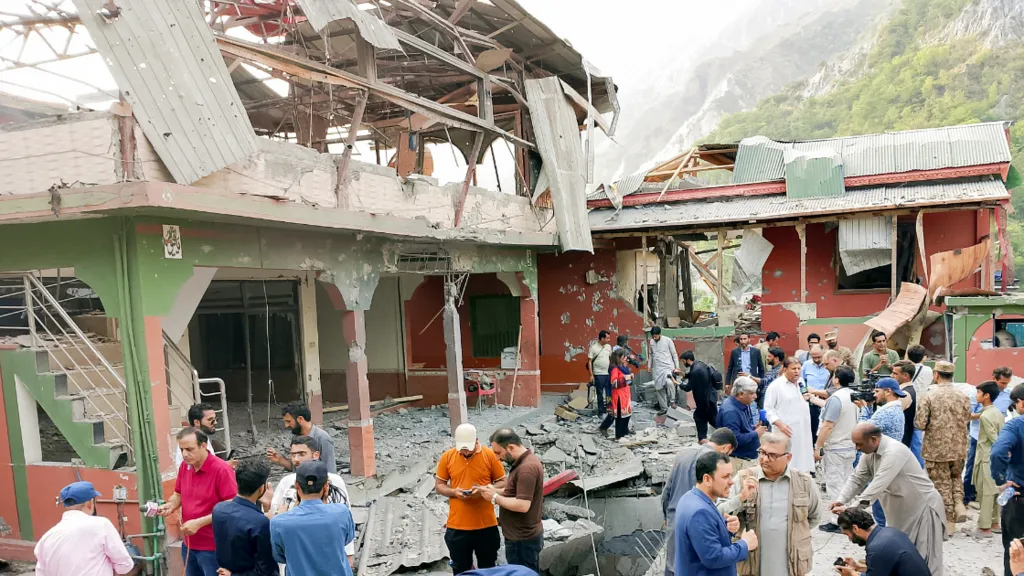 |
| People inspect a damaged mosque following India's strikes in Muzaffarabad in Pakistan-administered Kashmir AFP via Getty Images |
"Throughout 2024, violence continued in Kashmir in response to increasing efforts by New Delhi to consolidate territorial control. Attacks specifically targeted Indian travelers and workers in the region. In June 2024, militants opened fire on a bus carrying pilgrims traveling to a Hindu shrine in the town of Reasi. The attack killed nine and injured over thirty. In October, militants killed seven in Kashmir at a construction site for a tunnel project connecting Kashmir to the northern region of Ladakh.""On April 22, 2025, tensions escalated after militants attacked Indian tourists in Kashmir, killing twenty-five Indian nationals and one Nepalese national. The incident marked the deadliest terrorist attack in Indian territory since the 2008 Mumbai attacks. India blamed Pakistan for harboring the group responsible for the attack and arrested two Pakistani nationals as suspects. Pakistan denied any involvement, and its defense ministry even suggested the attack was a “false flag operation.” Although no group has been officially identified as responsible for the attack, the Kashmir Resistance—an offshoot of LeT—claimed responsibility online."Global Conflict Tracker
Both India and Pakistan have a stockpile of nuclear weapons, each 'reminding' the other of a guarantee of mutually assured destruction with neither country publicly disclosing their nuclear capabilities. Each is thought to have amassed between 170 and 180 warheads; short-, long- and medium-range. Each country has its own system of delivery to launch and propel their weapons to targets. The arsenals serve as a defense in prevention and deterrence of conflict beyond the conventional.
Each is aware that neither Pakistan nor India could survive a first nuclear strike and be able to retaliate through "second-strike capability"; a sobering perspective for any government. Both lay claim to Kashmir in its entirety. Border skirmishes equate to instability in the region and have for decades. A heavily militarized border divides each country's part of Kashmir where three wars have been fought in the past. Armed insurgents on the Pakistan side of the divide resist Indian rule, with Muslim Kashmiris in support of the goal of uniting Kashmir under Pakistani governance.
The number of border flare-ups and attacks in India's portion of Kashmir, prompted New Delhi toward an increasingly tough position on Islamabad, accusing it of supporting 'terrorism', which more than adequately describes the reality of the situation. India, as the most populous nation on the planet, spent $74.4 billion on defence in the current year; one of the world's largest arms importers.
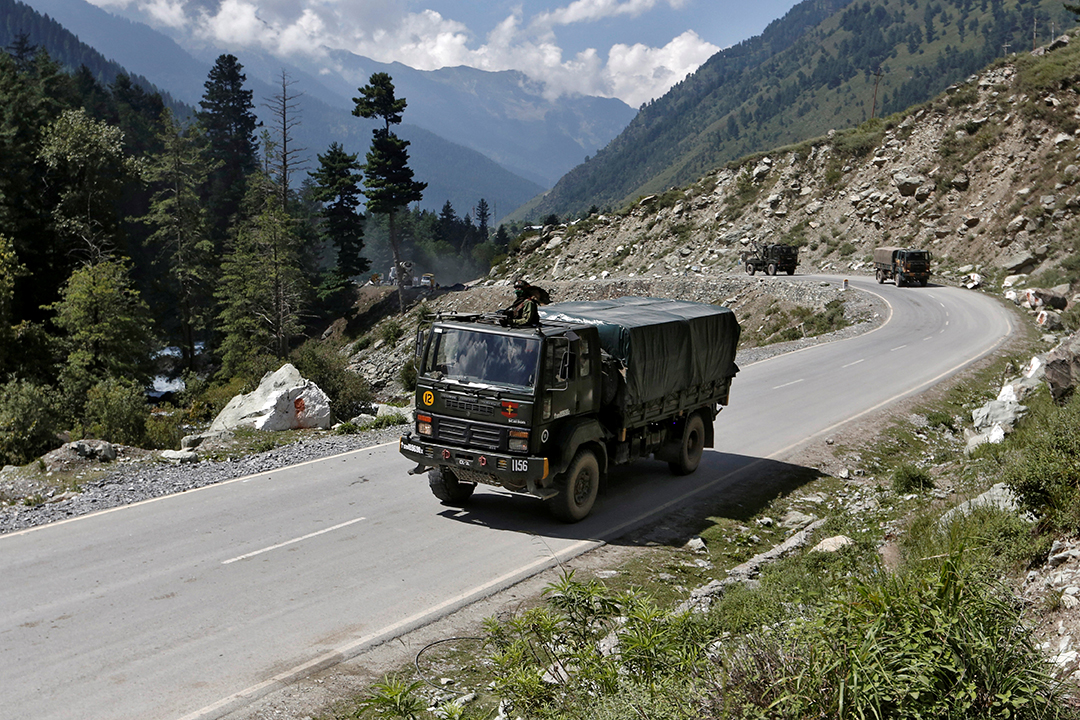 |
| Indian army Trucks on highway leading to Ladakh, Kashmir Danish Ismail, Reuters |
Although Pakistan spends a considerable sum -- $10 billion last year -- in arms, India has over double the number of active armed forces personnel than Pakistan. But there is another looming threat that India has that Pakistan doesn't share; its neighbour China, with its aggressive maritime security stance in the Indian Ocean. On occasion both Pakistan and India launch operations into airspace and territories controlled by the other, intended for the most part to damage check-points, installations or sites used by militants. Their lethal antipathy toward one another is religion-driven, not territorial.
For every step that India takes -- from closing down Pakistan's embassy in India, shutting off a traditional water supply agreement to Pakistan, closing its airspace to air traffic, to targeting sites in Pakistan known to harbour Islamist terrorist groups -- Pakistan follows suit and vows vengeance. Following missile strikes in Punjab province and Pakistan-administered Kashmir, a heavy exchange of fire between the two nations ensued. Pakistani Prime Minister Shehbaz Sharif commended his armed forces for shooting down five Indian jets, hit, he claimed after firing their missiles, while still in Indian airspace.
Three planes fell onto villages in India-controlled territory, although India made no official comments. During the April attack in Kashmir, some survivors informed Indian media that the gunmen singled out Hindu men and shot them dead at close range. Pakistan stands accused by India of being behind the attack by a new militant group, Kashmir Resistance. India has identified the group with links to Lashkar-e Taiba, a Pakistani militant group long accused by New Delhi of being supported by Pakistan.
 |
| Adnan Abidi, Reuters An Indian soldier stands guard on a highway in Kashmir |
Labels: Border Clashes, India, Kashmir, Muslim Militias, Mutual Assured Destruction, Nuclear Arsenals, Pakistan
posted by Pieface | 9:27 PM
|
0 comments