
Politic?

This is a blog dedicated to a personal interpretation of political news of the day. I attempt to be as knowledgeable as possible before commenting and committing my thoughts to a day's communication.

Monday, October 21, 2019

Chancellor Angela Merkel, Champion of Zionism

"A few days ago, I found in my mailbox an invitation that was probably sent to me by mistake. The President of the World Jewish Congress, Ronald S. Lauder, and the President of the Jewish Community of Munich and Upper Bavaria, Charlotte Knobloch, are ‘honored’ to invite me to a festive dinner on the occasion of Her Excellency the Chancellor of the Federal Republic of Germany Angela Merkel receiving the Theodor Herzl Award."
"Why is Merkel being given the Theodor Herzl Award? Because her representative at the United Nations abstains in anti-Israel resolutions — and thereby de facto supports them? The same official who equates Hamas rocket attacks on Israeli civilians with Israel’s demolition of the homes of Palestinian terrorists? For not relocating the German embassy from Tel Aviv to Jerusalem, as the United States did, and also warning other countries against taking such a step? For all this, she gets the Theodor Herzl Award?"                                   German political commentator Henryk Broder
"The Zionist Organization of America opposes the World Jewish Congress’s decision to honor German Chancellor Angela Merkel with the Herzl Award. The ZOA firmly believes that a foreign leader who continues to support the disastrously flawed 2015 Iran nuclear deal, which will enable the Iranian regime in time to become a nuclear weapons state, is a singularly inappropriate recipient of the WJC’s most prestigious award."                                                               “By any reasonable yardstick, Chancellor Merkel has done little if anything to justify the bestowal of this award and a great deal that should disqualify her as a candidate for this award."                                                                                                            "Which policy she has pursued does the WJC believe distinguishes Chancellor Merkel as a worthy recipient of this award? Her refusal to close down the operations in Germany of the vicious blood-soaked terrorist group Hezbollah? Her opposition to recognition of Jerusalem as the capital of Israel? Her stubborn support for the Iran nuclear deal that is opposed on bipartisan basis in Israel? Her unabashed claim that Iran is not anti-Semitic, despite its repeated calls for the Jewish State’s destruction."                                                                    "Whatever else may be said of Chancellor Merkel, she is an entirely inappropriate recipient of an award adorned with the name of the founding father of Political Zionism."                                                                                                 Morton Klein, President, Zionist Organization of America
(Photo by Thomas Lohnes/Getty Images)
"It seems paradoxical that Germany — as a country that is said to have learned from its horrendous past and which has a strong commitment to fighting antisemitism — is one of the strongest economic partners of a regime [The Islamic Republic of Iran] that blatantly denies the Holocaust and commits human rights abuses on a daily basis. Germany has included Israel’s security as a part of its raison d’être. As a matter of course this should exclude doing business with a fanatic dictatorship that is calling for Israel’s destruction, pursuing nuclear weapons and financing terror organizations around the world."
Dr. Josef Schuster, President, Central Council of Jews, Germany
Just about unanimous, the response of major Jewish organizations to the decision of the World Jewish Congress to honour German Chancellor Angela Merkel with the presentation of its prestigious Theodor Herzl Award for Zionism. Frau Merkel is beloved by her German subjects, and perhaps many Jews are among them, but it is her policies and that of her political ruling party that has made life for German Jews untenable in Germany. She and her party have expressed their deep shame and regret at Germany's Nazi past and its hugely successful efforts to annihilate European Jewry.

While expressing themselves as champions of Israel and good friends of the Jewish State, Germany also appears to subscribe to the much-mooted theory that good friends are permitted to be critical of the values and/or policies of their closest friends because they feel it is in the very best interests of friends to genuinely express opinions reflecting their perspectives for the greater goal of guiding them toward preferred options. Germany prefers two states side by side, an Israeli next to a Palestinian state.
Do not award A. Merkel  the Theodor Herzl Award

The Palestinian Authority, on the merits of its decision making in the past, turning down one goodwill offer after another to negotiate with Israel, and appears to favour a one-state policy; the obliteration of Israel, with the Jews being absorbed into a Palestinian state. This, from the PA which has already repeatedly stated unequivocally that no Jews would be permitted to live within a Palestinian State; so the take-home solution is a Juden-rein, one-state dedicated to the Palestinians alone, thank you very much.

Somewhat reminiscent of Nazi Germany which had resolved to initiate and carry through to fruition a Juden-rein Germany, to be followed by a Juden-rein Europe, and once the Thousand-year Reich was achieved, presumably, a Juden-rein world community. What Nazi Germany failed to fully accomplish, it seems that the German Democratic Republic has put into motion in Germany once again. The six million European-Jewish lives that were lost in the Holocaust have now been replaced by the presence in Germany of six million Muslims who have brought with them their own brand of viral anti-Semitism.

Germany had, over the past post-war years, absorbed a Turkish expatriate population that had come to the country as temporary foreign workers and eventually achieved citizenship, to be joined eventually by others from the Middle East. When Chancellor Merkel decided Germany would generously open its borders to a million irregular arrivals, migrants and refugees, they  joined the already-present five million Muslim German citizens. Jews who had lived in Germany for hundreds of years began to once again suffer a rising tide of anti-Semitism and violence.

Germany financially and philosophically supports various groups that promote Boycott, Sanctions and Divestment programs. Germany approved a UN resolution in May of 2016 -- at the annual assembly of the World Health Organization -- co-sponsored by the Arab League and the Palestinian delegation, singling Israel out as the world’s nonsensical sole violator of "mental, physical and environmental health". Unsurprisingly, and ironically, the German political party Alternative for Germany (AfD), labelled a "far-right" group that wants to halt Muslim immigration to Germany, has attracted the attention of German Jews

A 69-year-old German Jew, Emanuel Bernhard Krauskopf, joined the AfD in 2013, founding an offshoot, Juden in der AfD (Jews in the AfD, or JAfD). This was in reaction to Germany’s mainstream parties' inattention to anti-Semitism. "Every Jew who has been murdered in Europe since 2000 has been killed by Islamofascists", stated Mr. Krauskopf, who lost 50 family members in Nazi concentration camps. Many Jews in both eastern and western Germany were embracing the AfD , believing that continued mass migration poses a threat to the future of Jews in Germany. His detractors accuse him of being a "Jewish Nazi".
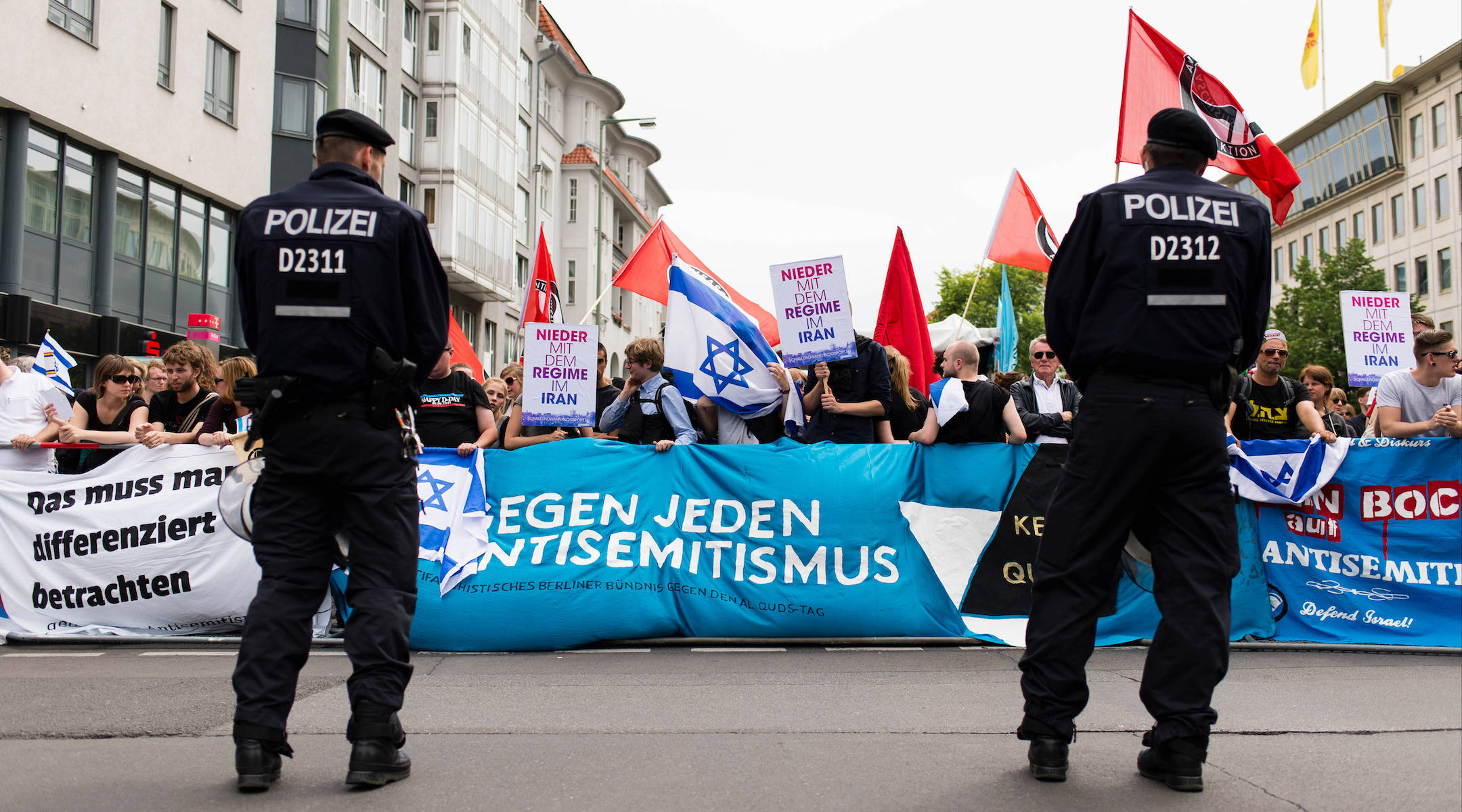
Demonstrators carry a banner that reads “Against any kind of anti-Semitism” during a rally against the annual al-Quds Day march in Berlin, July 11, 2015. Anti-Israel rallies are held annually on the day. (Gregor Fischer/picture alliance via Getty Images)
"Look, when the media tells you that the AfD is a Nazi party, and when the media looks for some Nazis [in AfD], which we have – like ALL the parties in Germany – this is nothing special about the AfD. The Left consists of Jew-haters, not all of them. Yes, we have some [‘Jew-haters’]. We try to get rid of them. It's not so easy because we have free speech."
"To import Jew haters into Germany while knowing it is an anti-Jewish act that's not just you know, some memorial. This is reducing our security in Germany by the chancellor of Germany herself."
"They [Berlin] are playing it down [the threat from Muslim immigration]. They're lying. No other word. They are lying about it. So, there are lots of excuses and the situation gets worse every day. Because the government has lost control. Jew-haters have been imported."
"[The German government knows] these are Jew-haters, so now you have no excuse like the normal excuse was after World War Two: ‘Yeah, but we didn’t know that this would happen, we didn‘t know...’ You know it now."
Bernhard Kraukopf

Labels: , , , , , ,

Tuesday, April 05, 2016

The Nobility of the United Nations

The United Nations represents the world. And the world comes together at the United Nations. The UN boasts a wide membership; no fewer than 192 member-states. And like all organizations, even one like the United Nations whose formation was stirred by noble aspirations to strive to accomplish world peace, and to intervene when human rights are threatened anywhere in the world, the idea of an oversight organization to make the prospect of a better world a reality, made for an opportunity to hive off various elements of United Nations concerns into various bodies.

Nations would be elected or appointed to various of those bodies to review the activities of other nations, to bring to their attention shortcomings requiring attention, and to encourage those nations to strive for improved outcomes for their populations. The plight of women, for example, in many countries of the world is nothing short of malevolently disastrous. Where women in those countries, some of them backwardly tribal, some in the throes of religious-inspired domination, others whose cultural attitudes demean women and seek to control them, have few rights and protections.

In those countries girls and women are raped and trafficked  to sex markets, enslaved and persecuted. In other countries, including those which inflict rape and human trafficking is common, women and girl are the victims of routine and debilitating circumcision, and girls as young as twelve are 'married' off to men much older than they are, and often it is concubinage that they are slated for, or becoming a sex-cipher in multiple-wife cultures where polygamy is legal and practised.

Women's right of inheritance is inferior to that of men in these countries, there are fewer legal, educational and employment rights, or none at all. Yet nothing seems to disentitle these human-rights-abusing countries from elevation as representatives to the UN Commission on the Status of Women. When the most recent annual meeting concluded at the United Nations in New York, one country out of the 192 represented at the UN was condemned. That single country was Israel, the only democracy in the Middle East.

In Israel women have equal rights under the law. The prevailing culture itself is one that adheres to and values equal status for both genders ... and extends that equal status to the gay community. Israel stood accused by the Commission on the Status of Women of violating the rights of Palestinian women. Despite that they, like all others in the state have full citizenship rights that come complete with legal equality rights. In Israel it is illegal to discriminate on the basis of gender. The only state in the Middle East where this is the reality.
"On the ground, Palestinian women are murdered and subjugated for the sake of male honour. Saudi women cannot drive. Iranian women are stoned to death for 'adultery'. Egyptian women have their genitals mutilated. Sudanese women give birth in prison with their legs shacked if they are Christian."
Anne Bayefsky, journalist
A panel on Zionism that was initially removed by UN officials from an exhibit on Israel prepared by the Israeli Mission to the UN and StandWithUs set to be displayed April 4, 2016. (Israeli Mission to the UN)
That very same day, at the UN Human Rights Council in Geneva, five resolutions were passed in condemnation of Israel. Syria, North Korea and Iran merited one resolution each. Neither Russia, Saudi Arabia, Sudan or China, all of which are well known to commit human rights abuses, were the target of any resolution.  

At the New York UN headquarters, Israel's permanent mission to the United Nations was ordered to remove three panels from an exhibition on Zionism. They were deemed "inappropriate". Of course, this is a venue where Zionism was once condemned as racist, a disgracefully slanderous charge that was levelled and led by the Organization of Islamic Cooperation.

The offending panels described Israel as being "the centre and focus of Jewish life and religion for more than three millennia". On the panels Israeli Arabs were identified as the largest minority group in the country. And Zionism was described as the "liberation movement of the Jewish people". Clearly, and without equivocation a red flag of impudent entitlement. Not a prideful declaration of Israel's purpose, but a prod of defiance by a nation targeted for censure, evermore.

After the UN banned a display about Zionism from an Israeli exhibition at its headquarters, another display protesting the decision was set up in New York, April 4, 2016. (Courtesy of StandWithUs)

Labels: , , , , ,

Wednesday, March 18, 2015

Americans Battle the Arab-Israeli Conflict

Middle East Quarterly
About  |   Archive  |   Submit Manuscript  |   Board of Editors  |   Contact Editor

SPRING 2015 • VOLUME 22: NUMBER 2


Texas senator Ted Cruz meets with Israeli prime minister Binyamin Netanyahu in Israel, January 11, 2013. A week after taking office, Cruz traveled to Israel on a congressional delegation trip, led by Senate minority leader Mitch McConnell.
When, in the midst of the 2014 Hamas-Israel war, the U.S. Federal Aviation Administration briefly banned American carriers from flying to Israel, Sen. Ted Cruz (Republican of Texas) accused Barack Obama of using a federal regulatory agency "to launch an economic boycott on Israel, in order to try to force our ally to comply with his foreign policy demands."[1]

In so doing, Cruz made an accusation no Israeli leader would dare express.

This is hardly unique: Over the years, other American political figures, both Republican (Dan Burton, Jesse Helms, Condoleezza Rice, Arlen Specter) and Democrat (Charles Schumer), have adopted tougher, and sometimes more Zionist, stances than the Israeli government. This pattern in turn points to a larger phenomenon: The Arab-Israeli conflict tends to generate more intense partisanship among Americans than among Middle Easterners. The latter may die from the conflict but the former experience it with greater passion.

More Anti-Israel than the Arabs


Eulogizing Helen Thomas in 2013, al-Monitor referred to her as a "firm advocate of Palestinian rights." At an Iraqi embassy dinner for the country's foreign minister Tariq Aziz, she accused the regime of cowardice for not retaliating against Israel after the destruction of the Osirak nuclear reactor in 1981. She commented, "Just yellow, I guess."
Americans who hate Israel can be more volubly anti-Zionist than Arabs. At a memorable Washington dinner party in November 1984, hosted by the Iraqi embassy for the visiting foreign minister Tariq Aziz, two tipsy American press grandees admonished and even insulted this emissary of Saddam Hussein for being insufficiently anti-Israel. Helen Thomas of United Press International complained that Iraq had not retaliated against Israel after the destruction of the Osirak nuclear reactor in 1981.[2] When Aziz tried brushing off her criticism, she scornfully accused the Iraqi regime of cowardice: "Just yellow, I guess." Later the same evening, Rowland Evans of the syndicated Evans and Novak column, interrupted Aziz when he called the Iran-Iraq war the most important issue in the Middle East, shouting at him to tell Secretary of State Shultz that the Arab-Israeli conflict was his main concern.[3]

The late Barry Rubin, who was present, subsequently commented: "Unaccustomed to being attacked for excessive softness on Israel, Aziz looked astonished."[4]

Similarly, in 1981, James E. Akins, a former U.S. ambassador to Saudi Arabia described as "more pro-Arab than the Arab officials,"[5] chided Sheik Zaki Yamani, the Saudi oil minister, for rejecting the idea of linking Saudi oil production to U.S. policy toward Israel. In 1993, Edward Said of Columbia University castigated Palestine Liberation Organization leader Yasir Arafat for entering into the Oslo negotiating process. Meanwhile, Anthony B. Tirado Chase, an analyst of Said's writings, found that "Said's rejectionism speaks for few in the West Bank or Gaza."[6] In 2003, George Galloway, the British parliamentarian, incited Palestinians against Israel:
The Arabs are a great people. Islam is a great religion. But it has to, and they have to, stand up. … I asked somebody once, when [Ariel] Sharon was massacring the Palestinians in Jenin, why the huge demonstrations in the Arab countries didn't continue? Why did they go away? They answered because a student was killed in Alexandria. I am very sorry for the student and his family, but the Palestinians are losing their children every day, yet it doesn't stop them from coming out the next day. So it can be done. Hizbullah drove the enemy running from their country. Fares Uday, a 14-year-old boy, stood in front of an Israeli tank and attacked it with his hands. And when they killed him, his brother and his neighbors came in his place.[7]
In 2009, after a lecture tour of American universities, the Palestinian journalist Khaled Abu Toameh observed that
there is more sympathy for Hamas there than there is in Ramallah. … Listening to some students and professors on these campuses, for a moment, I thought I was sitting opposite a Hamas spokesman or a would-be-suicide bomber. … What struck me more than anything else was the fact that many of the people I met on the campuses supported Hamas and believed that it had the right to "resist the occupation" even if that meant blowing up children and women on a bus in downtown Jerusalem.[8]

During the 2014 Hamas-Israel war, the Arab street remained largely calm.
Even more ironically, Abu Toameh found that many of the Arabs and Muslims on American campuses "were much more understanding and even welcomed my 'even-handed analysis' of the Israeli-Arab conflict." Along the same lines, the historian Bernard Lewis notes that "Israelis traveling in the West often find it easier to establish a rapport with Arabs than with Arabophiles."[9]

Conversely, Lewis notes the viciousness of some Westerners residing in the Middle East:
Time and time again, European and American Jews traveling in Arab countries have observed that, despite the torrent of broadcast and published anti-Semitism, the only face-to-face experience of anti-Semitic hostility that they suffered during their travels was from compatriots, many of whom feel free, in what they imagine to be the more congenial atmosphere of the Arab world, to make anti-Semitic … remarks that they would not make at home.[10]
One symptom of this: The recent Hamas-Israel war prompted anti-Israel hate demonstrations, some violent, on the streets of many Western cities, while—with the exception of territories under Israeli control—the Arab street remained largely calm.

More Zionist than the Israelis


In 2000, the late Edward Said, a vocal anti-Israel critic, complained that Zionist groups in the United States have views "in some way more extreme than even those of the Israeli Likud."
Similarly, American supporters of Israel tend to stake out more ardently Zionist positions than do Israelis. In 1978, Richard Nixon complained that "the problem with the Israelis in Israel was not nearly as difficult as the Jewish community here."[11] In 1990, Israeli journalist Yossi Melman was surprised to find a Jewish audience in Texas taking a harder line against the Palestinians than he did himself; he responded with alarm when one young man asserted, referring to a fracas with the Israeli police that left nineteen Palestinians dead, "I do not feel sorry for those Palestinians who were killed. The Israeli police should have shot a thousand of them," and no one in the audience took issue with him.

In 2000, Said complained that Zionist groups in the United States have views "in some way more extreme than even those of the Israeli Likud."[12] Also in 2000, when Israel's prime minister offered unprecedented concessions on Jerusalem, Malcolm Hoenlein, vice chairman of the Conference of Presidents of Major American Jewish Organizations, criticized his efforts "to take away or compromise Jewish sovereignty over the Temple Mount and turn it over to the jurisdiction of the United Nations or the Palestinian Authority." Later, he warned, "all of us will have to answer to our children and grandchildren when they ask us why we did not do more to stop the giving away of Har haBayit [the Temple Mount]."[13]

Polling by the American Jewish Committee regularly finds American Jews more skeptical than their Israeli counterparts on the question of the efficacy of diplomacy with the Arabs.[14] At the same time, for an American to be pro-Israel means liking all Israelis; starting with the American Israel Public Affairs Committee and Christians United for Israel, pro-Israel organizations offer unconditional support to Israel. Many American Jews go further: With neither their own lives nor those of their children at risk in the Israel Defense Forces, they do not publicly disagree with Israeli government decisions. By contrast, ranking Israelis repeatedly demand that Washington pressure their own government into taking steps against its wishes. Most famously, in 2007, David Landau, editor of Haaretz newspaper, told then-U.S. secretary of state Condoleezza Rice that Israel was a "failed state" and implored her to intervene on the grounds that Israel needs "to be raped."[15]

Explanations

Three reasons account for American partisans adopting stronger positions than their Middle Eastern counterparts:
Pure passion: Abu Toameh notes: "Many of the Palestinian Authority and Hamas officials … sound much more pragmatic than most of the anti-Israel, 'pro-Palestinian' folks on the campuses." That is because they have real-life decisions to make with which they must live. Israelis and Arabs maintain a patchwork of relationships and daily life that softens the harshness of rhetoric. In contrast, pure passion tends to reign in the West. Most Israelis have contact with Arabs, something few American Zionists do. Similarly, a fair number of Egyptians, Jordanians, Lebanese, and other Arabs come into contact with Israelis. For Middle Easterners, the enemy is human; for Americans, the opponent consists of two-dimensional political adversaries.

This even applies to so monstrous a dictatorship as Saddam Hussein's. As Barry Rubin commented about the experience of Tariq Aziz at dinner: "Perhaps it was easier to deal with the inner circles of Saddam's regime, where fear bred discipline, than with these wild, unpredictable Americans."[16] Two examples: Pro-Israel and anti-Israel Americans never need to cooperate on joint water supplies. Ismail Haniya, a prominent leader of the Hamas terrorist organization dedicated to Israel's elimination, has three sisters who emigrated from Gaza to Israel, live as citizens there, and have children who served in the Israel Defense Forces.[17]


Three sisters of Hamas leader Ismail Haniya live in Tel Sheva, the first Bedouin town established in Israel in 1967. Some of their children have even served in the Israel Defense Forces. For Middle Easterners, the enemy is human; for Americans, the opponent consists of two-dimensional political adversaries.
Solidarity: Israelis argue mostly with other Israelis and Arabs with Arabs; but in the United States, pro-Israelis argue with anti-Israelis. Israelis and Arabs in the Middle East feel free to disagree with their own side more than do their U.S. partisans. When a left-wing Israeli criticizes the Netanyahu government's policy, he disagrees with the Likud Party; when a left-wing American Jewish figure does the same, he attacks Israel. The former debates are within the framework of Israeli policymaking, the latter in the arena of American public opinion. Melman noted that "we Israelis have the luxury of expressing ourselves more frankly than many American Jews" and explained this by noting how "American Jews fear that their public criticism [of Israel] might be exploited by professional critics of Israel. Hence, most American Jews prefer to conceal their disagreements about Israel." Mattityahu Peled, a left-wing Israeli gadfly, similarly observed that the pressure on Jews who hold dissenting views in the United States "is far greater than the pressure on us in Israel. … probably we in Israel enjoy a larger degree of tolerance than you here in the Jewish community."[18]
In the United States, the Arab-Israeli conflict is better known than any Middle East issue and dominates the discussion.
Best-known policy issue: In the Middle East itself, other issues—civil wars in Syria and Iraq, the Saudi vs. Qatar vs. Iran rivalries, water problems—compete with the Arab-Israeli conflict for attention. But in the United States, the Arab-Israeli conflict is far better known than any other issue and thus dominates the discussion. As a result, the lines of debate are far more clearly etched: When the Islamic State in Iraq and Syria (ISIS) conquered Mosul in June 2014, no one knew what to do. But when Hamas launched rockets against Israel a month later, the facts and arguments were reassuringly familiar.

Conclusion

Arab-Israeli partisanship fits a broader pattern in which distance turns greys into blacks and whites, increasing political passions. In the case of the Contra war in Nicaragua, the journalist Stephen Schwartz writes that, on the one side, "Sandinistas often commented to me that they were put off to realize that their Democrat supporters in Washington employed a bloodthirsty rhetoric that would never have been heard in the towns of Central America." When asked about this, a Sandinista explained: "We have to face death, and it makes us less willing to speak idly about it; but they enjoy talking about a death they will never risk or inflict on others."[19]

The same reluctance applied on the other side, Schwartz found. A Contra supporter explained: "Our families are split by this conflict, and we do not feel the aggravated sense of rage displayed by foreigners about the war here. In fighting, we may have to kill, or be killed by, a relative with whom we grew up. It is not something that fills us with enthusiasm."

In other wars where combatants live in close proximity to each other but their supporters do not, a similar pattern has emerged: Civil wars in Vietnam, Ireland, and Bosnia come immediately to mind. Commenting on the Spanish civil war, Trotsky observed that the rhetoric in London was far more extreme than the reality in Barcelona.

In conclusion, this pattern runs contrary to the general assumption that the frenzied combatants in a war need cool-headed outsiders to help guide them to resolution and peace—an assumption that sometimes leads to the unfortunate decision to put ignoramuses in charge of diplomacy and policy. In fact, the locals may see the problem more lucidly and realistically than their foreign friends. It is time for foreigners to stop assuming they know how to achieve the region's salvation and instead to listen more to those directly involved.
Daniel Pipes is president of the Middle East Forum. DanielPipes.org

[1] Ted Cruz, "Did President Obama Just Launch an Economic Boycott of Israel?" Sen. Ted Cruz website, July 23, 2014.
[2] Brent Baker, "Tariq Aziz Too Soft on Israel for Helen Thomas," Media Research Center, Apr. 29, 2001.
[3] Barry Rubin, "America's Friend Saddam, 1988-90," Cauldron of Turmoil, p. 3.
[4] Ibid.
[5] Steven Emerson, The American House of Saud (New York: Franklin Watts, 1985), p. 250.
[6] Anthony B. Tirado Chase, "Edward Said's Anti-Oslo Writings," Middle East Quarterly, Mar. 1997.
[7] Douglas Davis, "In the Service of Saddam," The Jerusalem Post, Apr. 27, 2003.
[8] Khaled Abu Toameh, "On Campus: The Pro-Palestinians' Real Agenda," Hudson Institute, New York, Mar. 24, 2009.
[9] Bernard Lewis, Semites and Anti-Semites: An Inquiry into Conflict and Prejudice (New York: W.W. Norton & Co, 1986), p. 257.
[10] Ibid.
[11] Richard Milhaus Nixon, The Memoirs of Richard Nixon (New York: Grosset and Dunlap, 1978), p. 787.
[12] Edward Said, "American Zionism: The Real Problem (1)," al-Ahram Weekly (Cairo), Sept. 21-27, 2000.
[13] YudelLine, Sept. 29, 2000; Jewish Law Blog, accessed Feb. 17, 2015.
[14] Yale M. Zussman, "How Much Do American Jews Support the Peace Process?" Middle East Quarterly, Dec. 1998, pp. 3-12.
[15] Ezra HaLevi, "Haaretz Editor Asked US Secretary of State to 'Rape' Israel," Israel National News, Dec. 27, 2007.
[16] Rubin, "America's Friend Saddam, 1988-90," Cauldron of Turmoil, p. 3.
[17] The Telegraph (London), June 2, 2006.
[18] Mattityahu Peled, quoted in Paul Findley, They Dare to Speak Out: People and Institutions Confront Israel's Lobby (Chicago: Chicago Review Press; 3rd ed., 2003), p. 285; Middle East Policy, June 1992, pp. 136–57.
[19] Letter to the author, Mar. 24, 2009.

Labels: , , , , ,

() Follow @rheytah Tweet