This is a blog dedicated to a personal interpretation of political news of the day. I attempt to be as knowledgeable as possible before commenting and committing my thoughts to a day's communication.
"There are enough red flags that we're beholden to prepare."
"If the virus spills over into new species, it always gains an opportunity to mutate and adapt even further."
"So this is really an unprecedented level of viral activity for H5N1."
Dr.Samira Mubareka, infectious disease specialist, clinician scientist, Sunnybrook Research Institute/University of Toronto
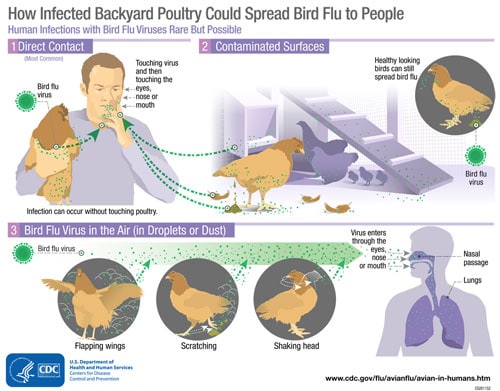
"The spillover of these viruses from wild birds to mammals could cause a
potentially devastating pandemic if the H5N1 viruses mutate into forms
that can spread efficiently among the mammalian species."
Research study, Canadian Food Inspection Agency, published in Emerging Microbes & Infections journal
There
have been fewer than a dozen Asian influenza cases confirmed among
humans identified globally since 2020. Even among those no instances
have been identified of H5N1 passing from human to human. Public health
agencies are involved in closely watching how the highly pathogenic
avian influenza H5N1 is evolving, a heightened level of alertness, the
impetus of which can be traced to the still-and-ever-presence of the
previous SARS-CoV-2 pathogen that upended the world community in a
massive infection and fatality rate.
First
identified in 1996, H5N1 had manifested itself in 2020 with a new type
that was detected in late 2021 in North America. Since that date, the
virus has decimated huge flocks of both wild and domesticated birds, the
result of which has been millions of poultry deaths in Canada alone,
from infection and from preventive culls. Dr. Mubareka advised that what
has partially captured the attention of scientists is the range of
species being infected by the virus.
The
first Canadian case was identified in a pet dog earlier this month,
among the hundreds of confirmed cases in wild skunks, foxes, mink and
other mammals dating to the beginning of 2021. Farmers in Ontario and
Quebec have been bracing for a potential wave of cases with the return
of migratory birds (bringing the infectious virus with them).
Public health agencies throughout Europe, Canada and the United States
feel for the time being that risk to humans of contagion is low. There
is no risk associated with consumption of cooked birds.
Scientists
with the Canadian Food Inspection Agency working at a laboratory in
Winnipeg where cases of H5N1 are confirmed and genetically sequenced,
studied cases in 40 different wild mammals, the researchers finding the
virus had undergone some "critical mutations".
The critical mutations referred to by the researchers involved that
part of the virus that allowed it to replicate; similar findings were
reported globally.The scientists found in 17 percent of the cases
changes advantaging the virus to replicate in humans.
On
the other hand, the researchers also found that the virus had not
developed a preference to lock on to receptors in a human nose, mouth
and throat -- the target of an influenza virus, key to human infection.
Multiple surveillance networks set to monitor and track the influenza
virus have been installed by the Public Health Agency of Canada, which
claims to take the situation "very seriously". Its recent experience with COVID-19 aided it in building H5N1-specific plans across government departments.
The
27 member states of the European Union agreed to implement a bird flu
vaccine strategy, with Mexico, Egypt and China on a list of countries
inoculating chickens against H5N1. Targeted vaccination could help to
prevent poultry losses and reduce the spread of the virus, advised
Shayan Sharif, professor and acting dean at the Ontario Veterinary
College, concerned at the possibility that the virus may mutate to
become more dangerous to humans and eventually transmit human-to-human.
"They've just painted themselves into a corner that's going to be hard to get out of."
"Whatever you do, at some point you will get a pretty scary surge of infections."
"What China has done is frittered away the benefits of the vaccination program."
Dr. Paul Hunter, professor of medicine, University of East Anglia, U.K.
"[China faces a] great challenge. If they open up, if they don't stick to the zero-COVID strategy anymore, there will be a huge wave of infection among their population, and it's a big-population country."
"Their health-care facilities or capacity will have to be transformed before encountering that kind of challenge [a need for more medical resources to handle the fallout of a failed policy]."
"I do think they have to have second thoughts about getting away from the zero-COVID strategy."
Yi-Chun Lo, deputy head, Centers for Disease Control, Taiwan
"He [Xi] owns the [zero-COVID] policy. It's very difficult for anyone to come to him now and say, 'Sir, we have to change our approach, because this is having a huge impact on the economy'."
Guy Saint-Jacques, former Canadian ambassador to Beijing, 2012 to 2016
"China might prove to be the major contributor to global COVID-19 deaths in 2022, perhaps exceeding one million."
"The virus is apolitical and will spread where immunity walls are low."
"In China, ideology now is driving everything."
Dr. Prabhat Jha, executive director, Centre for Global Health Research, St.Michael's Hospital, Toronto
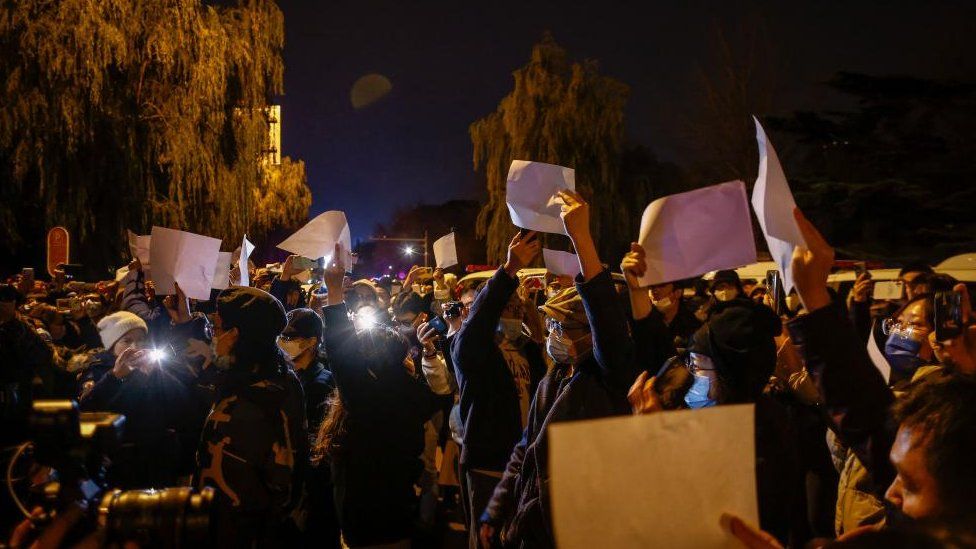
A protester reacts as he is arrested by police during a protest against
China's COVID-19 pandemic measures, on a street in Shanghai on Nov. 27. (The Associated Press)
Government authorities in Beijing -- above all China's President Xi Jinping -- have miscalculated. The country teeters on the precipice of pandemic disaster and that is because the manner in which its leaders directed their no-holds-barred campaign to eradicate the SARS-CoV-2 virus is about to backfire. The country's population now engaging in mass protests have shown their political masters in the Chinese Communist Party that people can be pushed only so far. That's the social dimension of the zero-COVID policy.
Then there is the inadequate number of vaccinations all carried out with made-in-China-inferior-efficacy vaccines, and the decision that ensuring all senior citizens be adequately vaccinated as a priority was never made. True, the country where the virus originated and where its leaders' reaction was faulted for good reason, has had a low infection rate and death count in comparison to most other countries of the world. Quite an achievement.
But its cost is gathering steam and preparing to explode. The lack of widespread infections has led to a lack of natural immunity. And the result of all those issues; low infection rate/no herd immunity; low vaccinations of the elderly, use of an insufficiently effective vaccine. represents a failure to calculate the scientific/medical fallout of that decision-making.
Chinese police officers block access to a site in Shanghai where
protesters opposed to China's strict 'zero-COVID' policies had gathered
on Nov. 27. (The Associated Press)
It is now assumed that should the country's zero-COVID policy be abruptly called off, a tsunami of coronavirus cases, hospitalizations and death would follow. There are now two options left to the government; continue the zero-COVID policy whose end is unforeseeable, and risk enraging the public even further and face a crumbling economy, or drop the policy and suffer the consequences of a pathogen run amok with few natural immunity constraints to block its advance.
President Xi is proud of the fact that China has suffered so few deaths to this point, particularly in comparison to the massive death count in the United States during the worst waves of the onrushing pandemic, now quelled to a steady-state. Researchers at the University of Toronto, UBC, Johns Hopkins, Oxford and others analyzed previous studies to reach the conclusion that vaccination is effective at serious illness prevention and death.
They also concluded that the after-effects to the general population of infections is even more helpful in disease prevention through acquired antibodies while a combination of both; hybrid immunization, represents the most lasting shield against severe COVID-inspired illness. Prior to the gross population wide vaccination, lockdown and mask controls were important.
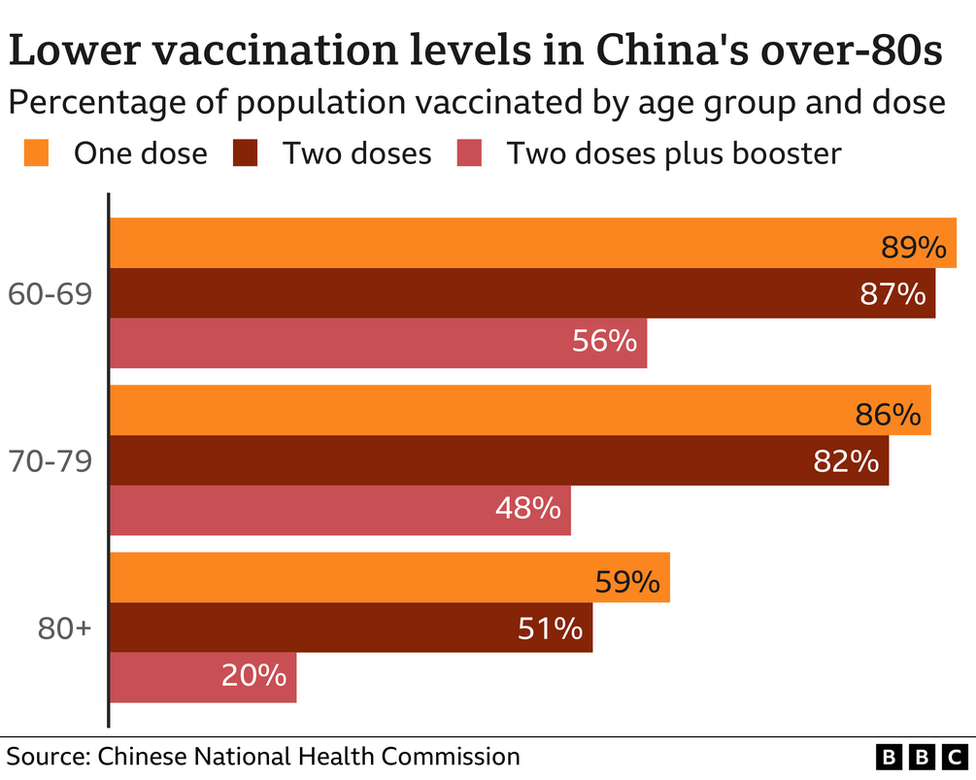
At this point, loosening restrictions, bearing in mind the more transmissible Omicron variants now circulating while broad infections took place, the benefits of hybrid immunity also resulted. Contracting COVID -19 in consideration of widespread vaccinations became less risky to human health. So while China has vaccinated 89 percent of its population, zero-COVID policies remained where large areas saw isolation of people at home or in government facilities -- reflecting a few cases.
It was working-age adults that Beijing targeted for immunization, leaving older Chinese residents most likely to fill up hospital ICUs or die from COVID largely unvaccinated. Half of the over-80 population in China has been immunized. And then there is the matter of the vaccines, with those most powerful proving their cutting-edge efficacy with the use of mRNA shots as well as adenovirus vaccines. China decided it would not import any of the mRNA vaccines and use only home-produced counterparts with far less proven efficacy.
For all practical purposes a flood of seriously ill COVID patients has the potential to completely overwhelm hospitals in China where there are roughly four intensive-care beds per 100,000 people, compared to 13 in Canada and 34 in Germany. And while Beijing has finally signalled it is is prepared to loosen some restrictions, the potential for a grave fall-out from their past severe and ill-thought-out mandates creates an aura of uncertainty about the possible outcome.
A protester shouts slogans against China's strict 'zero COVID' measures in Beijing on Nov. 28. (Kevin Frayer/Getty Images)
The Obdurate Autocratic Failings of the Chinese Communist Party on Zero-COVID
"The party and the people are trying to seek a new equilibrium."
"There will be some intsability in the process."
"Without the clear signal of party leader divisions -- I would expect this kind of protest might not last very log."
"[It is] unimaginable [that Xi would back down, and the party is experienced in handling protests]."
Hung Ho-fung, Johns Hopkins University
"[The West's vaccines offer] a major solution [to China's COVID problems."
"[According to health experts zero-COVID is unlikely to be achieved until vaccine uptake among China's elderly sees an improvement]."
"[Efforts are underway to increase coverage but] it's unlikely things will get better for the next half of the new year."
Xi Chen, associate professor, Yale University
A protester is arrested by police in Shanghai on Sunday night. HECTOR RETAMAL/AFP/AFP via Getty Image
Local authorities in China, making no allusion to credit the mass protests springing up all over China against the crude lockup methods being employed to stem the rising tide of COVID-19 outbreaks, have begun to ease imposed restrictions reflecting the state's zero-COVID mandate. In Beijing, the city government announced it plans to phase out gating to block access to apartment compounds where infections are diagnosed.
Manufacturing and trade centre Guangzhou, the current hot-spot in the latest wave of infections, announced that selected residents no longer will be required to undergo mass testing. The stringent measures originally in place to minimize deaths at the same time that other countries suffered magnitudes of infections and deaths no longer has the silent consent of the Chinese population.
According to the Chinese Communist Party ruling China, anti-coronavirus measures must continue "targeted and precise", while at the same time the least possible disruption should be caused to people's lives; local officials threatened with their jobs or similar punishments should outbreaks occur, codify their own strategies to match the central government's zero-COVID command-and-control demands.
Their response has been the imposition of quarantines and allied restrictions exceeding what the central government recommends. Hardships imposed on the population appear to be of no concern to the Xi administration, beyond the anodyne recommendations that lockdowns not cause community unrest. Millions of people in Shanghai were placed under strict lockdown in the spring, resulting in food scarcity and access to medical care being restricted.
Despite the ensuing turmoil, Xi loyalist, the city's party secretary, saw appointment to the No.2 position of the Communist Party. On the past weekend, protests were so sweeping in numbers and inclusivity many from among the educated urban middle class of the ethnic Han majority were in full vocal attendance. This is the group the ruling party relies upon to recognize a post-Tiananmen agreement that a better quality of life would accompany autocratic rule.
Following a fire on Thursday that killed at least ten people living in an apartment building in the city of Urumqi, where residents have been locked into their homes for four months, furious protests erupted particularly when the city council suggested those that died were insufficiently motivated to save themselves, prompting an avalanche of angry online questions whether firefighters or people attempting to escape the fire were blocked by locked doors or similar pandemic restrictions.
Foreign governments have suggested to Beijing that it use vaccines developed in the West to improve protection for its people, and once more effective vaccines are widely used the government could reconsider and ratchet back the draconian restrictions of the current zero-COVIDpolicy. Beijing has consistently refused to import the mRNA-based more highly successful vaccines developed by Pfizer-BioNTech and Moderna, insisting its own home-grown vaccines are effective.
They are not, however. Moreover, the most vulnerable in the population, the elderly, have not received vaccinations in numbers that should satisfy any responsible government. Analysis indicates that millions of unprotected people could perish under current circumstances should zero-COVID be abandoned. The acceptance of Western vaccinations could turn that scenario around.
"Europe and Germany have had very good experience with administering mRNA vaccinations", stated Steffen Hebestreit, adding that Olaf Scholz had "made this clear" to Chinese officials during a visit by the German chancellor to China. China is steadfast in its reliance on its own vaccines based on older technology, failing to offer the same protection as the West's vaccines against severe disease and death.
"'Zero COVID' [was] supposed to demonstrate the superiority of the 'Chinese model', but ended up demonstrating the risk that when authoritarian regimes make mistakes, those mistakes can be colossal."
"But I think the regime has backed itself into a corner and has no way to yield. It has lots of force, and if necessary, it will use it."
Andrew Nathan, Chinese politics specialist, Columbia University
Protesters are fed up with lockdowns, but their government is not budging
"...A bit of subtlety and nuance needs to be applied to people who are providing care on the front lines.' "People working in emergency departments and ICUs are a different beast than your average Canadian."
"It is not only a health and wellness issue, but a human resources issue."
"I have sent people under the age of 40 into the ICU. This wave is much more pronounced than the first two. The sheer volume of younger, healthier people coming in is quite something."
"[The faster vaccines can get into more arms], the sooner our community will be safe. [We would like to see front-line health workers get fully vaccinated]."
"Many of our team are exhausted, and the staffing gaps we have as a region are significant. Hopefully we can show them how much they are valued, appreciated and will be protected."
"We would welcome it if there was an opportunity for health-care workers to get their second doses sooner if there is sufficient vaccine supply."
Queensway Carleton Hospital statement
"[It is common for emergency physicians to not yet be fully vaccinated and there is a] growing unease [among them about the situation with the thirdCOVID wave continuing to place unprecedented pressure on hospitals in Ontario]."
"We are not asking to be preferentially vaccinated for personal protection. We are asking for full vaccination to maintain the integrity of the emergency health system, which is fragile."
Dr. Alan Drummond, Emergency doctor, co-chair, public affairs, Canadian Association of Emergency Physicians
The federal government, acting on advice from health specialists appointed as a consulting body for the government which had determined that given Canada's exceedingly tight supply of vaccines, it made sense to inoculate as many Canadians in descending order of age and profession as possible, with a first dose of vaccine. Extending the time for the second dose well beyond what the pharmaceutical companies have tested for in their research and efficacy-testing trials for best practise. With the aim to vaccinate as many Canadians as possible with at least one protective dose, available vaccines would go further the experts hypothesized, and the second dose could be safely delayed.
This is the route the government chose, and the provinces, which administer health care, set about vaccinating high-risk people in descending order from the frail elderly, the health-compromised, health-care community, racialized, front-line workers in service industries and hard-struck communities to the point later on where anyone over age 18 could make appointments for vaccination. First dose given, the wait for the second would be four months on; sixteen weeks. Which does render a high degree of protection from the SARS-CoV-2 virus for most people.
However, those in the medical community who come in direct contact on a daily basis with large numbers of COVID-19 patients, in particular those suffering from the effects of strains of concern like the UK, South African or Brazilian variants should, sensibly, be given the ultimate protection of two doses, not in the time scheduled for everyone else but as originally intended by the vaccine manufacturers in line with their research results for potency and safety.
Emergency room physician Dr. Laura Shoots is seen in this photograph. (Natalie Johnson/CTV News Toronto)
The United Kingdom found itself in a situation of raging contagion and insufficient vaccines, and it pioneered the method of leaving a wider gap between the first and follow-up doses, of 12 weeks, to enable it to inoculate greater numbers of people against COVID. Canada has followed suit, but extended the wait period by an additional month. Canada is now contemplating the issue of mixing vaccines; the original vaccine dose not necessarily followed by the same vaccine administered for the second dose.
Again, the manufacturers cannot guarantee safety and efficacy with this kind of massive departure from their products' protocol. Mix-and-match is not endorsed by the makers of the vaccines. But it has been broached in light of the very real fact of vaccine shortages and the anxiety involved in ensuring that a good proportion of a country's population is vaccinated in the interests of achieving the vaunted 'herd effect' and an eventual return to social normalcy, so countries can get back to work, children back to school.
In Canada, roughly 38 percent of the population has now had one dose of vaccine, similar to the European Union where about 34 percent have received their first dose. Where Canada stands in the more refined issue of full vaccination leaves a mere 3 percent of Canadians having received both doses, as compared to nine percent in the EU. For the U.K. its 12-week gap between doses was initiated in the interests of reducing the death and communicability rate. based on:
How well a single dose of a vaccine prevents serious and hospitalized COVID-19 cases;
The overall efficacy of a single dose of the vaccine;
Whether the protective effects of a single dose persist over the extended [up to 12-week] period.
Points one and two are fairly well assured; all major vaccines have a high degree of efficacy following the first dose; preventing death and hospitalization. It is point three where uncertainty steps into the picture, with no reasonably reliable evidence that a 12-week gap works; untested and unknown. Pfizer is known to have cautioned that it cannot vouch for the longevity of protection the first dose confers, all the more so with Canada's lengthy dosing interval of up to 16 weeks.
Little wonder that the medical community, reliant on the data they are aware of, through their professional understanding, and acutely aware of the vulnerability of their personal safety through constant exposure to people suffering serious effects from COVID, and likely carrying high viral loads more readily communicable, have good reason to be concerned. For themselves, for their families, and for their patients.
The government of Canada rates a high failure mark for a number of issues critical to the COVID situation and the need to address a pandemic that has so far demolished all hope that it will be readily settled and life as normal is on the near horizon. Its first massive error was relying on China as a vaccine partner. Which led to late contracts with pharmaceutical companies to provide their vaccines for Canada. Leading to a desperation to try something experimental in the hopes that more people could be vaccinated, sooner, to reach the goal of COVID control and normalization.
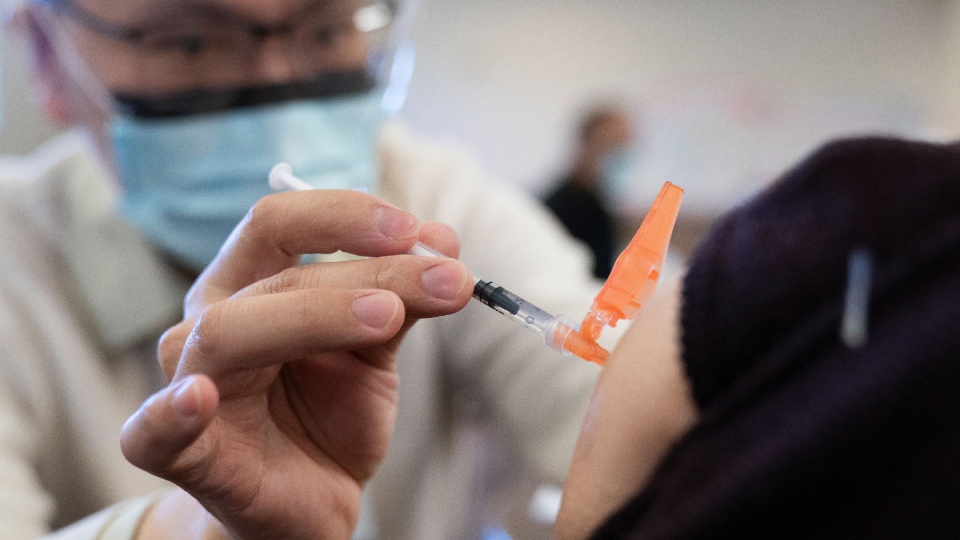
Federal Health Minister Patty Hajdu prepares to receive a first dose of
COVID-19 vaccine from Brian Gray, Director of Oak Medical Arts –
Mountdale Pharmacy, in Thunder Bay, Ont., Friday, April 23, 2021. THE
CANADIAN PRESS/David Jackson-Pool
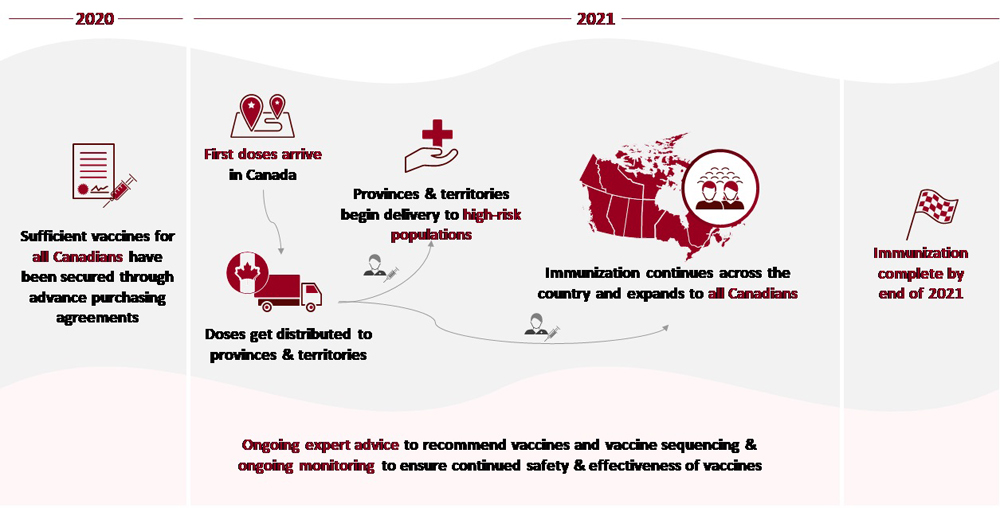
Canada is preparing to roll out an immunization response, which will
provide Canadians with access to safe and effective vaccines to protect
against COVID-19. This ambitious plan will be delivered through a
principled and evidence-informed approach that puts protecting the
health and safety of Canadians first.
Governments recognize that Canadians have made great sacrifices
to minimize the harmful effects of COVID-19 on our communities and that
many Canadians are anxious to know where, when and how they can receive a
vaccine. Extensive work has been done over the last several months to
secure strong vaccine options and to have the measures necessary to
deliver vaccinations to everyone in Canada. Immunizations will be free
to everyone in Canada and available over the course of 2021.
Until extensive immunization is achieved, public health measures
will continue to be essential to minimize the spread of COVID-19 in
Canada and save lives.
Canada's immunization response involves collaboration between the
Government of Canada, provinces, territories, First Nations, Inuit and
Métis leaders, municipal governments, public health and logistical
experts, manufacturers, and all Canadians.
Source: Government of Canada
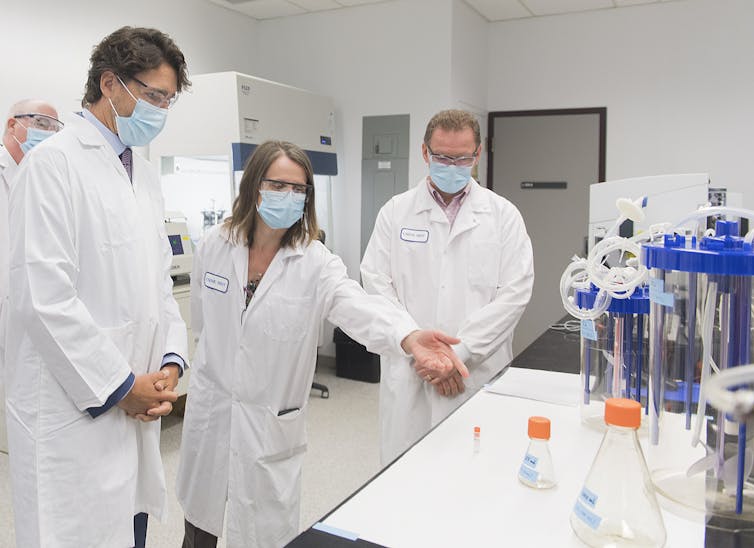
Justin Trudeau at NRC.CP/Graham Hughes
As of Feb. 5, Canada had administered 2.7 COVID-19 vaccination doses per 100 people compared to 61.7 for Israel and 16.2 for the United Kingdom. By contrast, Canada has signed contracts with seven different companies for a total of 234 million doses with options for tens of millions more.
Canada’s first attempt to ensure domestic production was a deal with the Chinese manufacturer CanSino Biologics in May 2020. Had that deal gone ahead, it would have involved trials at
the Canadian Centre for Vaccinology at Dalhousie University and, if
successful, subsequent domestic manufacturing. But within days of the
agreement being announced, there were already troubles as the Chinese
delayed sending the seed material for the vaccine and, ultimately, it
never arrived.
The failure of the CanSino deal and the delay in building the new NRC
facility left Canada reliant on foreign sources of vaccine. The
contracts for the vaccine were negotiated based on advice provided by
the 18 member COVID-19 Vaccine Task Force set up by the NRC in June 2020.
On top of having no domestic production and the delays, Canada is facing vaccine nationalism from other countries. U.S. President Joe Biden
is sticking to an America-first position and not allowing the Pfizer
plant in Michigan or the Moderna plant in New Hampshire to export any of
their vaccines to Canada until all Americans have been vaccinated.
The European Union is also threatening to block the export of vaccines possibly affecting exports from Belgium, as it too is confronting delays in being able to vaccinate its citizens
The Conversation
There we have it, the Government of Canada's confident assurance to Canadians that it has the matter of responding to the epidemic in Canada, part and parcel of the global pandemic, well in hand. Canadians can be justified in having confidence in their government, the necessary vaccines have been ordered -- even if at a late date, placing Canada behind all other advanced nations due to the tardiness of the ordering because that same government decided to put all its eggs in the wrong basket initially = signing a contract with CanSino Biologics, a Chinese pharmaceutical company under the direct control of Beijing -- and losing precious time until it looked about in desperation to find other reliable sources.
Two of those sources, the only two vaccines to be approved by Health Canada to date, Pfizer/BioNTech and Moderna, have run into production and delivery delays, leaving Canada in the lurch with a gross insufficiency of vaccine doses and the inability to inoculate the most vulnerable in its population. Canada now stands at a sad 57 in the world of vaccine implementation in its feeble efforts to inoculate its population. When Canadians celebrated in January that vaccines would finally be available, they were brought back to jarring reality when their prime minister promised that every Canadian that wanted to be vaccinated would be, by September of 2021. That far off in time?!
Well, since then that far-off date has been extended to the middle of 2022. And even then, there are no guarantees. While other developed countries have gone about efficiently and purposefully protecting their own, Canada turned in desperation to COVAX -- aUN-sponsored sharing program to ensure that developing and poor nations of the world are able to procure vaccines for themselves -- drawing from their stores and in the process depriving poor nations to the extent that they will have to wait longer. The situation has become cut-throat; every nation for themselves.
Brazil, so hard hit by the SARS-CoV-2 virus causing COVID-19, is now sending out medical teams to the most remote areas of the Amazon basin, using Chinese vaccines to inoculate their vulnerable populations, just as Alaska, a far richer state in a wealthy and powerful country, producing its own vaccines, sends out its medical teams to isolated and hard-to-reach remote indigenous villages. And Canada -- well, bringing up the rear. Because its government has failed to secure timely vaccines to protect its own. One quarter of Israel is fully vaccinated, the U.K. has administered 13 million doses, the U.S. is on track with its vaccination program.
Should Canada fail to address the pathogen's deadly spread which has killed 21,000 to date, that number could well accelerate, and rise to 46,000 by year's end even as some public health researchers feel that left unchecked, COVID could begin to dry up once 66 percent of the population has been infected. Of course by then the most vulnerable; the health-impaired, those with chronic health conditions, and the elderly will have been decimated in numbers. Numbers could rest at 24.8 million cases in total.
The World Health Organization's estimates are that COVID's fatality rate is 0.27 percent, so that simple math tells us that unchecked, COVID-19 could infect 76 percent of a population relating to 67,000 Canadian deaths in total. Pandemic models at the University of Washington forecast Canada to reach under 30,000 deaths by the first of June. Their September projects of Canada's death count happened to be an underestimate. Since March and the first lockdowns Canada-wide, an average of 1,900 people died monthly from the disease.
Economist Christopher Cotton led a Queen's University team to quantify the effect on the Canadian economy by continued lockdowns, reaching the estimated conclusion that Canada's economy would be hit on a scale of between eight to 14 percent, representing roughly between $176 billion and $308 billion. Put another way -- between $500 million and $850 million in missing revenues daily. Canada has outspent any other country on COVID emergency initiatives, building debt accordingly to astronomical heights.
Although the global pandemic has been a year in its destructive predation on the world, it is still early days, a long way from control. And like any virus SARS-CoV-2 has mutated and will continue to mutate; for the most part harmlessly, but as recent variants have proven in the United Kingdom, South Africa and Brazil, in increasingly threatening forms, far more insidiously contagious, and with as-yet unknown qualities with respect to lethality. And with those mutations and more to come until COVID has finally been put to rest, even greater threats will emerge from those variants.
Those mutations and their incipient threats have galvanized governments and health authorities in countries where vaccines are available and being used expeditiously to exert even greater efforts to control the disease's spread and impact. Canada's government will continue to smile and assure its population that it has everything under control and is doing all that can be done to protect them and those they care about. In the meanwhile, of course, the coronavirus raging in Canada has ample opportunity to mutate at leisure.
Paramedics transport a resident from Midland Gardens Care Community in Toronto. (Evan Mitsui/CBC)