Politic?

This is a blog dedicated to a personal interpretation of political news of the day. I attempt to be as knowledgeable as possible before commenting and committing my thoughts to a day's communication.

Thursday, May 06, 2021

Canada's COVID Concerns

"...A bit of subtlety and nuance needs to be applied to people who are providing care on the front lines.' "People working in emergency departments and ICUs are a different beast than your average Canadian."
"It is not only a health and wellness issue, but a human resources issue."
"I have sent people under the age of 40 into the ICU. This wave is much more pronounced than the first two. The sheer volume of younger, healthier people coming in is quite something."
Dr.Michael Herman, Emergency physician, Queensway-Carleton Hospital, Ottawa

"[The faster vaccines can get into more arms], the sooner our community will be safe. [We would like to see front-line health workers get fully vaccinated]."
"Many of our team are exhausted, and the staffing gaps we have as a region are significant. Hopefully we can show them how much they are valued, appreciated and will be protected."
"We would welcome it if there was an opportunity for health-care workers to get their second doses sooner if there is sufficient vaccine supply."
Queensway Carleton Hospital statement

"[It is common for emergency physicians to not yet be fully vaccinated and there is a] growing unease [among them about the situation with the third COVID wave continuing to place unprecedented pressure on hospitals in Ontario]."
"They [doctors, nurses, health-care staff] feel vulnerable."
"We are not asking to be preferentially vaccinated for personal protection. We are asking for full vaccination to maintain the integrity of the emergency health system, which is fragile."
Dr. Alan Drummond, Emergency doctor, co-chair, public affairs, Canadian Association of Emergency Physicians
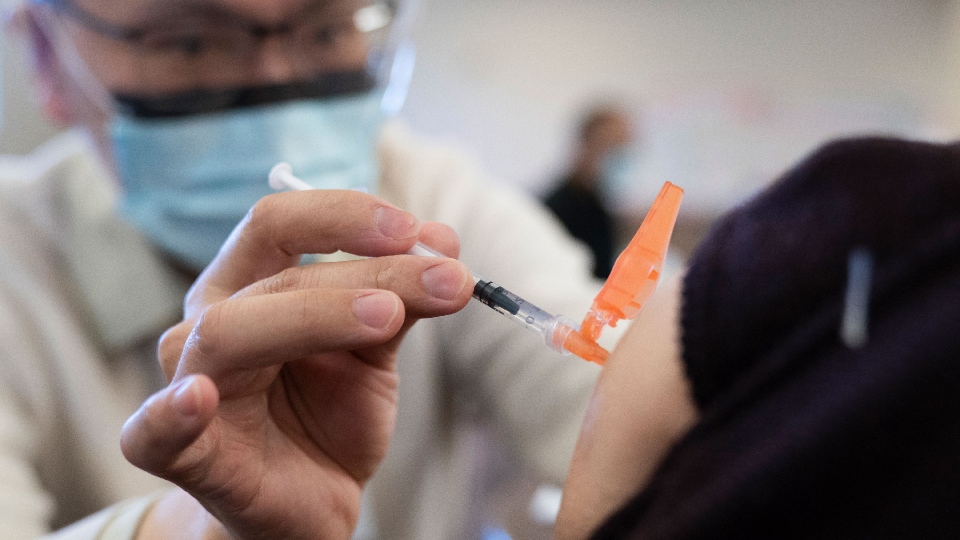
COVID-19 vaccine
 
The federal government, acting on advice from health specialists appointed as a consulting body for the government which had determined that given Canada's exceedingly tight supply of vaccines, it made sense to inoculate as many Canadians in descending order of age and profession as possible, with a first dose of vaccine. Extending the time for the second dose well beyond what the pharmaceutical companies have tested for in their research and efficacy-testing trials for best practise. With the aim to vaccinate as many Canadians as possible with at least one protective dose, available vaccines would go further the experts hypothesized, and the second dose could be safely delayed.

This is the route the government chose, and the provinces, which administer health care, set about vaccinating high-risk people in descending order from the frail elderly, the health-compromised, health-care community, racialized, front-line workers in service industries and hard-struck communities to the point later on where anyone over age 18 could make appointments for vaccination. First dose given, the wait for the second would be four months on; sixteen weeks. Which does render a high degree of protection from the SARS-CoV-2 virus for most people.

However, those in the medical community who come in direct contact on a daily basis with large numbers of COVID-19 patients, in particular those suffering from the effects of strains of concern like the UK, South African or Brazilian variants should, sensibly, be given the ultimate protection of two doses, not in the time scheduled for everyone else but as originally intended by the vaccine manufacturers in line with their research results for potency and safety.
 
Dr. Laura Shoots
Emergency room physician Dr. Laura Shoots is seen in this photograph. (Natalie Johnson/CTV News Toronto)
 
The United Kingdom found itself in a situation of raging contagion and insufficient vaccines, and it pioneered the method of leaving a wider gap between the first and follow-up doses, of 12 weeks, to enable it to inoculate greater numbers of people against COVID. Canada has followed suit, but extended the wait period by an additional month. Canada is now contemplating the issue of mixing vaccines; the original vaccine dose not necessarily followed by the same vaccine administered for the second dose.

Again, the manufacturers cannot guarantee safety and efficacy with this kind of massive departure from their products' protocol. Mix-and-match is not endorsed by the makers of the vaccines. But it has been broached in light of the very real fact of vaccine shortages and the anxiety involved in ensuring that a good proportion of a country's population is vaccinated in the interests of achieving the vaunted 'herd effect' and an eventual return to social normalcy, so countries can get back to work, children back to school.

In Canada, roughly 38 percent of the population has now had one dose of vaccine, similar to the European Union where about 34 percent have received their first dose. Where Canada stands in the more refined issue of full vaccination leaves a mere 3 percent of Canadians having received both doses, as compared to nine percent in the EU. For the U.K. its 12-week gap between doses was initiated in the interests of reducing the death and communicability rate. based on:
  1. How well a single dose of a vaccine prevents serious and  hospitalized COVID-19 cases;
  2. The overall efficacy of a single dose of the vaccine;
  3. Whether the protective effects of a single dose persist over the extended [up to 12-week] period.
Points one and two are fairly well assured; all major vaccines have a high degree of efficacy following the first dose; preventing death and hospitalization. It is point three where uncertainty steps into the picture, with no reasonably reliable evidence that a 12-week gap works; untested and unknown. Pfizer is known to have cautioned that it cannot vouch for the longevity of protection the first dose confers, all the more so with Canada's lengthy dosing interval of up to 16 weeks.

Little wonder that the medical community, reliant on the data they are aware of, through their professional understanding, and acutely aware of the vulnerability of their personal safety through constant exposure to people suffering serious effects from COVID, and likely carrying high viral loads more readily communicable, have good reason to be concerned. For themselves, for their families, and for their patients.

The government of Canada rates a  high failure mark for a number of issues critical to the COVID situation and the need to address a pandemic that has so far demolished all hope that it will be readily settled and life as normal is on the near horizon. Its first massive error was relying on China as a vaccine partner. Which led to late contracts with pharmaceutical companies to provide their vaccines for Canada. Leading to a desperation to try something experimental in the hopes that more people could be vaccinated, sooner, to reach the goal of COVID control and normalization.
Patty Hajdu
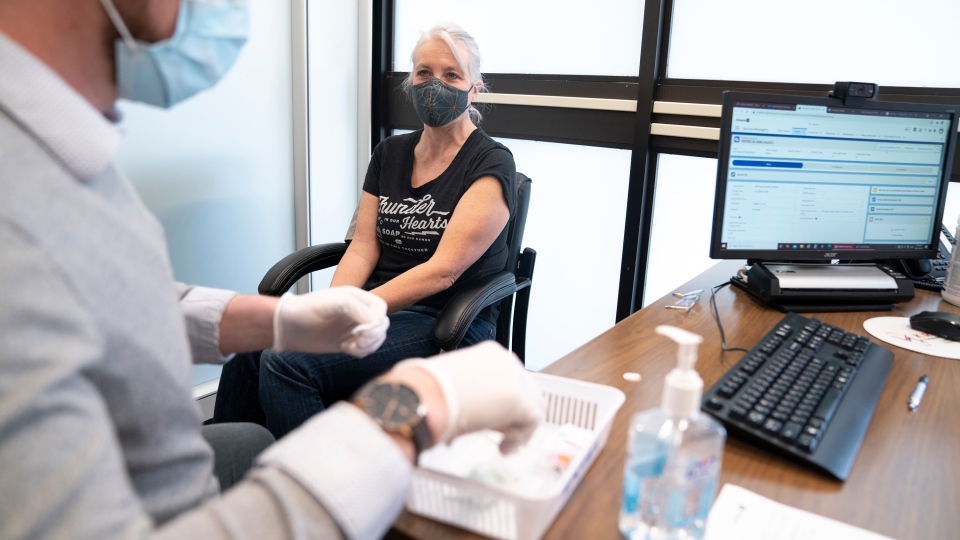
Federal Health Minister Patty Hajdu prepares to receive a first dose of COVID-19 vaccine from Brian Gray, Director of Oak Medical Arts – Mountdale Pharmacy, in Thunder Bay, Ont., Friday, April 23, 2021. THE CANADIAN PRESS/David Jackson-Pool

Labels: , , , , , ,

Thursday, April 02, 2020

The Taut Front Lines

"There are places that have shortfalls, there are decisions being made because we don't have the supply, period. Nobody at the moment has an understanding, a full Canadian understanding of how much PPE [personal protection equipment] is in stock at each facility."
"For every one patient who is on a ventilator, for every single day, you're talking somewhere in the order of hundreds of pieces of PPE when you add up the gowns, the gloves, the masks."
"When the prime minister says they have all this supply coming, how is it going to be distributed? How are they going to figure out where the need is? they have no idea, because nobody has done that work."
"We've started that work here; we're working on that frantically to figure that out. We're all on edge. This feels like the Viking ships are on their way, we don't know how many ships there are, we know that when they arrive they're going to pillage, destroy. We don't know how much we're going to be able to fend them off."
"We're just hoping they're just sending one ship, and we've got enough people to battle them. We just don't know."
Dr.Andrew Morris, infectious diseases specialist,Sinai Health System/University Health Network, Toronto
Doctors treat COVID-19 patients in an intensive care unit in Rome, Italy. Antonio Masiello/Getty Images

The community is agitated and concerned; no one wants to become infected with the novel coronavirus and most everyone is following recommendations to self-isolate, to practise great caution, to maintain a two-metre distance from others, to religiously wash and soap their hands for a protracted scrub, to be vigilant about what they come in contact with. The news -- all the news, everywhere -- is suffused with updates on the lightning speed of infection and the number of hospitalizations, much less deaths from respiratory collapse.

And then there are the health professionals, both doctors and nurses and others, those engaged in cleaning the hospital environment to make every effort to reduce the chances of a silent, lurking virus invading the closest human body, to replicate and to re-infect endlessly in a spiral of mass infection. Medical staff are in close contact with the ill; their profession demands it of them to serve the needs of the sick, leaving medical personnel in a moral quandary; what about their personal obligation to their own longevity, to their families?

Everything is hugely complicated by the fact that hospitals have insufficient personal protection equipment for their staff, leaving them vulnerable to infection while they tend to the needs of those infected. The rate of death of clinicians, of attending physicians, of caring nurses, of paramedics has astonished and frightened everyone in the medical fraternity. They are more exposed, the viral load they may be infected with may account for their increased mortality. This is their profession, one they are proud of and protective of. At a new, harrowing cost.
"Physicians may be permitted in exceptional circumstances to refuse to practice if they reasonably believe that the work environment creates a legitimate unacceptable hazard that is not inherent to their ordinary work."
"As always, members should document their rationale for decisions under crisis situations to assist in the event of medical-legal difficulties."
Canadian Medical Protective Association
"I think what [doctors are] really concerned about is, 'do I have the guidelines to make proper decisions and do I have the support structure to make an unthinkable rationing decision of two patients, and one ventilator."
"What they're looking for now is really some guidance, some standards on how to make those decisions should they be forced to do so."
"[Doctors] have questions about the reuse of protective gear, questions about what's appropriate with respect to the use of  homemade gear."
"Physicians can't refuse to see patients who are ill or who have an infection, but there would be some expectation that they would have the appropriate gear to be able to complete their task."
"And so that's what we're telling physicians, but that doesn't necessarily go far enough. Because at the end of the day, the building is still burning, patients are still sick and they need to be cared for and physicians feel that tremendous obligation to care for them."
"So it's really putting the doctors in a very difficult position, because they're concerned about their patients, they're concerned for their own health. They're concerned about transmitting the infection back to their family. And they're concerned about asymptomatic spread."

Dr.Todd Watkins, associate executive director, Canadian Medical Protective Association
Thanks to the new pestilence that is upon the world, and the many unknowns related to it, and its
virulence, medical professionals now have conversations with themselves that they never before contemplated having to indulge in, as introspection goes. How much exposure should they permit themselves given the very real risk of morbidity? Two nurses in New York City have died so far. "Doctors are getting sick everywhere", stated William P.Jaquis, president of the American College of Emergency Physicians.

Italy's experience has been telling. A first-world country with a first-rate medical system that has been overwhelmed by a firestorm of an infection rate that has exhausted them physically and psychologically, while taking a dreadful death toll of the medical community, on the verge of collapse. No fewer than 4,824 health-care workers were infected with the virus at last week's count, with 61 doctors having perished. That dread experience has informed Canadian doctors what the future may resemble for them, as well.
"My friends in Italy and Spain didn't seem to wrestle with it as much. We're a little less focused on the individual well-being here and more supportive of the social contract where we look out for each other."
"I just think Canadian doctors will be less likely to consider staying home if help is needed on the front lines of this battle."
Dr.Anand Kumar, critical care doctor, Winnipeg
A robot operated by medical teams helps treat patients suffering from COVID-19 in the Circolo hospital in Varese, Italy. Flavio Lo Scalzo/Reuters

In today's Canada where hospitals are concerned over their lack of equipment and doctors are exhausted before the real crush in intensive care units have even surfaced, doctors are isolating themselves, determined to avoid taking the novel coronavirus back to their families at home. The necessity of having to ration personal protective equipment places medical staff at higher risk of becoming infected themselves. And the scarcity of mechanical ventilators is the stuff of nightmares where doctors may be forced to make choices no one can morally contemplate.

To avoid over-use of PPEs, staff have begun using cellphones and baby monitors in communication with infected patients, hoping to limit face-to-face contact with the attendant need to fully suit up, using up scarce personal protective equipment. According to Public Services and Procurement, the federal government has placed on order 157 million surgical masks, 60 million N95 masks and 1,470 ventilators, while hoping to source even greater numbers.

Nightmare scenarios of having to decide in crisis situations whom to extend heroic care for, and whom to leave, haunts the medical profession, with the legal and ethical issues inherent in such dramatic decision-making. There's a brief window "during which they can be saved" reads an article published in the New England Journal of Medicine, when a patient's breathing deteriorates to the point where a ventilator is required. Should the ventilator be withdrawn the person will die within minutes.

"Unlike decisions regarding other forms of life-sustaining treatment, the decision about initiating or terminating mechanical ventilation is often truly a life-or-death choice." Should the  young leapfrog the old? How much time is given someone to recover before life support is removed? COVID-19 has become a global pandemic,"and the sad fact of the matter is that in most health systems around the world, physicians, nurses, health-care providers have limited-to-no access to personal protective equipment", noted Dr.Ross Upshur of the University of Toronto Joint Centre for Bioethics.

Labels: , , , , , ,

Thursday, March 26, 2020

Do As I Say : Don't Look At Me!

"A bonspiel is not an essential activity."
"I know our health-care providers are under a lot of pressure and scrutiny right now, but hard not to wonder why this event took place."
Timothy Caulfield, Canada Research Chair in health law and policy, professor, faculties of law and public health, University of Alberta

"There have been no deaths linked to this bonspiel. No patients have tested positive with COVID-19 to date."
"At this time, no other patients appear to have been exposed from cases to the bonspiel."
"[Any disciplinary action would be from the provincial physicians' colleges; the focus is on] caring for patients."
"It is not on disciplining physicians, particularly at a time when we need them the most."
Alberta government statement
Curling
Curling rocks are shown Friday, Feb. 10, 2017, during a media demonstration the day before the opening ceremonies of the USA Curling Nationals in Everett, Wash. (THE CANADIAN PRESS/AP, Ted S. Warren)
We are so hugely -- as a public faced with the fears of an infectious global pandemic that has skulked its way into Canada from its emergent home in Wuhan, China -- dependent on the army of skilled medical professionals to care for us in illness and restore us to health, if and when possible. Physicians, secure in their professional knowledge, their practised experience, their diagnostic and healing skills, are the most trusted group of professionals the world over. For the most part, they earn that trust.

But as humans with all the failings of any human being they can at times spectacularly fail that trust.
And this is precisely what occurred when a decision was made to proceed with an annual curling event that brings together health professionals from the Western provinces of Canada. Where, despite knowing that COVID-19 has a swift and deadly spread, and to deter that spread as much as possible people should maintain a safe distance from others to self-protect and protect others from the highly infectious novel coronavirus, 72 people with medical degrees chose to attend the event.

Now three of the attendees from Alberta are known to have become infected with the virus at the tournament that took place in Edmonton. Before they became aware that they were infected, and thus vectors, they had contact with patients and with their colleagues. Twelve in fact, of the 47 Alberta health care workers at the bonspiel which took place between March 11 and 14, tested positive for COVID-19. A situation that calls for them to self-isolate for at least two weeks, placing them outside the health-care system as patients, not as badly-needed practitioners.

Three of the twelve -- physicians in Red Deer, Alberta -- had physical contact with patients and co-workers so that 58 patients were attended to during the course of normal medical business by the doctors involved before they became symptomatic. Add other possible infections counting the 97 other health professionals these doctors' indiscretion may have contaminated. And if so, unbeknownst to those 97, their contact with their own patients would have rippled beyond the initial contact. This is how contamination spirals.

This situation was first brought to light when Dr.Allan Woo, head of the Saskatchewan Medical Association publicly revealed that he had been infected with the novel coronavirus due to his attendance at the bonspiel in Edmonton. Now, Saskatchewan has announced that 11 of their 22 health professionals attending the event also tested positive for COVID-19. Three doctors in Manitoba are self-isolating, having attended the event. 

Well, so much for the wisdom of doctors. And wait, other medical professionals as well have proven to be as unwary -- as when earlier in the month the Pacific Dental Conference that took place in Vancouver at which close to 15,000 dentists and hygienists attended also appears to have resulted in a COVID-19 outbreak. Reports of infections are beginning to emerge, one in particular, the death of a dentist who attended that event.

Students walk past a sign at the south entrance to the University of Calgary on Tuesday February 26, 2019. Gavin Young/Postmedia
Two people from the University of Calgary’s Cumming School of Medicine tested positive for COVID-19 after attending an Edmonton curling bonspiel that played host to more than 50 physicians last weekend, the university said in an email to faculty and students Friday. The University of Calgary is pictured on Tuesday February 26, 2019. Gavin Young/Postmedia

Labels: , , ,

Saturday, March 21, 2020

Seriously? Dunderheads!

"This bonspiel is an annual event that usually attracts fifty to sixty physicians from Western Canada."
"I believe I contracted the COVID-19 virus at this bonspiel."
"[My practice is rescheduling appointments, and the office is] communicating with patients I was in contact with."
"As I write this, I am reminded that physicians are not invincible. The risks of this pandemic are far too real."
"I have been self-isolating since Tuesday morning when I first noticed symptoms."
"I hope my personal situation serves as a signal for all healthcare workers, and others, to be vigilant about their health."
Dr.Allan Woo, president, Saskatchewan Medical Association
The Granite Curling Club is seen in Edmonton, on Thursday, March 19, 2020. The president of the Saskatchewan Medical Association, Dr. Allan Woo, has tested positive for the COVID-19 illness after playing at a bonspiel last weekend with 50-60 physicians at the club. Photo by Ian Kucerak/Postmedia
So, interesting news. While the medical community is busy explaining to Canadians at large how critical it is that everyone take COVID-19 transmission seriously and self-isolate to protect themselves and others from being infected, doctors, who most certainly should know better, have been themselves casual about exposing themselves to infection. To read that a province's top medical practitioner has been diagnosed with the novel coronavirus is to logically imagine that he contracted the disease through exposure to the many patients he sees. Wrong.

Not only is the logical supposition wrong, but that doctors organized a sport event in the practise of good fellowship at a time of high alert within the country when their medical skills are most needed, is beyond belief. But, on the other hand, as Dr.Woo admits in his defence as a mere human being, we are only human, and we all make mistakes. Even unbelievable whoppers like this one, on the part of organizers within the medical community, those who chose to attend within the medical community and those who now feel rather foolish within the medical community.

And how ironic it is that on the very day that the World Health Organization finally decided to declare the novel coronavirus a global pandemic, the gathering of doctors from across Western Canada took place in Edmonton. A curling tournament. All in good fun; solidarity among colleagues. Which has led Alberta's chief medical officer, Dr.Deena Hinshaw, to call a press conference where she revealed that 72 people had played in the bonspiel and some 45 had attended a following banquet.

The expectation is, not unreasonably, that additional physicians across Western Canada may now be at risk for contracting COVID-19; among those who attended the bonspiel, and among those with whom the attendees later professionally mingled. "I absolutely say that anyone who attended that is needing to isolate for 14 days", stated Dr.Hinshaw. Mind-boggling that at the very time the bonspiel took place, the Alberta government advised against gatherings of 50 or more people for essential staff. Who could be more 'essential' in the present situation than medical professionals?

It was, furthrmore, Dr.Hinshaw's opinion that depending on the number of people in any enclosed space at the same time, such a gathering would not be specifically prohibited (!). As for who the vector was, the belief is it was in all likelihood one among them in the gathering who had recently returned from a trip to Los Vegas. And then, of course, Dr.Woo himself interacted with patients he was treating, exposing all of them to the virus before he became symptomatic...
Dr. Allan Woo
Dr. Allan Woo (Facebook: Saskatchewan Medical Association)
"This investigation involves two provinces at least. All of the information is being collected and communicated to all the provinces from where people may have come to that event."
"Details are sought about where each of the participants were, did certain people sit together as a group and mix more than others, and based on that, a determination will be made shortly — in a day or two — does this involve all people who attended?"
"Beyond that, I would not like to discuss any particular details of any case in terms of exposures. Having said that, if we know that there is more than one case related to an event, we will be disclosing that."
Dr. Saqib Shahab, Saskatchewan chief medical officer of health


Labels: , , , ,

Friday, March 20, 2020

A Convergence of Circumstances : New Canadian MDs in Abeyance at a Critical Time of Need

"These are not medical students. These are fully trained doctors at the end of their training."
"Everything should be done to ensure they can practise medicine and care for patients in the face of this pandemic."
Dr.Emily Stewart, President, Resident Doctors of Canada

"We are a resource in this time of need that could be mobilized on an expedited basis. We can help, please let us."
"[With the delay announcement] our futures became uncertain. The futures of the Canadian physician supply chain became uncertain."
Concerned Family Medicine Residents
Tyler Anderson, National Post

Over two thousand Canadian doctors freshly schooled in medicine and its practise are reacting with disbelief at the news that their final exams to certify them have been suspended as a result of yet another reaction to the COVID-19 pandemic which has seen governments mandate stringent measures on ensuring that people do not gather in large numbers in fear of the novel coronavirus transmission.

Finishing two to five years of on-the-job training in their fields, the residents must pass exams to enable them to be qualified by either the Royal College of Physicians and Surgeons (for specialists), or the College of Family Physicians of Canada (for general practitioners). Both of these agencies have announced that the exams are to be delayed; written tests and face-to-face evaluations in view of the risk of spreading the virus.

Tentative plans are for the rescheduling of the March exams to the last week of April and early May for the Royal College, as long as the situation does not further deteriorate dramatically. Provincial regulators are being pushed by the two colleges and the residents' association to issue provisional licenses to enable the new physicians to get into practise, while awaiting the final exams.

Processing that many temporary licenses in one fell swoop has never occurred previously, but these are unusual times. There is an absolute and express need for more doctors to be able to join the medical community in view of dire shortages of both medical personnel and equipment to handle the growing epidemic of viral transmission. Yet having finished medical school, the students are considered doctors who must still undergo five-year residencies to become specialists and two-year programs to qualify as family practitioners.
Medical staff work at a computer terminal as they prepare for the opening of the COVID-19 Assessment Centre at Brewer Park Arena in Ottawa, during a media tour on Friday, March 13

Once the specialty exams have been passed, the college of physicians and surgeons in each province then awards the licenses permitting doctors to practise independently. The two certifying bodies are adamant that they cannot safely conduct exams bringing large numbers of residents and evaluators together, given the federal government's recommendation that Canadians isolate themselves.

"To quickly adopt a new exam delivery process with no previous logistics plan is extremely complex and risks the validity of the exam", explained Bruce Kvern of the College of Family Physicians, though they are exploring the potential of other options for the exams to be completed expeditiously, outside of using Internet-based technology to have the exams remotely held.

For security and technical reasons, it is not envisioned that the four-hour written test could be delivered at  home, while the oral portion is a multi-station process with the resident interacting with a mock patient posed by a practising family doctor in an evaluative procedure.

header

Labels: , , , ,

Wednesday, March 18, 2020

Righteous Rage Overcoming Fear

"The coronavirus epidemic has revealed the rotten core of Chinese governance. The level of popular fury is volcanic, and a people thus enraged may, in the end, also cast aside their fear."
"I cannot remain silent."
"Faced with this virus, the Leader has flailed about. Although everyone looks to The One for the nod of approval, The One himself is clueless."
"Regardless of how good they are at controlling the Internet, they can't keep all 1.4 billion mouths in China shut." 
"I can now all too easily predict that I will be subjected to new punishments; indeed, this may well even be the last piece I write."
Xu Zhangrun, law professor, Beijing
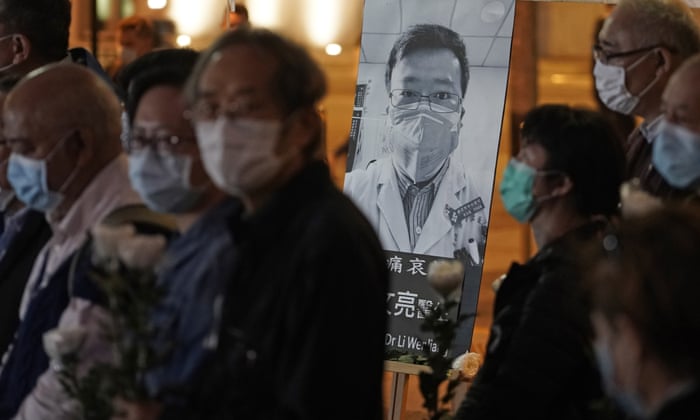
People attend a vigil for Chinese doctor and whistleblower Li Wenliang, in Hong Kong, on 7 February. Photograph: Kin Cheung/AP
The Communist Party of China bridles with indignation that anyone should blame The Peoples Republic for the global threat to human health and longevity that is striding through one country after another, wreaking havoc, destroying public trust in their governments, laying waste to the world economy, striking down the elderly and health-compromised and instilling the terror of fearful uncertainty everywhere. This mysterious zoonotic coronavirus is most certainly a Chinese curse on the world. Indeed we live in 'interesting times'.

And thanks to an arcane, mystical Chinese alimentary and pharmacopeia heritage and custom a viral plague has been released upon humanity, identified as a global pandemic. In its great wisdom, Beijing first responded to initial reports of the mysterious pneumonia that appeared so suddenly, with denial and refusal to take serious action to stifle the emerging threat. Chinese scholars themselves appear to have predicted that it was "highly likely" there would arise coronavirus outbreaks in an article in the journal Viruses a year earlier. 

Other Chinese scientists identified the virus and sequenced its DNA once the outbreak occurred, and then posted that sequence on a virology website on January 10, mere weeks after the virus erupted to make it accessible to scientists around the world. Their rapid sequencing and worldwide release enabled researchers all over the globe to use that data to begin looking for and testing all possible potential vaccines.

The while, the CPC was busy organizing its coverup, denying that anything was amiss, threatening doctors and scientists with punishment for spreading harmful false rumours injurious to China, when they began divulging the facts on the ground to the outside world. Chinese police were ordered to crack down on eight doctors accused of alerting others within the medical community of the rising risks related to this new virus. The doctors were denounced as rumor-mongers on national media.
Xi Jinping, coronavirus and the new cold war
Disinfecting an 'open market' in China

The Chinese public was horrified and then disgusted and then infuriated when they learned that Li Wenliang, a doctor who contacted his colleagues to alert and advise them of the presence of a new viral threat, and been singled out and threatened by police, forced to recant and apologize, later contracted the novel coronavirus himself, and ultimately died of it; had his warning been heeded, countless lives might have been saved.

Now Professor Xu has called on the Chinese public to demand free speech and free elections: "Rage against injustice; let your lives burn with a flame of decency; break through stultifying darkness and welcome the dawn". These sentiments will not be thought of kindly by the Chinese regime led by President Xi Jinping -- of the man denouncing their inaction and incompetence who is now incommunicado.

The government propaganda is transparent and most Chinese understand that the coronavirus was horribly mishandled, yet another example of ineptitude on the part of the regime where Xi's government mishandled a swine fever outbreak beginning in 2018 as well, which has killed one-quarter of the world's pigs. Before that, there was SARS, yet another viral agent that leapt from animals to humans by way of infected bats and civet cats, high on the culinary banquet list.

Chinese doctors and scientists can rival the world's best. Normal life expectancy in China now stands at 82, higher than the United States. For many years, China's technocrats, doctors and scientists led a push to open a new university every week, for years. In the same token, the Communist Party of China has taken great steps in another direction, stifling social media and journalism while the cult of 'Xi' dominated.

Doctors have worked themselves unstintingly in China, improvising when medical supplies became limited and to the present over 3,300 medical workers were infected with coronavirus (which they likely would never themselves have hesitated to call Wuhanvirus) and of that number at least eight have died. Professor Xu's condemnatory essay is vibrating around China, through the surreptitious distribution of copies.

Tsinghua University Xu Zhangrun blames Chinese Communist Party leaders for putting politics ahead of the people. Photo: Sohu
Tsinghua University Xu Zhangrun  Photo: Sohu

"The political system has collapsed under the tyranny, and a governance system [made up] of bureaucrats, which has taken [the party] more than 30 years to build has floundered", he wrote scathingly. He had written an article in 2018 criticizing Communist Party leaders for agreeing to lift the two-year term limit for presidents to allow Xi Jinping to remain in office beyond his 2023 second term. His punishment then was to be suspended from teaching at Tsinghua University. With his latest broadside targeting President Xi and the CPC, his friends feared he would be arrested and never heard from again

Labels: , , , ,

() Follow @rheytah Tweet