Politic?

This is a blog dedicated to a personal interpretation of political news of the day. I attempt to be as knowledgeable as possible before commenting and committing my thoughts to a day's communication.

Monday, February 09, 2026

The Protest Carnage in Iran
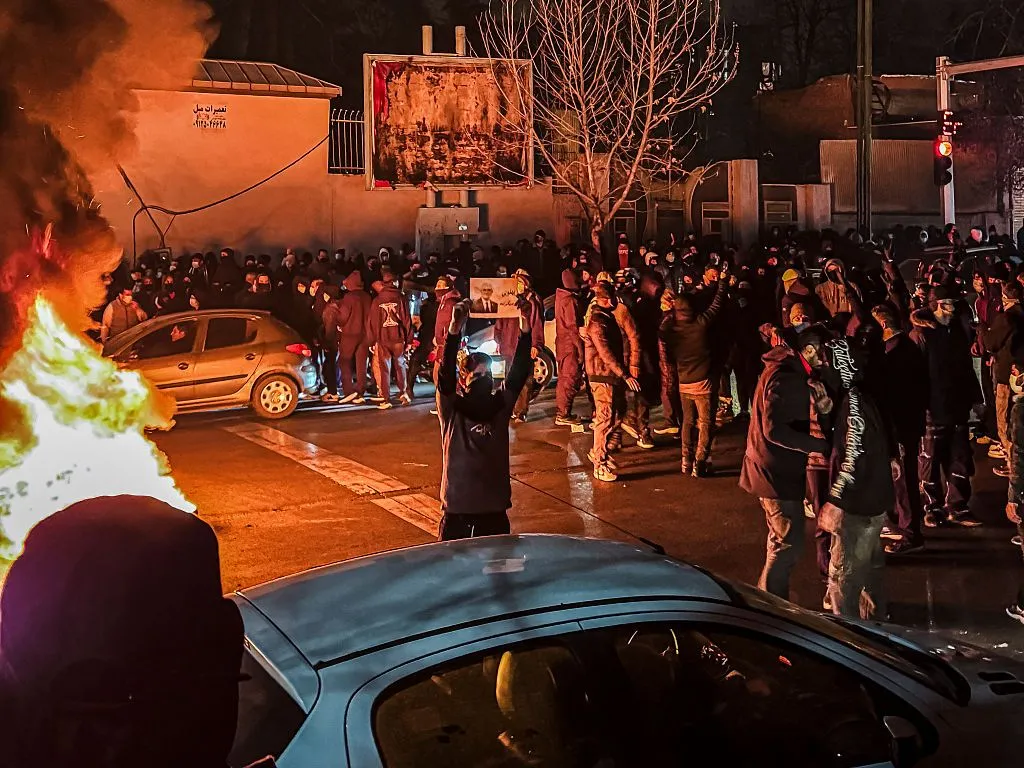
https://ichef.bbci.co.uk/news/1024/cpsprodpb/1977/live/6476d590-f6ad-11f0-b5f7-49f0357294ff.jpg.webp
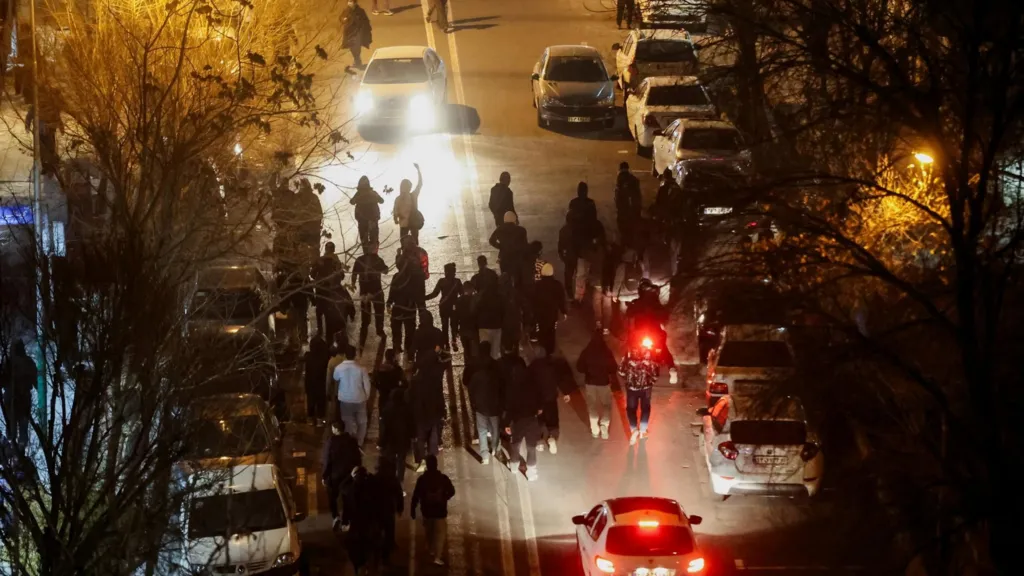
Protesters on a street in Tehran on 9 January  Getty Images
 
"[We witnessed] young people whose brains were smashed with live bullets, and a mom who was shot in the neck,her two small children were crying in the car, a child whose bladder, hip and rectum was crushed with a bullet."
"What I witnessed will forever haunt me. I feel guilty that I'm alive."
Isfahan MD
 
"Our statistics are based on the documentation standards of human rights organizations. They must either be confirmed by two independent sources, or our organization must have direct access to a very reliable source."
"Some of these statistics [Iran Human Rights estimates that there have been more than 25,000 deaths] include direct reports from victims as well as information from the medical field and reliable sources known to us." 
Norway-based Iran Human Rights director Mahmood Amiry-Moghaddam 
 
"[Around 7,000 serious eye injuries had been recorded in a specialized eye hospital in Tehran alone by January 16]."
"There are medical protocols in Iranian hospitals, and medical staff generally refrain from reporting cases that could later be used for criminal prosecution."
"We already observed this during the Mahsa movement. Fortunately, medical staff are siding with the protesters." 
Amir Mobarez Parasta, Iranian-German eye surgeon, head, Munich eye center
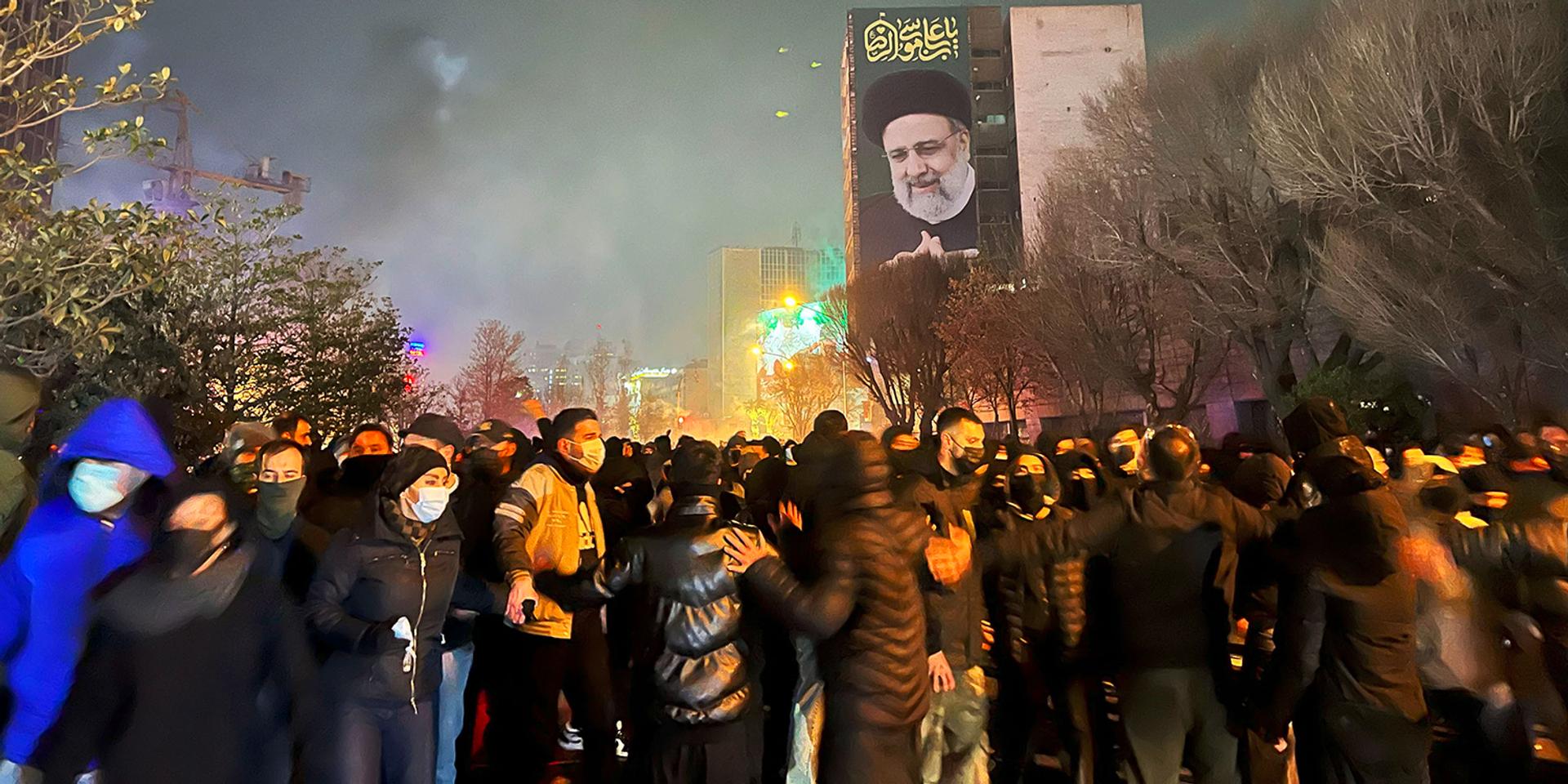
https://img.lemde.fr/2026/02/02/375/0/1500/750/1920/960/75/0/fa28ca2_ftp-1-7v8mhf2riked-415243-3457284.jpg
Tehran protests   Yalda Moaiery, Le Monde
 
Security forces in Tehran were known to have opened fire from the roof of a police station at protesters, firing live rounds into a crowded protest march, one person shot in the head. The protests, small in number at first when they began in late December, by early January the revolt by ordinary Iranians had become bloated with people, and then security forces began their deadly force. Iran's supreme leader Ayatollah Ali Khamenei, by January 9 ordered the Supreme National Security Council to crush the protests using any means at their disposal. 
 
Videos that were slipped out to Western news sources despite the regime shutting down the internet and phone service show security forces firing on protesters in cities across the country in early January. Photos went into circulation of hundreds of victims of the violence taken to hospitals or to morgues. The official death toll is in the low thousands. Iran Human Rights, a group based in Norway monitoring the situation in Iran confirmed 3,400 have been killed, while the Human Rights Activists News Agency out of Washington identifies the death toll at 5,200. Both these groups warn the number could eventually rise two or three times higher. 
 
According to Iran's own National Security Council, 3,117 people have died, listing among them 427 of its security forces. Ayatollah Khamenei and other officials of his government place the blame on terrorist cells allied with Israel and the United States, both as vectors of the uprising and the violence that ensued. Gunmen and security forces are shown on videos riding in pairs on motorbikes, using firearms, batons and tear gas. This would be the feared and hated Basij, a volunteer militia linked to the Islamic Republican Guard Corps.


One video filmed in Tehran shows protesters sheltering from gunfire, and a voice is heard to say: "Put your phone down, they'll shoot your hand off. There's a sniper among them." One video filmed in Haft Howz Square, Tehran shows people running, and the sound of gunfire. Some of the protesters have leg wounds, leaving trails of blood as they flee, limping off. A video filming security forces firing from a rooftop in the Tehran Pars neighbourhood shows rifle muzzle blasts and the sound of hundreds of gunshots and automatic fire.
 
Hospitals across the country, swamped by thousands of injured people in Tehran, Mashhad, Isfahan and Zanjan, led doctors and nurses to share what they witnessed, describing chaos, medical staff attempting frantically to save lives while their hospital whites became drenched in blood. Patients on benches and chairs and bare floors in the emergency rooms. Hospitals short of blood, searching for trauma and vascular surgeons. Their hospitals resembling a war zone. At the sprawling government medical facility of Shohada Tajrish Hospital, medical staff saw about 70 gunshot-wounded protesters every hour on January 9 and 10, the two days of peak violence. 
 
In scenes he described as 'terrifying' one doctor in Mashhad spoke of security forces appearing, and demanding access to patients so they could arrest them. Doctors resorted to setting up an ad hoc triage unit outside of the city for patients fearful of going to a hospital with their wounds. Most victims were shot in the upper torso, head and neck, and hundreds arrived dead or so terribly injured they succumbed to their wounds. 
 
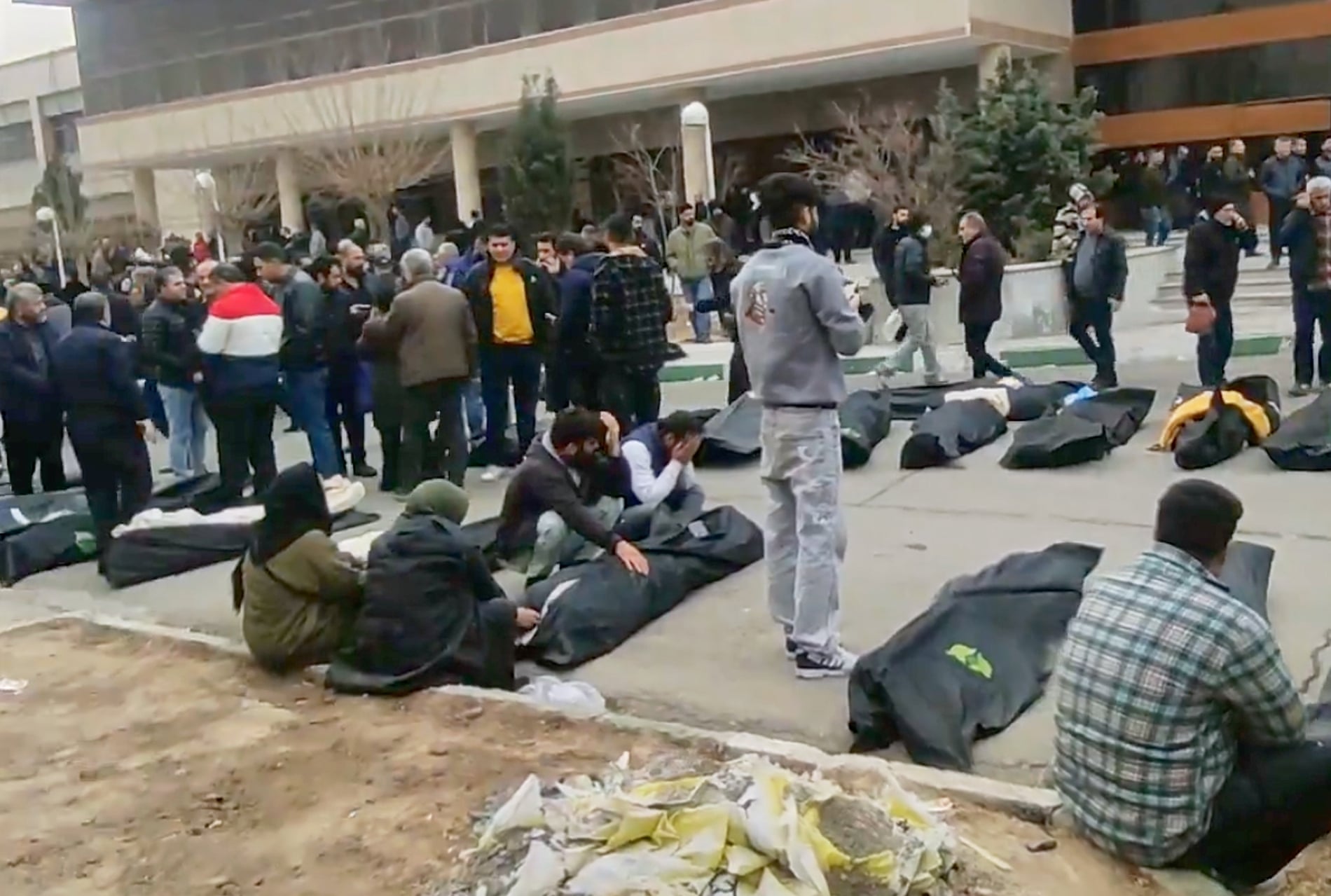
Morgues were overwhelmed with bodies in black plastic bags. Corpses stacked in refrigerators, placed on floors with scattered row-on-row of bodies in parking lots and courtyards where family members searching for their loved ones would unzip bags hoping to recognize the familiar features of a son, a father, a daughter known to have been killed, so they could be buried with honour. "It's a line. A line of people, so they can pick up their deceased. The young people. Their apple of their eyes", one man said.
 
By January 12 the protests dwindled, people stayed in their homes as security forces prowled the streets.  
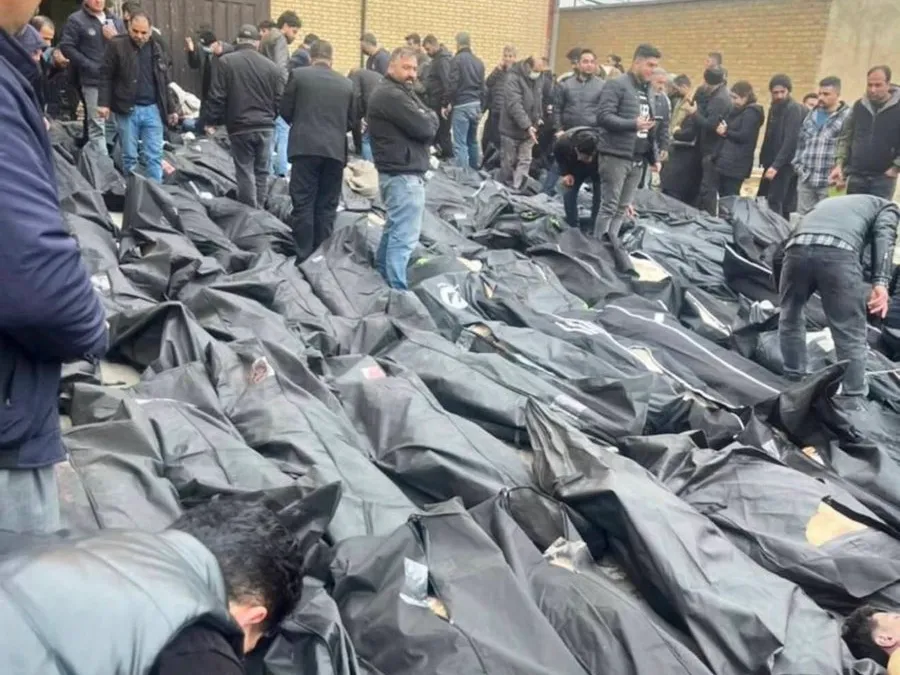
 
https://i.iranintl.com/images/rdk9umy0/production/e4d669501bb5f4591e308853bb271ca30fc74429-900x842.jpg?rect=0,45,900,675&w=992&h=744&q=80&fit=max&auto=format
The killings that swept Iran last month revived memories of 1988, when the Islamic Republic erased thousands of political prisoners in silence   Lawdan Bazargan, Iran Insight


Labels: , , , , ,

Thursday, January 29, 2026

The Prospect of a U.S. Military Strike

The prospect of a US military strike against Iran over its violent crackdown on protests has laid bare a shift in Middle East geopolitics—one marked by the unexpected upending of long-standing rivalries between Iran and regional powers such as Saudi Arabia and Turkey.
When protests erupted in Iran on December 28, 2025, few anticipated that they would reveal deep-seated geopolitical anxieties in Riyadh and Ankara. As the demonstrations spread across the country and drew warnings from US President Donald Trump of possible military intervention in support of the protesters, Saudi Arabia and Turkey—along with Qatar and Oman—unexpectedly rallied behind the Iranian regime, primarily due to concerns about the potential consequences of a regime change in Iran.
To be fair, prior to the Iranian protests, relations between Tehran and its rivals Riyadh and Ankara were not tense; in fact, they were moving toward closer engagement, with Saudi Arabia following up on the Chinese-brokered agreement with Iran and Turkey even planning a presidential visit. The protests, by highlighting the fragility of Iran’s political order, triggered new threat perceptions in Saudi Arabia and Turkey, leading both countries to lobby the Trump administration to refrain from military action against Iran.
While Turkey and Saudi Arabia hold differing views on Iran, they share a rarely highlighted concern: Israel’s potential influence in a post-Islamic Republic Iran. Both initially assessed that the protests were unlikely to topple the regime, yet the emergence of Reza Pahlavi—and his January 8–11 calls that drew massive crowds to the streets—heightened their anxieties. Monarchist chants calling for the return of the Pahlavi dynasty dominated the protests.
Reza Pahlavi, who has built strong relations with Israel, is far from a unifying figure in Iran’s polarized political landscape. His rise has unsettled non-Persian communities and devout segments of the population. Yet, from the perspectives of Saudi Arabia and Turkey, the surge of pro-Pahlavi chants across Iran suggested that Israel and the United States could expand their influence if the regime were to collapse. Amid the protests in Iran, Turkish Foreign Minister Hakan Fidan went so far as to accuse Israel of orchestrating the unrest, highlighting Ankara’s deep concerns about instability in Tehran. Notwithstanding, Saudi Arabia and Turkey were almost certain that Iranian protests, if left to their own devices, would not succeed in toppling the Iranian regime. US threats of a potential military strike in support of the protesters, however, radically changed risk assessments in Riyadh and Ankara.
Depending on how the situation in Iran evolves, the alliance of the ‘elders’ may soon be challenged by an emerging bloc of younger Middle Eastern states—comprising the UAE, Israel, and the Republic of Azerbaijan—smaller states that share a convergence of strategic interests in Iran and beyond.
So far, the US president’s decision to dial down threats of military action against Iran has contributed to preserving the status quo in the Middle East, especially after the Islamic Republic violently quelled protests. However, a significant military strike against Iran could open the door to profound geopolitical shifts across the region.
Said Khanafira, (doctoral researcher, Simon Fraser University, Canada) Geopolitical Monitor 
https://www.geopoliticalmonitor.com/wp-content/uploads/2026/01/Reza_Pahlavi_22293313571.webp
Reza Pahlavi, Geopolitical Monitor
 
"Hopefully, Iran will quickly 'Come to the Table' and negotiate a fair and equitable deal -- NO NUCLEAR WEAPONS -- one that is good for all parties."
"Time is running out, it is truly of the essence!"
"The next attack will be far worse [than that of the summer of 2025]."
U.S. President Donald Trump 
 
"Iran stands ready for dialogue based on mutual respect and interests -- BUT IF PUSHED, IT WILL DEFEND ITSELF AND RESPOND LIKE NEVER BEFORE!"
Iranian Embassy in Washington
https://i.guim.co.uk/img/media/f07467fe6b0f6e1e455ede2e0c3c961d6facc53f/0_0_3021_2034/master/3021.jpg?width=1900&dpr=1&s=none&crop=none
A screen grab from a video taken between 9 and 11 January purportedly showing dozens of bodies outside a morgue in Kahrizak on the outskirts of Tehran, Iran's capital. Photograph: AP
 
Appealing to Muslim states in the Middle East, a desperate Iran has reached out in a manner totally unlike its usual cloistered relations with majority Sunni Arab states, as the sole non-Arab Muslim state in the region. The Damocles Sword of an imminent attack by the United States on the Persian Islamic Republic has generated panic among the mullahs of the regime. Attacked by their own persecuted population over economic hardships that ignited a protest against the sinking value of the rial and the rising cost of living, the bloody crackdown by the regime drew the ire of the Trump administration articulating a red line whose crossing would bring the regime's downfall.
 
The world has witnessed a number of widespread populist uprisings in the Islamic Republic of Iran. All of which were met with violence committed by the Basij and components of the Iranian Republican Guard Corps, ideologically-driven to stifle protest by all means that could be deployed through military-style intervention, while the Iranian Police, committed to the welfare of their country but informed through the metric of public order and security may have dealt less harshly with the protesting public. 
 
The deaths of thousands of protesting civilians in outbursts taking place throughout the country, in each of its cities where vulnerable courage has met implacable denial, first with conventional crowd-control measures and threats for people to return to their homes, then increasingly with deadly fire, has captured the notice of the world, with videos, photographs and personal accounts reaching the outside world until the regime closed down the internet and peoples' modes of communication were slammed shut.
 
Threats by President Donald Trump of wartime measures his country would take to defend the protest movement should the massive death count continue, and hanging of protesters proceed as threatened by Iran's judiciary, have had their impact. Fear of an invasion has shattered the level of bombast-confidence that usually issues from the regime's elite government circles. With an attack impending should Trump finally make that decision, Saudi Arabia and the UAE let it be known their air or ground or sea space would be off limits for any U.S. attack on Iran.
 
Iran Protests
Photo provided by the U.S. Navy shows a Boeing F/A-18E Super Hornet landing on the Nimitz-class aircraft carrier USS Abraham Lincoln in the Indian Ocean on Jan. 22, 2026. (Mass Communication Specialist Seaman Daniel Kimmelman/U.S. Navy via AP)
 
The USS Abraham Lincoln has been moved to the region along with a number of guided missile destroyers whose utility can be achieved though simply launching attacks from the sea. The American armada that has moved into position is prepared to achieve any goal commanded by the White House. With communications cut off, it is no longer possible to receive reliable information on killing of peaceful demonstrators and mass execution of detainees. 
 
Iranians have been ordered to remain in their homes. There have been reports of wounded being taken out of hospitals or shot in hospitals by the regime's enforcers. People have been forced to pay a ransom to receive the bodies of their loved ones, and not all have the wherewithal to retrieve the bodies for a funeral to take place leaving the families in the double grip of the desolate grief of deprivation. State media now refer to the protesters as 'terrorists', the preferred term of the regime. 
"I feel that my generation failed to give a better lesson to younger ones."
"The result of decades of teaching by my colleagues and me led to deaths of thousands, and maybe more injured and prisoners."
Mohammad Heidari, Tehran teacher  
https://ichef.bbci.co.uk/news/1024/cpsprodpb/9320/live/300ddc10-fb9c-11f0-b385-5f48925de19a.jpg.webp
Iranian authorities responded with lethal force as the protests in Tehran escalated on 8 January   Wana via Reuters


Labels: , , , ,

Tuesday, November 29, 2022

The Obdurate Autocratic Failings of the Chinese Communist Party on Zero-COVID

"The party and the people are trying to seek a new equilibrium."
"There will be some intsability in the process."
"Without the clear signal of party leader divisions -- I would expect this kind of protest might not last very log."
"[It is] unimaginable [that Xi would back down, and the party is experienced in handling protests]."
Hung Ho-fung, Johns Hopkins University

"[The West's vaccines offer] a major solution [to China's COVID problems."
"[According to health experts zero-COVID is unlikely to be achieved until vaccine uptake among China's elderly sees an improvement]."
"[Efforts are underway to increase coverage but] it's unlikely things will get better for the next  half of the new year."
Xi Chen, associate professor, Yale University
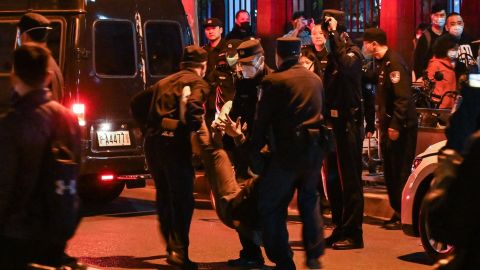
A protester is arrested by police in Shanghai on Sunday night.
A protester is arrested by police in Shanghai on Sunday night. HECTOR RETAMAL/AFP/AFP via Getty Image
 
Local authorities in China, making no allusion to credit the mass protests springing up all over China against the crude lockup methods being employed to stem the rising tide of COVID-19 outbreaks, have begun to ease imposed restrictions reflecting the state's zero-COVID mandate. In Beijing, the city government announced it plans to phase out gating to block access to apartment compounds where infections are diagnosed.

Manufacturing and trade centre Guangzhou, the current hot-spot in the latest wave of infections, announced that selected residents no longer will be required to undergo mass testing. The stringent measures originally in place to minimize deaths at the same time that other countries suffered magnitudes of infections and deaths no longer has the silent consent of the Chinese population.

According to the Chinese Communist Party ruling China, anti-coronavirus measures must continue "targeted and precise", while at the same time the least possible disruption should be caused to people's lives; local officials threatened with their jobs or similar punishments should outbreaks occur, codify their own strategies to match the central government's zero-COVID command-and-control demands.

Their response has been the imposition of quarantines and allied restrictions exceeding what the central government recommends. Hardships imposed on the population appear to be of no concern to the Xi administration, beyond the anodyne recommendations that lockdowns not cause community unrest. Millions of people in Shanghai were placed under strict lockdown in the spring, resulting in food scarcity and access to medical care being restricted.

Despite the ensuing turmoil, Xi loyalist, the city's party secretary, saw appointment to the No.2 position of the Communist Party. On the past weekend, protests were so sweeping in numbers and inclusivity many from among the educated urban middle class of the ethnic Han majority were in full vocal attendance. This is the group the ruling party relies upon to recognize a post-Tiananmen agreement that a better quality of life would accompany autocratic rule.

Following a fire on Thursday that killed at least ten people living in an apartment building in the city of Urumqi, where residents have been locked into their homes for four months, furious protests erupted particularly when the city council suggested those that died were insufficiently motivated to save themselves, prompting an avalanche of angry online questions whether firefighters or people attempting to escape the fire were blocked by locked doors or similar pandemic restrictions.

Foreign governments have suggested to Beijing that it use vaccines developed in the West to improve protection for its people, and once more effective vaccines are widely used the government could reconsider and ratchet back the draconian restrictions of the current zero-COVID policy. Beijing has consistently refused to import the mRNA-based more highly successful vaccines developed by Pfizer-BioNTech and Moderna, insisting its own home-grown vaccines are effective.
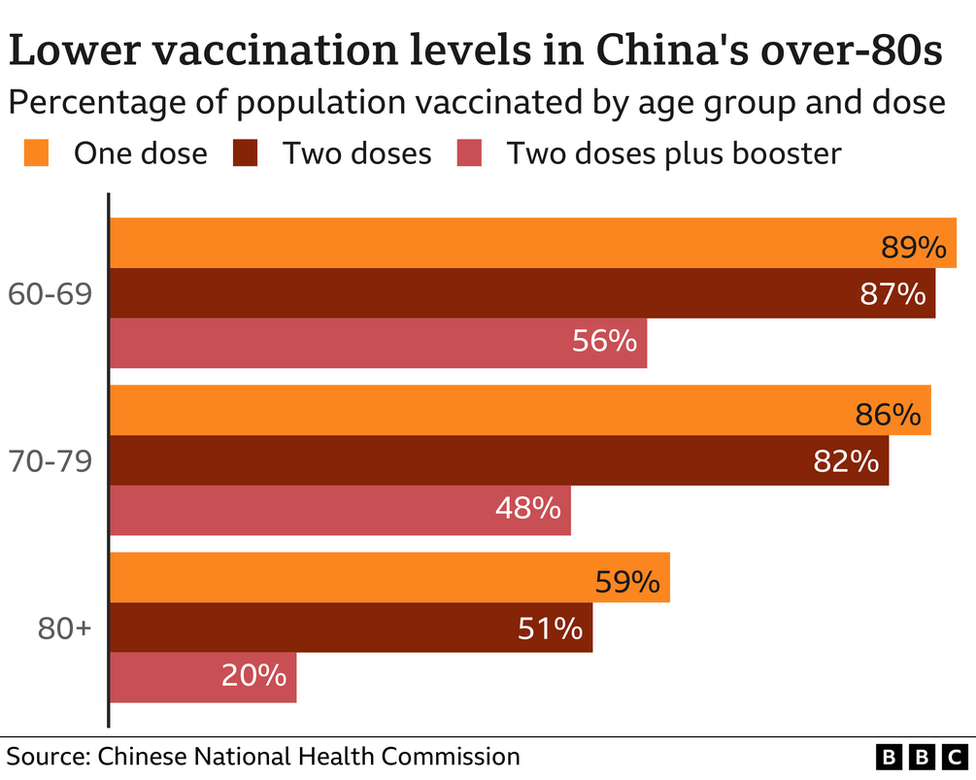
Charts of Vaccine rates in China
 
They are not, however. Moreover, the most vulnerable in the population, the elderly, have not received vaccinations in numbers that should satisfy any responsible government. Analysis indicates that millions of unprotected people could perish under current circumstances should zero-COVID be abandoned. The acceptance of Western vaccinations could turn that scenario around.

"Europe and Germany have had very good experience with administering mRNA vaccinations", stated Steffen Hebestreit, adding that Olaf Scholz had "made this clear" to Chinese officials during a visit by the German chancellor to China. China is steadfast in its reliance on its own vaccines based on older technology, failing to offer the same protection as the West's vaccines against severe disease and death.
"'Zero COVID' [was] supposed to demonstrate the superiority of the 'Chinese model', but ended up demonstrating the risk that when authoritarian regimes make mistakes, those mistakes can be colossal."
"But I think the regime has backed itself into a corner and has no way to  yield. It has lots of force, and if necessary, it will use it."
Andrew Nathan, Chinese politics specialist, Columbia University
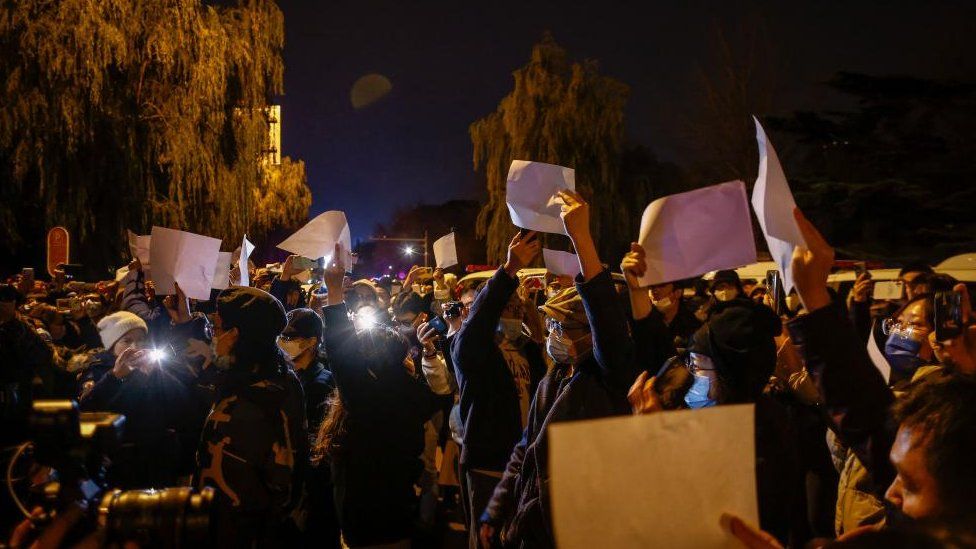
Protesters wave blank white pieces of paper during a protest triggered by a fire in Urumqi that killed 10 people in Beijing, China, 27 November 2022.
Protesters are fed up with lockdowns, but their government is not budging

Labels: , , , , ,

Monday, November 21, 2022

Toppling the Iranian Regime

"[The Islamic Republic's] strategic patience [is wearing thin; Tehran is preparing to[] punish [them: the U.S., United Kingdom, Israel and Saudi Arabia for their role in fomenting protests in Iran]."
"[The U.K. would] pay [for harbouring journalists working for a Persian-language satellite channel based in London whom British police have warned that the IRGC] represents an imminent, credible and significant risk to their lives and those of their families]."
Esmaeil Khatib, Iranian Intelligence Minister
 
"[We warned back in 2006 that Iran represents a threat to] the entire free world [as it] is not only seeking nuclear weapons, it is also destabilizing Lebanon with its Hezbollah proxy, supporting Palestinian terrorist groups, fueling Shiite militancy in Iraq and urging that Israel be wiped off the map."
National Post editorial
 
"[The National Post, as an institution, has been sanctioned by the Iranian Foreign Ministry for its] anti-Iran approach."
"[The sanctions are being imposed on the newspaper and eight individuals] for supporting terrorism and the Mojahedin Khalq Organization (MKO) terrorist group, inciting and encouraging terrorist acts and violence against the people of Iran, propagating false information about Iran and participation in the implementation and escalation of oppressive sanctions against the people of Iran."
"Obviously, the sanctions will not rule out the criminal prosecution of the individuals in competent courts of law due to their involvement in criminal actions."
National Post, 4 November 2022
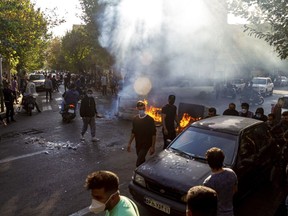
In this photo taken by an individual not employed by the Associated Press and obtained by the AP outside Iran, Iranians protests the death of 22-year-old Mahsa Amini after she was detained by the morality police last month, in Tehran, Thursday, Oct. 27, 2022.
The Conservative-led government of then-Prime Minister Stephen Harper closed off diplomatic relations with Iran in 2012. Cited were Iran's intrusions in Canada on the lives of Iranian-Canadians, an 8-month attack on the British embassy in Tehran giving notice that diplomats are in danger there. The fact that Iran was providing military aid to the Assad regime in the civil war in Syria, another; failing to comply with UN resolutions on its nuclear program, along with support of terrorist groups.
Also cited was Iran's routine threatening of Israel's existence, its racist antisemitic rhetoric and genocidal incitement. Official Canada spoke of Iran as "among the world's worst violators of human rights".
 
The Liberal, Trudeau government that followed stated its intention of restoring diplomatic relations with Iran. And in fact, negotiations between Canada and the Islamic Republic were taking place to achieve that end. Given more recent episodes in Iran's ongoing persecution of its people and its new role in providing Russia with killer drones in Ukraine, along with the stalemate between the IAEA over nuclear inspections and the continued stalling on a nuclear program that is close to achieving Tehran's purpose, capped by the murder by morality police of Mahsa Amini, a Kurdish woman, resulting in widespread protests, diplomatic renewal is no longer on the horizon.
 
 The ongoing protests erupting in every city across the country have brought out the country's police forces making use of deadly force. Estimates vary widely, but according to the group Human Rights Activists in Iran the most recent figures are over 300 dead, although other sources place that figure much higher. Tens of thousands of Iranians have been arrested. A week ago the Iranian parliament voted in favour of the death penalty to teach them -- protesters -- "a good lesson". The possbility of mass executions cannot be entirely discounted should the regime feel itself endangered.
 
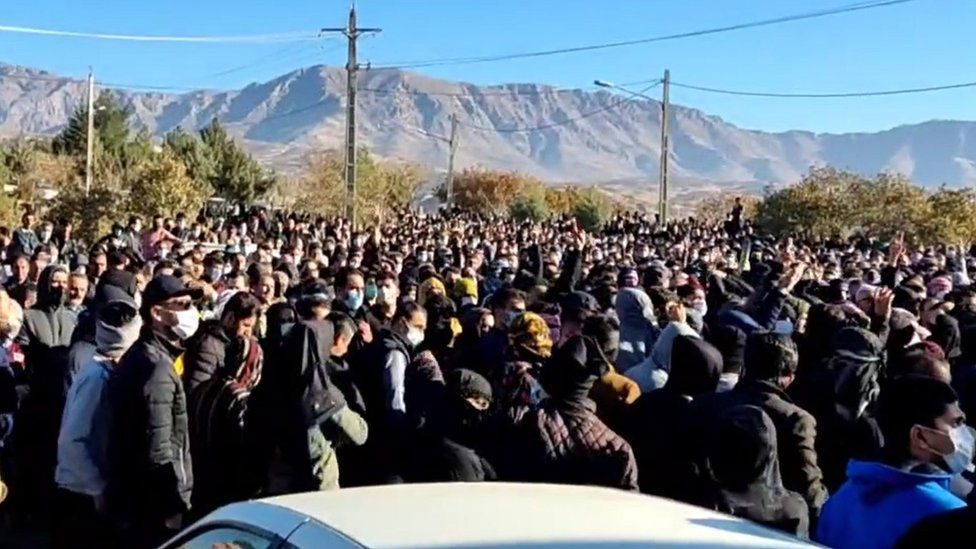
Mourners chant anti-government slogans at the funerals of two protesters in Javanroud, Bahaadin Vaisi and Irfan Kakai (21 November 2022)
Mourners chanted anti-establishment slogans at the funerals of two protesters killed in Javanroud  Hengaw
 
In the past decade, an estimated 6,876 Iranians have been executed, among them 67 youth and 185 women. The execution of protesters for crimes against god and nation are in their nascent stages. The International Atomic Energy Agency has released a report noting the Islamic Republic has amassed some 62.3 kilograms of 60 percent enriched uranium, a mere step from weapons-grade. Last week an IRGC official laid claim to his country's having developed hypersonic missiles able to evade modern air-defence systems.
 
The current government of Canada has been derelict in dealing adequately with the threat that Iran poses to the international community. It remains hesitant to list the Islamic Revolutionary Guard Corps as a terrorist organization, which it clearly is, and despite the fact that the Parliament of Canada voted in favour of doing just that. It would be humorous if it were not so diabolically serious that Iran accused Canadians it has targeted for sanctions of "facilitating and supporting terrorist acts". Threatening the seizure of the property in Iran of the eight Canadians sanctioned; of which there are precisely none.
 
Nor may they make use of Iran's banking system, or travel to the country. They are, needless to say, horribly disappointed. The people of Iran, out on the streets protesting courageously braving the assaults from the basij paramilitary and the riot squads and other policing agencies have seen expatriate Iranians living abroad coming out in droves to protest before Iranian embassies in foreign cities. They have seen people not of Iranian origin worldwide express solidarity with their struggle and protesting on their behalf to reawaken the world's conscience. 
 
What they need, desperately, to see is the regime of the Ayatollahs and the IRGC falter and fall. Leaving the population to recover its dignity and its hope for the future. A population that will be free to choose for itself whether it will remain a theocracy, whether it will continue to foment violence and terrorism at home and abroad, or will relax the restrictions imposed on them to be victims bound to a theological ideology that has been corrupted and anti-human in its sweep of human rights violations.
 
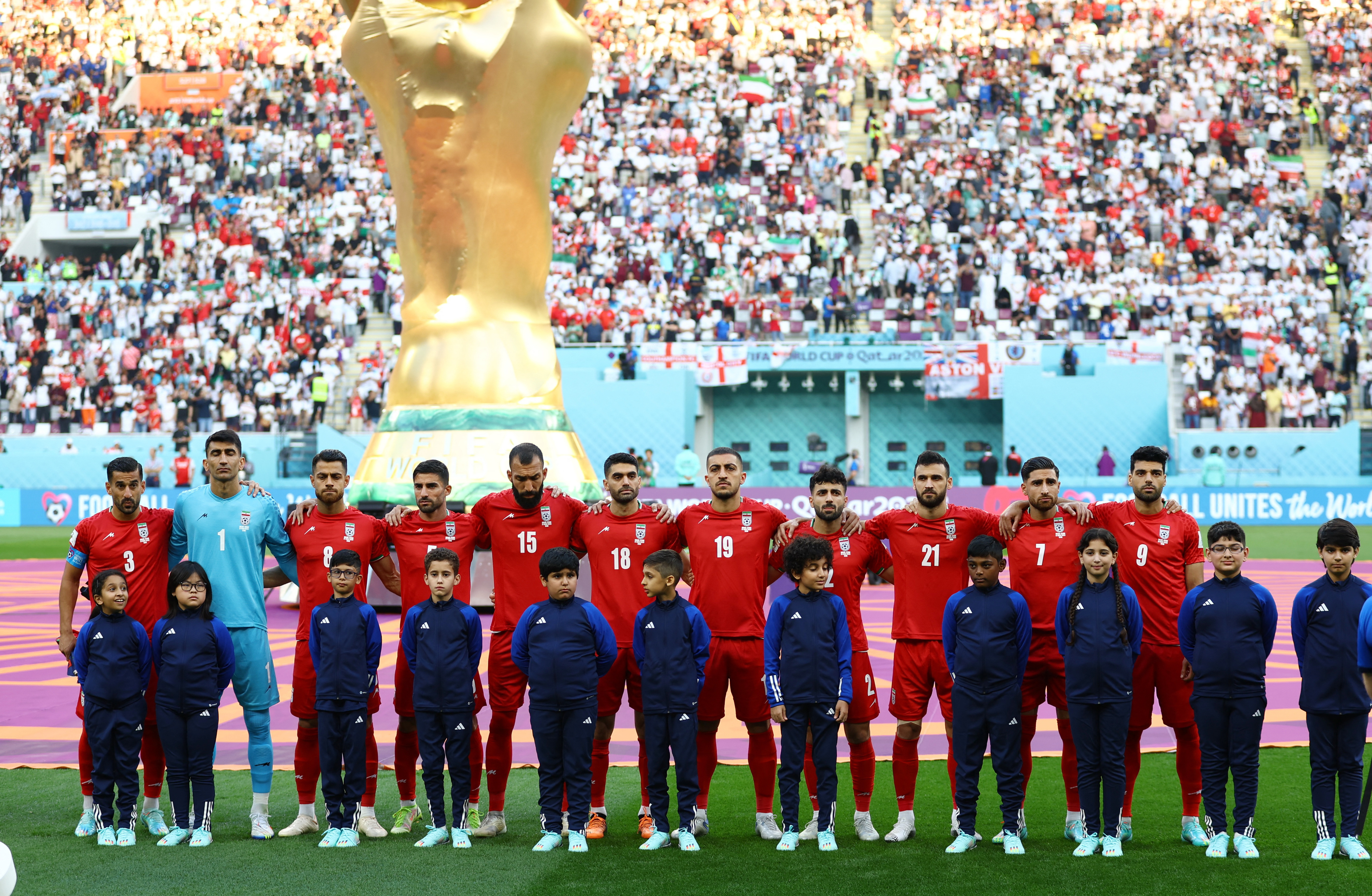
FIFA World Cup Qatar 2022 - Group B - England v Iran
Soccer Football - FIFA World Cup Qatar 2022 - Group B - England v Iran - Khalifa International Stadium, Doha, Qatar - November 21, 2022 Iran players line up before the match REUTERS/Hannah Mckay


Labels: ,

Monday, September 14, 2020

Solidarity or Just Plain Old Intimidation?

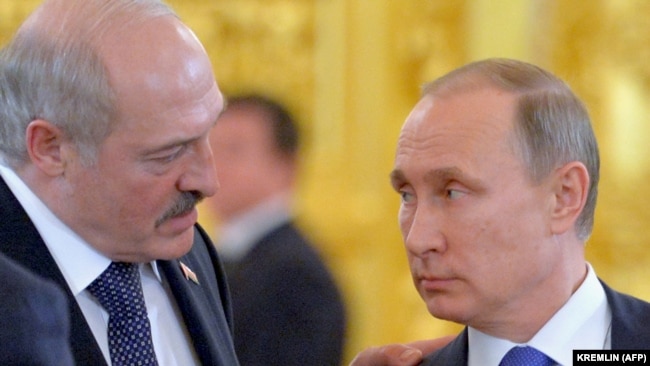
Belarusian President Alyaksandr Lukashenka (left) with his Russian counterpart, Vladimir Putin (file photo)
Belarusian President Alyaksandr Lukashenka (left) Vladimir Putin
"[There's a risk that] Russia will turn the most friendly neighbor they have into a population that sees them as an accessory to Lukashenko and his authoritarianism."
Nigel Gould-Davies, former U.K. ambassador to Belarus
 
"Participants in the unauthorized mass gathering blocked traffic and public transport and created a threat to the safety of road users."
"It's a shame to watch: screams, screeching... [of female protesters]. Such behavior is unfeminine."
Interior Ministry spokeswoman Olga Chemodanova 

"Fear is bad, violence is bad, lies are bad. You can’t pretend like nothing’s happening."
Belarusian State University languages department teachers video appeal for freedom of speech
 
"[Lukashenko would seek to intensify detentions and threats ahead of the Putin meeting] to show the Kremlin that the protests are abating and he is in control of the situation."
"But so far repression has had the opposite effect."
Ales Byalyatski, director, Vyasna human rights center

Opposition supporters protest against authoritarian leader Alexander Lukashenko in Minsk on Sunday.TUT.BY/AFP via Getty Images

Russia's defence ministry has announced that paratroopers from its elite Pskov division are being sent to Belarus. No worries; these are for joint drills to be initiated on the 14th, according to TASS state news agency. A show of solidarity between Russia and Belarus, nothing abnormal there, it's what friendly, neighbouring countries do, after all. No messages implicit or otherwise to the tens of thousands of Belarusians marching with messages for their autocratic ruler that they demand his resignation and a redo of the presidential election.

Their patient president and his staunch supporter, Vladimir Putin, have arranged a joint military exercise to help the people of Belarus focus on their unfortunate misunderstanding and to disavow it like the good, obedient people that they are, so that life can get back to normal for them and for Alexander Lukashenko who has, after all, no intention of stepping down, for the good of his country and for the ingrates that fail to acknowledge his sincere devotion to their well-being.

Of course 100,000 people exercised sufficiently with a sense of outrage over rigged election results do comprise a sizeable proportion of people fed up with the status quo, that's undeniable. They have experienced a gap in credibility over claims of a landslide election favouring the continuation of the 26-year reign of a president whose presence they have become fed up with. Electorates are like that, and are never to be taken for granted; as for example their absurd ideas about democracy.

So, "Slavic Brotherhood" joint military drills are in order. 

For the simple fact of the matter is, neither their president nor his  reat good friend Mr. Putin view favourably a return to Belarus of Sviatlana Tsikhanouskaya. They feel she should remain just where she is, in Lithuania. Foreign powers manipulating events in Belarus will not succeed in their malicious interference in the affairs of a sovereign state, whose independence Moscow has agreed is unassailable. The abduction and imprisonment of opposition figures? Simply a security measure to ensure public order is followed. A matter of public security, of adherence to the law.

Protesting, rioting, upsetting fellow countrymen who have the great good sense to remain at home, and carrying insulting signage are not the actions of patriotic people, but instead betray who and what they really are; thugs, in the pay of foreign elements seeking to wreak havoc in Belarus. It is beyond rude to carry a banner "Long live Belarus" and shout in unison "You're a rat" to their honourable president. Just no respect where it is due whatever; hang your heads in shame, Belarusians.

Nor should riot police tasked with maintaining law and order, be faced with crowds shouting "fascists" at them. The use of water cannons on protesters is justified in the maintenance of a peaceful and law-abiding society, where trouble-makers seek to upset order and good governance. Shots fired toward protesters? Well, threaten the Belarusian leadership and such things accidentally occur, you see. Barbed wire fencing around critical areas to keep the thugs at bay? Ordinary precautions.

A friend in need is a friend indeed and Belarus has that friendship in its neighbour, Russia. Which has offered its moral and practical support. Out of a desire to bring this unhappy situation to an end, Moscow will restructure Belarusian debt, and provide banking liquidity. And if need be, should these inconvenient and uncalled-for public displays of disobedience by the rabble continue to occur, Russian riot police can always be available on request.

Tens of thousands of opposition supporters are estimated to have marched through the streets of Minsk on September 13  TutBy Reuters


Labels: , , , ,

() Follow @rheytah Tweet