Politic?

This is a blog dedicated to a personal interpretation of political news of the day. I attempt to be as knowledgeable as possible before commenting and committing my thoughts to a day's communication.

Monday, June 15, 2026

Have Turkey's Erdogan and Russia's Putin Kissed-and-Made-up for the Very Last Time?

"This is a person [Recep Tayyip Erdogan] who keeps his word — a man."
"He does not follow his tail. If he believes it is advantageous for his country, he goes to the end"
"There is an element of predictability, and it is very important to understand who you are dealing with."
Vladimir Putin, 2021
 
"[Putin’s words are] exactly how I have known Mr. Putin since I first met him."
"He is straightforward and keeps his word."
"It is rare to have such strong relations with any state."
Recep Tayyip Erdogan
The Uneasy Alliance Between Putin and Erdogan
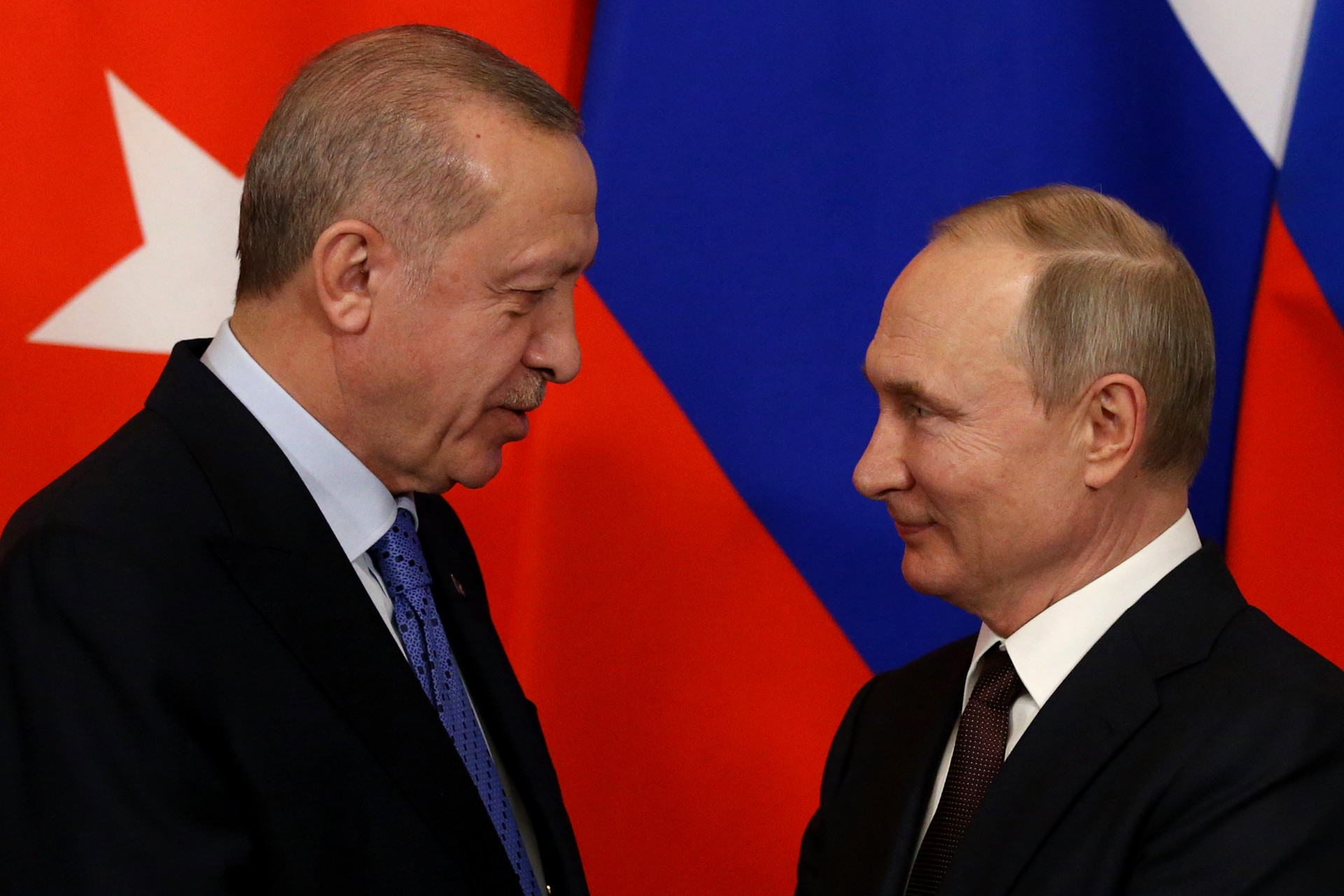
Russian President Vladimir Putin and Turkish President Recep Tayyip Erdogan at the Kremlin on March 5, 2020 in Moscow, Russia/ Mikhail Svetlov/Getty Images
  
"On Nov. 24, 2015, Turkey shot down a Russian fighter jet over Syria, resulting in the deaths of two Russian soldiers and prompting a sometimes spine-chilling war of words. At his annual press conference in December that year, Putin’s description of Erdoğan was quite different from the one he gave five years later. He said he did not “see any prospect of improving relations with the Turkish leadership,” whom he accused of trying to “lick the Americans in a certain place”."
"Sinking the knife in even deeper, Putin accused Erdoğan of betraying the secular system put in place by Turkey’s national hero, Mustafa Kemal Atatürk. “The creeping Islamization would probably cause Atatürk to turn in his grave,” he said. Erdoğan, for his part, lambasted Russian “war crimes” in Syria. Russia imposed sanctions, with the package holidays that brought hundreds of thousands of tourists to Turkey’s Mediterranean coast halted and goods like Turkish tomatoes no longer welcome in the other direction."
Stuart Williams, New Lines Magazine  
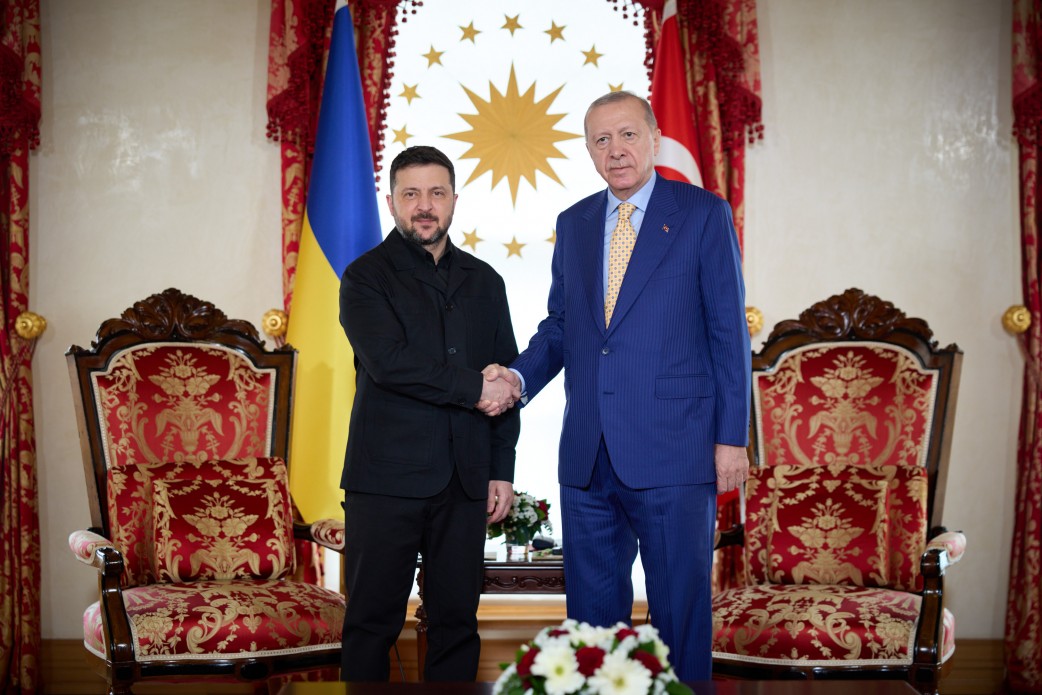
Suddenly Turkey is Ukraine's best friend -- no, really. With Erdogan's courteous assistance, Ukrainian President Volodymyr Zelenskyy now has cordial ingress to the movers-and-shakers of the Middle East. Many of whom have been under extreme violent duress, with the Islamic Republic of Iran punishing the Gulf states for their friendliness with the United States, not to mention Israel. U.S. military bases in Saudi Arabia, the UAE, Bahrain, Qatar and Kuwait, all of whom have been, to some degree targeted by the IRGC; above all, the United Arab Emirates.
 
If any leader of any country currently knows anything about counteroffensives and self-preservation, it is the Ukrainian President, and he is more than pleased to be able to demonstrate what the Ukrainian military has learned while it has been under massive bombardment by an aggressive, much larger conventionally armed neighbour. The Iran war has enabled Mr. Zelenskyy to cultivate closer ties with Gulf states. The Shahed-136 kamikaze drones that Russia uses in Ukraine have been supplied to Iran by Russia and China.
 
https://www.president.gov.ua/storage/j-image-storage/57/22/45/04cea6a977c8fa00116ae17bf3ba8d4c_1775321832_extra_large.jpeg
At the Dolmabahçe Palace in Istanbul, President of Ukraine Volodymyr Zelenskyy held a meeting with President of Türkiye Recep Tayyip Erdoğan.  President of Ukraine
 
Ukraine's answer to the devastating attacks on its cities and civil infrastructure was almost-instant devising, production and use of surprisingly simple advance drone technology which has given it longer reach into Russia itself, demonstrating what's good for the goose is fine for the gander in blowing up Russian military bases, bridges, ships, weapons storage, and oil depots. Ukrainian resistance has resulted in the deaths of tens of thousands Russian servicemen monthly, dealing severe blows to Russia's troop numbers and recruitment.
 
With all that experience behind them, Ukraine was pleased to dispatch air defense teams to Qatar, Saudi Arabia and the United Arab Emirates. Turkey, in ushering Ukraine into the comfort zone of making new contacts in the Middle East, has a new partner, as it leaves behind the old one with which its own agenda was never quite a perfect fit. After all, during the drawn-out civil war in Syria, Turkey armed the Sunni groups trying to break Bashar al-Assad's Alawite grip on the country, even as Erdogan targeted Kurds whose fighting prowess was superior to all of the regime's opponents.
 
And it was Russian warplanes out of the Russian air base in Syria that constantly flew over Sunni strongholds bombing them mercilessly. Just incidentally the very same Sunni fighting groups that Mr. Putin has attempted after the fall of President Assad, (domiciled now in Russia), to ingratiate himself with, hoping to be able to maintain both his remaining naval and air bases in the new Sunni-led government of Ahmed al-Sharaa. 
 
https://www.newarab.com/sites/default/files/media/images/0A76B1EF-A62A-44EC-89A0-0F4D6392318C.jpg
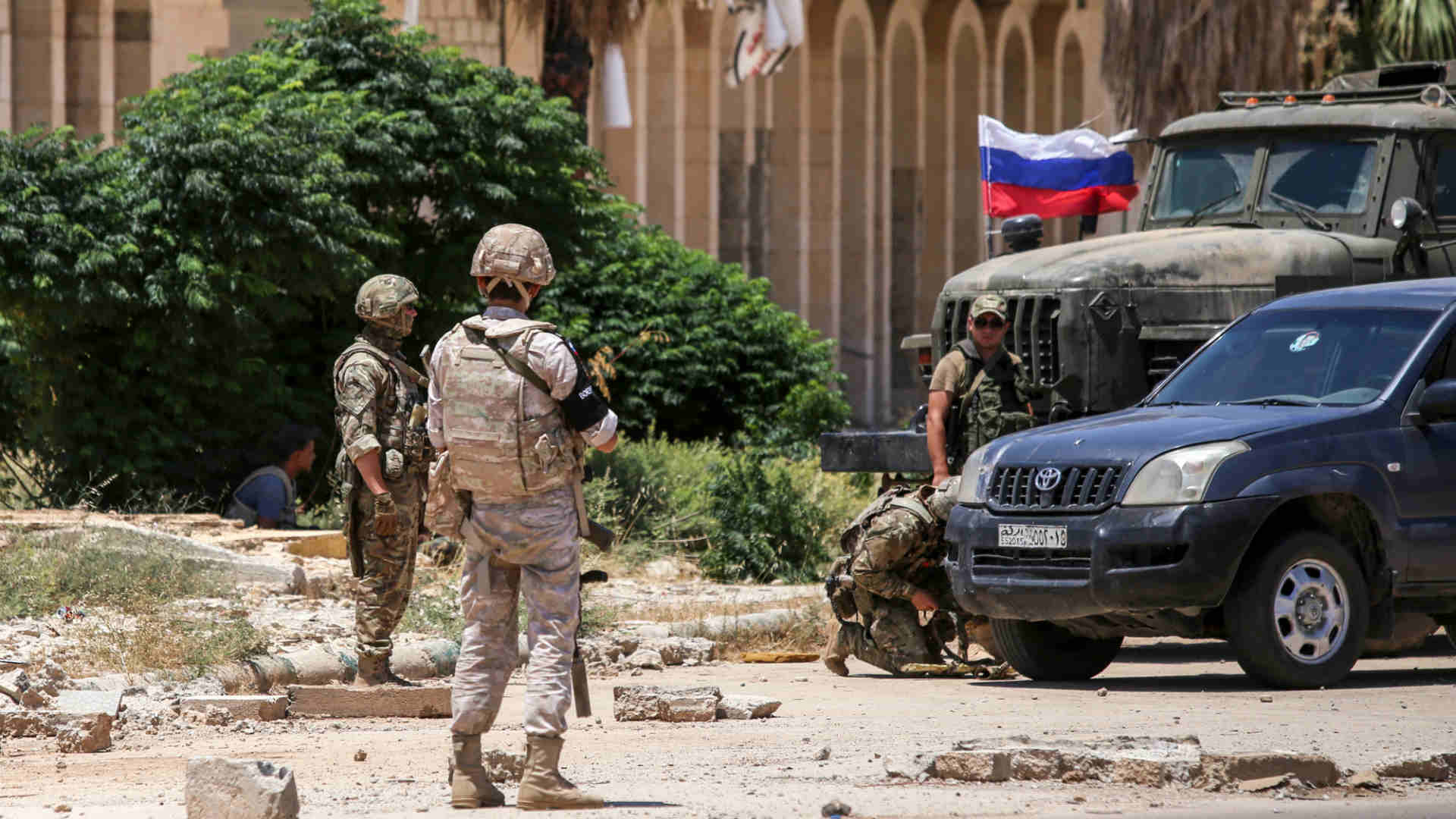
The Russian military presence in Syria has declined significantly over the past two years, from 114 military sites to only two bases today. [Getty]
 
In the early years of Russia's conflict in Ukraine when Moscow was isolated by the West, Turkey, though a standing member of the NATO alliance, spurned the sanctions. In the process becoming a link for Russian trade, investment and energy flows. A situation that gave Ankara greater leverage over Moscow. Russia, before the ouster of the Syrian Alawite regime, could do anything it wanted there and had hundreds of military bases; now under the new Sunni-led regime, reduced to two, albeit its major bases. 
 
It is Turkey that is now the power lever in Syria, helping its interim president al-Sharaa to be presented to the EU, the U.S. as the new, kinder, 'democratic' face of Syria with whom they could all do business with confidence. And in the process, Turkey has become the king-maker, which suits its future plans of greater dominance in the Middle East very well. A role that as a junior partner to Russia for so many years, Russia cultivated for itself, while it is Turkey now that has inserted itself in helping to rebuild the Syrian Army.
 
By openly giving assistance to Ukraine's President Zelenskyy, Mr. Erdogan is amply demonstrating that once again Turkey has spurned its sometimes-tenuous, but generally past-useful allyship with Russia, moreover a Russia that has, by its territorial aggression served to isolate itself, while continuing to aggravate and threaten his eastern European neighbours and needling NATO, of which Turkey is a member. Vladimir Putin and his war-wearied economy has lost the projection of global power, and Turkey for the time being has no further use of his allyship with Russia. 
 
https://cdn-live.foreignaffairs.com/sites/default/files/styles/_webp_medium_2x/public/images/2026/06/09/2025-09-01T101030Z_1521986028_RC2YIGAOA3UO_RTRMADP_3_CHINA-SCO-PUTIN-ERDOGAN.JPG.webp?itok=fDEDQRY6
Russian and Turkish delegations at a summit in Tianjin, China, September 2025 Vladimir Smirnov / Reuters


Labels: , , , , , , ,

Monday, December 01, 2025

Syria's Mass Graves

 
"Shortly after the fall of Bashar Assad in Syria in December 2024, reports emerged of mass graves being uncovered in liberated areas."
"Grim as such discoveries are, they should come as little surprise. The scale of the regime’s torture and killings in its detention facilities became evident years earlier, when in January 2014 a forensic photographer defected and left the country with a cache of 55,000 photos of people who had been tortured and died in detention."
"As an expert in forensic anthropology and mass casualties in conflict, I was asked to evaluate what became known as the “Caesar photographs.” What was clear to me then, and is even more so now, is that those photos represented a systematic approach to torturing, killing and disappearing massive numbers of people by the Assad regime."
"With Assad now gone, the newly formed government of the Islamist group Hayat Tahrir al-Sham has vowed to seek justice for the crimes Syrians suffered under Assad. Doing so will be difficult, even with the civil war in Syria being one of the better monitored conflicts in recent history. Yet it is a task that is imperative for the sake of pursuing justice in a shattered country and reducing the likelihood of violence returning to Syria."
Stefan Schmitt,  Project Lead for International Technical Forensic Services Global Forensic Justice Center, Florida International University 
https://images.theconversation.com/files/648151/original/file-20250211-15-8m8hg0.jpg?ixlib=rb-4.1.0&rect=0%2C0%2C5819%2C2905&q=75&auto=format&w=1336&h=668&fit=crop&dpr=1
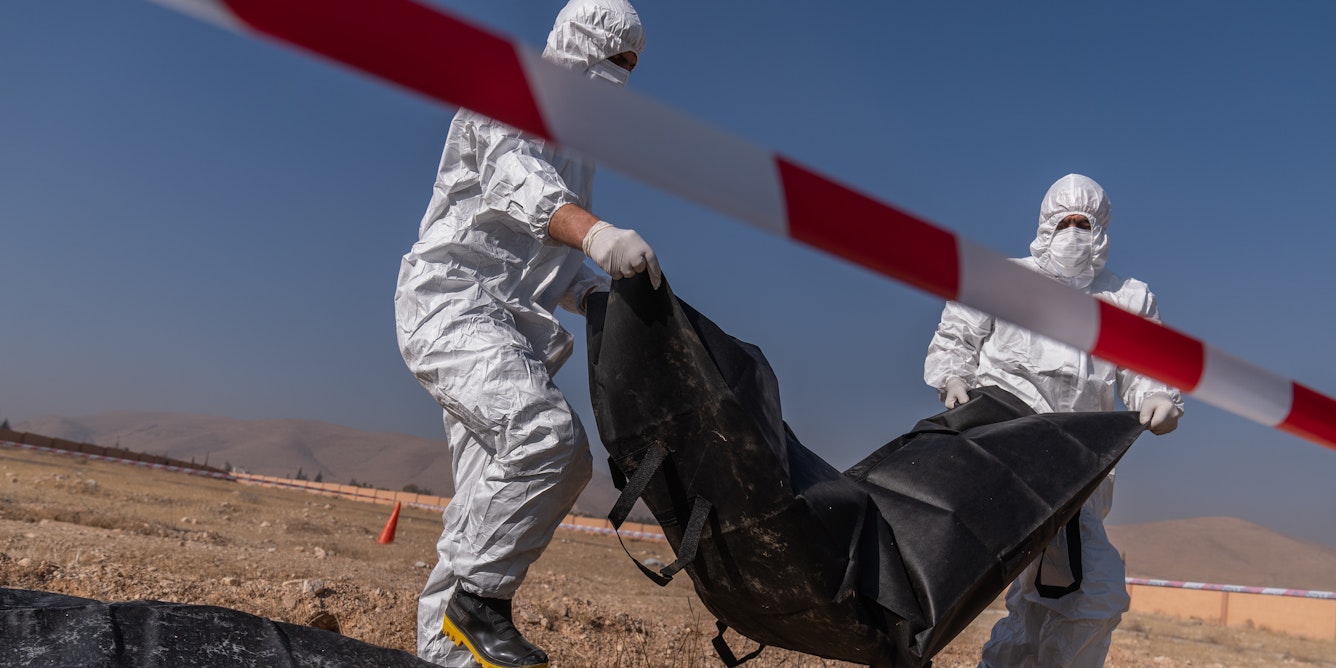
Members of the volunteer Syrian Civil Defense conduct work at a mass grave in the Baghdad Bridge area outside Damascus, Syria, on Dec. 17, 2024. Emin Sansar/Anadolu via Getty Images
 
"According to the Syrian Observatory for Human Rights, the uncovered graves were distributed as follows:
*November 6: Remains believed to belong to more than 5 people were found inside a farm near the village of Al-Ghizlaniyah on the road to Damascus International Airport.
*November 11: Remains of 3 people were found in a mass grave in the village of Tal Melah, northwest of Hama, during rubble removal. The victims’ identities remain unknown.
*November 17: Remains of 6 people were discovered inside the Air Defense Battalion "Batchoura" in the town of Otaya in Rif Damascus, during sewage rehabilitation work.
*November 30: A mass grave containing the remains of 10 unidentified individuals was found on the Tarablous road opposite the village of Al-Mazraa west of Homs, during construction work."
ANHA, Hawar News Agency  
https://hawarnews.com/en/uploads/images/202511/image_870x_692c8f55c5a3d.jpg
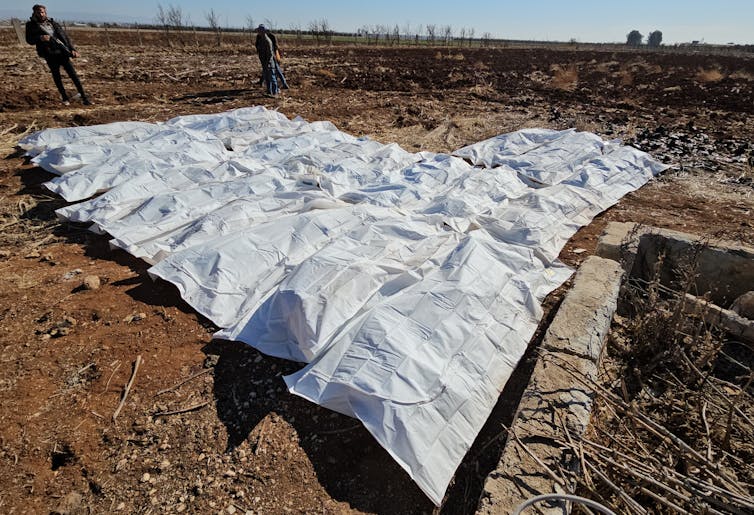
The month of November witnessed a series of shocking discoveries across several Syrian regions, where a number of mass graves containing the remains of 24 individuals were uncovered during debris removal and infrastructure cleaning operations. ANHA
 
 Following the overthrow of Syria's dictatorial president Bashar al-Assad in December, families of missing Syrians would arrive a the Najha cemetery hoping to find remains of their missing loved ones. They were intent on digging up the mass grave there marked by mounds of overturned dirt with their shovels. Once the realization set in that what they would find would represent bones in body bags with no way left to them to determine to whom those bones belonged, they gave up their desperate searches.
 
Tens of thousands of Syrians whom the Assad regime considered opponents had been detained and disappeared during the 14-year civil war between the Alawite Shiite regime of Bashar al-Assad and the majority Sunni Syrians. Many of those in Assad's prisons were killed under torture or executed, pointed out human rights groups. This was a regime that used chemical agents in their bombs to asphyxiate people, barrel bombs to tear them limb to limb, helicopter gunships targeting people waiting in bread lines.
 
Uncountable numbers of regime victims were hurriedly buried at the Najha cemetery outside the capital Damascus. Syrian families are haunted by the fate of their missing relatives. No fewer than 60 mass graves have so far been identified in Syria, with new ones discovered on a regular basis. The exacting forensic work to determine the identity of each of the bodies being recovered has become a problem for Syria's new government which has pledged accountability and justice for the Assad regime's war crimes.
 
For one man, 36-year-old Khaled al-Mishtowli, the loss of his family members are many in number; three brothers, his father, three cousins and two aunts. The agonizing work of identifying the bodies would have been advanced, he says wistfully, if those burying them "had at least buried the people's ID cards with their bodies".  The process of of exhuming and identifying the bodies will be a long, arduous, undertaking, which he and others call on the government and international groups to undertake. 
 
https://images.theconversation.com/files/648152/original/file-20250211-15-csj6hu.jpg?ixlib=rb-4.1.0&q=45&auto=format&w=754&h=515&fit=crop&dpr=1
An uncovered mass grave believed to contain the remains of civilians killed by the ousted Assad regime in Daraa, Syria. Bekir Kasim/Anadolu via Getty Images
 
According to the Syrian minister of emergency and disaster management, about 140,000 Syrians are missing. The figure of 400,000 deaths by the Assad regime has long been recognized. In 2013, Mr. al-Mishtowli explains, his relatives began disappearing from their town of Sayida Zeinab on Damascus' outskirts as they were engaged in ordinary pursuits, or on their way back home from their workplaces. His family members, all of whom were Sunni Muslim, were apprehended by pro-regime Shiite militias, he believes.
 
"We are asking for anyone, international organizations, the United Nations, anyone who can exhume the bodies and identify them", he pleaded. In response, a spokeswoman for a new Syrian commission on missing people responded: "This is a very long process, one that began now but will unfortunately extend over many years". Her commission will be dependent on international organizations to assist in building the required technical and forensic capabilities such as DNA laboratories. 
 
"The international community has to help the Syrian authorities to build infrastructure first, and to train their people to learn how to eventually do this on their own", explained Karla Quintana of the U.N. Independent Institution on Missing Persons in Syria, -- whereas in the past the United Nations and other international bodies took responsibility for exhuming mass graves.  
"We really haven’t seen anything quite like this since the Nazis."
"From the secret police who disappeared people from their streets and homes, to the jailers and interrogators who starved and tortured them to death, to the truck drivers and bulldozer drivers who hid their bodies, thousands of people were working in this system of killing."
"We are talking about a system of state terror, which became a machinery of death."
"I don’t have much doubt about those kinds of numbers given what we’ve seen in these mass graves."
Stephen Rapp, former U.S. war crimes ambassador at large
https://media-cldnry.s-nbcnews.com/image/upload/t_fit-860w,f_auto,q_auto:best/rockcms/2024-12/241218-syria-mb-1048-7858ec.jpg
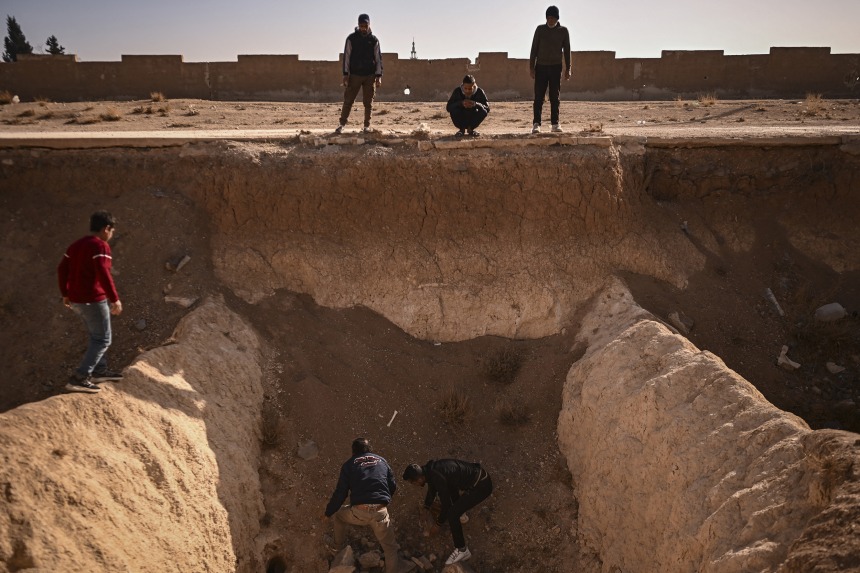
People search for human remains at a trench believed to be used as a mass grave on the outskirts of the Syrian capital, Damascus.   Aris Messinis / AFP via Getty Images


Labels: , , , , ,

Thursday, March 18, 2021

A Country That Was Once Syria and the Agony of Its People

(Khalil Ashawi/Reuters)  "More humanitarian access is needed,. Intensified cross-line and cross-border deliveries are essential to reach everyone in need everywhere."

"If Bashar al-Assad wins or survives in ways that give him control over most of Syria, Iran will have a massive new degree of influence over Iraq, Syria, and Lebanon in a polarized Middle East divided between Sunni and Shi'ite and steadily driving minorities into exile."
Anthony Cordesman, (2013) military and national security analyst, Center for Strategic and International Studies
 
"Bashar was never going to accept anything short of a total restoration of the 'wall of terror' built by this father in the 1970s and 1980s."
"No peace negotiations or reconciliation processes will ever change this reality, which has been built on fear and enforced with sectarian weapons."
Mustafa Khalifa, Syrian intellectual
 
"I would never (forget). When I left Syria, I had one of those rubber bands that you wear on your wrist. I had the Syrian flag on my hand. I swore that I will never take it off until I actually get my Canadian citizenship."
"Every day I look at it, it reminds me of what I've been through and what I've become right now."
"The big misconception is people calling it war. I guess it's war now, but it wasn't war when it started. It was a revolution against the dictatorship regime."
Mohammad Al Masalma, owner Mosy Photography, Syrian refugee, Halifax
FILE PHOTO: A father reacts after the death of two of his children, whom activists said were killed by shelling by forces loyal…
A father reacts in 2013 after the death of two of his children, whom activists said were killed by shelling from forces loyal to Syria's President Bashar al-Assad, at alAnsari area in Aleppo.

Syrian Sunnis felt they had good reason to mount protests against their status as citizens of Syria ruled by a Shi'ite Alawite minority regime that ignored the human rights of the majority Sunni population. Their president felt they had no right to protest anything. He called them terrorists. He warned the world community that if the protests which turned into armed rebellion after the Syrian military arrested, tortured and murdered children and adults alike for presuming to protest their living conditions and human rights, would impact the entire Middle East. 
 
What started as a peaceful protest became a searing, no-holds-barred civil war.

Sectarian hatred, tribalism, ethnic loyalties have always divided the Middle East. In Syria those divisions became a symbol of just how gruesome atrocities can become as commonplace instances of rancor and rage as the conflict began to attract the attention of seasoned Islamist jihadists from other dangerous conflicts like Libya arriving in Syria to further season the simmering pot of lethal antipathies. Syrian Sunnis whether or not they became part of the rebellion, became victims in a war of attrition, targeted by their president as connivers with the rebels intent on bringing down the regime.

It took no time at all before terrified Sunnis were forced to vacate their homes, their farms, their businesses, and towns seeking to escape being strafed and bombed by military aircraft. Hospitals, clinics, schools, apartment buildings were being indiscriminately bombed as long as they were in Sunni-majority areas. Heritage UNESCO areas of ancient antiquity weren't spared. Soon a new scourge entered the ravaged areas calling itself a new caliphate and threatening Christians, Yazidis and Kurds with death as infidels. 
 
The Islamic State of Iraq and the Levant's publicized atrocities horrified the world.
 
A doctor talks with refugees at a camp for displaced people in Atme, in Syria's northwestern Idlib province, near the border with Turkey, March 14, 2020.
A doctor talks with refugees at a displaced persons camp in Atme in Syria's northwestern Idlib province near the border with Turkey, March 14, 2020
 
But it was the Syrian regime of Bashar al-Assad that was responsible for slaughtering a half-million of its own citizens, of creating six million displaced Syrians living in squalid camps within Syria, and another six million swelling refugee camps in Turkey, Iraq and Lebanon. Europe and North America became the destination of Syrian refugees hoping to secure a future for their families. It has been a decade since the first demonstration turned into an uprising on March 15, 2011.

Then the Assad regime began to put down a rebellion of 'terrorists', turning to barrel bombs for greater effect in bombing innocent civilians and rebel groups alike. This has been as much Iran's war as it has been Syria's. Assad wants his authority reestablished throughout the country that was once Syria, and Iran plans to be the power behind the throne, as its rightful destiny. The Syrian Observatory of Human Rights counts 560,000 dead, while the Syrian Network for Human Rights places that figure 100,000 greater taking account of the Syrians brought to Assad's dungeons and never seen again.
 
Syrian amputee in refugee camp, with his children  (Mahmoud Hassano/Reuters)
 
With Tehran and Moscow at  his side, Bashar al-Assad prevailed. The Peshmerga in Kurdistan made it their mission to destroy ISIL's power base and threat to defenceless communities, even as Turkey as the neighbour sheltering more Syrians than any other, violates the Syrian border with the intention of rooting out a Kurdish presence in collaboration with the anti-Turkey Turkish Kurdish PKK. The awkward collaboration between Moscow and Ankara in defiance of a U.S. presence failed to relieve the agony of Syrians.
 
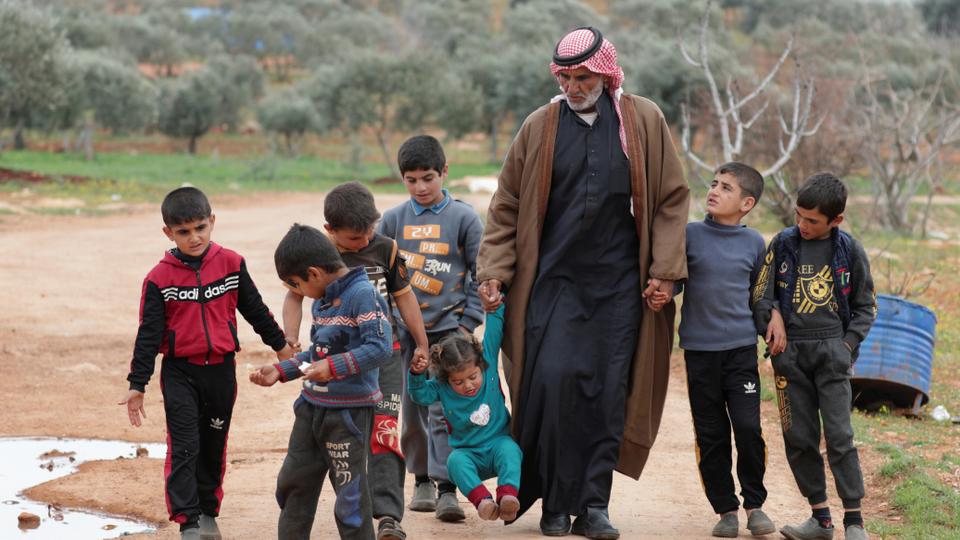
Syrian farmer, walks with his grandchildren, at an internally displaced camp in northern Idlib, Syria on March 11, 2021.
Syrian farmer, walks with his grandchildren, at an internally displaced camp in northern Idlib, Syria on March 11, 2021. (Reuters)

Any censuring initiatives arising in the United Nations is foiled by Russia which has gained a deep-water seaport and an airbase in Syria for its invaluable assistance in bombing Syrian Sunnis. The U.S. under the Obama administration challenged Assad to avoid using proscribed weapons against his people, that would be a 'red line' that could never be tolerated. The sarin gas attack in 2013 in Ghouta killed up to 1,729 Syrians of all ages. A trifling inconvenience that required no response from the U.S.

With that level of assent-by-unresponsiveness, there was nothing that would stop Assad from continued use of poison gas as a weapon of mass destruction and he now has over 300 chemical attacks under his belt, along with Russian protection of his regime. But of course the Obama administration could do little because to intervene in Syria would mean encountering the Russian air-defence system at Assad's disposal. Except the Russian anti-aircraft batteries appear to be unused, along with the Chinese low-altitude radar system.

The reality appears to be that only Israel has committed to deterring the best-laid plans of the Islamic Republic of Iran in its takeover of Syria and placement of Hezbollah at Syria's ostensible disposal. The Israeli Air Force carries out myriad bombing attacks on Hezbollah targets in Syria. The Israeli Air Force is well on its way to destroying a good proportion of Syria's air defences. And still maintains diplomatic relations with Moscow. 
 
The mass butcher of his own civilians remains beyond accountability for the atrocities he has committed against his country and its people. Aided and abetted by Russia and by Iran there appears no appetite from within the international community to demand justice for those who lost their human rights along with their disposable lives.
 
An explosion is seen following Russian airstrikes on the village of al-Bara in the southern part of Syria's northwestern Idlib province.
An explosion is seen following Russian airstrikes on the village of al-Bara in the southern part of Syria's northwestern Idlib province, March 5, 2020.   AFP


Labels: , , , ,

Friday, February 26, 2021

How Soon Forgotten! Justice Delayed is Justice Denied

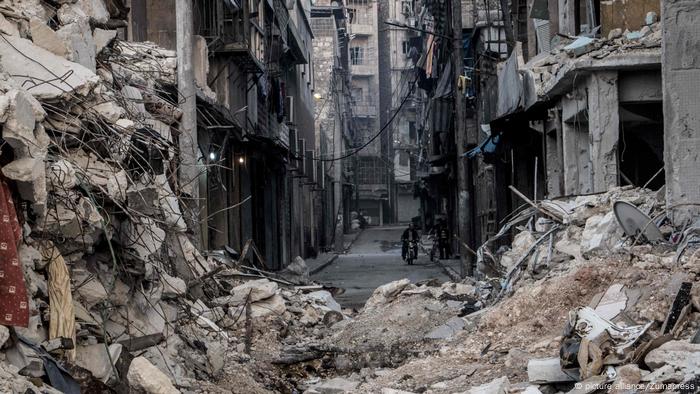
Ruined street in Alepp
The regime of Syrian President Bashar Assad has committed crimes against humanity and war crimes by subjecting cities to unlawful sieges that gave civilians no choice but to give up or die.

"[The] ICC has not opened an investigation in relation to Syria."
"Syria is not a state party to the Rome Statute and has not accepted the ICC [International Criminal Court] jurisdiction."
"Thus, crimes committed by its citizens on its own territories do not fall under the ICC jurisdiction, unless the [United Nations Security Council] would refer the situation to the ICC, which has not happened to date."
ICC spokesperson, Fadi el-Abdallah 

"The most heinous of violations of international humanitarian and human rights law perpetrated against the civilian population in Syria since March 2011."
"Such acts are likely to constitute crimes against humanity, war crimes and other international crimes, including genocide."
Commission of Inquiry on the Syrian Arab Republic report

"This matter has not been referred to the ICC, despite the several calls by the commission of inquiry, and numerous recommendations by the Human Rights council for the UN Security council to do so."
"[The Commission is exploring other] areas of criminal justice] to address the matter of Syrian war crimes]."
Office of the United Nations High Commissioner for Human Rights
"There were rivers of blood and maggots [exuding from the bodies], once, I couldn’t eat anything for days."
"[Some corpses were totally rotten and their faces] unrecognizable [as if they had been deliberately disfigured with a chemical. It is the stench of the rotting corpses that most disturbed him and continues to date.] The smell stayed in my nose, even after I showered at home."
Syrian undertaker,witness Z 30/07/19
 
"Someone gives evidence that mass graves were still being dug until at least 2017. This is the kind of government, the kind of regime, that you don’t establish relations with."
"[The revelations made in such testimonies and the evidence laid out] will facilitate future trials against regime officials if they were caught traveling to Europe."
"The individual acts of torture only constitute a crime against humanity if they are being committed within a specific context, that being a widespread and systematic attack against a civilian population. Z’s testimony establishes the crimes were systematic."
Patrick Kroker, senior legal advisor on Syria, European Center for Constitutional and Human Rights
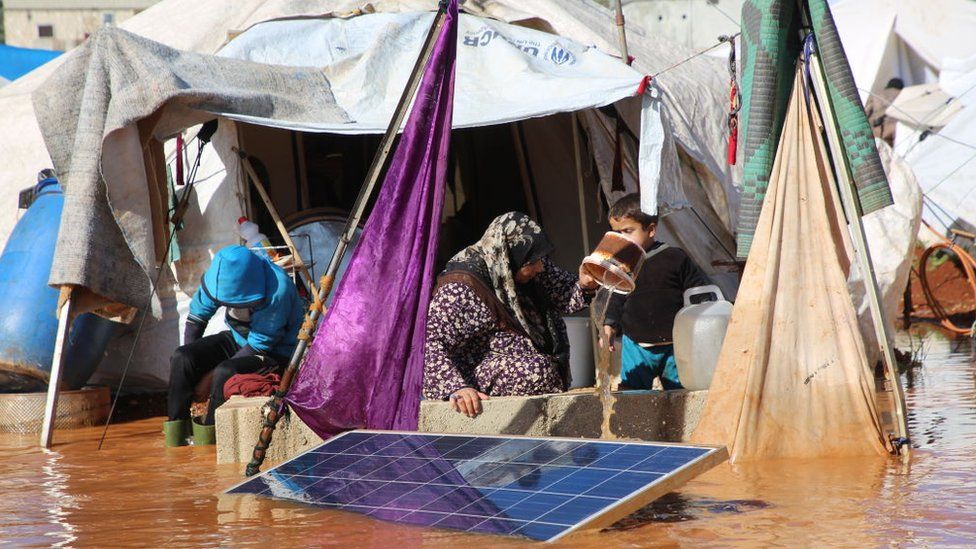
Heavy rainstorm flood syrian refugee camps In Idlib, Syria on January 31, 2021.
Millions of Syrians have been displaced in a decade of fighting    Getty Images

Syrian war planes strafing civilian Sunni Syrians in bread lines, hospitals and medical clinics bombed, barrel bombs targeting Sunni Syrian neighbourhoods, Syrian towns suffering the agonies of prohibited gas attacks. Children arrested, tortured, murdered. Women raped, imprisoned, murdered. Syrian citizens disappeared, never to be seen again alive or dead. Millions of Syrians internally displaced, fleeing bombardment. Millions more becoming  refugees, flooding neighbouring countries for haven, migrating desperately toward Europe.

Most leaders of countries conceive of legacy projects through which their administrations and their names will be respected and held in gratitude by their public. But not necessarily those in the Middle East, and certainly not the Assad family dynasty with their Alawite tribal affiliations and deadly sectarian hatred; a regime well known to have committed atrocities against its own people in the past and committed to carrying on that tradition. Syria and Iraq, both politically Baathist from opposite ends of the spectrum, both preying on their majority population, Sunni and Shia respectively.

The world watched, transfixed with revulsion at television screens, seeing children in agony from chlorine gas bombs hitting their night-time villages courtesy of their president, Bashar al-Assad, whose military was dispatched to clear Syria of the presence of Sunni Muslim 'terrorists', Syrian civilians who had agitated for equal status and treatment with their Alawite Syrian counterparts. They were rewarded by barrel bombs that wrenched their limbs from their torsos; a regime solution for terrorist activity.

Blood covers the hands of an injured boy following airstrikes believed to have been carried out by forces loyal to Syrian President Bashar al-Assad in Damascus, February 2015.   (Mohammed Badra/REUTERS)

An estimated 350,000 to 500,000 Syrian civilians were slaughtered by their own government, innocent civilians whom their president characterized as terrorists to justify his lethal responses to their pleas for equality as Syrian citizens. The bloody war against Sunni Muslim Syrians created 11 million refugees. A few years in to the civil war that proceeded, the regime battling Syrian Sunni militias attempting to overthrow the government that had systematically destroyed their human rights; the instability attracting actual terrorist groups seeing opportunities to advance their own agendas, among them the notorious Islamic State of Iraq and the Levant.

ISIL terrorists brought horror to the minds of those looking in at the Middle East, with their expanding capture of territory in Iraq and Syria, and their delight in torturing and murdering captured Europeans and Americans alongside their preoccupation with terrorizing and murdering and enslaving Yazidis, and their threats against Christians. Yet despite the terror they inspired in persuading those loyal to ISIL living abroad to launch attacks against Westerners in Europe and the United States, Islamic State could never match the kill rate of an established government that excelled in war crimes against civilians.

When "60 Minutes" documented the extent of the Assad regime's war crimes, activist Mouar Moustafa was the featured personality, a man who was determined to bring the full extent of the blighted criminality of al-Assad to public view through revealing his cache of documents signed by Assad authorizing depraved mass murder alongside thousands of photographs of civilians tortured to death in an accountability mission against his former president.

'Document hunters' smuggled hundreds of thousands of government files out of Syria. Here's how they did it
With the help of the Islamic Republic of Iran, the participation of Iran's proxy terror group Hezbollah and an assortment of Iran-controlled Shi'ite militias, augmented by the aerial bombardments of Russian warplanes, al-Assad finally had the upper hand, and with the dissolution of the Islamic State 'caliphate' the Syrian regime was enabled to restore its territory, mopping up the remainder of the Syrian resistance. The dreadful crimes committed by the Assad regime against its own people cries out for justice. Logically that should come with a trial against Assad himself and his advisers and military commanders.

But the International Criminal Court is disinterested in opening an investigation of Syria, just as the United Nations General Assembly has little interest in holding Syria to account for its paroxysms of mass murder, and the Security Council was never able to launch a condemnation of the regime with two of its permanent members, China and Russia, refusing to give assent. Finally, an accounting of sorts has arisen with a court in Germany having prosecuted and convicted a former Syrian regime officer for crimes against humanity.
 
A court in the German city of Koblenz sentenced former intelligence officer Eyad al-Gharib, 44, to four-and-a-half years in prison for aiding crimes against humanity. Convicted of accompanying 30 detained demonstrators being transported to prison, while fully aware of the systematic torture that awaited them in the prison. al-Gharib, a junior officer, had been arrested in 2019 along with senior regime officer Col.Anwar Raslan, under the principle of universal jurisdiction whereby a national court jurisdiction is given authority in issues of grave crimes against international law, irrespective of where the crimes take place.

Presiding judge Anne Kerber stands before pronouncing her verdict in the court in Koblenz, Germany, on February 24.

While it's a start on seeking justice, much, much more must be accomplished. Justice will only be served when Bashar al-Assad faces the full extent of international law and faces a penalty commensurate with his unspeakable crimes, and along with him, other members of his administration and the Syrian military which destroyed so many lives. President Vladimir Putin also has much to answer for in establishing support for the Syrian regime enabling it with that support to regain Syria while helping to slaughter Syrian civilians in the process.

There is no question the world is weary of these totalitarian governments persecuting innocent people, destroying countless lives, producing innumerable refugees and displaced populations facing miserable living conditions in lives of  traumatized horror. It is just so much easier to feel the horror, dread the outcomes, wish it would all go away, and turn away from it all, if only to maintain one's own sanity, sense of proportion and comfort in living normal lives in countries that sustain the rule of law and security and equality for all.

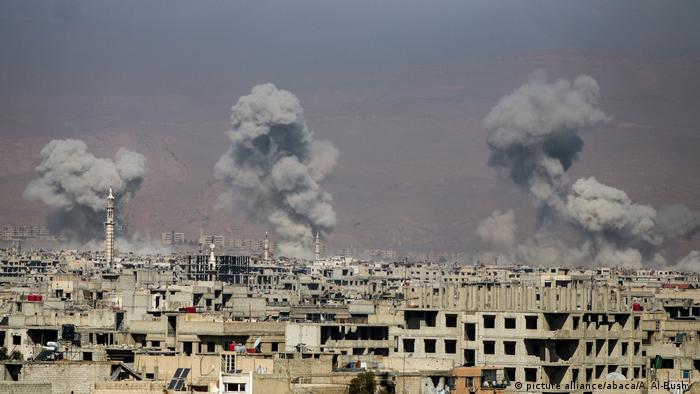
Syrien Luftangriffe gegen Ost-Ghouta (picture alliance/abaca/A. Al-Bushy )
"This is a historic verdict. Not only because it is the first to convict a Syrian regime official for crimes against humanity, but also because it recognizes his crimes were part of a widespread and systematic attack orchestrated by the highest bodies of Assad's regime."
"This is only the first of many other trials and investigations we are supporting. It is almost ten years since the crimes Eyad A. [al-Gharib] was convicted for were committed in those early days of the uprising as the regime cracked down on bare-armed protesters." 
Nerma Jelacic, director, Commission for International Justice and Accountability (CIJA)

Labels: , , , , , ,

() Follow @rheytah Tweet