
Politic?

This is a blog dedicated to a personal interpretation of political news of the day. I attempt to be as knowledgeable as possible before commenting and committing my thoughts to a day's communication.

Thursday, March 18, 2021

A Country That Was Once Syria and the Agony of Its People

(Khalil Ashawi/Reuters)  "More humanitarian access is needed,. Intensified cross-line and cross-border deliveries are essential to reach everyone in need everywhere."

"If Bashar al-Assad wins or survives in ways that give him control over most of Syria, Iran will have a massive new degree of influence over Iraq, Syria, and Lebanon in a polarized Middle East divided between Sunni and Shi'ite and steadily driving minorities into exile."
Anthony Cordesman, (2013) military and national security analyst, Center for Strategic and International Studies
 
"Bashar was never going to accept anything short of a total restoration of the 'wall of terror' built by this father in the 1970s and 1980s."
"No peace negotiations or reconciliation processes will ever change this reality, which has been built on fear and enforced with sectarian weapons."
Mustafa Khalifa, Syrian intellectual
 
"I would never (forget). When I left Syria, I had one of those rubber bands that you wear on your wrist. I had the Syrian flag on my hand. I swore that I will never take it off until I actually get my Canadian citizenship."
"Every day I look at it, it reminds me of what I've been through and what I've become right now."
"The big misconception is people calling it war. I guess it's war now, but it wasn't war when it started. It was a revolution against the dictatorship regime."
Mohammad Al Masalma, owner Mosy Photography, Syrian refugee, Halifax
FILE PHOTO: A father reacts after the death of two of his children, whom activists said were killed by shelling by forces loyal…
A father reacts in 2013 after the death of two of his children, whom activists said were killed by shelling from forces loyal to Syria's President Bashar al-Assad, at alAnsari area in Aleppo.

Syrian Sunnis felt they had good reason to mount protests against their status as citizens of Syria ruled by a Shi'ite Alawite minority regime that ignored the human rights of the majority Sunni population. Their president felt they had no right to protest anything. He called them terrorists. He warned the world community that if the protests which turned into armed rebellion after the Syrian military arrested, tortured and murdered children and adults alike for presuming to protest their living conditions and human rights, would impact the entire Middle East. 
 
What started as a peaceful protest became a searing, no-holds-barred civil war.

Sectarian hatred, tribalism, ethnic loyalties have always divided the Middle East. In Syria those divisions became a symbol of just how gruesome atrocities can become as commonplace instances of rancor and rage as the conflict began to attract the attention of seasoned Islamist jihadists from other dangerous conflicts like Libya arriving in Syria to further season the simmering pot of lethal antipathies. Syrian Sunnis whether or not they became part of the rebellion, became victims in a war of attrition, targeted by their president as connivers with the rebels intent on bringing down the regime.

It took no time at all before terrified Sunnis were forced to vacate their homes, their farms, their businesses, and towns seeking to escape being strafed and bombed by military aircraft. Hospitals, clinics, schools, apartment buildings were being indiscriminately bombed as long as they were in Sunni-majority areas. Heritage UNESCO areas of ancient antiquity weren't spared. Soon a new scourge entered the ravaged areas calling itself a new caliphate and threatening Christians, Yazidis and Kurds with death as infidels. 
 
The Islamic State of Iraq and the Levant's publicized atrocities horrified the world.
 
A doctor talks with refugees at a camp for displaced people in Atme, in Syria's northwestern Idlib province, near the border with Turkey, March 14, 2020.
A doctor talks with refugees at a displaced persons camp in Atme in Syria's northwestern Idlib province near the border with Turkey, March 14, 2020
 
But it was the Syrian regime of Bashar al-Assad that was responsible for slaughtering a half-million of its own citizens, of creating six million displaced Syrians living in squalid camps within Syria, and another six million swelling refugee camps in Turkey, Iraq and Lebanon. Europe and North America became the destination of Syrian refugees hoping to secure a future for their families. It has been a decade since the first demonstration turned into an uprising on March 15, 2011.

Then the Assad regime began to put down a rebellion of 'terrorists', turning to barrel bombs for greater effect in bombing innocent civilians and rebel groups alike. This has been as much Iran's war as it has been Syria's. Assad wants his authority reestablished throughout the country that was once Syria, and Iran plans to be the power behind the throne, as its rightful destiny. The Syrian Observatory of Human Rights counts 560,000 dead, while the Syrian Network for Human Rights places that figure 100,000 greater taking account of the Syrians brought to Assad's dungeons and never seen again.
 
Syrian amputee in refugee camp, with his children  (Mahmoud Hassano/Reuters)
 
With Tehran and Moscow at  his side, Bashar al-Assad prevailed. The Peshmerga in Kurdistan made it their mission to destroy ISIL's power base and threat to defenceless communities, even as Turkey as the neighbour sheltering more Syrians than any other, violates the Syrian border with the intention of rooting out a Kurdish presence in collaboration with the anti-Turkey Turkish Kurdish PKK. The awkward collaboration between Moscow and Ankara in defiance of a U.S. presence failed to relieve the agony of Syrians.
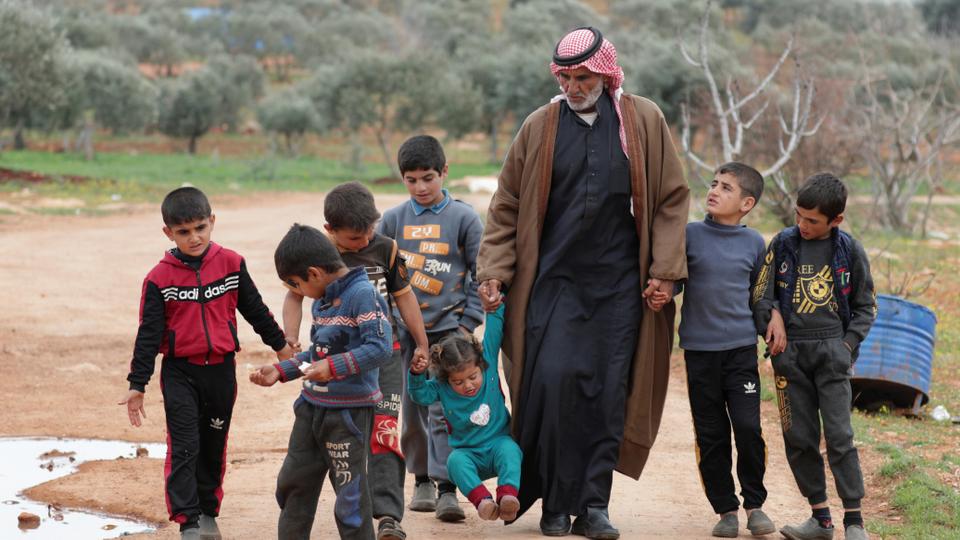
 
Syrian farmer, walks with his grandchildren, at an internally displaced camp in northern Idlib, Syria on March 11, 2021.
Syrian farmer, walks with his grandchildren, at an internally displaced camp in northern Idlib, Syria on March 11, 2021. (Reuters)

Any censuring initiatives arising in the United Nations is foiled by Russia which has gained a deep-water seaport and an airbase in Syria for its invaluable assistance in bombing Syrian Sunnis. The U.S. under the Obama administration challenged Assad to avoid using proscribed weapons against his people, that would be a 'red line' that could never be tolerated. The sarin gas attack in 2013 in Ghouta killed up to 1,729 Syrians of all ages. A trifling inconvenience that required no response from the U.S.

With that level of assent-by-unresponsiveness, there was nothing that would stop Assad from continued use of poison gas as a weapon of mass destruction and he now has over 300 chemical attacks under his belt, along with Russian protection of his regime. But of course the Obama administration could do little because to intervene in Syria would mean encountering the Russian air-defence system at Assad's disposal. Except the Russian anti-aircraft batteries appear to be unused, along with the Chinese low-altitude radar system.

The reality appears to be that only Israel has committed to deterring the best-laid plans of the Islamic Republic of Iran in its takeover of Syria and placement of Hezbollah at Syria's ostensible disposal. The Israeli Air Force carries out myriad bombing attacks on Hezbollah targets in Syria. The Israeli Air Force is well on its way to destroying a good proportion of Syria's air defences. And still maintains diplomatic relations with Moscow. 
 
The mass butcher of his own civilians remains beyond accountability for the atrocities he has committed against his country and its people. Aided and abetted by Russia and by Iran there appears no appetite from within the international community to demand justice for those who lost their human rights along with their disposable lives.
 
An explosion is seen following Russian airstrikes on the village of al-Bara in the southern part of Syria's northwestern Idlib province.
An explosion is seen following Russian airstrikes on the village of al-Bara in the southern part of Syria's northwestern Idlib province, March 5, 2020.   AFP


Labels: , , , ,

Monday, November 19, 2018

Casting Aspersions on Canadian Law and Justice

"When they came, I asked them, 'Why me?' and they say, 'Not only you; many people'."
"I said, 'Do you have clue like about why, for example, me?' Maybe they have clue. They didn't tell me. They didn't tell me anything."
"You don't want to do that ... but you have to say yes. They show you a picture [of the dead girl], to see what’s your reaction."
"We were working for a political organization [opposed to Saddam] underground [in Iraq] and we run away from there."
"I was nervous [when the investigators contacted him] And I’m sure I didn’t do anything. … This first time in my life I do this kind of interview or investigation. Never been in court or never even ask by police for anything in my life."
Ayub Faek, Kurdish refugee from Saddam Hussein's Iraq, Burnaby, B.C.

"I knew that, if they want, they're going to get an order from court or something, I don't know, to take it [DNA sample] from me, so that's why I gave it."
"I was thinking that maybe they just want to collect DNA from people from Middle East for future records. That’s what I thought. I still believe that. They said they’re going to destroy it, but I don’t believe it."
Ariyan Fadhil, Kurdish Iraq refugee, Burnaby, B.C.

"No doubt police are very alive to how delicate a balance this is."
"In other cases, we've heard in media reports people say the officer made it clear, 'You don't do this, we'll put you under a microscope'."
"If you're trying to build trust in communities to further your investigation, make this something people will find credible."
Micheal Vonn, policy director, B.C. Civil Liberties Association
ihit
IHIT investigators at Central Park in Burnaby looking for clues in the Marrisa Shen murder. - NOW FILES

British Columbia Civil Liberties Association is a busy outfit and latterly have declared their perturbation over a recent media report out of Burnaby Now newspaper outlining their findings that homicide investigators in the province deliberately in the course of a murder investigation targeted Middle Eastern men through a voluntary DNA collection "sweep" in a bid to find the young girl's murderer. The DNA dragnet, according to civil liberties watchers raises a red flag of racial profiling, coercion and targeting of vulnerable populations.

What's more, another disturbing element of the situation ostensibly is the opaqueness of the disposition of the DNA samples post-collection. This is an issue that dates back to July of 2017 when the body of Marrisa Shen, 13, was discovered in a forested Central Park area in Burnaby, British Columbia. Over 300 investigators were involved in a massive hunt for the murderer. The regional Integrated Homicide Investigation Team announced in September of 2018 that 28-year-old Ibrahim Ali had been arrested and charged with first-degree murder.
shen

The 14-month investigation into the murder saw police canvassing over 1,300 residents of Burnaby. Some 600 interviews had been conducted. And there were two thousand "persons of interest" who were identified and eliminated. The murder of the young girl was deemed to have been a random act of violence. The mystery remains of what exactly it was that led them to Ibrahim Ali now a permanent resident of Canada who arrived in March of 2017, a privately church-sponsored Syrian refugee. The young man was resident in close proximity to Marrisa Shen's home. She died four months after his arrival in Canada.

The local newspaper, Burnaby Now, had drawn the attention of B.C. Liberties Association when it published the results of their own media investigation into the police search for the murderer by pointing out that before the arrest of Ibraham Ali police contacted various men of Middle Eastern origin who were regional residents, asking whether they would provide voluntary DNA samples. The paper interviewed a number of such men and published their statements.

Mr. Faek, for example stated that he had been queried about his work and about his visits to the park, then shown a photograph of the murdered teen. He had agreed at the time that he would provide a blood sample from his finger. As did Mr. Fadhil who described being questioned in a van, during his lunch break, whereupon he too agreed to submit a blood sample. As for the DNA samples, both men doubted the police would destroy them once the investigation concluded. A rather strange, untrustful attitude to the justice system of the welcoming country.

"What I can tell you is that IHIT (Integrated Homicide Investigation Team) strictly adheres to Canadian law and RCMP policy with respect to the handling of DNA exhibits", responded Cpl. Frank Jang, spokesman for the unit, clarifying that it would not be proper to comment further while the case remains before the courts. "You should be able to take that to the bank", tersely commented Micheal Vonn, who felt that police agencies should provide written verification of samples having been destroyed to the people who provided them.

The sensitivity of civil rights groups to issues such as DNA sweeps and targeted groups in a murder investigation is misplaced when the police feel they have reasonable and reliable evidence to enable them to pursue a course of action leading to a suspect. Groping about in the dark and hoping by chance to find evidence without having to take assertive action to discover what evidence might be had through techniques that request the public for assistance isn't guaranteed to solve murder mysteries. Invariably, some group will be affronted by techniques that draw them in as suspects.

The alternative might be to simply allow a murder of an innocent person to go unchallenged, leaving a murderer free to repeat the atrocity. That those of a certain ethnic, religious, geographic profile were targets in this case may have been the result of insider information received by the police, supported perhaps by the earned reputation of some groups whose societal culture leaves them prone to both violence and contempt for women. Kurds don't fall naturally into that category. But in the final analysis it was a man whose background did equip him as a suspect.

Justice will be seen to be done because it will eventuate, under Canadian law. In this instance, it just happened to be a Syrian refugee to Canada who has been identified as the suspect. That fact is not an indictment of the entire Syrian refugee population in Canada. Portraying it as such by the actions that the police investigation service undertook, as suggested by the newspaper report and the civil liberties groups does neither the Syrian refugee population nor Canadian law and order groups any true justice.
"I was happy at first when I heard they arrested somebody. But I realized the accused is a former Syrian refugee and I was so shocked."
"I realized that this news had become national, so I started calling all my Syrian friends across Canada to put together a statement of support for the Shen family and condemn the crime."
"We think there should be an organized response from the [Syrian] community to such a horrible and shocking incident."
"If people want to know what the Syrian community thinks, we will be in front of the court … with a message of unity, hope and humanity."
"We are people just like any other people. We have good individuals and we might have bad individuals."
"I demonstrated against the dictatorship and was sent to prison where I was tortured. I was a medical student, but once I was sent to prison the third time I had to decide whether to stay and hope I would not be arrested again. I didn’t want to risk my life again."
"Now I am in the best nation on earth, I have learned the language and I am a very active member of the community. The vigil to me shows the true Canadian values of acceptance and diversity."
Mohammed Alsaleh, Syrian refugee, Burnaby, British Columbia


Memorial for Marrisa Shen at her murder scene in Central Park. Nick Procaylo / PNG

Labels: , , ,

Thursday, October 18, 2018

Securing the Safety of Canadians

"We would like to take this opportunity to thank the public for all of their ongoing support and concern for us in this past year. We are aware that so many people reached out to the police to provide information and we were so grateful for that."
"We would also like to thank the media for all of their attention to Marrisa's case. Lastly, we would like to thank the police for all their hard work and specifically IHIT [Integrated Homicide Investigation Team for their perseverance."
"We hope that justice will now be served and that Marrisa can finally be at peace in heaven."
Shen family, Burnaby, British Columbia
28-year-old Ibrahim Ali has been charged in the first degree murder of Burnaby teen Marrisa Shen, whose body was found in Central Park in July 2017. (Supplied by family)

"When a tragedy like this happens, it can and does impact public opinion and it's unfortunate that entire communities can be white-washed by the horrific alleged behaviour of one individual."
"We have found the vast, vast majority have left all of that behind -- the trauma, the war -- and just want to live a peaceful and productive life in Canada, paying taxes and supporting their kids in school."
Chris Friesen, director, Immigrant Services Society of B.C.

"[Marrisa Shen's case was] one of the biggest, if not the biggest murder investigations that IHIT has had [in terms of hours and effort by officers and the] leading edge [investigave techniques used]."
"The investigative path was extraordinary and I couldn't be more proud."
Eric Stubbs, RCMP assistant commissioner, criminal investigations, B.C.
Marrisa Shen was reported missing by her parents on July 18, 2017 in Burnaby, British Columbia. The city's Central Park was where the child's body was found the next morning. In the investigation police had identified and eventually eliminated over two thousand "persons of interest". It took over a year, but eventually police closed in on a suspect, and named 28-year-old Syrian refugee Ibrahim Ali, accusing and charging him of first-degree murder. Details of what caused Marrisa's death have not been revealed. The arrested man had no criminal record, and it was not revealed how the police were led to identify him as a suspect in the murder.

He had been in Canada for three months at the time of the murder. When he was arrested and charged he had the status of a permanent resident of Canada, was employed, and had family living in Burnaby. Immigration and Refugee Board authorities have been unable to find records of any public proceedings where this man was involved, but it is known he hadn't arrived at a port of entry to claim asylum. He is only one of 3,500 Syrian refugees living in 69 communities in British Columbia. Another Syrian man with the same name, in prison, was confused with the man arrested for the murder.

Over 1,300 residents of the city had been canvassed resulting in over 600 interviews, with more than a thousand hours of video footage. The public responded to a website the police launched in hopes of receiving tips, and that site had 80,000 visits. Although the RCMP's behavioural sciences group had developed a likely criminal profile of the-then unknown killer, no details have been released indicating what led them to identify this man as the murderer of 13-year-old Marrisa. The local Syrian community has expressed sadness and their full support in finding justice for the girl.

When the government of Canada set out to respond to a UN appeal for countries to absorb Syrian refugees, the decision could have been made to rescue women and children, Christians, and Kurds, all of whom are threatened Syrian demographics. Single Muslim men are known to have been a cause of criminal activities and in particular, violence against women where they have settled in great numbers in Germany, for example. Through both government and private auspices, an estimated 40,000 Syrian refugees were brought into Canada.

In Syria's Kurdistan, the Kurdish military have long since arrested and placed in prison Western nationals who had travelled to Syria to join Islamic State of Iraq and the Levant. Among them is a number of Canadian nationals, deeply involved in ISIS terrorist activities. One in particular, is known to have brutalized and murdered captives of ISIS, and to have been one of their 'voices' for narration of the horrifying videos of atrocities committed by the terrorists.
A screen shot from the ISIS execution video Flames of War, showing the narrator.
SITE Intelligence Group

One of the Muslim Canadians had informed the New York Times podcast Caliphate that he had executed captives while serving as a loyal ISIS operative. That man is known to have since returned to university studies in the Toronto area and has not been charged with any crime. Of the Canadians known to have joined ISIS and returned to Canada, few have been charged, despite that Public Safety Minister Ralph Goodale announced that Canada and its allies were collaborating to "assemble evidence from the battlefield that will be usable in courts of law".

That glib assurance aside, thus far no Canadian investigators have yet spoken with Ali, captured by the YPG armed group in northern Syria four months ago, even though he declared he had been interrogated by American, British and Kurdish officials. "From a recruitment perspective, it actually speaks to the people here saying, 'Hey, if that wanker from Mississauga or Hamilton or Calgary can do it, well then so can I'," said Phil Gurski, formerly an analyst with the Canadian Security Intelligence Service, who now heads Borealis Threat and Risk Consulting.

People gathered outside the BC Provincial Courthouse on Friday to show support for Marrisa Shen's family, the 13-year-old girl whose body was found in a Burnaby park. They also protested the government’s refugee screening process, which they say is inadequate, in light of the fact that the man accused of her first-degree murder, Ibrahim Ali, is a refugee from Syria.
Protesters gathered outside the B.C. provincial courthouse protesting the government's refugee screening process; the man accused of killing 13-year-old Marrisa Shen, Ibrahim Ali, 28, is a Syrian refugee.  Photo: Tessa Vikaner, StarMetro

Labels: , , , , ,

() Follow @rheytah Tweet