Politic?

This is a blog dedicated to a personal interpretation of political news of the day. I attempt to be as knowledgeable as possible before commenting and committing my thoughts to a day's communication.

Monday, June 29, 2026

On Tenterhooks of Suspense: Israel ... 27 October 2026

"Surviving the Israeli political scene for so many years has taught him a number of tricks, and he is, once again, like him or dislike him, a survivor."
"[In Israel's multi-party parliament, disparate factions reach delicately balanced compromises, where] simply somebody sneezing can make a coalition crisis."
"Netanyahu has faced probably dozens, if not hundreds, of coalition crises in his career."
"He knows the Israeli political scene like the back of his hand."
Ira Robinson, professor emeritus of Jewish Studies, Concordia University 
 
"The civilian leadership is putting the blame on the military, whose job and task it is to protect the borders of the nation on any given day."
"There is a leadership, a national leadership under whose watch this tragedy [7 October 2023] happened and under whose watch the successive wars have unfolded, so it's in this context that the MOU between the United States and Iran is coming."
"There are no major pieces of legislation that could be associated with him, or, or even opposing some, but people will judge him as on his record as a former IDF chief, and in Israel that matters a lot."
"[Bennet has no established party organization behind him and is a] one man show. To do well and to succeed well in Israeli politics in the long run, you need a party organization, because it's a very party-centred and party-oriented political system." 
Csaba Nikolenui, political science professor/director, Azrieli Institute of Israel Studies, Concordia 
 
"There is much overlapping between the public who prefer, for example, Eisenkot or Bennett or even [Avigdor] Lieberman. The division lines are not clear, and there is no agreement between these leaders who is going to become prime minister if they will eventually get more votes than the other side."
"He [Bennett] does have failure written under his name, but he seems to be a good compromise for people who would like to have someone of the moderate right who is capable of really managing things."
"Unless there is some dark horse around the corner [Netanyahu is seen as] irreplaceable [by his supporters]."
"[Ben-Gvir] is really pushing Netanyahu into making decisions and taking actions that were unthought of. Netanyahu doesn't like him, nor Smotrich, but he didn't have any other possibility [to form government]."
"In order to replace them, he should bring over party leaders from the other side, and [it] doesn't look as if he is going to get it."
Tamar Hermann, senior fellow, Israel Democracy Institute 
https://www.pewresearch.org/wp-content/uploads/sites/20/2016/03/PF_16.03.08_IsraelSurveyPromos_feature640x320.png?resize=640,320

Deep gulfs among Jews, as well as between Jews and Arabs, over political values and religion’s role in public life   Pew

 
Israel's system of government voting is guaranteed to make election outcomes difficult, and they always are, with much uncertainty and a great deal of negotiations taking place between the parties that generate the most popular vote and those that bring up the rear. It's not just that Israel is wedded to proportional representation, it's also that Jews themselves are culturally and habitually among the most argumentative people on Earth. Complicated yet further by the divisions in society of religious devotion in the Judaic tradition. Secular Jews dominate society in Israel, but there are large blocs of Orthodox and Ultra-Orthodox Jews and divisions in between.  
 
And to complicate matters yet further, although Israel is a democratic Jewish nation, it also incorporates into its citizenry Arab Muslims, Christians, Druze, Bedouin, Circassians, Kurds, B'hai, and other minority groups, all of whom have voting rights and for the most part exercise them. Israel's standing army, the Israel Defense Forces is mostly staffed by Jews, but also include Druze and Israeli Arabs in the military. It is the Ultra-Orthodox Jewish element in Israel from among whom resistance to join the military ensues. For non-Jews, military service is generally not a requirement, but is volunteer-driven as loyal Israelis. Not so for the ultra-religious. Israel is a complex country.

 
Protesters supporting the conscription of ultra-Orthodox men into the military block a road in the Haredi city of Bnei Brak, central Israel, clashing with locals, on June 26, 2026. (Avshalom Sassoni/Flash90)
 
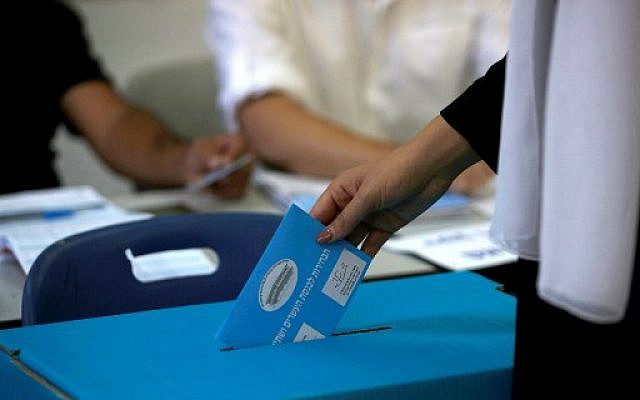
And it is set to go to the polls by October 27 when a divided electorate will make the decision with their votes whether or not Benjamin Netanyahu will continue on as Prime Minister. The man is both popular and disdained among segments of the population. It is not an easy task to govern a nation that is so perpetually politically, socially, culturally divided. The 7 October assault by thousands of Palestinian terrorists and ordinary Palestinians, led by the Hamas terrorists who govern Gaza traumatized Israelis in the scope of its savage brutality and sadistic fury.
 
The much-vaunted Israeli intelligence services, and the IDF, much less the government-of-the-day -- Netanyahu's, failed to detect suspicious activities leading up to the horrors of that day; this, despite the fact that border guards had reported alarming and potentially dangerous actions taking place, only to have their concerns set aside by government authorities. And that undeniable failure haunts the government to this day. As with any responsible governing authorities -- the buck stops at the top. The succeeding wars with Hamas in Gaza, Hezbollah in Lebanon, the Islamic Republic and the Houthis have all been inconclusive, largely given U.S. White House interference.
 
Benjamin Netanyahu has the hearts of many Israelis as well as diaspora Jews, while others loathe him. He has been a resolute, courageous leader of a people facing international opposition, left to fend for themselves against forces of violent opposition both regionally and globally, emanating from both foes and purported allies. That he has also been under indictment in a corruption trial ongoing for six years has been an additional burden -- for him personally and for Israelis wanting to see that put behind them. The corruption charges represent an excess perhaps linked to personal political vendettas. 
"[Netanyahu] is cautious not to push this draft issue on the agenda, because he doesn't want to alienate the ultra-Orthodox, and the ultra-Orthodox are strong."
"So long as he has that, and the support of the religious Zionist community, which is kind of unshakable, because these parties have nowhere else to go -- they will never support anyone to the left of Netanyahu -- Netanyahu kind of has them, has that corner fairly, fairly well guaranteed for him."
Csaba Nikolenyi 
Mr. Netanyahu has been forced by the Israeli political voting system to make a governing coalition with groups he would normally prefer to have no relationship with; their agendas are not necessarily his. The system demands compromises, some manageably attainable and others painful, the result of  awkward collaborations to maintain a government in power. Israelis, according to a recent poll, anxious as always for national security accept that war must be waged to secure that security. Israel has never known any other way of life, since 1948 with successive waves of military onslaughts from neighbours, then proxy militias of the Islamic Republic. 
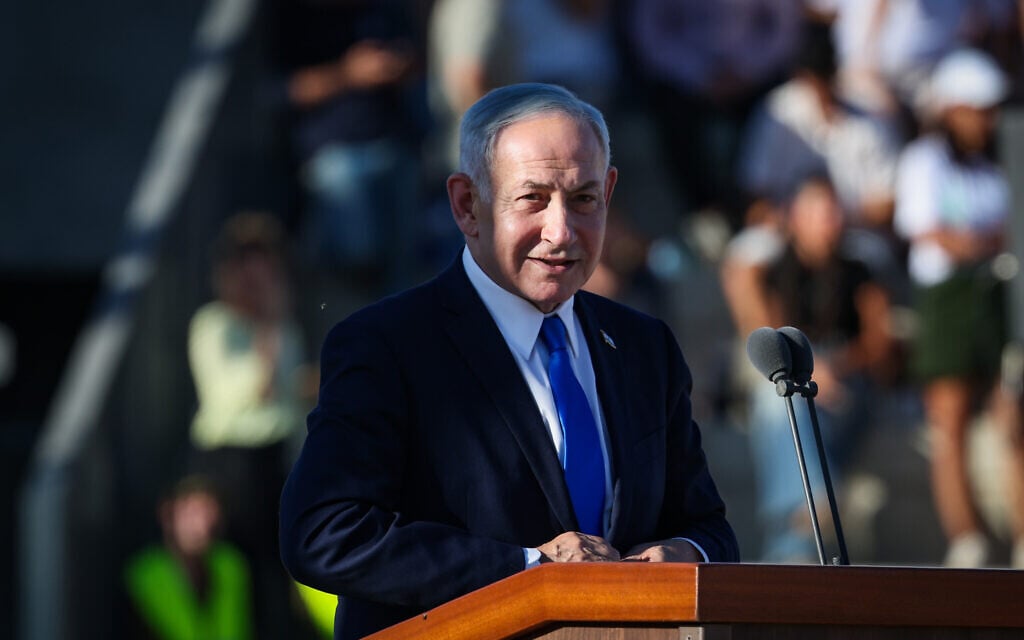
 
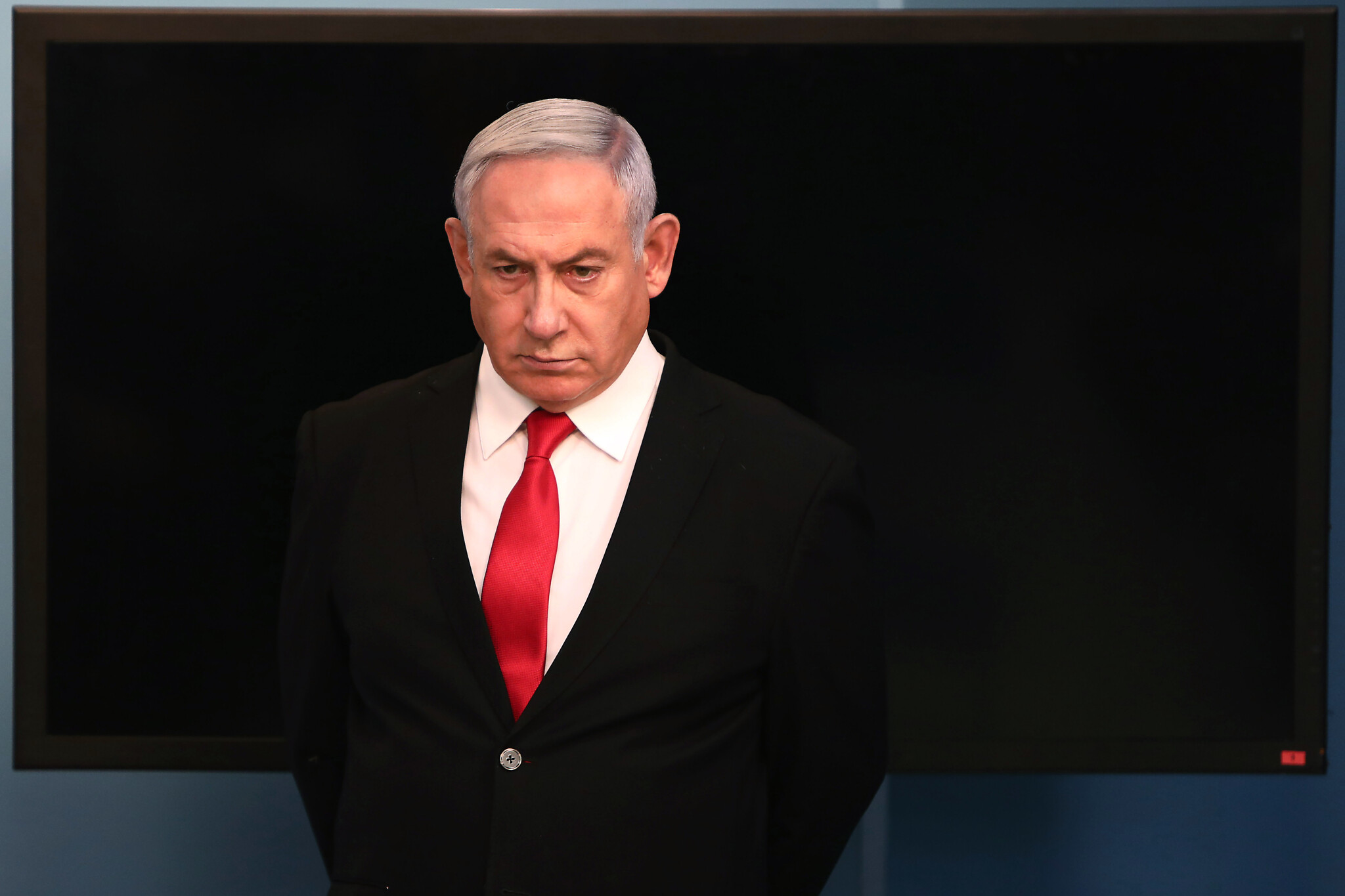
Israeli Prime Minister Benjamin Netanyahu at an IDF officers’ graduation course in southern Israel, June 25, 2026. (Flash90)
 
As for PM Netanyahu's coalition government; none other was available for him to maintain his government. In the current administration, Finance Minister Bezalel Smotrich has overseen a surge of settlement construction in the West Bank where mounting violence has emanated from. These are the leaders of the extreme rightwing parties serving in Netanyahu's government. The second is Itamar Ben-Gvir as national security minister, convicted of anti-Arab incitement in 2007. 
 
In this era, there has been no Israeli party capable of winning an outright majority to enable it to govern according to its distinct political views, without being forced to resort to coalition-making to preserve its government with the understanding that its coalition partners' support will last only as long as their demands are met in reflection of their own political agendas. As it is, Netanyahu's government lost two of its ultra-Orthodox parties when he refused to legalize exemptions from mandatory conscription for religious students. 
"The major small parties that you would want or probably need in a coalition are the religious parties, and that's a very volatile issue."
"And these parties will tell whoever it is, be it Netanyahu, be it Eisenkot, whoever it is -- 'You've got to give us what we want', and now the negotiation becomes, do you get 100 percent of what you want? Do you get 80 percent of what you want? What are the parameters."
"That's all backroom politics and Israelis are used to it."
Ira Robinson 
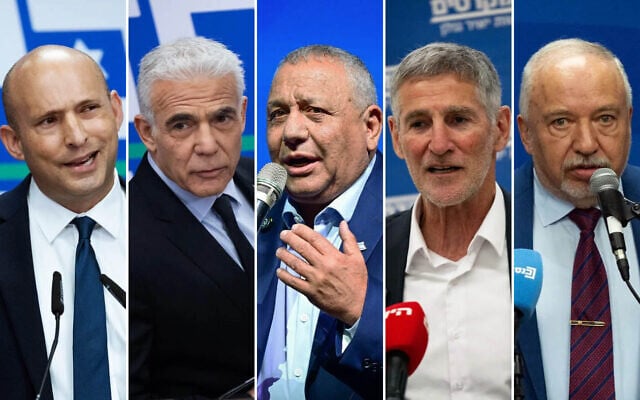
Left to right: Former prime minister Naftali Bennett speaks during a press conference at the Knesset in Jerusalem, May 20, 2026. (Yonatan Sindel/Flash90); Opposition Leader Yesh Atid MK Yair Lapid leads a faction meeting at the Knesset on May 25, 2026 (Yonatan Sindel/Flash90); Gadi Eisenkot, head of the Yashar party, speaks during a conference at Tel Aviv University, May 12, 2026. (Avshalom Sassoni/Flash90); Leader of the Democrats party Yair Golan leads a faction meeting at the Knesset in Jerusalem, on May 25, 2026. (Yonatan Sindel/Flash90); Yisrael Beytenu chair Avigdor Liberman leads a faction meeting at the Knesset on May 25, 2026. (Yonatan Sindel/Flash90)


Labels: , , ,

Wednesday, December 11, 2024

Persecuting, not Prosecuting the Prime Minister of Israel

"I'm simply astonished by the magnitude of the absurdity. And, I must say also the magnitude of the injustice."
It's an ocean of absurdity and I want to talk about it. I want to testify."
"I lead the State of Israel and the Israeli army on seven fronts [and] a few days ago, a tectonic thing happened here, an earthquake that hasn't happened in a century ... and now it happened in one fell swoop."
"And this thing [in Syria] changes reality."
Israeli Prime Minister Benjamin Netanyahu
https://www.reuters.com/resizer/v2/XFXZWT4VQJMAPCTA5ELVE4PIDQ.jpg?auth=e6d712c0dedb6820dc6fe9b9ca335f00f5d37cab4fd9b6e2c1459a480b8a3678&width=960&quality=80
Israeli Prime Minister Benjamin Netanyahu speaks during a press conference in Jerusalem, December 9, 2024. Maya Alleruzzo/Pool via REUTERS
 
A Prime Minister of a country at war, a war that has spread to include several countries surrounding Israel, from its south to its north, orchestrated by another country whose goal is to destroy the Jewish State with the aid of its proxies. Hamas, Hezbollah, the Houthies, the Syrian state, and the mastermind behind them all, the Islamic Republic of Iran have all had to be contended with by this man and his ruling cabinet, devising strategies, committing themselves and Israel to choices they hope and pray will protect its people, while at the same time focusing on the return of Israelis taken hostage by a terrorist group and its supporters.

The Herculean task of managing all of this, along with attempts to assure its less hostile neighbours that Israel's intentions are purely self-defensive. While simultaneously struggling to defend its honour and its UN-soiled reputation among both allies and detractors. Has there ever been another nation whose efforts at defense have been as hamstrung as Israel's? When its major benefactor feels entitled to place the country's existential response to terror seeking its obliteration under its final command, withholding vital munitions to coerce compliance?
 
All these issues juggled and considered, analyzed and discussed, decisions made in the hope that they will in the final analysis be helpful in securing a future for the tiny geographical enclave, suffocated by the overwhelming presence of a comparative gargantuan presence of another religion, culture, heritage, ethnic and ideological system alien and hostile to its own. A Prime Minister who has been stalked and accused and threatened by judicial action of a politicized, bitter opponent.
 
Under such duress that would crack the resolve and capability of  any lesser man, ordered to report for ongoing interrogation by law wielded by those whose animus toward Benjamin Netanyahu knows no bounds of decency, proportion and perspective, demanding that with this weight of responsibility to a nation on his back, he must regardless appear three times weekly for six-hour interrogations by mind-numbingly insensitive and oblivious members of the Tel Aviv District Court prosecution.
 
Which is where, after years of aggravated judicial assault, Israeli Prime Minister Benjamin Netanyahu began his testimony of self-defense against charges of corruption reflecting three suits brought against him close to five years earlier, by prosecutors. Despite the Prime Minister's consistent denials of the allegations lodged against him, denouncing the oppressive drive to convict him as representing political persecution, he focused on the "absurdity" of those cases and the trial's timing coinciding with the conflict with Hamas and the tenuous ceasefire with Hezbollah, added to the collapsed dictatorship of Syria's Bashar al-Assad. 

Despite the lawyers representing the Israeli Prime Minister requesting delays in his testimony, they were rejected by the court which has brought bribery and breach-of-trust charges against him in three cases, named and differentiated as 1000, 2000, and 4000. The Likud Party and its coalition partners, along with some opposition politicians dismiss the trial as a partisan effort at government change by ex-parliamentary methods. 

The prosecution ignored the advice rendered to them in June of 2023 when the judges advised the prosecution to drop the charges, citing "difficulties" in establishing guilt. This is a roadshow unworthy of the Jewish state, whose leftist politicians and population have besmirched themselves by an agenda of legalized slander, in the process endangering the country as a whole at a critical time of its embattled existence. Nothing less than shameful.

https://www.reuters.com/resizer/v2/UVB7S7H5YFOSRKYDOMISSXTGKI.jpg?auth=70c7171084285998fcbfc15f1f4710a883c5f9e4de524b2bebec4be1919b14a5&width=960&quality=80
Israeli Prime Minister Benjamin Netanyahu smiles as he prepares to testify in his trial on corruption charges at the district court in Tel Aviv at the start of his hearing on corruption charges on December 10, 2024. MENAHEM KAHANA/Pool via REUTERS

Labels: , , , , ,

Thursday, July 25, 2024

Benjamin Netanyahu Goes to Washington -- Again

"America and Israel must stand together. When we stand together something really simple happens: We win, they lose."
"These protesters that stand with [the terrorist Hamas group] they should be ashamed of themselves.""
"I have a message for these protesters: When the tyrants of Tehran, who hang gays from cranes and murder women for not covering their hair are praising, promoting and funding you, you have officially become Iran’s useful idiots."
Israeli Prime Minister Benjamin Netanyahu
https://media.cnn.com/api/v1/images/stellar/prod/gettyimages-465168774.jpg?c=16x9&q=h_653,w_1160,c_fill/f_webp
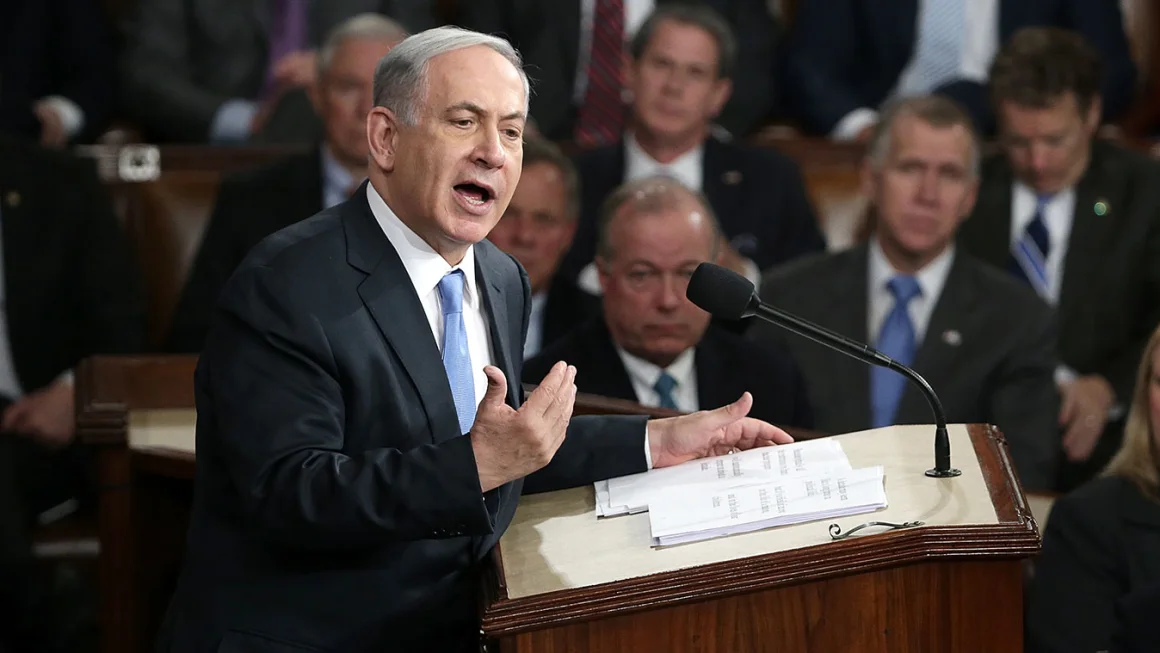
Israeli Prime Minister Benjamin Netanyahu addresses a joint meeting of Congress in the House chamber.   Win McNamee/Getty Images/


Standing before Congress on Wednesday, Israeli Prime Minister Benjamin Netanyah defended his nation's Gaza war as a necessary act to eradicate an evil enemy who slaughtered over a thousand people on October 7, when thousands of Hamas operatives, terrorist allies and ordinary Palestinian citizens  flooded into Israel in a well-rehearsed, organized day of terror, of mass rapes, mutilation, sadistic torture, slaughter of infants, children, the elderly, and hostage taking of Israelis into Gaza to be  used as prisoner-exchange pawns.

Protesters converged on Washington for the express purpose of excoriating the Israeli Prime Minister and of claiming Israel to be intent on genocide in Gaza, while championing the nobility of Hamas's strike for liberty against an Israeli juggernaut intent on strangling Palestinian statehood ambitions. Mr. Netanyahu is very well aware of Palestinian aspirations gearing toward the destruction of Israel and its ancestral landmass forming the base of the longed-for Palestinian state, expressed in the protests clamouring for 'intifada' and 'final solution'.

Israel, he assured the lawmakers, both Republicana nd Democratic who applauded his presence, must continue n Gaza until such time as "total victory" has been achieved. He spoke with derision of the large number of protesers against the war that Palestinians brought on themselves; the roiling protests on college campuses throughout the United States along with those taking place on the streets including outside the Capitol where he spoke.

Initiating his remarks with acknowledgement of President Joe Biden, he praised the president's efforts. More lavish praise was reserved for former president -- currently the Republican presidential contender -- Donald Trump "for all he's done for Israel". Outside the capital, tall steel barriers were in place, with police making use of pepper spray against the thousands of anti-Israel protesters who rallied nearby.

House Speaker Mike Johnson received Mr. Netanyahu warmly, along with the other Republican lawmakers who had arranged for his speech in the House chamber. A bipartisan standing ovation recognized Mr. Netanyahu's importance as a major ally in the Middle East for the United States. This appearance represented the fourth address by Mr. Netanyahu before a joint meeting of Congress by a foreign leader.

On the downside, and surprisingly undiplomatic, over fifty Democrats made the choice to boycott Mr. Netanyahu's speech. Vice-President Kamala Harris was among those who chose to be elsewhere rather than courteously receive the Israeli prime minister and hear out his speech to Congress. A shameful exercise in discourtesy and a shallow political statement of antagonism, more's the pity.
 
https://i.guim.co.uk/img/media/fee92da63138addb1413f58e0e65eb0eb1cf2d3b/0_0_5568_3712/master/5568.jpg?width=1900&dpr=2&s=none
Pro-Palestinian protesters and police clash at Union Station in Washington DC. Photograph: AFP/Getty
 

Labels: , , , , ,

Sunday, March 22, 2020

Prudently Tried-and-True

"These are bad, mad and uncertain times — for all of us humans. To stop a virus that scientists acknowledge they do not yet fully understand, all of human interaction is being remade."
"And as it happens, here in Israel, this rapidly, radically altering framework for our daily existence happens to coincide with an ongoing political crisis, in which our war on the coronavirus killer is being directed, and directed well we broadly think, by a deeply controversial politician. Netanyahu is a leader who has always been divisive, who the state legal hierarchy alleges is corrupt, and who has led an assault on core institutions of our democracy in the past two years as he faced off against police investigators and state prosecutors. Netanyahu is also a leader some of whose reasonable measures to thwart the spread of the disease — the closure of most court functions, for instance is not unique to Israel — just so happen to serve his narrow interests as well."
"When his carefully selected ministers and party allies send most of our judges home, when they introduce the monitoring of all our phones, and when they suspend the activities of the parliament that is meant to provide at least some oversight of his government, Israel finds itself in the midst of two crises."
"I think it’s the virus we should be more worried about."
David Horovitz, founding editor, The Times of Israel
In this Saturday, March 14, 2020 file photo, Israeli Prime Minister Benjamin Netanyahu arrives for a speech from his Jerusalem office amid the coronavirus crisis. (Gali Tibbon/Pool via AP, File)

This is a prime minister fighting for his political life and his legacy. As the longest-serving prime minister Israel has ever had in the short history of its re-emergence from the historical record, no one can deny that this is a man whose acumen and intelligence has served the country extremely well. That old adage warning about the dangers inherent in changing horses midstream certainly applies here, as Israel, accustomed to facing existential challenges on an ongoing basis, is now faced with a dread and sometimes deadly virus threatening to diminish lives, destroy the economy and compromise its already-complicated politics. 

The emergence of the noval coronavirus out of Wuhan, China, its spread throughout the east and in this world of interlocking globalization and communication, its swift contamination in Europe, Oceania, North America and the Middle East, fast approach in Africa, has spelled out unforeseen panic out of a situation that had been foreseen by science, but ignored by politics. Since mid-January, news of mass quarantines in China alerted Israeli political leaders, public institutions and other officials to an oncoming storm.

The focus was how to manage a crisis that would migrate globally and hit Israel just as it would most of the countries on Earth. Nothing quite fixes the mind, individual and collective, as does a threat to longevity. And it is not as though this country in particular hasn't faced many such events heralding doom, which resolve, skill and the will to endure allowed Israel to subdue those threats, time and again. Living on the cusp of threatening disaster has hardened its population against vulnerability and fear, made it more resolute and capable of surviving.

The response was rapid and rude to the very idea of a nation united in adversity, with some believing the reactions were too emphatic, and others that they failed to go far enough. As Israel's second largest trading partner after the U.S. with a flow of goods and people between the two countries significant, three weeks before the first case was diagnosed in Israel, direct flights between China and Israel were suspended. Then, a woman repatriated from the cruise shop off the coast of Japan brought the first case of COVID-19 to Israel.

Health officials re-directed passengers on a flight from South Korea, sending them home when it became evident that among the tourists were individuals who were coronavirus positive. Proactive responses to the anticipated arrival of the novel coronavirus were exercised, with each day new announcements, recommendations, even while Israelis were in the throes of a tense third election in a year. When the government understood that the virus was firmly established in the U.S., issues of the economy, security, family connections arose.

In stepped U.S. Vice-President Mike Pence managing the U.S. domestic coronavirus response, asking Prime Minister Benjamin Netanyahu to impose a global ban on all travellers entering Israel; handing the administration an avoidance of singling out the United States. Leading to Israel's ban on entry of all foreign nationals; the first country to enact such a preventive step. Directives requiring all Israelis to remain at home with limited exceptions, and surveillance will ensure that they will. The measures taken by Singapore and Hong Kong, quite similar in nature, proved hugely successful.

Israel was intent on 'flattening the curve', the best scientific medical advice in getting a step ahead of the infectious novel coronavirus. "We want to be like South Korea, not Italy", said the prime minister, in defending his directives. The intention, to control the rate of contagion to ensure overload is avoided and with it the breakdown of the national health-care system. Community transmission prevention is a critical tool in flattening the curve, controlling the spread, not preventing something that cannot at this stage be 'prevented'.

"This is a war. We have to adapt to a new way of life", Mr. Netanyahu has informed his public. And wars are what Israelis are all too familiar with. This is a man who has many enemies, detractors whose deepest wish is for the prime minister to be convicted of the charges pending against him. This is also a man who had distinguished himself as a brilliant manager of crises, an eloquent public speaker. This man's intuition bolsters an impressive intelligence capable of assimilating complex detail, then to translate it into terms anyone can understand.

As a tactician he has few peers to manage diplomatic issues and the nation's security. So what a shock when in the aftermath of three inconclusive elections, President Reuven Rivlin tasked Benny Gantz, the Blue and White party leader, intent on unseating Mr. Netanyahu, to make an effort to form a governing coalition, effectively sidelining Benjamin Netanyahu and his 'right wing' bloc. In the intensity of the coronavirus crisis, Prime Minister Netanyahu has appealed to Mr.Gantz, to form a coalition government. The measure of the man will be seen in Mr. Gantz's response.

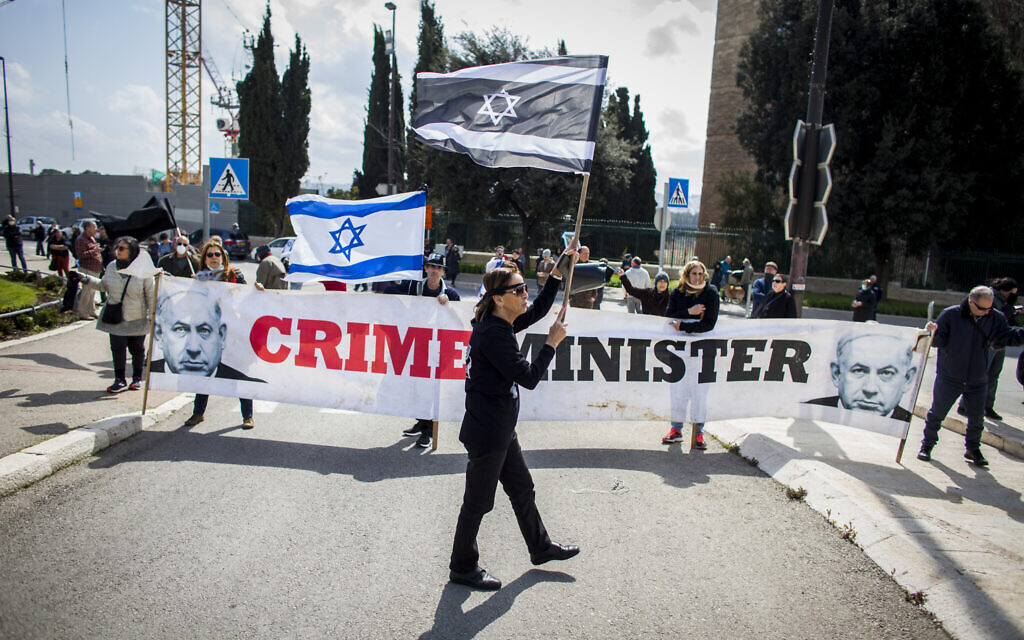
People wave Israeli flags, inverted Israeli flags and banners during a protest outside the Israeli parliament in Jerusalem, Thursday, March 19, 2020, accusing Prime Minister Benjamin Netanyahu's government of exploiting the coronavirus crisis to cement his power and undermine Israel's democratic foundations. (AP Photo/Eyal Warshavsky)

Labels: , , , , , ,

Saturday, December 28, 2019

Israel : On Temporary Malfunction Break

"It's a political crisis that we have never gone through before or even anticipated."
"We have never been in a situation where a political candidate did not succeed in putting together a government, and that happened now not only once, but twice."
"[The bind has resulted from both] weaknesses in our system and the unique situation of a popular prime minister who is charged with severe crimes."
Yohanan Plesner, president, Israel democracy Institute

"We are kind of running on autopilot."
"But it means the government really has no flexibility in dealing with any crisis that might arise, there can't be any changes in budgets, and it loses all degrees of freedom to run the country."
Dan Ben-David, professor of economics, Shoresh Institution, and Tel Aviv University

"In the United States, when you have a problem, you can call your representative in Congress. But here there is no one to represent you, no one to hold the administration accountable."
"We have completely forgotten how a functioning democracy works right."
Tal Schneider, senior diplomatic and political correspondence, Israeli business newspaper Globes
Israel's Prime Minister Benjamin Netanyahu, seen at a Dec. 18 Likud party supporters meeting, declared victory in his primary election battle for leadership of the party on Thursday. (Jack Guez/AFP/Getty Images)

Legally embattled though he is, Prime Minister Benjamin Netanyahu has succeeded in fending off his leadership challenger to remain head of the Likud Party, and as such he continues on as a dominant figure in Israeli politics with few contenders that can match his legendary popularity, his history as the longest-serving, born-in-Israel prime minister of the Jewish state. Easily submerging his challenger in the flood of majority votes cast in his favour, he now prepares to lead the country in its third election within a single year.

Israeli Druze community September 2019, Daliyat al-karmel, northern Israel. (Jalaa Marey/AFP)

There are, however, no guarantees that third time around will reach success. In fact, the current political turmoil points to yet another stalemate -- and then what? This inability to come to an agreement, a political 'understanding' for the good of the country is unfortunately an expression on a larger scale of a fairly typical Jewish cultural trait of argumentative illogic; to gain a point by destroying a contested supposition. Netanyahu's appeal to the Israeli public to proceed with ventures certain to see widescale condemnation on the world stage, thrills some, and worries others.

He has the wind at his back in concurrence by the Trump administration determined to take Washington in directions historically hinted at but never committed to in its support of Israel. His amicable relations with Vladimir Putin, the growling bear whose latest adventures in the Middle East place him at odds with Israeli interests, still reflect a soft landing when military missions are deployed that annoy the Kremlin.

Benny Gantz walks during a session of the Knesset in Jerusalem on December 11, 2019.(Gali TIBBON / AFP)

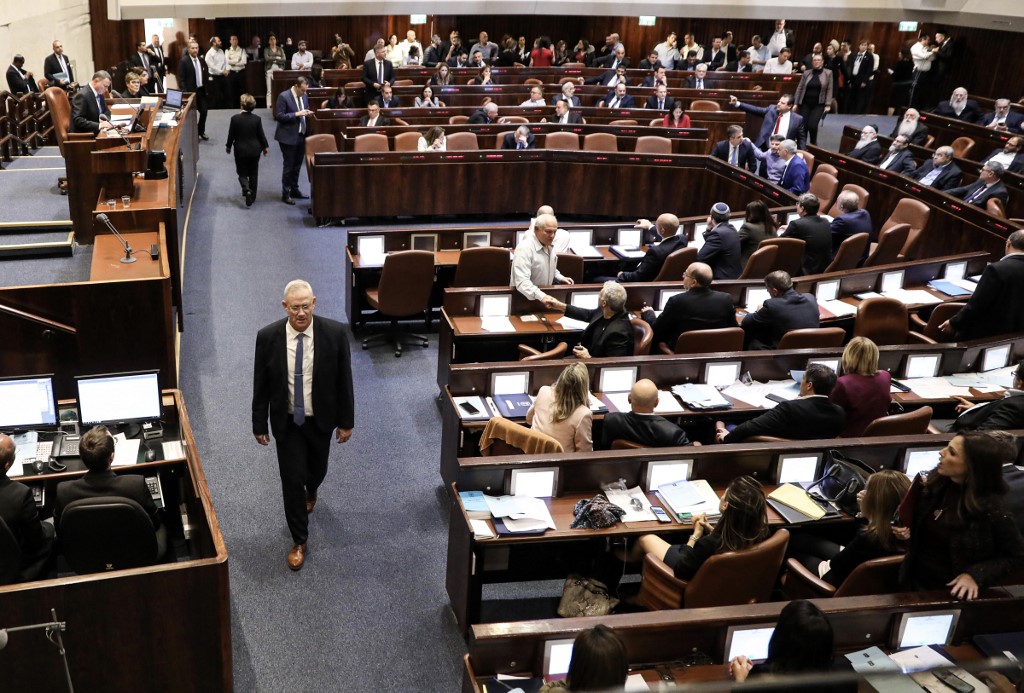
The parliamentary democracy that Israel is, has been temporarily placed on hold, its prime minister viewed by some as heading a "caretaker government" with executive and legislative functions placed on the backburner absent the formation of a working government. Few laws have been approved by the Knesset, no state budget approved for the new year, senior appointments put on hold. Government offices, institutions limited to the past year's budget spending.

Indicted in three cases that center on bribery, fraud and breach of trust, this is an embattled prime minister characterizing charges laid against him as a political witch hunt by enemies determined to force him from office. As a matter of mere coincidence and comparison, the parliamentary democracy which is Canada also has a prime minister popular among those constituents who returned him to office, despite having engaged in the very same morally, ethically questionable conduct, and other than reducing his already-challenged reputation, has paid no political price.

Israel's Supreme Court awaits an opinion on the issue of whether a prime ministerial candidate facing prosecution should be allowed to form a government, having requested such a draft from Attorney General Avichai Mandelblit who indited Netanhahu in November, for their perusal. Meanwhile, Mr. Netanahu's cabinet continues its weekly meetings, the military goes on training and conducting security operations. The nation's hospitals, schools and public transport remain operational.

Waiting ... waiting ... on tenterhooks. March 2 cannot come soon enough. And.then.what?

A general view of the Israeli parliament during a vote on a bill to dissolve the parliament, at the Knesset, in Jerusalem on December 11, 2019. (Hadas Parush/Flash90)

Labels: , ,

() Follow @rheytah Tweet