Politic?

This is a blog dedicated to a personal interpretation of political news of the day. I attempt to be as knowledgeable as possible before commenting and committing my thoughts to a day's communication.

Tuesday, August 18, 2020

Canada: Indigenous Residents and 'Settler Population'

"[This blockade and encampment represents a protest] to protect and save the land for our future generations who will have nowhere to live and prosper if the settler population continues to unlawfully encroach upon our lands."                   "The Haudenosaunee Confederacy Chiefs Council is opposed to this development and as the holder of collective rights for the Haudenosaunee people has not granted any type of consent which would allow this development to proceed."         "The Council holds rights collectively on behalf of the Haudenosaunee." Haudenosaunee Confederacy Chiefs Council

"We are exposed to acts of domestic terrorism at least twice a year. Does anyone outside our rural county care?"                                                                         "Where else in Ontario do citizens endure almost constant blockades of their roads and the railways, and have tire fires lit across their main thoroughfare as well as the bypass to the town?"                                                                               Resident, Caledonia housing development, Ontario

"[I] encourage all sides and each and every person involved to carefully consider the actions they take and the impacts those actions will have on the situation." Mark Hill, elected chief, Six Nations
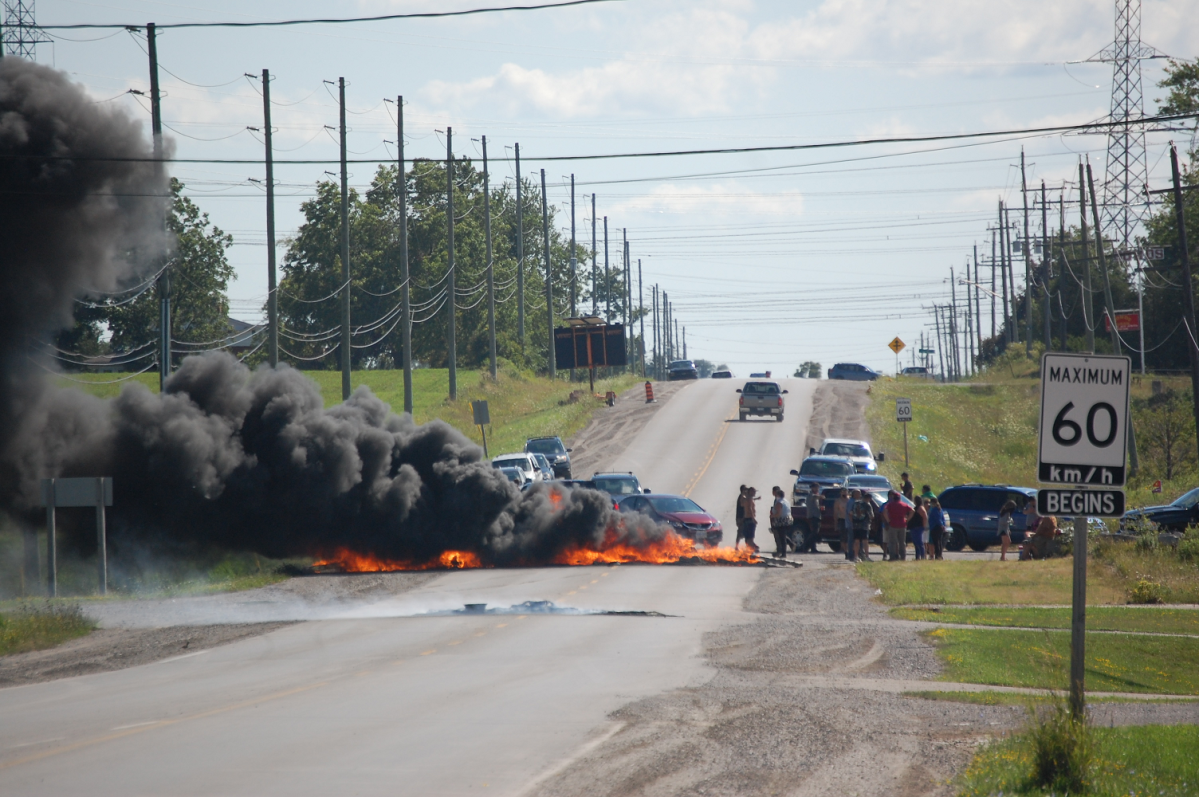
OPP closed the road as a group of protesters lit tires on Highway 6 near Argyle Street in Caledonia, Ont.
OPP closed the road as a group of protesters lit tires on Highway 6 near Argyle Street in Caledonia, Ont. Lisa Polewski / 900 CHML

"The OPP took a measured, professional and safe approach while assisting with enforcement of the court injunction."                                                                      "As a result of demonstrators that then went onto Argyle Street North in Caledonia, OPP have closed Argyle Street North between Highway 6 and Braemar Avenue for public safety and to assist in maintaining traffic flow in the area. The Highway 6 by-pass between Argyle Street North and Greens Road is also closed."                     OPP Constable Rodney LeClair

Caledonia, about 10 km distant from Hamilton, Ontario, is once again in the news. An old standoff that took place earlier when a land dispute between Indigenous people in southwestern Ontario and a land developer, led to blockades, encampments, and violent protests, finally settled when the province bought out the developer and handed the land in question to the tribal authorities. Bad feelings tend not to evaporate when people living in a suburban development are threatened, face violence and intimidation as was the case with the original Caledonia protest.

Caledonia is now on repeat. A new encampment named 1492 Land Back Lane in place since mid-July, established on McKenzie Meadows -- a site where a developer has plans to build 218 homes on 25 acres, where home buyers had expectations of moving into their new homes come the fall, is the focus of the occupation of parcels of land on the acreage, leading to a halt in construction, despite a court-ordered injunction that construction could proceed.

The 2006 standoff between earlier developers and the Six Nations of the Grand River ignited protests, saw tire-burning and residents forced to run a daily blockade to leave and get back to their homes. There were incidents of violence resulting to injuries. Indigenous 'warriors' were adamant they had no intention of leaving, and the 'settlers' had better get used to it. Neither the government of the day nor the Ontario Provincial Police had any wish to apply the law, remove the threats along with the warriors and rescue residents from the dilemma they were facing.

Until the province agreed to abort the subdivision project, leaving the disputed land in the hands of the Indigenous community. A new developer, Foxgate Developments more latterly purchased a new tract of land at McKenzie Meadows through consultations with the Six Nations elected council. The elected leadership of Six Nations had agreed to support the development project according to documents filed in court. The issue now is that elected chiefs are in full agreement of the land being developed for residential purposes, while the hereditary chiefs oppose it leaving the developer to struggle between both.

Foxgate Developments' entirely legal purchase of the land in question from the democratically elected chiefs acting on behalf of the people they represent is now in limbo; a replay of the earlier drama that had degenerated into intimidation, threats and violence, where the province refused to step in and authorize the OPP to protect the lawful activity of a developer and those who had purchased homes and had every expectation of living in them without constant harassment.

Rocks could be heard hitting police vehicles as Ontario Provincial Police officers are slowly pushed back by a large group of indigenous protesters gather in Caledonia over the noon hour on Wednesday August 5, 2020. Earlier in the morning, a large contingent of police removed protesters occupying a nearby residential construction site, prompting supporters from the nearby Six Nations of the Grand River Territory to arrive. (Brian Thompson/Postmedia Network)

Earlier in the month the blockade had been cleared, arrests taking place when Ontario Provincial Police took steps to enforce a court-ordered injunction at the site permitting development of areas of the site to continue and the locked roads to be cleared. The parcels of land that had been illegally occupied were cleared to enable development to proceed. Locals had been frustrated by the lack of action by the OPP, and even at the present time, portions of area highways have been closed.

Over the summer, the cleared camp has been gradually re-occupied; the OPP dismantling overturned. These recurring, dangerous face-offs lead back to various levels of government not having concluded good-faith bargaining with the Indigenous populations, finally settling grievances and land rights after hundreds of years. The site, part of the Haldimand Tract, was given to members of the Haudenosaunee nation in 1784 in acknowledgement of their having fought for the British during the American Revolutionary War.

The courts are still struggling with details of land ownership in that tract, remaining under dispute reflecting 29 separate claims focusing on land loss and assets over the years. Little wonder Indigenous peoples are frustrated and angry, when it's long past time that any questions revolving around land claims should have reached an agreeable compromise between governments and the Indian nations.

About 10 tents dotted the site on August 12, along with the frame of a structure demonstrators have said will be used as a kitchen. (Dan Taekema/CBC)

Labels: , , ,

Friday, June 07, 2019

Acknowledge History, But Move to the Future

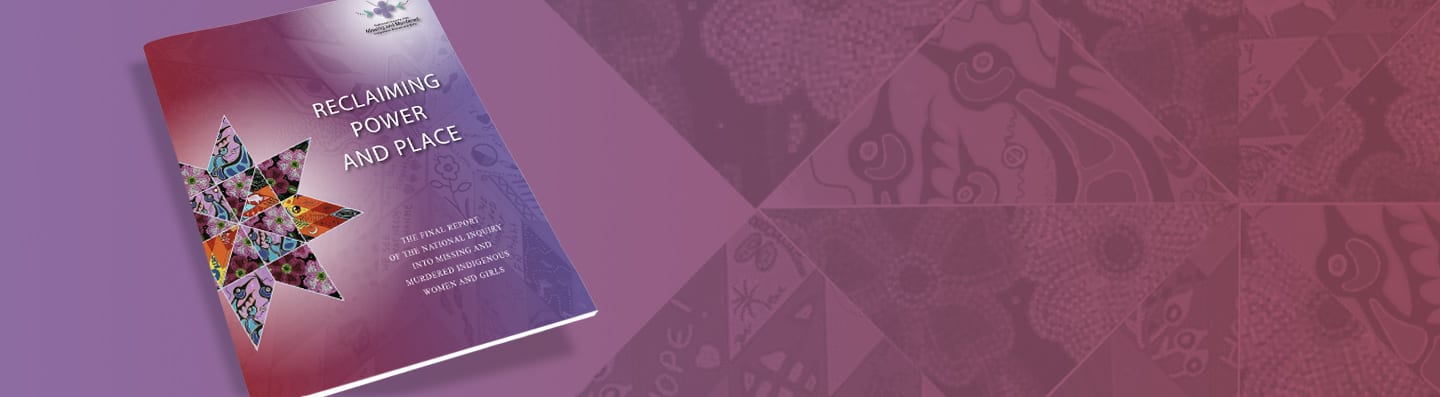
https://www.mmiwg-ffada.ca/wp-content/uploads/2019/05/header-report-1.jpg
"[There exists] a race-based genocide of Indigenous Peoples -- empowered by colonial structures -- leading directly to the current increased rates of violence, death, and suicide in Indigenous populations."
Final Report of the National Inquiry into Missing and Murdered Indigenous Women and Girls
"...Any of the following acts committed with intent to destroy, in whole or in part, a national, ethnical, racial or religious group, as such: 
  • (a) Killing members of the group;
  • (b) Causing serious bodily or mental harm to members of the group;
  • (c) Deliberately inflicting on the group conditions of life calculated to bring about its physical destruction in whole or in part;
  • (d) imposing measures intended to prevent births within the group;
  • (e) Forcibly transferring children of the group to another group." 
Article 2 of the United Nations Convention 
Women embrace during the closing ceremony of the National Inquiry into Missing and Murdered Indigenous Women and Girls in Gatineau, Quebec, Canada, June 3, 2019.REUTERS/Chris Wattie

The National Inquiry into Missing and Murdered Indigenous Women and Girls was struck by the federal government to look into the murder or disappearance of an estimated 1,200 Indigenous women over a period of perhaps a decade. These were for the most part unsolved crimes. There had been previous studies of the situation, one or more of which was conducted by the Royal Canadian Mounted Police, Canada's federal police force.

Although the current committee, after interviewing Indigenous women throughout Canada, had concluded they were justified in naming the murdered and missing women the result of a genocide -- in the process trivializing the meaning of a word meant to convey the wholesale and focused state-sanctioned annihilation of a specific demographic -- what they conveyed was a misplaced sense of dramatic accusation, for the crimes were not state-sanctioned nor were they "committed with intent to destroy in whole or in part" any racial or ethnic group.

According to the 1946 United Nations General Assembly, "Genocide is a denial of the right of existence of entire human groups, as homicide is the denial of the right to live of individual human beings". Such was far from the reality of the missing and murdered Indigenous women in Canada. The actual, glaring fact of reality is that the murder of Aboriginal women is attributable largely to the community in which they live, sharing their lives with Aboriginal men who are the perpetrators.

Statistics from the RCMP as well as other sources are clear; 90 percent of the murders in question are committed by intimate partners, men who knew their victims within the Indigenous community, where 72 percent of Aboriginal women are murdered in their homes, very few among them were involved in the sex trade, murdered by clients. On the other hand, Indigenous men comprise an even greater number of murdered, and they as well within their own communities.
A woman holds a sign during the closing ceremony of the National Inquiry into Missing and Murdered Indigenous Women and Girls in Gatineau, Quebec, Canada, June 3, 2019. REUTERS/Chris Wattie

Of the 20,313 national homicides that took place between 1980 and 2012, five percent of the victims were Aboriginal women; in contrast 70 percent of murdered or missing Aboriginal individuals were men. The public at large is aghast at these numbers. But it is from within the Aboriginal communities themselves that this symptom of mass dysfunction exists. What these inner circle and domestic pathologies represent is conditions of isolation, broken homes, family trauma, addiction and welfare dependence and a culture of abuse.

Canada's Aboriginal population represents the fastest-growing demographic in the country; there are more Aboriginal children and young people than any other group in Canada. Indigenous Canadians were the victims of racism in the past, and that racist attitude still exists although it is waning. On the other hand, there is the issue of counter-racism, where Aboriginal women are denied the privilege accorded Aboriginal men, to live within their community if they marry outside the tribe to non-Aboriginals.

If there is any whiff of 'genocide', the finger of blame should be shifted from the Canadian population as a whole, toward the Aboriginal communities that fail to practise self-respect. By living on remote reserves in favour of refusing to join the general population where employment is available and Aboriginal people can live the very same lives as other Canadians, independent and self-sufficient, the ongoing inclination is to live 'traditionally'. But the traditional way of life is eschewed for a welfare, unemployed existence that leads to poverty and resentment.

Massive amounts of tax dollars have been expended in support of the reserve lifestyle, with those on reserves living in government-supplied homes where they see no stake in what is normal household upkeep on their part so accommodation deteriorates and the expectation is that new homes be built. With idleness due to lack of employment opportunities, boredom sets in for all age groups, and access to drugs and alcohol lead to addiction and familial neglect with children's needs poorly cared for. A self-inflicted harm absent values.

It really is past time for Canada's Aboriginal communities to follow the example of some among them that have proudly established commercial enterprises in successful bids to become independent and capable of serving the needs of their communities. Weeding out the corruption known to exist in other communities would go a long way to guiding them toward an improved future.

Simply banking on the utility of inducing guilt in the greater Canadian population with historical claims of racism and ill-guided measures for inclusion of Aboriginals serves no function but to continue the social abrasion that has mounted a wall of disaffection between both communities.

Labels: , , ,

Monday, September 03, 2018

'Alleged Language' or Simple, Observable and Plain Reality?

"He steps up to them and tells 'All of you people need to get jobs' ... and 'You guys can't keep hanging around here being vagrants'..."
"And 'You guys need to get out of here'."
Scott Many Grey Horses, Facebook

"I found the whole thing completely outrageous. I felt so strongly that these are really people with significant challenges. Nobody would hire these people. They cannot get a job. Most of them have severe addictions or prenatal exposure to alcohol."
"I just felt unless someone helped them voice their complaint, it would just get swept under the rug."
"To me, that’s someone who has a high level of education and who deals on a day-to-day basis with people from that community, to exhibit such hostility towards that group was kind of mind-blowing in fact. I thought something should be done about it."
"It was just shocking to me. The rejection said the conduct didn't happen during his practice time. It wasn't while he was practising medicine so there's nothing they can do about it."
"When a person demonstrates an obvious disdain for an identifiable and vulnerable group of people, how can you be assured that kind of obvious bias and negative view of them doesn't effect the way he practises medicine? Surely that is something that needs to be investigated, and I urged them to reopen the complaint."
Lethbridge lawyer Ingrid Hess

"We are investigating and will take any necessary action once that investigation is complete."
"There is no excuse for the comments that were allegedly made in this instance, and we want to assure those involved in this incident that this sort of alleged language in no way reflects the beliefs or values of Alberta Health Services."
Alberta Health Services

"I am of the view that the various concerns raised in your letter of complaint do not relate to patient care."
"I understand the feelings of those affected by Dr. Clarke's remarks. They were unfortunate and inappropriate."
"The College nevertheless cannot dictate the behaviour of what a physician does outside a clinical setting excluding extreme circumstances."
Michael Caffaro, assistant registrar, complaints director, Alberta College of Physicians and Surgeons
Dr. Lloyd Clarke will remain on administrative leave until the matter is resolved, Alberta Health Services says.
Dr. Lloyd Clarke, associate medical director, Alberta Health Services, Cardston, Alta. will remain on administrative leave until the matter is resolved, Alberta Health Services says.  (YouTube)

It's a pretty straightforward situation. A medical doctor by chance, but it could have been anyone who works for a living and feels disgust when he walks by a group of people outside the entrance of a store clearly loitering, not engaged in any useful work of any description in the middle of the day. It doesn't take too much cerebral functioning to conclude that the individuals appearing to be homeless Indigenous people, are doing nothing to further themselves, much less support their most basic needs, appearing to be satisfied to collect handouts to keep body and soul together.

Simply being Indigenous is no handicap in life. Presenting as handicapped based on being Indigenous because the larger society is seen as privileged at the expense of the Indigenous population is fallacious and self-destructive. But it does work wonders in inducing guilt in the minds of those being blamed for the conditions that Indigenous people find themselves in mostly as a result of their own lack of willingness to do something for themselves rather than be dependent on social welfare.

Dr. Clarke, the man accused of 'racism' because of disparaging remarks he made of homeless Indigenous would be in a fairly good position to medically judge the extent of their handicapped inability to fend for themselves as most people are expected to do. He obviously felt fed up and no little bit annoyed at the situation whereby people prefer to do nothing for themselves while exploiting a social convention whereby the hale and productive feel obliged, as they should, to give aid to those whom genuine life circumstances have not favoured.

Yet when someone with the intelligence and the public social conscience to point out to them that they could make a choice to restore a level of dignity to their lives by making an effort to help themselves, it is seen as a dreadful affront. Homeless, without a visible means of income, helpless and vulnerable in the opinion of the woman who read the account of the encounter that a purported bystander Scott Many Grey Horses posted on his Facebook account, it was scandalous, racist, unprofessional and unbearable to have accosted the group's lazy dependency.

Unable to perform some elemental labour, or unwilling to do anything that might result in self-sufficiency when panhandling and welfare are so much easier to come by, and viewed by many in the First Nations communities as the rightful obligation of the colonial-identified 'white man' to the noble Indian from whom he wrenched the stewardship of the land called Canada. Dr. Lloyd Clarke stopped briefly at the sight of able-bodied people, quick to register the indignity they suffered on Facebook when the physician analyzed their situation and chided them for their complacency and lack of responsibility.

Lawyer Ingrid Hess was propelled into service on behalf of these malingerers when she read the Facebook post, took the trouble of tracking down two of the people involved, and convinced them to sign a complaint. She was furious that the doctor had suggested the people in the group were searching out prescriptions for Tylenol 3s. How dare anyone confront these poor underprivileged people who, because they are Indigenous, are forgiven their unwillingness to exert a level of personal responsibility for their own well being?

She launched herself on a crusade to 'out' the doctor and ensure that he would be punished for his lack of compassion for society's psychologically impoverished. Thus far, Dr. Clarke has been placed on administrative leave while Alberta Health Services 'resolves' the issue, while promising that a different doctor would be available to anyone taking offence, should they require medical assistance from the Cardston clinic.

Labels: , , , ,

Friday, August 10, 2018

Irreconcilable Identities and Challenging Credulity

"[The lawsuits are intended to] hold the person responsible for Colten's wrongful death accountable [and in the process to] force the RCMP to look deeply within itself [to examine how it] interacts with the Indigenous citizens of Canada."
"The search officers who attended the home deliberately engaged in discrimination by subjecting three proud members of the Red Pheasant First Nation to ridicule, unlawful searches and humiliating breath tests."
"While the loss of Colten [Boushie] has devastated the plaintiffs, it has been the unending memory of the defendants' high-handed and egregious conduct that has caused the plaintiffs' injuries."
Lawyers for the Red Pheasant First Nation Reserve Boushie Family

"[There] can be no true reconciliation until the RCMP, itself, acknowledges that the callous manner [in which officers treated the Boushie family] was due -- at least in part -- to the fact that they were proud members of the Red Pheasant First Nation."
Chris Murphy, lawyer, Boushie family
Debbie Baptiste, mother of Colten Boushie, speaks during a press conference on Parliament Hill in Ottawa on Feb. 14, 2018.
Rural communities in Western Canada have a problem with the presence of First Nations reservation young people's obstreperous behaviour and flouting of the law. Many rural properties and farms owned by white farmers whom Canada's Indigenous nations now characterize as "settler" farms are being plagued with criminal entry and theft of all manner of farm equipment. Homes are frequently illegally entered and the occupants made concerned and wary over the presence of young men often inebriated and frequently up to no good.

Such was the case on August 9, 2015 when five young men and women drove a grey Ford Escape SUV from Red Pheasant First Nation over to a popular swimming area by a nearby river. They spend a fun afternoon together, drinking all the while. When they decided to return home they discovered a flat tire on the vehicle. The SUV was steered onto a farm where later evidence made it clear that someone among the five had made an unsuccessful effort to steal a truck parked there, smashing a window with a .22-calibre rifle they had with them.

The attempt unsuccessful, they drove on to a farm 15 kilometres further up the road belonging to a farmer by the name of Gerald Stanley who was making some fence repairs on his property, with his grown son. Both heard a wild commotion in the distance, around their house, and hurriedly went over to see what was happening. Someone among the inebriated five that arrived in the SUV had tried to start a quad on the property and when the Stanleys drove up all got in the SUV and tried to drive off, hitting a parked vehicle in the melee.

Mr. Stanley, fearful for the safety of his wife who was on the scene mowing the lawn, but whom he was unable to see, told his son to enter their house and retrieve a firearm. He went himself to the nearby garage and took possession of a firearm he had stored there. In the heated atmosphere and excitement and fear, Boushie, seated in the driver's seat, alone, because his companions had run off in a panic, was shot in the head, and killed by a single gunshot. At trial, Mr. Stanley testified that his gun had gone off accidentally and he was found not guilty of the charge of second-degree murder.
William Boushie, brother of Colten Boushie, speaks to media during a rally outside of the Saskatchewan Provincial Court in North Battleford, Thursday, August 18, 2016. People rally outside a Saskatchewan courthouse Thursday where a farmer accused of fatally shooting a First Nations man is to make an appearance.

William Boushie, brother of Colten Boushie, speaks to media during a rally outside of the Saskatchewan Provincial Court in North Battleford, Thursday, August 18, 2016. People rally outside a Saskatchewan courthouse Thursday where a farmer accused of fatally shooting a First Nations man is to make an appearance. Liam Richards/THE CANADIAN PRESS
The verdict by jury which had excluded the presence of any Indigenous representatives, had infuriated the First Nations communities who charged that Canada was racist and its policies and laws injured and dishonoured First Nations. Numerous protests took place, but eventually the issue quieted down, as other similar events continued to take place. Now, the mother of the young man who had lost his life, along with her two remaining children are suing those involved in her son's death; the farmer Gerald Stanley and the RCMP. Two lawsuits totalling $2-million.

Colten Boushie's mother Debbie Baptiste faults Mr. Stanley for acting with "excessive force" against her then-22-year-old son. She seeks $60,000 compensation for grief counselling, $100,000 in lost wages, and $200,000 "in aggravated, exemplary and punitive damages to be proven at trial". The attorney general of Canada and several RCMP officers are named in a separate suit. Her son's death, states his mother is "a direct result of the negligent, reckless or intentional acts of the defendant, Gerald Stanley" who failed to assess potential risk, shot her son at "point blank range" and failed to administer assistance to her son.

Ms. Baptise is also claiming over $400,000 in damages for her suffering following her son's death; the grief she was caused, the loss of his "care and companionship" and past and future income (on a reserve with a 74% unemployment rate). As for the statement of claim against the RCMP, another $550,000 is sought in damages while her sons each seek $450,000 for damages as well. She stated that RCMP officers asked if she had been drinking and told her to "get herself together", on their arrival and the delivery of the message that her son was dead.

She had, the lawsuit states, along with her sons, suffered depression, anxiety, nervous shock, interference with normal sleeping patterns, loss of enjoyment of life and suicidal ideation -- all linked to the harsh manner she contends the RCMP officers confronted her with while delivering their message and looking to find evidence in her home. In grieving and continuing to grieve the loss of her son, this poor woman and her son's siblings would find life's cruel consequences of sociopathic tendencies much easier to deal with once in possession of two million dollars that would help to ease their way to dealing with the past and finding peace and harmony in their deprived lives.

And no, no one on either side of this horribly divisive and unfortunate event would ever wish that a young man should lose his life over the ill life-choice of potential theft of property. The outcome of this tragic event represents an abject failure of both communities; that of the Indigenous community to find a life for themselves other than on isolating reserves with no future for their youth, and that of the outside community which understandably has no idea how to deal with the outcome of a failure to resolve the unresolvable.

Faced with the wildly undisciplined, anti-social presence on private property of five inebriated young people it is in fact, little wonder that the Stanley family went into a panic at the presence of strangers whose behaviour they had no idea how to deal with, or whether they were in mortal danger because of that presence. Imprinted into human reaction to perceived danger is the compulsion to act in self protection. The incidence and reputation of Indigenous youth invading private property and lifting goods invoked unreasoning fear, and little wonder.
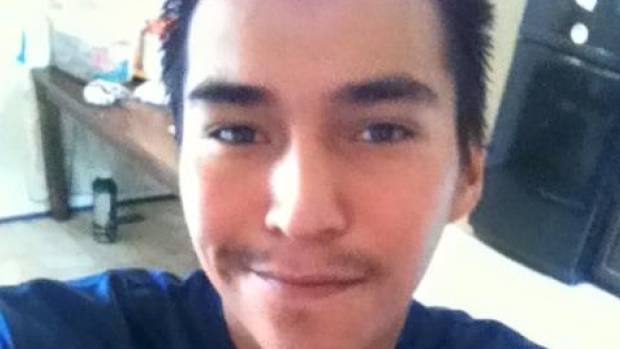
Colten Boushie is shown in this undated Facebook photo.
Colten Boushie is shown in this undated Facebook photo.

Labels: , , , , ,

Sunday, February 11, 2018

Rage Across The Land : Subjective/Objective

"The justice system needs to stop locking up our youths. All of our loved ones are in jail. White people ... they run the court system."
"Enough. We're going to fight back."
"They're not sweeping us under the carpet. Enough killing our people. We fight back. Go to hell, Gerald Stanley. That's where you belong."
Debbie Baptise, Red Pheasant First Nation resident, Saskatchewan

"I was terrified. I didn't know what to say [to police]. I was young, I was stupid, I've changed a lot since that happened, and I'm willing to face the consequences."
"I was scared for myself and I was scared for the people there, that they might get in trouble, and I knew I was wrong but that's just how I was feeling over there because I was scared out of my mind. I didn't know what to say."
"I wasn't there to steal."
Cassidy Cross-Whitstone, 18, trial witness

"I'd seen a younger-looking man go inside the house, walk inside the house and then shortly after that, meanwhile, the person that said 'Go get the gun', went and grabbed his own handgun."
"He shot Colten in the head."
"I was lying to police. [Giving her statement to] make it seem like I did something wrong so I didn't know how to answer him."
"[I was] still intoxicated [at the time]."
Belinda Jackson, 24, trial witness
Gerald Stanley, right, pleaded not guilty to second-degree murder in the death of Colten Boushie and underwent a two-week jury trial. He has been found not guilty.
Gerald Stanley, right, pleaded not guilty to second-degree murder in the death of Colten Boushie and underwent a two-week jury trial. He has been found not guilty. (Facebook/Liam Richards/Canadian Press)

On an early August afternoon in 2016, five Indigenous youth from the Red Pheasant First Nation drove into the farmyard of Gerald Stanley purportedly to ask for help for their flat tire. They had been out at a nearby river, swimming and drinking. Previous to driving into the Stanley farm, they had driven into another, nearby farm with the intention of stealing a truck, which failed to start. When Gerald Stanley and his son Sheldon who were busy building a fence, heard the noisy entrance of the SUV driven by the five youth they also heard and viewed in the distance one of the young men attempting to start their all-terrain vehicle.

Mrs. Stanley was not far away, mowing the lawn. The two Stanley men raced toward their yard, to stop whatever was happening. The younger Stanley ran into the farmhouse to retrieve a long gun, and his father ran to a barn to retrieve a revolver. In the melee that followed, with the SUV backing into a parked SUV belonging to Mrs. Stanley, the five inebriated young people in disarray, then two of the young men bolting, Mr. Stanley appeared to have inadvertently shot 22-year-old Colton Boushey, still sitting in the stopped but running SUV in the back of the head.

The two young women sitting in the back seat emerged from the SUV, pulled open the driver's door of the SUV, and pulled at Colten Boushie sitting in the driver's seat, who was dead, and as he slumped sideways out of the SUV, a rifle in his lap fell out as well. Its barrel was missing, later discovered at the previous farm they had entered, beside the smashed window of the truck. The two young women fell on Mrs. Stanley, beating her to the ground, then fled.

Young Cassidy Cross-Whitstone admitted to lying to police about the rifle in the SUV, claiming it belonged to someone else in his SUV, and that he was sober at the time of the entry into the Stanley farm. That they had driven to the farm solely to ask for  help with the tire he had blown when he had earlier swerved off the road, intoxicated. Gerald Stanley testified later in the trial that he hadn't meant to shoot anyone. He had shot into the air, and his gun, he claimed, accidentally went off.

The jury was instructed by the judge in Battleford, Saskatchewan, to find Gerald Stanley guilty of the charge of manslaughter only if they were convinced that the killing of the young Indigenous man was no accident. After deliberating for 13 hours their verdict was 'not guilty'. The courtroom erupted in accusations of an  unjust verdict, and that justice had once again failed the Indigenous community of Canada.

Colten Boushie's mother's (Debbie Baptise) statement about the disproportionate incarceration of Indigenous people is quite correct, but the reality is also that they are disproportionately involved in crime in comparison to the non-Indigenous majority. Violence also appears endemic in that community. Accidents do happen in overheated, excited exchanges between people whose suspicion of one another leads them to regard one the other as hostile.

Fear and injury are no excuse for causing someone's death. But those emotions of suspicion and fear can and do lead to situations where misunderstanding turns to violence, whether by intention or through accidental reaction. Actions have consequences. And the consequence of these young people's untrustworthy behaviour in a generalized atmosphere where farmers have experienced many instances of illegal activities and missing property leading to angry confrontations was realized in the death of Colten Boushie.

The verdict does nothing to satisfy the tribal and human relations agony of grief at the untimely death of yet another young Indigenous man. But it does reflect the neutrality of the justice system when a jury decided the death to be accidental. The jury, comprised entirely of white men and women, failed to have the confidence of the Indigenous community. There are threats of reactions that will erupt to demonstrate just how dissatisfied that community is over the outcome of the trial.
"Colten Boushie was shot in the back of the head at point blank range. Nevertheless, an all-white jury formed the twisted view of that obvious truth and found Stanley not guilty."
"[The verdict] crushed the spirit [of the community in a ruling that was] absolutely perverse."
Red Pheasant First Nation Chief Clint Wuttunee
But the simple facts are that there was evidence and there were witnesses and circumstances and situations arise that call for mature minds to account for inappropriate actions and the sometimes inevitable consequences. 

Labels: , , , , ,

Friday, January 05, 2018

Indigenous Shibboleth

"[Both Ancient Beringians and all Native Americans] descended from a single founding population that initially split from East Asians around 36 thousand years ago, with gene flow persisting until around 25 thousand years ago."
"[Human remains at Upward Sun River and modern Native Americans] derived from the same ancestral source, which carried a mixture of East Asian and Mal'ta related ancestry."
"[The Alaska study gives] direct genomic evidence that all Native Americans can be traced back to the same source population from a single Late Pleistocene founding event."
New Scientific paper, University of Alaska Fairbanks

"We're a country based on immigration, going right back to our, quote, Indigenous people, unquote, who were immigrants as well, 10, 12, 14,000 years ago."
(former) Canadian Governor-General David Johnston

"What we do when we look at the current data is we look at the patterns, and right now we have hundreds of sites that form a very distinctive pattern of slow expansion from southern Siberia to northern Siberia, into Alaska, and further south."
"It confirms itself by these multiple lines of evidence."
"It would be difficult to overstate the importance of this newly revealed people to our understanding of how ancient populations came to inhabit the Americas. This new information will allow us a more accurate picture of Native American prehistory. It is markedly more complex than we thought."
Professor Ben Potter, anthropological archeologist, University of Alaska Fairbanks

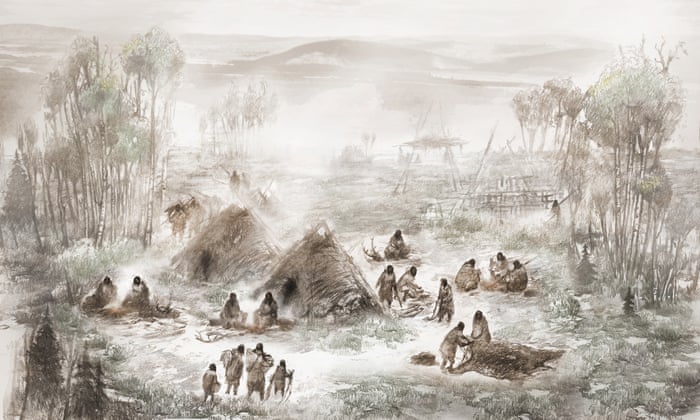
An illustration of the Upward Sun River camp in what is now Interior Alaska. Illustration by Eric S. Carlson in collaboration with Ben A. Potter
When then-Governor-General David Johnston stated that all those living in North America were, going back into ancient history, immigrants, he committed social-cultural-political Indigenous heresy. By merely iterating what has been known in anthropological and archaeological investigative circles for quite a few years, but not necessarily spoken out loud in public for fear of an Indigenous native backlash, he invited just that backlash, though he obviously hadn't intended to. He was, at the time, making an effort to reassure recent immigrants that they had joined a nation of immigrants.

The public uproar that followed, with First Nations groups lashing out at the soon-to-depart Governor-General for misreading history, lumping First Nations with European, Asian and African migrants to Canada creating intolerable insult not to be countenanced, and the dignified and learned David Johnson retreated from his scholarly lesson of migration in a follow-up public admission of inadvertently misguided linking of ancient migrants with current immigrants. Nonsense, of course, but in the greater interests of keeping the peace, a question of diplomacy.

As in science be damned; the illusions of a people convinced of their victimhood and entitlements must be assuaged in their sense of overwhelming grievance. But the science is in and it cannot be gainsaid. Most recently, to add to the knowledge already gathered, the ceremonial burial of two infants from 11,500 years past was discovered of ancient Beringians -- people who crossed the Bering Land Bridge once connecting North American to Asia -- leading to the interpretation of their DNA identifying them as having emanated out of Asia.

In a new research paper published in the journal Nature, the discovery at Upward Sun River in central Alaska was linked to a migrating group out of a population in eastern Asia isolated for thousands of years from a greater population, migrating into Alaska around 15,000 years ago. According to anthropological archaeologist Ben Potter, tool technology found among them gives additional clear linkages to Asian groups.

Though scientific investigation has not made clear how Ancient Beringians fared, whether absorbed into other Native Americans or became victims of conflict, the latest research demonstrates through this first genetic analysis of the oldest human remains in the American area of Beringia, that both Native Americans and Ancient Beringians had a common descent. The Mal'ta were an ancient population close to Lake Baikal in what is now Siberia, identified from the remains of a four-year-old boy who lived and died there 24,000 years earlier.

Scientific theory has progressed to the point where theory has been validated by new findings and investigations, along with technologically advanced genetic screening linked to archaeology. There remain instances where cultural determination and social practices overrule science and technology, however, as in Kennewick Man dating to 9,000 years ago when academic science was overruled in civil courts acceding that Native American tribes could reclaim the remains for burial, preventing additional study.

Cultural sensitivity urges caution lest the sensibilities and righteously victimized outrage of Native Americans be stricken with the insults of doubt that they have always been the original inhabitants of North America, not as science now claims, original immigrants from elsewhere, most notably Asia. Native Americans insist that their legends prove positively that their ancestors lived since time immemorial on the land co-opted by late-arrival Europeans.

Indigenous North Americans vastly prefer their version of land possession and heritage, spurning scientific enquiry that has succeeded in giving ample proof of Indigenous Americans moving across a then-accessible land bridge to North America as a racist, colonial myth whose purpose is obvious; to assault Indigenous dignity, veracity and heritage.
"We didn’t know this population existed."
"These data also provide the first direct evidence of the initial founding Native American population, which sheds new light on how these early populations were migrating and settling throughout North America."
Ben Potter, lead study author, professor of anthropology, University of Alaska Fairbanks
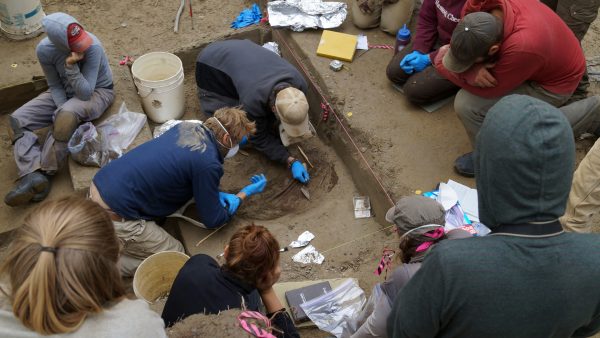
Upward Sun River excavation
UAF photo courtesy of Ben Potter   Members of the archaeology field team watch as University of Alaska Fairbanks professors Ben Potter and Josh Reuther excavate at the Upward Sun River site

Labels: , , , , ,

Monday, January 25, 2016

Uncompromising "Scholarly" Oral Tradition?

"Although contributions to scholarship necessarily involve a combination of quality and quantity, generally we would expect to see five to six peer-reviewed, significant publications by the time you seek tenure."
Dean, Faculty of Law, University of British Columbia

"[There is] nothing about indigeneity that prevents an indigenous person from having the capability of meeting the  university's requirements."
"[Lorna June McCue] had not even commenced to meet [the standard]."
UBC lawyers

"I was doing teaching with my community -- they should value the teaching I am doing with my community."
"This is work that does not fit conveniently into an academic timetable, but it is vital."
Former law professor Lorna June McCue
Lorn June McCue has alleged that peer-reviewed research is contrary to indigenous oral traditions and that UBC’s research standard effectively discriminated against her “race, colour, ancestry, place of origin … and sex.”
Jenelle Schneider/Postmedia News  Lorna June McCue has alleged that peer-reviewed research is contrary to indigenous oral traditions and that UBC’s research standard effectively discriminated against her “race, colour, ancestry, place of origin … and sex.”
 
Exceptionalism, that is how people who feel entitled by virtue of their special place in society, should be viewed and treated; the general imposition of expectations that hold true for everyone else should be waived for them because they are so special. Former professor of law at University of British Columbia, a hereditary chief with the Ned'u'ten people of the Lake Babine First Nation in British Columbia, she acted as the director of First Nations Legal Studies at UBC.

She is now making representation to a provincial human rights tribunal that she was denied tenure and dismissed when, in her opinion, after 11 years at the university she had proven herself ready to be elevated to permanent staff. That this did not occur was not her fault, she contends, since she produced all that was required of her as an aboriginal with her own traditions, but the fault of the university which insisted on imposing on her "significant compromise" away from First Nations' oral tradition which she felt should replace the scholarship evidence the university required of her.

All professorial staff at the university are advised that to be considered for tenure they are expected to publish at least up to five and if possible more, academic papers in their field of study for publication in a respected scholarly peer-review journal. The matter was addressed to Ms. McCue directly. She insisted her indigenous oral tradition should have superseded the university's requirements. She had, she insisted, attended conferences, made submissions to UN bodies and contributed chapters in non-peer-reviewed publications.

The university, she claims, forces indigenous scholars to compromise their research through insisting it be contained in non-oral forms. "The essence of her position is that UBC's stance forces her, as an indigenous scholar, to be someone she is not", a tribunal document stated in encapsulating the petition by Ms. McCue. It was pointed out that this person simply kept ignoring warnings that she must generate peer-reviewed research if she were to expect tenure, as other indigenous scholars at the university had done themselves.

Certainly, the university went out of its way to encourage Ms. McCue to exert herself as required.
She was given eight months free of teaching to enable her to place her focus solely on producing research papers for publication. In that period her sole publication was an eight-page article that appeared as a chapter in a non-peer-reviewed work. Tribunal documents took note of this discrepancy: "[UBC] does not and need not weigh unknown, unreported and unpublished work as heavily as peer-reviewed publications."

This indigenous professor doesn't appear to have been someone who earned respect and admiration among the students she taught. Many noted she seemed to them to be unprepared, unschooled and unhelpful. She noted in her CV that as an academic she has been "successful in collaborating with legal professionals that work with indigenous peoples". That, and a paid-up plane ticket can get you to Disneyland.

Labels: , , ,

Tuesday, September 29, 2015

Reserve Dysfunctional Violence

"And then he [the father] said: 'You got three seconds to leave or I'm gonna kill you. You and your mom', ... Then he looked at me."
"And then I pulled the trigger."
"I couldn't stop him from hurting my mom. My mom was telling my dad to stop. But he wouldn't stop."
13-year-old parricidal boy, John D'or Prairie, Alberta

"His worry was that if he didn't overcome his father, they'd both be beaten to death."
Lawyer for 14-year-old boy, rural Manitoba, First Nations reserve

"It's been for the best My mom might eventually have been killed by my father ... and everyone can just be who they want to be."
Matthew Crichton 27, Grovedale, Alberta
Matthew Crichton pleaded guilty to manslaughter in the death of his 73-year-old father. He had, he said, only intended to fire a warning shot at his abusive father. Because of the circumstances of the death of his father, Matthew Crichton was given a few months' jail sentence.

In the case of the Manitoba 14-year-old, his father had been drinking all day. He struck his wife with a cellphone, then squeezed lemon juice into her eyes. The boy sought to intervene. A scuffle ensued, and with a knife, the boy fatally severed his father's pulmonary artery. He hadn't meant to kill his father.

The weapon used by the thirteen-year-old in Alberta was a Winchester 30-30. The RCMP and North Peace Tribal Police found the boy standing outside his home, awaiting their arrival at his First Nations settlement of a thousand people, in northern Alberta. The boy informed police that he had killed his father in self-defence And last week an Alberta judge agreed with him. He had spent two years in custody, and was forthwith released from custody.

After his client was found not guilty of second-degree murder, his lawyer stated "He is not a murderer", that the boy was "devastated in fact", with his father's death, because it was at his hand. Under the Youth Criminal Justice Act youth cannot be named. The trial, however, revealed that the boy, his siblings and their mother had suffered years of abuse at the hands of their father.

He hit the children daily, threatened to kill them, put one son in hospital forcing him to take unprescribed medications and once had attempted to run them all over with his truck As for the mother, when she appeared in court her appearance spoke volumes. She had no upper teeth and scars and lumps were spread over her head.

The father began attacking the mother in the early hours of August 5, 2013. Bursting into his parents' bedroom with a rifle, the boy confronted his father. And shot him. There comes a time when the weak and the vulnerable decide they will no longer be victims. And they take steps to free themselves from the bonds that denied them liberty.

At a dreadful personal cost. Sometimes there are no other choices.


'Joey' has been acquitted and freed from custody, but experts wonder what will happen to him now.
'Joey' has been acquitted and freed from custody, but experts wonder what will happen to him now. (CBC) 
"A 13-year-old is young to be involved in a homicide. Typically, the age range is 15 to 17." 
"They may love the parent. And typically they say that they do. But the stress has been such that when the parent is now deceased, the parent is no longer perceived as a continuing threat to them. So there's a sense of relief. Just relief it's over."
Kathleen Heide, criminology professor University of South Florida, author of Understanding Parricide: When Sons and Daughters Kill Parents 

"It certainly strikes me as being a plausible outcome that a judge would find that he acted in self-defence. The Criminal Code is quite clear in terms of what the standard for self-defence is, and what factors get considered. You've got a very serious abuser, you've got an ongoing assault. You've got an effort to protect not only himself, but his mother who's being abused. You've got that history of abuse and you've got this very young boy who presumably believed this was the only alternative left to him — or at least there was some reasonable doubt about that. And that's what convinced the judge to acquit."
University of Alberta law professor Steven Penney
 

Labels: , , , ,

Wednesday, September 25, 2013

A Loving Home

"It is reverse racism."
"I suppose the Metis people would prefer to put a positive spin on it, but I don't know how you can have positive racism. They will say it is cultural rather than racist, but we all know what the facts are and the facts are this: I have two Filipino clients that are ideal parents that can't adopt a child of Metis background -- no matter how long that child has been in their care, because they are not culturally appropriate."
"And it is a tragedy for this little boy."
Paul Walsh, Winnipeg lawyer

"We refer to it as '60s Scoop. Thousands of children were taken away from their culture and their communities, and a lot of communities are still suffering the effects of that."
"Our children are the spirit of our communities. If you don't have that spirit, if you don't have children in your life, you lose all purpose in life."
"I'd be really sad if people could just open the door and say goodb6ye to a child that they have cared for without there being some feeling of loss. But, again, I don't think it has to be the end for them. If everybody is doing this right the adoptive family will see that these [foster parents] are people who need to be involved in the adoptive child's life and be a resource to the family who is adopting them."
"It doesn't matter what your culture is."
Billie Schibler, CEO, Metis Child and Family Services Authority
So there. It doesn't matter what your culture is. It does, though, matter if your ethnicity is not right. And perhaps culture goes along with that. Filipinos are well known to adore their children. Perhaps they adore all children. This couple whom the little boy in question refers to as "Mama" and "Papa", certainly love the child they have raised for two years.

He came to them as a foster child when he was six months of age, and he's now two and a half years old. They love him and want to legally adopt him as their own. But he is part Metis and they are Filipino-Canadians. The twain may meet temporarily, in an anxious pinch for aid, but permanently? Perish the thought. (How ever did Jean Chretien and his wife manage to adopt their last child, a First Nations child? Just asking.)

In this instance, not being Minister of Indian Affairs, the Filipino-Canadian couple will not have Manitoba's Metis Child and Family Services Authority viewing their bid with favour. They consider their aspiration to be a bad cultural fit. This, when it is well enough known that First Nations children returned to the loving bosom of their tribe from a respite in the care of non-Native fosters, all too often suffer maltreatment, child abuse, neglect.

But that child's First Nations identity is oh so much more vital to its well-being than being raised in a supportive, loving household with parents who dote on them and fully intend to honour the child's background by exposing the child when the time is right to the culture from which the child came, so it will not be forgotten; a bi-cultural, privileged child of two world views, as it were.

Too bad, so sad. It is just not to be, if First Nations tribes have anything to say about it. And they do, they have a lot to say about it.

Labels: , , , ,

Tuesday, August 27, 2013

Controversy, Corruption and Chief Theresa Spence

"I can't afford to go all the way there. They, of all people, should understand poverty and make it possible for off-reserve members to have a vote.
"There are plenty of educated people from Attawapiskat. We've got doctors and lawyers and accountants who are living off-reserve so they can get a job, go to school, or for health reasons. They need to be part of this process if anything is going to change.
"There are a lot of functional and healthy bands. Ours is not." (one of them)
Jocelyn Iahtall, Attawapiskat First Nation reserve member, Ottawa

The troubled, in-the-news-dysfunctional Attawapiskat First Nation is holding elections for band council. All reserve members are informed that if they wish to vote they must appear at the James Bay site in person to cast their ballot. There is no other way available. Mail-in ballots have not been made available as an alternative. Band members living outside that remote northern Cree community, wishing to exert their right to vote and have some say in what occurs there are hugely disturbed.

Attawapiskat has 3,351 band members. Of that number 1,862 live on the reserve, according to Aboriginal Affairs and Northern Development Canada. It's pretty expensive to fly into the remote community. Return flight from Timmins in northern Ontario to much further-north Attawapiskat is around $1,200. To and from Ottawa, where Jocelyn Iahtall lives, it's $2000, an inaccessible amount to someone living on low income.

Mike Koostachin, an Attawapiskat member currently living in Fort Albany Cree Nation is prepared to pay the return ticket cost of $400, although it represents an expense he hasn't budgeted for. "Transparency in Attawapiskat is at zero percent. In my opinion incompetent people are running our government system, and the same people are running for council again."

Once on a special committee of Attawapiskat band members, Mike Koostachin helped to draft a new custom-designed election code, meant to bring the band in line with the Supreme Court of Canada's 1999 decision that all members of a First Nation band over 18 years of age, living on- or off-reserve should be entitled to participate in band elections.

There was also a move afoot to prevent council members from holding other influential positions at the same time. That draft code had measures preventing abuse of power. It specifically pointed to councillors appointing friends or family members to decision-making bodies; the education authority, health services and the group managing money received from mining developments; nor could councillors have a criminal record.

The vote to approve the new code passed in 2010, but the band council decided against ratifying it on the grounds that only 74 of a possible 2,166 eligible voters had managed to cast their ballot. "We're not denying any people from voting; they can come here to vote", says the band's electoral officer who anticipates 400 of over 2,100 eligible voters will arrive to vote.

According to Jocelyn Iahtall, friends and family living on the reserve who would like a change from the incompetent and corrupt management of current Chief Theresa Spence and her band of councillors, are fearful of coming forward and making their views known. For the simple reason that the chief and council have complete control of housing, health education and band finances.

And they have no wish to be punished for appearing to defy the authority of the incumbents who have every intention of holding on to their positions for now and for the foreseeable future.

Labels: , , ,

Monday, August 19, 2013

Ethical Priorities

"Terrance McArthur does not deserve severance pay of any amount, and the idea of severance for a convicted child sex offender is reprehensible We strongly urge [the band] council to modify their policies and take back the severance pay."
Aboriginal Affairs Minister Bernard Valcourt press secretary

Saskatchewan First Nation Chief Terry McArthur of the Pheasant Rump Nakota First Nation will be serving nine months in jail for having sexually assaulted a young girl. He had, at the very least, the decency to plead guilty sparing the teenager the need to relive the assault through a court of law requiring her presence as a primary witness. Decency in this context is most certainly a relative concept given his actions that led to the charge.

It would appear that the band council reached their decision to pay the former chief $47,625 representing severance and the balance of his term salary. In gratitude that he has finally agreed to step aside from his position, presumably. After pleading guilty to the charge laid against him in May he repeatedly refused to resign his position as band chief despite demands from community members. How he might have thought it feasible to carry on as though he had never disgraced his office is insane.

The band council, however, was prevailed upon to re-think their decision to hand over almost $48,000 of band operating expenses. "We thought we could afford it. Now, looking back at our finances right now, this is something that we cannot afford and we have already stated that we will not be paying him severance", said tribal councillor Gaylene McArthur. She stressed the band has also not paid any of the former chief's legal bills.

"We did not put any dollars towards any part of former chief Terrence McArthur's court case, either be it lawyer, bail or whatever ... and our books will prove it ... when we release our audit for 2014", she further explained, obviously stung by the criticism the band council had received, from critics outside the band and even louder ones from within by outraged band members of the 400-member tribal band.

Sympathy was extended from some quarters for the fact that the former chief and his family "have been threatened and attacked if he does not resign immediately", before his eventual resignation on July 30.  The band council also mentioned the unfortunate but predictable occurrences whereby some band members "have viciously slandered" the chief through the media. How a convicted sex offender attempting advantage of a 16-year-old girl from his position of trust could be viciously slandered beyond his own choice of conduct is a puzzler.
"Whereas, Chief Terrance McArthur has been slandered it is now difficult for him to carry out his public duties", read the release under legal advice by the band council when they originally advised they would be paying the former chief severance. As though he hadn't committed a gross breach of decency in the assault of a minor, his atrocious action earning him the enmity and contempt of the band. Whose disgust for his gross stupidity would have led to their public and published condemnation. 

Abby Ulmer, a councillor at the Regina Sexual Assault Centre, stated the positive aspect of a guilty plea saves the victim from having to testify. But the idea of severance sends a strange message. "I know that people often would see that as a totally separate issue, that because he was chief he's entitled to severance or this, that or the other thing. But I just think it really sends a confusing message to people, almost like 'OK, I've pleaded guilty to this, but meanwhile I'm going to get a large payout'."

The Canadian Taxpayers Federation can always be relied upon to critique such absurdities staining the public record. "We always stress that there's lots of good communities out there where this type of thing isn't happening, but certainly when you hear of someone getting a $47,000 severance payment to go and sit in jail, it just makes no sense whatsoever", said Colin Craig.

What appears to have escaped the notice of the band council is the well-earned anger of many within the Pheasant Rump Nakota band. No one should be rewarded for committing a base offence against any member of the band. Assaults against vulnerable women and children should be denounced for the grave human rights abuse they represent. Anyone who commits such abuse should be rightfully denounced, should face justice.

That consideration first and foremost as stated, is the condition of band finances leading to the withdrawal of the initial decision to pay the chief what under ordinary circumstances he would be owed, represents an erroneous presumption of ethical priorities. The charge laid against Chief McArthur represents a serious offence whose commission and his guilty plea should have automatically disqualified him from his position and from monetary recompense.

Labels: , , , , , ,

Tuesday, February 19, 2013

Indigenous Insecurity

It is unspeakably sad and tragic that Canada's aboriginal peoples suffered historically in their own country by a succeeding wave of first settlers, their political representatives, and colonialist sentiments that hardly regarded their human rights when their traditional lands were encouraged to be signed away in the faith that justice and fairness would prevail, because the British Crown promised it.

It is no less sad and tragic that time has not made their situation any more palatable.

Canada's million-strong aboriginal peoples still suffer discrimination, lack of opportunity, an unwillingness on the part of authorities to finally settle their legitimate grievances dating back to the agreements that have never been finalized giving them full authority over their own lands. The residential schools that sought to 'civilize' young children to appreciate the white man's way of life created further divisions and anguish.

Not that there was malice behind the plan; rather it was an attempt to teach young aboriginals life skills in the new world it was thought they would be entering through assimilation. Skills that were absent in their own settlements where traditional lifestyles were then far more common than they are now.

A hundred years of residential schools created a demographic of children who did become skilled in areas that would benefit them in later years.

But it also created a wider group of adults who recall those years with bitterness because of the enforced separation from their families and their clans. And those were perhaps not those among the population who suffered the abuse of neglect, the debasement of their own culture, sexual abuse and violence.

It was long the social culture of the British Isles that wealthy families would send their children to boarding schools. And in those schools the scions of great wealth would learn formally social skills and academic performance that would prepare them to take the reigns of the family fortune and social standing, representing the British elite.

Many of those schoolchildren suffered the abuse of loneliness and neglect, physical violence, and sexual abuse, and many lives were traumatized by those encounters; they have been well written about. Perhaps aboriginal children were not as flexible in their ability to spring back while taking advantage of their schooling; their pain may have exceeded that suffered by British children.

The British could blame their very own social structure for all the ills that traditionally were imposed upon them. The children of First Nations peoples could look with aggravated scorn and blame on the values of an entirely different culture and society that were imposed upon them, values that they preferred in the final analysis to reject and embrace their own.

To learn now that out of the 150,000 aboriginal children that filtered through the Indian residential schools from 1910 to the 1970s with all the tribulations that they suffered, along with the advances that were represented to some, that an estimated 3,000 children were documented to have died while in the care and custody of the agencies, religious and governmental that operated those schools, adds to the tragedy.

But those deaths must also be taken in proportion to what they represent. Aboriginals were especially vulnerable to diseases that everyone suffered from; where white people often recovered, aboriginals succumbed; the impact on them was far more lethal; their exposure was new and morbid. Tuberculosis was a killing disease, partly due to ignorance over spread and treatment.

Some children died, incredibly, of malnutrition, others through accidents, and yet others as a result of fires burning through schools killing both students and staff. Exposure to the environment and drowning have been listed as other causes of death. During that time frame it is highly likely that children from white backgrounds suffered at least like fates through misadventure.

While history records tragedies of many dimensions, all regrettable, there is no way of altering what happened. We live in the present, while deploring incidents of the past that shed no enlightenment on what we truly represent. Most Canadians would far prefer the country's first and original inhabitants to find themselves comfort and opportunity equal to that of any other Canadians.

Labels: , , , , ,

() Follow @rheytah Tweet