
Politic?

This is a blog dedicated to a personal interpretation of political news of the day. I attempt to be as knowledgeable as possible before commenting and committing my thoughts to a day's communication.

Tuesday, November 01, 2022

The Khalistani Rebellion

"We don't want any violence. We don't want any violence from pro-Khalistan forces or the Indian side."
"We are saying, let's give votes a chance ... We are fighting for our own political opinions to be heard."
Gurpatwant Singh Pannun, Sikhs for Justice
 
"They're using Canadian territory for activities which could jeopardize India's security and interests."
"If the [Canadian government can do something about the referendum] and try to prevent it, that would be useful because it only creates a bad atmosphere and incites violence against India and Indians."
Manish, Indian High Commissioner to Canada 

"Secessionism amongst Sikhs has been very much in retreat in India itself."
"My sense is that there aren't serious tensions between Hindus and Sikhs."
"The main attacks that Hindus or Muslims or Sikhs have faced have come from white nationalist groups -- racist groups -- attacking all of them equally as people of colour."
Dr. Narendra Subramanian, political science professor, McGill University
Trudeau and then-Defence Minister Harjit Sajjan, left, met with Chief Minister of Punjab Amarinder Singh in Amritsar . (Sean Kilpatrick/Canadian Press)
 
Relations between Canada and India, long friendly, have become somewhat strained in the last several years. Jagmeet Singh, the leader of Canada's third political party, the New Democratic Party (NDP) is a Khalistan proponent and supports the referendum being carried out on Canadian soil. Harjit Sajjan, now Minister of International Development was formerly Canada's Minister of Defence, and a supporter of a Sikh homeland in the Khalistan movement to separate the Indian Punjab from India to become a Sikh-autonomous region.
 
When Prime Minister Justin Trudeau visited India in 2018, his manner of dress was bizarre enough to draw the amazed attention of Indians; the Trudeau family costumed themselves throughout the trip in flashy outfits not even Bollywood stars would appear in. At a reception, the appearance of a former Khalistani convicted of attempted murder of a visiting Punjabi official to Canada, proved an embarrassment to Canada, and a provocation to Narendra Modi's government.
 
A former premier of British Columbia Ujjal Dosanjh, himself a Canadian Sikh, had years ago been savagely beaten by Sikh separatists for his public condemnation of the separation movement. A British Columbia Sikh newspaper editor who had also been critical of the movement was murdered by Sikh separatists. And Canada's worst terrorism event took place when in the mid-1980s Khalistani terrorists placed bombs on Air India Flight 182 flying from Canada to India, killing all 329 aboard. 

There are 800,000 Sikh Canadians comprising 2.1 percent of the Canadian population, a huge diaspora. In 2019 the Statistics Canada total for all Indo-Canadians came to 1,008,995. By no means does the total, whether Hindu or Sikh support the separatist movement of Sikh nationalists. After the Air India bombing, the Khalistan movement receded to a degree in its provocations. At the present time, however, another movement has arisen calling for a referendum on separatism among the global diaspora of Indian Sikhs.
 
Khalistan Referendum in Canada (Source: Twitter/@Azhar Javaid)
 
Called the Punjab referendum, it asks people of Sikh origin their opinion of the Sikh-majority Indian state of Punjab separating, fulfilling the dream of Khalistan. Canada has become one amongst the first to hold votes, organizers claiming that over 100,000 people participated in the balloting near Toronto a month ago. A group calling itself Sikhs for Justice is careful to point out theirs is a peaceful exercise in free will. A situation that New Delhi sees as an abhorrent attempt against its territorial integrity and sovereignty.

Whatever the outcome of the referendum it has no legal status; it is not binding, and completely unofficial. Its organizers hope to strike a 'moral' victory to enable it to apply international pressure on India. Voting on the referendum began in the U.K. a year ago, went on to Italy and Switzerland, and a second round resumed in Brampton, just outside Toronto a month ago. It is destined to move to Montreal, Edmonton, Calgary, Vancouver, Surrey and Abbotsford early in the coming year before travelling to the United States.

With the balloting complete, its organizers hope to be able to present a compelling proof to the United Nations that Indian Sikhs have a moral and traditional heritage right to their own geography independent of India to be self-governed by Sikhs alone. The ghostly horror of the partition of India and Pakistan, and Pakistan and Bangladesh in 1948 comes to mind. India's reaction to the movement has been predictably condemnatory.

The truly curious thing about the entire situation is that separation appears to be entirely led by the expatriate Indian Sikh community. Within India, Sikhs, particularly those living in the Punjab, appear rather less than interested in separating, more than a little comfortable with the status quo. Indian Sikhs appear not to be influenced by the strenuous, disruptive efforts of the diaspora to impose upon them a state they're not asking for.

And what is passing strange, is the fact that their peers populating the globe in foreign countries as citizens of those countries, expend time, energy and political will in expounding their vision of a dire need for an exclusionary homeland, one where neither they nor their descendants will cleave to and live within. In Canada, a rift is appearing between Canadian Hindus and Canadian Sikhs. The former becoming targets of the latter.

Liberal Member of Parliament Chandra Arya last month accused "Khalistani extremists' of painting  graffiti on the BAPS Shri Swaminarayan Mandir temple in Toronto. In July, a Rutgers University report warned of an explosion in "Induphobia:" online. The source not Sikhs, but white supremacists, Islamists and Iranian trolls sowing division.
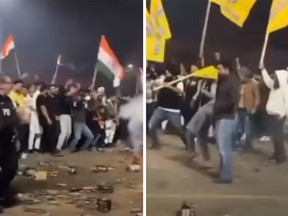
A crowd waving Khalistan flags faced off with nationalists brandishing the Indian flag in a Mississauga, Ont., parking lot on Diwali. Police watched as the two sides yelled and set off fireworks, but there was no violence.
A crowd waving Khalistan flags faced off with nationalists brandishing the Indian flag in a Mississauga, Ont., parking lot on Diwali. Police watched as the two sides yelled and set off fireworks, but there was no violence. Photo by SherePunjabRadio AM600 /YouTube

Labels: , , , , , ,

Monday, October 30, 2017

Spain's Season of Discontent

"[Three Catalonias exist]; you have the small or middle sized cities and towns where the support for independence is massive. Then you have all the cities surrounding Barcelona, where the majority of people speak Spanish at home, and where the support for independence is [comparatively] low."
"And then you have Barcelona, which is a mixture of both worlds."
Oriol Bartomeus, professor, Autonomous University of Barcelona, Barcelona, Spain

"There are people who are pro-independence in a classical way -- they talk about Catalan culture, language and identity. But the success of the pro-independence movement is in the way that it has brought on board people from other identities and perspectives."
"It's not a nationalist movement, it's a movement about sovereignty."
Antonio Banos, former lawmaker

"It's a very pluralistic city and there is a lot of diversity of opinions in Barcelona."
"...If you compare it [Barcelona] with people in the heart of Catalonia, it's not as pro-independence."
"For many years, Barcelona has been a Mediterranean city, a global city, and thousands of people have always mobilized here for peace, or dialogue and for human rights."
"And that remains the case today."
Ada Colau, Barcelona mayor
Independence supporters gathered outside the Palau Catalan Regional Government Building on Monday following last week's decision by the Catalan parliament to vote to split from Spain. The Spanish government responded by imposing direct rule and dissolving the Catalan parliament.
Independence supporters gathered outside the Palau Catalan Regional Government Building on Monday following last week's decision by the Catalan parliament to vote to split from Spain. The Spanish government responded by imposing direct rule and dissolving the Catalan parliament. (Getty Images)

Popular sentiment in Barcelona appeared to go all out for independence, in an restive area of Spain that has been edging toward secession for a very long time. At the same time the October 1 referendum brought out an estimated 43 percent of the electorate of Catalonia to cast their ballots in a vote that the Spanish courts banned, an event that the central Spanish government did its violent utmost to halt. That reaction no doubt spurred the greater majority of those who came out to the polls to vote in favour of an independent Catalonia; they did so by their significant 90 percent support.

Spain has reacted by declaring the referendum illegal, an assault on the democratic values of the country, a claim that runs counter to using intimidation, anger and force rather than reason and debate. And because the Catalan autonomous government has been dismissed not only is the populace perplexed, but investors and business leaders view the current and impending destabilization as a signal to vacate a sinking ship. If the central authority is determined to run Catalonia they have their work cut out.
AFP_TU7J7
Spanish Interior Minister Juan Ignacio Zoido, left, holds a meeting with the new chief of Catalan regional police, Ferran Lopez, right, in Madrid on Monday. Lopez has replaced the dismissed regional police chief Josep Lluis Tapero. (Angel Diaz/AFP/Getty Images)

The counter-rally defending Spanish unity was a massive display of pro-union sentiment. "Catalan leaders have broken the law. The central government has let this situation go for too long, for even 30 or 40 years, thinking that we were never going to arrive at this extreme, but here we are. Our society is fractured, there are family members and friends who no longer can talk about politics to avoid conflict", complained one retiree at the rally.

The atmosphere is both heated and concerned in Barcelona. The pro-Spain rally may have taken place in that most cosmopolitan and pluralist of Spanish cities, but in Catalonian towns elsewhere there is little evidence of a willingness to relinquish the dream of independence. Migrants from Andalusia and Extremadura decades earlier made Barcelona a more diverse population, unwilling to separate from Spain, whereas people born to Catalan parents urge for independence, though Catalans living elsewhere in Spain are pro-union.

"We have organized ourselves late, but we are here to show that there is a majority of Catalans that are no longer silent and that no longer want to be silenced", a pro-union Alex Ramos, head of the group Catalan Civil Society, stated as he marched along with hundreds of thousands of Catalans voicing opposition to Friday's declaration of independence. Regional leader Carles Puigdemont called for Catalans to engage in peaceful opposition to the central government's regional affairs takeover. He and his fired cabinet would keep "working to build a free country".

Spain Catalonia/Puigdemont
It is expected that Catalan leader Carles Puigdemont will likely have a news conference in Brussels on Tuesday, but it remains unclear whether he will ask for asylum in Belgium. (Emilio Morenatti/Associated Press)

Labels: , , ,

Thursday, April 24, 2014

Respecting Confederation's Institutions

"To welcome is to grow and to open oneself. In Quebec we are going to grow together."
"You will have the difficult but essential task of helping to heal the wounds of recent months by participating in the construction of an open, inclusive society proudly sharing an identity based on our language and our shared values."
"We have built Quebec together. Let us also build a common future around a shared sense of pride in our accomplishments. We are all proud Quebecers. There are so many things that unite us. It is time to work together again, as we have been doing in the last 350 years."
"Quebec is faced with profound, structural issues that go beyond a change in government. In short, we have been spending beyond our means for a long time. We thus have to act with strength, courage and determination to correct a situation that represents a threat for the quality of life of current and future generations."
"Ladies and gentlemen, it is no longer time for marginal, cosmetic measures. The time for difficult decisions has arrived."
"We are Quebecers proud of our history and unique identity. We believe that belonging to the Canadian federation and our shared citizenship with other Canadians are levers for the progress of Quebec."
Quebec Premier Philippe Couillard, Quebec City
Quebec Premier Philippe Couillard waves as he is sworn in during a ceremony Wednesday, April 23, 2014 at the legislature in Quebec City. THE CANADIAN PRESS/Jacques Boissinot
Quebec Premier Philippe Couillard waves as he is sworn in during a ceremony on April 23, 2014 at the legislature in Quebec City. (Jacques Boissinot/CP)
On Wednesday in Quebec City, at the swearing-in ceremony of the new premier, the province's lieutenant-governor, the provincial representative in Quebec of Queen Elizabeth II was given proper prominence. The Canadian flag was no longer hidden. And the new Liberal premier of the Province of Quebec will begin undoing all the harm done to his province and to the larger Canadian identity fostered by the 19-month misrule of the Parti Quebecois whose raison d'etre was always the achievement of sovereignty.

In introducing his new 26-member cabinet in the National Assembly's Salon Rouge, the province discovered that there is now a new ministry; of "Immigration, Diversity and Inclusion" to replace the old Immigration Ministry of the province the PQ misused so divisively. Mr. Couillard spoke conciliatorily to the province's anglophone demographic so long marginalized, under-serviced and unappreciated for their contribution to the general welfare of Quebec.

Allaying the fears engendered by the statements and resolve expressed by former Premier Pauline Marois serving the interests not of the voters that put her in power, but those of the separatist party she served with passion, to the extent that many of those anglophones were readying themselves to move lock, stock and barrel out of a province they held dear, but which threatened their equality rights within Canada.

The new premier addressed the issue of economics challenging the stability of a province that overspends itself for social programs it can ill afford. With the highest debt of all provinces, the greatest government spending and the highest rate of taxation in Canada, a dire situation that requires stringent and dedicated attention to returning to the balance required to return the economy to health while still focusing on social issues of importance, like health care, eduction and employment.

The previous government led by Jean Charest pledged itself to overturning many of the political, social and economic ills that had long plagued the economy, and to begin he knew he would have to confront Quebec's powerful unions' attitude of entitlements beyond the reach of any government. And while he struggled to achieve an end he felt was required, he ran into the indomitable will of those very same unions.

But his government also fell victim to the corruption that was endemic to Quebec corporate interests and politics, and which when revealed to their full comprehensive embrace brought him the contempt of the voting public which saw no course of correction other than to punish the Liberals and return the Parti Quebecois to administering the affairs of the province. And that turned out to be a solution itself in need of a countervailing remedy.

Now that it has arrived, the province anticipates remedial action to benefit all its citizens. That being so, Premier Couillard has his work cut out for him.

Labels: , , , , , ,

() Follow @rheytah Tweet