Politic?

This is a blog dedicated to a personal interpretation of political news of the day. I attempt to be as knowledgeable as possible before commenting and committing my thoughts to a day's communication.

Wednesday, February 05, 2020

Rest In Peace, Dr. Frank Plummer

"He was admired and regarded highly by academics and researchers around the world, and his legacy of seeking to develop an HIV vaccine remains one of the landmarks of infectious disease prevention."
David Barnard, president, University of Manitoba

"His contributions have had a cumulative global impact on saving the lives of tens of thousands of people for decades and also improving the lives of HIV-positive people around the world."
Digvir Jayas, vice president, research, University of Manitoba

"A family history of liver disease plus alcohol was my undoing."
"[I began to drink scotch] to celebrate, relax and deal with stress, anxiety, disappointment and grief."
"Having committed my career to medical science and human health, I saw this study as one more way to make a contribution -- this time, literally using my brain [through deep brain stimulation DBS in an effort to combat his alcoholism]."
Dr.Frank Plummer, microbiologist, infectious-disease expert, 67, former scientific director, National Microbiology Laboratory, Winnipeg
CBC 1987: Dr. Frank Plummer talks about the breakthroughs in HIV/AIDS research in South Africa.

"He was always focused on truth and knowledge and making the world a better place."
"He wanted everyone to know he was a proud Winnipegger and a proud Canadian, and that all of us can make important globally significant contributions."
"He helped to identify a lot of the key factors that are involved in HIV transmission in the early days [in Kenya in the 1980s]."
"He developed a lot of interventions that helped save hundreds of thousands of lives across the world. Frank was definitely a brilliant mind." 
Keith Fowke, head of medical microbiology and infectious diseases, University of Manitoba
"Frank dedicated decades of his time to Africa and led world-changing breakthroughs in HIV prevention.""Of course, the most noteworthy breakthrough that he and his team made was the finding of female sex-workers who were resistant to HIV. The gift these women have given science in the years since has been unparalleled.
"Frank had just had a joyful reunion with many of them a couple days before his passing."
Matthew Gilmour, director general, National Microbiology Lab, Winnipeg
Frank Plummer was recently reunited with a group of women he worked with in the past on his last visit to Kenya in 2020. (Photos by Jo Kennelly)

He was an extraordinarily gifted and passionate researcher whose work in Africa was widely acknowledged for his valuable contribution to the fight against AIDS/HIV. It was while he opted to live and work in Kenya that the stress of the work environment, the depression caused by seeing so many people die, among them colleagues, had him seek an outlet of relaxation and mood control, and he turned to alcohol to achieve that temporary dimming of the agony he felt. He became reliant on alcohol to relieve stress and depression.

And he found it difficult, just as most people do, to regard himself as an alcoholic. It was when, after years of alcohol abuse had ravaged his body and he was diagnosed with cirrhosis of the liver and needed a liver transplant, that he found the usual conventional methods of aid in withdrawing from alcohol consumption failed to work for him. When he discovered that Sunnybrook Health Sciences Centre in Toronto, the world's sole centre testing deep brain stimulation for alcoholism was prepared to embark on a study, he volunteered to become the first person to undergo that surgery.

Over a million Canadians are afflicted in any given year with alcoholism. He felt that not only might he be able to solve his personal alcohol problem, but a positive outcome would prove immensely useful to the countless others for whom alcoholism had become a ruination of their lives, their health. Following the procedure where an incision was made in his cranium, and two quarter-sized holes drilled into his brain to accommodate an implant like a heart pacemaker to continually send signals to his brain, he no longer craved alcohol.

"I maybe have two or three drinks if I do drink. And I can stop", he said in an interview. He had been accustomed to drinking in the morning and at night would have 20 ounces of scotch. "It got to be the main focus of my life", he explained, which led him to search for a more "robust" medical solution, and the procedure he underwent at Sunnybrook was just what the doctor ordered for himself. His life changed completely, alcohol no longer of great interest to him.

"My life is full of lots of other things than alcohol", he stated. He was writing a book, he developed an interest in cooking, and he relished taking his dog for walks. "Just enjoying life for the first time in a very long time." This was, after all, a man who excelled in the practise of a profession of profound importance for the greater good of the human community. He had helped to set up the national laboratory in Winnipeg which became a world-class research institution.

During the SARS, Influenza and H1N1 epidemics he helmed the laboratory. He was doing so during the development of an Ebola vaccine. This was a man whose research shaped public health policy globally. In Kenya, he had built a world-class research operation. There, he made the observation that a group of women had a natural immunity to HIV-1, a discovery providing vital information for the development of an HIV vaccine.

Ultimately, he became the first person in a North American trial to undergo deep brain stimulation for chronic heavy drinking, in 2018. Several months ago he made the decision to publicly reveal his battle with alcoholism. He had turned his life around. He went with his family to Kenya, returning to the country where he had spent years striving to help it in its battle against a deadly, rapacious virus.
And there he was scheduled as a keynote speaker at the University of Nairobi's annual meeting.

Renowned Canadian scientist Frank Plummer dies in Kenya, where he led HIV breakthroughs

And it was at the collaborative centre for research and training in HIV/AIDS/STIs yesterday that he collapsed, was taken to hospital in Nairobi, and the grim news was released that this extraordinary man had been pronounced dead on arrival, with no confirmed cause of death yet established for public release.


Labels: , , ,

Sunday, July 14, 2019

Unforgotten, Eva Mozes Kor

"As we were  holding on to my mother, a Nazi came running, yelling at us in German shouting 'Twins! Twins!' Another Nazi came over and pulled my mother to the right while the other one pulled me and my sister to the left."
"My mother started screaming and I remember her hand was still in the air and she was crying and I never even got to say goodbye to her. I didn't realize that would be the last time I would ever see her."
Eva Mozes Kor, Holocaust survivor, Mengele victim
Eva Kor poses at the CANDLES Holocaust Museum in Terre Haute, Ind., in 1999. (Bob Poynter/The Tribune-Star/AP)

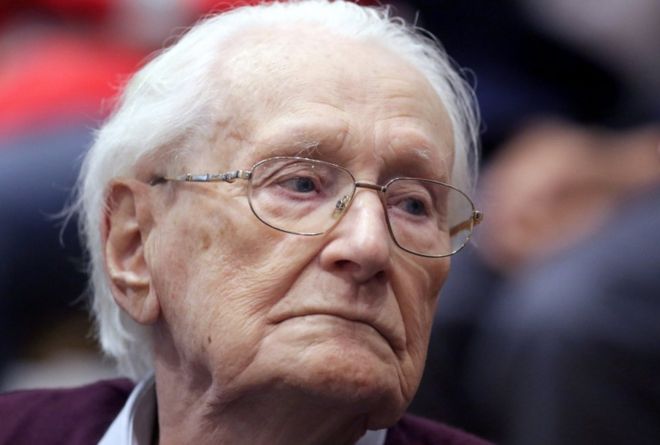
In 2015 Eva Mozes Kor was a witness in a German court where Oskar Groening, a former S.S. guard, the "bookkeeper of death" was on trial. He was convicted of complicity in the murder of 300,000 Jews. He pleaded that he had nothing to do with the organized killing of Jewish internees, but the court held that his complicity lay in the fact that he was a willing tool of the machinery of internment leading to mass extermination. As an accessory, required to keep the wheels of the machinery of death in motion, he was found guilty as charged.
Oskar Groening pictured during his trial in 2015
The former Nazi guard said he felt "moral guilt" for his actions at Auschwitz - but never served a day of his sentence  Reuters

There were, besides Eva Mozes Kor -- to identify the man and validate his connection with the death camp -- another 49 former internees. When the jail sentence was brought down after the German man's conviction, Eva Mozes Kor made her objection to his punishment known. Leading the other witnesses to make it perfectly clear they did not share her sentiments. Eva Mozes Kor argued that Groening's sentence would have had a more useful application by forcing him to speak publicly of his experiences in an aid to countering claims of Holocaust deniers.

She herself, throughout the years following the end of World War II and her rehabilitation back to health and the future, dedicated herself to doing just that; public speaking where she gave talks, appeared in documentaries and wrote several books detailing her horrific experiences. She died at age 85, while leading one of many annual tours to Auschwitz. On July 4th, she breathed her last in Krakow, Poland.

Born at Port, Romania in 1934, she and her twin sister Miriam were deported along with their family --  parents and two older sisters -- from a regional ghetto, when they were shipped out to Auschwitz. The very night they were separated from their parents on arrival at the camp, with the memory of their mother's anguished agony at separation from her twin daughters, the girls, aged ten, were informed they were the only ones left in their family; the rest had perished in the gas chambers.
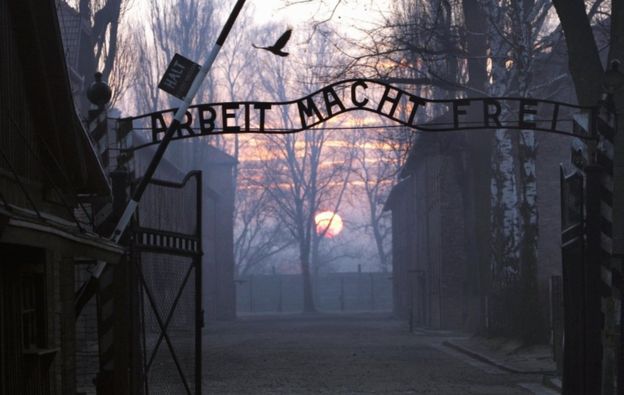
The main gates at the entrance to the Auschwitz I Nazi concentration camp in Oswiecim, Poland, pictured as the sun sets
It is estimated that 1.1 million people, most of them European Jews, died at Auschwitz  AFP/Getty Images

And they were spared only so that they could serve as guinea pigs in the infamous Dr. Mengele's experimental laboratories with his focus on twins, subjecting them to horrendous research resulting in the death of most of the experimental subjects. Eva was frequently drained of blood in one diabolical experiment whose design was to establish how much blood loss a human could be subjected to without triggering death. She was regularly injected with chemicals.

Had one of the two girls died as a result of any of the experiments they were subjected to, the other would have been immediately killed with an injection to the heart to enable Mengele to carry out a "comparative autopsy". Eva founded Candles (Children of Auschwitz Nazi Deadly Lab Experiment Survivors) in 1984. She aided in setting up a Holocaust museum close to where she lived. In the early 1990s her work occasioned a cooling rift with other surviving Mengele twins when it became known she was prepared to forgive her transgressors.

She took this path in 1993 when she met Hans Munch who had been a physician at Auschwitz, a friend of Mengele. "I found out that he was a real human being and a very nice man. I really liked him and that was a very strange feeling. He said the nightmare he lived with every single day of his life was watching the people dying in the gas chambers.... I asked if he would go with me to Auschwitz in 1995 to sign a document saying what he did at the ruin of the gas chamber in the company of witnesses, and he said yes. Afterwards, I decided to give him a letter of forgiveness."

"Forgiveness", she later explained "has nothing to do with the perpetrator. Forgiveness has everything to do with the victim taking back their life. I don't have to deal with the whole issue of who did what to me -- and how on earth am I going to punish them and make them pay for it?"

In the final analysis, Eva Mozes Kor dedicated herself to ensuring that the horrors of the Holocaust were not forgotten, by establishing memorials, by speaking out often publicly and lending her experience to posterity. That she found it spiritually liberating to profess and feel forgiveness for the horrors inflicted upon her as a helpless child by a bestially brutal hatred-and-death cult was her decision to make.

She could not and would not make it on behalf of anyone else; not her anguished mother, her dead sisters, or the other 49 members of her extended family who all perished at the hands of rabidly inhumane ideologues who dedicated their resources to a well-calibrated and carried-out program of mass annihilation in the world's most ambitiously successful effort at genocide.

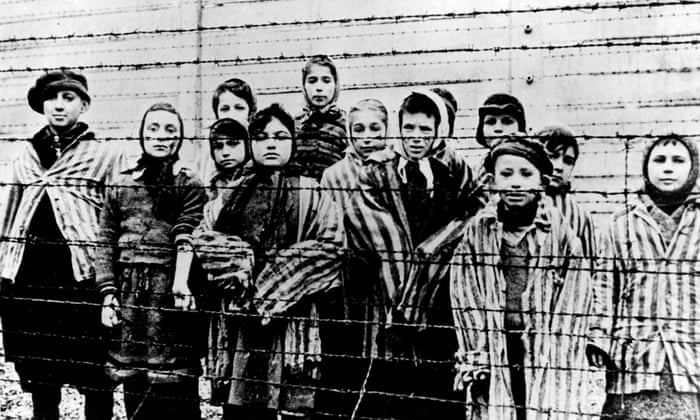
A group of children in the Auschwitz concentration camp in January 1945, just after liberation by the Soviet army. Photograph: AP

Labels: , , ,

Thursday, April 17, 2014

Melancholy Farewell

"He was a man who was highly principled and ruthlessly pragmatic, combative but engaging, smart and educated while never assuming that he knew it all.
He could be hard-headed, yet also soft-hearted.
He could display a quick and biting temper, but, far more often, a deep and gentle sense of humour.
He particularly enjoyed -- and delivered -- many jokes about his own shortness.
He observed that he never got in the way of his own PowerPoints, but, short as he was, upon the world stage he strode like a giant.
I do not say these things to imply that Jim was a contradictory person. He was not, in any way.
As a human being he was the complete package."
Prime Minister Stephen Harper
Stephen Harper attends Jim Flaherty's state funeral
Prime Minister Stephen Harper and his wife Laureen arrive at the state funeral for former finance minister Jim Flaherty in Toronto on April 16, 2014. Flaherty died of a heart attack last week.   Photograph by: Tyler Anderson/Postmedia News, Postmedia News
 
Yesterday, Canada laid to rest its longest-serving Minister of Finance, who served under the Conservative government of Prime Minister Stephen Harper. A man of great integrity, pride and love of Canada, the partisan ugliness that has gripped Parliament appears somehow to have passed him by; he was respected and appreciated by his colleagues in the House of Commons, of all political stripes.

And on the occasion of his state funeral, many of those same Parliamentarian colleagues were in evidence to pay their last respects to a man they all recall with fondness. He served in the Ontario cabinet of former Premier Mike Harris, and many of his colleagues from that era were in evidence, as well. Along with the current mayor of the City of Toronto for whom he was a stalwart family friend, loyal to that friendship even in dire adversity.

Flaherty
A book of condolences and a photograph of former finance minister Jim Flaherty in the lobby of House of Commons on Parliament Hill. Flags have been flying at half-mast on Parliament Hill and Canadians have been lining up to sign an online book of condolences since Flaherty died last week. Photograph by: THE CANADIAN PRESS/Fred Chartrand, Canada.com
 
A photograph of Jim Flaherty, along with several books of condolence were laid out in the House of Commons for visitors or anyone interested to write their comments in his memory, and many thousands lined up to do just that. His death appears to have joined together Canadians in a common purpose of paying tribute to a man dedicated to Canada's future, prepared to lay aside differences, for the moment. And they did in the most wholesome manner.

The shocking, totally unexpected death of this man who had resigned his cabinet post having achieved his goal of presenting Canadians with a balanced budget, foreseen for 2015, cast a pall of grief and disbelief over those who knew him as a reputable and credible man of public office. His premature death at age 64, just at a time when he was determined to spend more time with his family, after years of travelling the world in service to his country sent shock waves throughout the international community.

Ontario MPP Christine Elliott and her sons stand by the casket of her husband, the late former federal finance minister Jim Flaherty, during visitation in Whitby, Ont., on Tuesday, April 15, 2014. THE CANADIAN PRESS/Frank Gunn
 
His widow, Ontario Member of Provincial Parliament, Christine Elliott, and their triplet 28-year-old sons Quinn, John and Galen, spoke moving tributes to the man they loved and will now sorely miss while never forgetting that his spirit lingers over them and will do so to the end of their days. All those in solemn attendance, recalling the man who was, wore bright touches of green to pay tribute to the Irish in Jim Flaherty.

"Dad, I love you", Quinn Flaherty declared. "We love you. Put your feet up, lay your head back, close your eyes and relax. We will take it from here."

Labels: , ,

Tuesday, January 14, 2014

The Measure of a Man

"The idea that he changed from the man of war to the man of peace misses that which defined him. Actually, he never changed. His strategic objective never wavered. The state, which from the age of fourteen he fought to bring into being, had to be protected for future generations. When that meant fighting, he fought. When that meant making peace, he sought peace."
Former British Prime Minister Tony Blair
President Shimon Peres eulogizes former prime minister Ariel Sharon in Jerusalem, Monday, January 13, 2014 photo credit: Amos Ben Gershom/GPO/Flash90)
President Shimon Perez eulogizes former prime minister Ariel Sharon in Jerusalem on January 13, 2014 - photo credit Amos Ben Gershom/GPO/Flash 90

"You were the shoulder on which Israel's security rested. The story of your life is bound to the story of this country. And your life was dedicated to the life of this country. Your footprints are imprinted on every hill and in every valley."
Israeli President Shimon Peres
US Vice President Joe Biden pauses after laying a wreath on the grave of former prime minister Ariel Sharon, Sunday, January 13, 2014 (screen capture: Channel 2)
U.S. Vice-President Joe Biden pauses after laying a wreath on the grave of former prime minister Ariel Sharon on Sunday, January 13, 2014 - screen capture Channel 2

"The man had a command and presence. He filled the room ... he was indomitable ... Like all historic leaders, all real leaders, he had a north star that guided him. A north star from which he never, in my observation, never deviated. His north star was the survival of the state of Israel and the Jewish people wherever they resided."
U.S. Vice-President Joe Biden

Israel's history, its existence and its travails are treated differently than any other country's of the world. Israel is viewed with the lens of fine critique; everything minutely parsed, the country and its leaders held to standards of human behaviour and moral and legal heights to which no other country is demanded to be exemplars of. Its creation signalled the potential of two side-by-side nations, a situation its Arab neighbours couldn't begin to contemplate much less tolerate.

When a succession of wars was imposed on Israel, a tiny state with a small population threatened by the combined armies of its far larger neighbours, Israel proved its unwillingness to vanish from the geography. It was home, and it meant to stay there. From the Middle East came the ancient Jewish tribes and to the Middle East they returned from their vast dispersal, to join those of their brethren who had never left. The geography that had once expelled them would never do it again.

And the singular individual most involved in aiding one Israeli governing administration after another to prove just that on the self-protective battlefield of response to invasions died with the state honours that he had earned over his lifetime of being a Jew, an Israeli, a patriot, a soldier, a Prime Minister of Israel.
Ariel Sharon (photo credit: Eyal Yitsah/Flash90)
Ariel Sharon - photo credit Eyal Yitsah/Flash 90


Ariel Sharon's tactical genius, his imaginative strategies, his understanding of people and their impulses served to inform him on how best to reach his objectives to secure an end to hostilities between Jew and Arab. Even his imagination failed, however, to conjure up the future. When the future was yet dim and he envisioned emptying Gaza of its Jewish presence to leave it to Palestinians to demonstrate their capability in making for themselves a future state, his gamble with the possibilities of the future morphed into a wasteland of terror. That terror responded immediately Israel vacated Gaza, with deadly attacks and rockets.

In view of that experience which he never gained consciousness to meditate upon and plan an alternate strategy in response to the compellingly clear Arab Palestinian love affair with victimhood, blame and vengeance, one can only now hypothesize what he would have done about the West Bank. Entirely leaving the West Bank to the auspices of the aspirational Palestinian state would similarly on past evidence, leave Israel vulnerable to ongoing rocket and suicide-bomb attacks infiltrating over the border. Israel would forever be dependent on intercepting the attacks.

Would he, after viewing the collapse of Gaza into a terror state administered by an organization dedicated to the destruction of Israel and recouping all the territory now occupied by the state to themselves, consider seriously the Palestinian Authority demands? He lent himself to a defensive war when it was required, to ensure the longevity of the State of Israel, and he turned himself to overtures leading to peace, hoping an agreement would result from his unilateral gesture, and Arab Palestinians rose to the challenge by refusing peace and incinerating all hope for the future.

He rests now, on his farm in southern Israel.  Hamas and its followers gloat at his death, the warrior laid to rest, their enemy destroyed by age, time and the ravages of ill health. In celebration as in their ordinary morbid celebration of violence, rockets were lobbed into Israel, several of which fell just short of Ariel Sharon's farm. Resignation to peace and stability, good governance and a robust economy to enhance the future of the Palestinian Arabs appears beyond the vision of their leaders.


Labels: , , ,

Saturday, January 11, 2014

Ariel Sharon, brilliant general, divisive politician, is dead

DEBKAfile Special Report January 11, 2014, 3:11 PM (IDT)
Ariel Sharon, Israel's 11th prime minister
Ariel Sharon, Israel’s 11th prime minister, will go down in its military and political figure as a commanding and controversial figure - and a flawed giant. Born on Feb. 26, 1928, he died on January 11th, 2014, aged 85, without recovering from an eight-year coma induced by a stroke he suffered in 2006.

Sharon was one of Israel’s most celebrated, victorious and innovative generals – and a maverick. He served the Israeli army from its inception in 1948, founding some of its elite units and leading key operations in Israel’s 1948 War of Independence and its troubled aftermath.

He emerged from the assault on Sinai in the Six-Day war of 1967 as a brilliant military strategist. In the 1973 Yom Kippur War, he led a force that encircled the Egyptian Third Army and crossed the Suez, cutting short its massive advance through Sinai to the Israeli frontier. Sharon saved the country by acting in defiance of orders, a fact forgotten by a grateful nation who hailed him as a hero, although he paid for it by failing to attain the top IDF command.

He then brought his sledgehammer style and conflicted nature into politics. He first joined Likud and was assigned various ministerial portfolios under Prime Minister Menahem Begin in 1977-92 and in Binyamin Netanyahu’s first administration in 1996-99.

As defense minister, he led the IDF to victory against the Palestinians in the 1982 Lebanon War, forcing Yasser Arafat and PLO leaders to abandon their South Lebanese strongholds on the Israeli border and go into exile in Tunisia.

But then the world media backed by the Israeli left factions held him responsible for failing to prevent the Lebanese Phalangists’ massacre in the Sabra and Chatila Palestinian refugee camps. Sharon eventually won a suit for libel against Time Magazine, but association with that atrocity continued to dog him and forced him into early retirement from politics.

In 2000, Sharon made a comeback as Likud leader. Then in 2001, a nation desperate for a savior from the non-stop suicide bombings and bus burnings of the Palestinian intifada massively elected him prime minister.

In a four-month operation he launched in 2002, the IDF resoundingly defeated the Palestinian front. Sharon went on to construct a defense wall along the Green Line as a barrier between the West Bank. He finally held Yasser Arafat, intifada leader, to siege in his Ramallah center of rule.

This second siege, like the first in Beirut two decades earlier, ended in Arafat’s exit – this time to France.

In 2005, the hawk and dynamic champion of Israeli West Bank settlement in the West Bank and the Gaza Strip, underwent a remarkable transformation. In the face of stormy resistance, he orchestrated Israel’s unilateral disengagement from the Gaza Strip, forcibly evicting all 8,000 settlers and every last soldier. Under television cameras, weeping families were hauled from their homes which were then razed to the ground. Condemned for this burtal operation in many circles, especially his own Likud, he quit the party and formed the centrist Kadima.

Then on Jan. 4, 2006, on the way to easy re-election for another term as prime minister, Sharon was suddenly incapacitated by a crippling stroke. He relapsed into a coma, from which he never recovered.

Thursday, Jan. 1, his health began to deteriorate due to kidney failure. His doctors advised the family that corrective procedure would be too risky to undertake in his condition and at his age.

With all his flaws, Ariel Sharon, the general and national leader went down as an invincible lion.

Labels: , , ,

Israel bids farewell to Ariel Sharon, as it grapples with his divisive legacy

Former prime minister Ariel Sharon passed on today in Tel Aviv. But the intense debate over his leadership lives on, reflecting divergent visions for Israel, especially its settler movement.

By Staff writer / January 11, 2014
Israeli Prime Minister Ariel Sharon visits the southern Israeli Bedouin town of Rahat in August 2004
Sharon, the hard-charging Israeli general and prime minister who was admired and hated for his battlefield exploits and ambitions to reshape the Middle East, died Saturday. The 85-year-old Sharon had been in a coma since a debilitating stroke eight years ago.
Heidi Levine/AP/File

Jerusalem
Israel bid farewell today to the last – if perhaps most controversial – of its founding generation of leaders, former general and prime minister Ariel Sharon, who passed on after a long illness.

Mr. Sharon, who devoted more than 60 years of his life to establishing, defending, and leading the state of Israel, was both loathed and lionized by Israeli Jews. That chasm is perhaps most stark on the issue of Israeli settlement in territory conquered during the 1967 Arab-Israeli war. Sharon was instrumental in expanding the Jewish presence from a few outposts to cities and communities totaling more than half a million Jews today.

In what would become perhaps the most defining and controversial move of Sharon’s career, he unilaterally withdrew from the Gaza Strip in 2005, removing more than 8,000 Israeli settlers and dismantling an infrastructure of Israeli control that he had championed for decades. The images of Israeli soldiers dragging fellow Israelis out of their homes divided the country more deeply than any other government move in the past decade.

In the eyes of the peace camp, the 2005 Gaza pullout was a bold, pragmatic move. For those seeking to establish Greater Israel where the patriarchs and prophets once walked, however, it was an unthinkable act of betrayal. While Sharon may be gone, the controversy over Israel’s identity and destiny – put in sharp contrast by his Gaza withdrawal – is very much alive today, not least of all in the peace negotiations now under way.

The settler movement today commands outsized influence in Israeli politics, due in no small part to Sharon’s role in helping them to establish "facts on the ground." In recent weeks, legislators have put forward a spate of bills designed to protect Israeli claims to the West Bank, including one to annex the Jordan Valley. And Minister of Economy Naftali Bennett of the Jewish Home party threatened to quit Prime Minister Benjamin Netanyahu’s coalition government if he agreed to a peace deal based on the pre-1967 lines dividing Israel and the West Bank.

But in Sharon’s eyes, the fight for Greater Israel was lost more than a decade ago and it was necessary to proactively cut Israel’s losses – a task that took on urgency not only because of growing international pressure but also because he saw himself as uniquely able to carry it out.

“Many times, he used to tell us that unfortunately [he] believed that he is the last Israeli leader who can look right into the eyes of the Israelis and to tell them, ‘Listen friends we had a dream, it didn’t work, it’s over, and now is the time to take some very painful decisions,’ ” says Dov Weissglas, Sharon’s former chief of staff.

Whether Prime Minister Netanyahu has the will or political capital to carry out such decisions himself remains to be seen. At a 2003 Likud meeting in which Sharon faced intense criticism for agreeing to the Bush administration’s road map for peace with the Palestinians, Mr. Netanyahu was among those who were shocked by Sharon’s insistence that Israel must end the “occupation” of the West Bank – a word with strong negative connotations that he had steered away from using in the past.

“The idea that it is possible to continue keeping 3.5 million Palestinians under occupation – yes, it is occupation, you might not like the word, but what is happening is occupation – is bad for Israel, and bad for the Palestinians, and bad for the Israeli economy,” Sharon said. “Controlling 3.5 million Palestinians cannot go on forever.”

But as Sharon said himself, the prime minister’s chair offers a unique view that can cause even the most stubborn politicians to change their minds. “What you see from here, you don’t see from there,” he said, in his most famous explanation of his decision to withdraw from Gaza after decades of supporting the settler movement.

For years, Sharon had seen Israeli presence in Arab areas as a pillar of Israeli security, and helped settlers cut through government bureaucracy to build up their communities.

“Ideologues had great ideas, but some of them couldn’t set up a tent,” says Jonathan Blass, rabbi of Neve Tzuf, who has lived in West Bank settlements since 1975. “He was always Mr. Facts On The Ground. He was the person who would get things done.”

Sharon may not have shared the full ideology of the settler movement, especially those who saw it as fulfilling biblical prophecy, but his ideology of security dovetailed with their goals. He sometimes cut corners in his efforts to accelerate settlement expansion, and those benefited were content to look the other way.

But one of the lessons learned from Sharon’s 2005 decision, says Rabbi Blass, is not to tolerate a lack of integrity in political leaders just because they’re on your side. “Because someone who doesn’t follow the rules might – especially if he’s not deeply committed ideologically – might one day turn that same trait against you.”

“Put not your trust in princes,” said Sharon's former deputy Yaazkov Katz, quoting from the Bible, when asked in 2009 how to explain the prime minister's about-face. Mr. Katz, one of the founders of the Gush Emunim settler movement, whom Sharon rescued from near death on the battlefield, went on to help his former commander more than double the number of Israelis living across the 1967 lines as his assistant in the ministry of housing and construction. “Since we are speaking about a human being, it is impossible to trust him, especially since we are dealing with someone who is not connected to Torah and has no fear of heaven.”

Many settlers bitterly resent the 2005 Gaza “expulsion” as an undemocratic move that set a dangerous precedent and undermined their willingness to trust Israeli leaders’ assurances.
“He implemented a platform that was the exact opposite of what he ran on,” says Rabbi Blass. “Everyone says – great, courageous move. It was a horrible crime against democracy…. I think he trampled Israeli democracy to the point where it’s hard to recover.”

It’s not only settlers who fault Sharon’s record on democratic values.
Many Israelis, not to mention Arabs, who referred to him as a butcher and a terrorist, saw Sharon as a bullheaded politician and inveterate violator of human rights, particularly those of Palestinians. Most infamously, a government-appointed inquiry declared Sharon (then minister of defense) indirectly responsible for the 1982 massacre of hundreds of Palestinian refugees at Sabra and Shatila by Lebanese militiamen allied with Israel.

Sharon resigned his post. But in a remarkable political comeback, he climbed to the top echelons of government within two decades, winning the 2001 prime ministerial elections with 62.4 percent of the vote, the largest margin in Israeli history.

At the time, the second Palestinian intifada was in full swing. Many blamed Sharon for instigating the uprising with his provocative visit in September 2000 to the ultra-sensitive Temple Mount compound, home to the Al Aqsa mosque, though some Palestinian leaders have publicly said that his visit merely provided a spark for an uprising already being planned.

While the Israeli leader’s brashness and disregard for criticism alienated many, it also appealed to Israelis when they felt under siege. Sharon, who had always seized the offensive and prioritized Israel’s security interests above all else, was seen as a leader who would take the decisive, if controversial, steps necessary to protect them.

“You felt that you had steady experience, cautious hands at the helm,” says Prof. Meron Medzini of Hebrew University, who says that while Sharon was an extremely controversial figure, Israeli views have softened partly due to his long illness and partly due to a recognition that Israel did well under his premiership, ending the second Intifada and strengthening ties with America.

In Hebrew, Ariel means “lion of God,” and Sharon was one of the largest figures in Israel, praised for his courage if also feared for his strength and ability to attack his enemies. Whatever Israelis may feel about the man who was for decades at the frontlines of Israel’s battles with its neighbors, who strengthened its territorial claims and secured American commitment to preserve the largest settlement blocs in the West Bank, he is the last of Israel’s founding generation of leaders to bid his country farewell.

“He is the last link to the heroic or august days of the founding of the state,” says Professor Medzini, who worked with a number of prime ministers in Israel’s early days. “He represents both the beautiful face of Israel and some of the ugly face of Israel.”

Labels: , , ,

Friday, December 06, 2013

Nelson Mandela death: Commentators reflect on a global legacy

Nelson Mandela addresses a crowd a few weeks after his release from prison in 1990. 
 
 By governing "wisely and democratically", Mandela took a place in the pantheon of revolutionaries-turned-leaders, rather than dictators, writes Max Boot
 
Within hours of Nelson Mandela's passing, commentary from around the world began pouring in - reflecting the greatness of the man and the impact his life had on the entire globe.
In South Africa, the tributes were particularly poignant. The Mail & Guardian's Mark Gevisser writes that the man his fellow South Africans endearingly called "Madiba" was a father to his nation in a most personal sense:
Mandela epitomised those instincts we most associate with childhood: trust, goodness, optimism; an ability to vanquish the night's demons with the knowledge that the sun will rise in the morning. But he also made us feel good, and warm, and safe, because he found a way to play an ideal father, beyond the confines of his biological family or even his national one. He was the father we would all have wanted if we could have designed one. He was wise with age, benignly powerful, comfortingly irascible, stern when we needed containing, breathtakingly courageous, affirming when we needed praise - and, of course, possessed of the two childlike qualities that make for the best of fathers: an exhilarating playfulness and a bottomless capacity to forgive.

According to Patrick Bulger of the South African Business Daily, it was Mr Mandela's capacity to forgive, and what it meant to the birth of a new South Africa, that is a key to his legacy:
Mandela's life was not just about ending apartheid, for which he can claim much of the credit, it was also about bringing into being the possibility of a historic reconciliation between black and white, given that the latter would always remain visitors to the continent until this meeting of minds could start the healing needed after decades, centuries, of domination.

In the US, tributes to Mr Mandela have been a combination of nostalgia, a clear-eyed look at his life, and a reflection on what is in store for South Africa.
Douglas Foster of The Nation contends that one of Mr Mandela's greatest triumphs was preparing South Africa to move on after his death.
"It was part of his legacy that so many of his countrymen had grown tired, even angry, at being asked whether the dream of establishing a new kind of society would outlive him," he writes. "It was perhaps his most enduring gift that this question, asked ritualistically by outsiders, should sound so silly, so wide of the mark, on the day he died. In the end, there was a period but no question mark. Would the dream survive? The answer: it already had."

Magogodi Makhene writes in Salon about her memories of meeting Mr Mandela as a child:
 
There is a beautiful praise song from the days before the country was born, a song that may have been sung on a day like the one on which I met Mandela, "Nelson Mandela! Nelson Mandela! Hauna o tswanang le yena" — There is none. There is none like you. When I'm alone, in my private thoughts, and this song crosses my mind, I remember the smells and sounds of being 7, in my father's arms, peering over a small concrete gate and holding Nelson Mandela's warmth in my tiny hands, my expectant heart waiting for the day we would tell this story, about the time the world started over and our country was born.

Dave Gilson of Mother Jones remembers Mr Mandela's revolutionary past and his fiery speech delivered to the court that sentenced him to prison.
"The speech, delivered in Mandela's characteristically deliberate style, marked the boundaries of his idealism and pragmatism, his militancy and moderation, his courage and caution," he writes. "The manifesto remains one of the clearest political portraits of Mandela, whose revolutionary past seemed to fade as he became a global icon, a genial grandpa who sat for photo-ops with an endless parade of celebrity well-wishers."

Nelson Mandela in Sandton, South Africa, on June 17, 2010. Nelson Mandela 'cast a giant shadow' from prison
 
As a revolutionary, writes Max Boot for Commentary, Mr Mandela was an admirable insurgent, who governed "wisely and democratically" once he came to power.
"This is not, needless to say, the norm. Much more common are insurgents like Lenin, Stalin, Mao, Castro, Mugabe, Kim Il Sung, and (fill in the blank) who, while posturing as freedom fighters battling an evil dictatorship, swiftly become dictators in turn as soon as they seize power," he writes. "The exceptions to that rule are some of the greatest figures of modern history - the likes of George Washington, Michael Collins, David Ben-Gurion, and, most recently, Nelson Mandela."

To remember Mr Mandela as a saint does him a disservice, argues Adam Roberts in Slate. "He may be compared to the likes of Mahatma Gandhi or Mother Teresa, as a great moral figure of our times," he writes. "But the myth should not overpower the reality of a humane, richly complicated, and passionate individual."

"Now that Mandela has died, something will shift in South Africa for good," writes Natasha Joseph for the Atlantic. "It will be time to take stock of where we are as a young democracy and realize that ending apartheid was just one battle in a much bigger war. I hope we're ready to fight."

"When Nelson Mandela was released from prison in 1990, South Africa was a catastrophe waiting to happen," writes Roy Isacowitz for the Israeli paper Haaretz. "Had Nelson been anything but Mandela - anything but that exquisitely modulated blend of common sense, compassion and authority - the whole place could well have gone up in flames."

Stephanie Nolen of the Canadian Globe and Mail writes that Mr Mandela's "life showed him to be a skilled tactician, a ruthless adversary, an able politician, an incisive and catholic thinker about liberation and oppression."

It was Mr Mandela's persistence, writes Patrick Carlyon of the Sydney Telegraph, that set him apart.
"His aims would match those of many other political heroes," he writes. "But few others were forced to persist for 50 years, for a cause that for most of that time appeared doomed. And few could persevere against such injustice with such unyielding grace."

Even journalists covering Nelson Mandela were touched by the greatness of the man, according to Bryan Pearson, who worked as an AFP Johannesburg correspondent in the 1990s.

"Covering the 'Mandela story' was a life-enhancing experience," he writes. "He humbled us all into trying to be better human beings and, more especially, to embrace reconciliation at a time when all South Africans, black and white, were still bearing the scars of apartheid."

Vic Adlhadeff, former chief subeditor of The Cape Times, writes that Mr Mandela was "was the unspoken presence" in a newsroom where coverage of the anti-apartheid movement was strictly censored.


"Mandela was there. Silenced. Casting a giant shadow. Yet always there. And as one of the nation's anti-apartheid newspapers, we were acutely aware that in our midst was a colossus whose time had to come. And when it did, it would change South Africa forever."


Labels:

Monday, October 28, 2013

Considering Options

Depending on one's choice of religion, death's sting might not be as deadly as claimed. Not when there is promise of an afterlife. Of course whether one abodes in heaven or hell might be a concern. Resurrection as a choice relating to particular religion; well, all things considered who might wish to return as a cow, a chicken, a pig, to be transformed into some manner of edible on someone's dinner plate. Or, conversely, another person whose life-performance is nothing whatever to relish; say a mass murderer, a child predator, a war criminal, a bloody tyrant.

In Christianity, heaven is a concept that exists to entice the faithful to good behaviour during their lifetimes. After life? Well, it's said that heaven can be construed as a 'state of being', or a place, but since no one can have certain knowledge of which it is, how would that play out? An anxiously hovering spirit, never seen, but in constant anguish if they're in the state of being of hell, or perhaps lounging on a cloud, up in heaven, watching entertaining scenes below.

Mormonism persuades its faithful to believe they will, at death, be reunited in a long, unbroken line with their families and their ancestors for eternity. Apostates excepted. One tries to imagine those long, interminable, bitter family arguments from which there is never, ever any escape. Everywhere one turns, there is yet another family member waiting for an argument over borrowed finances, or critical comments they've taken umbrage with.

Ah, now, Zoroastrianism also promises the Catholic version of heaven and hell. If one has been very bad as a result of forgivable human weakness contributing to ill deeds and sins, confession will help, or mercy offered to others, a kind of indulgence that will transfer the soul from the fires of hell to the plush accommodations to be found in heaven. All one needs do is be intrinsically good; if there's any doubt you can end up mired in an intermediate state; neither heaven nor hell. Which sounds rather like life itself.

As for Judaism, "This world is compared to an ante-chamber that leads to the World-to-Come", a phrase uttered by the venerable Rabbi Ya'akov. There may be a 'next life', an afterlife whatever that might be to strain the hopeful imagination. It appears also that the souls of the departed may stand a fairly good chance of being resurrected after the coming of the Messiah; yet to appear, anticipated over the ages, but extremely shy of presentation.

Hinduism offers another kind of panacea to death; reincarnation; a series of new lives. The catch? Each one of those new lives offers the opportunity to do penance and correct sins committed during each of the previous lifetimes. This protocol could quite conceivably leave a whole lot of sinners extremely busy for an eternity of atonement. A thief returns as a victim, for example, and the never-ending scenario goes into endless repetition mode.

Oh yes, and there's also Scientology which recognizes the soul (mind?) as life's most vital aspect. In this religion there's no fuss, no muss, no restrictions on behaviour other than to sign that one-billion-year contract with the church leadership. Behave as you will, ethics have no bearing on how the soul presents on reincarnation. Commitment to authority in the current sense is critical; sounds like a tyranny of faith.

Buddhism offers reincarnation as well, but escaping all human desire is required to bring the soul beyond the birth-death-rebirth cycle to achieve the most elite goal of nirvana. And that is? Liberation. Experiencing nothing but a great deep vacuum of emotions. Nirvana permits the successful aspirant to be entirely extinguished. To become a vapour of nothing whatever. A free spirit that will no longer exist.

In Shintoism, the religion of Japan, birth is celebrated, but death is left to others to dispose of; the dead are not to be touched, though that condition creates freedom for the spirit. And in that freedom the spirit joins with the divine. In that absorption into the divine, what was once a human becomes the essence of a spirit which in joining the divine becomes ... well, the divine.

Islam believes that a waiting game exists with the dead patiently waiting where they are buried, for the advent of final judgement. The fires of hell await those who deserve the torture they will endure there, while paradise awaits those who have distinguished themselves by good deeds and fealty to the spirit of Islam during their lifetime. Infidels need not apply.

Labels: , , , ,

Sunday, September 29, 2013

Breaking The Silence

"Our concern was, once you've gone through the Holocaust, you're going to be mostly devastated, and you're not going to really absorb anything from the other galleries, so the learning experience from that other gallery is diminished, if not lost."
George Shirinian, executive director, The Zoryan Institute

The construction site is bordered by trees. Several concrete structures are appearing in the middle of the construction site. In the foreground there is a street and in the background we see the cable structure of the Provencher bridge as well as office buildings in Saint-Boniface, a Winnipeg suburb.

"To say that we're not going to shine a light in dark corners on some of Canada's history, we absolutely will. We must, to be relevant. But there's always a balance. People are passionate about who they are, people are passionate about their culture, and we respect that. Frankly, this issue about controversy, we embrace it. Why do we embrace it? Because it comes with the nature of what human rights is all about."
Stuart Murray, Canadian Museum of Human Rights CEO
Originally conceived as a memorial to the Holocaust, when six million Jews perished during World War II as Nazi Germany sought to shed the world of the presence of Jews, devoting time, resources, funding and planning to the deliberate, finely orchestrated atrocity of extinguishing the lives of innocent men, women and children in the deadly ferocity of state anti-Semitism, the museum's intentions have widened.

Media magnate Israel Asper used his family foundation to contribute the original $22-million to the project, to build in Canada a memorial that other countries of the world have long since committed to, and a public appeal to Canadians to donate to the memorial went out, along with drawing in the federal government to name the enterprise a federally-approved one, as a national museum.

The original intention to focus on one area of human genocide was altered with the initiation of a wider project to highlight and give thoughtful memorial to all large-scale human atrocities genocidal in their intent. Breaking the Silence includes five genocides that have official recognition by the Parliament of Canada; the Holocaust, the Holdomor, the Armenian and Rwandan genocides and the Bosnian Srebrenica genocide.

Almost from the word go, loud criticism has emanated from within the Ukrainian-Canadian community fearing that the emphasis on the Holocaust would diminish the horror of the famine inflicted by Joseph Stalin on pre-WWII Ukraines when millions died of starvation, among them Ukrainian Jews.

"Our position was and remains that no community's suffering should be elevated above all others in a national museum that is funded by the taxpayer", stated Lubomyr Luciuk, Ukrainian-Canadian Civil Liberties Association member. Legislation was passed by Parliament in 2008 designating the Canadian Museum of Human Rights a national museum, with a commitment to paying its operating costs estimated at $21-million annually.

The Zoryan Institute, a think tank focused on Armenia, feels insufficient attention will be paid within the museum to the Turkish-inflicted Holocaust suffered by Armenians. A Palestinian-Canadian living in Winnipeg insists that the museum should also feature the suffering of Palestinians focusing on their dispossession with the creation of the State of Israel; a strange comparison of unequal perceptions.

And finally, Chief Murray Clearsky of Manitoba's Southern Chiefs Organization feels that the term "genocide" is not being used to describe the history of Canada's aboriginal peoples with the settlement of white Europeans who displaced First Nations from their status as the first inhabitants of the country, inflicted injustice and suffering on them in the process.

"As a proclaimed 'human rights leader', it is impossible for the state to admit to a genocidal foundation", wrote Chief Clearsky. "This is a genocide whose name dare not be spoken in the museum." Arthur Schafer of the University of Manitoba's Centre for Professional and Applied Ethics, a museum supporter, acknowledged that the museum required independence from possible government interference.

"Governments sometimes want everything to be whitewashed. There will be controversy. There is a risk of inappropriate influence. All of us have to be vigilant."  What is clear is that the best of intentions for the best of all possible reasons will always have its passionate critics in a pluralist society.

An aerial picture of downtown Winnipeg with a computer generated image of the new Museum fully built. A river winds its way through the picture.
The Canadian Museum for Human Rights is located in the heart of downtown Winnipeg, Manitoba, Canada at the forks of the historic Red and Assiniboine Rivers.

Labels: , , , ,

Wednesday, April 10, 2013

Reviling The Dead

Baroness Thatcher was careful to become involved in anything that mattered to her, from the politics of her country and her refusal to be thwarted, bullied, coerced or tempted by anything that disturbed her vision of the infallibility of her judgement, to the prospect of her death, and what she would wish to be remembered for, celebrated as, and above all, the ceremony that would accompany her funeral upon being dispatched from the living.

Queen Elizabeth II and her royal consort, who thought little of the woman when she was their Prime Minister, will both attend this signal event. A high-level committee executing what has been named Operation True Blue is hard at work putting the finishing touches on the funeral ceremony when Britain and her allies will send their final farewells to this woman both admired and despised.

She is seen at one and the same time as the Mother Theresa of the British economy and the Caligula of labour

The True Blue committee is comprised of MI5, National Security Secretariat, police, Buckingham Palace, Church of England, Parliamentary authorities, government departments, and representatives of Mrs. Thatcher's estate.  Her funeral will be a public and controversial one. There will be objectors, those who have amused themselves by celebrating her death, as a potent reminder of her legacy of scorn by British unions which she attempted to destroy.

LONDON, UNITED KINGDOM - APRIL 08: A lady drinks from a bottle and holds a front page of a newspaper displaying an image of former Prime Minister Margaret Thatcher as she and others celebrate her death in Brixton on April 8, 2013 in London, England. Lady Thatcher has died this morning following a stroke aged 87. Margaret Thatcher was the first female British Prime Minster and governed the UK from 1979 to 1990. She led the UK through some turbulent years and contentious issues including the Falklands War, the miners' strike and the Poll Tax riots. (Photo by Danny E. Martindale/Getty Images)

The funeral will cost over $9-million, but would have cost more but for her request for it to stop short of a full state event, saving the taxpayer another $1.2-million. Dame Thatcher's estate is set to pay for part of the expenses, and the government doubtless the lion's share. But in fact, Britain celebrating itself in this manner is priceless, as it were. Poetry will be read, music played, paying homage to William Wordsworth and Sir Edgar Elgar.

The Guardian newspaper cartoon showed Mrs. Thatcher descending into hell, while the Socialist Worker front page printed "Rejoice". A movie marquee read: "Margaret Thatchers Dead LOL". So much for British dignity and heritage pride, giving no honour whatever to that controversial figure revered and detested. The public is taking no cue from their Queen for whom Mrs. Thatcher was not a beloved figure, but toward whom she is offering honour.

"This really shows the dissimilarity between the two countries", a dual national remarked, who had worked with Mrs. Thatcher after she left office, in academia. "One does not recall, with the passing of controversial figures in the U.S. anything remotely resembling the really crude approach we've seen over here. There is a class ingredient here that we simply don't have in America. They like to perpetuate this; the bitterness goes from father to son."

This is a public that had been through much, and their mean bitterness demonstrates just that; poverty, unemployment, misery. Britain's class system reduced to the establishment versus the unions during the economy-ameliorative reign of Mrs. Thatcher. The harm she did to those who were defenceless has outlived her. Her reputation as a fearless leader who would not back down from any of her positions remains highly admired by others who represent society and politics.

"Having lived in both places, I can see the U.K. is far more deprecating, far more critical, and has far fewer taboos in criticizing leaders. In a way, her death is allowing people to vocalize the sense of frustration they are feeling with the current economic crisis", pointed out Robin Niblett, director of the Chatham House think-tank.

Of course the United States has its notorious Fred Phelps and his Westboro Baptist Church to attend funerals of American servicemen and hold up obnoxious signs. Britain has its unionists who will picket Dame Thatcher's funeral carrying signs reading "Good Riddance".

Labels: , , , ,

Saturday, March 16, 2013

Quebec's Remorseless Shame

Paul Rose was the leader of the Chénier cell of the FLQ. Paul Rose was the leader of the Chénier cell of the FLQ. (Radio-Canada)

Immediately after the abduction of Quebec's deputy premier and Minister of Labour Pierre Laporte, a letter written by him as a prisoner of the FLQ was received by then-Premier Robert Bourassa, where Mr. Laporte gave warning that those who had kidnapped him were prepared to kill him.  Quebec, he wrote, was on the precipice of a "blood-bath". "After me, it will be a third, a fourth and a fifth", he wrote. 

Mr. Laporte did not live to see his 50th year; on October 17, 1970, Paul Rose wrote a communique stating that the FLQ had "executed" the "Minister of Unemployment and Assimilation" Years later, in an interview with Le Devoir, he stated: "I regret nothing: 1970, the abductions, the prison, the suffering, nothing. I did what I had to do. Placed before the same circumstances today, I would do exactly the same thing. I will never deny what I did and what happened. It was not a youthful indiscretion."

This was the man who led the Front de liberatuion du Quebec, dedicated to violence and terrorism, in their fanatical dedication to the separation of Quebec from Canada. The abduction of British trade commissioner James Cross led then-Prime Minister Pierre Trudeau to enact the War Measures Act to cope with the situation of 200 minor bombings in Montreal by the FLQ, mostly in anglophone areas of the city, delivering home the message of their mission.

For his heinous crime, Paul Rose is admired and cited as an example of heroic courage by some in Quebec. "We did this because we believed in the advancement of society", Paul Rose claimed sanctimoniously, and this statement endeared him to the sovereigntists who still today applaud his tactical genius on their behalf. "The day I was sentenced to life in prison my mother, my friend ... told me, 'Paul, I'm proud of you", he said on temporary release from prison to delivery his mother's funeral eulogy.

At the 1982 Parti Quebecois convention his brother, Jacques Rose, also jailed for the Laporte kidnapping was given a thunderous ovation. Using his famous shrug, Rene Levesque called the episode an "outbreak of delirium".  A Radio Canada report in 2010 claimed that Mr. Laporte had been "accidentally" strangled. Truth was that a coroner's inquest finding he had been strangled with the help of the gold religious medal he wore, corroborated a wire-tapped conversation between Rose and his lawyer, that he had "finished" off Mr. Laporte with his own gold chain.

At the 40th anniversary of the October Crisis, a former National Assembly member, Raymond Garneau said in 2010 that to "see the assassin Paul Rose interviewed on the CBC French network, one could believe that murderers were victims and victims murderers."  And on the death of Mr. Rose at age 69, of a stroke in Montreal's Sacre-Coeur Hospital, his body not stuffed hastily into the trunk of a car as Mr. Laporte's had been at age 49, Radio Canada reported "the activist, political scientist and trade unionist" had died.

And finally, Quebec Solidaire, an highly-activist separatist party with two seats in Quebec's National Assembly, offered their sincere condolences to the family of Paul Rose. "Throughout his life, Paul Rose remained convinced of the need to fight for the national liberation and social emancipation of the people of Quebec. He chose, after the tragic events of October 1970, to continue that fight through democracy and citizen involvement", they wrote, in sympathy.

The "tragic events of October 1970"?  "...democracy and citizen involvement?" They memorialize an belligerently violent secessionist, an arsonist, bomb-maker, murderer.  Le Devoir did their part by honouring him in memoriam as a "prominent figure in the history of contemporary Quebec".  This is a newspaper where, before becoming a politician, Pierre Laporte had worked as a reform-inspired parliamentary correspondent in the 1950s.

Mildly put: for shame...!

Labels: , , , , , ,

Friday, March 15, 2013

Men Of Honour

Canada has had and continues to have its share of social misfits, those whose ideology they claim to be honourable, and which is clearly at odds with the social and political attitudes of their time. They tilt at windmills in a somewhat less than honourable manner all too often, while proclaiming themselves to be motivated by social justice and honour.

One such is former FLQ member Paul Rose, who died Thursday from a stroke. The other is Amir Khadir, a Member of the Quebec National Assembly with the pro-sovereignty Quebec solidaire party. MNA Khadir felt that the Parti Quebec government and its ministers should offer a public condolence in respect of Paul Rose.

 
Québec solidaire's Amir Khadir drops plan for legislature tribute to late FLQ member Paul Rose   Paul Rose
 
This is a man who was a convicted FLQ terrorist. A man whose activities and those of his associates committed to violent actions like placing bombs in mailboxes and kidnapping people to make their point of the necessity for Quebec to separate from Canada. Their actions raised the level of security imposed within Quebec to that of an apprehended insurrection. Then-Prime Minister Pierre Trudeau responded by imposing the War Measures Act.

The crisis ended with the murder of Quebec deputy premier Pierre Laporte during the 1970 October Crisis by members of the Front du liberation du Quebec. Mr. Laporte had been abducted from the front lawn of his home while playing a game of touch football with his nephew in October of 1970. That was the last time his family saw him alive. His strangled body was discovered in the trunk of a car.

Canadian troops were sent into the province to give the provincial police back-up as they carried out arrests of suspected FLQ members. The entire situation caused Canadians to look at themselves and their leaders with a certain amount of disbelief and in some quarters abhorrence for the wholesale manner in which people suspected of involvement in the FLQ were arrested, their civil rights 'arbitrarily' suspended.

The Parti Quebecois government has issued no formal comment on the death of Paul Rose. And Mr. Khadir felt this to be a unfortunate lack of sensitivity on their part. "You can share the reservations he had about his past in the FLQ, but no one can question his sincerity, his devotion, his integrity, his intellectual honesty", he insisted. It takes sincerity, devotion, integrity, and represents intellectual honesty to endanger the lives of people.

Not everyone's passion, disrupting peace and security is honourably sincere in the opinion of those who are adversely affected. And then there is the honourable MNA Amir Khadir, a physician and infectious disease specialist whose world view has been shaped in part by his birth in Iran, though he came to Canada as an immigrant with his parents when he was ten. He has been involved in humanitarian work in Zimbabwe, India, Nicaragua, Iraq and Afghanistan.

So much so good. And then, on the other hand, as though to point out how complex peoples' sensibilities are, the man also is rather notorious. Not only as a passionate separatist, but claiming to have modeled his protest alongside students last June over tuition hikes, as modelled on Martin Luther King and Mohandas Gandhi. Bill 78 was to be disobeyed, according to this member of the Quebec legislature.

The comparison in that instance was to U.S. racial segregation prior to the civil rights movement. He became part of a 2010 boycott of a family-owned shoe store in Montreal carrying a line of Israeli-made shoes. He wrote a public essay in defence of Hezbollah's right to resist "oppression". And he spoke of the British royal couple Kate and William as parasites as they prepared to visit Canada in 2011.


Clearly a man of strongly-held convictions. Like Paul Rose. And he has just, coincidentally, called off his earlier insistence that Paul Rose be honoured in Quebec's legislature.

Labels: , , , , , , , , , ,

() Follow @rheytah Tweet