Politic?

This is a blog dedicated to a personal interpretation of political news of the day. I attempt to be as knowledgeable as possible before commenting and committing my thoughts to a day's communication.

Friday, March 28, 2025

Beijing's Designs...

"China is always willing to work together with the Canadian side, by following the principle of mutual respect, seeking common ground while reserving differences."
"But China also opposes any country using China as a bargaining chip when it deals with other countries." 
"But of course, to reach such an agreement [free trade deal], both sides need to work in the same direction toward the same goal."
"When I was having conversations with Canadian friends from all walks of life, all sectors here in Canada, I heard a strong voice that China and Canada should strengthen co-operation."
"But unfortunately, at the same time, oftentimes we see some disrespect and smearing and attacking of China's core interests."
"China firmly supports Canada’s sovereignty and territorial integrity just as China supports that of all the other countries, but of course we hope this kind of respect is mutual."
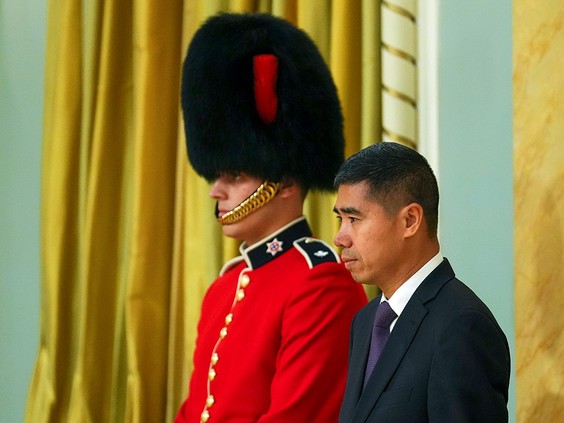
China's Ambassador to Canada, Wang Di
https://smartcdn.gprod.postmedia.digital/nationalpost/wp-content/uploads/2025/03/Wang-Di.jpg?quality=90&strip=all&w=564&h=423&type=webp&sig=zltHmLCMdI8R9NtN5HzFGg
"I hope that companies between our two countries can enjoy a transparent, open and non-discriminatory business environment," says China's Ambassador to Canada Di Wang. Photo by Sean Kilpatrick/The Canadian Press/

China's core interests are wound up in its approach to world dominance in trade and achieving the status of a world power equal to that of the United States of America. Everything that Beijing does is calibrated to achieve those ends. And China is relentless in its self-actualizing mission of achieving its divinely inspired destiny as a super-hegemon. Its links throughout the world -- in North America, Europe, Australia, Africa, the Middle East are geared to creating a type of dependence beginning with trade and ending with dominating world markets in chemicals and organic matter critical to new-age technology.
 
Belt and Road Initiative - Wikipedia

China first ingratiates itself internationally, then demands respect and collaboration as it paternally guides countries which have been infiltrated by expatriate mainland Chinese through cultural indoctrination to instill admiration for the Peoples Republic of China. Its intelligence agents are everywhere, its social media sites dominate markets, its modern version of the Yellow Silk Road -- Belt and Road Initiative through investment and critical domestic infrastructure loans throughout the world have created dependencies inimical to the countries involved, becoming indebted beyond their ability to persevere.
 
And nothing seems to stop China's subterfuges and self-entitlements in maneuvering its operatives subtly into local culture and positions of social and academic, scientific and political advantage to Beijing, where infiltrated operatives deliver what they glean to their sponsors. Trade secrets, scientific advances, political positions, military situations, are all grist for the Beijing mill of conquest and control. As for respecting other countries' borders, Chinese interest in the Arctic to challenge Canada's North West Passage in the interests of vast mineral resources' acquisition is another story.
 
The government of Canada is warned by China's ambassador against using it as "bargaining chip" in its trade negotiations with the United States, even while holding out the carrot of pursuing a bilateral free trade agreement as long as Canada remove barriers to Chinese investment.Those barriers are there for a specific reason, that Canada has no interest in having its natural resources under the control of a foreign government which has on many occasions displayed its acquisition agenda to the detriment of Canada's national interests. 

Diplomatic relations between Ottawa and Beijing which is at present Canada's second-largest trading partner have cooled considerably beginning when Huawei Technologies Co. executive Meng Wanzhou had been detained in 2018 at the request of the U.S. through an extradition warrant at Vancouver's International Airport which led to China arresting two Canadian businessmen then in China, as retaliatory hostages in claims of espionage charged against the two. More recently four Canadians were sentenced to death on charges of drug smuggling in China. The dual-citizens were executed over their presumed 'drug crimes'.
 
In August, Canada announced its intention to match the U.S. higher tariffs on Chinese electric vehicles, aluminum and steel, prompting China to enact retaliatory measures against Canadian canola, pork and seafood, impacting Western Canada. Chinese investment in critical mineral projects have been curbed in Canada, Huawei has been banned from fifth-generation wireless networks, and TikTok's parent, ByteDance Ltd. was ordered to close its Canadian subsidiary.
 
China, however, is consumed with its energy needs to power its growing technology functionality and Canada is more than willing to sell energy to China in the form of oil exports and liquefied natural gas.  As for claims by security intelligence officials in Canada that China, along with countries that include India and Russia, may attempt interference in the federal election now  underway in Canada, Mr. Wang characterized them as "completely unjustified, groundless accusations", despite ample evidence in the not-so-distant past that Beijing has done just that.
"At the core of the Chinese strategy is asymmetric interdependence that allows for its weaponization of trading relations … on other countries that cannot easily pivot away from a reliance on Chinese sources."
"By pre-emptively diversifying exports of easily substitutable products that are vulnerable to asymmetrical transactions, we could reduce the leverage that adversaries might otherwise seek to exploit."
University of Toronto political scientist Lynette Ong
https://www.ctvnews.ca/resizer/v2/LWBAE2XNGIILUKKRCX7J6KYV4E.jpg?smart=true&auth=7c63a0b404f8ac3dfa535be554b7f0cd5fb2aba8ef1eb5bd5df613f14f065716&width=1600&height=899
China's Ambassador-designate to Canada Wang Di presents his credentials to Governor General Mary Simon during ceremony at Rideau Hall in Ottawa on Wednesday, June 26, 2024. THE CANADIAN PRESS/Sean Kilpatrick


Labels: , , , , ,

Friday, October 01, 2021

World Indebtedness to Munificent China

"Many poor governments could not take on any more loans. So [China] got creative."
"[Instead loans were handed to a] constellation of sectors other than central government [often backed by a government guarantee]."
"The contracts are murky, and governments themselves don't know the exact monetary values they owe to China."
"What we're seeing right now with the Belt and Road Initiative is buyers' remorse."
"Many foreign leaders who were initially eager to jump on the BRI bandwagon are now suspending or cancelling Chinese infrastructure projects because of debt sustainability concerns."
Brad Parks, executive director, AidData, U.S.-based research firm
"These debts, for the most part, do not appear on government balance sheets in LMICs [low and middle-income countries]."
"However most of them benefit from explicit or implicit forms of host government liability protection, which has blurred the distinction between private and public debt and introduced major public financial management challenges to LMICs."
"Beijing is more willing to bankroll projects in risky countries than other official creditors, but it is also more aggressive than its peers at positioning itself at the front of the repayment line [via collaterization]."
AidData report
 
Chinese President Xi Jinping, in response to criticism, promised in 2019 that his country's ambitious Belt and Road Initiative would be subject to increased transparency in program financial stability and that there would be "zero tolerance for corruption". Of course, China's ruling Communist Party fails to equate sharp business practise with corruption. They're just going about their transactions in fairly unconventional ways that also happen to screen them from too much unwanted scrutiny. Until a reviewer who knows what to look for reveals the presence of unscrupulous methodology.

A total of one hundred, sixty-five countries are now indebted to China. Which had unveiled a bold new plan to resurrect a modern, improved "Silk Road" of enhanced trade opportunities where all roads lead inevitably to China. A vast network of highways, bridges and other communication infrastructure was to be built in low- and medium-income countries who badly needed modernized transport infrastructure and China made an irresistible offer to build and finance them on a loan basis with tantalizing terms.

Those countries that took the bait are now in a position of facing a total of $385 billion in hidden debts through their participation in the BRI. In the case of 42 poorer countries, debt exceeding ten percent of their individual GDP has become their reality. There are some loans revealed through AidData research that have been under-reported to the World Bank, are off the public balance sheets through a system of special purpose and semi-private loans.

The revelations by that research indicate that loans are "substantially greater" than the data in possession of research institutions, credit rating agencies or intergovernmental organizations with surveillance responsibilities "previously understood" to be the case, according to the study. The World Bank and International Monetary Fund, were said to be aware of problems, but the report gave substance to the scale of just how much was beyond their purview, going under-reported.
 
 
China's overseas lending dramatically underwent change from government-to-government loans to the point where close to 70 percent of the financing was transferred to state-owned companies, banks, joint ventures, private institutions and special purpose vehicles. Which resulted in an estimated $385 billion of debt under-reported with the lenders no longer central government bodies attached to strict transparency.

When Beijing originally developed its BRI in 2013 with a view of investing in global infrastructure hundreds of countries across Central Asia and Africa including low- to middle-income countries, signed up for the investment program launched by President Xi Jinping. Some of those same countries anxious not to miss an opportunity to advance their trade potentials are now rethinking their original enthusiasm. Laos, Papua New Guinea, the Maldives Brunei, Cambodia and Myanmar are part of the list of nations owing debt in excess of ten percent of their GDP.
 
The Yuxi-Mohan railway between China and Laos under construction in May 2019 in China's Yunnan Province.   Getty Images
 
Part of the debt accumulated by Laos as 'hidden debt' was found to be quite significant through research, where the $5.9 billion China-Laos railway project funded entirely with unofficial debt is equivalent to about a third of the impecunious country's GDP. China focused on  countries rich in resources with corruption at high levels for increased loan provisions. The report notes that 35 percent of BRI projects were rife with corruption, faced labour violations, environmental pollution, and public protests.

Countries with traditionally poor performance on conventional measures of credit-worthiness saw China increasing its provisions of loans there in comparison to other international lenders; at the same time imposing much higher interest rates, alongside shorter repayment periods. Of the 50 largest loans, forty were collateralized, generally against future commodity exports. Whatever the scenario, China came out winning, its client countries hooked and sunk.

The arrangement for Pakistan saw Chinese loans with average interest rates of 3.76 percent -- in comparison to an OECD-linked loan rate of 1.1 percent. "A lot of banks wouldn't even lend to Pakistan. If you're able to secure a loan you have to pay the higher risk premium", explained Peter Call, a research fellow at the Australia-based Lowy Institute.  The Center for Global Development in 2018 found Djibouti, Kyrgyzstan, Laos, the Maldives, Mongolia, Montenegro Pakistan and Tajikistan owing over half of all their foreign debt to Beijing.

China systematically underreports its debt to the World Bank's Debtor Reporting System by lending money through special purpose vehicles, a study reveals. (Source photos by AP and Reuters)

Labels: , , , , , ,

() Follow @rheytah Tweet