Politic?

This is a blog dedicated to a personal interpretation of political news of the day. I attempt to be as knowledgeable as possible before commenting and committing my thoughts to a day's communication.

Sunday, June 19, 2022

Riding the Devil in Afghanistan

"There's a lot of good people here. Engineers, doctors, educated people."
"But they have problems with drugs. The problem is getting worse, day by day."
Drug addict, Pul-e-Sukhta underpass, Kabul, Afghanistan
 
"I was a graduate from school and I prepared for college and loved a girl and I was unsuccessful. The family did not approve."
"After that, there was no chance for me, so I just used heroin to calm myself."
"When I came out [of Kabul's Ibn Sina rehabilitation hospital], what could I do? There was still no work."
"I have been to the hospital, but I became addicted again when I left."
Syed Ramin, 32, drug addict, Kabul
 
"By order of our supreme leader, Haibatullah, there has been a decision to reduce the problem."
"Nowadays there has come a reduction of our drug problem."
Abdul Nasir Munqad, Taliban leader appointee, hospital director
 
"Our problem is different to European countries, where people take drugs for pleasure. If we ask our patients, they have no jobs, they have no income."
"We started our religious classes because our country is a religious country and it has a good effect. It is our experience that we can root out this problem with religious classes." 
Dr. Atiq Azimi, secretary to the Ibn Sima rehabilitation hospital director
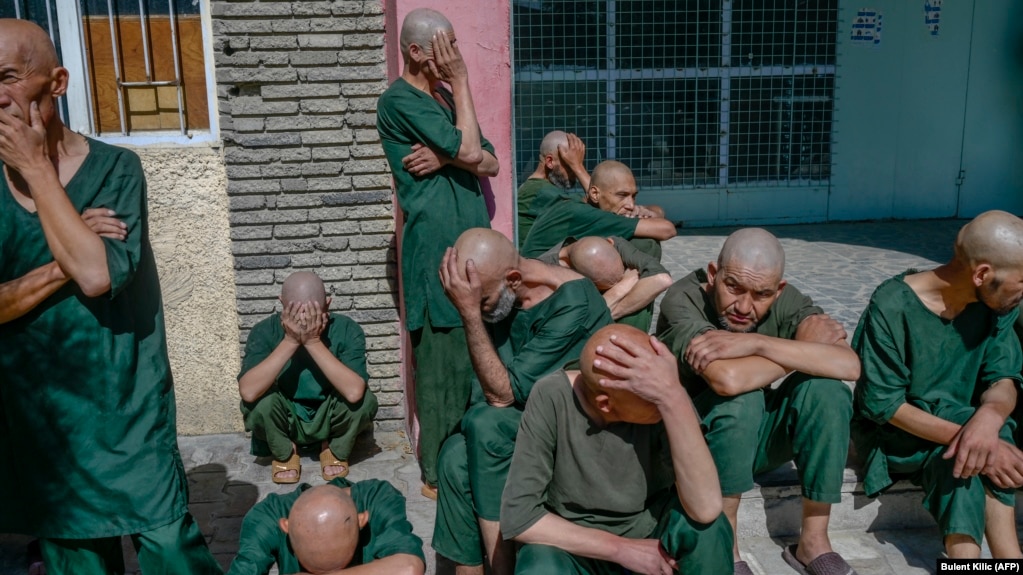
Drug addicts rounded up by the Taliban and forced to shave their heads brace for 45 days of withdrawal at the Avicenna Medical Hospital for Drug Treatment in Kabul. Many others have been sent to prisons that lack any drug treatment

Afghanistan is held to have one of the highest proportions of opium or opiate use within its population, in the world. In a nation of 39 million people, the country has an estimated 1.9 to 2.3 million regular drug users, according to a survey undertaken in 2015. The situation has become worse since then with the economic collapse that struck the country when international aid that supported many of Afghanistan's institutions disappeared with the return of the Taliban.

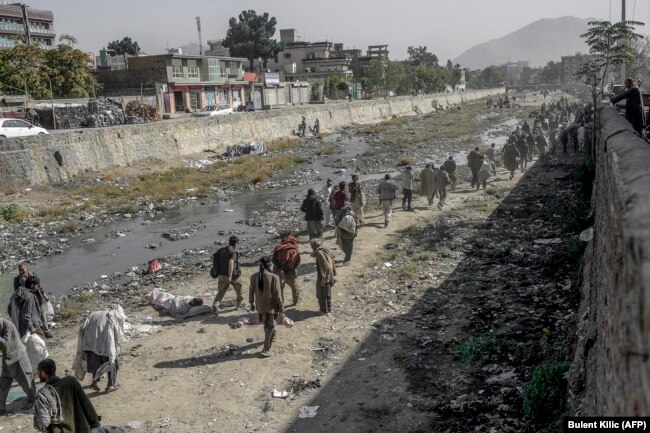
In one place along the outskirts of the capital Kabul, there are nearly a thousand drug addicts who shelter under a bridge in a western neighbourhood of the city. People stumble about, barely conscious of their surroundings, skeletal, disinterested in anything, focusing on drugs. To the curious onlooker many of those who exist within this area appear to be close to death. Yet among the living corpses, tradespeople selling tea move about.

Above the bridge underpass a regular stream of traffic moves, its noise barely noticed by those of the living dead below. All efforts to put a stop to the country's drug trade have failed. There is a burgeoning new trade in methamphetamine, exacerbating the situation where traditionally opiates ruled the market. Most of the addicts living under the bridge relate their stories of addiction to heroin or meth; some explain their addictions began as migrant workers in Iran.

Others speak of the dangers of grinding tours of the southern provinces while with the Afghan military, fighting the Taliban, which led them to drug use. When the Taliban resumed power in August of 2021 one of the initiatives it spoke of was to solve the country's addiction problem. They took to rounding up thousands of addicts off the streets, to force them into the Ibn Sina rehabilitation hospital.

Taliban fighters round up drug addicts in Kabul.

There are a thousand beds in the hospital and following the Taliban raids such crowding occurred as to see three patients in each of those beds. Overcrowding led to violence and conditions where little prospect of weaning addicts away from drugs seemed possible. Hospital doctors persuaded the Taliban to stop funneling addicts into the hospital. Many were taken to prisons instead. The hospital, now administered by a former prisoner of Bagram high-security prison, houses far fewer patients now.

Each of those patients undergoes a 45-day program to help with drug withdrawal where the firs 14 days are devoted to detoxification, followed by rehabilitation. Since enforced roundups were stopped almost all patients are 'voluntary'. Brought by their families to the hospital they cannot leave during treatment in a situation which houses them like inmates. Some of the patients try to escape their confinement. There are frequent clashes between patients and staff and violence occasionally breaks out.

"There are big differences between treating drug addicts in prisons and proper addiction-treatment centers. If patients think they are being forced to quit addiction...they will never accept treatment."
"No one can quit drugs if they are not ready to. The only way a drug addict can quit is to satisfy himself and prepare himself psychologically, which is not possible in prison."
 
Salem Sadid, local psychologist, Farah, Afghanistan

"Definitely when there are economic hardships, when the population is displaced, they want to seek mechanisms to cope with their hardships."
"That definitely makes people vulnerable to more regular drug use."
Kamran Niaz, Office on Drugs and Crime, United Nations


Labels: , , ,

Monday, January 27, 2020

How Prepared to Cope? The Classic Closing the Barn Door...

"For me, that is a sign that the information at the border did actually percolate through to the patient and his family."
"The system is working and the person obviously got the information that they needed to enter the health system in a safe and responsible manner."
"[The Toronto man] has been managed with all appropriate infection and prevention control protocols, so the risk of onward spread to Canada is low."
"Nevertheless it would not be unexpected that there will be more cases imported into Canada in the near term given global travel patterns."
"The risk to our community remains low."
Dr.Theresa Tam, Chief Public Health Officer, Canada

"[Once he became more ill], when he needed medical support, in fact, he followed all the information provided at the airport."
Federal Health Minister Patty Hajdu
Passengers, and people waiting to pick them up, wear masks at Toronto Pearson International Airport on Sunday. (Evan Tsuyoshi Mitsui/CBC)

At Pearson International Airport in Toronto, China Southern Airlines flight CZ311 brought home to Canada citizens who had visited relatives in Wuhan, China, the epicentre of a novel coronavirus outbreak. Among the passengers was a man in his 50s who had boarded the international flight in Guangzhou, already feeling ill, but saying nothing to anyone. Throughout the flight back home to Canada the man felt increasingly ill, as well as on arrival in Canada. He failed to report to border service officers that he had been in Wuhan and now felt ill.

The airport has instituted "detection" measures including screening questions at electronic border kiosks, asking whether travel to Wuhan had taken place in the past 14 days. Reminding people to report any symptoms similar to flu to border service agents. At those kiosks fact sheets are available printed in English, French and Chinese, outlining the symptoms that people should be aware of, and to seek out medical attention should they begin to feel ill.

The man left the airport, revealing nothing, and went to his home. This is a typical human reaction; never believing anything could happen to you, preferring to believe you're afflicted with a minor cold, and just need a good rest at home. A family member a day later dialed 911 to report that the man had recently travelled to Wuhan and was feeling ill. Wearing protective gear, paramedics responded, to take the man to Sunnybrooke Health Sciences Centre, where he was placed in isolation in a negative-pressure room. A day later, the man's wife entered the system with the very same symptoms.
"We are informing these people [passengers of flight CZ311 who may have come into contact with the man] that they may have been exposed to a potential health risk, what signs and symptoms they should look out for and when and what type of medical treatment should be sought out, if that becomes necessary."
Toronto Medical Officer of Health Dr.Eileen de Villa
There are now 19 suspected cases of coronavirus under investigation in Ontario. Numbers are growing, in a micro-reflection of China, where it is now reported that there have been 106 deaths from the coronavirus, among a growing case load exceeding two thousand, seven hundred in number and steadily increasing. In Toronto, people are beginning to panic, asking whether their medical procedures including surgeries and childbirth can take place in hospitals other than those holding patients with presumptive coronavirus.
Chinese officials have reported the illness has now infected more than 2,700 people. Several countries throughout Asia, Europe and North America have also confirmed cases. (Evan Tsuyoshi Mitsui/CBC)

Testing of all suspected cases takes place at the national microbiology laboratory in Winnipeg. In China, over 50 million people have been placed under quarantine, with new research arising in fears of "substantive" human-to-human transmission and where travel in Wuhan and 15 other cities have been restricted, all public transportation systems shut down as China desperately scrambles to halt the spread of a new virus that has spread to Europe and North America.

On average, each case in China is held to have infected 2.6 other people, up to January 18. A theoretical estimate given the population density and travel patterns of Chinese at New Year's following traditions of returning home to reunite with family during Chinese New Year. China's health minister has issued a warning that the virus is at a "crucial stage of containment". Which is to say, China hopes that the spread is being contained.

Early studies published several days ago in The Lancet reported people can become infected without being symptomatic, a condition that ensures the virus will be more difficult to contain, of a novel coronavirus of which the initial 41 confirmed cases saw one-third of those people developing acute respiratory distress syndrome or required intensive care.

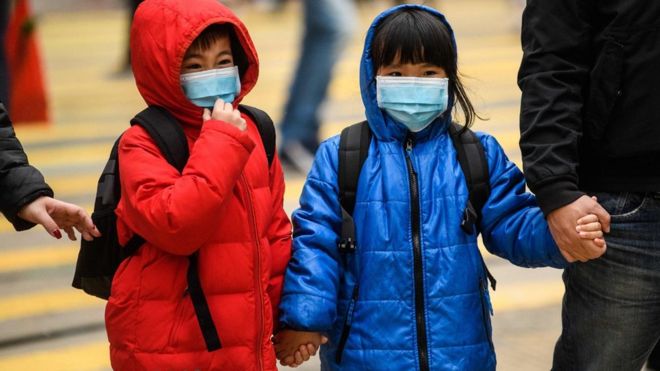
Two children wearing face masks and holding hands
106 people have died from the new coronavirus; newly infected have almost doubled

"There's a certain amount of the infection control system that relies on people's proclivity to self-report."
"You can't rule out that anyone who came into contact with this person, no matter how brief that contact was, could have been infected. But the likelihood is extremely low."
"The real risk would have been for people in his immediate vicinity [to have been exposed to the man] for prolonged periods."
Matthew Miller, associate professor, Michael G.DeGroote Institute for Infectious Diseases Research, McMaster University
It takes approximately 12 hours, slightly longer, for a China-to-Canada flight. That's a considerable amount of exposure time. Given a small enclosed area where at least a hundred people are packed closely together, and from time to time move about to access toilet facilities, to stretch their legs, contact accessibility is fairly high. Air quality aboard planes is not exactly first-class. It appears that self-reporting reliance is a dead end to singling out possible infectious agents. Which translates to Canada's system of detection on arrival is beyond faulty.


Labels: , , , , , ,

() Follow @rheytah Tweet