

Canada Is Afire!
"Climate change is greatly increasing the flammability of the fuel available for wildfires because the trees, fallen trees and underbrush are all so dry.""This means that a single spark, regardless of its source, can rapidly turn into a blazing inferno."Natural Resources Canada"What we're getting now is bigger fires, faster-moving fires and also a faster return rate of those fires.""Instead of burning through once every 50 to 200 years, they're coming through every five years, every 10 years."John Vaillant, author, Fire Weather: A True Story from a Hotter World
 |
| A helicopter battles wildfires near Coombs, B.C., on Sunday, Aug. 3, 2025. THE CANADIAN PRESS/Chad Hipolito |
This week alone in Canada, 7.4 million hectares of forest has burned; twice as much damage as wildfires caused to date this year in the United States; almost as much as burned areas of Argentina, Chile and Columbia in combination. Saskatchewan and Manitoba declared states of emergency; a few other provinces ordered residents out, even entire communities in view of the fast-moving fires and dangerous smoke. Air-quality alerts have been triggered in the largest of Canadian cities.
In this country of massive, magnificent forests, firefighting resources are stretched to breaking across Canada. The Canadian Interagency Forest Fire Centre - the country's national firefighting co-ordinating body -- reported 721 fires raging across the country; 158 of that total are classified as out of control. The CIFFC states that national wildfire preparedness level is at the highest possible rating -- Level Five; translating to all national firefighting resources having been deployed.

In Atlantic Canada, the Weather Network states the region could expect thundershowers shortly; the other option is for the hot, dry weather to continue, fanning wildfires. Saskatchewan has lost 2.8 million hectares to wildfires this year, far more than the 1.9 million during the 2023 season which was Canada's worst year for wildfire devastation. In neighbouring Manitoba, 1.7 million hectares have been scorched; the second hardest-hit province.
Wildfire devastation has spread throughout the country with the exception of Prince Edward Island. British Columbia, Alberta and Ontario are experiencing above normal fire numbers with more forest than usual being consumed. Newfoundland's wildfires threatened St. John's and in New Brunswick 15 active wildfires were announced, two out of control. Nova Scotia is battling a new wildfire. A bolt of lightning, a discarded cigarette, a spark from a piece of machinery, all represent a source of ignition; with the right conditions the initial flame erupts and rapidly spreads.
Hotter temperatures trigger more lightning strikes. According to Natural Resources Canada, those lightning strikes cause about fifty percent of all fires, yet account for about 85 percent of annual area burned. Fires on average burn 2.1 million hectares of forest annually in Canada, according to government statistics; a fraction of the 15 million acres consumed by the 2023 inferno, barely a quarter of the loss this year to date.
 |
| An out-of-control wildfire in the Annapolis County community was estimated to be 300 hectares in size on Thursday, prompting a mandatory evacuation. CBC |
Saskatchewan's Public Safety Agency states that about 80 percent of the 2025 fires in the province were caused by human activity, mostly accidental in nature, and that statistic holds for Manitoba as well. In heavily forested British Columbia, however, six of ten wildfires this year were attributed to lightning strikes. Whereas an open fire left unattended by someone began the wildfire at Susie Lake on the outskirts of Halifax, this week.
Eight firefighters died in their battle with the 2023 blazes. During the 2013-2018 period, records show that wildfire smoke contributed to some 240 premature deaths per year in Canada. A growing body of research found links between exposure to particulates from wildfires and the likelihood of being diagnosed with dementia and experiencing worsening symptoms of epilepsy and cognitive decline.
At the present time, wildfire response is a provincial and territorial responsibility. The country's fire chiefs for the past decade have been calling for a body to coordinate, support and strengthen wildfire responses across Canada. "Work is already underway to identify and advance options to improve Canada's wildfire response capacity, including better co-ordination across jurisdictions and building long-term resilience", announced Emergency Management and Community Resilience Minister Eleanor Olszewski.
 |
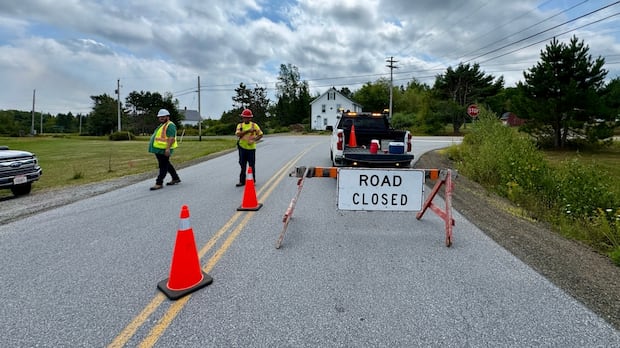
| Traffic is diverted as the Trans Canada Highway remains closed outside of St. John's N.L. due to a wildfire in the Paddy's Pond area on Wednesday, August 13, 2025. File photo by The Canadian Press/Paul Daly |
Labels: Canada, Climate Change, Forest Management, Wildfires
posted by Pieface | 9:16 PM


0 Comments:
Post a Comment
<< Home