


"Doing Things Right" Through Global Collaboration
"The space station, high above, is a microcosm ... an international collection of people living in a finite area with finite resources, just like the planet below.""I got to see the world, in effect, take one breath out of 4.5 billion breaths ... There has been life, uninterrupted, on Earth, for four billion years.""That's really optimism-building. Life isn't going anywhere. The world isn't going anywhere.""The question is: How good a quality of life do we want for people, and how sustainable do we want it to be?""Everyone on the space station, their lives are in each other's hands If anybody makes a mistake, everyone else dies.""[If ever we doubt our capacity to collaborate, we need only] look up, morning and night, and watch the space station fly over. It's a pretty clear example of what we do together when we do things right."Canadian astronaut Chris Hadfield"You flush the toilet, and yesterday's coffee becomes today's water.""It is the greatest lesson of the international space station; the opportunity to learn how effective collaboration actually works [in hoping to address climate change collaboratively].""You're developing technologies, many of which are going to help with the greening economy and ... enable us to have less environmental impact.""[Earth is] a beautiful blue oasis cast against the infinite void of space."Astronaut Dave Williams"The globe, like the ISS, is a closed loop. It depends on finely-tuned connections between the land, oceans, atmosphere, the freshwater cycle, flora and fauna.""The planet is whole. And it's integrated.""[A mutant virus originating in Asia and wreaking havoc on the world may seem unbelievable to most, but] for an astronaut, that is very easy to appreciate.""The view out the window takes everyone by surprise. There's [something] about seeing the Earth with our naked eyeball and seeing it from above The privileged position that you have, somehow, it just amplifies the beauty and majesty of it all.""[The view of the Earth from space was] personally transformative. Viewed from afar, our marbled-blue planet is alone for hundreds of millions of kilometres, surrounded by nothing but void.""There is a network of ground-based measurements for greenhouse gases across the world. But the thing about those measurements is it's so unequally distributed ... If you ever want a global picture, it's really lacking. And satellites can do that."Astronaut Robert Thirsk
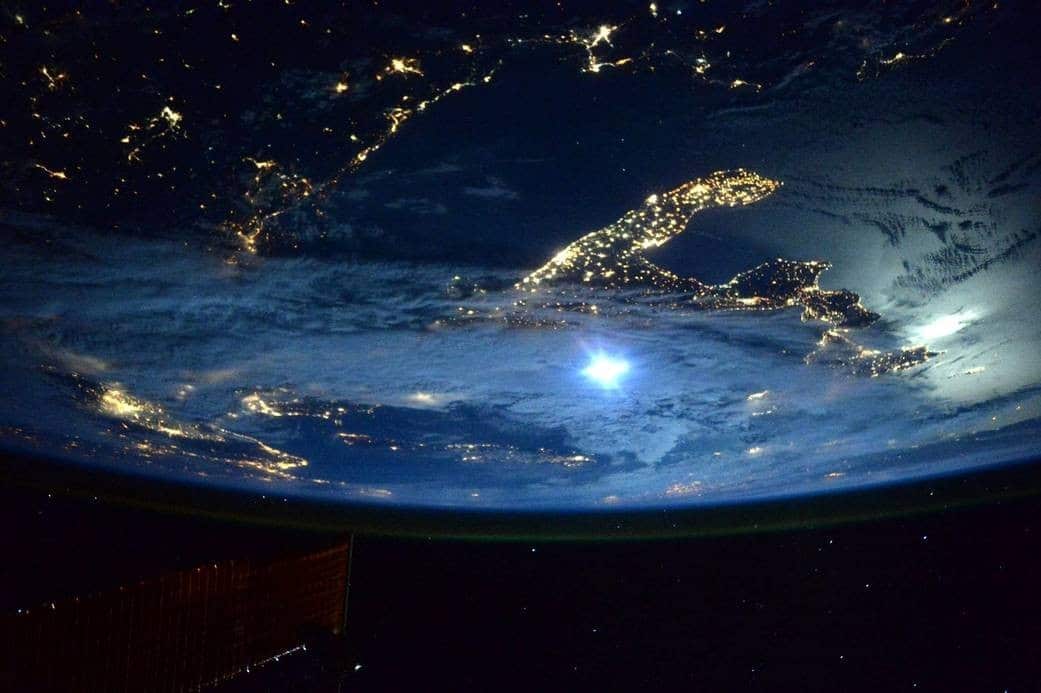 |
| Views from the International Space Station Space Adventure |
The limited living resources on the International Space Station leads to people within the confines of the station performing everyday personal routines from sleeping, eating, reading, writing, discussing theories and examining and interpreting viewed and experimental issues, to work together, both independently and as a team to make the most of the resources available to them. All aboard the station are keenly aware of their isolation, emphasizing their reliance on technology and on their collegial, professional relations with their astronaut peers.
Yet the conditions in which they must perform their tasks motivate them to appreciate the closed-loop heating and water systems that make them independent of outside sources for vital day-to-day management of their needs. The astronaut team on board at any given time represent members from the international community bringing with them a range of technical and professional expertise, with all working to maintain and operate the "habitability systems" of the station.
And they liken that situation and their experiences to those of the planet. Humanity's natural habitat with its related resources that make life possible and manageable for all creatures that exist on Earth. There is the stewardship of resources and the absolute need to be aware of how we are using and abusing those resources along with a dire need to communally agree to husband them and not to violate the very source of our habitable world. The space economy valued at $424 billion is set to create new employment opportunities linked to climate innovation.
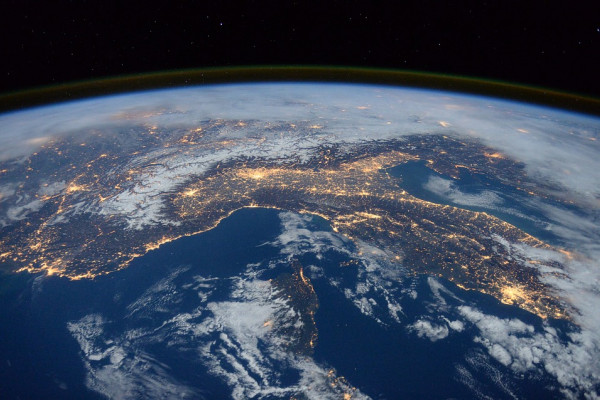 |
| TheNakedScientists.com |
But the innovative technology developed to make space travel and exploration and experimentation feasible itself has benefits for greater use on Earth itself. Necessity, the mother of invention, saw many new technical innovations to fit into a temporary lifestyle aboard a closed space capsule where inhabitants had to be self-reliant, making use of whatever was available to them for survival. Technology in food preparation suitable for a weightless atmosphere, and the fabrication of new metals more durable and flexible and tougher...
Sitting in the space station and viewing space through its generous windows, astronauts watch the unfolding of natural events on one side of the world after another. Forest fires in Siberia drift over to North America, diminishing air quality there. An initially unassuming atmospheric depression in the south Atlantic becomes a Category 4 or 6 hurricane affecting residents along the Gulf Coast. The ISS travels at 8 km/s; 25 times the speed of sound, completing a single orbit of the globe every 90 minutes. ISS occupants witness a sunrise and a sunset every 45 minutes.
Astronauts from their perch within the ISS can see the ecological crisis in real time, every day, peering out and down at the world below them. Jagged strips peeled deep into the Earth's crust from mining ventures; polluting smog, grey and opaque, hovering over cities below. Clear-cut in the Amazon rainforest to make way for agriculture. It isn't only astronauts eyeing the world from above. Satellite companies now keep an eye on emissions from their space vantage. GHGSat Inc. sends satellites into space to track methane emissions.
One of its satellites detected 13 plumes of methane emissions from a coal mine in Russia in January, the largest methane leak ever detected by the company. Methane is 25 times more effective in trapping heat in the atmosphere than carbon dioxide. Methane leaks were pinpointed by a GHGSat satellite in Turkmenistan where emissions equivalent to 240,000 gas-powered cars were being released into the atmosphere. A landfill in Pakistan was detected in 2021 with a methane plume.
The astronauts failed to breach a divide on the solutions to the climate crisis, but did reach agreement that addressing the issue would require precise political cooperation. On a planetary scale, pointed out Mr. Williams, disagreements are more complex, involving greater numbers of authorities making it difficult to find solutions that work for all governments. The difference: "We're just a bunch of people up there" remarked Mr. Hadfield. "All the crews from all the nations, the cultures that are represented, have a single-minded focus on accomplishing the mission objectives", pointed out Mr. Thirsk.
A common language of equally felt responsibility is the first step, they argued. Astronauts aboard the ISS are required to speak English and Russian, while English serves as the interstellar lingua franca. Yet, said Mr. Thirsk, even so, "when you're on board the space station as a crew member, most of us tend to think of ourselves as humans first." Humans are not regimented nor disciplined to think as a multi-reliant group like bees or ants. Therein lies our reasoning brilliance and our potential failure.
"I do worry about the motives of some of these world leaders who have created an unstable geopolitical situation. I don't se the older generation showing enough leadership in making the difficult decisions, today.""It's really easy to be critical of the lack of collaboration. There are areas that, quite clearly, where we are not collaborating here on Earth and areas that we are."Astronaut Robert Thirsk
| Business Insider |
Labels: Astronomical Collaboration, Climate Change, International Space Station, Space Science
posted by Pieface | 9:15 PM
|
0 comments


