
Politic?

This is a blog dedicated to a personal interpretation of political news of the day. I attempt to be as knowledgeable as possible before commenting and committing my thoughts to a day's communication.

Friday, April 15, 2022

Government of Canada, Dishonouring a Promise to Afghan Interpreters

"Afghan interpreters were once heroes to the government of Canada. Today they are zeros because they are stressed, depressed, panicking and mentally unstable due to [fears over] the lives of their families and their loved ones."
Ahmad Shoaib, former Afghan interpreter working with Canadian forces in Afghanistan

"The federal government, in particular the IRCC [Immigration, Refugees and Citizenship Canada], should stop playing politics with us."
"It's a matter of life and death for our parents and siblings."
"IRCC promised us and promised the public that if an applicant made it to a third country they would contact IRCC and they would help them to take them out of that country."
"Going to the Taliban and asking them for a family passport, the first question they will ask is why do you need a passport for every single member of your family, who did you work for and who did you have a relationship with, any foreign NATO members."
Ghulam Faizi, former interpreter

"We failed to build a society where freedom and women's rights are respected, where everyone has an opportunity to be what they want, where the dreams of young generations can be seen, and where minorities had a voice."
"This pain will always be hunting us down because we believed in it, we fought for it with the Canadian Forces, shoulder to shoulder."
"The minister of immigration made promises directly to us, and we want him to keep these promises."
"Zero families' members have arrived under this current policy."
Hameed Khan, former interpreter
Taliban members stop women protesting for women's rights in Kabul on October 21, 2021.
Taliban members stop women protesting for women’s rights in Kabul, Afghanistan, on Oct. 21, 2021. Photo: Bulent Kilic/AFP via Getty Images
 
Former members of the Canadian military who had served in Afghanistan and valued the work of Afghans serving as interpreters, as staff working for the Canadian embassy, felt morally compelled and obligated to urge the government to speed up its promise of bringing to Canada these hundreds of workers that had been loyal to Canada while stationed in Afghanistan, before the fall of Kabul and the Taliban takeover of the country. 
 
These groups dedicated to extricating former Afghan workers with Canadians overseas, lobbied government, raised funds to supply to former interpreters and their families to enable them to live in safe houses while awaiting rescue, voiced their frustration with government's delays and excessive administrative paperwork hindering speed in rescuing them from a dire fate once the Taliban was in power and seeking revenge on those they considered 'traitors'.

The government of Canada was ill prepared and seemed in no particular hurry to extract people whom they had repeatedly assured they would be rescued and brought to Canada, along with their families. In the end, about 400 Afghan citizens were flown to Canada, leaving hundreds more behind and in danger. Now, and once again, Afghan interpreters who served with Canadian troops and are living in Canada, continue to urge the government to cut excess red tape and make good on their promises. 

In testimony before the House of Commons special committee on Afghanistan, former interpreters charge Canada's IRCC with misleading them; promises of the rescue of family members have been devoid of the sincere efforts their rescue requires. The hundreds of Afghan civilians who responded to Canada's need for local help during Canada's 14-year mission under the NATO umbrella included contractors who worked as interpreters, security staff and embassy employees.
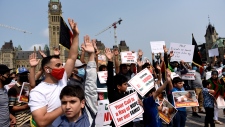
 
Afghan interpreters
People participate in a rally calling on the Canadian government to evacuate the families of interpreters and locally employed civilians who supported the Canadian Armed Forces in Afghanistan as they are being targeted by the Taliban, on Parliament Hill in Ottawa, on Tuesday, Aug. 3, 2021. THE CANADIAN PRESS/Justin Tang
 
Canada had introduced measures to grant Afghan allies permanent residence in Canada in recognition of their contribution to Canada's military in the country opposing the Taliban and post-conflict, digging village wells, building rural elementary schools and health clinics and many other civic initiatives, including training the Afghan police force and military. The promises have never been completed resulting from a desultory speed at which applications are processed and demands by the IRCC for additional, hard-to-obtain official documents 'qualifying' those desperately in need of rescue for what was promised.

At one point the interpreters in Canada, anxiously awaiting the arrival of their family members to Canada as promised, were informed that their family members would not need passports. But that assurance was changed, with the IRCC now claiming that transporting family members without passports would be "difficult". Suggesting that family members approach Taliban authorities directly to access passports. A mind-numbing prospect, and one so obviously likely to place any who might be foolish enough to take such a step, in immediate danger.

The Afghans awaiting reunion with their family members, as promised by the government of Canada, are aghast that they are now being informed that loosening immigration restrictions for family members would result in a number of security issues. This, at a time when they take note that immigration restrictions have been relaxed for Ukrainians fleeing the combustible chaos that has engulfed Ukraine, with Russia's violent invasion.
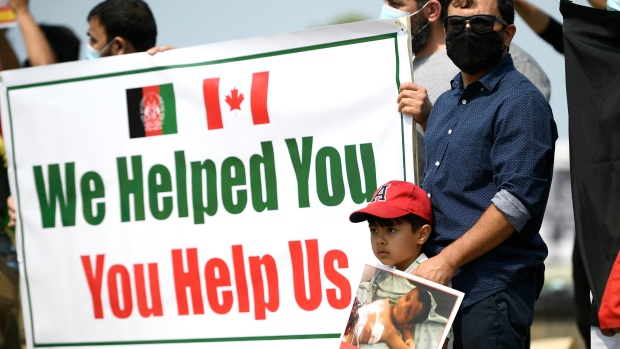
Afghan interpreters
People participate in a rally calling on the Canadian government to evacuate the families of interpreters and locally employed civilians who supported the Canadian Armed Forces in Afghanistan as they are being targeted by the Taliban, on Parliament Hill in Ottawa, on Tuesday, Aug. 3, 2021. THE CANADIAN PRESS/Justin Tang

Labels: , , , ,

Friday, April 01, 2022

Afghan Promise -- Holding the Liberal Gov't of Canada to Account

"The Taliban [interrogating those they suspect of having worked with the West in Afghanistan] the first question is, 'Why do you need a family passport?"
"Who did you work for and who did your family work for'?"
Ghulam Faizi, former Afghan interpreter, Canadian citizen
 
"They were promised that they would bring their family members here to Canada within weeks."
"It has now been almost three months since they submitted their applications following the government's instructions."
"Three hundred families have submitted their applications. Not one family member has made it to Canada."
New Democrat Member of Parliament Jenny Kwan 
Members of the Afghan National Police meet with soldiers from the Canadian Armed Forces in Kandahar, southern Afghanistan, on April 20, 2006. When Canadian soldiers left Afghanistan in 2011, they left behind local Afghans — former interpreters and mission staff — who helped them navigate the country they had landed in nine years earlier. (John D. McHugh/AFP/Getty Images)
 
Canada's federal government has been in no hurry to rescue vulnerable Afghan citizens who had worked with the Canadian military, diplomatic missions and NGOs and whom the Taliban regard as traitors they mete out capital punishment to. Despite having pledged that it could be relied upon to bring these interpreters, office workers, maintenance people, to Canada to start a new life in the West, as recompense for placing themselves in danger during the years that Canada had a military/diplomatic presence in Afghanistan, the Liberal government of Justin Trudeau has failed to respond.

It is well enough known the danger that these Afghan citizens live under. That the Taliban has a punishment agenda it carries out, despite denying that it targets former government workers, those who collaborated with the NATO-member countries in the U.S.-led, UN-approved mission to oust al-Qaeda and the Taliban from Afghanistan. The U.S., tired of its unending role in the war-torn country, chose to negotiate a 'peace agreement' with the Taliban. This, even while the Taliban kept mounting violently deadly attacks in the country.

With foreign Western troops geared to depart the country, led by the United States in a hasty retreat, the Taliban made swift strides in gaining control, and finally toppling the government in Kabul. So much for a peace agreement, a power-sharing deal. Despite that the Taliban leadership claimed they had no intention of hunting down those they consider to be traitors, this is precisely what has occurred, making the urgency to withdraw the vulnerable slated for death an imperative.

A recent press conference organized by one of the government's opposition parties saw interpreters warning they plan to hold a hunger strike in protest against government inaction to save their loved ones. Although these are people who managed to make it to Canada in previous organized flights out of the country to arrive in Canada, their families were left behind. Families they now say are fleeing from house to house in hopes of evading the door-to-door searches the Taliban have undertaken.

Afghans who applied for passports to leave the country following Canadian government instructions, points out Ghulam Faizi, now a Canadian citizen, formerly an interpreter in Afghanistan, are being interrogated by the Taliban. He spoke of the long wait for Canada to process papers in neighbouring countries like Pakistan, where the Afghans there seeking temporary haven see their visas expiring and the threat of deportation back to Afghanistan looming.

Afghans gather outside the passport office in Kabul on Oct. 6, 2021, after Taliban officials announced they would start issuing passports to citizens again following months of delays that hampered attempts by those trying to flee the country after the Taliban seized control. (Jorge Silva/Reuters)

"We feel like we have been lied to from day one"
, he said. Jenny Kwan, the Member of Parliament, urged the government to treat Afghans in the same expeditious manner as they do Ukrainians fleeing the Russian invasion. To stop the persecution of these vulnerable Afghan families, their entry to Canada must be speeded up, the processing of their papers and biometric data can be carried out once they arrive, rather than waiting for everything to be done before they're permitted entry to Canada.

To date, none of the promised Afghan families have been enabled to travel to Canada under special immigration measures already introduced last year. This, despite interpreters living now in Canada, anxious about their families' fate in Afghanistan repeatedly met with government officials and the immigration minister citing delays and logistical problems.

To date, the government brought close to 10,000 Afghans to Canada, of the 40,000 they promised would be arriving. Meanwhile the situation in Afghanistan is fraught with danger for those implicated and identified by the Taliban as accessories to the 'criminal acts' of their relatives who had worked under the former government of Afghanistan with foreign forces.

Afghan people fill out their details to register to leave the country in front of the British and Canadian embassy in Kabul, Afghanistan, on Aug. 19, 2021. Those trying to arrange a way out of the country following the Taliban takeover say it's taking too long and their window for escape is narrowing. (Wakil Kohsar/AFP/Getty Images)

Labels: , , , ,

Tuesday, August 31, 2021

Confused Yet? Canada Has Everything Under Control

"I don't know [whether to advise Afghans to remain at safe houses in Kabul or attempt to escape on an allied military or civilian flight]."
"I'm saying: 'Try to stay alive. Try to get out if you can'. But I don't think any of us have any concrete answers for them."
Stephen Watt, Co-founder, Northern Lights Canada refugee group

"[Afghans who applied under the special program should] shelter in place, given the volatility of the situation."
"Should individuals decide to assume the risk of travelling, the Pakistan government has indicated they will try to facilitate Canadian-sponsored individuals' entry into Pakistan on request of the Canadian High Commission in Islamabad."
Foreign Affairs Canada

"We have still around 900 [people] in safe houses waiting for IRCC [Immigration, Refugees and Citizenship Canada] to approve their applications and decide what to do next."
"We've got good contacts at the Canadian Embassy in Pakistan. We can build the route line. We can do it. We just don't want to build it and then strand 1,000 people in Pakistan for two years and have to hire immigration lawyers. So we need to know decisively and quickly."
"I'm just horrified we treated our closest allies this way, all the people in Afghanistan who stepped up and put their lives on the line."
"The vast majority of them have been left behind so far. We just need to do better, and we need to move fast to get them out of the country."
(Retired) Corporal Tim Laidler, advocate for Afghan refugees

Taliban fighters stand guard in front of the Hamid Karzai International Airport after the U.S. withdrawal in Kabul, Afghanistan. Khwaja Tawfiq Sediqi/AP

Of the 8,000 Afghans who worked as interpreters, clerks, cooks, cleaners and in other positions for the Canadian military, diplomats and NGOs, under three thousand were able to make their way to the airport in Kabul, get through security and be transported out of Afghanistan, out of reach of retributive Taliban 'justice' poised to reward Afghans whom the Taliban consider to be traitors for having worked for foreign interests during the U.S.-NATO-led mission in Afghanistan which originally routed the Taliban from government.

The Taliban as fundamentalist Islamists with zero regard for human rights, had plagued Afghans under their Islamic Emirate of Afghanistan rule up until 2001, with strict interpretation of sharia law and harsh punishment for anything seen as infractions; women without face coverings, women appearing in public without male escorts beaten; music and dancing forbidden, anything Western forbidden, unshaven men flogged, public executions as just punishment for failing to uphold the values of the Taliban; above all no schooling for girls, and women forbidden to work outside the house.
 

A man weeps during a mass funeral for members of a family killed in an accidental  U.S. drone strike targeting ISI suicide bombers in Kabul, Afghanistan, on Monday. Marcus Yam/Los Angeles Times via Getty Images

Afghans who for the past two decades have grown accustomed to, and grown up within a quasi-democracy with equality and individual rights and an appreciation of freedom, abhor the new reality of a return to Taliban rule. But it is those Afghans who had committed the grave treasonous act, as the Taliban see it, of working alongside Western interests in governing the country whose lives are in grave peril, and for whom their former Western allies promised rescue.

The shocking immediacy of the Ghani government collapse and the desertion of the national police and military enabling the Taliban to march uncontested into Kabul caught the Western allies off guard in their lack of preparedness to expeditiously rescue the tens of thousands of Afghans to whom promises had been made, many of whom had secured visas for their international destinations. Canada was among those that failed to react in good time, despite ample warning.

Within Canada, groups comprised of military veterans, refugee advocates and others who had lobbied the government of Canada for months to step up in response to an oncoming tragedy once the Biden administration announced its end-of-August deadline for retreating from the country, despite the entreaties of the Afghan government when it was well known a collapse would be imminent without the protective presence of a foreign military contingent, primarily the U.S. In Canada, the refugee advocates' pleas went unanswered.

They remain determined to restore Canadian honour by continuing to advocate, pressing the government to commit to greater efforts on behalf of the Canada-linked Afghans, and to do all in their power to manage events on the ground through long-distance contacts with the ongoing aim to rescue those who are threatened by death, courtesy of the Taliban. Given the current confusion the advocates are uncertain how to proceed without government commitment.
 
Afghans wait in long lines for hours to try to withdraw money, in front of a bank in Kabul on Monday. The Taliban have limited weekly withdrawals to about $200 US. (Khwaja Tawfiq Sediqi/The Associated Press)
 
Despite the Liberal government led by Prime Minister Justin Trudeau having been under pressure of constant criticism for its lack of alacrity in acting and advancing the cause of pulling Afghans out of danger, a special immigration program has proven incapable of rising to the occasion, plagued by problems both technical and bureaucratic. Canada's foreign affairs department has issued conflicting advice to the remaining Afghans awaiting flight from death.

The uncertainty of the government-issued conflicting messages and frustration over thousands of applications from former interpreters, local staff and family members to Canada's Immigration Refugee and Citizenship department is evident in its failure to act, to adequately advise, to provide updates to people on the status of their applications. In the absence of application approvals, the aid groups determined to act where government will not, find themselves at an impasse.

There is an estimation of 500,000 people; among them Canadian citizens, former allies among those planning to pursue any avenues that might lead to escape from Taliban revenge. Afghans who are very well aware that an additional risk awaits them in the form of the Islamic State terrorists well ensconced in Afghanistan. On Monday rockets were once again fired at the Kabul airport, intercepted by U.S. anti-missile defences. And now the U.S. forces and their diplomats are no longer present, as of Tuesday.

According to the United Nations, the entire country faces a dire humanitarian crisis. There is drought, mass displacement, and COVID-19, and they are cut off from foreign aid, the very agencies that warn of the Afghan health care system on the verge of collapse.

Taliban fighters arrive at the Hamid Karzai International Airport after the U.S. military's withdrawal in Kabul, Afghanistan, on Tuesday. The departure of the last U.S. plane late Monday marked the end of America's longest war. (Khwaja Tawfiq Sediqi/The Associated Press)

Labels: , , ,

Tuesday, August 24, 2021

Desperate to Leave Afghanistan

People sit as they wait to leave the Kabul airport in Kabul on Monday, Aug. 16, 2021, after a stunningly swift end to Afghanistan's 20-year war, as thousands of people went to the city's airport trying to flee the Taliban's return.
"While French commandos in buses got their people out, we sent texts [in English] telling our friends to head to the airport on their own. Ten buses screamed out of France's embassy in Kabul early this week, past every Taliban checkpoint along the way, and according to eyewitnesses, zipped confidently through a back-entrance gate and straight onto the chaotic tarmac at Hamid Karzai International Airport. Five hundred exhausted and terrified passengers were then loaded onto a French military aircraft which quickly took off."
"All of our allies had eyes and boots on the ground ... at Kabul's airport. Canada did not. It closed its embassy and withdrew all its diplomats and military by jet to Ottawa just as the Taliban was rolling into town."
Kevin Newman, journalist, former anchor, Global National
 
"I'm scared. Who knows, they could come here in the middle of the night and nobody is going to know anything. We could be executed, any day any time, any minute -- I can feel the death coming."
"The Taliban are driving around, staring at us, wondering what's going on here [at the hotel assigned to his family by the Canadian government, in Kabul while awaiting rescue]."
"Your government put us in the line of execution."
Abdul Ahmadullah, Kandahar native, awaiting rescue in Kabul 

"Abdul has worked on a daily basis, often on short notice, assisting in resolving issues both complex and urgent in nature."
"His family and country have reason to be proud of this fine young man."
Canadian military officers letter of commendation
 
"The security situation surrounding the airport has become increasingly dangerous. Violence has become more common and Taliban checkpoints in surrounding area are preventing many from reaching the airport area."
"For those who do make it ... Canadian Armed Forces members have been able to assist eligible evacuees to enter the airport parameter."
Unnamed senior government official
Afghans board a U.S. Air Force transport plane during an evacuation at Hamid Karzai International Airport in Kabul on Sunday. Officials told media Monday that Canada's special forces are currently working inside and outside the confines of the airport to ensure Canadians and eligible Afghans can get onto planes destined for Canada. (U.S. Air Force/REUTERS) 
 
Canadian military veterans who were assigned to tours of duty in Kandahar province, Afghanistan, as part of the Western allied forces led by the United States and NATO, have been extremely aware of the imminent danger their former Afghan colleagues would be exposed to. They have been working for months independently of government agencies to locate and contact former Afghan volunteers, interpreters and others working with the Canadian military for the ten years of its presence there.

That same group has desperately urged the Liberal Trudeau government to action, emphasizing the dire reality of a tragedy waiting to unfold. They have been frustrated at every turn. Agonizingly complex paperwork has confronted Afghans registering, proving their past work performance with the military, with the Canadian diplomatic mission as locally engaged employees and workers with Canadian NGOs. One department of government has shunted them off to another. During registration procedures communication lines freeze.

And it soon became distressingly evident that the Government of Canada had made up no contingency plans for evacuation of Afghans who were eventually successful in obtaining visas, much less those whose complex, often confusing paperwork had stalled. Finally, with the Taliban entrance to Kabul imminent, Canada yanked its diplomats out of Kabul and its military, sending them all back to Canada. And no one was left to aid and expedite the rescue of hundreds of Afghans promised evacuation by Canada. 

Messages sent directly from the Department of Foreign Affairs to the cellphones of the registered visa applicants and holders informed them they must make their own way to the airport for airlifting out of Afghanistan, at a time when the Taliban is manning checkpoints refusing to allow even visa holders entry to the airport. Canada prepared two transport planes to land at the Kabul airport and they returned half empty. People were simply unable to reach the airport, as ordered by an absent Canada.
 
More than 1,000 Afghans have been flown out on 12 Canadian flights thus far. Canadian Forces are not bringing people into this country without legitimate documentation, unlike the U.S. and U.K., says a former Afghan interpreter. CBC
 
Abdul Ahmadullah's plight is a case in point. Back in June the Canadian government responded to his need as a former interpreter for Canadian Forces in the knowledge that he was a marked man having worked for the Canadian combat mission Kandahar and he was forced into hiding while simultaneously the Taliban were searching for all Afghans linked to foreign forces. Others, like him interpreters, were found and murdered.

Ahmadullah had reached Kabul a month ago, with his family, waiting with dozens of other ex-employees locally engaged by Canada at downtown Kabul hotels until a flight could take them away. Their wait is interminable and they grow increasingly fearful in an atmosphere of grim suspense, where it has become impossible to reach the airport grounds much less make it inside, without assistance. Massive crowds of desperate Afghans and the presence of Taliban fighters surround the airport complex.

Some other countries working to extract their nationals and Afghans linked to them from Kabul and onto planes have taken people to the compound by helicopter, or with the use of armed convoys. The backstory is that interpreters' lives have been threatened by the Taliban and many assassinated by them. Ahmadullah had applied to emigrate to Canada back in 2011, when the Canadian mission left or as he put it "disappeared like ghosts".

Soon after the Canadians had departed Ahmadullah's young son, on his way home from school was abducted and he was contacted by someone representing the Islamic Emirate of Afghanistan inviting him to appear at a certain place, to see his son. "My wife told me, 'If you go there, both of you are going to die'." Instead, with the help of Pashtun elders he was able to negotiate a ransom for his son. Who came home badly beaten, missing two toenails. "You better run for your life, they're coming after you", warned one of the elders.

He, his wife and children moved every six months to new locations, attempting to change their appearance as they did -- for the next seven years. In June Kandahar was breached by the Taliban who killed all the officers manning the local police station, and took their place. The day of the invasion he appealed to Canadian officials and was wired $1,500. He and his family left for Kabul. In their absence from Kandahar their home was burnt to the ground.

When the Taliban took the capital on August 15, all those at the hotel they had been assigned to by the Canadian government were informed they should head out to the airport. When they did, they reached a dangerous place of mad chaos, packed with desperate people. They had little option but to return to the hotel to try again the following day, with similar results. Those in the hotel whom the Canadian government has pledged to rescue have tried again and again to reach the blast barriers of the airfield.

According to Ahmadullah, Taliban guards ripped up one former employee's Canadian visa then beat him. He was warned not to return or he'd be killed. "He didn't have hope any more", said Ahmadullah. He said, '[If we wait for Canada, we will die." The Canadian Armed Forces assigned to help extract Afghans has three to four days left to airlift people out of Kabul.
 
 U.S. President Joe Biden has informed his allies that the withdrawal date of August 31 is firm and will not be renegotiated with the Taliban. His concern now is that U.S. troops are vulnerable to attacks by Islamic State terrorists, obviating the potential of conflict with Taliban terrorists since the Taliban refer to August 31 as their 'red line' for foreign departures. And then there is their statement that they do not want any more Afghan nationals leaving on evacuation flights

Hoping to flee the country, people gather outside the airport in Kabul, Afghanistan, on Aug. 20, 2021.   JIM HUYLEBROEK/The New York Times News Service

Labels: , , , , ,

() Follow @rheytah Tweet