Politic?

This is a blog dedicated to a personal interpretation of political news of the day. I attempt to be as knowledgeable as possible before commenting and committing my thoughts to a day's communication.

Tuesday, September 08, 2026

Memories of Newfoundland's 9/11 'Guests' : Operation Yellow Ribbon

https://vip-media.nbcnewyork.com/2021/09/Screen-Shot-2021-09-07-at-12.25.31-PM.png?w=800
NBC New York
 
"Our college year just started ... And it was a normal morning. Everybody was in class, or wherever they were supposed to be."
"Everybody started crowding around the television, some radio. And the campus virtually came to a standstill."
"When the passengers came down to their breakfast, it was like walking into a first-class hotel. I mean, everything in the world that you wanted for breakfast was available."
"The big problem our cooks had, after the first day, was the stores were running out of food. [But] our cooks had managed to secure, you know, 250 or 300 chicken breasts in their raid of the stores the night before."
"The Salvation Army took control of the local hockey rink, and ... turned that into a walk-in cooler."
Newfoundlander Mac Moss
https://assets3.cbsnewsstatic.com/hub/i/r/2026/09/05/8d3284f2-41d8-4645-9a69-ad188962f36d/thumbnail/620x313/adbe84b9bbd60e4a95a04c4a3ed051ce/ground-planes-at-gander-rogers-tv.jpg
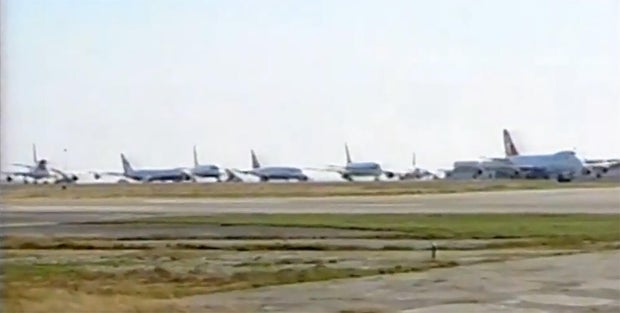
Thirty-eight international flights were grounded at Gander International Airport on the morning of Sept. 11, 2001, when U.S. airspace was shut down. Rogers TV
 
 Gander is about 335 kilometers distant from St. John's, the capital of Newfoundland. In 2001 the eyes of the world turned on northeastern Newfoundland, as it became known as a temporary haven for frightened Americans unable to fly through American skies for the period of time that U.S. internal security locked its airspace to flight in the grimly sober aftermath of the al-Qaeda terrorist attack on New York's Twin Towers, Washington's Pentagon, and the Pennsylvania interruption by passengers of a third plane heading for destruction of yet another U.S. landmark. 
 
The world was shocked into incredulity at the brazen unexpected, appalling violence unleashed by terrorists overcoming passenger flight pilots on a massive suicide-mission to steer the planes they commandeered directly into iconic American buildings, to destroy them and all the lives that occupied them on that fateful day. A quarter-century has since passed, but for Newfoundlanders who cared for over 6,700 stranded Americans for days following the attacks, that memory will last as long as they do, and beyond.
 
At that time, principal of the Gander Campus of the College of the North Atlantic, Mac Moss was alerted to the attacks when a staff member called to tell him "We're listening to the radio up here. And a plane just flew into one of the World Trade Center Towers". The emergency services of the town of Gander soon called him,  asking whether accommodation could be made by the campus to look after incoming planeloads of passengers, to provide shelter, first aid and food. "I knew the size of the campus, the space we had available, and I said yes", said Moss.
 
https://assets3.cbsnewsstatic.com/hub/i/r/2026/09/05/7982de3a-1d34-4029-a110-9dba764f85ba/thumbnail/620x465/25db72c32911307fe74aa1de8f2b263e/shelter-in-gander.jpg
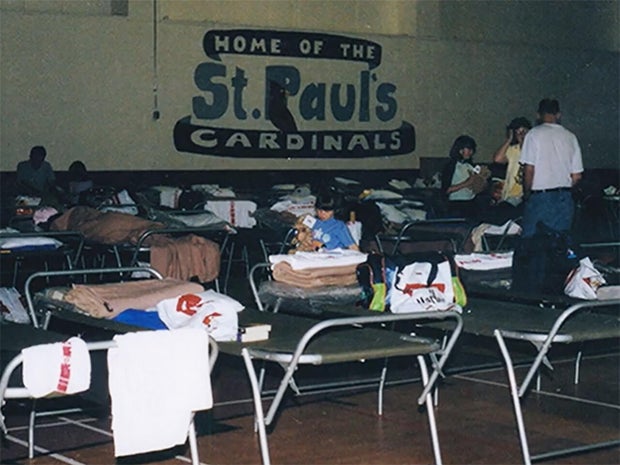
Shelter was given to 7,000 stranded passengers and crew members in schools, churches, and private homes in Gander. CBS News
 
 A jumbo jetload of people disembarked at 7:00 p.m., carrying 234 passengers, the first of two such planes the college ended up hosting. It just happened that the college had commercial cooking and electronics classes on tap, allowing students and staff to prepare hot food, set up television feeds, install microphones in the cafeteria and gather linked supplies Employees of the college and their spouses volunteered bedding and food for their 'guests'. Free medical treatment, including prescription renewals was provided by Gander. A few student nurses assisted. "We had them set up serving a little triage area", recalled now-retired former principal Moss.
 
Tight living conditions necessarily prevailed for the passengers, with "20 or 30 people to a room, and ... they were lying on a tile floor, with just a blanket or a sheet  underneath them. If they didn't have a pillow, we gave them an extra sheet to put over shoes for pillows". Once the passengers left, Mr. Moss recalled, he had slept only several hours in those three days when his campus hosted the passengers. He eventually published a book, 'Flown into the Arms of Angels: Newfoundland and Labrador's Unsung Heroes of 9/11', in 2021
 
Some of those American 'guests' have remained in contact with some of the Newfoundlanders who had hosted them during that fearful, trying time. The impression the entire event held with him, recalls Mr. Moss is "how well our towns -- plural our towns -- were prepared to handle such an event, and they didn't know it, because they had never experienced [this] before". 
 
The Town of Gander has planned a "Parade of First Responders", along with a special remembrance of the thousands of lives lost in 9/11. The commemorative events for the 25th anniversary of the plane landings and the American citizens who became temporary guests, will host a number of notables, expected to speak at the commemoration. Among them, U.S. Ambassador Pete Hoekstra, Newfoundland and Labrador Premier Tony Wakeham, and former prime minister Jean Chretien, in office on the day of the attack when between 224 and 240 U.S. flights were diverted from U.S. airspace to Canadian airports. 
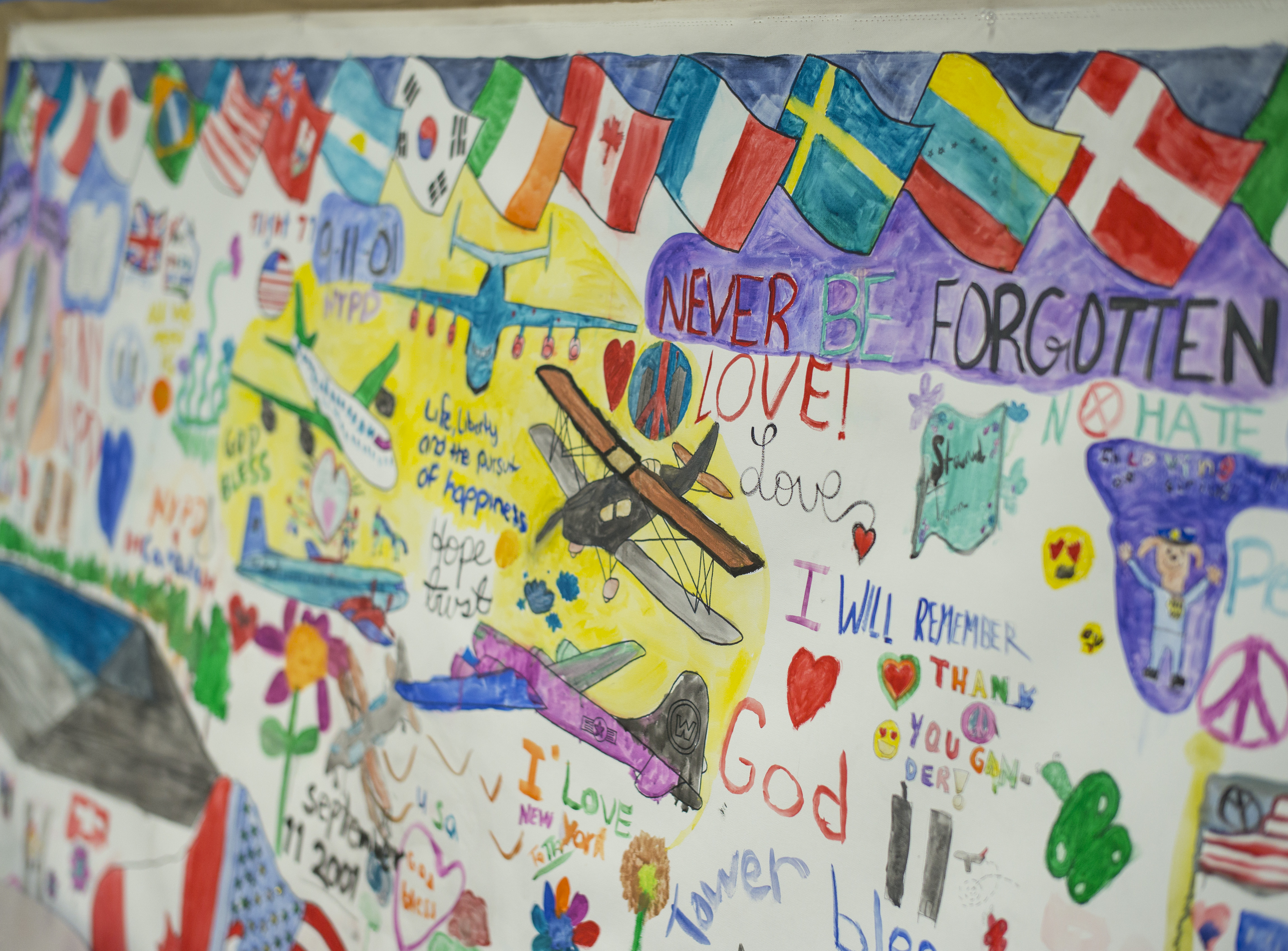
 
A mural created for Gander, Newfoundland, thanks the town for hosting stranded travelers on 9/11. The colorful mural includes drawings of planes, hearts, flowers, peace signs, and messages of thanks.
Mural Thanks Gander for Hosting Stranded Travelers on 9/11, Memorial and Museum, Gander, Nfld
 
"I did over 300 interviews, and I always asked them the same question: 'How did you feel after the passengers left'?"
"What they remembered most was the total exhaustion."
"After the passengers left, I don't think I had a good night's sleep for two or three months [mulling over details of the few days hosting confused U.S. plane passengers]." 
Newfoundland host Mac Moss 

Labels: , , , ,

Friday, March 27, 2020

Funerals: Not The Events To Attend

"We were all in a period of adjustment and learning new things about how to cope with the coronavirus and containing its spread. It's become a mini-epicentre here."
"Everyone comes in and they're all over each other and everyone is calling out to each other and slapping each other on the back and hugging. Normally I'd shake hands and hug half the people there."
"I was very careful not to shake hands with any of the people who came, including with the family themselves. They understood. They were just grateful they were able to gather and have a funeral."
Father Paul Lundrigan, St. John’s on March 16. (CBC)
"We need to now make sure families understand this is so necessary for their protection, especially families who are grieving."
"They're so emotionally charged, they're just not thinking about keeping physical distance and washing hands and they're crying over each other. That's the quickest way to spread this disease, people who have wet noses and wet eyes and wiping their eyes and then touching each other, holding each other and kissing each other."
"It's probably one of the most dangerous places to be [at a funeral]."
Reverend Paul Lundrigan, Catholic priest, St.John's Newfoundland

There were two funerals in St.John's on March 15 and 16, at the W.J.Caul Funeral Home, overlooking the city harbour. Over 60 of the province's 82 cases of COVID-19 have been traced to the funeral home. Someone among the funeral attendees had an active, infectious case of the novel coronavirus and had attended both funerals. Someone who had returned from a trip abroad. Newfoundlanders are emotional, demonstrative people, somewhat in that regard, like Italians, where in Italy COVID-19 has devastated the country.

As a result of the fact that a lot of people are very neighbourly in Newfoundland in a way not quite seen elsewhere in the country, it seems obvious now that funerals and funeral wakes are just the places where viral transmission can very readily take place. Reverend Paul Lundrigan presided over one of the funerals and himself visited during the wakes that overlapped at the funeral home. And where he would on normal occasions take part in physical contact as a way to offer comfort at such times of grief and stress, on this particular occasion he withheld that contact.

That was in view of the fact that a health emergency had been declared. At the present time Father Lundrigan is in self-isolation. He was not among those who contracted the novel coronavirus. He has no symptoms of COVID-19, no coughing, no fever, and most certainly has not experienced any difficulty breathing. Unlike many others who attended the funerals and wakes. Where between March 15 and 17 transmission of the virus took place, at the funeral home. At the time, health regulations had limited the number of people at gatherings to 50.

Out of both services that overlapped, the theory was that among the funeral staff someone may have been a vector, but people in the community felt that someone who arrived for one funeral, knowing members of the second family's funeral stayed behind for both even though people were making an effort to avoid close contact. People would move back a row of pews if someone else sat in front of them, or they would move to the other end of a pew. But there was evidently sufficient contact to spread the virus.

And some of those who tested positive for COVID-19 after attending the funerals also spread the virus to health-care workers, including paramedics. Several days later the funeral home posted a public notice denying chatter of any problems at its facilities: "We have been in touch with the Department of Health and have been advised that no COVID-19 infection has been linked in any way to staff, family, or visitors."

The following day the health department advised the home that an individual who tested positive for COVID-19 had attended services for both funerals, which led the home to contact all involved, including musicians and pastors, including Reverend Lundrigan. The home is now closed until at least April 1. "The health of those we serve, and the greater community, is of utmost importance", the funeral home stated. 

And the Archdiocese of St.John's has stopped public funeral services altogether for the present. Should a burial be required, a brief graveside blessing is to be held in the company of a few immediate family members, only. At some future date, 'celebrations of life' ceremonies may be resumed.
A letter from Archbishop Peter Hundt on Monday to the Archdiocese of St. John's stated clergy will no longer preside over public funeral services, amid the COVID-19 pandemic. (Shutterstock/GreenAppleNZ)
"It has had an impact on workers in the health-care system."
"We are following in the footsteps, in some respects, of other jurisdictions. There have been outbreak clusters around a retirement home in B.C., there was a convention of professionals in Vancouver and a bonspiel in [Edmonton] that have all generated similar concerns."
John Haggie, Newfoundland Health Minister

Labels: , , ,

Saturday, February 16, 2019

A Country Divided

"I want to do all we can do to protect this headquarters and protect the thousands of good, well-paying jobs we have at SNC-Lavalin."
"We know that SNC-Lavalin, that they didn’t follow legal rules — in Libya especially — and they have to pay for that, especially the people that were involved. SNC-Lavalin, I met the president, they are ready to put on the table very large amounts of penalty [financial fines]."
"Right now there is no controlling shareholder, so there’s a real risk that this company could be bought by somebody, for example from the U.K. For me, it would be bad news for Quebec."
"Can you [Prime Minister Trudeau] settle as soon as possible in order that we keep those jobs? We need those jobs."
"When I discussed that with Justin Trudeau, I’m not asking him not to punish SNC-Lavalin, I’m just trying to say, can you settle as soon as possible, in order that we keep the jobs. We need those jobs."
Quebec Premier François Legault on the SNC-Lavalin criminal case controversy
Prime Minister Justin Trudeau and Quebec Premier François Legault before departing for Yerevan, Armenia, at the Ottawa International Airport on Oct. 9, 2018. iPolitics/Matthew Usherwood
"There is no social acceptability for oil in Quebec. We have hydro electricity surpluses. So I'll try to sell them."
"There is no social acceptance for a pipeline that would pass through Quebec territory."
"I am not embarrassed to refuse dirty energy [from Alberta oilsands extraction] while we are offering clean energy [James Bay electricity] at a competitive price."
Quebec Premier Francois Legault
The “United We Roll” convoy of semi-trucks travels the highway near Red Deer, Alta., Thursday, Feb. 14, 2019, on its way to Ottawa. Jeff McIntosh/THE CANADIAN PRESS
"The main message we are taking to Ottawa with this convoy is that our oil-and-gas sector is in trouble."
"We need a prime minister to be a champion for the industry that has done so much to fuel this country’s prosperity."
"We need to get our pipelines in the ground and soon. We need to abolish Bill C-69 and Bill C-48 and we need the carbon tax abolished."
Glen Carritt, convoy manager

"The carbon tax is killing us, our small town of Bonnyville is curling up and dying."
We've been told to hang on from our government, from five years ago, many, many people that we know and love up there, that we considered newfound oilfield family have moved, they've gone home, bankrupt."
"They're not only bankrupt financially, they're bankrupt emotionally."
Roberta Graham, Alberta protester, United We Roll group
The “United We Roll” convoy of semi-trucks prepares to leave Red Deer, Alta., Thursday, Feb. 14, 2019, on its way to Ottawa to draw attention to a lack of support for the energy sector and lack of pipelines. Jeff McIntosh/THE CANADIAN PRESS
The six-day trip by road in large transport and semi-trailers has set out to mount their protest; a message from Alberta and Saskatchewan to Ottawa, that the Canadian Western provinces whose economy has buoyed Canada's economy and hugely, disproportionately supported Canada's equalization payments to the 'have-not' provinces like Quebec, are losing vital infrastructure, investment, employment and hope and will no longer stand for being shunted aside.

The trip from Red Deer to Regina, on to Kenora, Ontario, to Sault Ste. Marie, then Arnprior and finally Parliament Hill to be reached on the 19th is on its sway. The protest is not only about the shut-down of Canadian oil transport by pipeline then tanker, but includes complaints respecting 'open borders' and illegal migrants, and Saudi oil imports and the failure of the Liberal government of Justin Trudeau to build the Trans Mountain pipeline. 

In putting roadblocks in the way of pipelines to transfer oil to deepwater ports like British Columbia which ships out more dirty-burning, environmentally disabling coal than any other place in North America [yet adamantly refuses to allow an oil pipeline to go through the province from Alberta], Canada's oil industry is faltering, and income from discounted oil sales because of delivery failures has caused an economic crisis that is unsustainable. Pressure is on Ottawa to regard the fortunes of the Western provinces as fondly as the Liberals do Quebec/

The Liberal voting base is basically Quebec. There is a paltry three seats for the Liberals in Alberta, one in Saskatchewan and seven in Manitoba, a whisper of a presence in the Prairies. But the United We Roll convoy is determined to deliver their message to Ottawa in as forceful a way as possible: the future of the oil and gas industry is vital to the well-being of the country and the current stalemate that has crippled the industry has victimized too many Western Canadians with uncertainty about the future through mass unemployment. 

Glen Carritt, organizer of United We Roll convoy spoke of more trucks joining his convoy as it crossed Manitoba and entered Ontario. A convoy from Newfoundland estimated at 50-strong would also join up once in Ontario, making up for those lost to the convoy when it completed its first day rolling across the country because not everyone was able to take the requisite time it would take to drive across the country, after completing the first leg of the journey. Of the original number that set out 70 remained steadfast in the convoy. 

Along the route the convoy drivers came across supporters holding signs of encouragement and Canadian flags as they drove past. Those unable to join the convoy supported it financially through donations made with a GoFundMe campaign which gathered in $80,000 on the first day of the convoy's trip. "I can't make my own trip down to Ottawa myself, so I figured that the fuel I would burn I may as well hand it off to somebody else. It's just a little part that I figured I could do and try to help out I guess", explained Kelly Keil in his black Dodge pickup, handing out gallon containers of diesel fuel. 

While temperatures fell below -20C, even in the middle of nowhere supporters waited, waved, took photographs and cheered the convoy on. The carbon tax is a particular irritant to rural Canadians lacking an option to take public transit or those who depend on heavy machinery for work. The cancellation of the Energy East pipeline and the Northern Gateway, then the halt of the Trans Mountain expansion by a Federal Court of Appeal ruling has disheartened all too many.

Leader of the Parliamentary official opposition, Conservative Party Leader Andrew Scheer is scheduled to join Saskatchewan Premier Scott Moe in Moosomin, near the Manitoba-Saskatchewan border for an associated rally. Polling in January from the Angus Reid Institute found almost two-thirds of Canadians view the lack of pipeline capacity in Canada as representative of a crisis. Quebec, with no agreeing majority saw 40 percent in agreement.

The Quebec Premier wails about the possibility of the corrupt activities of SNC-Lavalin earning it a guilty verdict in its criminal trial, resulting in a ten-year loss of government contracts, ending up with bankruptcy and thousands of jobs being lost for Quebecers. This is the same provincial leader who scorned the need for an energy east pipeline contaminating Quebec soil, a province that yearly takes in millions of tax dollars extracted from Alberta in equalization payments, yet has no concern that Alberta is suffering a loss of revenues and jobs.
More than 150 vehicles of various sizes took off from Red Deer Thursday morning en route to Ottawa. Robin Grant/Red Deer Express


Labels: , , , , , , , , ,

() Follow @rheytah Tweet