

Criminalizing Denialism : Canada's Residential Schools
"I went to the sacred site [Kamloops] where 215 anomalies were found. As my chief said: crime scene...""This is genocide. Not only cultural genocide.""It is genocide, to try and get rid of a people deliberately."Manitoba Keewatinowi Okimakanak Grand Chief Garrison Settee"This country still tries to commit genocide.""We have unmarked graves. I don't like to all them unmarked graves; these are crime scenes that need to be protected as well as investigated."Pimicikamak Cree Nation Chief David Monas"These denialists? Stop it. This is the truth, that Tk'emlup te Secwepemc truth.""Denialists need to hear our stories and also need to know the truth, and I think it's right there. It's bare. It's the truth.""We know that many of these residential schools had graves. Many had unmarked graves and this is the truth."National Regional Chief Terry Tegee
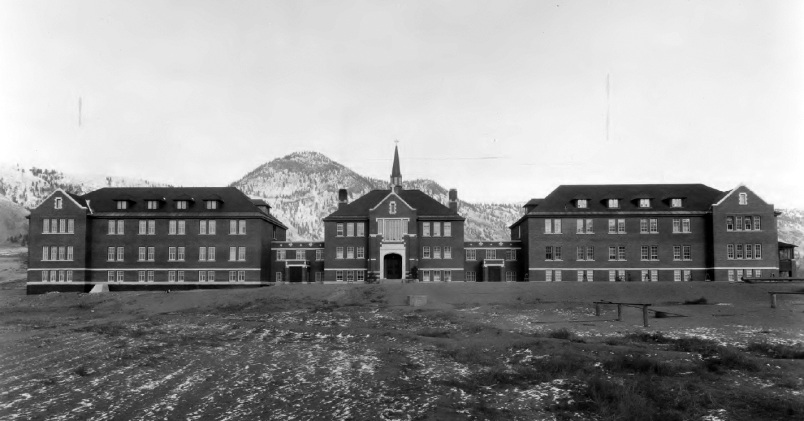 |
| Former Kamloops Indian Residential School, British Columbia, circa 1930 Archives Deschâtelets-NDC, Fonds Deschâtelets |
Denialism to Canada's First Nations is the withholding of credulity at a presumed government initiative to 'take the Indian out of the Indian', through the imposition on an unwilling Canadian Indigenous population of the Residential School System initiated in 17th century Canada to school Indigenous children in church-run institutions that were set up to expose children to standard educational curricula taught in schools throughout Canada. The schools operated up to the late 1990s.
Many indigenous parents wanted their children to have a good education. Aside from math, geography, history and science - admittedly from a Eurocentric-Western cultural tradition to prepare children for the wider world's opportunities in their futures, issues such as Western social interaction, hygiene, and preparations for life in a wider community outside that of tribal communities were central to the education system children were exposed to. Some children thrived, many others did not.
There were children who were disciplined harshly, instances where homesick children were treated badly. While instilling a Western way of life into the children through deliberate exposure to a lifestyle unlike their own, children were not permitted to speak their indigenous languages, and punishment for disciplinary infractions could be punitive in nature. There were issues with predatory sexual attacks. Issues that also cropped up at elite, prestigious institutions where boys in Toronto were sent by well-off parents for their education.
Issues that were all too common in British schools where the well-off elite sent their offspring for educational opportunities superior to those taught in schools catering to the offspring of ordinary citizens. The Residential School system in Canada started with the intention of preparing Indigenous children to take their place in the wider community outside the confines of tribal reserves. In preparing these children with an education that would enable them to go on to higher education many became professionals; lawyers, educators, health professionals.
From today's perspective this plan to educate while depriving children of their heritage, their history, their culture and their pride in Indigeneity, represents a human rights travesty. This is certainly how many among those communities view it today, with resentment, anger and a demand for reparations. It is not the
'good' intentions and future welfare of those involved that really matter in the final analysis, it is how those for whom this experiment in social patterning feel about the outcome that is at the crux of their discontent and entitled grievances.
So when unmarked graves containing bodies of hundreds of children at the former residential school in Kamloops first was announced five years ago, no one questioned it as fact, despite that ground-penetrating radar had identified 'anomalies' and not the possible presence of human bodies. Taken as truth, Canadian flags were ordered at half-mast for six months, Canadian and international news wrote of First Nations 'genocide' because that's how it was described by indignant onlookers and Indian chiefs.
The 'unmarked graves' were never disinterred, despite generous funding from the federal government to determine whether or not there really were graves, and not buried farm gates, posts, upheaved rocks or anything else that would qualify as 'anomalies'. The original charges of 'children's bodies' found were subtly changed to 'aberrations' or 'anomalies', highly reliant on children's hushed whispers of 'buried bodies', taken as testaments of actual occurrences.
Which led to Nunavut Senator Nancy Karetak-Lindell attempting to include residential school denialism in the Liberal government's anti-hate law, Bill C-9. To include residential school denialism to make it illegal for anyone to engage in "condoning, denying or downplaying" residential schools' 'discoveries' of unmarked graves. The penalty for which would be a proposed maximum of two years' imprisonment.
First Nations chiefs are in agreement that a law is needed to criminalize denialism.
Bad enough that in the years following Tk'emlups te Secwepemic Chief Rosanne Casimir's statement that ground-penetrating radar confirmed "the remains of 215 children who were students of the Kamloops Indian Residential School. Some were as young as three years old", churches were attacked. In the immediate aftermath of that revelation which prompted the New York Times to write "Horrible History: Mass Grave of Indigenous Children Reported in Canada", worse occurred when churches began being torched and vandalized, some burnt to the ground on First Nations reserves. No one was ever held responsible.
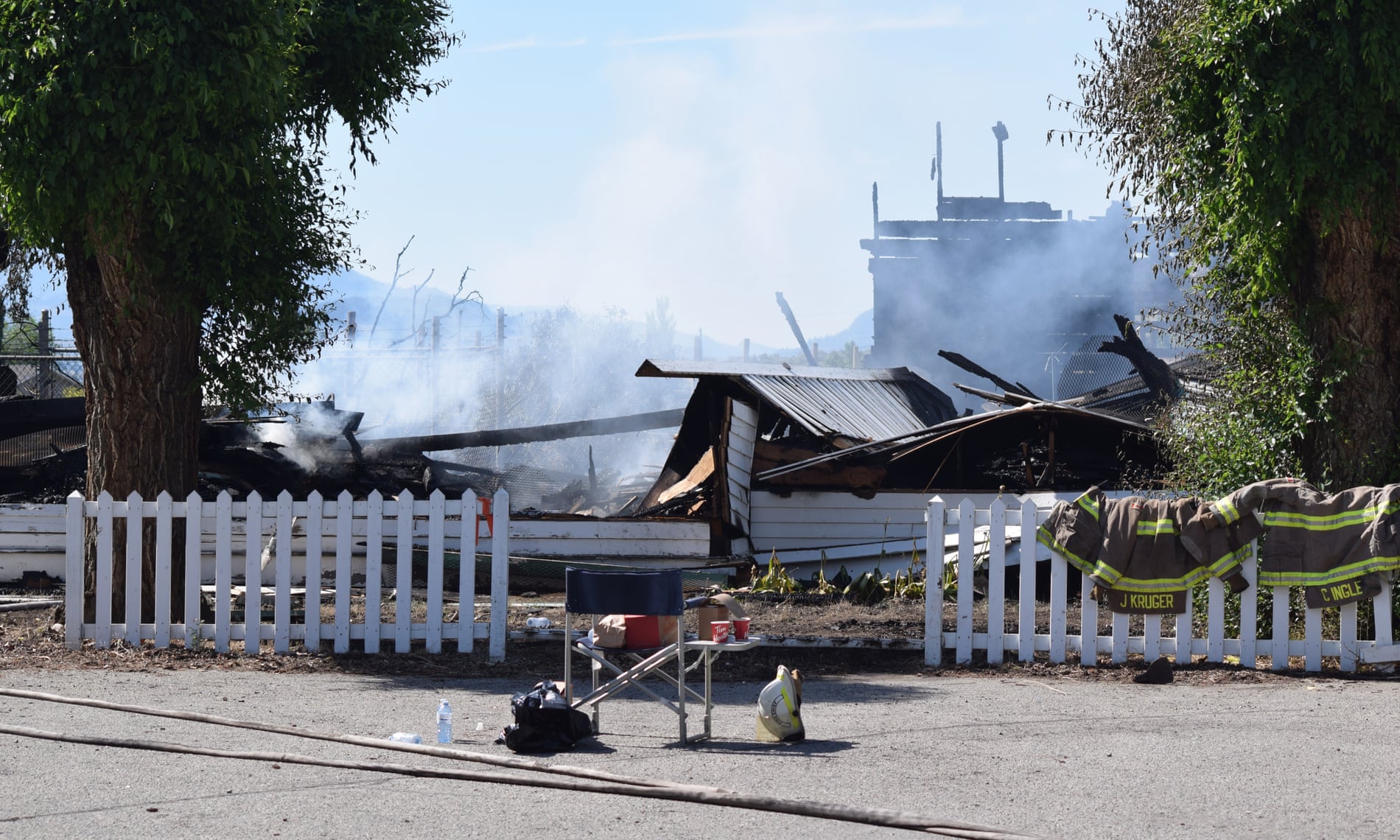 |
| Firefighters' jackets hang on the fence of the burned-out remnants of Sacred Heart church on the Penticton Indian Reserve, near Penticton, British Columbia, on Monday. Photograph: James Miller/AP |
"The Survivors speak. Warm memories.""Many students have positive memories of their experiences of residential schools and acknowledge the skills they acquired, the beneficial impacts of the recreational and sporting activities in which they engaged, and the friendships they made."Truth and Reconciliation Commission
Labels: Criminalizing Denialism, First Nations Chiefs, Ground-Penetrating Radar Anomalies, Myth of Unmarked Residential School Graves
posted by Pieface | 9:19 PM


0 Comments:
Post a Comment
<< Home