This is a blog dedicated to a personal interpretation of political news of the day. I attempt to be as knowledgeable as possible before commenting and committing my thoughts to a day's communication.
"[There is no] hate [for those involved in drug offences; they are not considered] bad people."
"We are now seeing much more dangerous substances, like meth and fentanyl, creeping into our region..."
"We cannot afford to ignore the signs [in considering the safety of the community]."
Chief and Council, Buffalo River Dene Nation, Saskatchewan
"In Manitoba and across Canada, fentanyl poisonings are taking lives
daily."
"Our front-line workers and families are doing all they can, but
support from federal and provincial governments remains fragmented,
underfunded and reactive."
"Families are torn apart, two children are left without parents, and
our social fabric is broken."
"The scale of this crisis demands immediate, co-ordinated federal
action."
"Piecemeal funding and short term pilots are not enough. The
federal government has both fiduciary and treaty obligations to act."
Cold Lake First Nations Chief Kelsey
Jacko
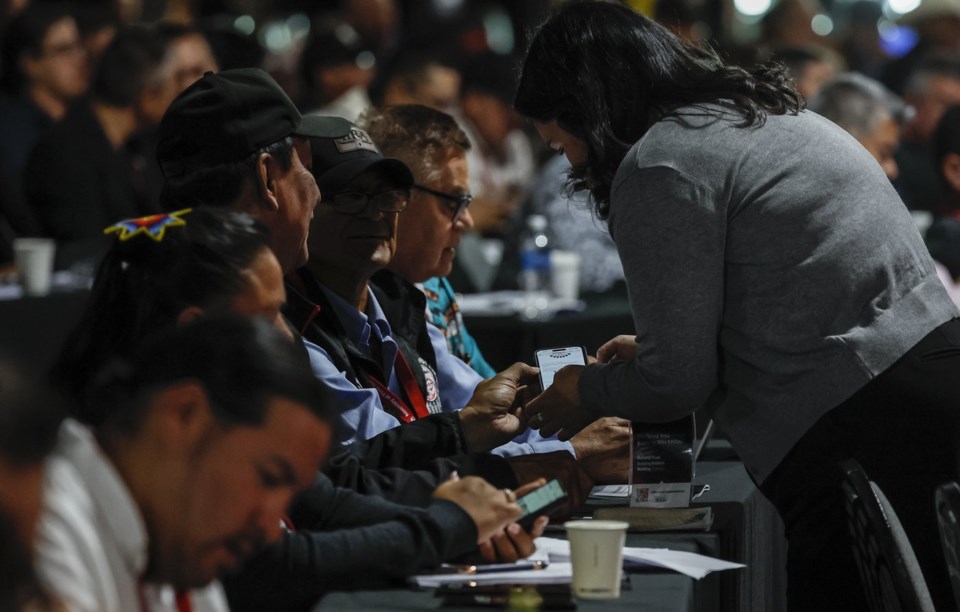
Delegates vote electronically on resolutions at the Assembly of First
Nations (AFN) Annual General Assembly in Winnipeg on Wednesday, Sept. 3,
2025. THE CANADIAN PRESS/John Woods
Friday saw a proposed law that First Nations chiefs voted unanimously to support while calling on the federal government to begin enforcing a crackdown on drug dealers selling illegitimate drugs in their communities that claim the lives of users. The Assembly of First Nations was also called upon to declare a state of emergency among all First Nations, and to appeal to the federal government for greater support for treatment and prevention. The law, as proposed, would see sentences for drug traffickers to a 15-year minimum where death occurs from tainted drugs.
Law enforcement, furthermore would be given authority to access the cellphones of victims in search of those traffickers responsible for the proliferation of the drugs. The resolution appealed to the Assembly of First Nations to advocate for federal resources required to address root causes of drug use, focusing on prevention, intervention and rehabilitation. The proposal called for "legal reforms that reflect the true scale and human impact of the fentanyl crisis, and that prioritize the protection of life over the criminal impunity currently enabling traffickers and dealers."
Countrywide, Canada's First Nations have become actively involved in banishing drug dealers from their communities, their effort to curb the skyrocketing rate of drug overdoses, in sharp contrast to government strategies which prioritize harm reduction and drug trafficking-lenient treatment. September 3 saw the Ojibway community of Netmizaaggamig Nishnaabeg in Ontario authorize the Anishinabek Police Service to treat unauthorized visitors as trespassers.
"Unfortunately, there's people coming into the community with these drugs that are taking advantage of our people", stated deputy chief Thurston Kwissiw. Saskatchewan's Buffalo River Dene Nation last month announced it planned to begin evicting its own members from reserve housing who are involved in drug activities. Kwakiutl First Nation on Vancouver Island looked at available options for the eviction of members accused of drug dealing. Hereditary chief David Knox informed local media "we're tired of watching our loved ones get killed from these toxic drugs".
The family of an alleged drug trafficker and accused murderer's family on Haida Gwaii saw their home demolished and were forced to leave the islands. Pickets followed the family to the mainland, intercepting them at bus stops to ensure they moved on. Multiple Indigenous communities in the North enforce blanket bans on alcohol, assisted by the RCMP. In the northern Alberta community of Fox Lake, a bootlegger was recently detained while attempting to smuggle in 124 bottles of illicit vodka.
Opioid Addiction – image: depositphotos.com
Fatal overdoses among Indigenous people in British Columbia is seven times greater than the average. Overdose deaths in Alberta have been responsible for a sharp drop in Indigenous life expectancy. The average First Nations person in Alberta lives to 62.8 years, down in a decades' time from a 2013 peak of 72.4, much less than the current non-Indigenous life expectancy in Canada of 81.8 years.
It has long been acknowledged by government health authorities that Indigenous communities are affected more dramatically by illicit drugs than non-Indigenous communities. Yet, official strategies have tended to sidestep the issue of drug trafficking interdiction. Published in 2023, the official Canadian Drugs and Substance Strategy, posits that high Indigenous drug use is attributable to "historial and intergenerational trauma, including the impact of colonization".
The self-flagellating federal government gave expression to then-attorney general David Lametti's statement that "We hare repealed the mandatory minimum penalties that have most contributed to the over-incarceration of Indigenous people, Black persons and racialized Canadians", in explaining the 2022 passage of Bill C-5, the Liberal legislative gift influenced by Critical Race Theory to non-punishable minority groups held to be disadvantaged and not responsible for their misdemeanors, thus removing mandatory minimum penalties for drug trafficking offences.
Finally, the Assembly of First Nations is signalling that this approach has not worked, and will not work, to address these habitual problems of sociopathy prevalent in specific groups. The 1,500-member Mississauga First Nation last October scored a precedent-setting legal victory with an Ontario court upholding their trespassing order against an accused drug dealer who continually frequented the community. In the process the Mississauga leaders emphasized their long struggle to have police enforce their community codes.
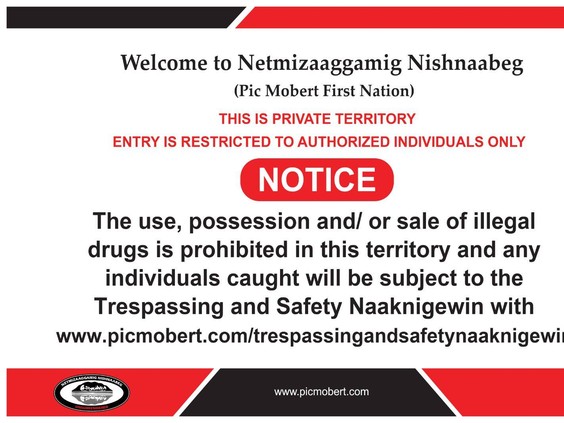
A
sign distributed around the Pic Mobert First Nation announcing the
enforcement of a new rule intended to evict and exile drug traffickers. Photo by Facebook.com/Pic Mobert First Nation
"We want minors to stop being the preferred labour force of organized crime."
"Today
it's cheaper to hire them, and the penalties are laughable. So we
propose that, in serious crimes such as murder, they receive the penalty
of an adult, although they serve it in a [special] correctional
facility until they are 18."
Vincente Taiano, National Assembly of Ecuador
"It shocked me to see children nine or ten years old with rifles, learning to shoot. It's an image you can't easily forget."
"I
spoke with children who had killed dozens of people as part of their
training. They were willing to do it for ten or 20 dollars."
"They called their victims 'breasts' because they're worth what a chicken costs."
Monica Velasquez, journalist, independent digital media LaPosta
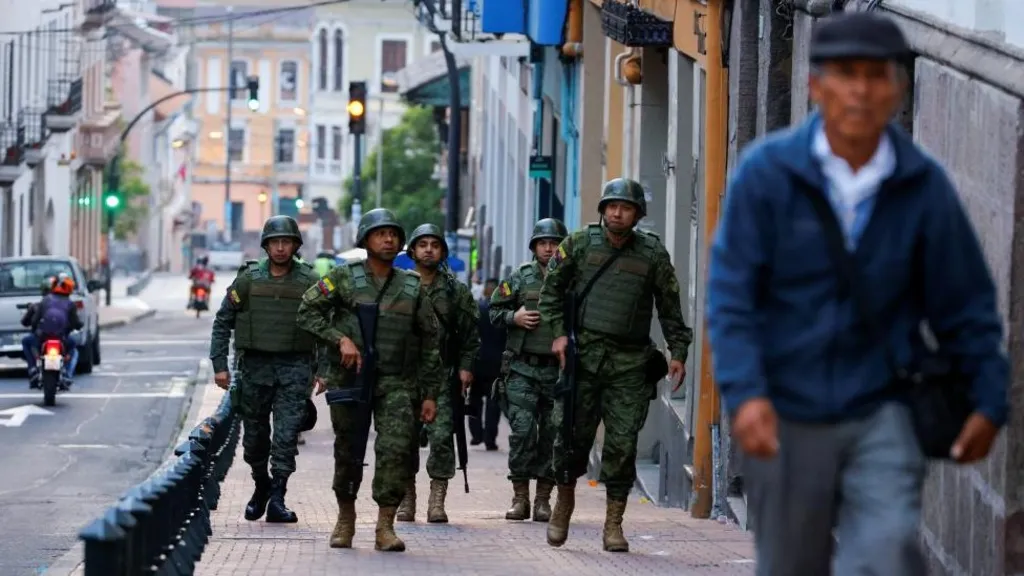
Soldiers have been deployed to boost security Reuters
A
documentary produced by Monica Velasquez in 2021 reported the
phenomenon of 'hitman schools'. Her documentary revealed footage of
armed instruction given to youths with criminal aspirations. These
schools take place on the streets of Duran, in Ecuador. The city became
the world homicide capital in 2023. Child involvement in crime is of
such a magnitude that Ecuador's own statistics reveal that the leading
cause of death among minors in the country is murder.
Because
of her activist revelations, Ms. Velasquez was under constant threat of
violence, convincing her that to preserve her life it was necessary to
leave her country. She now lives, a refugee from Ecuador, in Canada.
Organized crime groups' threats hounded her from Ecuador. She must now,
as it happens, recognize that in Canada too -- not yet at the extent
seen in Ecuador -- organized crime recruits adolescents to work with the
group in drug trafficking and vehicle thefts; stolen for export abroad.
There
were 6,964 homicides in Ecuador last year, reflective of the incidence
of violent crime in the country. Of those homicides, many were at the
hands of armed and trained teens embroiled in violence through organized
crime. The South American country is now considered one of the most
dangerous places in the world. Last spring a murder occurred that
shocked even the most blase Ecuadorians accustomed to reading about
criminal events in their country.
A
14-year-old boy was revealed in a brief video, seated on a bus, pulling
a firearm out of his backpack, then threatening the bus driver, to
extract money from him. The bus driver's young daughter happened to be
seated beside her father and appealed to the boy to take the money and
leave. From the bus steps as the boy was exiting, he suddenly turned and
shot point blank at the driver's head, killing him instantly.
Someone
like that 14-year-old committing a crime of that dimension under
Ecuadorian law would receive no more than eight years of confinement in a
juvenile court if he was convicted of the crime. With time off for good
behaviour his sentence could be halved. There is a moral/justice
dilemma for Ecuador to solve for itself in the face of these blatant,
frequent crimes committed by children.
Violence
in the country is out of hand. Six of every ten members of local
cartels are minors, according to a 2024 report by the Konrad Adenauer
Foundation in Germany. The National Assembly of Ecuador is grappling
with the dilemma of what can be done. Following the bus murder, Vicente
Taiano, a conservative legislator, called for a debate too long in
coming to address the critical and dangerous issues before it, of child
violence associated with gang memberships.
It
is now up to the National Assembly to reach a consensus of how the
issue can be addressed. It has been under discussion for months, with no
forward movement. Under Ecuadorian law the age of criminal
responsibility -- the lowest in the region -- is 12 years. However, says
Parliamentarian Taiano, the penalties are "very soft". He then proposed
a toughening of the criminal law, citing: adult crime, adult penalty.
Pierina
Correa, president of the Legislative Commission for Children's Rights
accuses the prospective change in youth criminal law proponents of being
"penal populists".
It is her opinion that children in Ecuador, while not exempt from
prosecution, must also be recognized as requiring more guidance.
"They are not turning to organized crime because they have a criminal
vocation, but because the state has failed them in every way", she accuses.
Argentina
and Peru also are in discussion respecting how they might address a
similar social legal problem. Sweden, considered a developed country,
found the number of children taking part in blood crimes there had
tripled in 2024. The difference is that none of these countries have
seen 'hitman schools' tutoring children in weaponry handling and
financial incentives to commit violence, including killing people.
And
then, in Ecuador another complicating factor has emerged. The internal
armed conflict with the state declaring war on drug trafficking cartels
has seen the military enlisted in the war on drug trafficking cartels. A
military patrol of 16 soldiers had detained four children in Ecuador's
south back in December. The children's bodies were found weeks later,
mutilated and charred. The soldiers stand accused of forced
disappearance.
Workers
carry bundles of drugs seized in various police operations, to be
incinerated in Cayambe, Ecuador.Dolores Ochoa / AP
"The impact of the over-policing of racial minorities and the carding of individuals within those communities without any reasonable suspicion of criminal activity is more than an inconvenience." "[Given that three police officers entered a small private backyard without a warrant or permission to question five racial minorities], these young men would have felt compelled to remain, answer and comply." Supreme Court of Canada
"[Reasonable and well-intentioned members of the public would consider a decision to exclude the evidence and exonerate someone] who was prepared to reach for a loaded weapon during a violent struggle with the police as not merely alarming, but intolerable." Supreme Court Justice Michael Moldaver, dissenting opinion
A view shows the Supreme Court of Canada in Ottawa. On
Friday the high court ruled that Tom Le's charter rights were violated. (Chris Wattie/Reuters)
A majority of the Supreme Court of Canada claimed that actions of police in May of 2012 one night amounted to arbitrary detention, representing a serious violation of 20-year-old Tom Le's -- a resident of a Toronto housing complex considered to be a "problem address" where drug trafficking was known to occur -- Charter rights. The Charter of Rights and Freedoms, they pointed out, protects people like Mr. Le from 'harassment' of this type.
Police, they concluded, had no reasonable cause to enter the backyard where Tom Le, an Asian-Canadian, was standing in conversation with four young black men late at night. The police officers had been informed by security guards at the complex who patrol the housing co-operative that the place gave them concerns about drug trafficking in the rear yard where a suspect had been recently seen.
Two officers entered the yard and began asking questions, requesting identification, a process known as 'carding', which has come under question for appearing to disproportionately target young men of racial minority backgrounds. That police intuition, allied with the very reality that it is young men of racial minority backgrounds that have a tendency to engage in illegal pursuits like drug trafficking disproportionate to their numbers in society, appears to be of little moment to this reasoning.
A third officer patrolled the perimeter of the property, stepped over a low fence, and advised a man to keep his hands visible. While another officer questioned Mr. Le, demanding his ID, he asked about a satchel the man had slung across his body. Mr. Le failed to respond to the query over the contents of the satchel, choosing to flee. He was tackled and apprehended a short distance away.
His bag was scrutinized and seen to contain a loaded handgun and a large amount of cash. He was arrested, taken to the nearest police station, where he then handed police 13 grams of cocaine in his possession. At trial, Mr. Le pleaded not guilty, arguing the seized evidence should be excluded, since police had violated his constitutional rights of freedom from arbitrary detention and unreasonable search.
When the trial judge found for the police, that they had legally detained the defendant, Mr. Le went on to challenge his conviction in the Ontario Court of Appeal which upheld the trial judge's finding of guilt. From there, he took his case to the Supreme Court. This, of course, is the very same Canada that bemoans the trafficking of drugs, cut with fentanyl and carfentanil that is increasingly taking the lives of young Canadians from drug overdoses.
Majority rules. Of the nine members of the Supreme Court, two dissented -- Justice Michael Moldaver and Chief Justice Richard Wagner -- while seven of their colleagues agreed with drug trafficker Tom Le that his Charter rights had been injured, and that the incriminating evidence that made for his conviction be set aside, so that absent 'evidence' he was free from conviction of criminal activity.
"Corporal
Catellier searched the accused’s vehicle with what I have found to be
an absence of reasonable grounds to arrest the accused." "This time, she [police service dog Doods] went to go sit and appeared to be startled by her rear-end hitting the concrete barrier on the passenger side of the van." "He [expert witness] described the dog as very lackadaisical ... He said that dogs that make a find are typically happy, engaged, excited, and more alert because they expect to be able to play with a toy." "The arrest of the accused and subsequent searches of the accused’s van
incident to that arrest therefore violated s. 8 of the Charter." "This was not a situation where the police merely opened
the hood or the rear of the vehicle to take a quick peek inside. It was
not a minor or technical breach. Rather, the breach was more blatant.
The impact of state intrusion was thus relatively high." B.C. Supreme Court Justice Michael Brundrett, pre-trial ruling
"The dog and the signal that the dog gives, we're relying on that to give the police officers what they don't have, and that is grounds to make an arrest, detain the person, start the criminal process." "When you're looking at what the dog actually does, you're starting from a point when you don't have grounds to make an arrest or to engage in a search, so the dog has to get you over that hump of reasonable grounds." "If the dog is equivocal in their behaviour, then it's, I think, a legitimate argument to say it doesn't give you that extra evidence you need." Michael Spratt, Ottawa defence lawyer
RCMP drug-sniffer dog, PSD Doods -- still from video
Canada, like the United States, has an extremely serious problem with the criminally illegal proliferation of Fentanyl on the streets, sold for illicit profit as an opioid of choice, or used as filler in other types of drugs for greater profit. There has been an epidemic of drug overdoses linked to Fentanyl, a powerful synthetic drug used during surgeries to dull pain, and prescribed for patients suffering from chronic pain. It's a highly addictive drug, one that ensnares both non-recreational-drug users and those accustomed to using street drugs.
For police, it's a high priority to get dealers off the streets with their deadly wares. And this was what was in RCMP Cpl.Clayton Catellier's mind during traffic patrol on Highway 1 near Chilliwack, British Columbia in April of 2017 at a traffic stop when a brown Ford Windstar minivan sped behind his vehicle 15 kph over the speed limit, causing Cpl. Catellier to pull the van over. He noted that the driver was "shaking violently".
And then other signals alerted the police officer, well versed in the ways of drug runners, when he smelled the strong odour of air freshener or cologne permeating the vehicle, and noticed the presence in the vehicle of a number of cellphones, including BlackBerrys whose presence is suspicious since the encryption capabilities they come with has gained huge popularity with drug dealers. The driver, Sandor Rigo, explained he had just driven from Calgary to Vancouver and back, for used tires.
The judge noted in his statement that the van driver's explanation represented "one of the most illogical travel stories that (Catellier) had heard in the hundreds of traffic stops that he has conducted". Judge Brundrett acknowledged at the same time that Highway 1 between Chilliwack and Hope is notorious for drug running, so he was not completely ignorant of all the hints that a seasoned police officer could intuitively put together to reach an instant alert.
It just happens that this particular stretch of highway is known as a drug corridor. All of which hints spurred Cpl. Catellier to call on his search dog to do some serious sniffing. This was Doods, a trained police service dog with a good record of sniffing out the presence of drugs. She sniffed about the vehicle, tail wagging, nose busy at the van, and began to signal the presence of drugs. According to Cpl. Catellier, she placed her paws on the side of the vehicle, then attempted a 'sit' signalling the presence of drugs.
Fentanyl pills Photo: The Canadian Press
The 'sit' position was incomplete, interrupted by the dog's back end coming in contact with a concrete barrier. The intention was obvious, however, spurring the police officer to arrest the driver in whose possession a quantity of cash had been found during a frisk. A search of the vehicle proceeded at the side of the highway, but nothing incriminating was found until the van was towed to town. There, the police officer searched the interior housing of the right wheel well, to discover five plastic bags full of fentanyl pills.
And it was then that the van driver was charged with possession for the purpose of trafficking. This was a discovery of a substantial amount of deadly fentanyl; 27,500 pills. At a pre-trial hearing, a U.S. expert witness, a former Anaheim County police officer testified for the defence, claiming it was his belief the dog gave no sign that drugs were present. And even though the judge viewing the dash cam video on the RCMP vehicle verified that Doods had committed a partial sit, he still ruled the sit was "highly ambiguous".
He ruled the sit not to be 'legitimate', and as such the arrest violated the van driver's Charter rights. He was acquitted of all charges. A perfectly idiotic ruling in view of the evidence the search of the van revealed, incriminating without an iota of doubt the man whom the judge had seen fit to acquit. When the law utterly lacks common sense, despite a crisis of drug overdoses from deadly drugs being dealt on the streets, leading to countless deaths, it's time to question why.
Doods is incensed, and anyone with an ounce of sensible thought processes should be outraged.
Upon sniffing the car — her tail wagging and
nose bouncing off the van — Doods began to signal there were drugs, but
her attempt to sit was impeded by a concrete barrier near the vehicle.
Leann Parker/RCMP