Politic?

This is a blog dedicated to a personal interpretation of political news of the day. I attempt to be as knowledgeable as possible before commenting and committing my thoughts to a day's communication.

Sunday, September 28, 2025

Russian European Airspace Violations

"The repeated violations of our airspace are unacceptable. The message is clear: Russia is testing the European Union and NATO."
"And our response must be firm, united and immediate."
"At today's meeting, we agreed to move from concept  to concrete actions."
"[Ministers backed a broad plan to bolster the EU's eastern defences; the] immediate priority [should be a] drone wall, with advanced detection, tracking, and interception capabilities."
EU defence commissioner Andrius Kubilius 
 
"[Ukraine is] ready to participate [in the project]."
"The drone wall will create a fundamentally new defence ecosystem in Europe, of which Ukraine is ready to be a part."
Ukraine's defence minister Denys Shmyhal  
https://dims.apnews.com/dims4/default/59bd519/2147483647/strip/true/crop/5165x3408+0+0/resize/1440x950!/format/webp/quality/90/?url=https%3A%2F%2Fassets.apnews.com%2F6b%2Fc1%2Fd6ec0ff7d0ce5fb3f3e81522373b%2Fdf277eb34427443ebd5f5df4e7f96f10
A mobile radar installation is seen at the Danish military site on Amager, Pionegaarden, near the village of Dragoer and on the coast of Oresund, the sea between Denmark and Sweden, on Friday, Sept. 26, 2025. (Steven Knap/Ritzau Scanpix via AP)

The urgent need to create a "wall" of anti-drone defences following airspace violations by Russia, was unanimously agreed to by European Union countries on Friday. The threat that was made glaringly obvious this past week when  unidentified drones gave Denmark and Norway little option but to close down some of their airports gave sharp focus to the extent and breadth of the threat facing EU and NATO-member nations.
 
Online discussions were held by the EU defence commissioner with ministers from ten EU states located mostly along the bloc's eastern border. Ukraine, though not a member of the EU, was invited to take part in the discussions, given its proven capabilities to detect and disarm the missiles in their airspace by shooting down Russian drone swarms. 
 
The meeting participants agreed that focus would initially be on the development of a network of sensors to assist in better detection of such threatening incursions', feasibly on line within a year. Building full interception capabilities would take longer in the goal of intercepting the drones. Ursula von der Leyen, EU chief, in a keynote speech this month produced the first call for a "drone wall", mere hours following a NATO shoot-down of Russian drones in Poland. 
 
https://dims.apnews.com/dims4/default/61e6f88/2147483647/strip/true/crop/7971x5314+0+0/resize/1440x960!/format/webp/quality/90/?url=https%3A%2F%2Fassets.apnews.com%2F63%2F56%2F62e66e5caedbe3a893feb4f97a41%2Fdc30120af0a042678b2585ddaff7c64b

An engineer watches a Ukrainian-made quadcopter drone at an undisclosed location in Ukraine, June 12, 2025. (AP Photo/Efrem Lukatsky) 

NATO's initial response had little option given its unpreparedness, other than to use top-of-the-range fighter jets to fire expensive missiles with an aim of shooting down a handful of cheap Russian drones, emphasizing gaps in the alliance's arsenal for addressing such airborne threats. Since then, the alliance conveyed additional hardware to its eastern flank, yet the sort of low-cost capabilities of fending off Russian attack drones lack Ukraine's experience.
 
The proposal for the "drone wall" represents a portion of the broader impetus by Europe to  support an addition to its defences in recognition of the threats emanating from Russia. The program thus considered should be regarded as a new flagship defence project being worked on by the bloc in its response to Moscow's growing belligerence. 
 
https://dims.apnews.com/dims4/default/c95212f/2147483647/strip/true/crop/8192x5464+0+0/resize/1440x960!/format/webp/quality/90/?url=https%3A%2F%2Fassets.apnews.com%2Fbb%2F64%2F2c71ee4f59b3a1bbf7cd8d9da60c%2F8d1f2daeffb5466fbd865029fe331ebd
Ukrainian soldiers prepare to launch an Avenger UAV drone in Ukraine’s Kharkiv region, Wednesday, Sept. 24, 2025. ( AP Photo/Yevhen Titov)

Labels: , , , , , ,

Sunday, October 31, 2021

Benighted Vaccine Ignorance: Thinning of the Eastern European Population

"It's not a tall tale. I see that this disease kills, and strong immunity wouldn't be enough -- only a vaccine can offer protection."
"I'm really scared and I'm pleading with doctors to help me correct my mistake [buying a fake vaccination certificate for his travel documents hauling cargo to European points]."
"You can't heat this illness. You can buy a counterfeit certificate, but you can't buy antibodies."
"Ukrainians are slowly starting to realize there is no alternative to vaccination."
Andriy Melnik, truck driver, Kyiv, Ukraine

"We're seeing low vaccine uptake in a whole swath of countries across that part of the region [Eastern Europe]."
"Historical issues around vaccines come to play. In some countries, the whole vaccine issue is politicized."
Catherine Smallwood, Europe COVID-19 incident manager, World Health Organization

"We are on the verge of catastrophe, pushed by aggressive opponents of vaccination and the lack of funds."
"Regrettably, five workers in my ward have quit over the past week."
Dr.Serhiy Shvets, head, surgical ward, Biliaivka Hospital, Ukraine
"I'm weeping in despair when I see that 99 percent of patients in serious condition with COVID-19 are unvaccinated, and those people could have protected themselves."
"We are left struggling to save them without sufficient drugs and resources."
"Fake stories have spread widely, making people believe in microchips and genetic mutations."
:Some Orthodox priests have openly and aggressively urged people not to get vaccinated, and social networks have been filled with the most absurd rumours."
"Ukrainians have learned to distrust any authorities' initiatives, and vaccination isn't an exclusion."
Dr.Olha Kobevko infectious disease specialist, Chernivtsi Hospital, Ukraine 
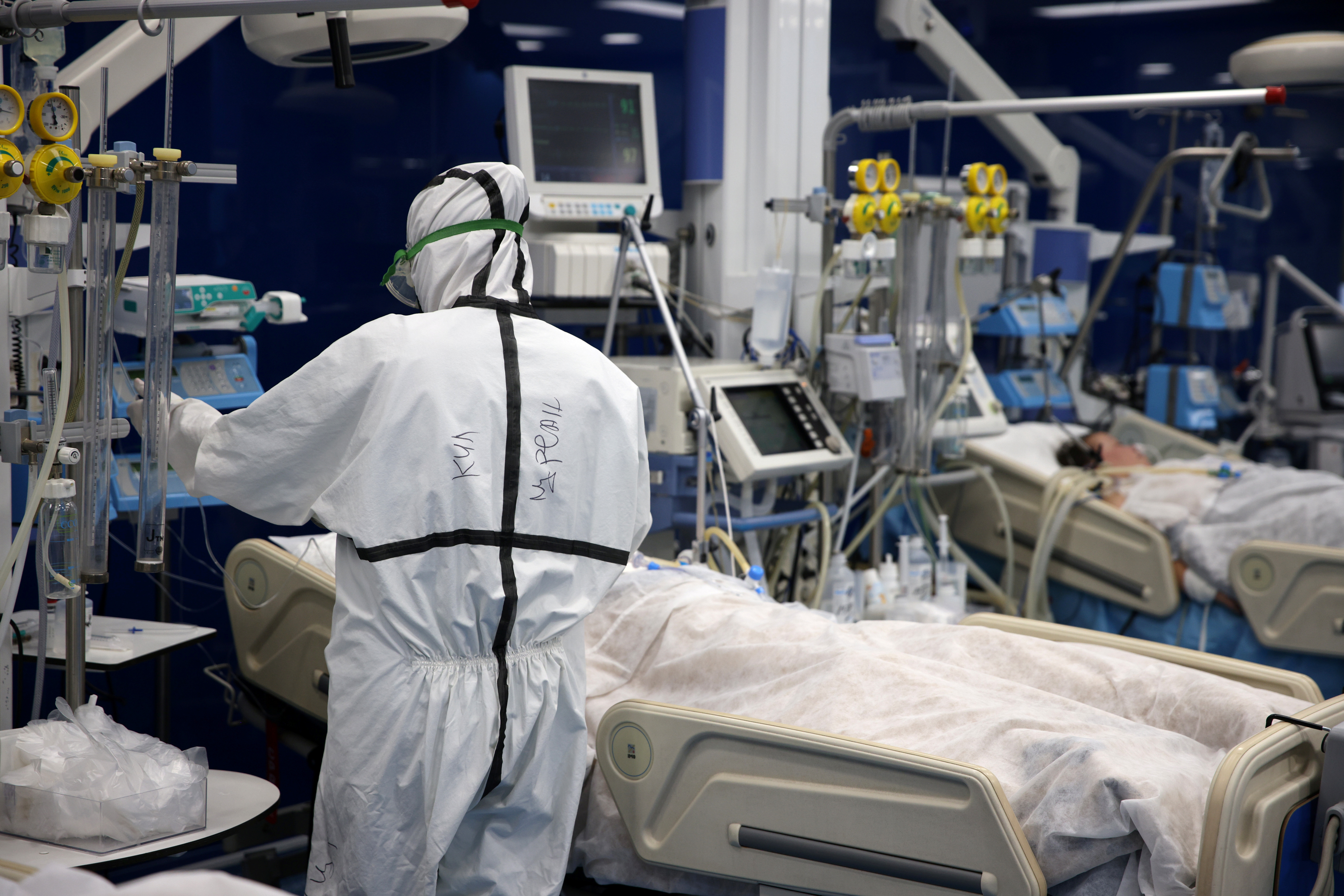
A medic tends to coronavirus disease (COVID-19) patients at the intensive care unit (ICU) of Pirogov hospital in Sofia, Bulgaria, October 15, 2021. Picture taken October 15, 2021. REUTERS/Stoyan Nenov
A medic tends to coronavirus disease (COVID-19) patients at the intensive care unit (ICU) of Pirogov hospital in Sofia, Bulgaria, October 15, 2021. Photo: October 15, 2021. REUTERS/Stoyan Nenov
 
On the African continent, populations vulnerable to the SARS-CoV-2 virus causing COVID in every country have little option over whether or not to be inoculated against the novel coronavirus. They haven't the opportunity, since vaccines of any type and origin are scarce, and where vaccines are available they're short-dated and there is a serious lack of syringes. The WHO  calls this lack of equity. It is the wealthy countries of the world that are swimming in vaccines.

And there anti-vaxxers and vaccine-hesitant people in significant numbers represent the only deterrence to having the majority of any population inoculated against COVID. The promises made by advanced countries in the West with ample access to medical equipment and vaccine doses to provide the WHO vaccine-sharing program Covax with doses for the less advanced countries of the world are not meeting their obligations. In Europe there is no shortage of vaccines. The EU is acknowledged as having a high rate of vaccine coverage altogether.

And then, there is Eastern Europe, a dismal failure in vaccine uptake by its populations. Unsurprisingly, as a result of resistance to vaccines, the countries of Eastern Europe are facing a catastrophic rise of     COVID cases, hospitalizations and deaths. Exceptions to the widespread trend of vaccine rejection are the Baltic nations, Poland, the Czech Republic, Slovenia and Hungary. Public distrust is driving a low uptake of vaccines in other Eastern European countries, however.
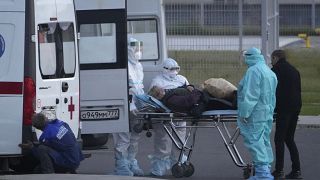
 
Medical workers carry a patient suspected of having coronavirus on a stretcher at a hospital in Kommunarka, outside Moscow, Russia, Monday, Oct. 11, 2021.
Medical workers carry a patient suspected of having coronavirus on a stretcher at a hospital in Kommunarka, outside Moscow, Russia, Monday, Oct. 11, 2021    AP Photo/Alexander Zemlianichenko
 
There were 1,159 recorded COVID-related deaths in Russia in 24 hours, last week, the largest daily death count since the beginning of the pandemic. Roughly a third of the country's 146 million population has been fully vaccinated. In response, the Kremlin ordered a nonworking period to last to November 7. In Hungary private companies can require their employees to be vaccinated if they want to retain their employment, and government employees are required to be be vaccinated. 

Poland reported its highest number of daily infections at over 8,000 last Thursday. A mere 15 percent of the adult population in Ukraine is fully vaccinated, representing the second-lowest rate in Europe, following Armenia's 7 percent. Teachers, government employees and other workers are required to be fully vaccinated by November 8 in Ukraine to avoid suspension in pay. People may not board planes, trains or long-distance buses without proof of vaccination or a negative test.

A black market in counterfeit documents has emerged with fake vaccination certificates selling for $100 to $300. Police have opened 800 criminal cases into workers at 15 hospitals in Ukraine being involved in counterfeit certificates, with 100 mobile units deployed to track down users, according to the Interior Minister. Last week, a former lawmaker was among those arrested. In the western city of Chernivtsi, ten to 23 patients die daily of COVID, with those aged in their 30s and 40s impacted.

Believing the rumours that Western vaccines contain microchips to control people, Lidia Buiko, 72, chose the Chinese Sinovac vaccine: "Priests have urged us to think twice about getting immunized -- it would be impossible to get rid of the chip", she explained, waiting for her injection in a Kyiv clinic. It is estimated that roughly half of Ukrainian medical workers express vaccine reluctance. "The risks of misinformation to vaccination have never been  higher; nor have the stakes", commented     UNICEF representative in Ukraine Murat Sahin.

About 35 percent of vaccine-eligible adults in Romania are fully immunized where tighter restrictions are in effect requiring vaccination certificates for attending a gym, the movies or shopping malls. With a 10 p.m. curfew, shops close at 9 p.m., bars and nightclubs shuttered for 30 days, and masks are mandatory in public. 
 
Bulgaria has a quarter of its adult population fully vaccinated and reports record numbers of infections and deaths. Official data identify Bulgaria with the highest COVID-19 mortality rate in the 27-nation European Union, with 94 percent of deaths representing the unvaccinated.Authorities in Georgia launched a lottery of cash prizes to entice the population to be vaccinated, where 33 percent of the population has been fully vaccinated.
"[So many are] afraid of the vaccines because of the immense [amount of] fake information that has flooded social media and TV."
"Every day we see people arriving with shortness of breath and most of them are feeling sorry for not being vaccinated."
Dr.Dragos Zaharia, Marius Nasta Institute of Pneumology, Bucharest

"[The government's information campaign] was not designed according to the peculiarities of our country."
"The emphasis should have been done, for instance, on the Georgian Orthodox church, because we have many instances when priests are saying that vaccination is a sin."
Dr.Bidzina Kulumbegov, Georgia
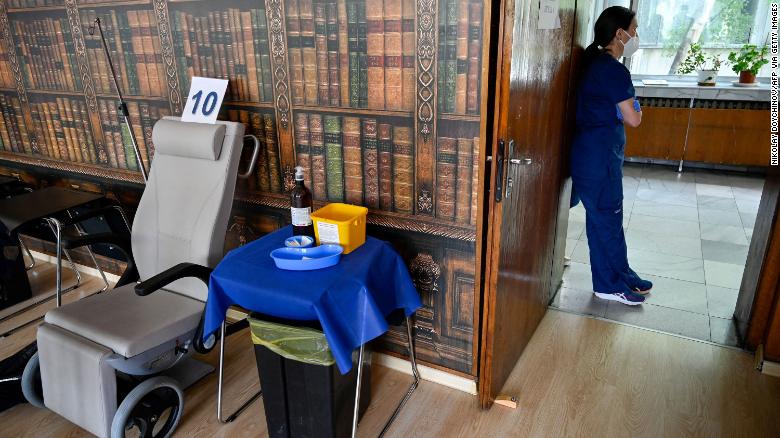
A healthcare worker is waiting for patients at a Covid-19 vaccination centre at The Military Medical Academy in Sofia.

Labels: , , , ,

Monday, February 18, 2019

Poland ... Begs To Differ....

Poland ... Begs To Differ

US Vice President Mike Pence and his wife Karen Pence, right, stand with Poland’s President Andrzej Duda and his wife Agata Kornhauser-Duda, left, under the gate during their visit at the Nazi concentration camp Auschwitz-Birkenau in Oswiecim, Poland, February 15, 2019. (AP Photo/Michael Sohn)

"[Poland is waiting in] expectation that the Israeli side will say in a clear way what Prime Minister Benjamin Netanyahu meant when he said the words that were quoted by the Israeli media."
"[Explanations from Israel are] unclear, [leaving Warsaw awaiting clarification]."
Polish Deputy Foreign Minister Szymon Szykowski vel Sek

"The Prime Minister's comments concerning Poland were misquoted by the Jerusalem Post, which quickly issued a correction clarifying that an error had been made in the editing of the article."
"Netanyahu spoke of Poles and not the Polish people or the country of Poland. This was misquoted and misrepresented in press reports and was subsequently corrected by the journalist who issued the initial misstatement."
Office of Israeli Prime Minister Benjamin Netanyahu

"I am a son of Holocaust survivors and I was even born and grew up in a community made up of Holocaust survivor. The memory of the Holocaust is something we cannot compromise about; it is clear and we won’t forget or forgive."
"In diplomacy you try not to offend, but nobody will change the historical truth to do something like that. Poles collaborated with the Nazis, definitely. As Yitzhak Shamir [former Israeli Prime Minister] said, 'they [Poles] suckle anti-Semitism with their mother’s milk'."
"No one will tell us how to express ourselves, or how to remember our fallen."
Israel Katz, recently appointed acting Israeli Foreign Minister 
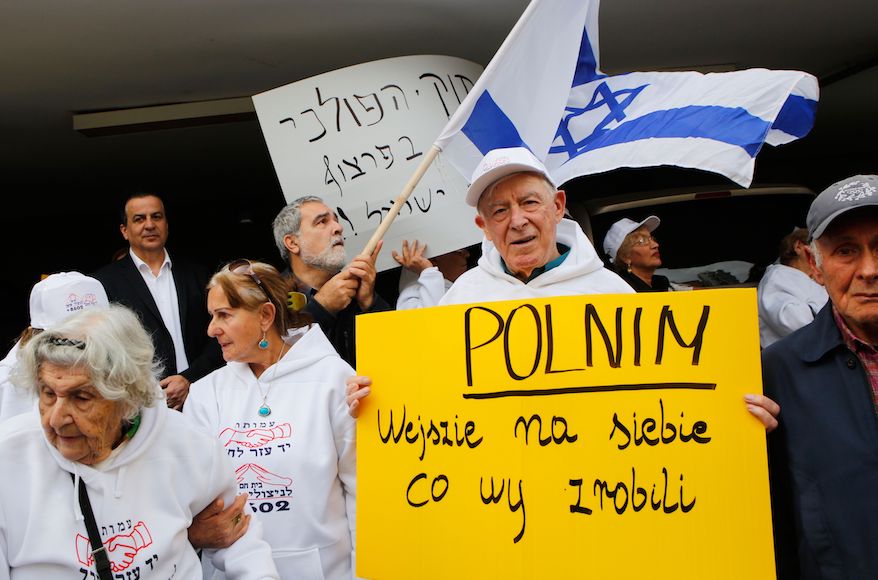
Holocaust survivors hold banners and wave an Israeli flag during a protest in front of the Polish Embassy in Tel Aviv, on February 8, 2018. (Gil Cohen-Magen/AFP/Getty Images/File)
Nazi Germany set up its death camps in every European country it occupied. Poland's concentration camps and death camps held and destroyed half of all lost Jewish lives; three million people. In all occupied countries nationals of those countries as citizens, along with their national police and military became voluntarily complicit with the Nazi killing machine, from France to Ukraine, Lithuania to Poland, sometimes with great helpful enthusiasm going beyond what their S.S. over-masters anticipated in usefulness in rounding up and dispatching Europe's Jews.

Some, but not all of those European countries have admitted their complicity while some, like Poland, stuck with the historical record it doesn't much care for, goes out of its way to try to exonerate itself and its citizens from claims it and many of its citizens were unusually helpful to the extermination work of the Final Solution. Last year, when Poland officially passed a law making it unlawful, a criminal offence, to speak of 'Polish death camps', rather than 'German death camps', an outcry from Israel and Holocaust survivors forced Poland to withdraw.

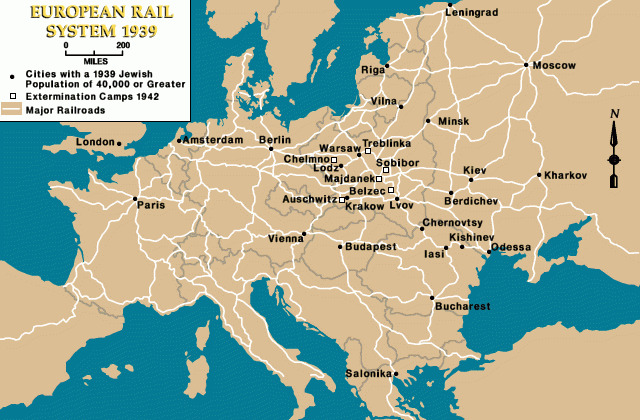
The killing camps located in Polish territory were often the last stop where Jews were collected from holding camps in other countries; the crematoria in Polish death camps were kept extremely busy. The European rail system transported Jews from across Europe -- from Greece and Holland, France and Italy -- into Poland where they were gassed, their bodies incinerated, the particulate matter that ensued up the smoke stacks and scattered around the countryside, enriching the soil for agricultural purposes.

<p>The European rail network played a crucial role in the implementation of the <a href="/narrative/2816/en">Final Solution</a>. Jews from Germany and German-occupied Europe were deported by <a href="/narrative/5789/en">rail</a> to <a href="/narrative/2746/en">killing centers</a> in occupied Poland, where they were killed. The Germans attempted to disguise their intentions, referring to deportations as "resettlement to the east." The victims were told they were to be taken to labor camps, but in reality, from 1942 onward, deportation meant transit to killing centers for most Jews. <a href="/narrative/5041/en">Deportations</a> on this scale required the coordination of numerous German government ministries, including the Reich Security Main Office (RSHA), the Transport Ministry, and the Foreign Office. The RSHA coordinated and directed the deportations; the Transport Ministry organized train schedules; and the Foreign Office negotiated with German-allied states to hand over their Jews.</p>

Israel often goes out of its way to diplomatically placate the injured feelings of countries like Poland and Ukraine when the issue of death camps and the willingness of their populations to deplete their countries of Jews led them to volunteer their help, in service to the Final Solution. This time around Poland once again making an effort to distance itself from the horrors of the Holocaust points out that it too lost millions of its people killed by the Nazis. As did Russia, when they turned against one another, Russia opting out of the Axis pact.

Israeli Prime Minister Netanyahu and his wife and retinue were on a visit to Poland to take part in the commemoration of the Warsaw Ghetto uprising. Vice-President Pence and his wife were there for the solemn ceremony, as were Polish officials. The Warsaw Ghetto saw Polish Jews gathered within a geographic square in the city, off-limits to any but Jews, crowded together, living in squalor awaiting their final disposition. And when the transports began, and the rumours of death camps began circulating, the knowledge of their future in death camps spurred young Jewish men and women to rise against their oppressors.

Using the underground sewer system young Jews had for years smuggled themselves out of the ghetto to bring back food, medicine, and whatever arms they could find. Of the tens of thousands of Jews still left in the ghetto out of their total of 300,000 who had been steadily deported to death camps, an estimated 500 representing two defensive groups armed themselves and plotted the uprising. They built bunkers where the resistance could hide, they contacted the Polish underground which supplied them with some guns. Then they mounted their resistance and stopped the deportations temporarily.
The entrance to the gas chamber in Auschwitz I, where Zyklon B was tested on Soviet prisoners of war. [LCID: 50773]

Instytut Pamieci Narodowej 

Entrance to the gas chamber in Auschwitz IThe entrance to the gas chamber in Auschwitz I, where Zyklon B was tested on Soviet prisoners of war. The building in the background is a hospital for SS members. Auschwitz, Poland, date uncertain. 


Most of the resisters were killed by the Germans who had been forced out of the Ghetto. Individuals held on, refusing to surrender, until they were all killed, the rest of the Jews placed on transports to death camps, and the Warsaw Ghetto was demolished and razed, the uprising over; 1943. But they had managed to keep fighting for a month against the mighty German S.S. troops, a rag-tag band of desperate Jews using old, dilapidated weaponry and sacrificing themselves to restore hope and dignity to others.

Photograph from SS General Juergen Stroop's report showing the Warsaw ghetto after the German suppression of the ghetto uprising. [LCID: 34091a]
Photograph from SS General Juergen Stroop's report showing the Warsaw ghetto after the German suppression of the ghetto uprising. Stroop, commander of German forces that suppressed the Warsaw ghetto uprising, compiled an album of photographs and other materials. This album later came to known as "The Stroop Report." The right of this image from the album shows a column of Jews being transported out of the ghetto for deportation. Warsaw, Poland, April–May, 1943.
  • National Archives and Records Administration, College Park, MD

"To symbolize the German victory, Stroop ordered the destruction of the Great Synagogue on Tlomacki Street on May 16, 1943. The ghetto itself was in ruins. Stroop reported that he had captured 56,065 Jews and destroyed 631 bunkers. He estimated that his units killed up to 7,000 Jews during the uprising. The German authorities deported approximately another 7,000 Warsaw Jews to the Treblinka killing center, where almost all were killed in the gas chambers upon arrival."
Holocaust Encyclopedia
While in Poland for the memorial ceremony, Netanyahu commented that "Poles co-operated with the Nazis", meaning that some Poles were invested in killing Jews during the Nazi occupation of Poland. While the Prime Minister specifically did not indict all of the Poland, the Jerusalem Post article that has so enraged Poland, quoted him as saying "the Poles", a sweeping condemnation of all of Poland and its people. Mr Netanyahu, of course, is quite aware that over 6,800 Poles have been recognized for their help to Jews at risk of their own lives, recognized by Yad Vashem, Israel's Holocaust memorial.

Poland's underground resistance fought the German occupation, and some Jews fought with them. The truth and reality are never clear-cut, however. The indisputable fact is that there has always existed anti-Semitism of a virulent, brutal and violent nature in Poland. Pogroms occurred as regular as clock-work over hundreds of years in Poland against Jews whose homes were established in Polish towns and villages. And that some -- a large enough number to be in the majority -- Poles approved of Jews being rounded up and shipped out, considered unwanted, foreign elements.
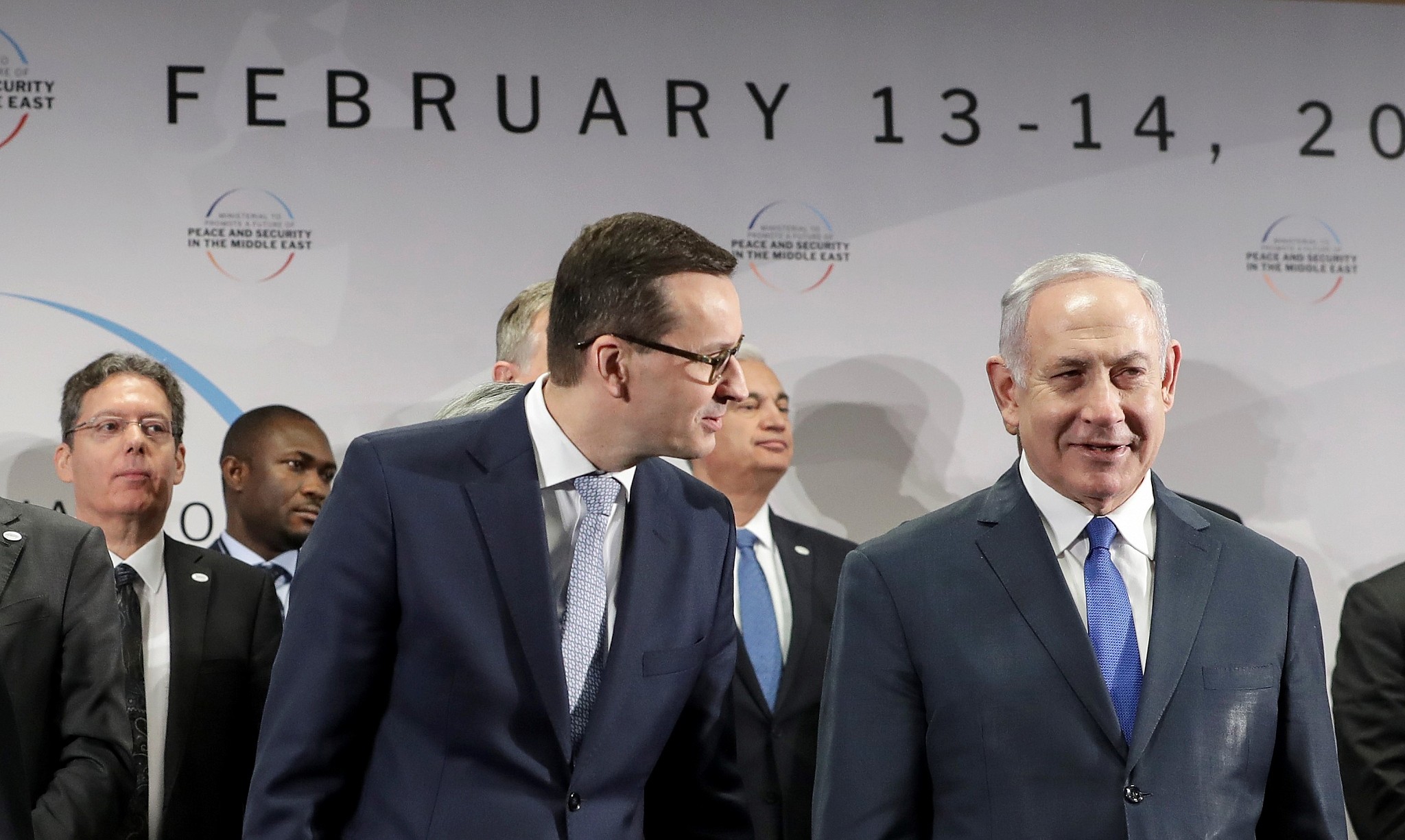
Prime Minister of Poland Mateusz Morawiecki, left, and Prime Minister Benjamin Netanyahu, at a conference on Peace and Security in the Middle East in Warsaw, Poland, February 14, 2019. (AP/Michael Sohn)

Poland was sufficiently affronted by these declarations from Israelis in their views of Polish action during the Holocaust years, to threaten to pull out of a scheduled meeting of Central European leaders, the  Visegrad Group representing an alliance of nationalistic countries within the European Union supporting Israel; Hungary, the Czech Republic, Poland and Slovakia more strenuously supportive of Israel than countries of Western Europe. That meeting was to have taken place today, Monday, but was cancelled when Poland withdrew.
"Accusing all Poles of anti-Semitism offends the Righteous; it also offends all those who today want to see in them the true representation of Polish society. And it also offends us, Polish Jews, who are a part of that society."
"One does not clarify lies by another set of lies. It is not honest [and] it is not moral to fight lies with another set of lies. What do you want? [Katz] functionally said that all Poles are anti-Semites. So how do you expect the Poles to react? There are irresponsible people on both sides and when an irresponsible statement is made it empowers other irresponsible people to react. This in no way justifies anti-Semitism in Poland, just as it does not justify distortion of the truth by Israeli leaders."
Polish Chief Rabbi Michael Schudrich, Union of Jewish Communities in Poland

Major Nazi camps in Europe, January 1944 [LCID: eur72160]

Labels: , , , , , , ,

Sunday, July 10, 2016

NATO Summit Concluded

"They [Russia declaring NATO is engaged in 'sabre-rattling'] can say that, but they absolutely know that it isn't."
"It represents solidarity and cohesion in the alliance and a great opportunity. It raises the threshhold of risk. It may be slight but it is definitely there. Terms like tripwire that can be used as descriptors, but what it really does is raise that calculus of risks."
"Do you take any steps against a nation, given that the alliance has decided to put in what will be very credible combat forces not intended to attack, entirely defensive in nature?".
General Jon Vance, Canadian Chief of Staff

"It [Bloomberg graphic] purports to show that Russia is being 'aggressive' by proposing new battalion numbers along its western borders. If the information is accurate, it will mean a total of around 30,000 troops split into three divisions."
"At the same time, NATO wants to send 4,000 soldiers, mostly American and British, to the Baltic States and Poland. This graph is being used as a propaganda tool to make it appear that 4,000 'defensive' NATO personnel are facing off against 30,000 "aggressive" Russians."

"The truth is completely different."
"For starters, the Russian units will be stationed exclusively in Russian sovereign territory. The concept of a country keeping armed forces on its own soil is hardly revolutionary. By contrast, these American and British servicemen and women will be very far away from home."
"Also, the figures are completely misrepresented. As the image below shows, it is Russia which is outnumbered. And vastly so."
RT -- Russian global English-language news network
So, then, according to Moscow and the RT network that expresses Kremlin-approved news perspectives, eastern Europe, the Baltic states and NATO are neurotic about Russia's intentions, and pitifully paranoid. Russia, on the other hand, has good enough reason to be concerned, that its borders contiguous with those of former Russian satellites in the USSR era, are bristling with the presence of malign-purposeful troops representing the military presence of countries of the West, far from home.

Russia's near-abroad, in other words, has been 'occupied', even if by specific invitation, by its nemesis, NATO, representing the strength and power of Western democracies who have no business in the territory of Greater Russia, just happening to abut on once-dependent nations, now professing great fear of Russia reaching its long mechanized tentacles to bring them once again far closer than they prefer to be, to Moscow's embrace.

Mind, they do have the absorbing and mind-boggling recent precedent of Georgia and Moldova losing some of their autonomous regions to Moscow's need to protect its Russian-speaking colleagues who happen to live in the territories that found their independence with the dissolution of Soviet power. With Vladimir Putin's muscle-flexing on those occasions, concern was expressed and there was simply no defensive feints from outside the two nations concerned.

And then came Ukraine, whose independence Moscow could not envision as separate from Greater Russia's. But when push came to shoving the Russian-approved Viktor Yanukovych from his splendid palace, the decision was made to annex Crimea and do the same with the Donetsk region, lending military and weaponry to the Russian-Ukrainians who feel more Russian than Ukrainian, deciding to haul up the geography and move it within Russia's borders, like a board game.

When Vladimir Putin mused about nuclear deterrence, those rumblings were seen as what they were meant to be, a warning to the West which reacted predictably enough, accusing Moscow of nuclear-rattling. So now Moscow is levelling counter-accusations against NATO of sabre-rattling. It's all one unfortunate, giant misunderstanding. Including all the submarine and warplane mischief rattling the nerves of Europe.

The deployment of British, German, American and Canadian super-sized brigades to the Baltics is NATO's preparation for rapid response should President Putin turn his attention away from Syria to launch an acquisitive-exploratory probe elsewhere. NATO remains committed to an ongoing dialogue with Russia, since at heart all sides are reasonable; just that reason has been hijacked by an unfortunate level of distrust, oh and misunderstanding, of course.

Talk about settling comfortably on a precipice: Canadian troops are to be situated in the new year for operation on a Latvian army base, a mere 250 kilometres from Paskov, across the border in Russia, home to three airbases and roughly ten thousand troops of Russia's elite 76 Guards Assault Division.
But relations with Moscow were not the only concern for the NATO summit just concluded in Warsaw. President Obama's statement aside: "We're moving forward with the most significant reinforcement of our collective defence any time since the Cold War".

There is the critical issue of opposing the Islamic State in Syria and Iraq and the statement that flights by alliance AWACS warplanes to begin in the fall: "a clear signal of our resolve to help tackle terrorism", said Secretary-General Jens Stoltenberg, of the training and capacity-building mission for Iraqi armed forces. Unfortunately, no word since no obvious discussion let alone consensus on any moves to persuade Bashar al-Assad to remove himself from Syria's self-destruction.

NATO has decided in its 28-member wisdom to focus instead on shutting down human smuggling operations that have succeeded in flooding Europe with the greatest migrant crisis in generations. Not to consider the source of the limitless frantic rush to vacate the death-zone that Syria has become thanks to its regime's focus on the 'terrorists' who have rebelled against his sectarian rule, but how to ensure that those Sunni Syrians fleeing the Shiite regime can be persuaded to remain where they are.

"We will provide greater support to our partners, so they can secure their countries and push back against violent extremism", Mr. Stoltenberg waxed on, referring to help given to Jordan and to Libya, one struggling to ensure that the Islamist menace within doesn't gain the upper hand, the other struggling to keep the ISIL menace that has already established itself from taking control of the entire country.

The ISIL terrorists, as menacingly bloodthirsty as they are, it should be noted, haven't taken the death toll close to approximating those who have died in Syria, viciously abused by their own government.
NATO Logo

Labels: , , ,

Wednesday, June 22, 2016

Dual-Purpose Sabre-Rattling

"We believe that NATO buildup on Russia's doorstep, which is reminiscent of Cold War sabre-rattling, is a complete waste of money and resources, diverting them from the real existential threat of international terrorism."
"Given that terrorists make no distinction between Russians and Canadians, as well as reports claiming 151 nationals of Canada are on an ISIS 'kill list', common sense and pragmatism dictate the need to join efforts, as opposed to reincarnation of Cold War containment."
Russian embassy statement, Ottawa
General Sir Richard Shirreff, who served as Nato's deputy supreme allied commander in Europe until 2014, warned that an attack on Baltic states Lativa, Estonia and Lithuania was a possibility. Russian tanks are pictured in Moscow

It might be a more convincing argument, that Russia feels uncomfortable and put-upon by the too-close geographical presence in its near-abroad by NATO troops if it were not for several items that in and of themselves point to the fact that Russia's actions have brought about the current situation of NATO recognizing its obligation to protect its member-countries because of threats to the sovereign security of those nations through Kremlin-designed activities.

Spurning international condemnation, Russian President Vladimir Putin saw little amiss in annexing the Crimean Peninsula, effectively looting it from Ukraine to benefit Greater Russia; in so doing, he claimed, righting a historical error and restoring to Russia its heritage property. And no amount of censure, nor the imposition of sanctions convinced Moscow to reverse its claims, let alone to stop supporting and inciting ethnic Russian rebels in east Ukraine.

Russia's earlier action with two provinces in Georgia pretty well set the template. The concern in eastern Europe among former Soviet-era satellites is who might be next; Moldova too representing that precedent. As for reminding the world that the civilized portions of it, among which Russia includes itself, is battling a vicious Islamist killing machine and this is where the focus should be, with Russia allied with Western powers to defeat the Islamic State, that too would seem meaningful if Russian jets weren't strafing and bombing Syrian Sunni rebel groups instead of ISIL.

The civilized country that Russia has allied itself with in the Middle East is the sectarian-conflicted Syria of Bashar al-Assad whose penchant for imprisoning, torturing and killing children distinguishes him, including his slaughter of close to a half-million of his own citizens, as a barbarous criminal felon. Yet this is the civilized leader to whom Mr. Putin cleaves, agreeing to view the Sunni rebels in the civil war as 'terrorists' and targeting them as such.

NATO has formulated a protective presence of some message-powerful volume with the installation of super-battalions of one thousand military personnel each in eastern Europe with the U.S. Britain and Germany each leading one battalion, and NATO allies inviting Canada to take command of the fourth. The Government of Canada has not yet responded to the invitation, but as a NATO member it is difficult to imagine it would do so negatively.

This new force and its extraordinary size is considered essential to ensure that Russia thinks deeply before once again violating the sovereignty and the territorial integrity of any of the eastern European countries whose concern for their sovereign state and future has been intensified by Vladimir Putin's drive toward a semi-restoration of Russia's glory within the period of the USSR dominating eastern European nations.

The tense stand-off between Russia, Europe and NATO represents a fall-out of the impetuosity and imperialistic attitude of Vladimir Putin who acts without regard to the consequences in the obvious attitude that he is entitled to do precisely as he wishes and that any reaction to his behaviour in Russia's near-abroad is Moscow's business, not that of NATO.

NATO thinks otherwise, obviously, hence the largest military exercise in Poland the Baltics since the Cold War taking place recently, irritating Mr. Putin no end. Yet he fails to see the connection between his own impulsive, worrying directions to his military when his submarines, military jets and military personnel take injudicious actions against their Western counterparts in episodes of malicious bullying.

Labels: , , , , , ,

Sunday, June 19, 2016

Normalizing Relations With a Goaded Russia

"What we shouldn't do now is to inflame the situation by loud saber-rattling and shrill war cries."
"Whoever believes that symbolic tank parades on the alliance's eastern border will bring more security is mistaken. We are well-advised not to create pretexts to renew an old confrontation."
German Foreign Minister Frank-Walter Steinmeier

"For this [normalization of relations between Canada and Russia] there should be some specific steps, which should be made by both sides."
"The [Canadian] prime minister himself said when we were at G20 in Antalya that he thinks how we should re-establish the relations in full. We welcome this ... and will get down to this task, to work together."
"If Canada wants to join [U.S. missile defence program] -- join it! What else can I say? We could not dictate to you what to do. Do what you want. And we will do what we think is necessary to provide our security."
Russian President Vladimir V. Putin

"I pointed out that although Canada has shifted its approach on a broad range of multilateral and international issues, we remain committed to the fact that Russia's interference in Ukraine must cease."
Canadian Prime Minister Justin Trudeau 
US troops land with parachutes at the military compound near Torun, central Poland, on June 7, 2016, as part of the NATO Anaconda-16 military exercise
© AFP 2016/ JANEK SKARZYNSK

Stop Goading Russia, Steinmeier Urges After NATO Military Exercise (Sputnik)

From each principal's version of the collegial discussion that took place between the two leaders -- Russia's president/prime minister/president [for life] and Canada's new Liberal prime minister who is anxious to the point of turning himself into a living pretzel to convince the world that Canada's latest love affair with the Liberal government returns the country to normalcy -- there is an obvious disparity in the intelligence imparted and positions agreed upon.

Russia's plunge into the comfortable familiarity of throwing its weight around Europe and persuasively informing its neighbours that Russia too is "back" into its USSR-collective mode, prepared to once again absorb its former satellites has them quavering and NATO reminding its members of their obligations to one and all, inclusive of those former satellites now NATO members. Germany is ever-sensitive to the volatile nature of Russia-Europe relations.

Canada's new government is on track to emulate U.S. President Barack Obama's lingering commitment to "normalize" relations with the Islamic Republic of Iran, with the world of Islam, and with recalcitrant, authoritarian Russia, a juggling act that threatens to fall in upon itself from time to time reflecting the Obama administration's "hands-off" attitude to worrisome world affairs. The goal has eluded the United States, the world's power house, but this Canadian administration is giving it a go.

Canada "is back!" exulted Trudeau junior, though this is not the world his father knew, nor is Canada the country he was familiar with. The son-and-heir aspires to moving Canada's importance in world affairs up a notch, starting with ingratiating itself with the United Nations' peace-keeping efforts, expressing yet another monumental failure. Justin Trudeau hardly knows where to look first to cast his wide, vacuous smile of amity.

His overture to Russia will be fractured if he agrees to NATO's invitation to become one of the four nations agreeing to spearhead a new mega NATO force on Russia's border, committing a one- thousand-member battalion of Canadian troops to do its part, in Greece. The United States, Britain and Germany round out the fabulous four, and Mr. Trudeau would like to be in that illustrious company, elevating Canada under his guidance to an enviable position of trust and responsibility.

One that will, of necessity, further estrange it from Russia, despite the ramblings of "normalizing" relations. The large-scale ten-day military training exercise taking place in Poland with over twenty NATO and partner countries taking part, was not viewed with great favour by Russia, which in response saw President Putin order checks on his armed forces combat readiness. And despite Germany's cautious warning, it was part of that military exercise of NATO's.

One might venture the opinion that the previous Conservative government of Stephen Harper was true to its moral principles in downgrading its relations with Russia in reflection of Moscow's annexation of the Ukrainian Crimean in 2014. And that Moscow remains intransigent over its support of ethnic Russian separatist forces in eastern Ukraine is ample proof that its entitlement is set in stone leading Mr. Harper to invite Mr. Putin to "get out" of Ukraine at a previous G20 summit.

The principled Mr. Harper was not particularly to Mr. Putin's liking. The malleable, suggestible Mr. Trudeau certainly demonstrates promise.

Poland NATO Exercise
Polish Army soldiers hold flags of some of the countries participating in the Anaconda-16 military exercise, during the opening ceremony, in Warsaw, Poland, Monday, June 6, 2016. Poland and some NATO members are launching their biggest ever exercise, involving some 31,000 troops, as central and eastern European nations are seeking strong security guarantees among concerns about Russia's assertiveness and actions. (AP Photo/Alik Keplicz)

Labels: , , , ,

Tuesday, June 16, 2015

The Menace of Face-Off

"[Russian forces] along the entire perimeter of Russia's western border will be reinforced [in response to a buildup of U.S. heavy military equipment in the Baltics or Eastern Europe]."
"Russia won't have anything else to do but bolster its forces and resources on the western strategic theatre of operations."
Russian army General Yury Yakubov
RS-24 Yars (NATO reporting name SS-27 Mod 2) is a Russian MIRV-equipped, thermonuclear intercontinental ballistic missile. Photo: Mobile ground-based system RS-24 Yars at the Teikovo missile force, Ivanovo region, 2011
RS-24 Yars (NATO reporting name SS-27 Mod 2) is a Russian MIRV-equipped, thermonuclear intercontinental ballistic missile. Photo: Mobile ground-based system RS-24 Yars at the Teikovo missile force, Ivanovo region, 2011    © ITAR-TASS/Vladimir Smirnov
"[Talks are underway] about the stationing of U.S. military equipment in Poland."
"We have been working for a while on increasing the American military presence in Poland and across the eastern flank of NATO."
"This all adds up to a growing presence of U.S. forces in Poland, and heavy equipment is significant as it is durable. If need be, it can be here for years or even decades."
"This is not an ad hoc response to a crisis. [A final decision would be taken] soon."
Tomasz Siemoniak, Polish defence minister
What to do when an overbearing menace of a neighbour threatens once again? A country, unlike a home-owner, cannot move away. But it can re-align its focus and reach a sovereign determination that leads it into another camp entirely, having had more than ample experience as a satellite-dependent of the assertive neighbour whose bullying tactics have rendered that relationship dysfunctional beyond acceptance.

The writing has long been on the wall, with former allies of the Soviet Union, absorbed in its stifling embrace for far too long, released from bondage and choosing to depart the union with unseemly alacrity, shifting themselves inexorably into the Western orb. Russia has been enormously displeased. And under its current leadership expresses its displeasure quite clearly. Not merely with words but actions as well, to the huge discomfort of all the countries whom it has chosen to harass.

Aside from the harassment of submarines where they don't belong, warplanes buzzing sovereign airspace, dire and dark warning of nuclear warheads, abductions and incitement of rebels to seize territories to join them with Greater Russia, enabling Moscow to reclaim geography it has no legal international right to absorb into its territory in an ongoing blitz of intimidation in eastern Europe, Vladimir Putin bristles at the insult to Russian dignity brought on by NATO and EU sanctions.

RS-24 Yars was first tested on May 29, 2007. Some reports say it can carry up to 10 independently targetable warheads
RS-24 Yars was first tested on May 29, 2007. Some reports say it can carry up to 10 independently targetable warheads    © ITAR-TASS/Vladimir Smirnov

For their part, the Baltic nations and the rest of Eastern Europe, let alone the West view Russian enterprise as ruinous to world peace; hugely unsettling, at the very least. And since Lithuania, Latvia, Estonia, Poland, Romania, Bulgaria and Hungary are allies of the United States and members of NATO, the nervous tension resulting from the trauma Ukraine is suffering symbolic of the vulnerability of the others has resulted in a warning to Russia to cease and desist.

Topol-M is a cold-launched, three-stage, solid-propellant ICBM. Its mass at launch is 47,200 kg and maximum range is 10,500 km. Photo: Topol-M involved in a rehearsal for V-Day Parade, at the Alabino Training Range near Moscow, 2008
Topol-M is a cold-launched, three-stage, solid-propellant ICBM. Its mass at launch is 47,200 kg and maximum range is 10,500 km. Photo: Topol-M involved in a rehearsal for V-Day Parade, at the Alabino Training Range near Moscow, 2008   © ITAR-TASS/Marina Lystseva

U.S. authorities have put forward a proposal to place weapons and vehicles in the countries involved and this inevitably has resulted in a race to build up arms at the Russia-Europe border should the situation continue to escalate. The fortification of military assets in Eastern Europe as planned will result in a matching buildup by Russia. Former Soviet republic countries have urged NATO to strengthen its resources in the area.

The annexation of Crimea dealt a heavy blow to their dreams of complete separation from their neighbour; the Soviet-era exchange of ethnic groups now sees Russians living in former satellite states purportedly as an endangered species, according to a protective Vladimir Putin, responding to the anguish of Russian speakers in Eastern Europe who must be 'protected from violations of their human rights'.

Russia is prepared to respond to any such U.S. move, according to General Yakubov, by outfitting its missile brigade in Kaliningrad "with new Iskander tactical missile systems", along with alterations to its defence interests in Belarus. The mobile ballistic missile Iskander, capable of delivering a conventional or a nuclear warhead is no toy.

Iskander missile
Iskander missile    © Dmitry Rogulin/TASS

Labels: , , , ,

() Follow @rheytah Tweet